
Study Guides
Pearson Edexcel International GCSE Physics (4PH1): Ideal gas molecules
Gas pressure from molecular collisions, absolute zero, the Kelvin scale and the two gas laws with worked examples, for Edexcel IGCSE Physics 4PH1, 5d.
- Subject
- Physics
- Level
- IGCSE
- Topic
- Solids, liquids and gases
- Author
- Marlbridge Academic Team
- Updated
- Reviewed by
- Hassan (what this means)
Aligned to Pearson Edexcel IGCSE Physics (4PH1), Issue 4. Official specification .
Syllabus page (what it covers and how it is assessed): Pearson Edexcel IGCSE Physics.
Syllabus points this page covers
4PH1
- 5d Ideal gas molecules
Found an error? Report a correction.
Need help with this topic? Request a free trial class for IGCSE Physics (4PH1).
This guide covers sub-topic 5(d) Ideal gas molecules, statements 5.15 to 5.22 of the Pearson Edexcel International GCSE in Physics (4PH1), Issue 4. It is core content, so it can appear on either paper. The Solids, Liquids and Gases study guide introduces the gas laws; this page explains why each one holds in terms of molecules, where absolute zero comes from, and how to handle gas-law problems that combine with other parts of Topic 5.
What 5(d) covers
- 5.15 explain how molecules in a gas have random motion and that they exert a force, and hence a pressure, on the walls of a container;
- 5.16 understand why there is an absolute zero of temperature, which is −273 °C;
- 5.17 describe the Kelvin scale of temperature and convert between the Kelvin and Celsius scales;
- 5.18 understand why an increase in temperature results in an increase in the average speed of gas molecules;
- 5.19 know that the Kelvin temperature of a gas is proportional to the average kinetic energy of its molecules;
- 5.20 explain, for a fixed amount of gas, the qualitative relationship between pressure and volume at constant temperature, and between pressure and Kelvin temperature at constant volume;
- 5.21 use
p₁/T₁ = p₂/T₂for a fixed mass of gas at constant volume; - 5.22 use
p₁V₁ = p₂V₂for a fixed mass of gas at constant temperature.
How a gas exerts pressure (5.15)
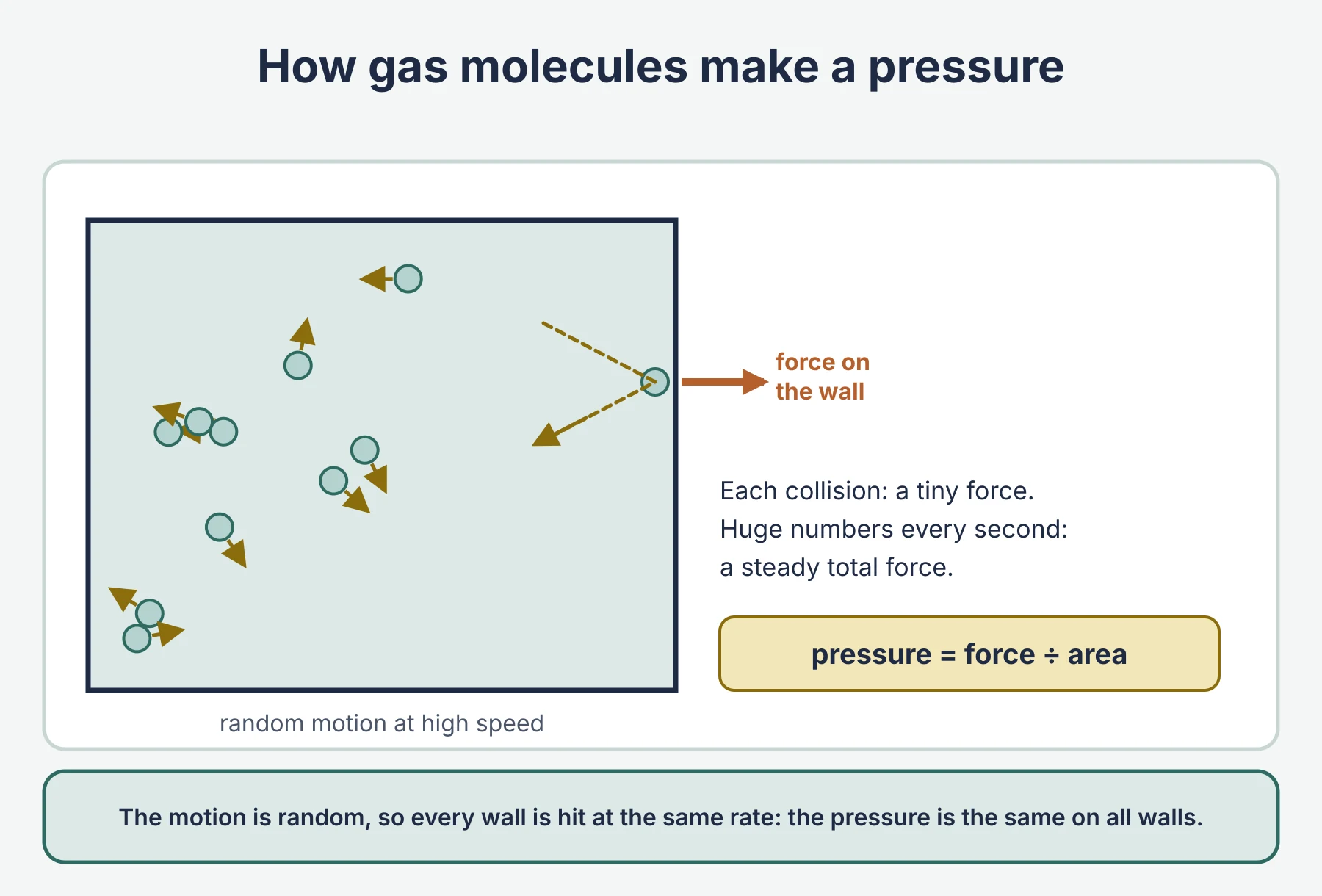
The molecules of a gas move in random directions at high speeds, colliding with each other and with the walls of their container. When a molecule hits a wall and bounces back, the wall must push on the molecule to reverse its direction, and the molecule pushes back on the wall with an equal and opposite force (Newton’s third law). One collision gives a tiny force, but enormous numbers of molecules hit every part of the wall every second, giving a steady total force. Pressure is that force divided by the area of the wall.
Because the motion is random, collisions happen at the same rate on every wall, so the pressure is the same on all of them.
Temperature and molecular speed (5.18, 5.19)
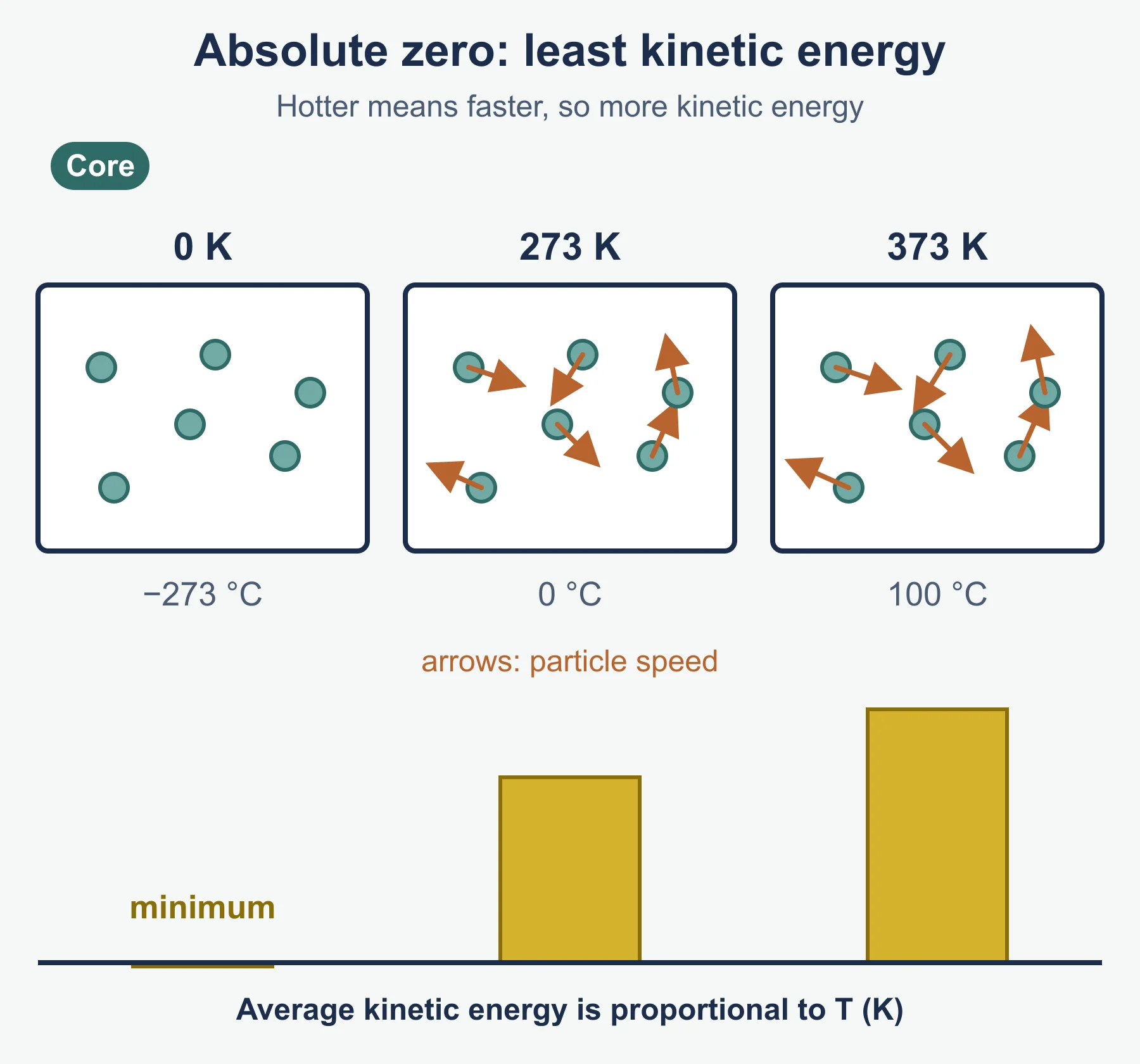
Heating a gas transfers energy to the kinetic store of its molecules, so they move faster on average. The molecules in a gas do not all have the same speed; temperature is linked to their average kinetic energy.
The Kelvin temperature is proportional to the average kinetic energy of the molecules:
average kinetic energy of molecules ∝ T (in kelvin)So heating a gas from 300 K to 600 K doubles the average kinetic energy of its molecules. Heating it from 20 °C to 40 °C does not double it: in kelvin that is 293 K to 313 K, an increase of only about 7%.
Absolute zero and the Kelvin scale (5.16, 5.17)
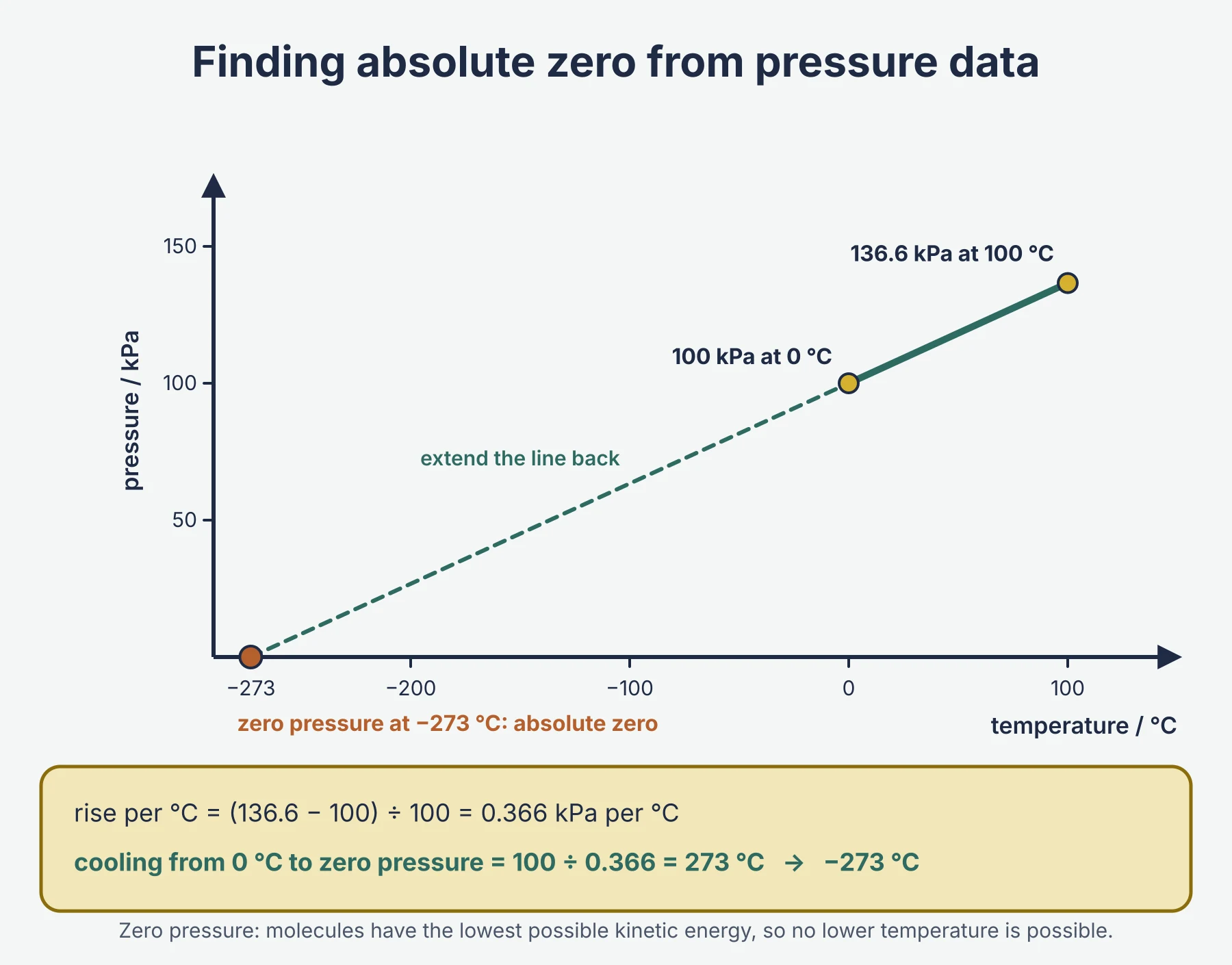
If a fixed mass of gas is cooled at constant volume, its pressure falls steadily. A graph of pressure against temperature in °C is a straight line. Extending the line back to where the pressure would be zero always meets the temperature axis at about −273 °C, whatever gas is used.
Worked example 1: finding absolute zero from data. A sealed flask of gas has a pressure of 100 kPa at 0 °C and 136.6 kPa at 100 °C.
pressure rise per °C = (136.6 − 100) / 100 = 0.366 kPa per °C
cooling needed from 0 °C to reach zero pressure = 100 / 0.366 = 273 °C
so zero pressure at 0 − 273 = −273 °C
Zero pressure would mean the molecules had stopped hitting the walls: they would have the lowest possible kinetic energy. Nothing can have less, so no lower temperature is possible. This temperature is absolute zero.
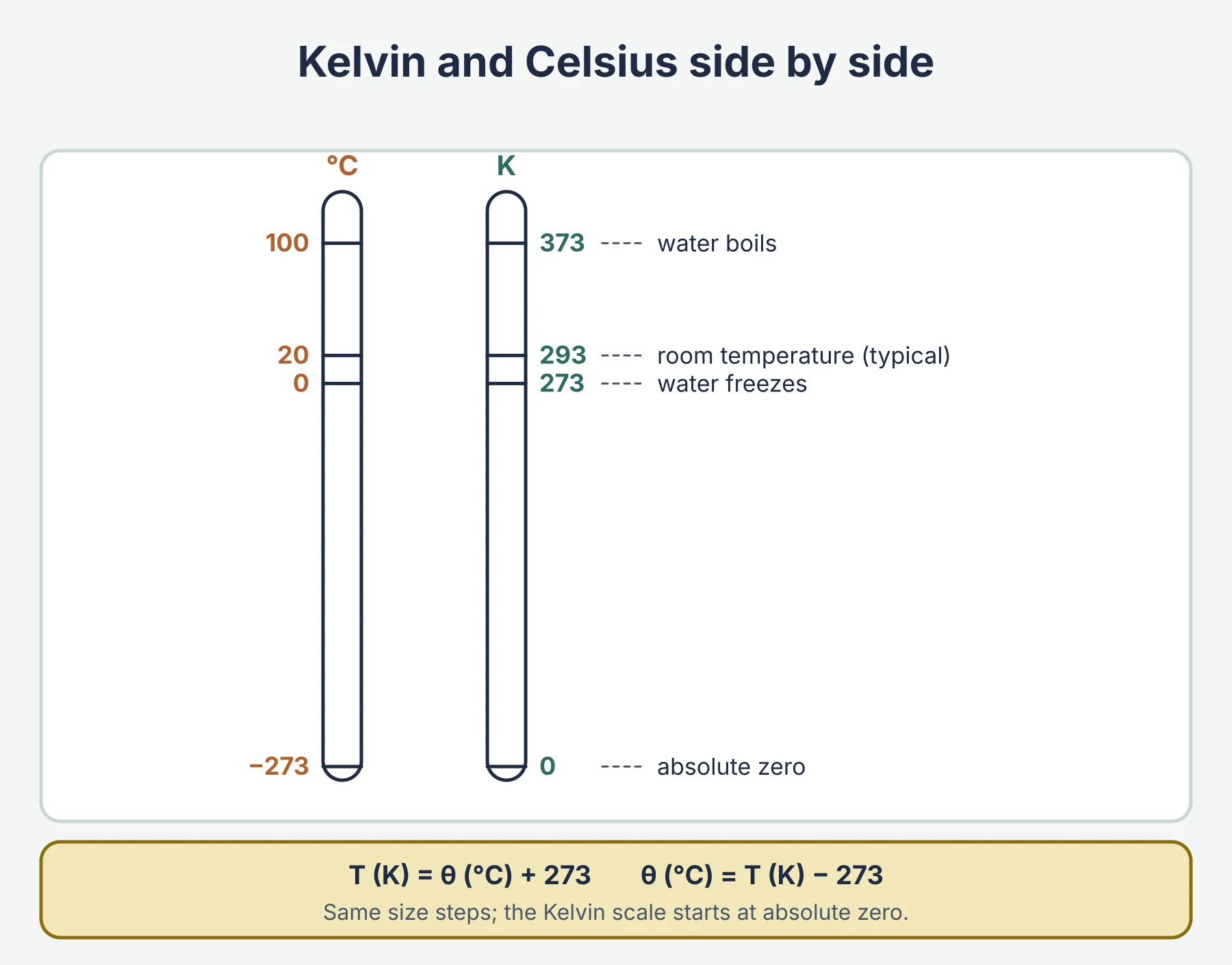
The Kelvin scale starts at absolute zero and uses steps the same size as degrees Celsius:
T (K) = θ (°C) + 273 θ (°C) = T (K) − 273| Temperature | °C | K |
|---|---|---|
| Absolute zero | −273 | 0 |
| Water freezes | 0 | 273 |
| Room temperature (typical) | 20 | 293 |
| Water boils | 100 | 373 |
Pressure and volume at constant temperature (5.20, 5.22)
If a fixed mass of gas is squashed into a smaller volume without changing its temperature:
- the molecules’ average speed is unchanged (same temperature);
- but they have less distance to travel between collisions with the walls, and there is less wall area, so they hit each unit area of wall more often;
- so the pressure increases.
Halving the volume doubles the pressure: pressure is inversely proportional to volume, and p × V stays constant.
p₁V₁ = p₂V₂A graph of p against V is a curve that gets less steep as V increases; a graph of p against 1/V is a straight
line through the origin.
Worked example 2: a bicycle pump. A pump contains 150 cm³ of air at 100 kPa. The outlet is blocked and the handle is pushed in slowly (so the temperature stays constant) until the volume is 50 cm³.
p₂ = p₁V₁ / V₂ = 100 × 150 / 50 = 300 kPa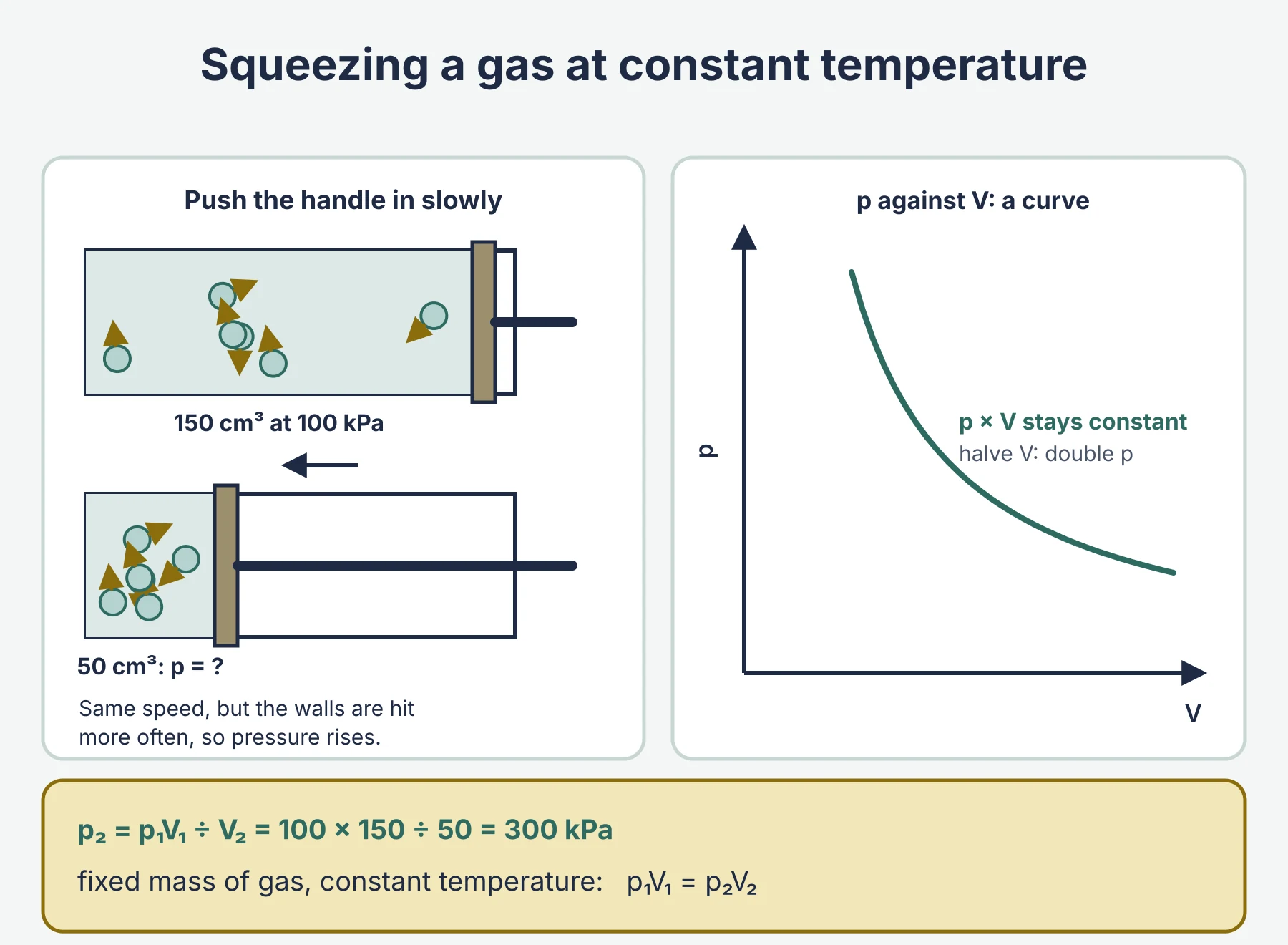
Pressure and temperature at constant volume (5.20, 5.21)
If a fixed mass of gas in a rigid container is heated:
- the molecules move faster on average;
- so they hit the walls more often, and each collision is harder (each collision exerts a bigger force);
- so the pressure increases. Both effects must be mentioned for a full explanation.
Pressure is proportional to the Kelvin temperature:
p₁ / T₁ = p₂ / T₂ (T in kelvin)Worked example 3: a car tyre. A tyre has a pressure of 2.4 × 10⁵ Pa at 7 °C. After a long drive the air inside is at 37 °C. Assume the volume does not change.
T₁ = 7 + 273 = 280 K        T₂ = 37 + 273 = 310 K
p₂ = p₁ × T₂ / T₁ = 2.4 × 10⁵ × 310 / 280 = 2.7 × 10⁵ Pa (2 s.f.)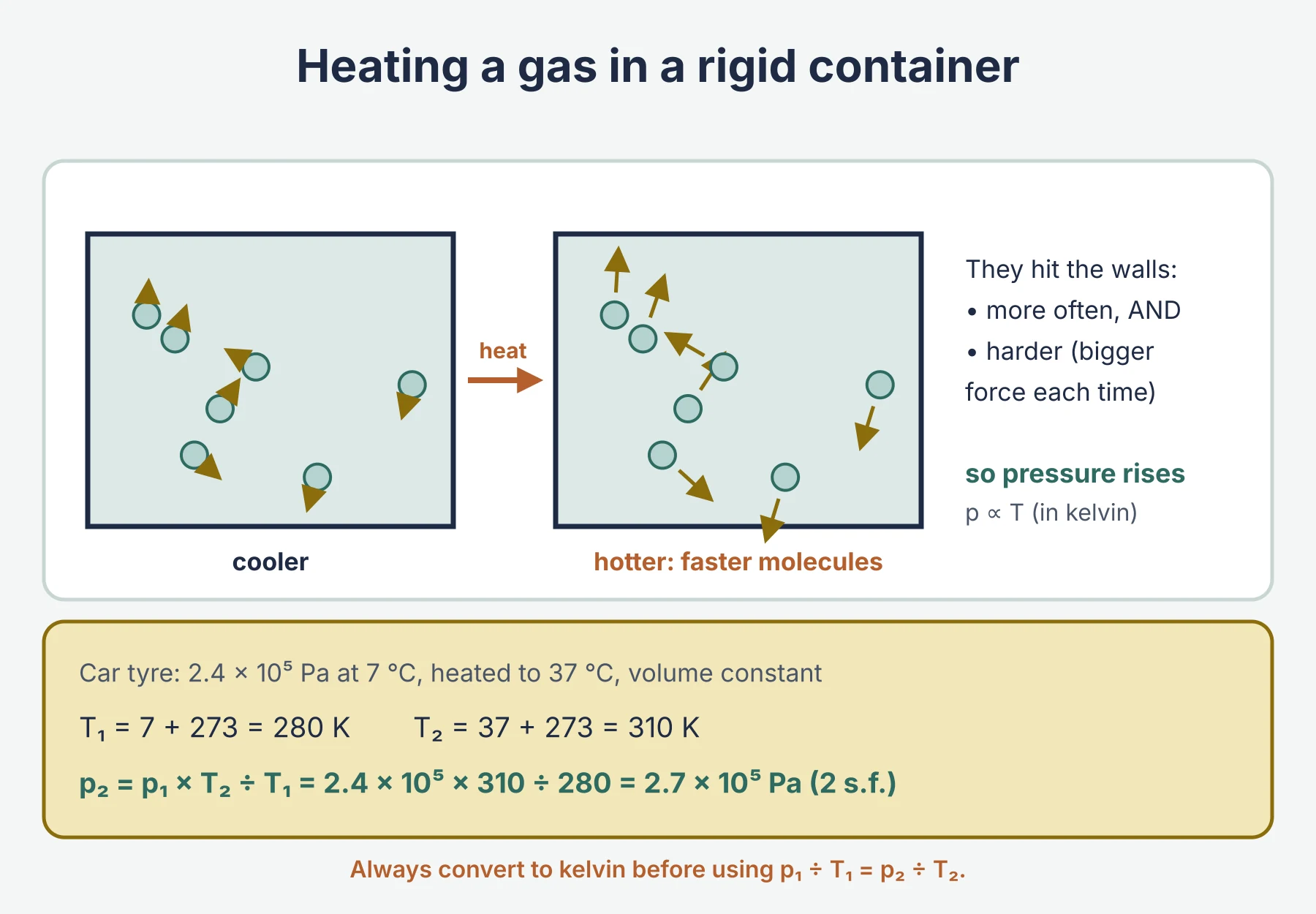
Combining with pressure in liquids
Gas-law questions can link to p = h × ρ × g from sub-topic 5(b).
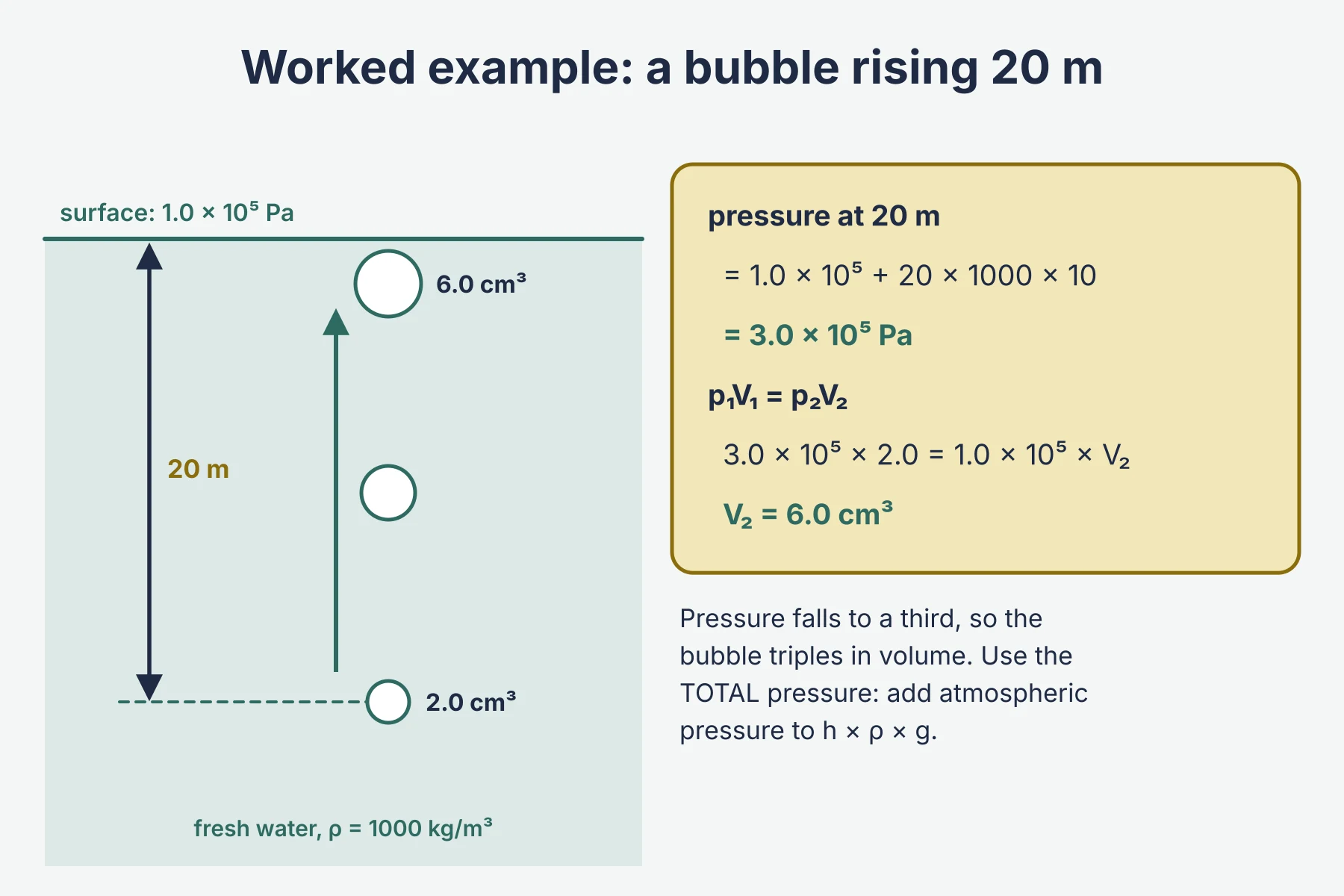
Worked example 4: a rising bubble. A diver releases a bubble of volume 2.0 cm³ at a depth of 20 m in fresh water (ρ = 1000 kg/m³, g = 10 N/kg). Atmospheric pressure is 1.0 × 10⁵ Pa. Assume the temperature of the bubble does not change. Find its volume at the surface.
pressure at 20 m = 1.0 × 10⁵ + 20 × 1000 × 10 = 3.0 × 10⁵ Pa
p₁V₁ = p₂V₂: 3.0 × 10⁵ × 2.0 = 1.0 × 10⁵ × V₂
V₂ = 6.0 cm³
The bubble triples in volume as it rises, because the pressure on it falls to a third.
Common mistakes
- Using °C in
p₁/T₁ = p₂/T₂. Always convert to kelvin first. - Explaining a pressure rise on heating with “molecules hit the walls more often” only. Heating also makes each collision harder.
- Saying molecules move faster when a gas is compressed at constant temperature. Their average speed is unchanged; only the collision rate changes.
- Saying molecules “stop” at absolute zero. They have the minimum possible kinetic energy.
- Forgetting the conditions: both laws need a fixed mass of gas, and each holds one quantity constant.
- Using depth pressure without adding atmospheric pressure in a bubble problem: the gas law needs the total pressure.
Exam technique
- Explain gas pressure: random motion → collisions with the walls → each collision exerts a force on the wall → pressure = total force ÷ area.
- Explain a change in pressure: say what happens to the speed of the molecules (or not), to how often they hit the walls, and to how hard they hit.
- Calculate: write the gas law, convert temperatures to kelvin, keep volume and pressure units consistent, and check the direction of change is sensible (heating should raise pressure; compressing should raise it too).
- Describe the Kelvin scale: starts at absolute zero (0 K = −273 °C), same size steps as °C.
Keep going
- Ideal gas molecules revision notes
- Ideal gas molecules practice questions
- Density and pressure study guide, for
p = h × ρ × g
Written against the Pearson Edexcel International GCSE in Physics (4PH1) specification, Issue 4. Always check the current specification for your examination year.
Related resources
-
Practice questions
Pearson Edexcel International GCSE Physics (4PH1): Ideal gas molecules – Practice Questions
Original 4PH1 questions on gas pressure, absolute zero from data, Kelvin conversions, molecular energy and both gas laws, with full answers.
Physics · Pearson Edexcel · IGCSE
Try questions -
Revision notes
Pearson Edexcel International GCSE Physics (4PH1): Ideal gas molecules – Revision Notes
Recall notes for 4PH1 sub-topic 5d: gas pressure, absolute zero, Kelvin conversions, molecular kinetic energy, both gas laws and a self-test.
Physics · Pearson Edexcel · IGCSE
Revise topic -
Study guides
Pearson Edexcel International GCSE Physics (4PH1): Units for Solids, Liquids and Gases
The units of Topic 5 in Edexcel IGCSE Physics 4PH1: Pa, kg/m³, m² and m³, °C and K, J/kg °C, and the area, volume and density conversions.
Physics · Pearson Edexcel · IGCSE
Read guide
Related articles
Get free revision emails (optional)
Occasional emails with practice questions, worked explanations and links to free resources for the qualification and subjects you choose. No spam, and you can unsubscribe from any email. The free tools on this site never need an email.