
Revision Notes
Pearson Edexcel International GCSE Physics (4PH1): Ideal gas molecules – Revision Notes
Recall notes for 4PH1 sub-topic 5d: gas pressure, absolute zero, Kelvin conversions, molecular kinetic energy, both gas laws and a self-test.
- Subject
- Physics
- Level
- IGCSE
- Topic
- Solids, liquids and gases
- Author
- Marlbridge Academic Team
- Updated
- Reviewed by
- Hassan (what this means)
Aligned to Pearson Edexcel IGCSE Physics (4PH1), Issue 4. Official specification .
Syllabus page (what it covers and how it is assessed): Pearson Edexcel IGCSE Physics.
Syllabus points this page covers
4PH1
- 5d Ideal gas molecules
Found an error? Report a correction.
Need help with this topic? Request a free trial class for IGCSE Physics (4PH1).
These notes condense sub-topic 5(d) Ideal gas molecules (statements 5.15 to 5.22) of Pearson Edexcel International GCSE Physics 4PH1, Issue 4. For the explanations and four worked examples, use the Ideal gas molecules study guide; for exam-style questions, the Ideal gas molecules practice questions.
Equations
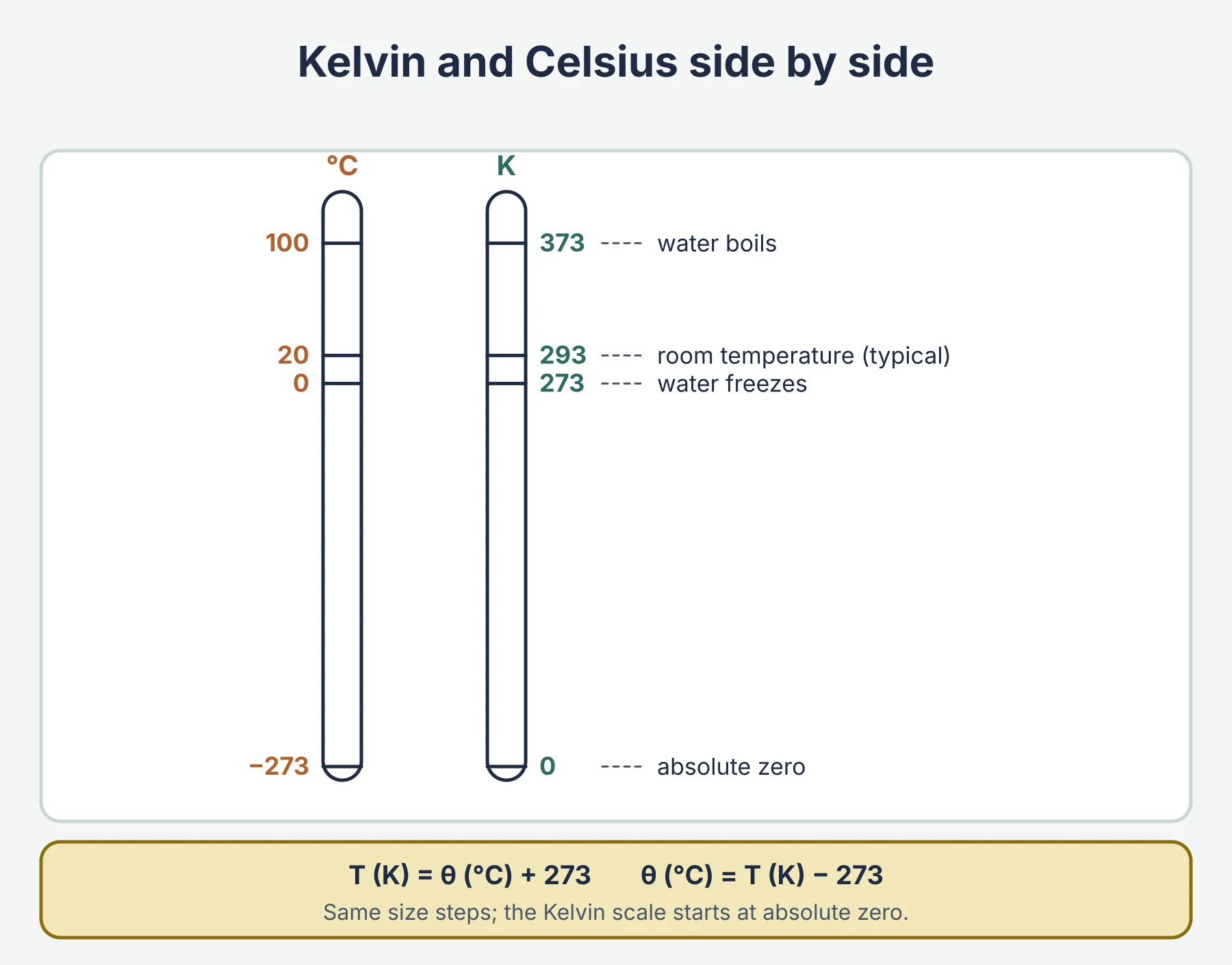
T (K) = θ (°C) + 273
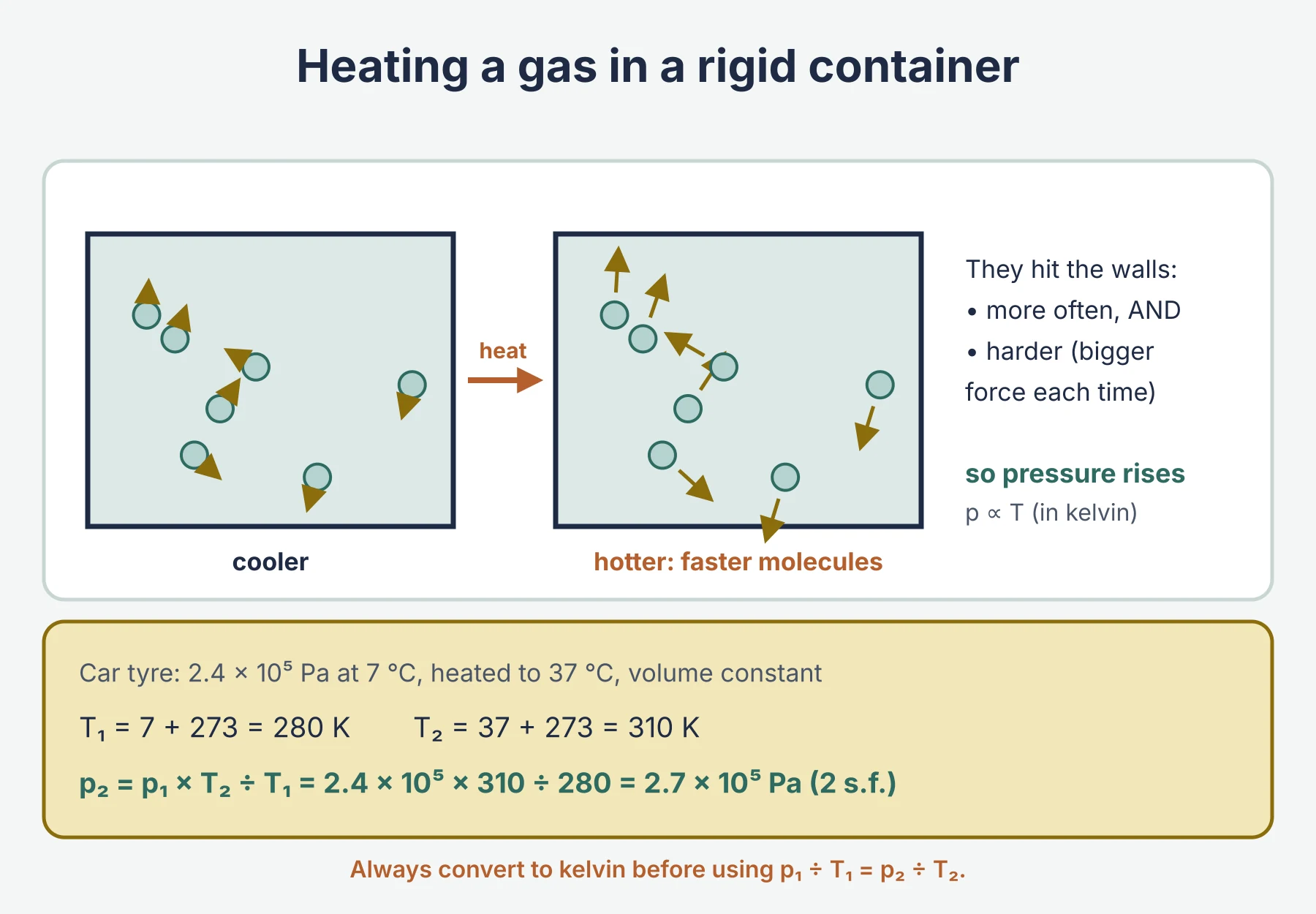
p₁ / T₁ = p₂ / T₂      fixed mass, constant VOLUME, T in kelvin
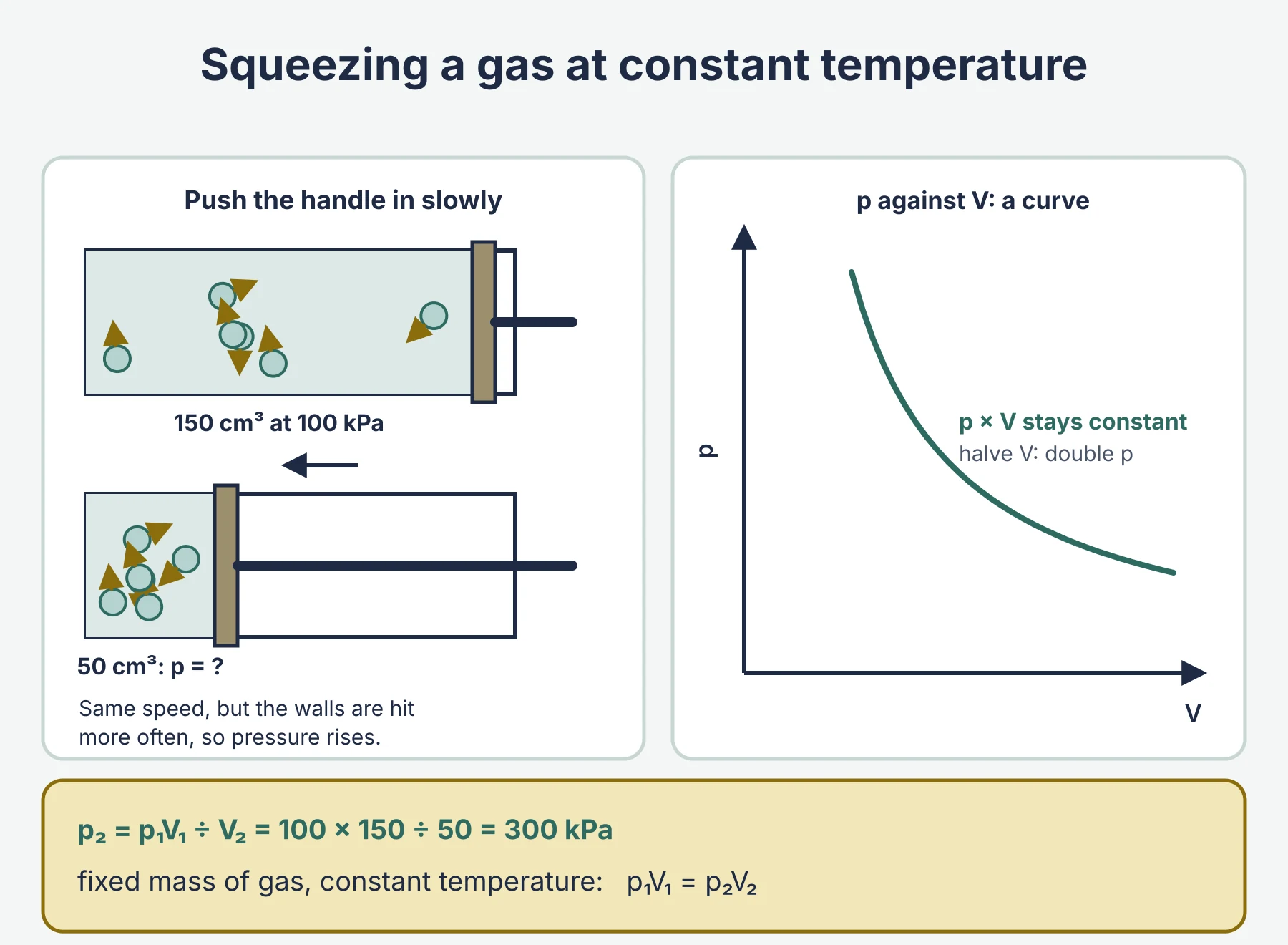
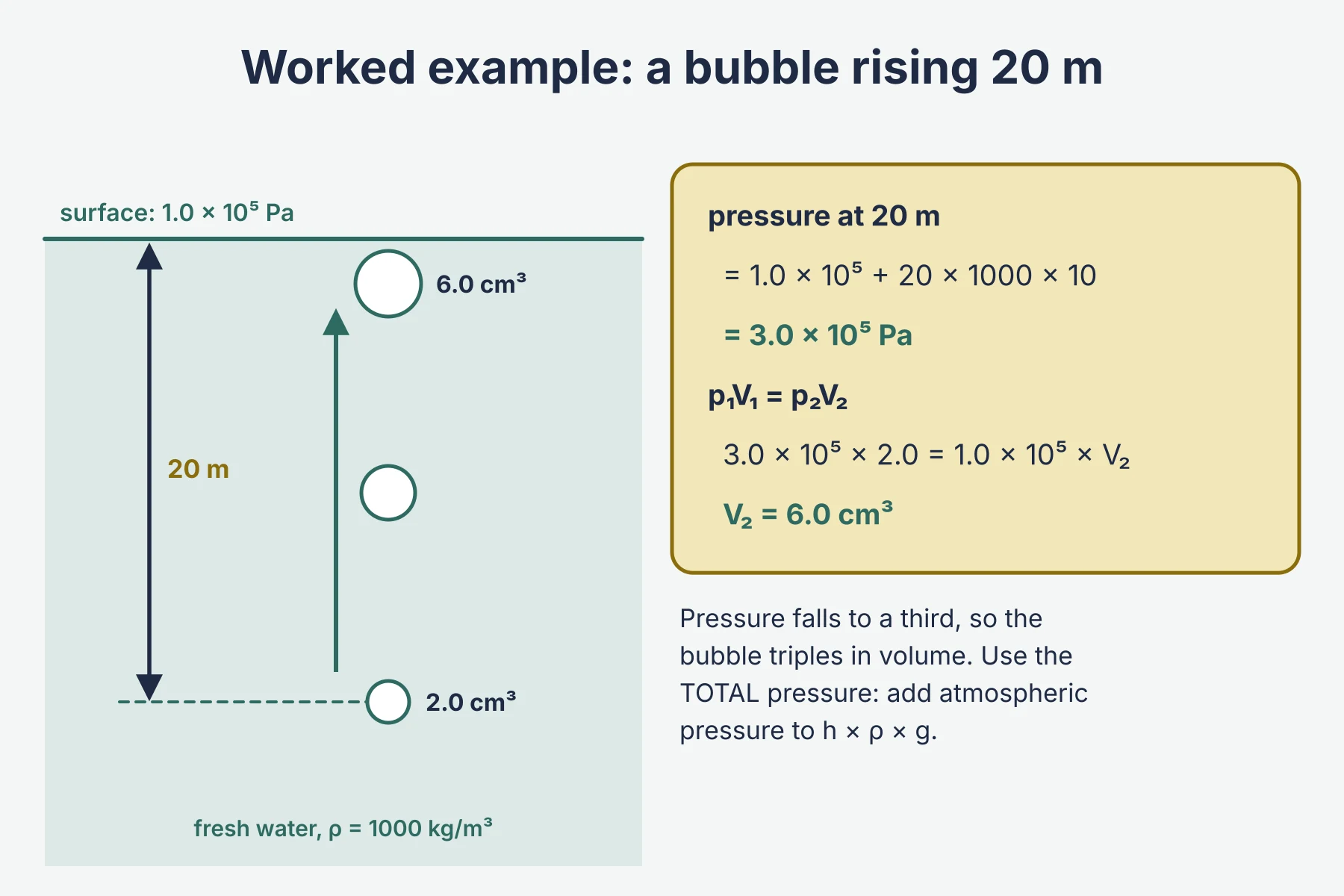
p₁ V₁ = p₂ V₂          fixed mass, constant TEMPERATURE
These two gas laws are “use” statements (5.21, 5.22) and are not in the specification’s list of relationships you must recall, but you still need to recognise which one a question needs.
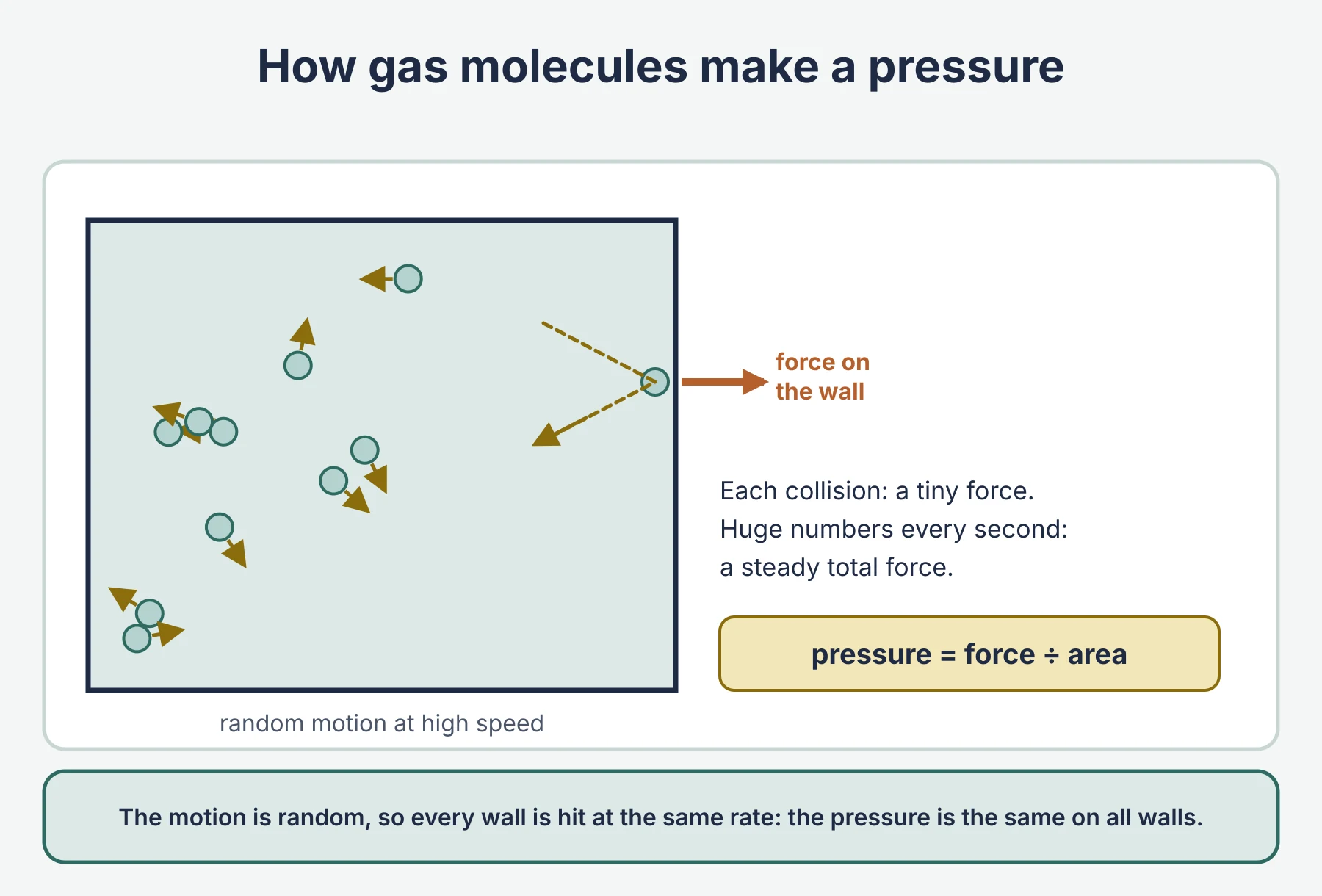
Gas pressure in four steps (5.15)
- Gas molecules move randomly at high speed.
- They collide with the container walls.
- Each collision exerts a small force on the wall.
- Total force ÷ wall area = pressure. Random motion means the same pressure on every wall.
Temperature (5.16 to 5.19)
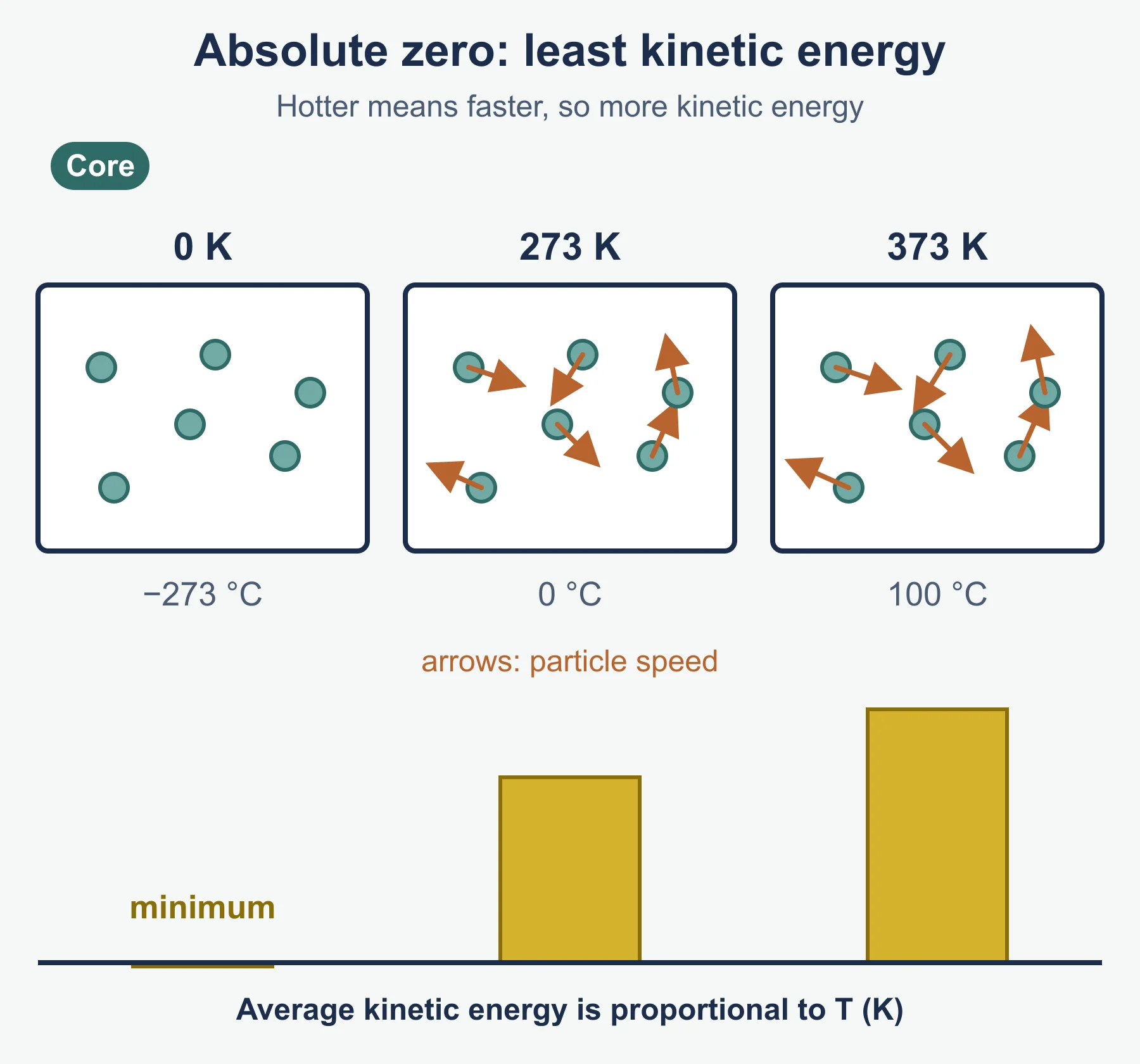
- Heating → molecules gain kinetic energy → average speed increases.
- Kelvin temperature ∝ average kinetic energy of the molecules. Double the kelvin temperature, double the average kinetic energy.
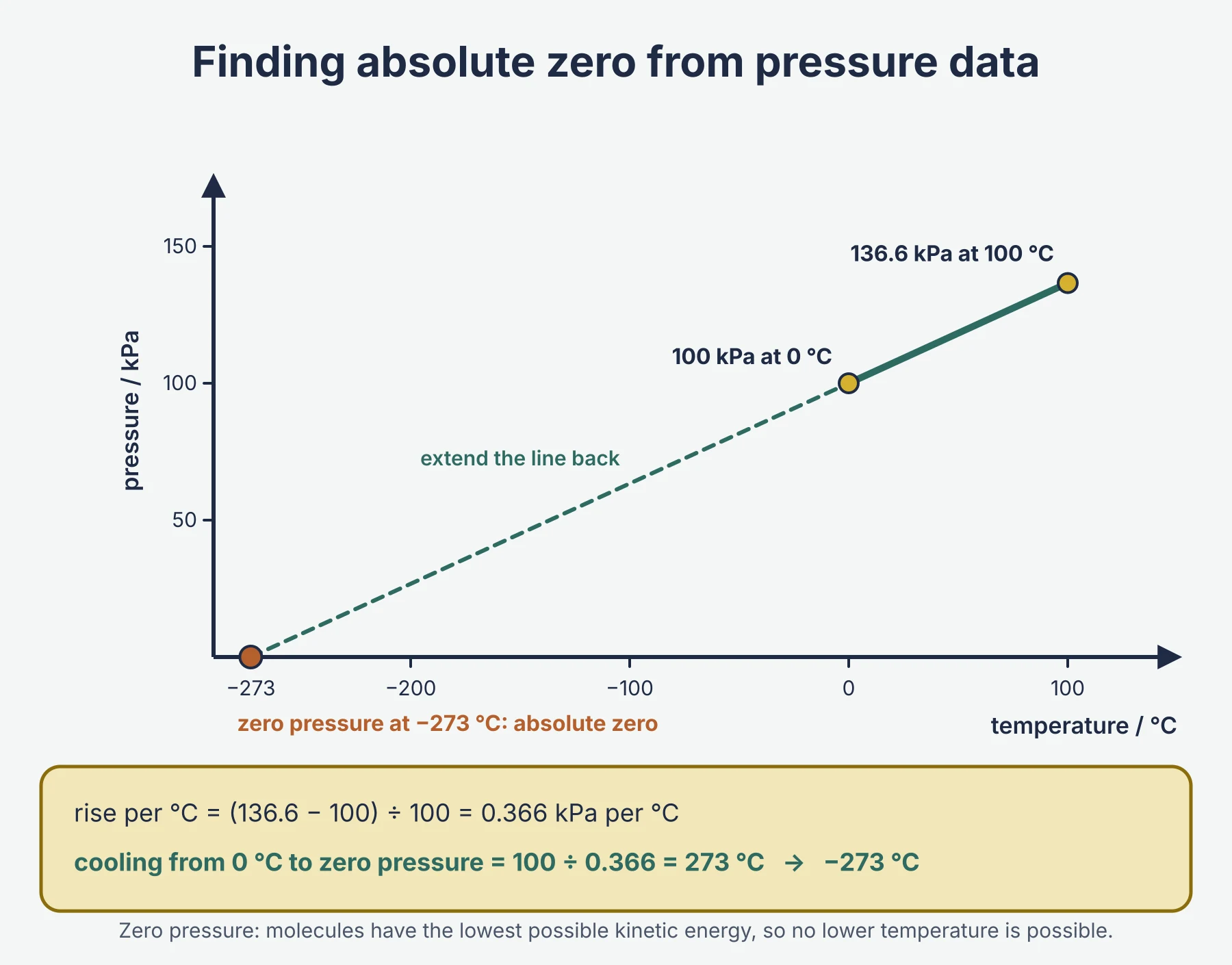
- Absolute zero = 0 K = −273 °C. A graph of pressure against °C for a gas at constant volume extrapolates to zero pressure at −273 °C. At this temperature molecules have the minimum possible kinetic energy, so nothing can be colder.
- Kelvin scale: starts at absolute zero; 1 K step = 1 °C step; no negative values; no degree sign.
| °C | K |
|---|---|
| −273 | 0 |
| −73 | 200 |
| 0 | 273 |
| 27 | 300 |
| 100 | 373 |
| 227 | 500 |
The two relationships explained (5.20)
| Change | Molecular speed | Collisions with walls | Pressure |
|---|---|---|---|
| Volume decreased, temperature constant | Unchanged | More frequent | Increases |
| Volume increased, temperature constant | Unchanged | Less frequent | Decreases |
| Temperature increased, volume constant | Increases | More frequent and harder | Increases |
| Temperature decreased, volume constant | Decreases | Less frequent and gentler | Decreases |
Graphs
pagainstTin kelvin (constant volume): straight line through the origin.pagainstTin °C: straight line crossing the temperature axis at −273 °C.pagainstV(constant temperature): a curve; pressure halves when volume doubles.
Calculation checklist
- Identify which quantity is constant: volume → use p/T; temperature → use pV.
- Convert every temperature to kelvin.
- Keep pressure units the same on both sides (both Pa or both kPa) and volume units the same.
- Rearrange, substitute, calculate.
- Sense check: compressing or heating should increase the pressure.
Key terms
| Term | Meaning |
|---|---|
| Random motion | Molecules moving in all directions with a range of speeds, changing direction at each collision |
| Gas pressure | Force per unit area from molecules colliding with the container walls |
| Absolute zero | 0 K or −273 °C; the temperature at which molecules have the least possible kinetic energy |
| Kelvin scale | Temperature scale starting at absolute zero, with steps equal in size to degrees Celsius |
| Fixed mass of gas | A sealed amount of gas: no molecules enter or leave |
| Average kinetic energy | Mean kinetic energy of all the molecules in a gas; proportional to kelvin temperature |
Exam traps
- Celsius in p₁/T₁ = p₂/T₂: the most common lost mark in this sub-topic.
- Only one effect when heating raises pressure: give more frequent and harder collisions.
- Saying molecules speed up when a gas is compressed slowly at constant temperature.
- Saying molecules stop moving at absolute zero.
- Doubling °C and saying the kinetic energy doubles; it is the kelvin value that must double.
- Using p₁V₁ = p₂V₂ when the temperature changes as well.
- Using only h ρ g for the pressure on an underwater bubble; add atmospheric pressure.
Self-test
- Convert −40 °C to kelvin.
- Convert 350 K to °C.
- Explain how the molecules of a gas exert a pressure on the walls of a container.
- Explain why no temperature can be lower than absolute zero.
- A gas is heated from 200 K to 400 K. What happens to the average kinetic energy of its molecules?
- Explain why the pressure of a gas increases when it is compressed at constant temperature.
- Explain why the pressure of a gas in a sealed rigid container increases when it is heated.
- A gas at 90 kPa occupies 0.60 m³. It is compressed at constant temperature to 0.45 m³. Calculate the new pressure.
- A sealed jar of air at 100 kPa and 17 °C is cooled to −13 °C. Calculate the new pressure.
- A gas at 27 °C is heated at constant volume until its pressure doubles. Find its new temperature in °C.
- Describe the graph of pressure against kelvin temperature for a gas at constant volume.
- State the two conditions needed for p₁V₁ = p₂V₂ to apply.
Answers: 1. 233 K. 2. 77 °C. 3. The molecules move randomly and collide with the walls; each collision exerts a force on the wall, and the total force per unit area is the pressure. 4. At absolute zero the molecules have the minimum possible kinetic energy, so no more energy can be removed and the temperature cannot fall further. 5. It doubles. 6. The molecules have the same average speed but less space, so they hit each unit area of the walls more often, giving a greater force per unit area. 7. The molecules move faster, so they hit the walls more often and with greater force. 8. p₂ = 90 × 0.60 ÷ 0.45 = 120 kPa. 9. T₁ = 290 K, T₂ = 260 K; p₂ = 100 × 260 ÷ 290 = 90 kPa (89.7 kPa). 10. T₁ = 300 K, so T₂ = 600 K = 327 °C. 11. A straight line through the origin (pressure proportional to kelvin temperature). 12. A fixed mass of gas, and constant temperature.
Related resources
-
Study guides
Pearson Edexcel International GCSE Physics (4PH1): Units for Solids, Liquids and Gases
The units of Topic 5 in Edexcel IGCSE Physics 4PH1: Pa, kg/m³, m² and m³, °C and K, J/kg °C, and the area, volume and density conversions.
Physics · Pearson Edexcel · IGCSE
Read guide -
Practice questions
Pearson Edexcel International GCSE Physics (4PH1): Units for Solids, Liquids and Gases – Practice Questions
Original 4PH1 practice on Topic 5 units: cm² and cm³ conversions, g/cm³ to kg/m³, Celsius and kelvin, pascals and J/kg °C, with full answers.
Physics · Pearson Edexcel · IGCSE
Try questions -
Revision notes
Pearson Edexcel International GCSE Physics (4PH1): Units for Solids, Liquids and Gases – Revision Notes
Recall notes for 4PH1 sub-topic 5a: Pa, kg/m³, m² and m³ conversions, Celsius and kelvin, J/kg °C, when units may stay as given, traps and a self-test.
Physics · Pearson Edexcel · IGCSE
Revise topic
Related articles
Get free revision emails (optional)
Occasional emails with practice questions, worked explanations and links to free resources for the qualification and subjects you choose. No spam, and you can unsubscribe from any email. The free tools on this site never need an email.