
Revision Notes
Pearson Edexcel International GCSE Physics (4PH1): Change of state – Revision Notes
Recall notes for 4PH1 sub-topic 5c: melting, evaporation and boiling, temperature-time graphs, ΔQ = mcΔT and both practicals, with a self-test.
- Subject
- Physics
- Level
- IGCSE
- Topic
- Solids, liquids and gases
- Author
- Marlbridge Academic Team
- Updated
- Reviewed by
- Hassan (what this means)
Aligned to Pearson Edexcel IGCSE Physics (4PH1), Issue 4. Official specification .
Syllabus page (what it covers and how it is assessed): Pearson Edexcel IGCSE Physics.
Syllabus points this page covers
4PH1
- 5c Change of state
Found an error? Report a correction.
Need help with this topic? Request a free trial class for IGCSE Physics (4PH1).
These notes condense sub-topic 5(c) Change of state (statements 5.8P to 5.14P) of Pearson Edexcel International GCSE Physics 4PH1, Issue 4. All of it is Physics-only, assessed on Paper 2. For explanations and worked examples, use the Change of state study guide; for exam-style questions, the Change of state practice questions.
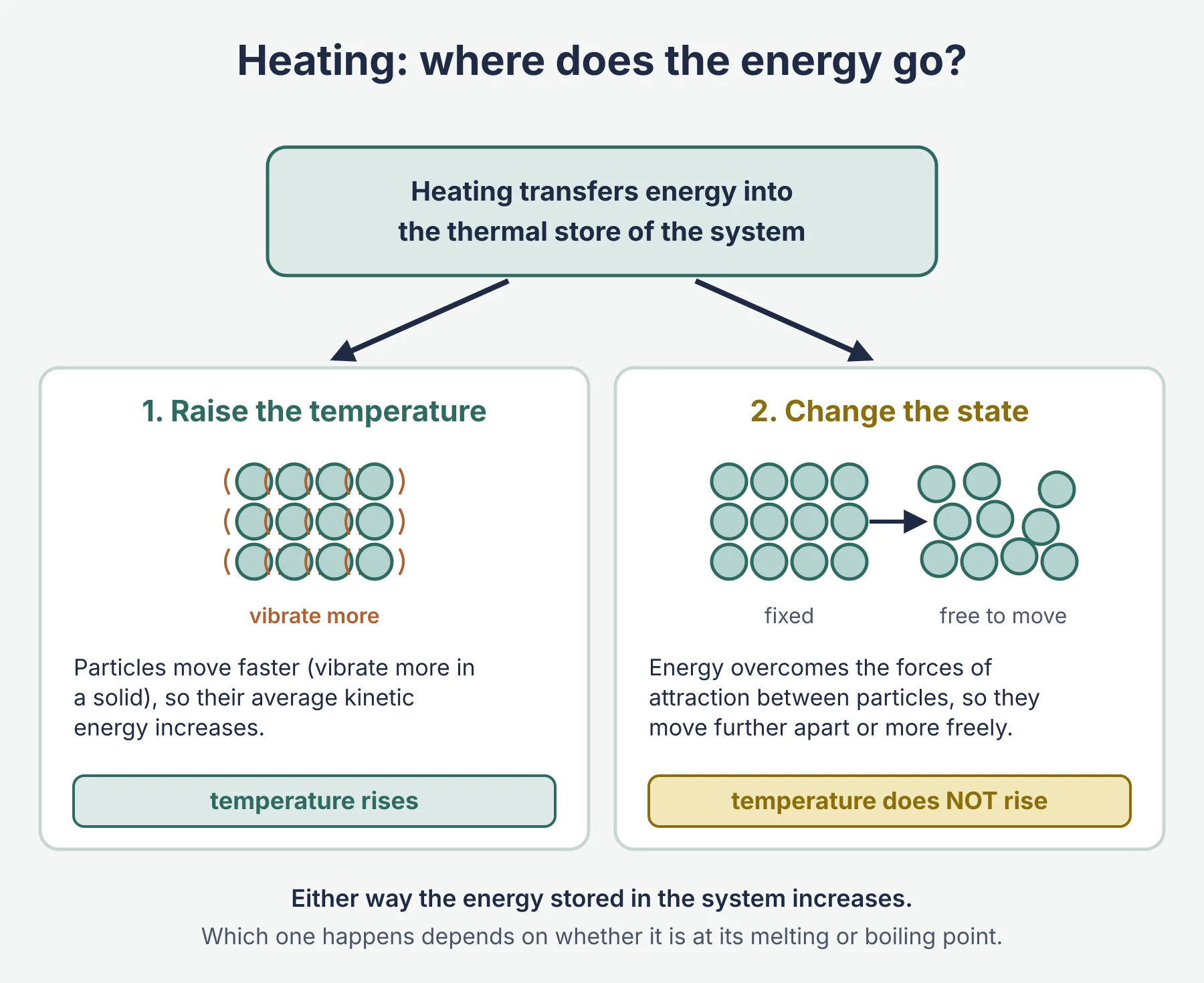
Heating does one of two things (5.8P)
| Situation | What the energy does | Temperature |
|---|---|---|
| Not at melting or boiling point | Increases the kinetic energy of the particles | Rises |
| At melting or boiling point | Overcomes forces of attraction between particles | Stays constant |
Either way, the energy stored in the system increases.
Particles (5.10P)
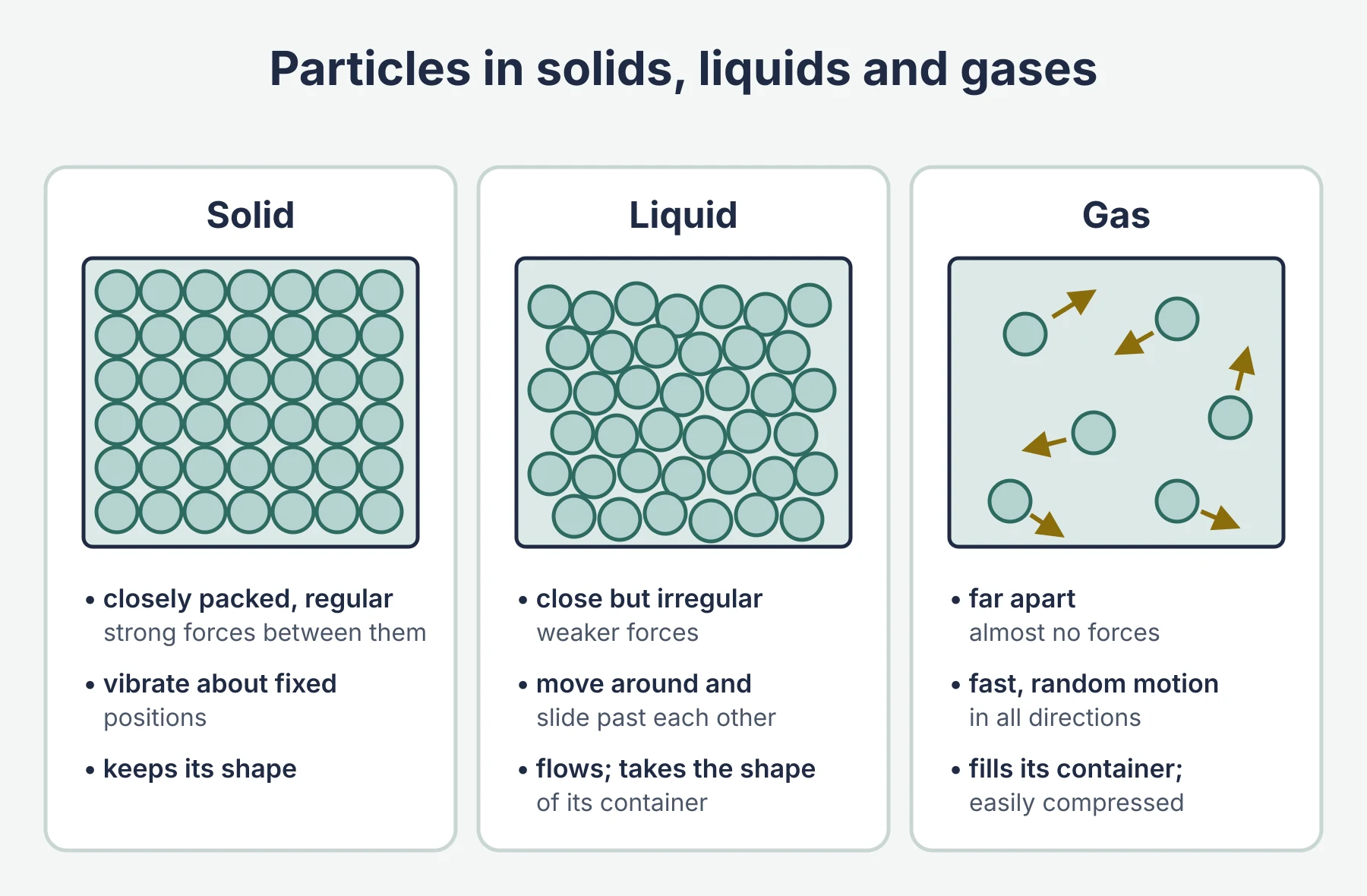
- Solid: close, regular pattern; strong forces; vibrate about fixed positions.
- Liquid: close, irregular; weaker forces; move around and slide past each other.
- Gas: far apart; almost no forces; fast, random motion in all directions.
Melting, boiling, evaporating (5.9P)
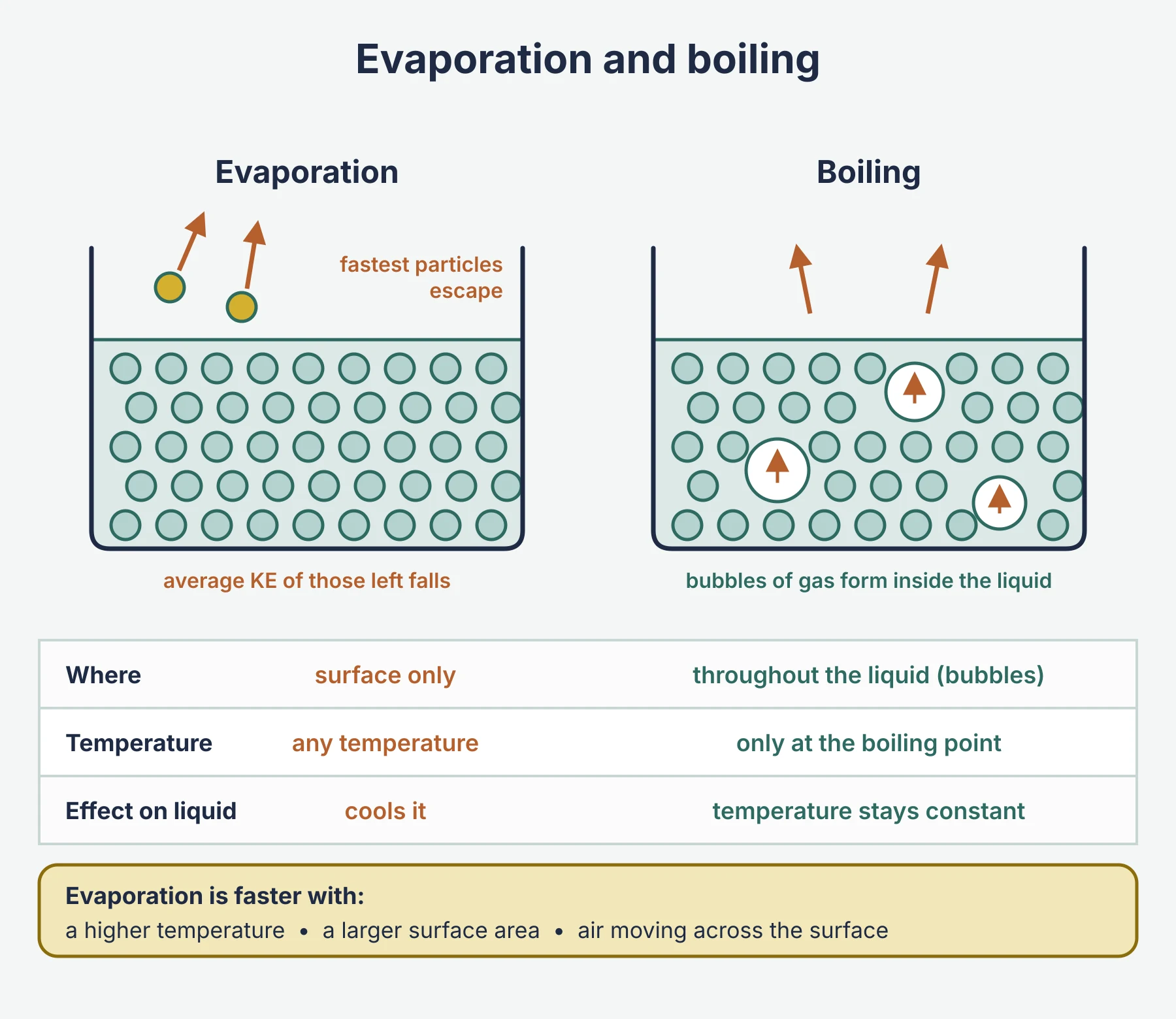
- Melting: particles gain enough energy to leave fixed positions; stay close together; temperature constant at the melting point.
- Boiling: throughout the liquid, at the boiling point only; bubbles of gas form inside; temperature constant.
- Evaporation: surface only, any temperature; the fastest particles escape, so the average kinetic energy of the remaining particles falls and the liquid cools.
- Evaporation is faster when the liquid is warmer, has a larger surface area, or has air moving over it.
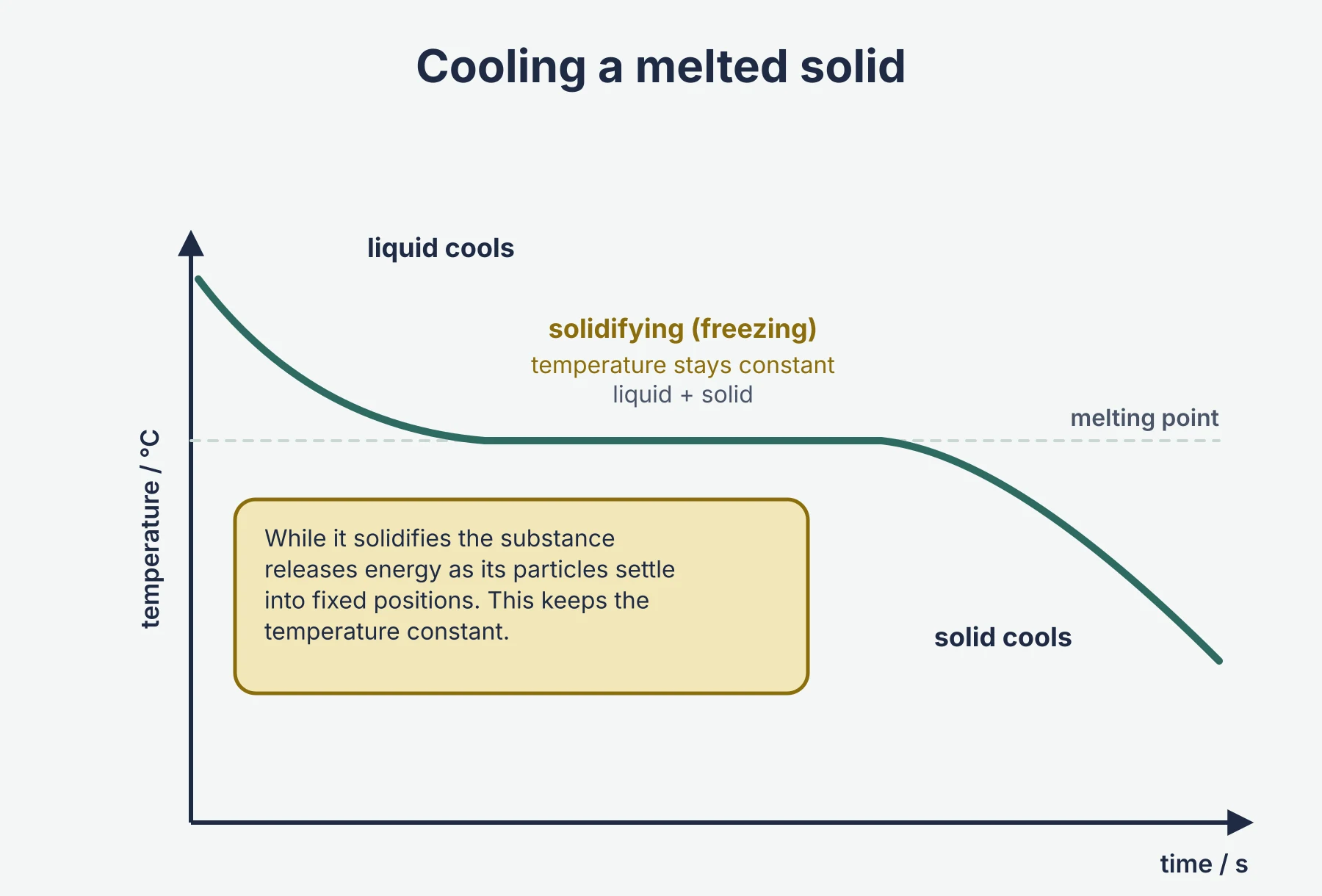
Temperature-time graphs (5.11P)
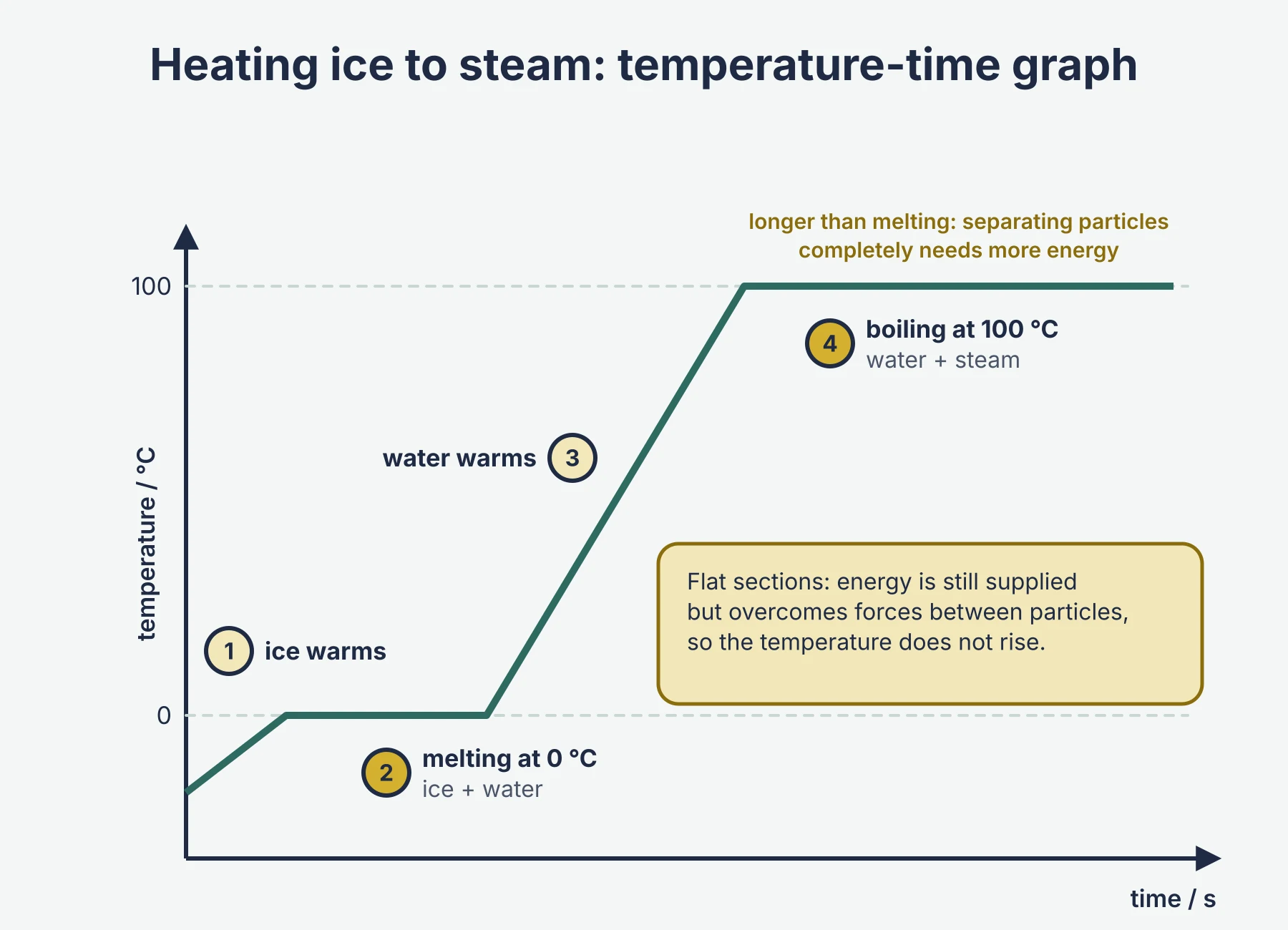
Heating ice:  rise → FLAT at 0 °C (melting) → rise → FLAT at 100 °C (boiling)
Cooling liquid: fall → FLAT at freezing point (solidifying) → fall- Flat section = change of state; energy is still being transferred, but the temperature does not change.
- For water heated steadily, the boiling plateau is longer than the melting plateau.
- Method: steady heating, stir, read every 30 s at eye level, plot temperature (y) against time (x).
Specific heat capacity (5.12P, 5.13P)
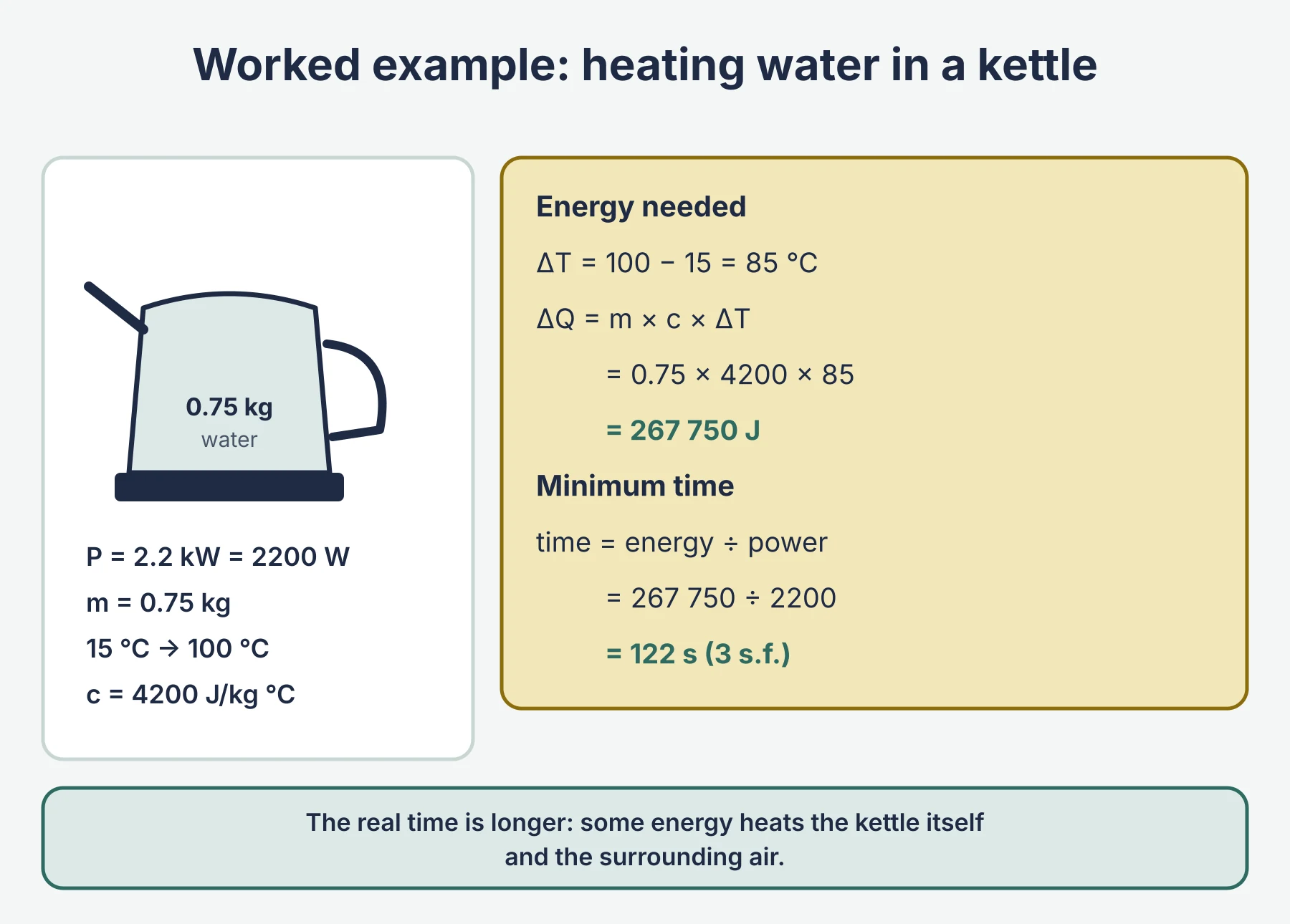
Definition: the energy needed to raise the temperature of 1 kg of a material by 1 °C. Unit: J/kg °C.
ΔQ = m × c × ΔT c = ΔQ / (m × ΔT) ΔT = ΔQ / (m × c) m = ΔQ / (c × ΔT)- Water: c = 4200 J/kg °C (high: slow to heat up and cool down).
- Use only for temperature changes, never across a change of state.
- ΔT can be in °C or K (same size).
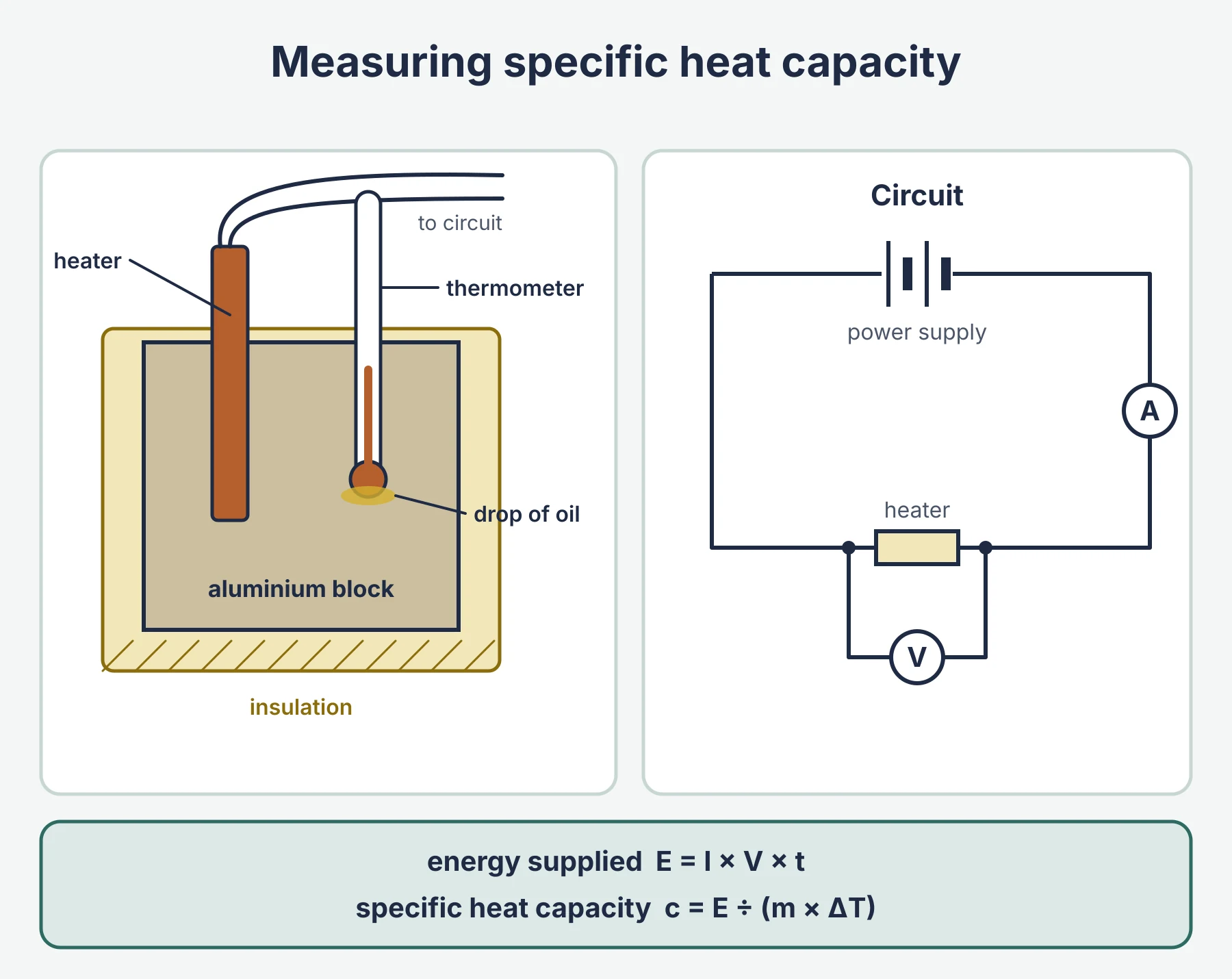
The specific heat capacity practical (5.14P)
- Mass of block (or water) on a balance.
- Heater and thermometer in the block; oil in the thermometer hole; insulation round the block.
- Measure current, voltage and time (or use a joulemeter):
E = I × V × t. - Record start and highest temperatures:
ΔT. c = E / (m × ΔT).
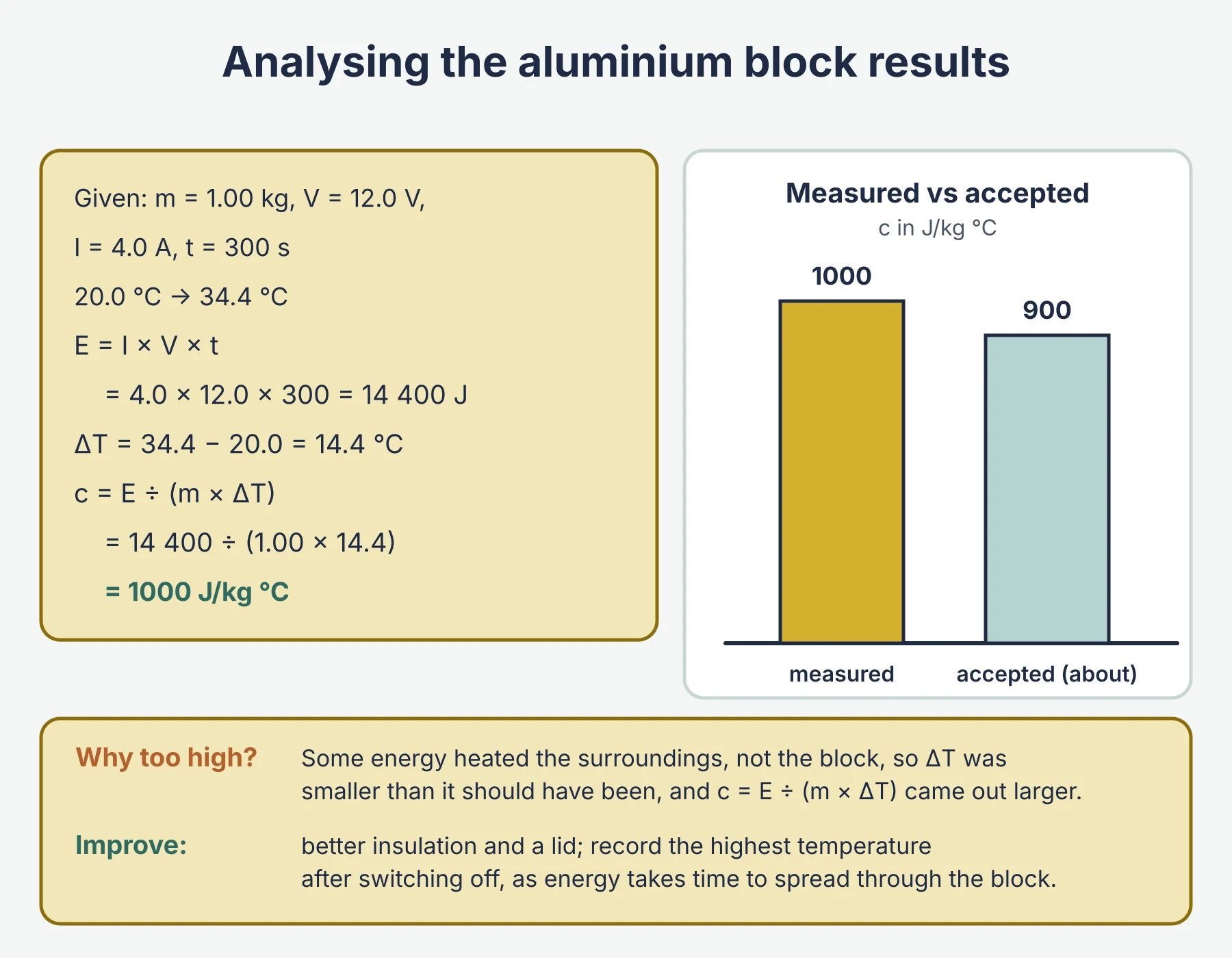
Why the measured c is usually too high: some of the energy supplied heats the surroundings, so the temperature rise is smaller than it would be if all the energy went into the block. Improve with more insulation, a lid (for water), and stirring (for water).
Key terms
| Term | Meaning |
|---|---|
| Change of state | Melting, freezing, boiling, evaporating or condensing; no change in temperature while it happens |
| Melting point | Temperature at which a solid turns to a liquid (same as the freezing point) |
| Boiling point | Temperature at which a liquid turns to a gas throughout its volume |
| Evaporation | Liquid turning to gas from the surface, at any temperature |
| Specific heat capacity | Energy to raise 1 kg of a material by 1 °C |
| Thermal store | The energy of the particles of a system |
| Temperature-time graph | Graph of temperature against time while a substance is heated or cools |
Exam traps
- “Temperature rises while it melts”. It stays constant.
- Using ΔQ = m × c × ΔT during melting or boiling.
- “Evaporation only happens at 100 °C” or “evaporation heats the liquid”.
- Mass in grams with c in J/kg °C.
- Using the final temperature instead of the temperature change.
- Explaining a high experimental c with “human error” instead of energy transferred to the surroundings.
- Describing particles in a gas as “vibrating”. Gas particles move freely and randomly.
Self-test
- State the two effects heating can have on a substance.
- Explain why the temperature of ice stays at 0 °C while it melts.
- Give two differences between evaporation and boiling.
- Explain why evaporation cools a liquid.
- Describe the arrangement and motion of particles in a liquid.
- Define specific heat capacity.
- Calculate the energy needed to warm 0.40 kg of water by 25 °C (c = 4200 J/kg °C).
- Calculate the energy needed to warm 300 g of aluminium by 50 °C (c = 900 J/kg °C).
- 8400 J is transferred to 0.50 kg of water. Calculate the temperature rise.
- 45 000 J raises the temperature of a 1.5 kg block by 20 °C. Calculate its specific heat capacity.
- Explain why a value of c measured in a school laboratory is usually higher than the accepted value.
- On a cooling curve for a liquid, what does a horizontal section show?
Answers: 1. Raise its temperature, or change its state. 2. The energy supplied is used to overcome the forces between the particles, not to increase their kinetic energy, so the temperature does not rise. 3. Any two: evaporation happens at the surface only, boiling throughout the liquid; evaporation happens at any temperature, boiling only at the boiling point; evaporation cools the liquid, boiling keeps it at constant temperature. 4. The fastest-moving particles escape from the surface, so the average kinetic energy of the remaining particles falls, and temperature depends on that average. 5. Close together in an irregular arrangement, moving around and sliding past each other. 6. The energy needed to raise the temperature of 1 kg of the material by 1 °C. 7. ΔQ = 0.40 × 4200 × 25 = 42 000 J. 8. ΔQ = 0.300 × 900 × 50 = 13 500 J. 9. ΔT = 8400 ÷ (0.50 × 4200) = 4.0 °C. 10. c = 45 000 ÷ (1.5 × 20) = 1500 J/kg °C. 11. Some energy from the heater is transferred to the surroundings, so the measured temperature rise is smaller than it should be, which makes the calculated c too large. 12. The substance is changing state (solidifying) at its freezing point, so the temperature stays constant.
Related resources
-
Study guides
Pearson Edexcel International GCSE Physics (4PH1): Density and pressure
Density and its practical for solids and liquids, pressure = force/area, pressure in fluids and p = hρg worked examples, for Edexcel IGCSE Physics 4PH1.
Physics · Pearson Edexcel · IGCSE
Read guide -
Practice questions
Pearson Edexcel International GCSE Physics (4PH1): Density and pressure – Practice Questions
Original 4PH1 questions on density, the density practicals, pressure on surfaces, fluid pressure and p = hρg force problems, with full answers.
Physics · Pearson Edexcel · IGCSE
Try questions -
Revision notes
Pearson Edexcel International GCSE Physics (4PH1): Density and pressure – Revision Notes
Recall notes for 4PH1 sub-topic 5b: density, the density practical, p = F/A, fluid pressure in all directions and p = hρg, with a self-test.
Physics · Pearson Edexcel · IGCSE
Revise topic
Related articles
Get free revision emails (optional)
Occasional emails with practice questions, worked explanations and links to free resources for the qualification and subjects you choose. No spam, and you can unsubscribe from any email. The free tools on this site never need an email.