
Study Guides
Pearson Edexcel International GCSE Physics (4PH1): Change of state
Heating and stored energy, melting, evaporation and boiling, temperature-time graphs and specific heat capacity practicals for Edexcel IGCSE Physics 4PH1.
- Subject
- Physics
- Level
- IGCSE
- Topic
- Solids, liquids and gases
- Author
- Marlbridge Academic Team
- Updated
- Reviewed by
- Hassan (what this means)
Aligned to Pearson Edexcel IGCSE Physics (4PH1), Issue 4. Official specification .
Syllabus page (what it covers and how it is assessed): Pearson Edexcel IGCSE Physics.
Syllabus points this page covers
4PH1
- 5c Change of state
Found an error? Report a correction.
Need help with this topic? Request a free trial class for IGCSE Physics (4PH1).
This guide covers sub-topic 5(c) Change of state, statements 5.8P to 5.14P of the Pearson Edexcel International GCSE in Physics (4PH1), Issue 4. Every statement is Physics-only, so this sub-topic is assessed only on Paper 2. The Solids, Liquids and Gases study guide summarises it; this page explains what happens to the energy when a substance is heated, how to obtain and read a temperature-time graph, the difference between evaporation and boiling, and how to carry out and evaluate the specific heat capacity practical.
What 5(c) covers
- 5.8P explain why heating a system will change the energy stored within the system and raise its temperature or produce changes of state;
- 5.9P describe the changes that occur when a solid melts to form a liquid, and when a liquid evaporates or boils to form a gas;
- 5.10P describe the arrangement and motion of particles in solids, liquids and gases;
- 5.11P practical: obtain a temperature-time graph to show the constant temperature during a change of state;
- 5.12P know that specific heat capacity is the energy required to change the temperature of an object by one degree Celsius per kilogram of mass (J/kg °C);
- 5.13P use
change in thermal energy = mass × specific heat capacity × change in temperature(ΔQ = m × c × ΔT); - 5.14P practical: investigate the specific heat capacity of materials including water and some solids.
Where the energy goes when you heat something (5.8P)
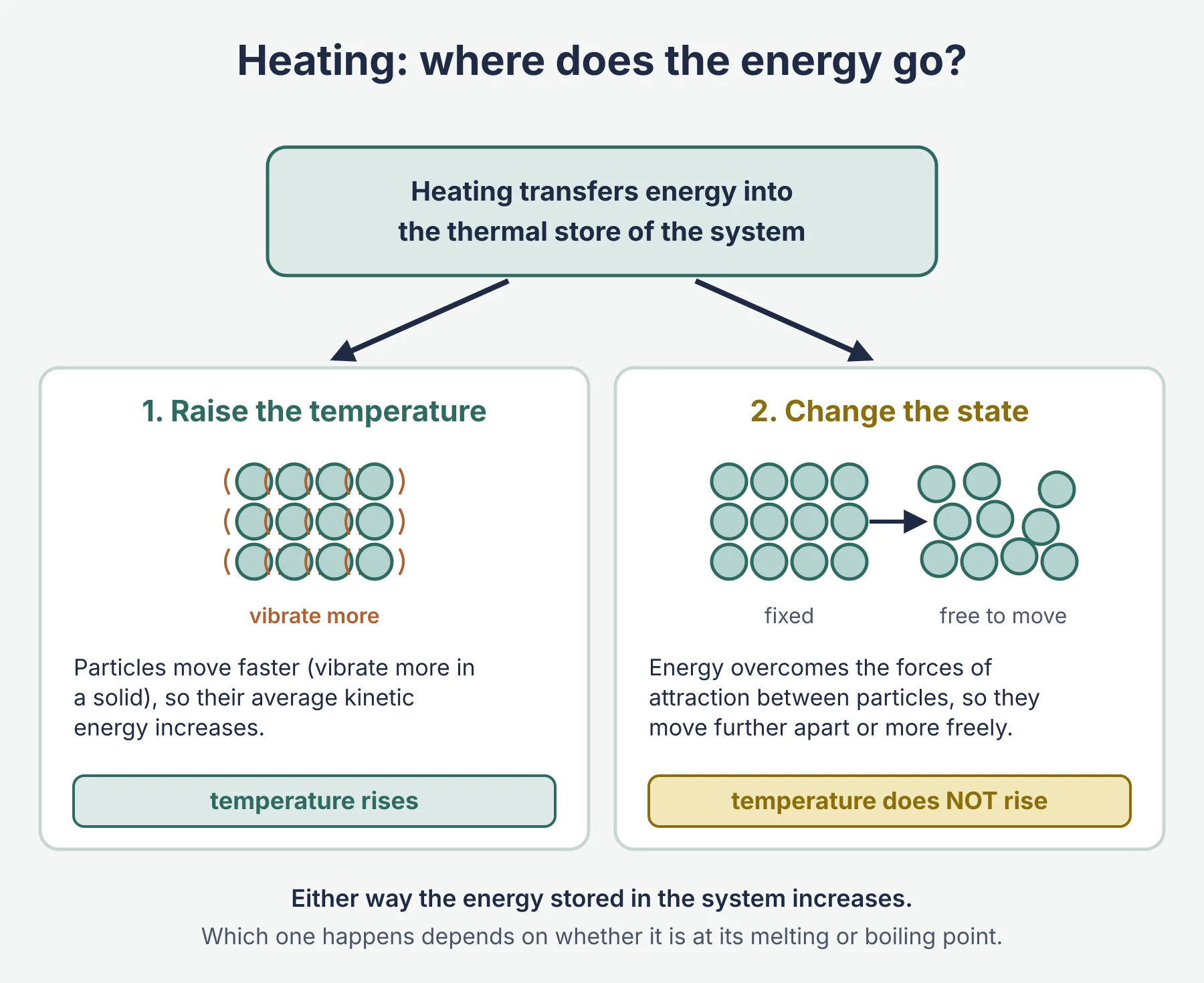
Heating transfers energy into the thermal store of a system: the total energy of its particles. That energy can do one of two things:
- raise the temperature: the particles move faster (vibrate more in a solid), so their average kinetic energy increases;
- change the state: the energy is used to overcome the forces of attraction between particles, so they can move further apart or move more freely. The temperature does not rise while this happens.
In both cases the energy stored in the system increases. Which one happens depends on whether the substance is at its melting or boiling point.
Particles in the three states (5.10P)
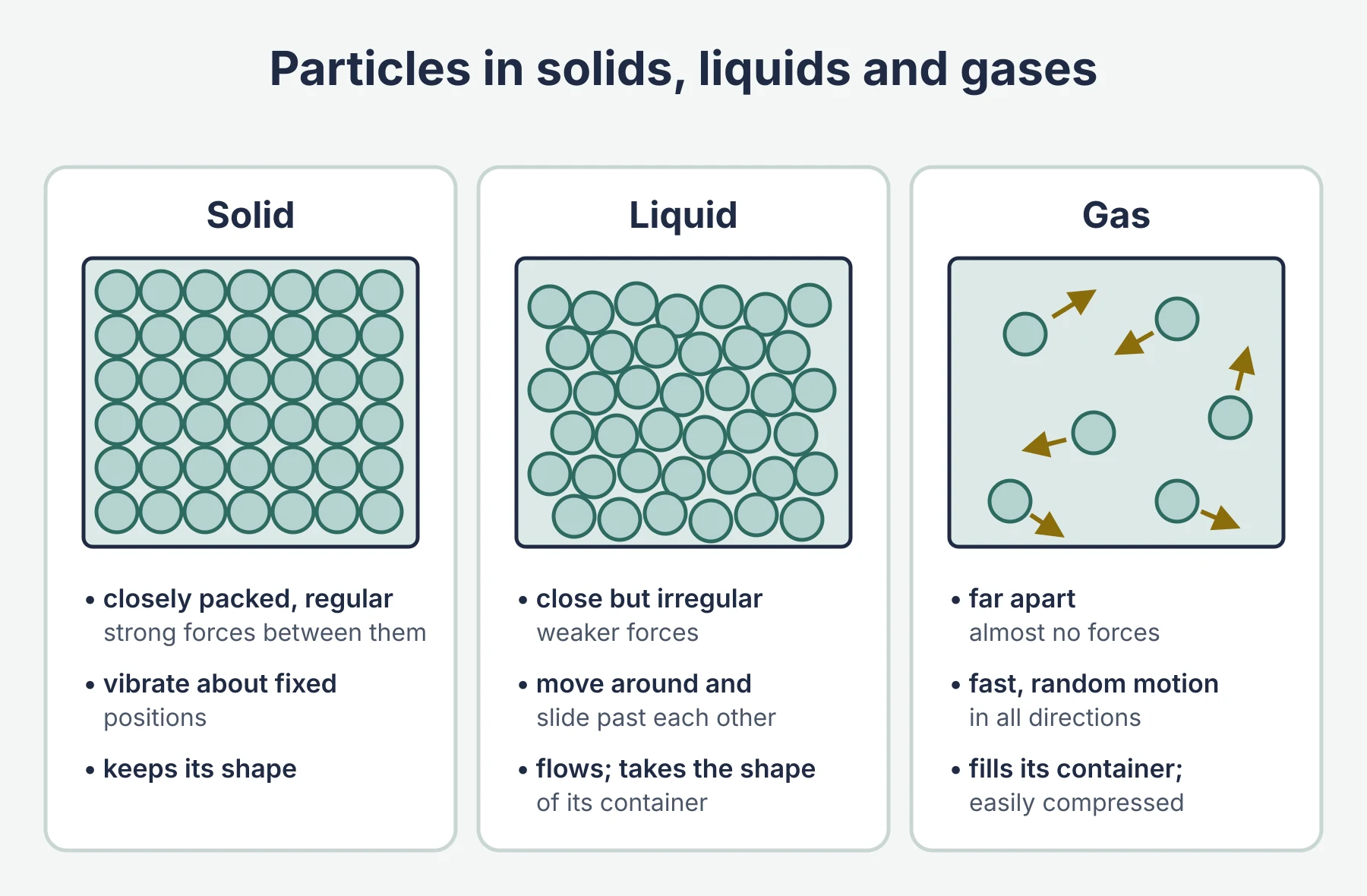
- Solid: particles closely packed in a regular arrangement, held by strong forces; they vibrate about fixed positions. A solid keeps its shape.
- Liquid: particles still close together but irregularly arranged; forces are weaker than in a solid, so they move around and slide past each other. A liquid flows and takes the shape of its container.
- Gas: particles far apart, with almost no forces between them, moving quickly and randomly in all directions. A gas fills its container and is easily compressed.
Melting, evaporating and boiling (5.9P)
Melting. At the melting point, energy supplied lets particles break free of their fixed positions. The regular arrangement breaks down and the particles can move past each other, but they stay close together.
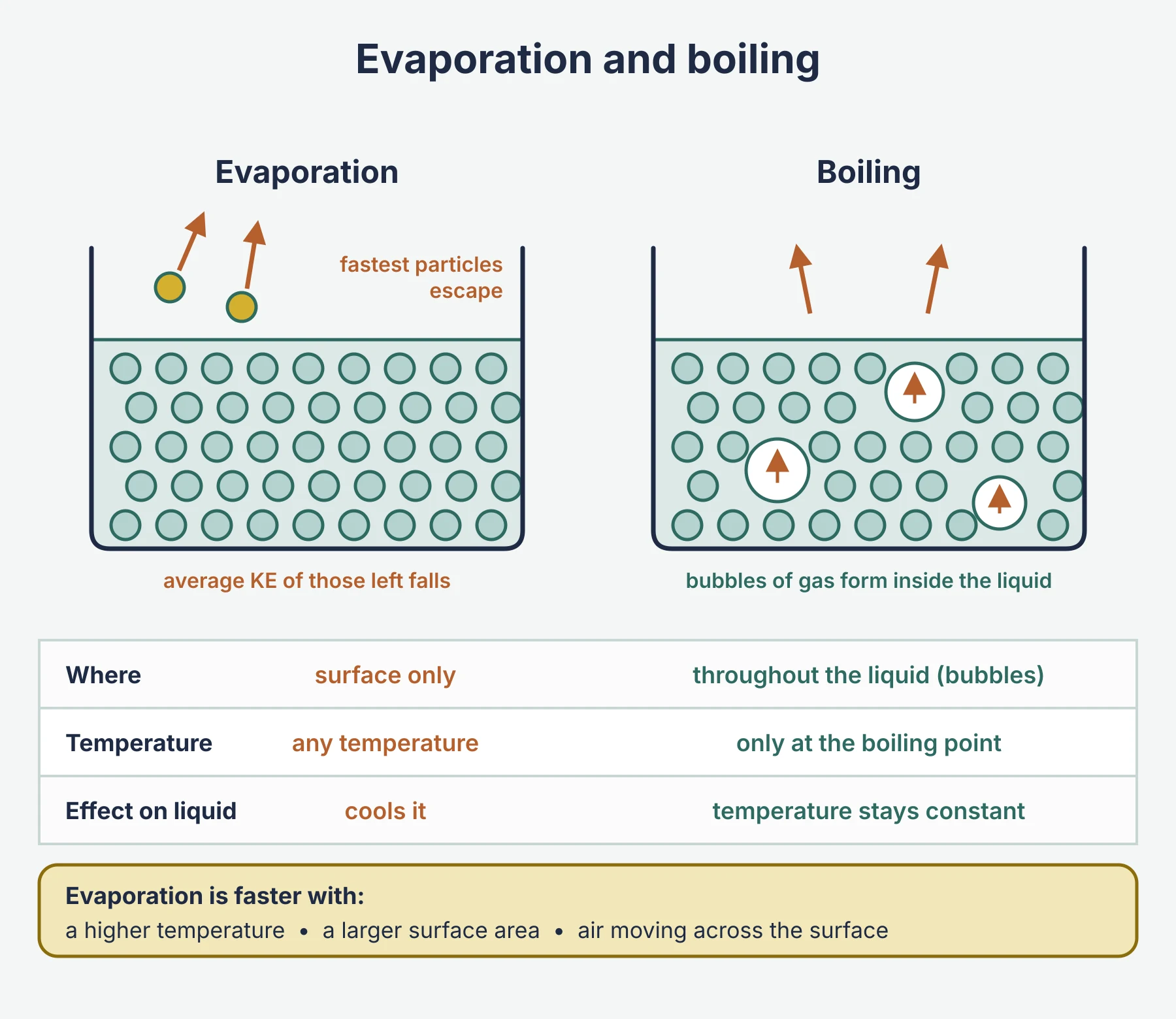
Boiling. At the boiling point, energy supplied lets particles throughout the liquid escape from each other completely. Bubbles of gas form inside the liquid, and the temperature stays at the boiling point until all the liquid has turned to gas.
Evaporation. Evaporation happens only at the surface, and at any temperature below the boiling point. The particles in a liquid have a range of speeds. The fastest-moving particles near the surface have enough energy to escape. Because the most energetic particles leave, the average kinetic energy of those left behind falls, so the liquid cools. That is why sweat evaporating from skin cools you down. Evaporation is faster with a higher temperature, a larger surface area, or air moving across the surface.
| Evaporation | Boiling | |
|---|---|---|
| Where | Surface only | Throughout the liquid (bubbles) |
| Temperature | Any temperature | Only at the boiling point |
| Effect on liquid | Cools it | Temperature stays constant |
The temperature-time graph practical (5.11P)
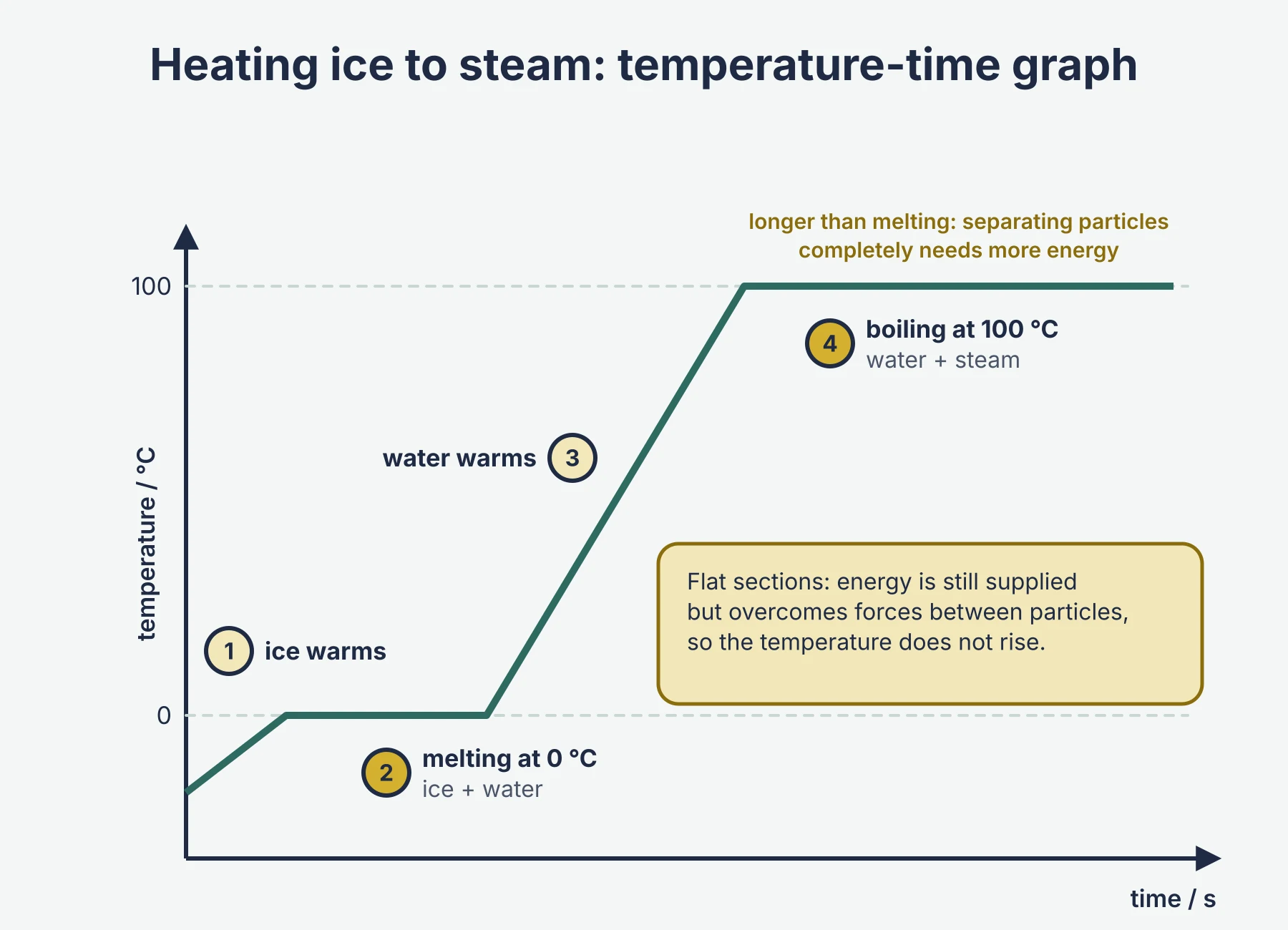
Heating ice to steam. Put crushed ice from a freezer into a beaker with a thermometer, heat it steadily, and record the temperature every 30 seconds, stirring gently. The graph shows:
- a rising line as the ice warms up to 0 °C;
- a flat section at 0 °C while the ice melts (energy is overcoming forces between particles);
- a rising line as the water warms;
- a flat section at 100 °C while the water boils.
For water heated at a steady rate, the flat section for boiling is longer than for melting, because separating the particles completely needs more energy than letting them slide past each other.
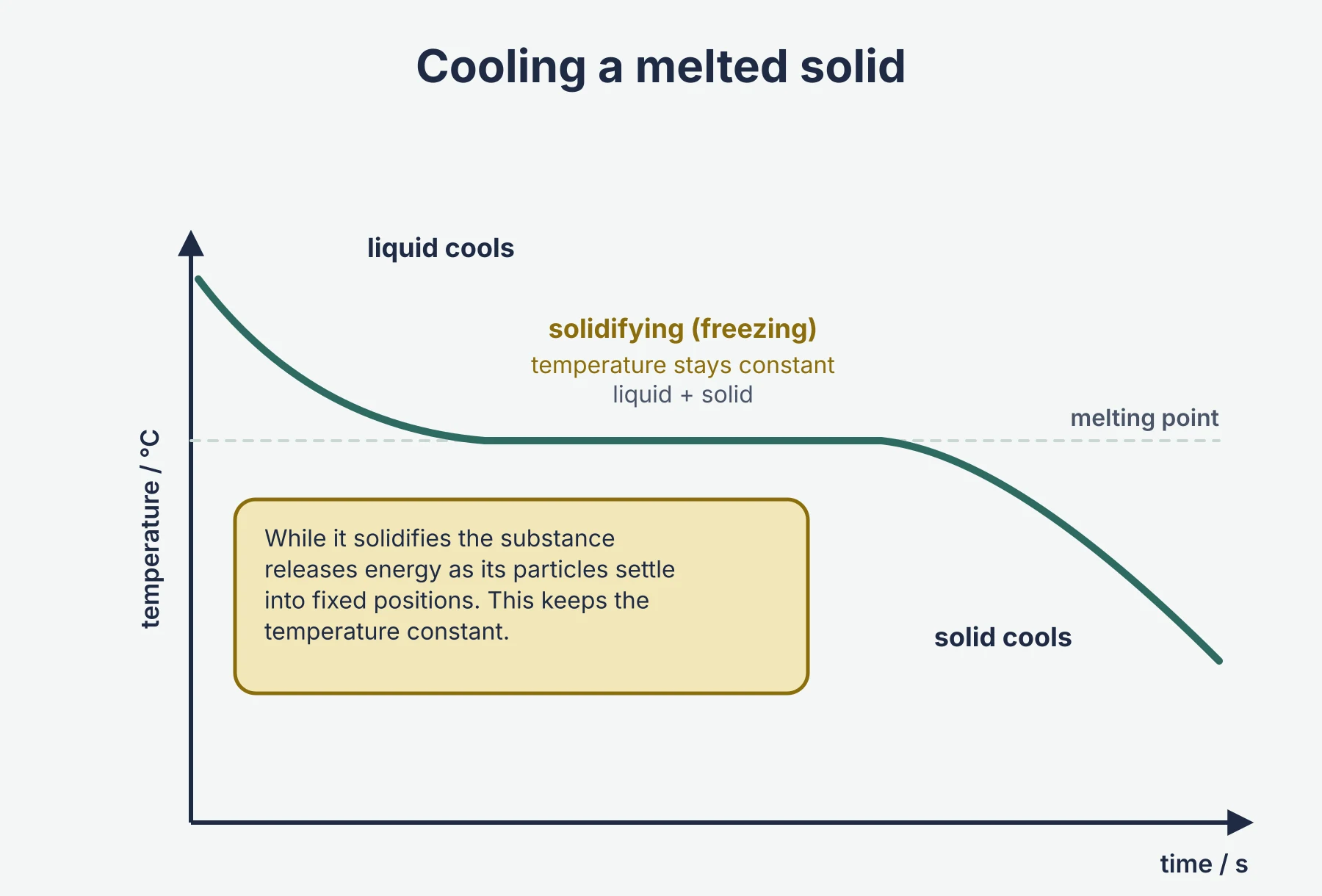
Cooling a melted solid. Alternatively, melt a solid with a melting point above room temperature in a test tube in a hot water bath, take it out, and record its temperature as it cools. The graph falls, then stays flat at the melting (freezing) point while the substance solidifies, then falls again. During the flat section the substance is releasing energy as its particles settle into fixed positions, which keeps the temperature constant.
Good practice: heat steadily, stir, take readings at regular short intervals, and read the thermometer at eye level. The flat sections are easier to spot with frequent readings.
Specific heat capacity (5.12P, 5.13P)
The specific heat capacity c of a material is the energy needed to raise the temperature of 1 kg by 1 °C.
Its unit is J/kg °C. Water has a high value (4200 J/kg °C), so it takes a lot of energy to heat and releases a lot as
it cools, which is why it is used in central heating systems and hot water bottles.
ΔQ = m × c × ΔT c = ΔQ / (m × ΔT) ΔT = ΔQ / (m × c)ΔT is a temperature change, so it can be in °C or K. This equation only applies while the temperature is
changing, not during a change of state.
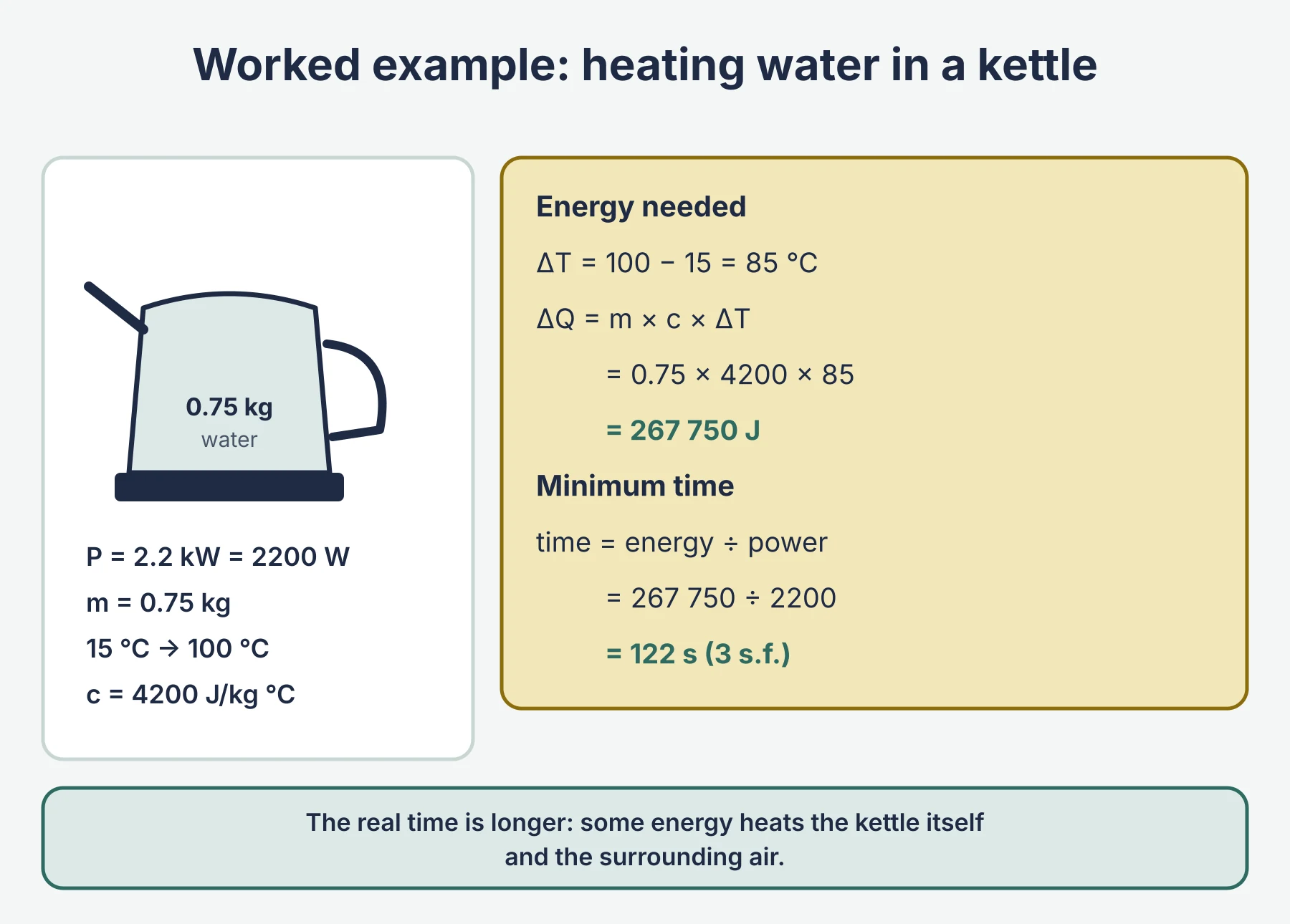
Worked example 1: a kettle. A 2.2 kW kettle heats 0.75 kg of water from 15 °C to 100 °C (c = 4200 J/kg °C). Find the energy needed and the minimum time.
ΔQ = m × c × ΔT = 0.75 × 4200 × 85 = 267 750 J
time = energy / power = 267 750 / 2200 = 122 s (3 s.f.)
The real time is longer, because some energy heats the kettle itself and the surrounding air.
The specific heat capacity practical (5.14P)
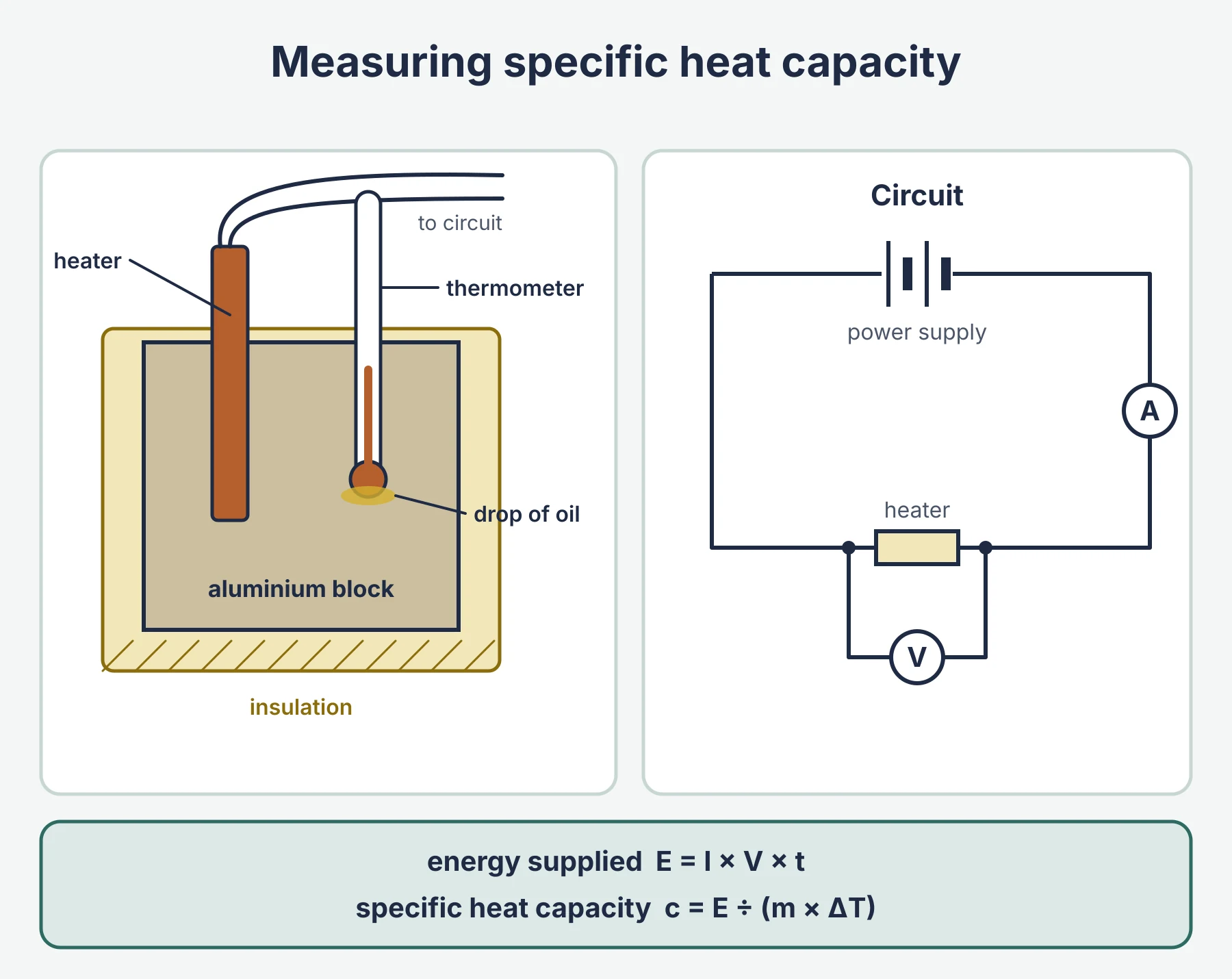
Method for a solid block (for example aluminium, with holes for a heater and a thermometer):
- Measure the mass of the block on a balance.
- Insert an electric heater and a thermometer; put a drop of oil in the thermometer hole for good thermal contact.
- Wrap the block in insulation.
- Connect the heater to a power supply with an ammeter and voltmeter (or a joulemeter). Record the starting temperature, switch on and start a stopwatch.
- After a measured time, switch off, and record the highest temperature reached.
- Energy supplied
E = I × V × t; thenc = E / (m × ΔT).
For water, heat a measured mass of water in an insulated beaker with an immersion heater, stirring so the temperature is even.
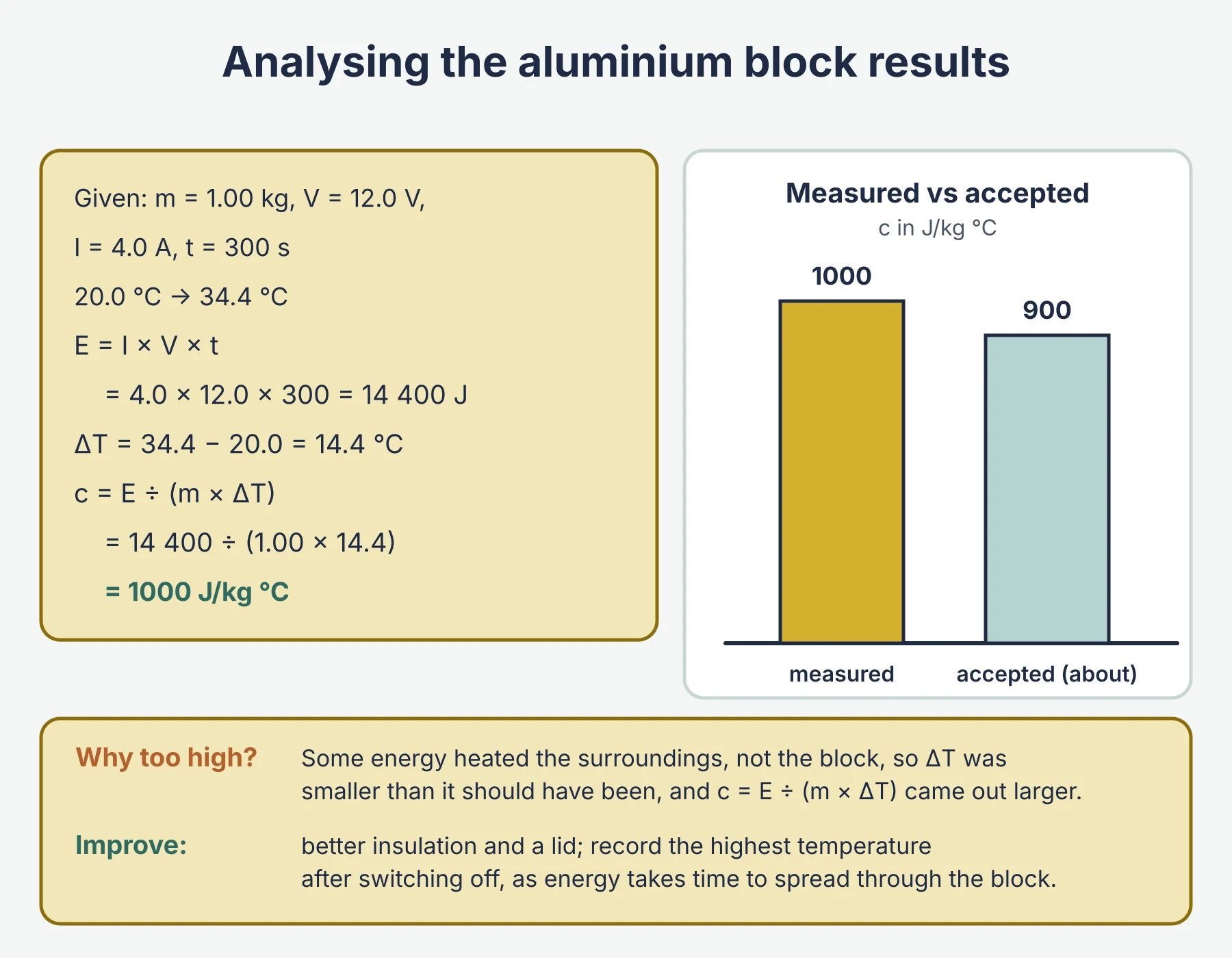
Worked example 2: analysing results. A 1.00 kg aluminium block is heated by a 12.0 V heater carrying 4.0 A for 300 s. Its temperature rises from 20.0 °C to 34.4 °C.
E = I × V × t = 4.0 × 12.0 × 300 = 14 400 J
ΔT = 34.4 − 20.0 = 14.4 °C
c = E / (m × ΔT) = 14 400 / (1.00 × 14.4) = 1000 J/kg °C
The accepted value for aluminium is about 900 J/kg °C. The measured value is too high because some of the energy supplied heated the surroundings, not the block, so the temperature rise was smaller than it should have been. Better insulation and a lid reduce this; waiting to record the highest temperature after switching off allows for the time energy takes to spread through the block.
Common mistakes
- Saying the temperature rises during melting or boiling.
- Using
ΔQ = m × c × ΔTacross a change of state. - Saying evaporation happens only at the boiling point, or that it warms the liquid.
- Explaining a flat section with “the energy is lost”. It is being used to change the arrangement of the particles.
- Forgetting to convert grams to kilograms before using c in J/kg °C.
- Saying the experimental value of c is too high “because of human error”. Name the cause: energy transferred to the surroundings.
Exam technique
- Describe a temperature-time graph: say what happens to the temperature in each section and what state the substance is in.
- Explain a flat section: energy is still being supplied, but it is used to overcome forces between particles, so the kinetic energy of the particles (and the temperature) does not increase.
- Calculate: write
ΔQ = m × c × ΔT, convert mass to kg, find the change in temperature, then substitute. - Evaluate the specific heat capacity practical: compare with the accepted value, give the direction of the error and its cause, and suggest an improvement.
Keep going
- Change of state revision notes
- Change of state practice questions
- Ideal gas molecules study guide, the next sub-topic
Written against the Pearson Edexcel International GCSE in Physics (4PH1) specification, Issue 4. Always check the current specification for your examination year.
Related resources
-
Practice questions
Pearson Edexcel International GCSE Physics (4PH1): Change of state – Practice Questions
Original 4PH1 questions on particles, evaporation, temperature-time graphs, ΔQ = mcΔT and the specific heat capacity practical, with full mark-scheme answers.
Physics · Pearson Edexcel · IGCSE
Try questions -
Revision notes
Pearson Edexcel International GCSE Physics (4PH1): Change of state – Revision Notes
Recall notes for 4PH1 sub-topic 5c: melting, evaporation and boiling, temperature-time graphs, ΔQ = mcΔT and both practicals, with a self-test.
Physics · Pearson Edexcel · IGCSE
Revise topic -
Study guides
Pearson Edexcel International GCSE Physics (4PH1): Density and pressure
Density and its practical for solids and liquids, pressure = force/area, pressure in fluids and p = hρg worked examples, for Edexcel IGCSE Physics 4PH1.
Physics · Pearson Edexcel · IGCSE
Read guide
Related articles
Get free revision emails (optional)
Occasional emails with practice questions, worked explanations and links to free resources for the qualification and subjects you choose. No spam, and you can unsubscribe from any email. The free tools on this site never need an email.