
Revision Notes
Pearson Edexcel International GCSE Physics (4PH1): Density and pressure – Revision Notes
Recall notes for 4PH1 sub-topic 5b: density, the density practical, p = F/A, fluid pressure in all directions and p = hρg, with a self-test.
- Subject
- Physics
- Level
- IGCSE
- Topic
- Solids, liquids and gases
- Author
- Marlbridge Academic Team
- Updated
- Reviewed by
- Hassan (what this means)
Aligned to Pearson Edexcel IGCSE Physics (4PH1), Issue 4. Official specification .
Syllabus page (what it covers and how it is assessed): Pearson Edexcel IGCSE Physics.
Syllabus points this page covers
4PH1
- 5b Density and pressure
Found an error? Report a correction.
Need help with this topic? Request a free trial class for IGCSE Physics (4PH1).
These notes condense sub-topic 5(b) Density and pressure (statements 5.3 to 5.7) of Pearson Edexcel International GCSE Physics 4PH1, Issue 4. Full explanations and five worked examples are in the Density and pressure study guide; exam-style questions are in the Density and pressure practice questions.
Equations (all must be recalled)
ρ = m / V            m = ρ × V            V = m / ρ
p = F / A            F = p × A            A = F / p
p = h × ρ × g        h = p / (ρ × g)      (p = pressure DIFFERENCE over vertical height h)
Units: ρ in kg/m³, m in kg, V in m³, p in Pa (N/m²), F in N, A in m², h in m, g in N/kg.
Density
- Density belongs to the material: cutting a block in half halves mass and volume, density unchanged.
- 1 g/cm³ = 1000 kg/m³. Water: 1000 kg/m³.
Density practical (5.4)
| Sample | Mass | Volume |
|---|---|---|
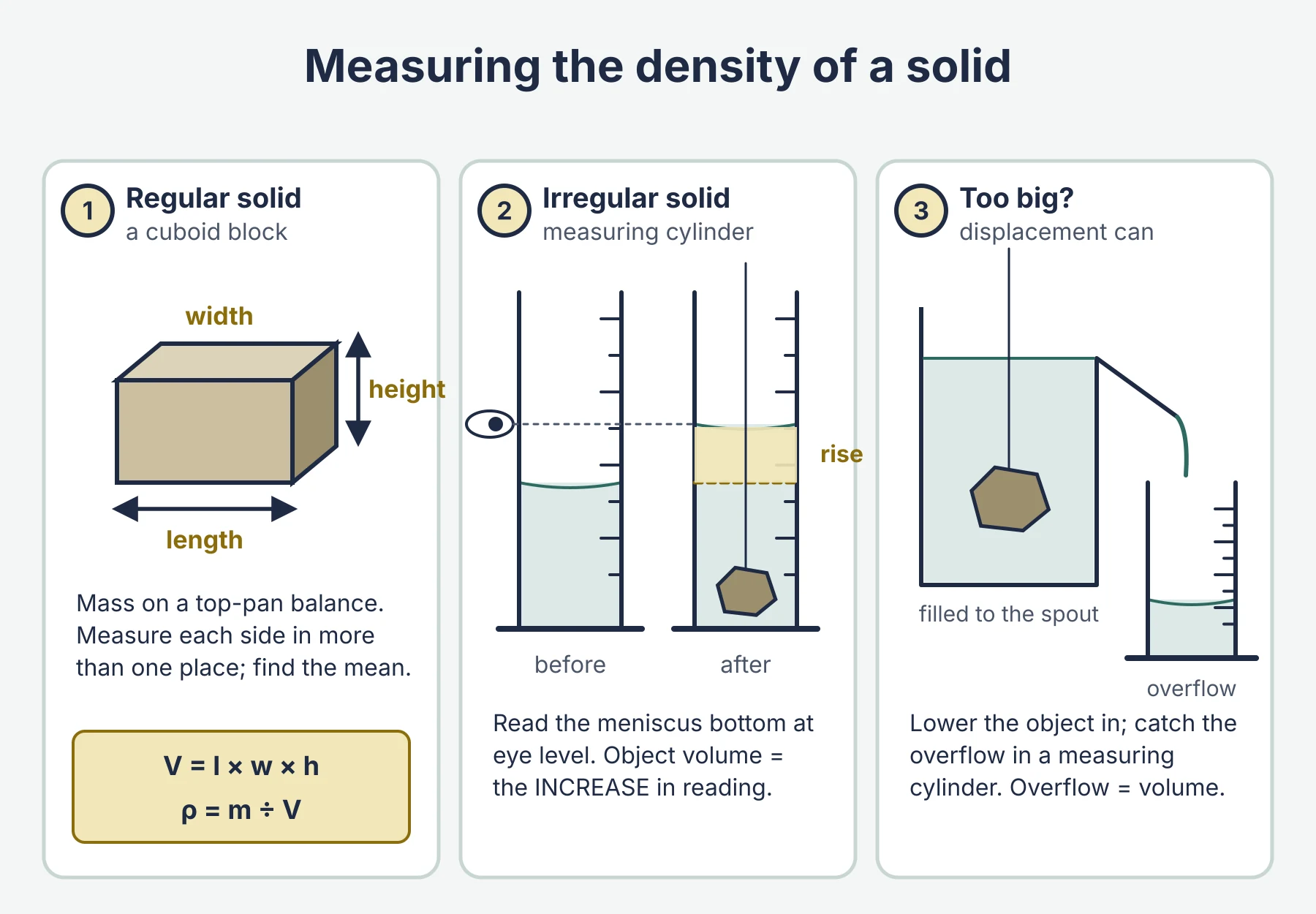
| Regular solid | Top-pan balance | Measure length, width, height (ruler); multiply |
| Irregular solid | Top-pan balance | Displacement: rise in water level in a measuring cylinder, or overflow from a displacement can into a cylinder |
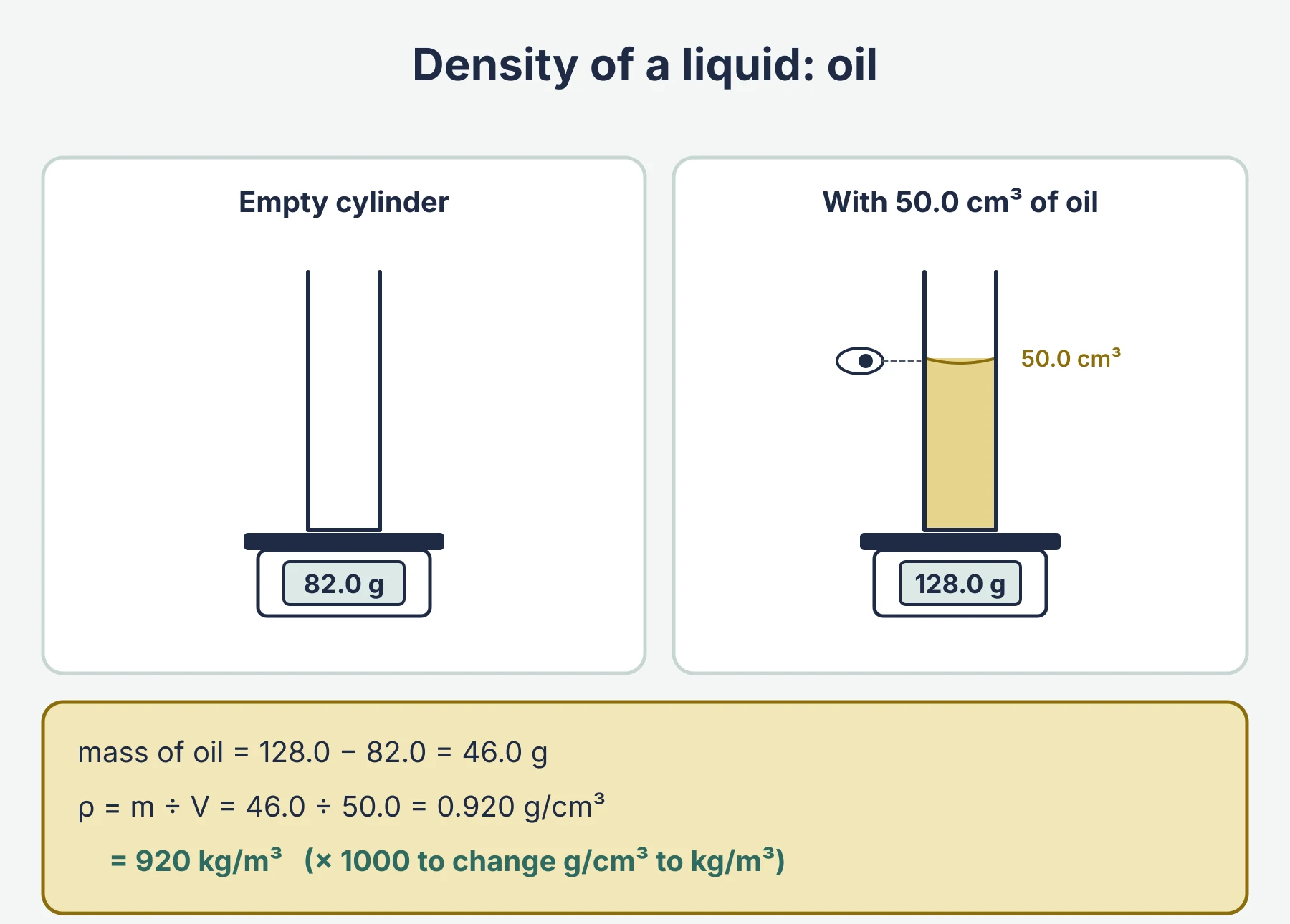
| Liquid | Balance: (cylinder + liquid) − (empty cylinder), or tare the balance | Measuring cylinder, read at the bottom of the meniscus, eye level |
Better results: larger samples; repeat and average; read the meniscus at eye level; remove air bubbles from a submerged object; measure each dimension in several places.
Pressure on surfaces
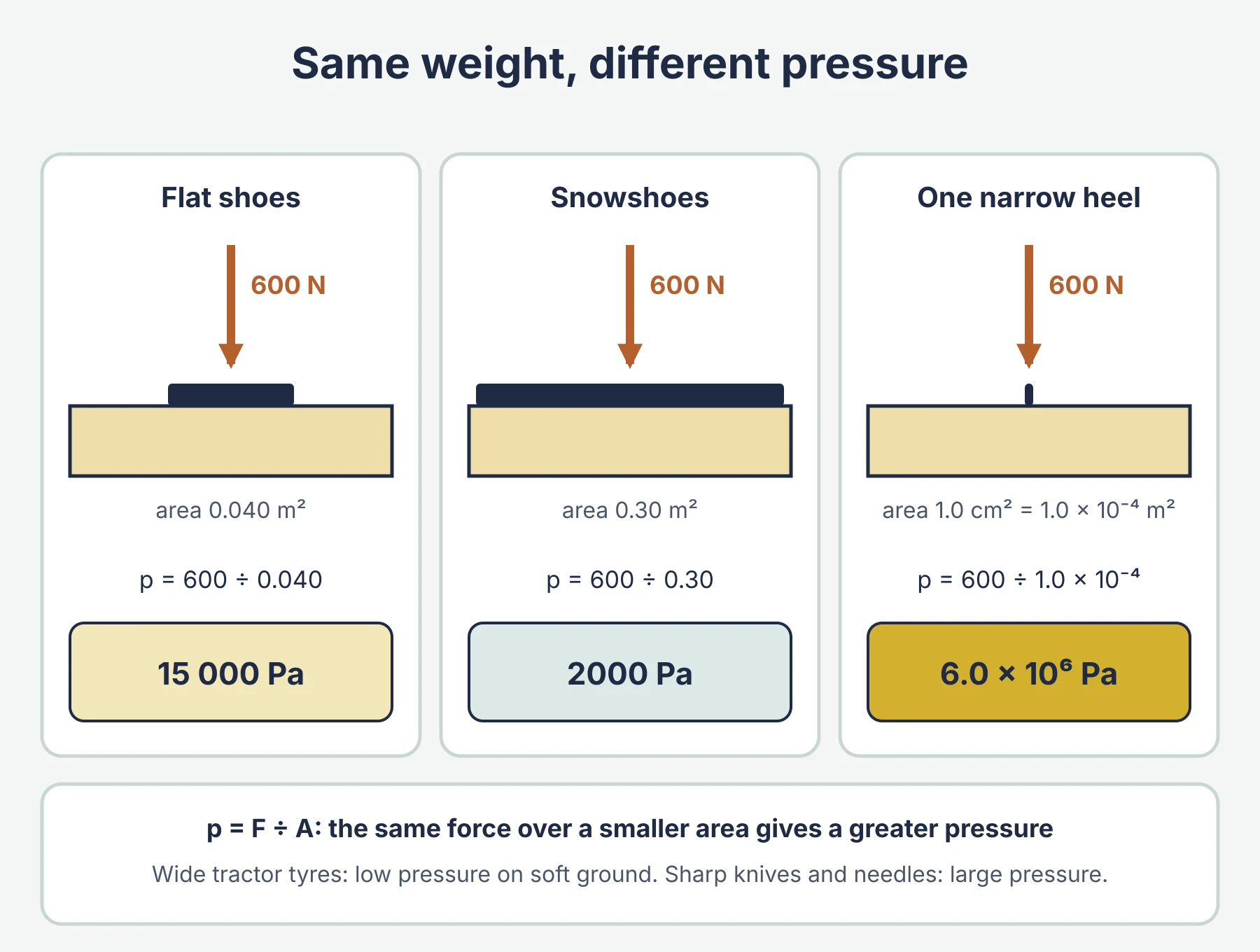
- Same force, smaller area → bigger pressure (knife edge, needle, nail point, narrow heel).
- Same force, bigger area → smaller pressure (snowshoes, tractor tyres, wide foundations, skis).
- Force must be the component at right angles to the surface; for an object resting on the floor, that is its weight.
Pressure in fluids
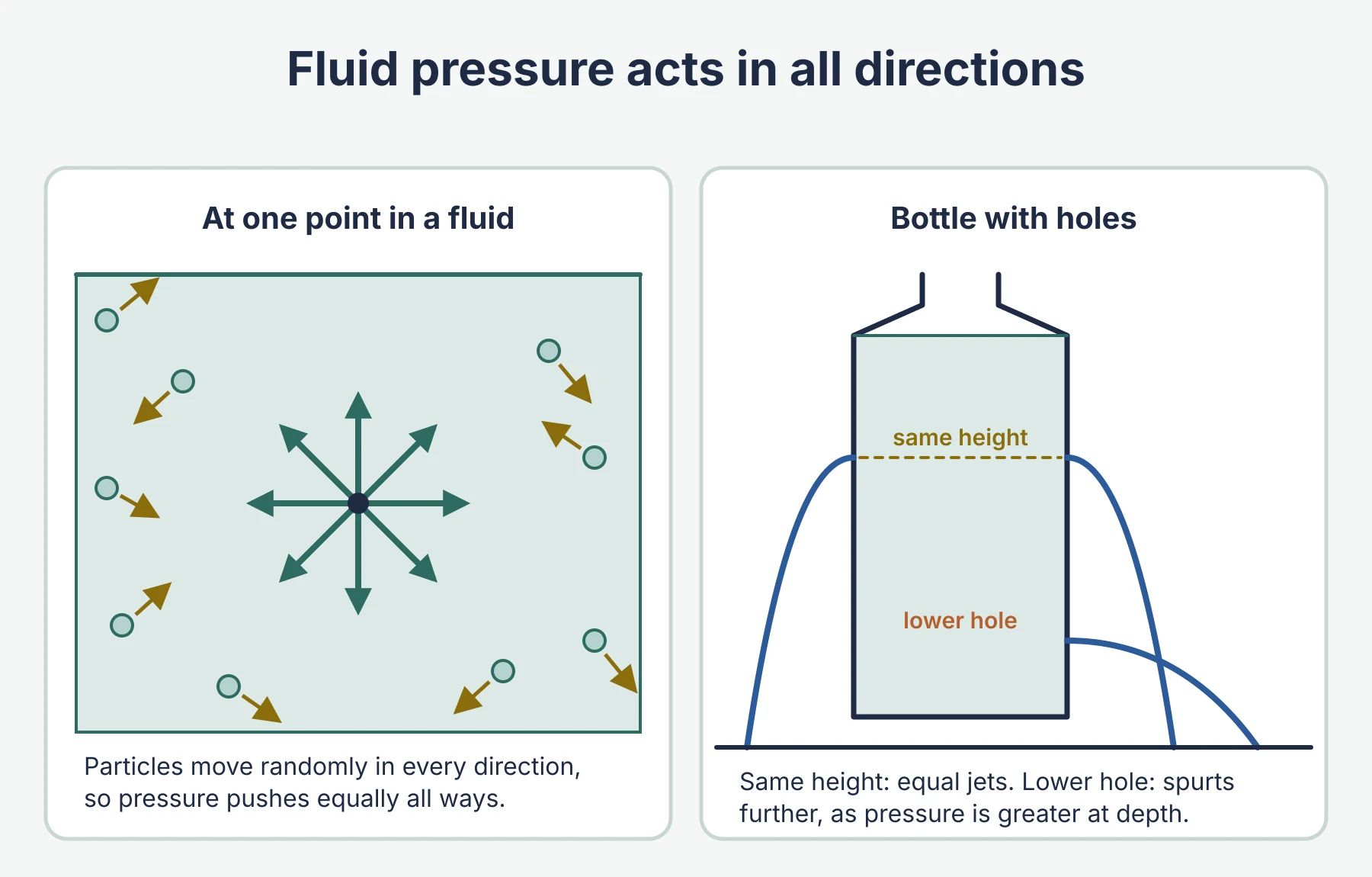
- At a point in a liquid or gas at rest, pressure acts equally in all directions (5.6), because particles move randomly and hit surfaces from every direction.
- Pressure increases with depth and with density of the fluid.
- It does not depend on the shape or width of the container.
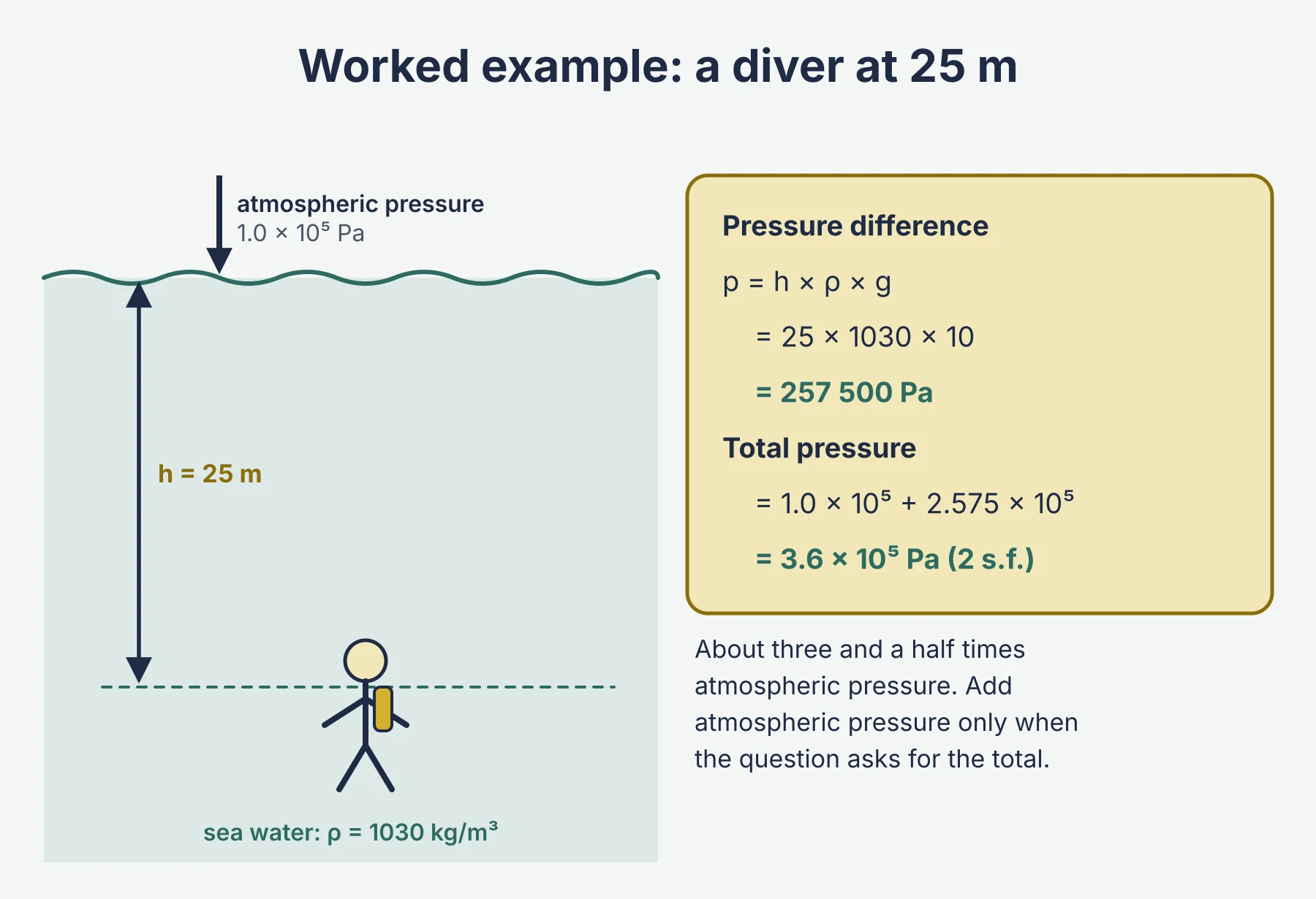
- Total pressure under a liquid = pressure at the surface (usually atmospheric) + h × ρ × g.
Evidence: holes at the same depth round a bottle spurt equally; lower holes spurt further.
Two-step pattern
step 1:  p = h × ρ × g        (pressure from depth)
step 2:  F = p × A            (force on a window, hatch or wall)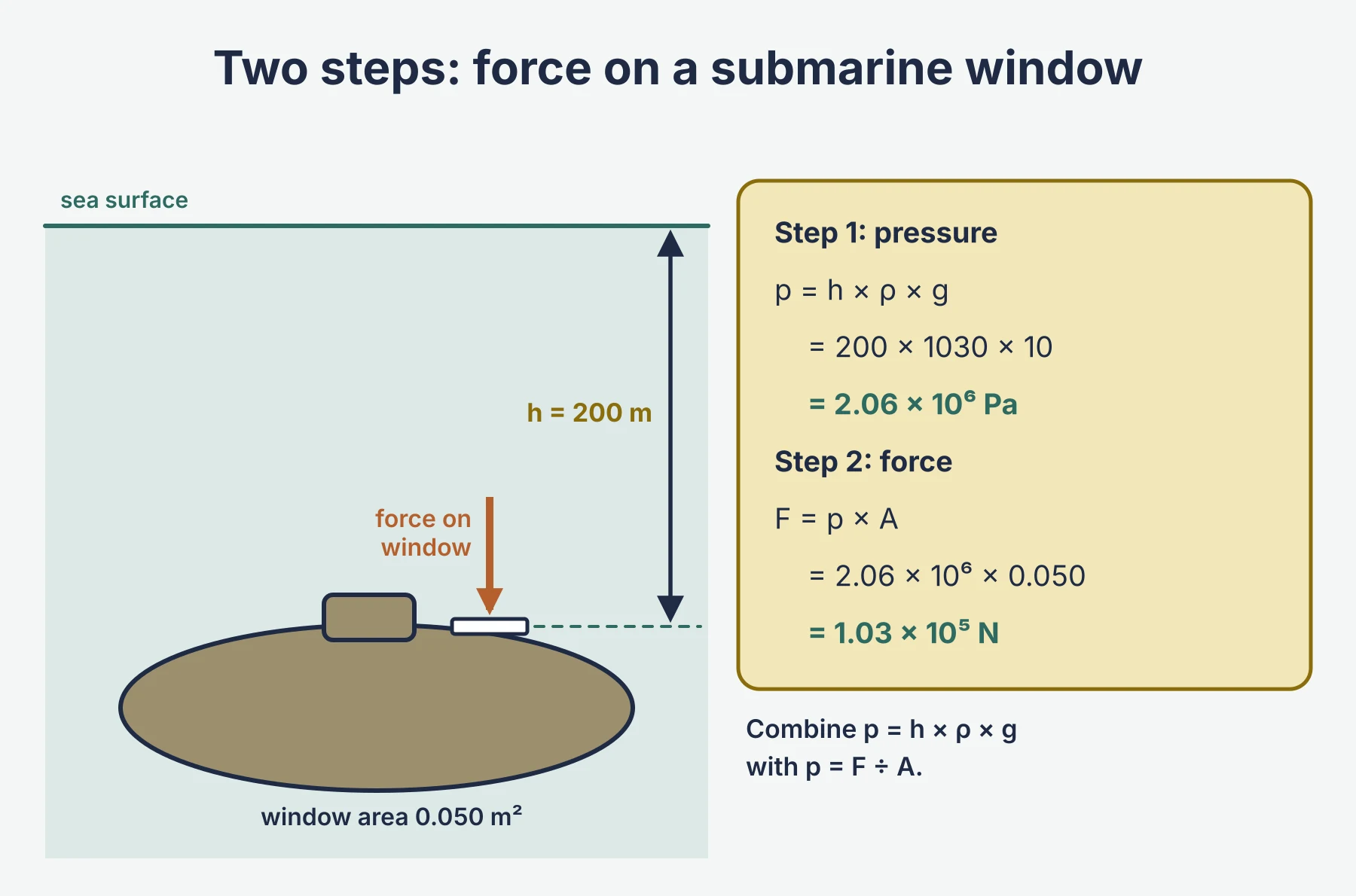
Key terms
| Term | Meaning |
|---|---|
| Density | Mass per unit volume of a material, ρ = m/V |
| Pressure | Force acting at right angles to a surface, per unit area, p = F/A |
| Pascal (Pa) | Unit of pressure; 1 Pa = 1 N/m² |
| Pressure difference | Difference in pressure between two points in a fluid, h × ρ × g |
| Displacement | Using the rise in water level to find the volume of an object put into it |
| Meniscus | Curved liquid surface in a cylinder; read the bottom of it at eye level |
| Fluid | A liquid or a gas: a substance that can flow |
Exam traps
- cm² not converted: 1 cm² = 1 × 10⁻⁴ m².
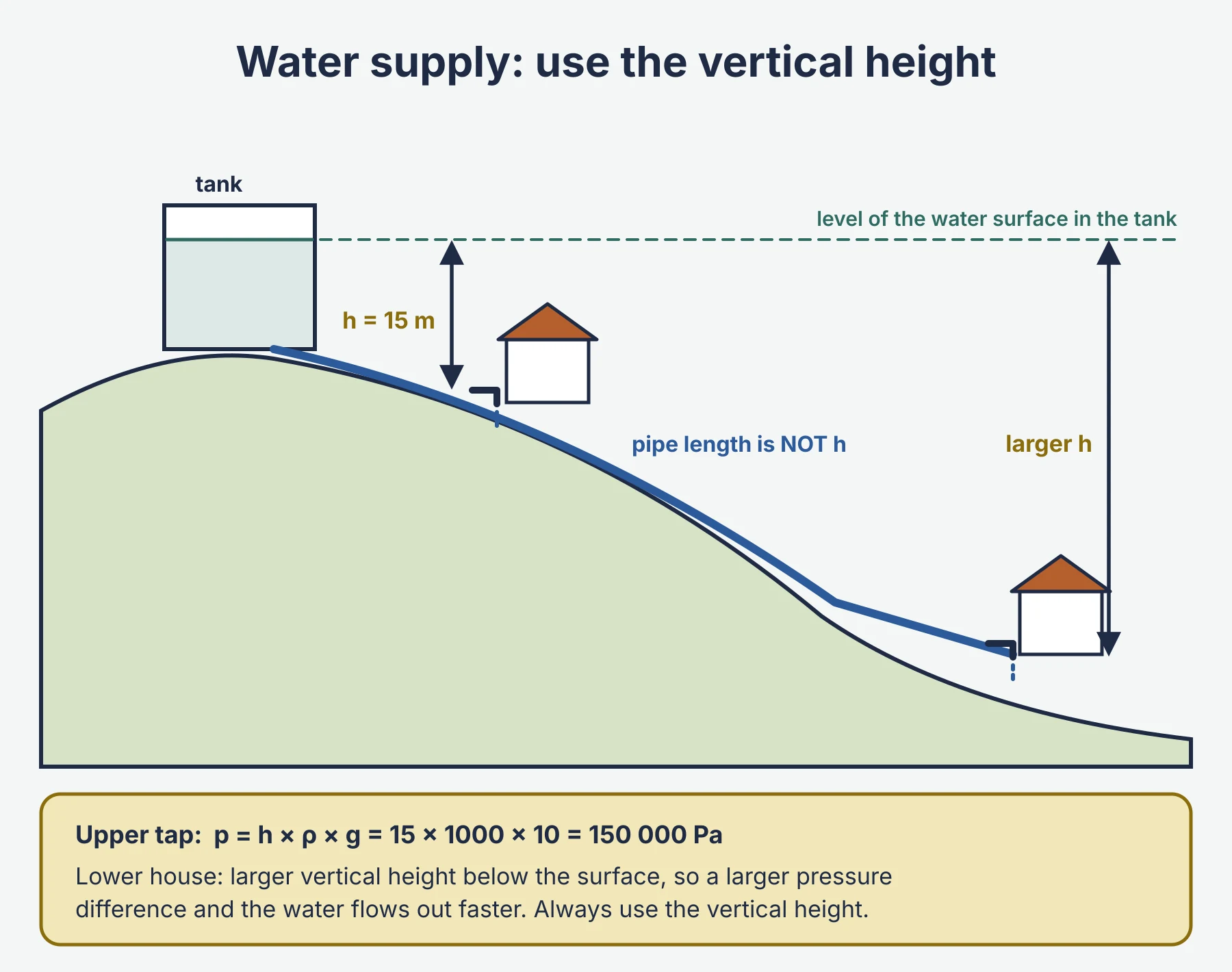
- Using total depth from the bottom of a tank instead of depth below the surface.
- Using a slanted length rather than the vertical height in h × ρ × g.
- Adding atmospheric pressure when the question asks for the pressure “due to the water” alone, or leaving it out when it asks for the total.
- Saying liquid pressure acts only downwards.
- Using the final cylinder reading, not the rise, as the volume of a stone.
- Forgetting to subtract the container’s mass from a liquid’s mass.
Self-test
Take g = 10 N/kg.
- A 0.60 kg object has a volume of 2.4 × 10⁻⁴ m³. Calculate its density.
- Calculate the mass of 0.50 m³ of water.
- Iron has a density of 7800 kg/m³. Calculate the volume of a 3.9 kg iron block.
- Describe how to measure the volume of a small irregular stone.
- Calculate the pressure when a 900 N force acts on 0.030 m².
- What area is needed to keep the pressure from a 1200 N load down to 4000 Pa?
- Calculate the pressure difference between the surface and a depth of 12 m in water.
- Atmospheric pressure is 100 kPa. Calculate the total pressure at 12 m depth in water.
- Why does water spurt further from a hole near the bottom of a bottle than from one near the top?
- In which directions does pressure act at a point in a liquid at rest?
- At what depth in an oil of density 850 kg/m³ is the pressure difference 17 000 Pa?
- Explain why camels’ wide feet help them to walk on soft sand.
Answers: 1. ρ = 0.60 ÷ 2.4 × 10⁻⁴ = 2500 kg/m³. 2. m = 1000 × 0.50 = 500 kg. 3. V = 3.9 ÷ 7800 = 5.0 × 10⁻⁴ m³. 4. Part-fill a measuring cylinder with water and record the volume; lower the stone in so it is fully under water; record the new volume; the stone’s volume is the difference. 5. p = 900 ÷ 0.030 = 30 000 Pa. 6. A = 1200 ÷ 4000 = 0.30 m². 7. p = 12 × 1000 × 10 = 120 000 Pa. 8. 100 + 120 = 220 kPa. 9. The pressure is greater at greater depth, because there is more water above pushing down. 10. Equally in all directions. 11. h = 17 000 ÷ (850 × 10) = 2.0 m. 12. A wide foot spreads the camel’s weight over a large area, so the pressure on the sand is smaller and the feet do not sink in as far.
Related resources
-
Study guides
Pearson Edexcel International GCSE Physics (4PH1): Ideal gas molecules
Gas pressure from molecular collisions, absolute zero, the Kelvin scale and the two gas laws with worked examples, for Edexcel IGCSE Physics 4PH1, 5d.
Physics · Pearson Edexcel · IGCSE
Read guide -
Practice questions
Pearson Edexcel International GCSE Physics (4PH1): Ideal gas molecules – Practice Questions
Original 4PH1 questions on gas pressure, absolute zero from data, Kelvin conversions, molecular energy and both gas laws, with full answers.
Physics · Pearson Edexcel · IGCSE
Try questions -
Revision notes
Pearson Edexcel International GCSE Physics (4PH1): Ideal gas molecules – Revision Notes
Recall notes for 4PH1 sub-topic 5d: gas pressure, absolute zero, Kelvin conversions, molecular kinetic energy, both gas laws and a self-test.
Physics · Pearson Edexcel · IGCSE
Revise topic
Related articles
Get free revision emails (optional)
Occasional emails with practice questions, worked explanations and links to free resources for the qualification and subjects you choose. No spam, and you can unsubscribe from any email. The free tools on this site never need an email.