
Revision Notes
Pearson Edexcel International GCSE Physics (4PH1): Electromagnetic induction – Revision Notes
Recall notes for Edexcel 4PH1 sub-topic 6d: induced voltage, generators, transformers, turns ratio, VpIp = VsIs and transmission, with a self-test.
- Subject
- Physics
- Level
- IGCSE
- Topic
- Magnetism and electromagnetism
- Author
- Marlbridge Academic Team
- Updated
- Reviewed by
- Hassan (what this means)
Aligned to Pearson Edexcel IGCSE Physics (4PH1), Issue 4. Official specification .
Syllabus page (what it covers and how it is assessed): Pearson Edexcel IGCSE Physics.
Syllabus points this page covers
4PH1
- 6d Electromagnetic induction
Found an error? Report a correction.
Need help with this topic? Request a free trial class for IGCSE Physics (4PH1).
Condensed notes for sub-topic 6(d) Electromagnetic induction (statements 6.15 to 6.20) of Pearson Edexcel International GCSE Physics (4PH1). Transformer content (6.17P to 6.20P) is Physics-only and assessed on Paper 2P. Full explanations are in the Electromagnetic induction study guide.
When is a voltage induced?
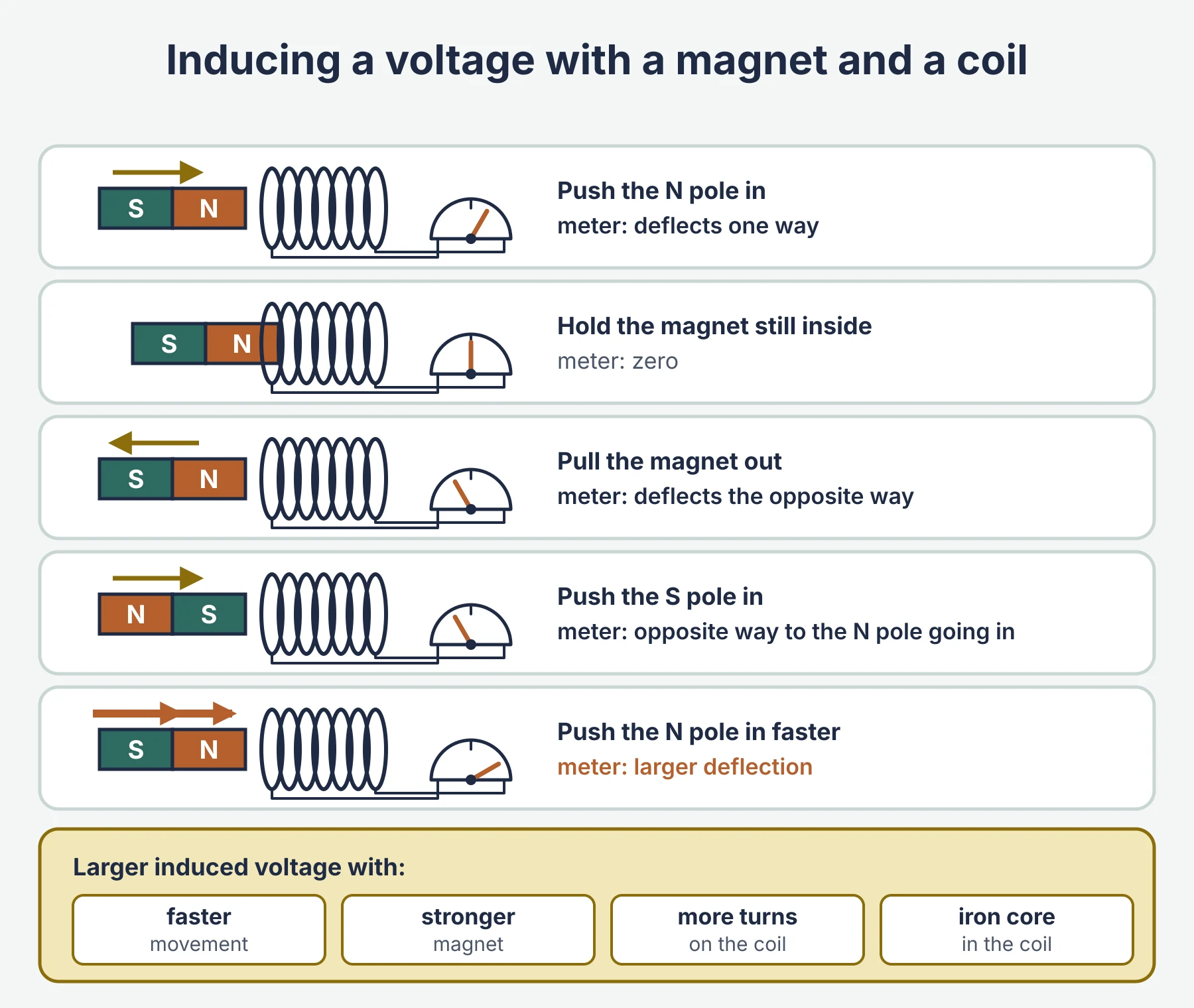
- When a conductor moves through a magnetic field (cuts field lines).
- When the magnetic field through a coil changes.
- Complete circuit → induced current flows.
- No relative movement, no change → no induced voltage.
Size increases with: faster movement; stronger magnet; more turns on the coil; iron core in the coil.
Direction reverses when: the motion reverses; the magnet’s pole is swapped.
Generators
| Type | What moves | Output |
|---|---|---|
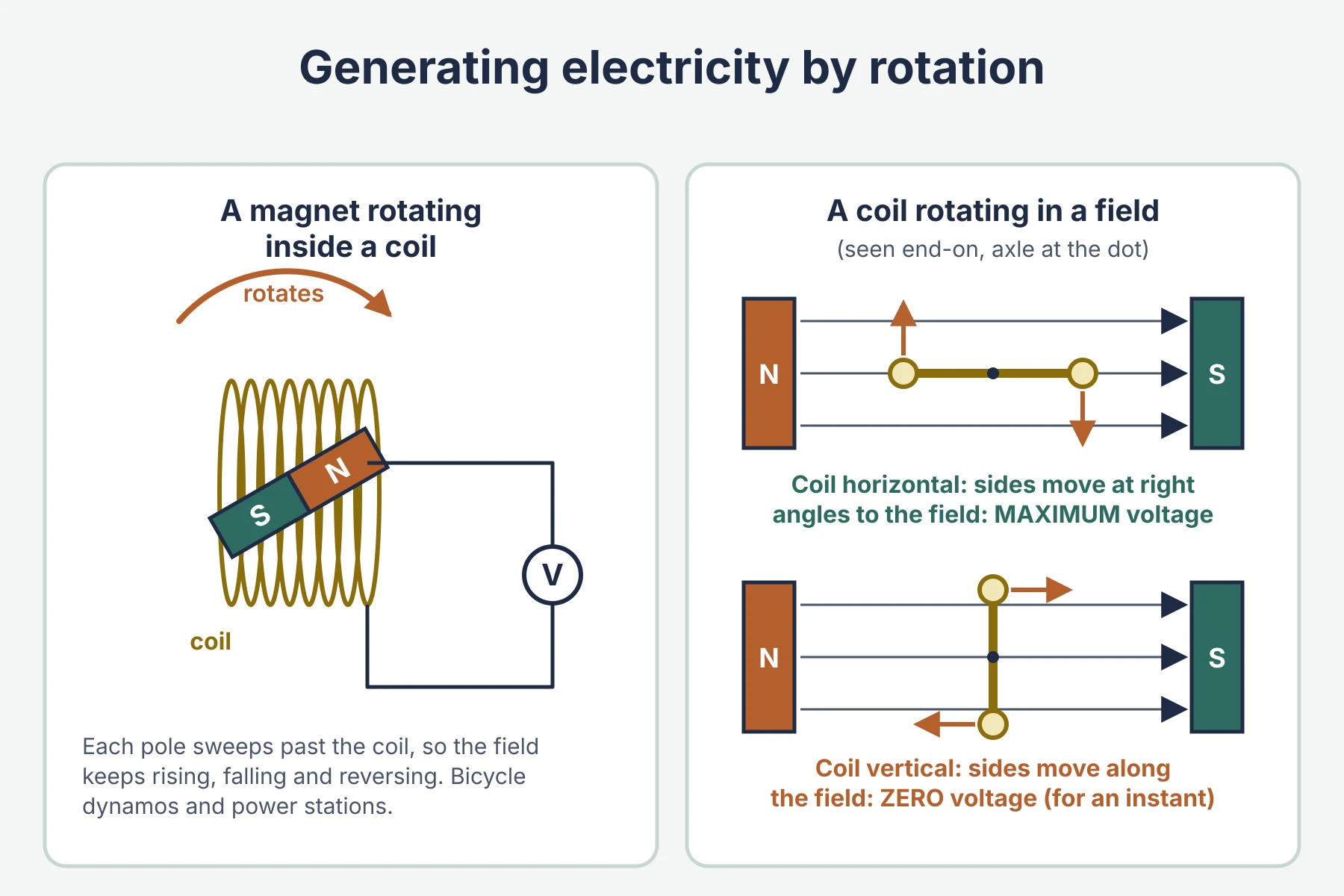
| Magnet in a coil | Magnet rotates; poles sweep past the coil | a.c. |
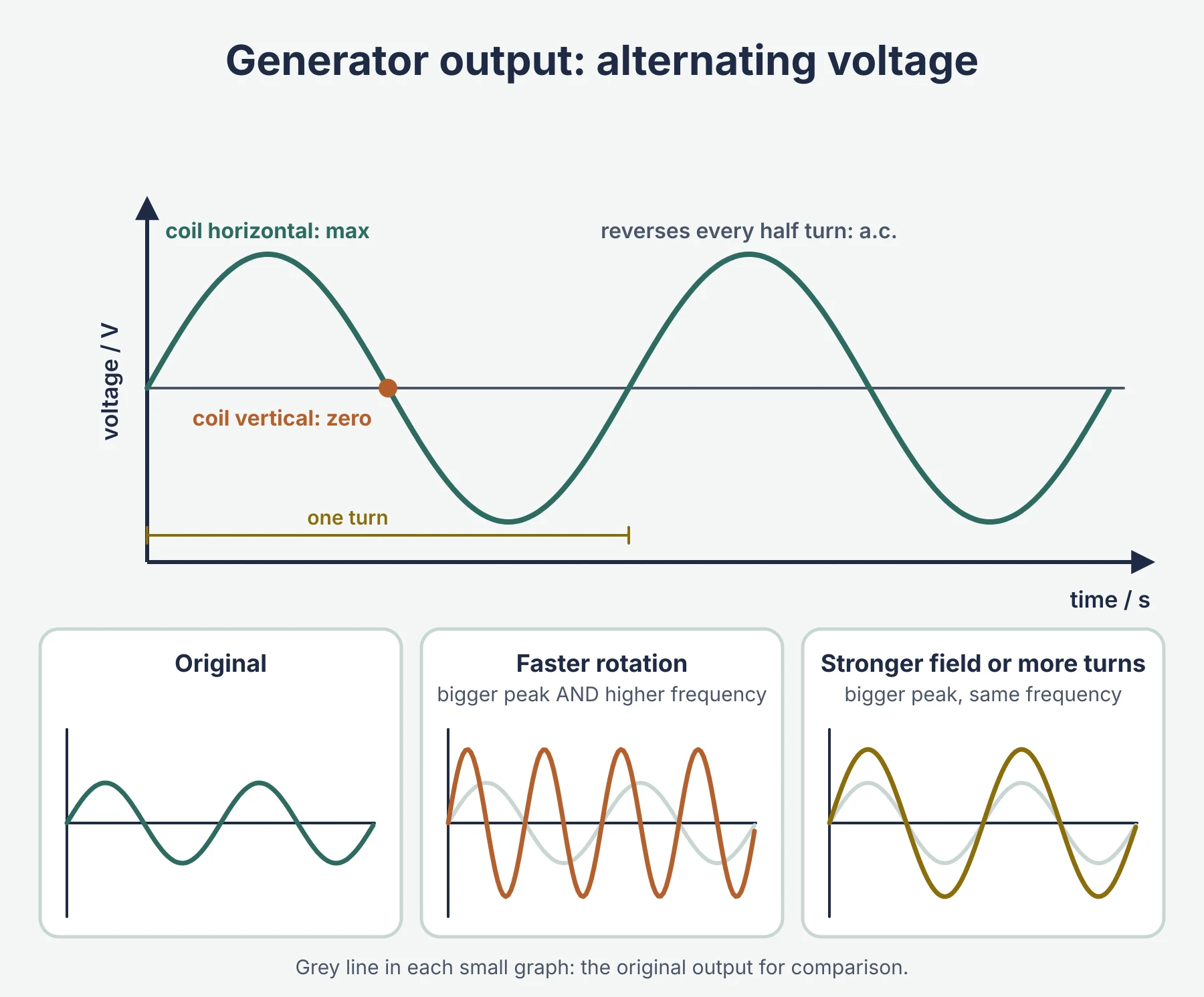
| Coil in a field | Coil rotates between magnet poles | a.c. (reverses every half turn) |
- Voltage is maximum when the coil’s sides cut across the field at right angles; zero at the instant they move along it.
- Faster rotation → larger peak voltage and higher frequency.
- Stronger field or more turns → larger peak voltage, same frequency.
Transformers (P)
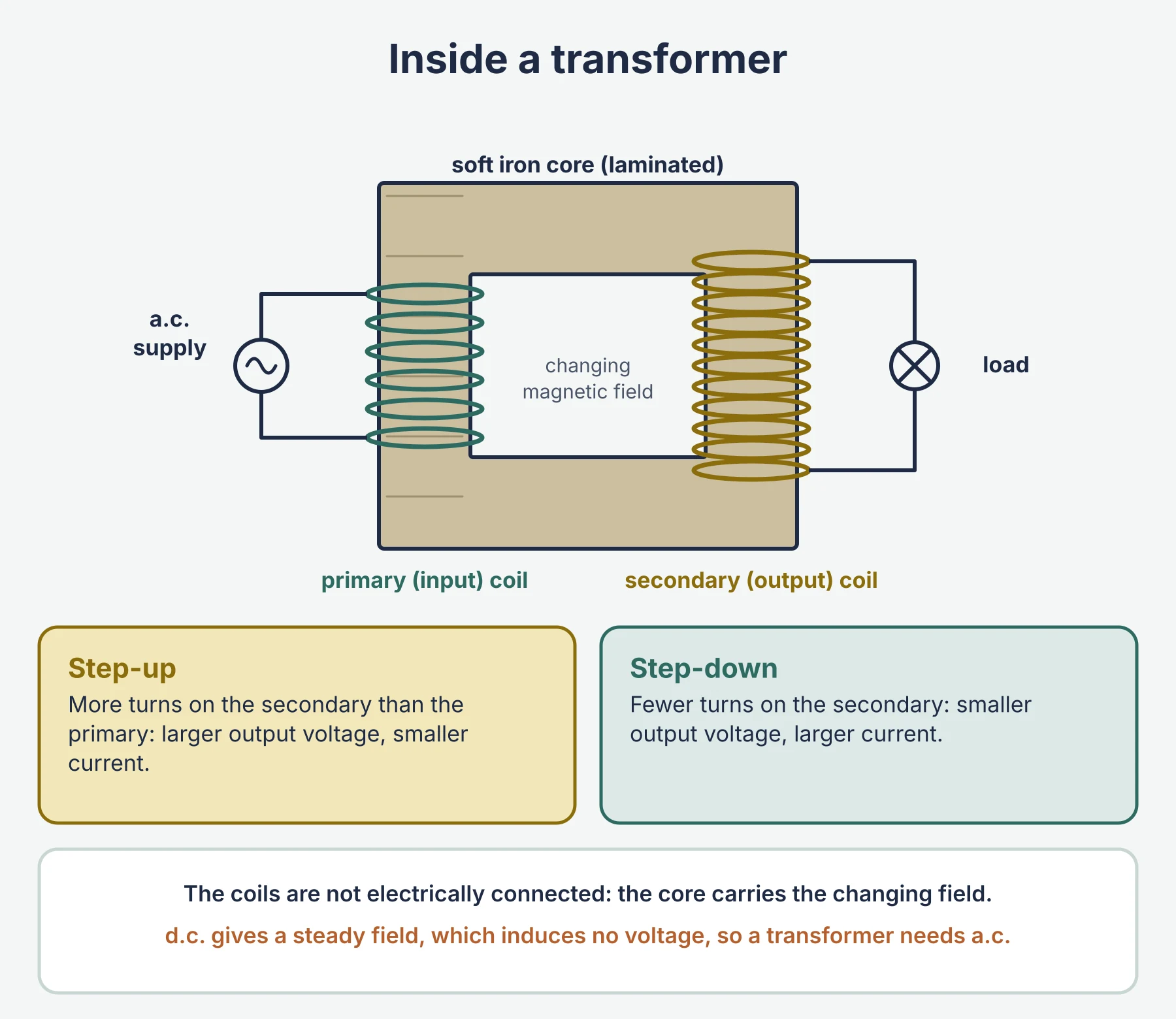
Structure: primary coil (to a.c. supply) + secondary coil (to load) + soft iron core.
How it works:
- a.c. in the primary coil
- → changing magnetic field in the iron core
- → changing field through the secondary coil
- → alternating voltage induced in the secondary
- d.c. will not work: a steady field induces nothing.
- Step-up: Ns > Np, so Vs > Vp. Step-down: Ns < Np, so Vs < Vp.
Equations (both must be recalled):
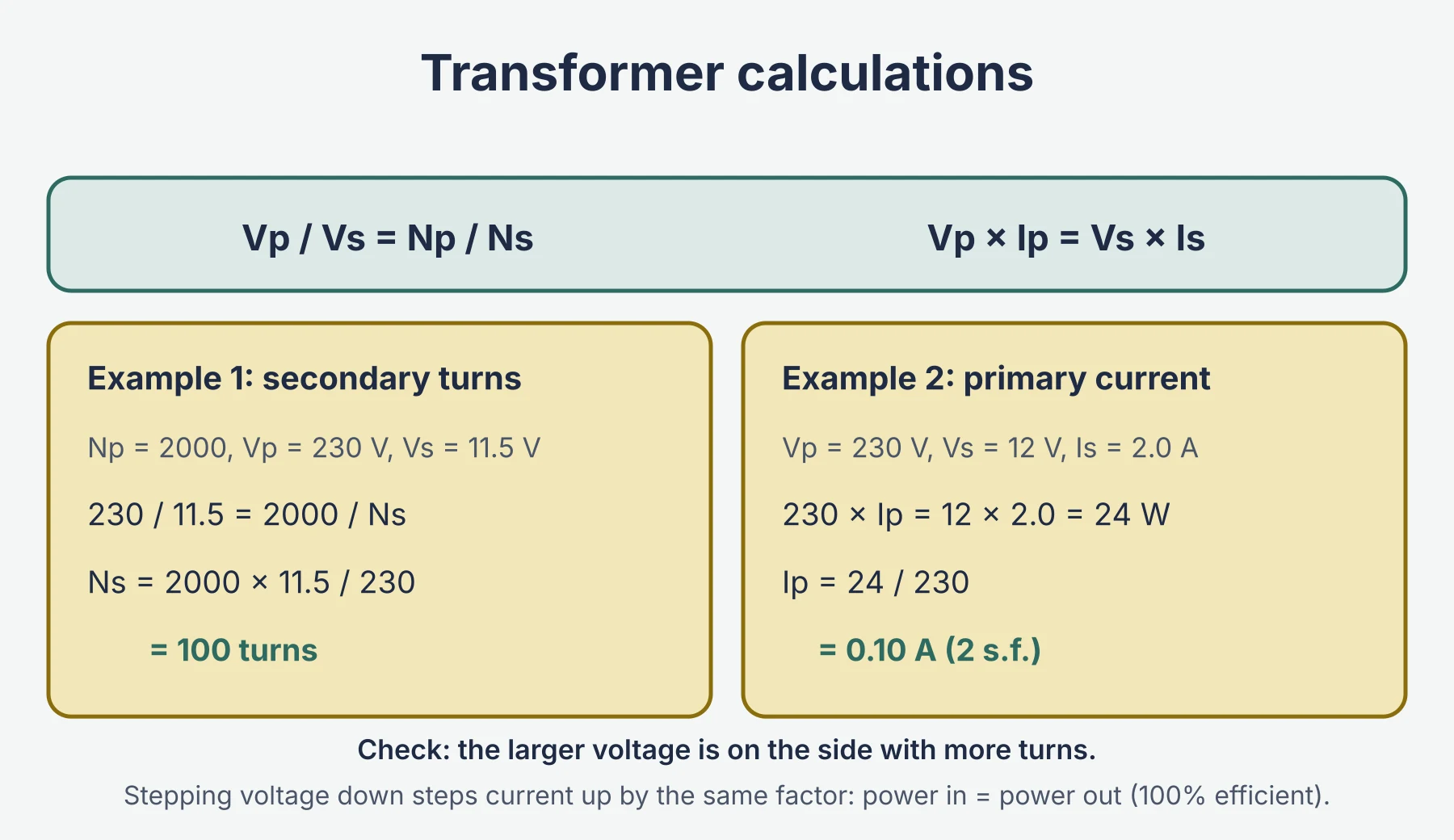
Vp / Vs = Np / Ns
Vp × Ip = Vs × Is      (100% efficient)
Voltage up by a factor → current down by the same factor.
Transmission (P)
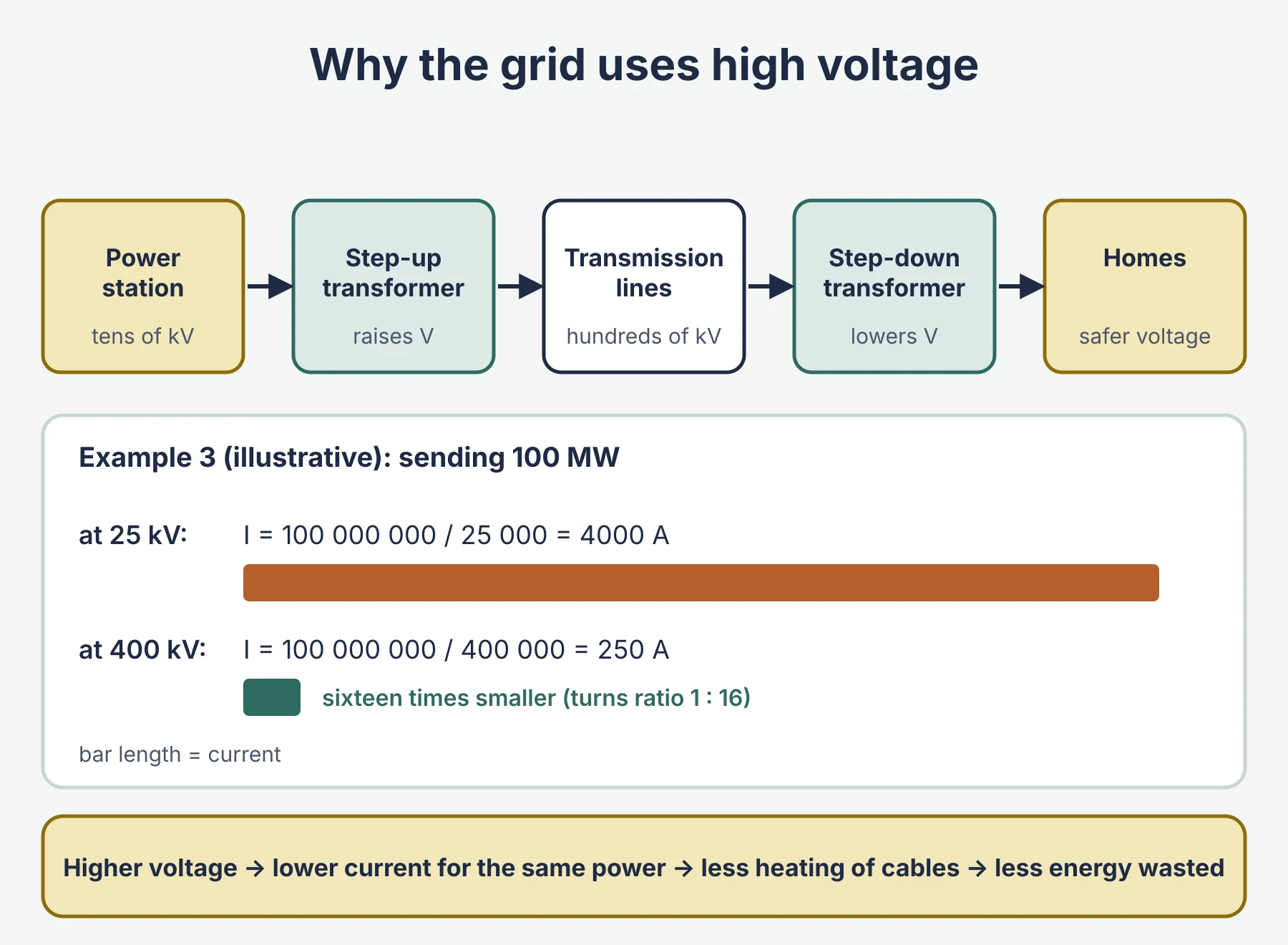
- Step-up transformer at the power station → very high voltage in the cables.
- Same power (P = V × I) at higher voltage → lower current.
- Lower current → less heating of the cables → less energy wasted.
- Step-down transformers near users → safer voltage for homes.
Quick calculation pattern
Illustrative figures. A transformer has 500 primary turns, 25 secondary turns and a 240 V primary.
- Vs = 240 × 25 / 500 = 12 V (step-down by a factor of 20).
- If Is = 3.0 A and it is 100% efficient: Ip = (12 × 3.0) / 240 = 0.15 A.
Key terms
| Term | Meaning |
|---|---|
| Electromagnetic induction | Producing a voltage by relative movement of a conductor and a field, or by a changing field |
| Induced voltage | The voltage produced by electromagnetic induction |
| Generator | Device that rotates a magnet or coil to induce an alternating voltage |
| Primary coil | Input coil of a transformer, connected to the a.c. supply |
| Secondary coil | Output coil of a transformer, connected to the load |
| Turns ratio | Np : Ns, equal to Vp : Vs |
| Step-up transformer | More secondary turns; raises voltage, lowers current |
| Step-down transformer | Fewer secondary turns; lowers voltage, raises current |
Exam traps
- “A magnet inside a coil induces a voltage”: only if it moves or the field changes.
- Upside-down ratios: the side with more turns always has the larger voltage.
- Step-up does not increase power; it trades current for voltage.
- High-voltage transmission lowers current, not resistance.
- Missing the iron core, or saying the coils are wired together.
- Answering “rotate faster” without also noting the frequency rises, when the question asks about the output trace.
Self-test
- State two ways of inducing a voltage in a coil.
- A magnet rests inside a coil connected to a meter. What does the meter read? Why?
- Give three ways of increasing the voltage induced when a magnet is pushed into a coil.
- Why is the output of a simple generator alternating?
- A generator’s coil is rotated twice as fast. Describe two changes to the output.
- Name the three parts of a transformer.
- Explain why a transformer will not work from a battery.
- A transformer has 1200 primary turns and 60 secondary turns. The primary voltage is 230 V. Calculate the secondary voltage.
- Is the transformer in question 8 step-up or step-down?
- A 100% efficient transformer has Vp = 11 000 V, Vs = 230 V, Is = 50 A. Calculate Ip.
- Explain why electricity is transmitted at high voltage.
- Why are step-down transformers needed before electricity reaches homes?
Answers
- Move a magnet into or out of the coil (relative movement); change the magnetic field through the coil (for example, switch a nearby electromagnet on or off).
- Zero: the field through the coil is not changing, so no voltage is induced.
- Push it in faster; use a stronger magnet; use a coil with more turns.
- Each side of the coil (or each pole of the magnet) moves first one way through the field and then the other, so the induced voltage keeps reversing.
- The peak voltage increases; the frequency doubles.
- Primary coil, secondary coil, soft iron core.
- A battery gives d.c., which produces a steady magnetic field; a steady field induces no voltage in the secondary.
- Vs = 230 × 60 / 1200 = 11.5 V.
- Step-down (fewer secondary turns).
- Ip = (230 × 50) / 11 000 = 1.05 A, so about 1.0 A.
- For a given power, a higher voltage means a lower current; a lower current heats the cables less, so less energy is wasted.
- The transmission voltage is far too high to be used safely in homes, so it is reduced to a safer value.
Frequently asked questions
Is the generator content Physics-only in 4PH1? No. Statements 6.15 and 6.16, on induced voltage and generators, are core. Only the transformer statements, 6.17P to 6.20P, carry a “P” reference.
Do I need to know about laminated cores? The specification asks for the structure of a transformer, which is two coils on an iron core. Laminations are useful background but are not named in the statements.
Next, try the Electromagnetic induction practice questions.
Related resources
-
Study guides
Pearson Edexcel International GCSE Physics (4PH1): Electromagnetism
Fields around currents, electromagnets, the motor effect, the left-hand rule, d.c. motors and loudspeakers for Edexcel IGCSE Physics 4PH1 sub-topic 6c.
Physics · Pearson Edexcel · IGCSE
Read guide -
Practice questions
Pearson Edexcel International GCSE Physics (4PH1): Electromagnetism – Practice Questions
Original questions with full answers on field patterns, electromagnets, the left-hand rule, moving charges, motors and loudspeakers for Edexcel 4PH1 6c.
Physics · Pearson Edexcel · IGCSE
Try questions -
Revision notes
Pearson Edexcel International GCSE Physics (4PH1): Electromagnetism – Revision Notes
Quick recall for Edexcel 4PH1 sub-topic 6c: field patterns, electromagnets, force on moving charges, the left-hand rule, motors and loudspeakers.
Physics · Pearson Edexcel · IGCSE
Revise topic
Related articles
Get free revision emails (optional)
Occasional emails with practice questions, worked explanations and links to free resources for the qualification and subjects you choose. No spam, and you can unsubscribe from any email. The free tools on this site never need an email.