
Study Guides
IB DP Business Management: The seven Ps of the marketing mix
Study guide to section 4.5 of IB DP Business Management: product, price, promotion, place, people, processes, physical evidence and marketing mixes.
- Subject
- Business
- Level
- IB
- Topic
- Unit 4: Marketing
- Author
- Marlbridge Academic Team
- Updated
- Reviewed by
- Salman Ahmad (what this means)
Aligned to International Baccalaureate IB Diploma Programme Business (DP Business Management), First assessment 2024. Official specification .
Syllabus page (what it covers and how it is assessed): IB Diploma Programme Business.
Syllabus points this page covers
DP Business Management
- 4.5 The seven Ps of the marketing mix
Found an error? Report a correction.
Need help with this topic? Request a free trial class for IB Diploma Programme Business (DP Business Management).
This guide teaches section 4.5, The seven Ps of the marketing mix, from the IB Business management guide, first assessment 2024. It applies to SL and HL. Items that the guide marks as HL only are labelled the same way here: dynamic pricing, competitive pricing, contribution pricing and price elasticity of demand. The wider unit is covered in the Unit 4 study guide, and you can check your starting point with the free diagnostics.
Use this page with the revision notes and the practice questions. The course hub is at IB DP Business Management and the printable list is the syllabus checklist. The examples here are invented businesses with figures checked by calculation.
What 4.5 asks you to do
| Element | What you must be able to do | Level |
|---|---|---|
| Product | Link the product life cycle, product portfolio and marketing mix; evaluate extension strategies; link the life cycle to investment, profit and cash flow; explain branding (awareness, development, loyalty, value) and why it matters | SL and HL |
| Price | Judge how appropriate cost-plus (mark-up), penetration, loss leader, predatory and premium pricing are | SL and HL |
| Price | Judge dynamic, competitive and contribution pricing; use price elasticity of demand | HL only |
| Promotion | Explain above the line, below the line and through the line promotion; evaluate social media marketing | SL and HL |
| Place | Evaluate different types of distribution channels | SL and HL |
| People, Processes, Physical evidence | Evaluate each for a service, including cultural variation in employee-customer relationships and changes in delivery processes | SL and HL |
| Appropriate marketing mixes | Judge which mix suits a particular product or business | SL and HL |
The guide pairs most of these with the skill “evaluate” (AO3), so reasoned judgement matters more than description.
Product
Product life cycle, portfolio and the mix
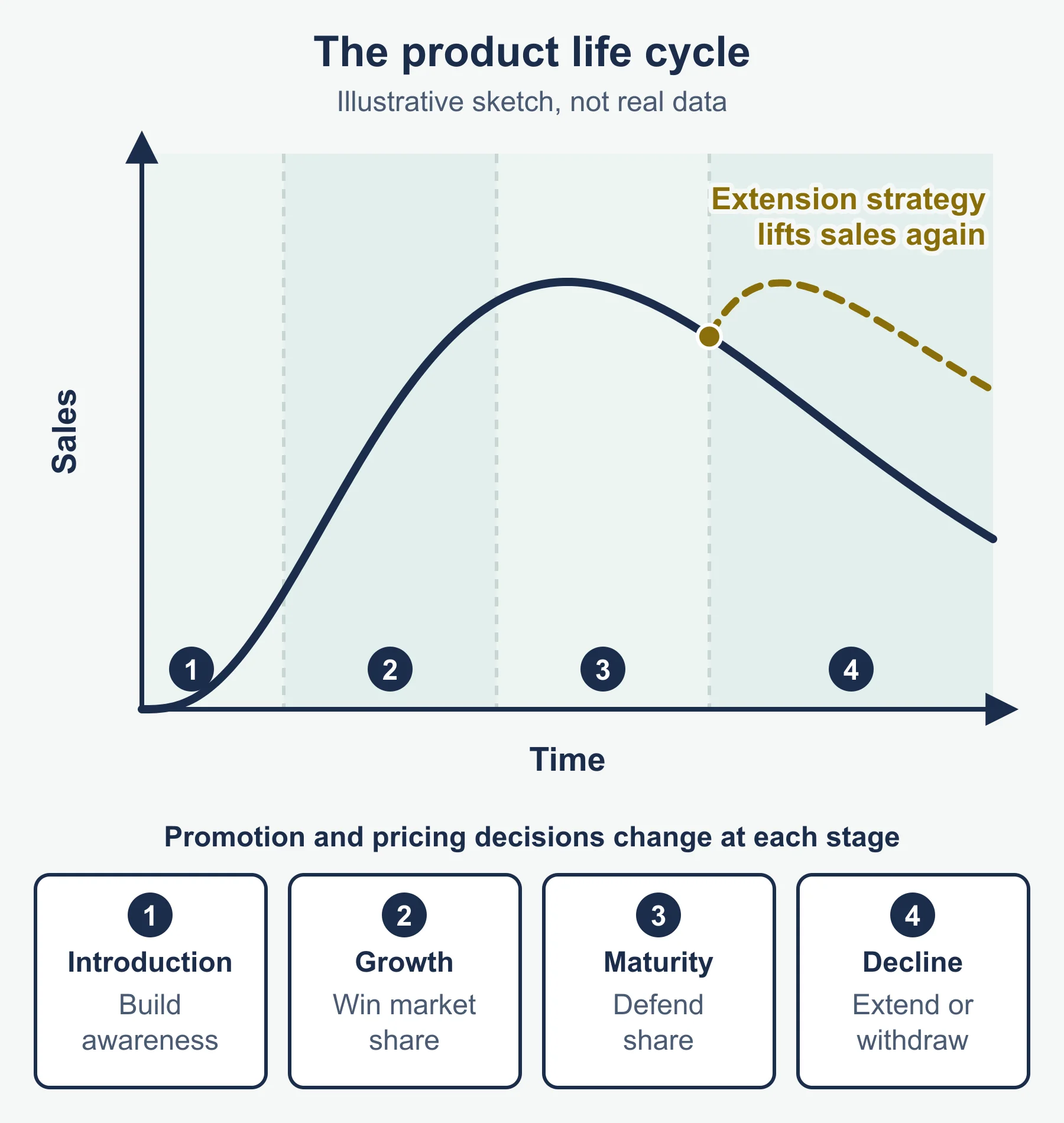
The product life cycle (PLC) describes the sales path of a product over time. The standard form has four stages: introduction, growth, maturity and decline. A business rarely has one product, so it holds a product portfolio, a range of products at different stages. The Boston Consulting Group (BCG) matrix is a toolkit model the guide suggests for this unit, and it helps you judge the balance of a portfolio.
The marketing mix changes as a product moves through the cycle.
| Stage | Typical product focus | Typical price and promotion |
|---|---|---|
| Introduction | Basic version, few variants | Penetration or premium price; promotion to create awareness |
| Growth | More variants, building the brand | Prices held or adjusted; promotion shifts to preference |
| Maturity | Differentiation against many rivals | Price competition; reminder promotion; wider distribution |
| Decline | Cut the range or harvest | Little promotion; selective distribution |
Investment, profit and cash flow across the cycle
Link these three to the stage, because the guide asks for the relationship.
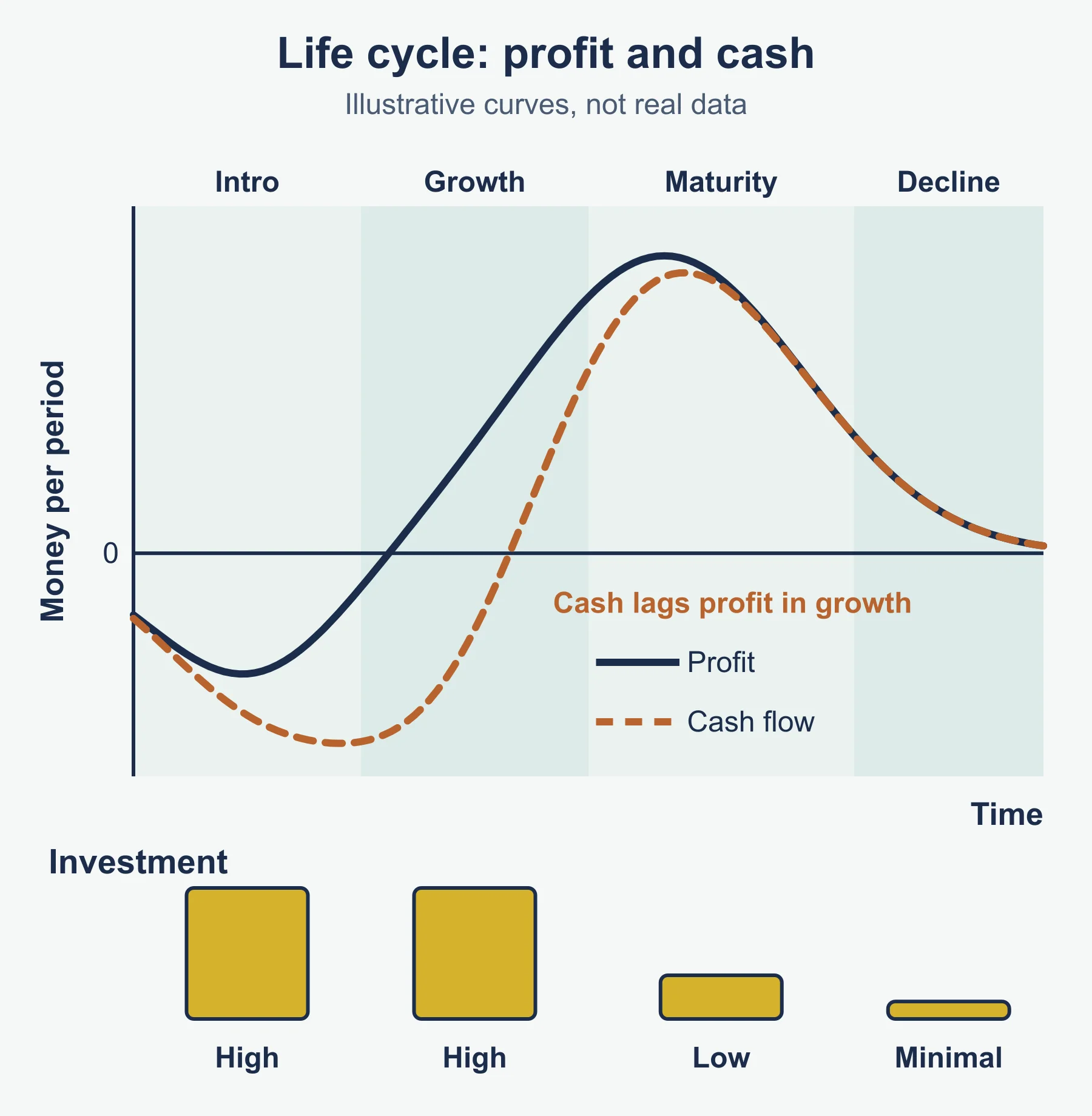
| Stage | Investment | Profit | Cash flow |
|---|---|---|---|
| Introduction | High (development, launch) | Losses likely | Negative |
| Growth | Still high (capacity, stock) | Rising, often small | Often still negative, improving |
| Maturity | Low, mostly maintenance | Usually highest | Strongly positive |
| Decline | Minimal | Falling | Positive but shrinking |
Cash flow often lags profit in growth because the business pays for stock and equipment before customers pay. A portfolio works well when cash from mature products funds the launch of new ones.
Extension strategies
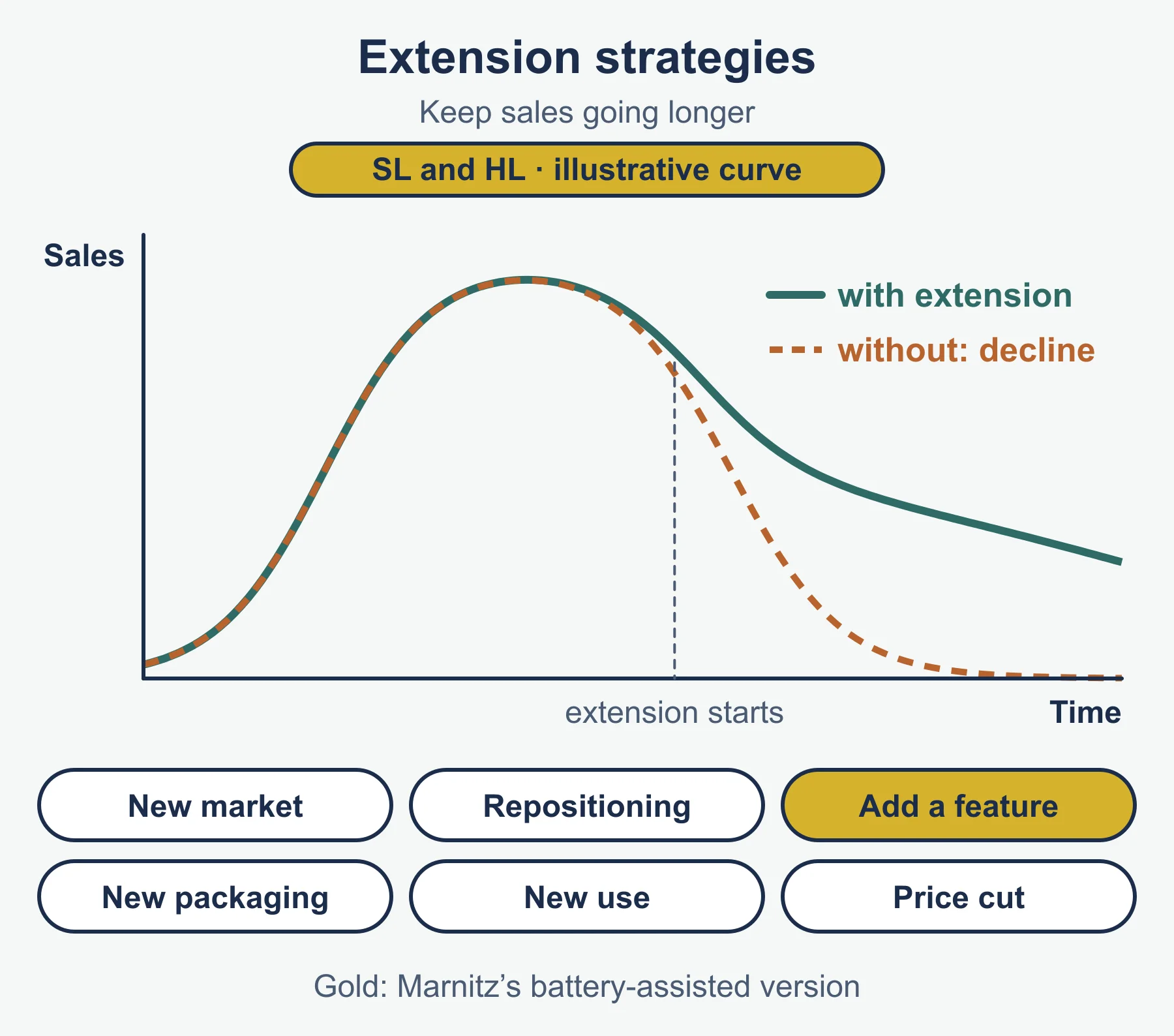
An extension strategy aims to keep sales going for longer and put off the start of decline. Examples are finding new markets, repositioning, adding features or a new variant, changing packaging, a new use for the product, or cutting price. The guide pairs this with evaluation, so ask whether the strategy fits the product, costs less than a new launch, and avoids harming the brand.
Worked example: Marnitz Cycles. Marnitz Cycles sells a commuter bicycle that has been in maturity for six years. Sales growth has stalled at 1% a year. The firm considers (a) a battery-assisted version and (b) a price cut.
- The battery version reaches a new segment and supports a higher price, but needs development investment, so cash flow falls before it rises.
- The price cut is cheap and quick, but rivals can copy it and the brand may start to look low quality.
A balanced answer recommends (a) if cash reserves are strong and the segment is large enough, because it extends the life cycle without relying on price. It names the condition on which the judgement depends.
Branding
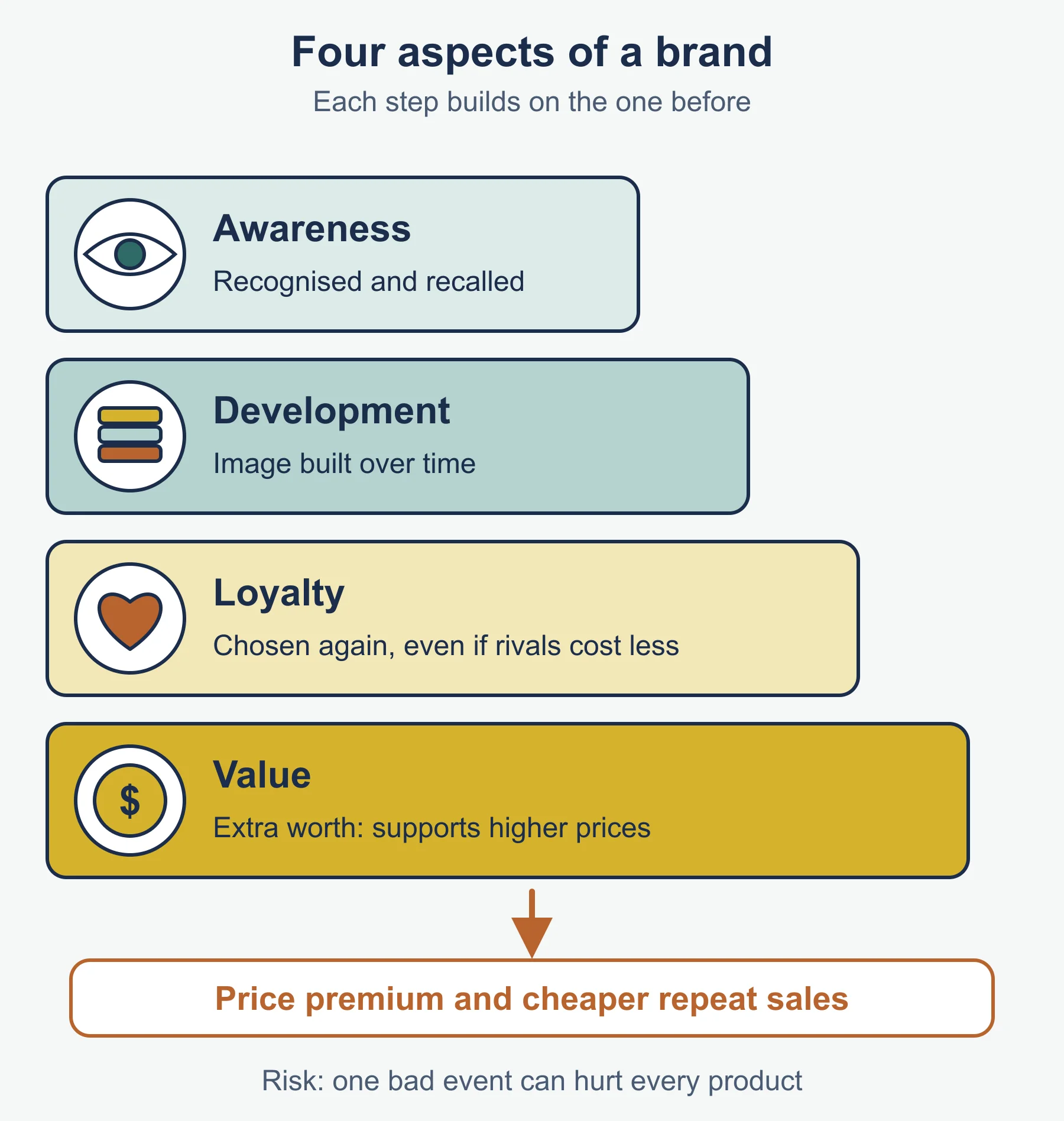
The guide lists four aspects of branding.
- Brand awareness: how far customers recognize and recall the brand.
- Brand development: building the brand’s image and personality over time, through consistent design, quality and messaging.
- Brand loyalty: customers choosing the brand repeatedly, even when rivals are cheaper.
- Brand value: the extra worth a brand carries, which supports higher prices and can be counted as an asset when a business is sold.
The importance of branding is that it separates a product from near-identical rivals, supports a price premium, lowers the cost of winning repeat customers and makes new products easier to launch under a trusted name. The risk is that one bad event can damage every product under the same brand.
Price
The guide asks how appropriate each method is. “Appropriate” means you judge it against the product, the market and the objective.
| Method | How it works | Suits |
|---|---|---|
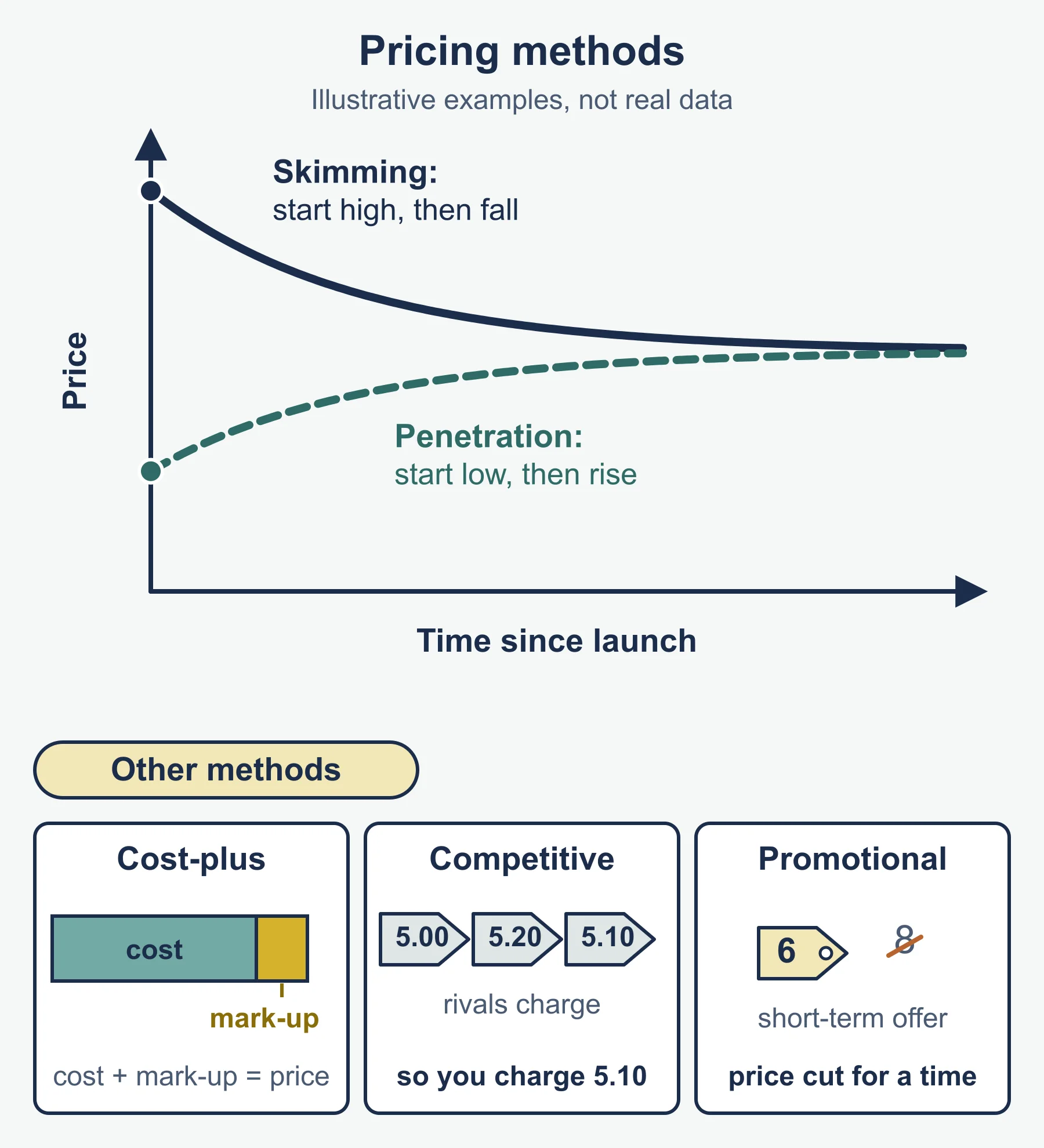
| Cost-plus (mark-up) | Unit cost plus a percentage mark-up | Stable costs, little rivalry |
| Penetration | Low price at launch to gain share quickly | Price-sensitive markets, launches |
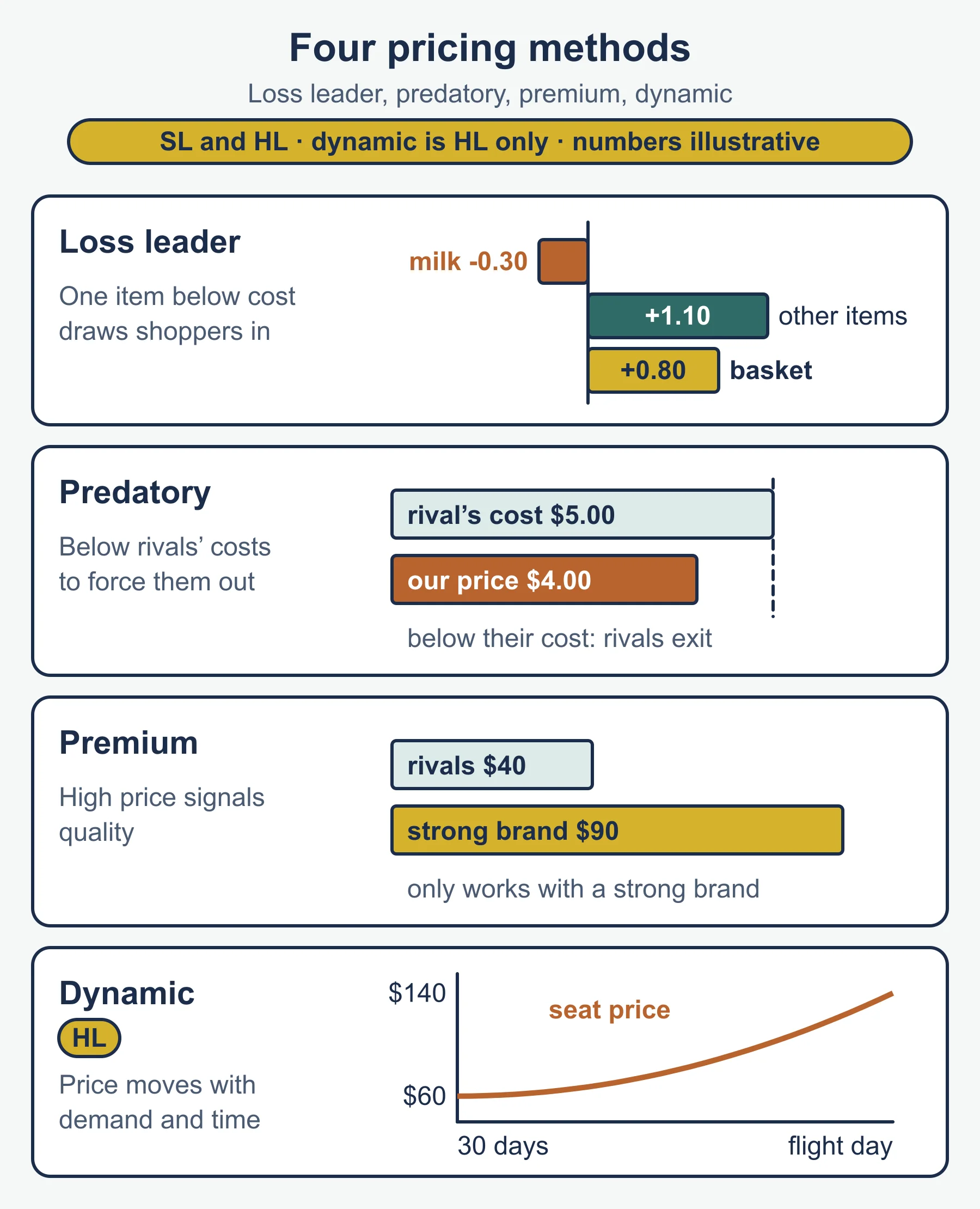
| Loss leader | One product sold below cost to draw customers who buy other items | Retailers with a wide range |
| Predatory | Price set below rivals’ costs to force them out | Rarely: risks heavy losses and scrutiny |
| Premium | High price to signal quality and exclusivity | Strong brand, differentiated product |
| Dynamic (HL only) | Price changes with demand, time or customer | Seats, rooms, online sales |
| Competitive (HL only) | Price set with reference to rivals’ prices | Crowded markets, similar products |
| Contribution (HL only) | Price must cover variable cost and give a contribution to fixed costs and profit | Spare capacity, special orders |
| Price elasticity of demand (HL only) | Measures how demand responds to price | Judging the effect of a price change |
Predatory pricing is aimed at harming competitors and is generally viewed unfavorably, so in an answer describe the risk in general terms and avoid citing specific rules.
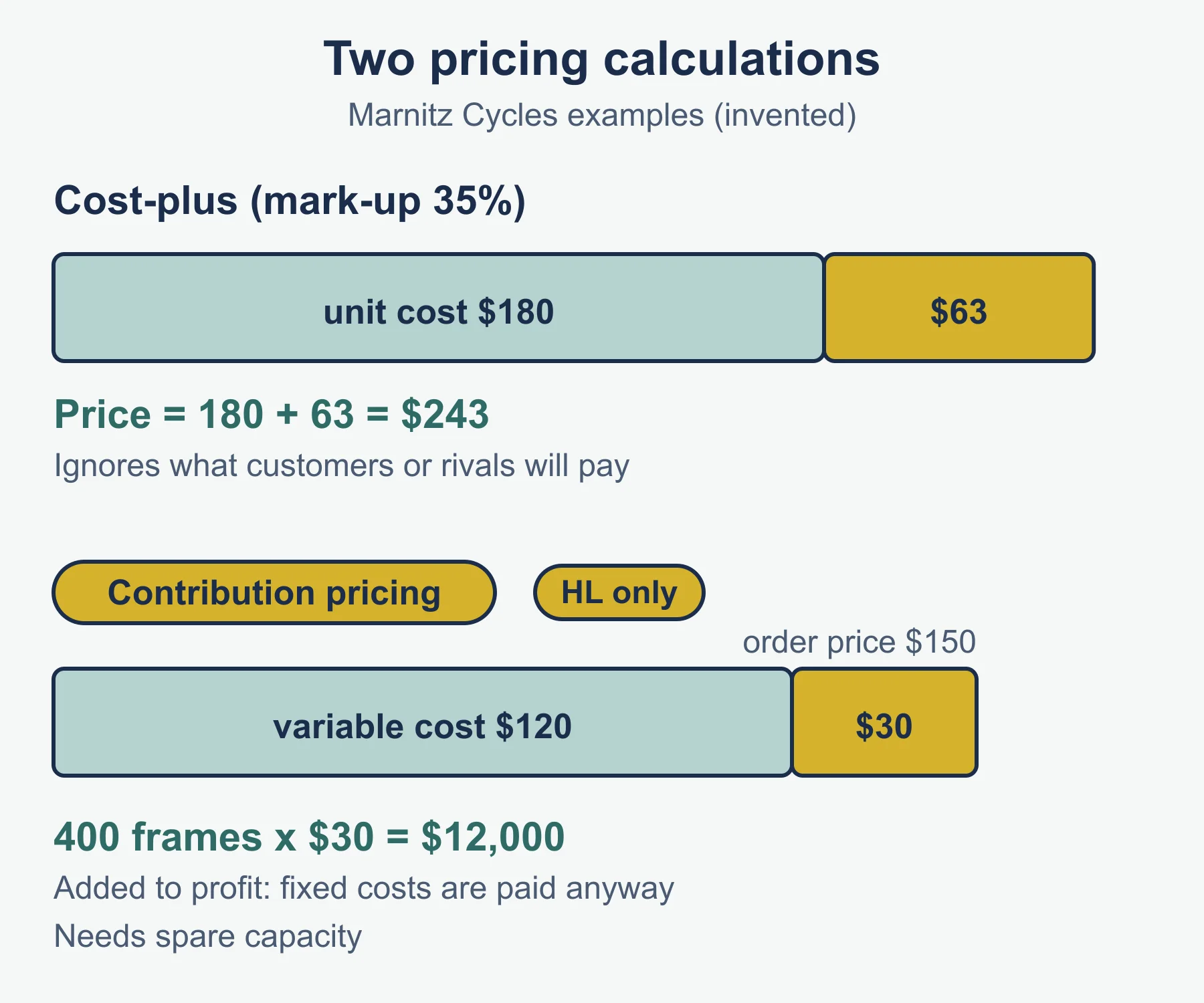
Worked example: cost-plus. Marnitz Cycles’ unit cost is $180 and its mark-up is 35%.
Mark-up = 180 × 0.35 = 63 dollars.
Price = 180 + 63 = 243 dollars. The method is simple, but it ignores what customers will pay and what rivals charge.
Worked example: contribution pricing (HL only). A distributor offers to buy 400 frames at $150 each. The variable cost is 120 dollars per frame and the factory has spare capacity.
Contribution per unit = 150 − 120 = 30 dollars.
Total contribution = 400 × 30 = 12,000 dollars. The fixed costs are paid regardless, so the order adds 12,000 dollars to profit. The risk is that regular customers learn of the low price and expect it.
Worked example: price elasticity of demand (HL only). The standard form is:
PED = percentage change in quantity demanded ÷ percentage change in price
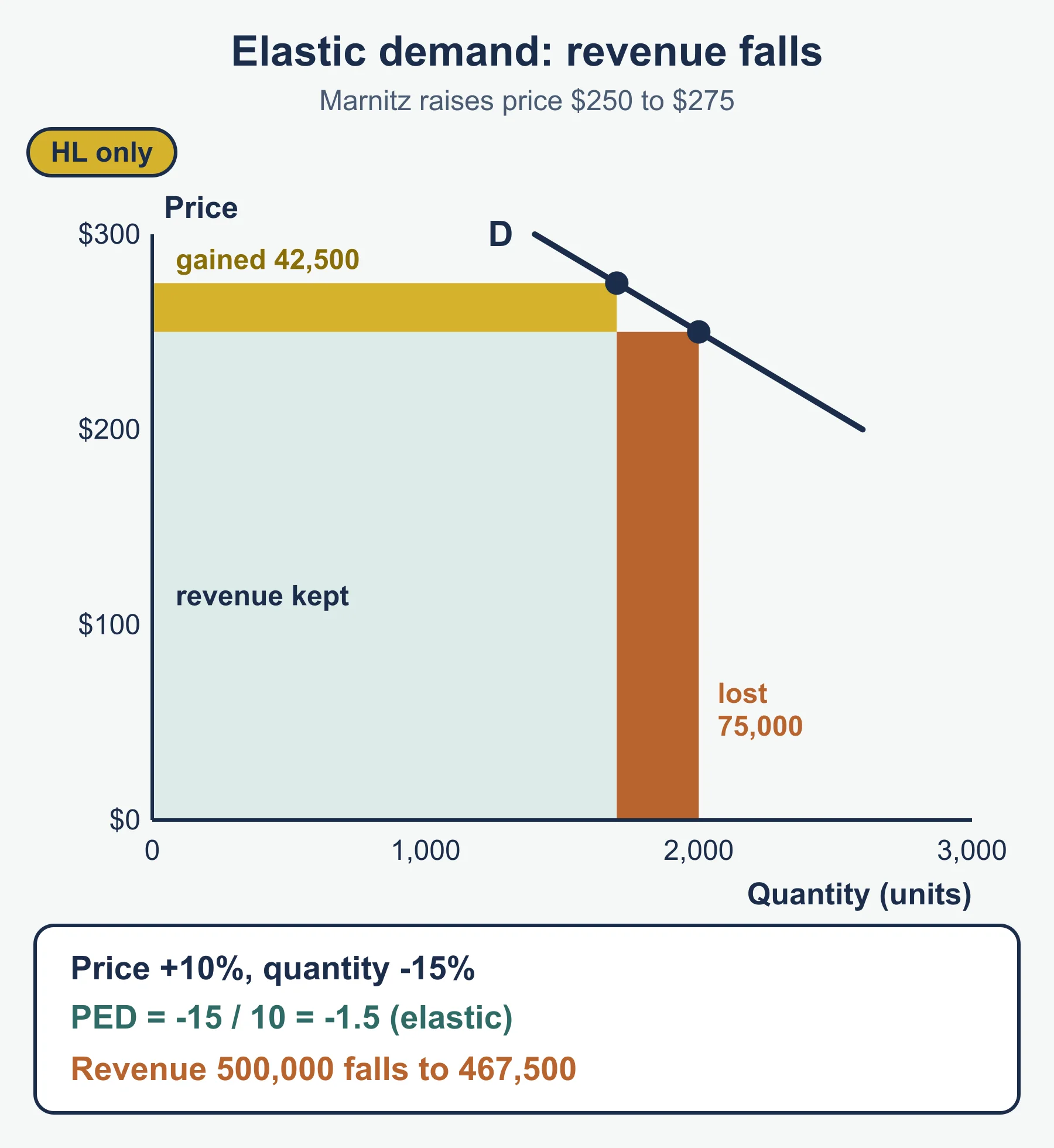
Marnitz raises a price from 250 to 275 dollars, and monthly sales fall from 2,000 to 1,700 units.
- Change in price = (275 − 250) ÷ 250 × 100 = +10%.
- Change in quantity = (1,700 − 2,000) ÷ 2,000 × 100 = −15%.
- PED = −15 ÷ 10 = −1.5.
Demand is price elastic (the size of the figure is above 1). Revenue falls from 250 × 2,000 = 500,000 dollars to 275 × 1,700 = 467,500 dollars. A business facing elastic demand loses revenue by raising price, so a price cut may suit it better. If demand were inelastic (size below 1), a rise would increase revenue.
Promotion
| Type | Meaning | Examples |
|---|---|---|
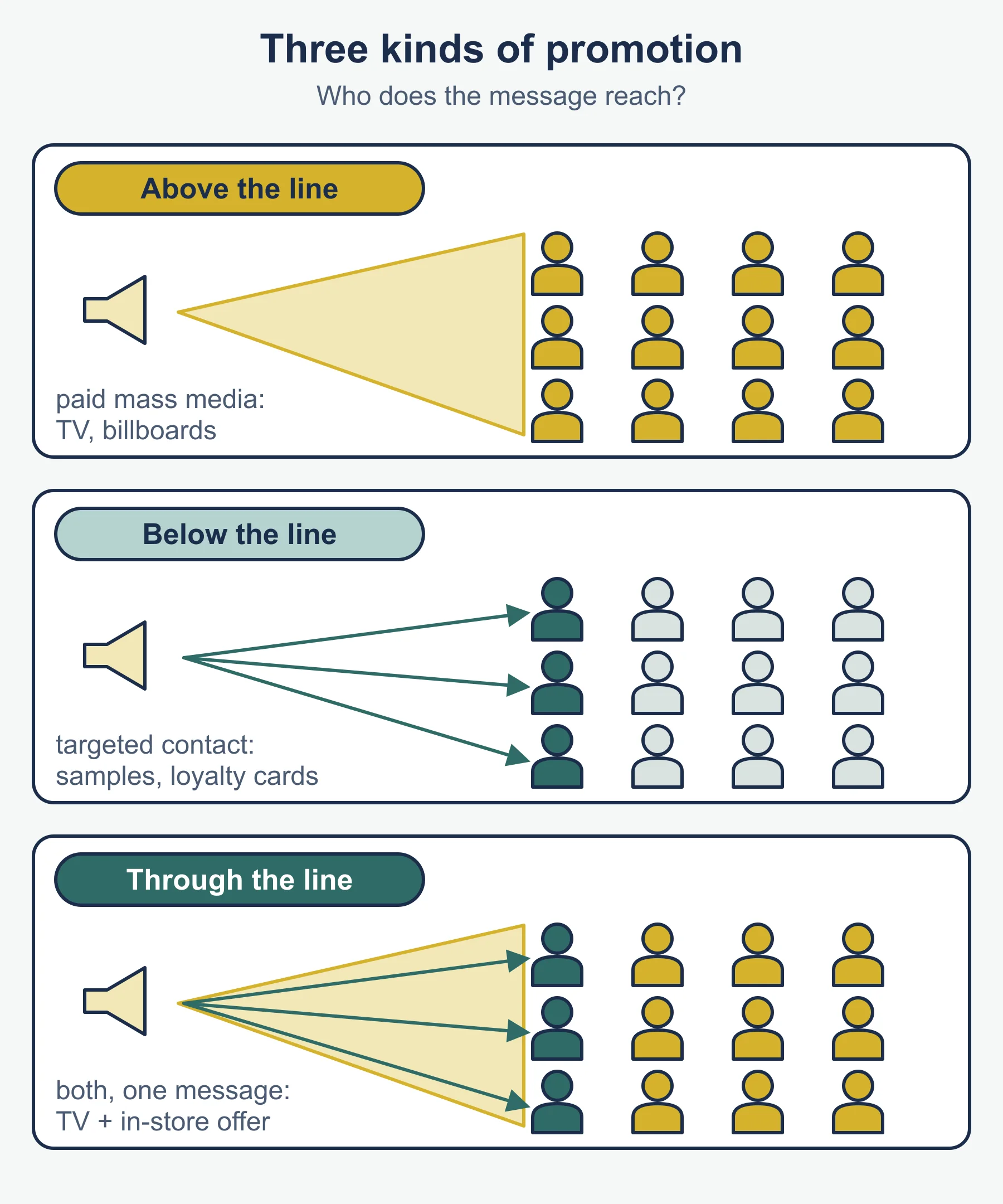
| Above the line | Paid-for mass media aimed at a wide audience | TV, radio, press, cinema, billboards |
| Below the line | Targeted promotion in which the business controls the contact | Discounts, samples, loyalty cards, events, direct mail |
| Through the line | A campaign combining both, with one message | A TV advert plus an in-store offer and social posts |
Above the line has wide reach but high cost and is hard to measure. Below the line is cheaper per customer and easier to track, but reaches fewer people.
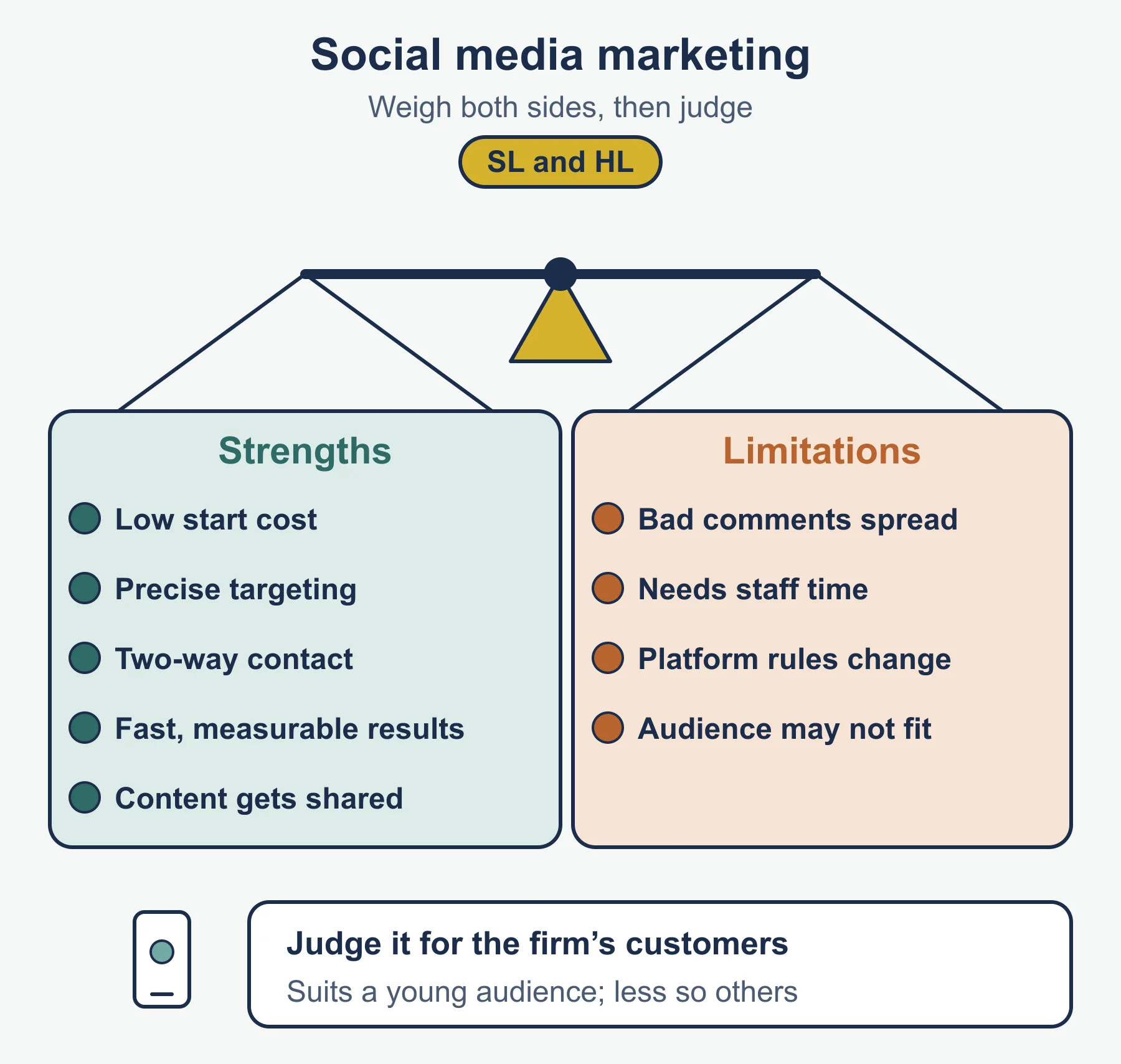
Social media marketing as a promotional strategy asks for evaluation. Strengths: low cost to start, precise targeting, two-way contact, results that can be measured quickly, and content that customers share. Limitations: negative comments spread fast, the business needs staff time to respond, platforms change their rules, and the audience may not match the target market. Judge it for the firm’s customers: it suits a young audience, and less well a business whose buyers do not use these platforms.
Place
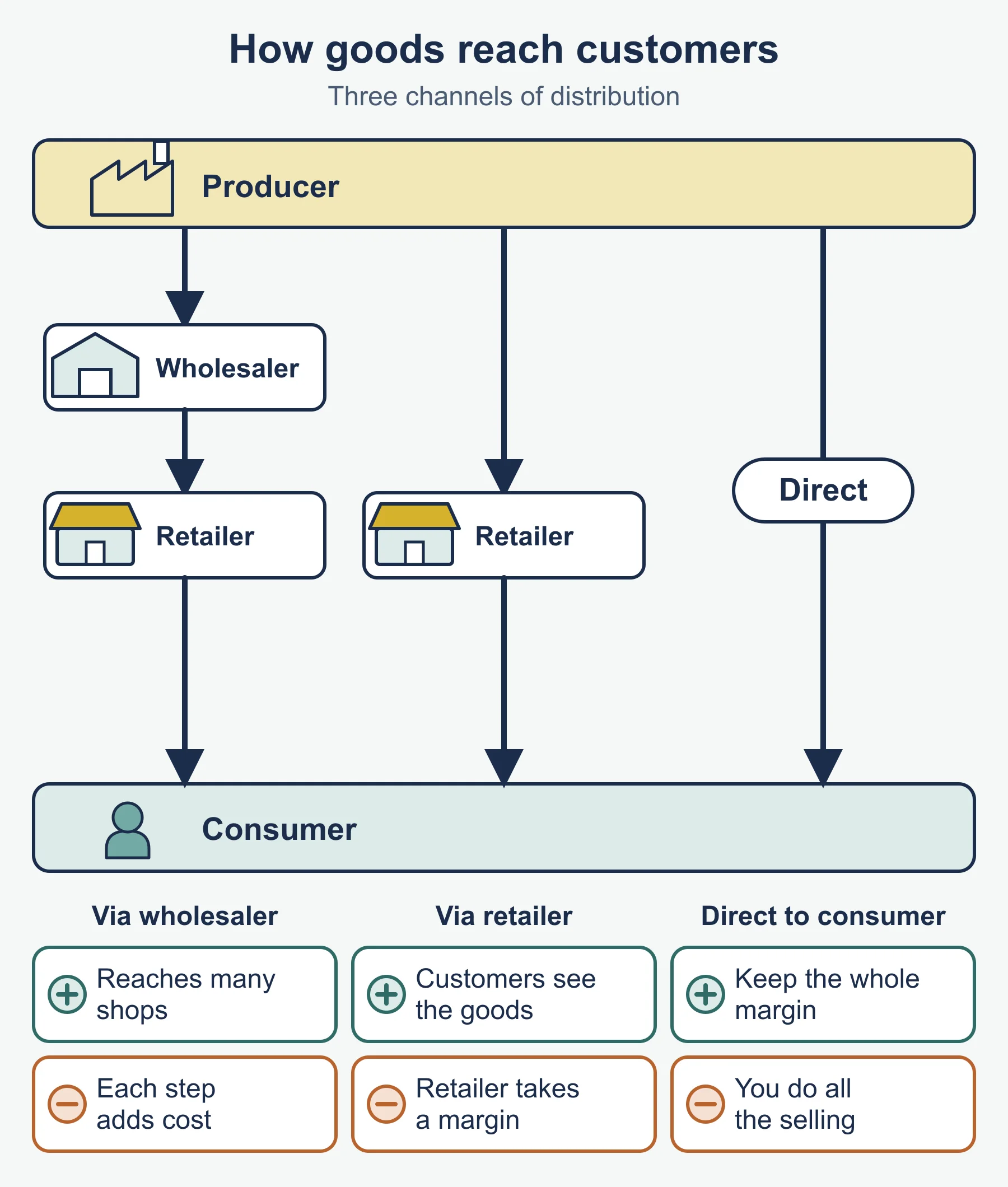
Place covers how the product reaches the customer through distribution channels. Types include direct (manufacturer to consumer, such as online sales or own shops), one intermediary (retailer), and longer chains using wholesalers or agents. The importance of the choice:
- Direct selling keeps the whole margin and the customer data, but the business pays for delivery and stock.
- Retailers give reach and convenience at the cost of margin, and the retailer’s own priorities affect how the product is shown.
- Online channels reach distant customers at low cost but need reliable delivery and returns.
Match the channel to the product: a luxury item may need a controlled channel to protect its image, while a low-price item needs wide availability.
The three service Ps
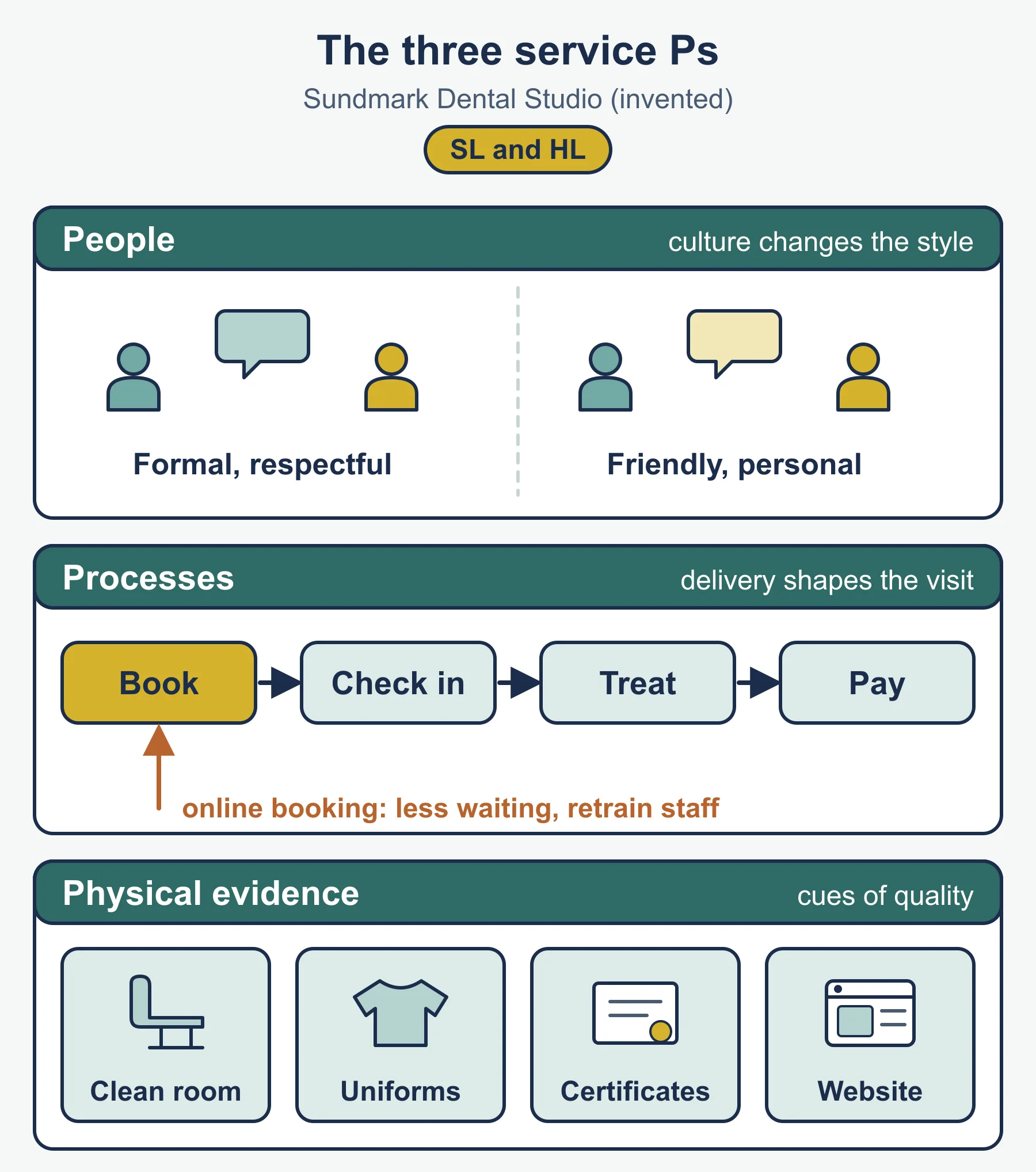
A service is intangible, produced and consumed together, and varies with who delivers it. That is why the guide asks for the three extra Ps in a service context.
Worked example: Sundmark Dental Studio. The studio is a service business.
- People: the importance of employee-customer relationships is that patients judge the whole visit by how the dentist and receptionist treat them. Cultural variation matters: in some cultures patients expect formal, respectful distance, and in others a friendly, personal style. Training and recruitment must reflect the local culture.
- Processes: the importance of delivery processes is that booking, check-in, treatment and payment shape the experience. A change such as online booking reduces waiting and errors, but may disadvantage patients who dislike technology, and staff need retraining.
- Physical evidence: because a service cannot be inspected beforehand, tangible cues signal quality: a clean waiting room, uniforms, a tidy website, branded appointment cards and visible certificates.
Appropriate marketing mixes
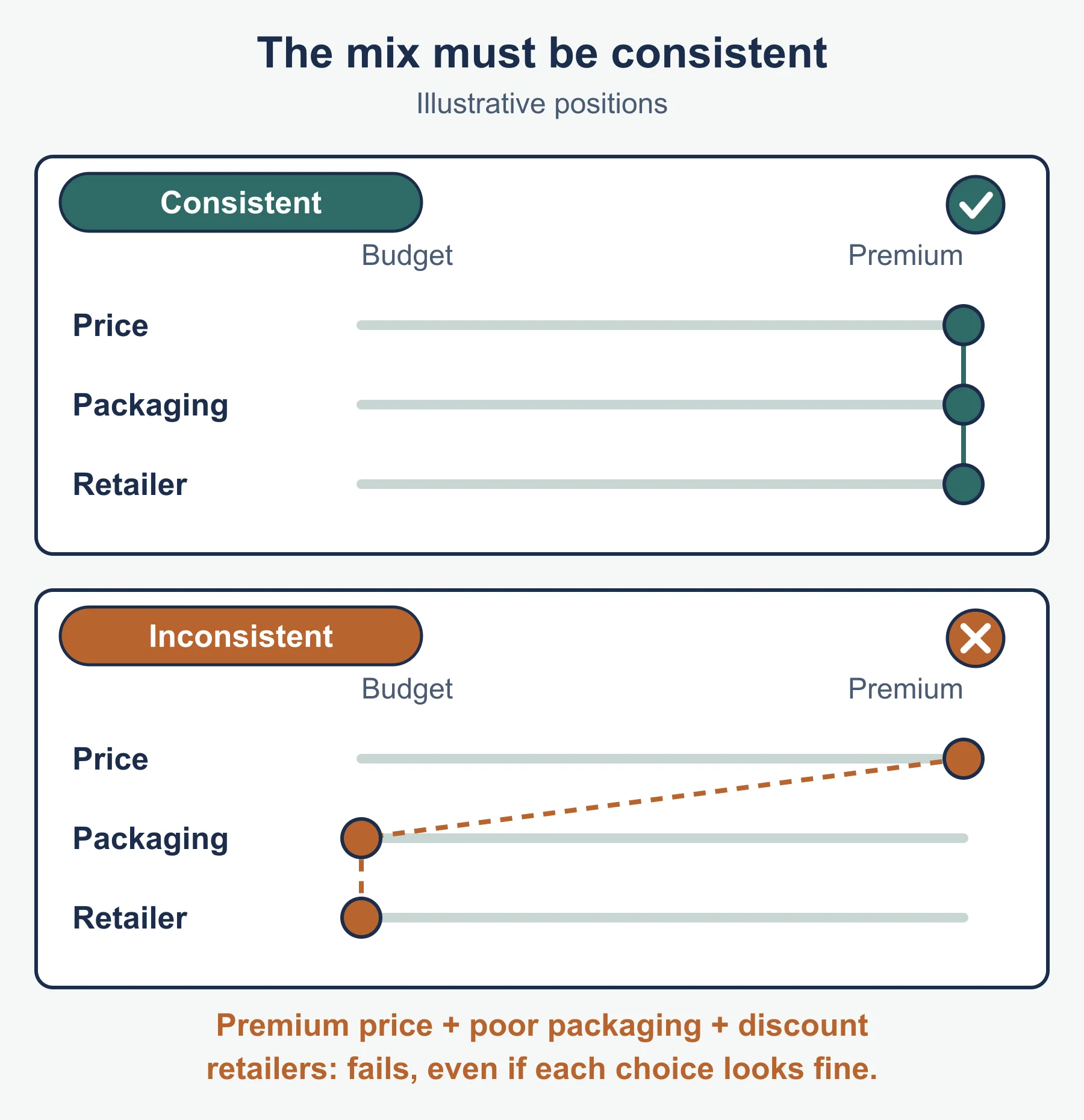
The guide ends with the judgement that matters most. There is no best mix, only one that fits the product, target market, stage in the life cycle and objectives, and that stays consistent across the seven Ps.
| Business | Likely fit |
|---|---|
| Luxury watch | Premium price, selective distribution, strong brand, high-quality physical evidence |
| Budget supermarket line | Competitive or loss leader pricing, wide distribution, below the line offers |
| Local dental studio | Emphasis on people, processes and physical evidence; modest promotion |
A mix is inconsistent if, for example, a premium price is paired with sale-bin distribution. State the link between Ps explicitly.
Common errors
- Listing the seven Ps without applying them to the business named in the question.
- Describing a pricing method without judging whether it is appropriate for the case.
- Confusing through the line with above the line.
- Giving a PED answer without the sign or without stating whether demand is elastic or inelastic.
- Treating people, processes and physical evidence as irrelevant to a manufacturer: they matter most for services, but all products have some service element.
- Concluding “it depends” with no condition. Name the factor that decides.
Frequently asked questions
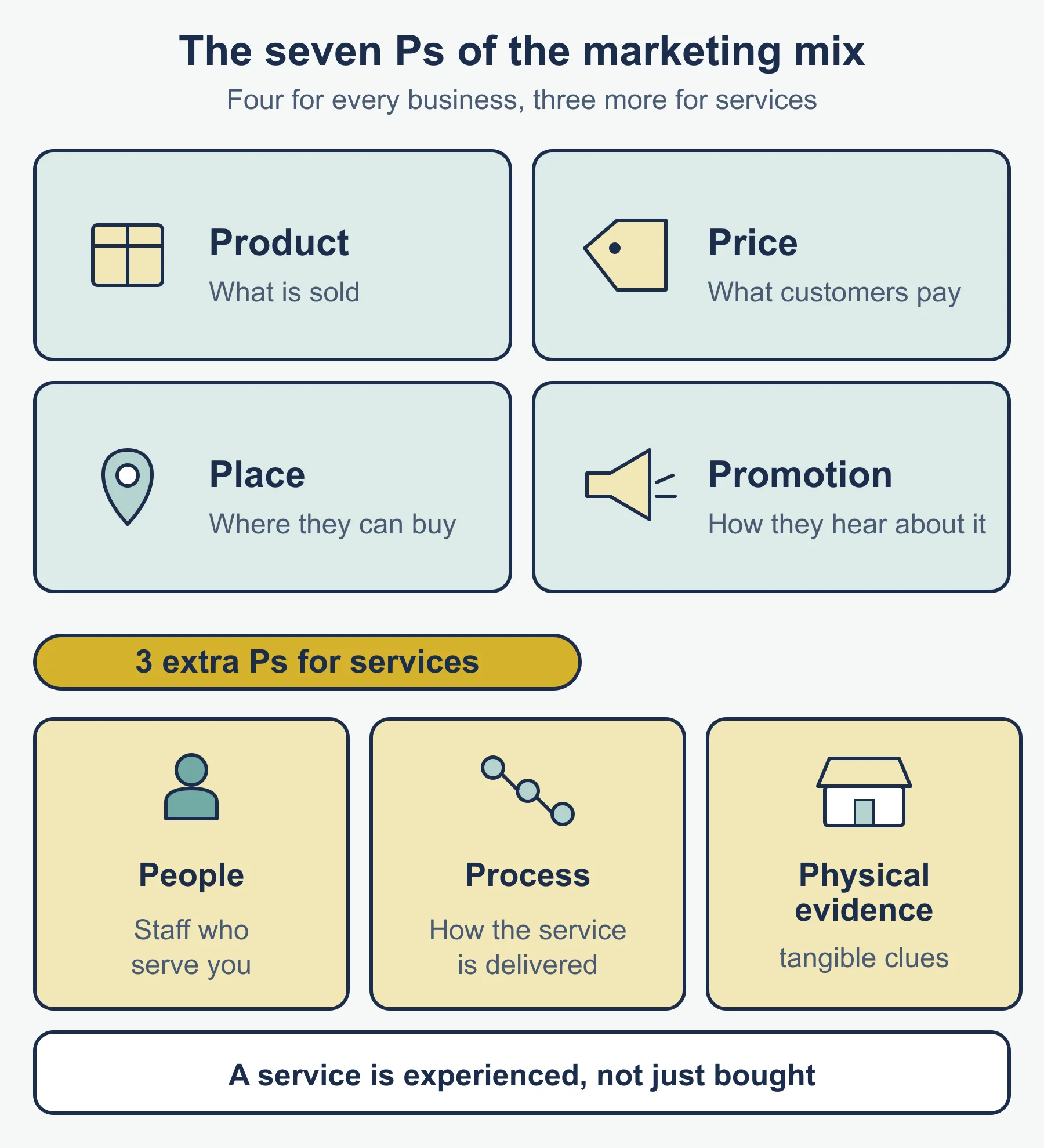
What are the seven Ps of the marketing mix? The seven Ps are product, price, promotion, place, people, processes and physical evidence. The IB guide frames the last three in the context of marketing a service.
What is an extension strategy? An extension strategy aims to keep sales going for longer and put off the start of decline for a product in maturity. Examples include new markets, repositioning, new features or variants, and new packaging.
What are the four aspects of branding in IB Business Management? The guide lists brand awareness, brand development, brand loyalty and brand value. Branding matters because it separates a product from near-identical rivals and supports higher prices and repeat sales.
How do you calculate a cost-plus price? A cost-plus price is the unit cost plus the unit cost multiplied by the mark-up percentage. For example, a unit cost of 180 dollars with a 35% mark-up gives a price of 243 dollars; the method is simple but ignores what customers will pay.
What makes a marketing mix appropriate? There is no single best mix, only one that fits the target market, the product’s stage in the life cycle and the business’s objectives. A mix is inconsistent if, for example, a premium price is paired with sale-bin distribution.
Official syllabus
International Baccalaureate Organization, Diploma Programme Business management guide, first assessment 2024, section 4.5, published February 2022 and updated May 2022. Next, try the practice questions.
Get free revision emails (optional)
Occasional emails with practice questions, worked explanations and links to free resources for the qualification and subjects you choose. No spam, and you can unsubscribe from any email. The free tools on this site never need an email.
Related resources
-
Practice questions
IB DP Business Management: The seven Ps of the marketing mix – Practice Questions
Original practice questions with worked answers on section 4.5 of IB DP Business Management: pricing, promotion, branding, service Ps and mixes.
Business · International Baccalaureate · IB
Try questions -
Revision notes
IB DP Business Management: The seven Ps of the marketing mix – Revision Notes
Condensed revision notes for IB DP Business Management section 4.5: the seven Ps, pricing methods, promotion types, PLC links and a short self-test.
Business · International Baccalaureate · IB
Revise topic -
Study guides
IB DP Business Management: International marketing (HL only)
Study guide to IB DP Business Management 4.6 (HL only): the opportunities and threats of entering and operating internationally, with worked examples.
Business · International Baccalaureate · IB
Read guide
Related articles
-
teaching
A Level tuition in Dubai: Cambridge or Pearson Edexcel International A Level?
Schools in Dubai and Abu Dhabi teach either Cambridge International AS & A Level or Pearson Edexcel International A Level. How the two are structured, why it matters for tuition, and how online classes from Lahore work.
9 October 2026
-
curriculum guides
Choosing subjects at IGCSE and A Level
How subject choices at 14 and 16 affect university options later, and how to keep pathways open without overloading a timetable.
28 July 2026
Studying this with a teacher
Working through Business IB?
This page is free and stays free. If you would rather be taught it, Marlbridge runs Business classes one-to-one, online in your own time zone. The first trial class is free. WhatsApp replies within an hour (8am–11pm Pakistan time, every day); email the same day.
IB Business teachers at Marlbridge

