
Revision Notes
IB DP Geography: 12.2 Changing identities and cultures – Revision Notes
Condensed IB DP Geography notes on 12.2: culture and identity, diffusion, homogenisation, glocalisation, resistance and multiple identities, with a self-test.
- Subject
- Geography
- Level
- IB
- Topic
- Unit 5: Human development and diversity
- Author
- Marlbridge Academic Team
- Updated
- Reviewed by
- Azam Siddique (what this means)
Aligned to International Baccalaureate IB Diploma Programme Geography (DP Geography), First assessments 2019. Official specification .
Syllabus page (what it covers and how it is assessed): IB Diploma Programme Geography.
Syllabus points this page covers
DP Geography
- 12.2 Changing identities and cultures
Condensed recall for 12.2 Changing identities and cultures (Unit 5: Human development and diversity). For the full explanation, read the Human development and diversity study guide.
Key terms
| Term | Meaning |
|---|---|
| Culture | Language, religion, food, dress, values and practices |
| Identity | How individuals and groups see themselves and are seen by others |
| Cultural diffusion | Spread of cultural traits through migration, trade, media and digital networks |
| Cultural homogenisation | Cultures converge towards a shared, often Western or commercial, pattern |
| Hybridisation / glocalisation | Blending of global and local features (glocalisation: Roland Robertson); for example global brands adapting products to local tastes |
| Cultural resistance and revival | Communities defend or reinvigorate traditions, language or heritage because they feel threatened |
| Multiple identities | Overlapping local, national, ethnic and global identities |
Migration and digital life can intensify multiple identities.
Further terms worth using:
| Term | Meaning |
|---|---|
| Diaspora | A population living outside its place of origin that keeps cultural and economic links with it |
| Cultural imperialism | The argument that powerful countries and corporations impose their culture on others |
| McDonaldization | George Ritzer’s term for the spread of standardised, efficiency-driven ways of producing and consuming |
| Lingua franca | A shared language used between speakers of different languages, now often English |
How culture moves
- Migration and diasporas carry food, religion, music and language; diaspora communities often blend the culture of origin with that of the host society.
- Media and streaming distribute film, music and television globally almost instantly.
- Transnational corporations spread brands, products and working practices.
- The internet and social media let ideas, trends and language spread peer to peer, not only from powerful centres outwards.
- Tourism and education expose people to other cultures, and study abroad builds networks.
Flows are not only from the West. The Korean Wave (Hallyu) shows diffusion from an Asian economy: K-pop groups such as BTS and Korean series such as Squid Game (2021) gained huge global audiences, helped by streaming platforms and by South Korean government support for cultural exports as a form of soft power. Bollywood films and Japanese anime are other examples.
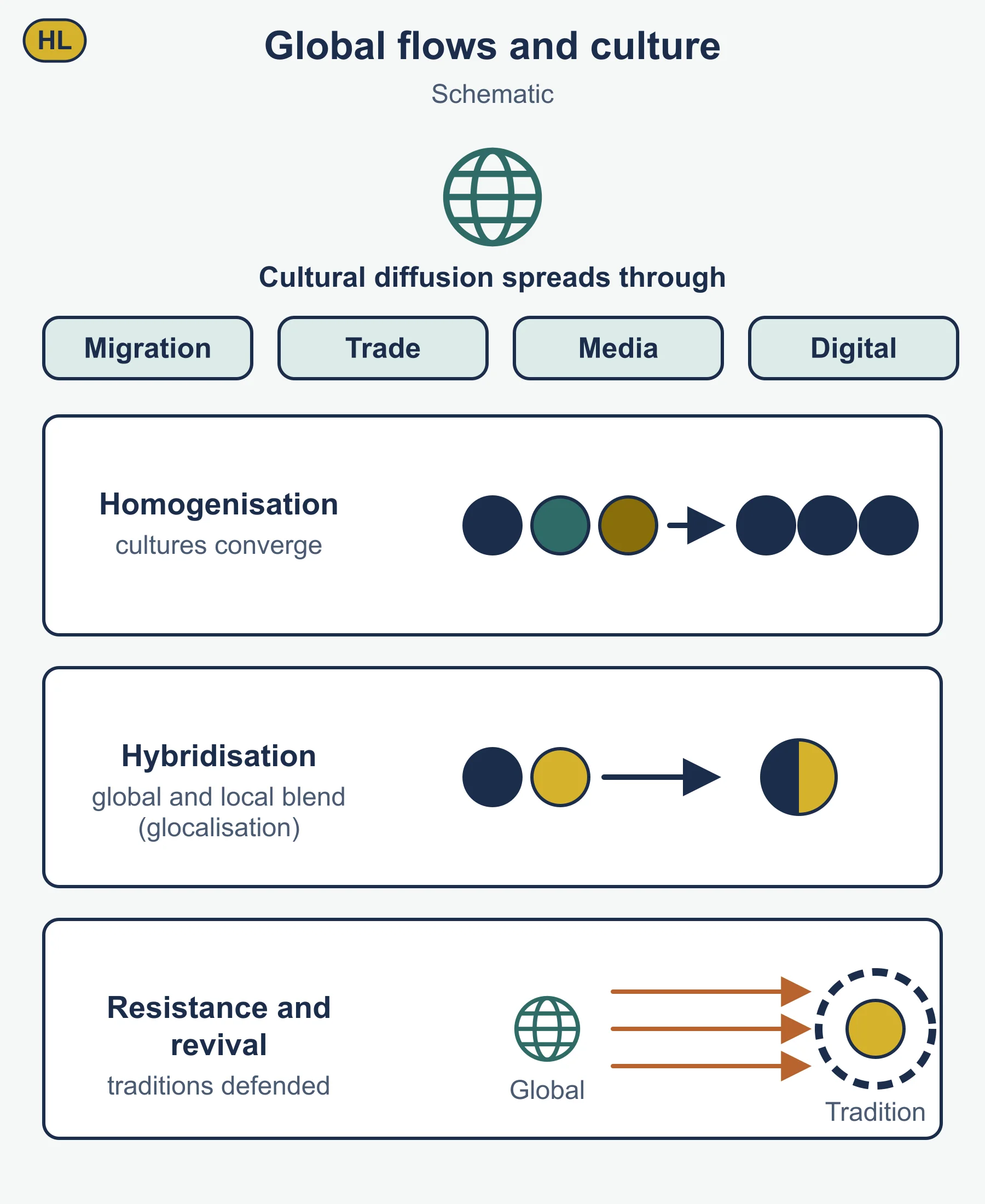
Evidence for each argument
| Homogenisation (erosion) | Hybridisation and new forms |
|---|---|
| Global brands and chains appear in cities worldwide | McDonald’s in India sells no beef and offers vegetarian items such as the McAloo Tikki |
| English spreads as the language of business, science and the internet | Global streaming services commission local-language content for local audiences |
| UNESCO considers a large share of the world’s roughly 7,000 languages to be endangered | Diaspora communities create new fusion food, music and fashion |
| Young people in many countries share similar consumer tastes | Non-Western cultural exports (Hallyu, Bollywood) reach global audiences |
Resistance and revival
- Welsh language revival: a Welsh-language television channel (S4C, from 1982), the Welsh Language Act of 1993, Welsh-medium schooling and a government aim of one million Welsh speakers by 2050.
- Māori language revival in New Zealand: “language nest” pre-schools (kōhanga reo) from the early 1980s, and recognition of Māori as an official language in 1987.
- Protecting national culture: quotas for local-language music on radio, as in France, or for domestic films in cinemas.
Revival shows that globalisation can provoke a stronger sense of local identity rather than simply erasing it.
Two arguments to weigh
- Globalisation erodes diversity (homogenisation).
- Globalisation creates new cultural forms (hybridisation, glocalisation).
The best answers give evidence for each side from a named place, then reach a judgement about which is stronger in that context.
Who is affected
Media, language and migration do not affect all age groups or social classes in the same way. Younger people and city dwellers may adopt new influences faster; others may act to protect traditions.
A second-generation migrant may feel British at school, Pakistani at home and Muslim at the mosque, and switch identity by context; these multiple identities are a normal outcome of global interaction rather than a sign of confusion. Identity is also shaped by how others see a group, which can mean discrimination or stereotyping.
Model paragraph (to what extent)
“The spread of global brands into India might suggest homogenisation, but McDonald’s had to remove beef and build a largely vegetarian menu to succeed there, so the global brand adapted to local culture rather than replacing it. At the same time, English-language media are changing the tastes of young urban Indians faster than those of older rural people. Globalisation has therefore produced hybrid forms in food while increasing convergence in some youth consumer culture, so the effect is uneven rather than a simple loss of diversity.”
Exam traps
- Presenting homogenisation as inevitable and complete.
- Writing about culture in general with no named place.
- Treating a community as having one voice.
- Confusing culture with identity.
- Assuming cultural flows run only from the West to the rest.
- Using glocalisation examples without explaining why the company adapted.
Self-test
- Distinguish culture from identity.
- Define cultural diffusion.
- What is glocalisation?
- Why might communities revive traditions?
- Why is a judgement needed in a 12.2 answer?
- What is a diaspora?
- Give one example of cultural diffusion that does not come from the West.
- Give one piece of evidence for homogenisation.
- Name two measures used to revive the Welsh language.
- What does McDonaldization mean?
- Why might two members of the same family respond differently to global culture?
Answers: 1. Culture is the practices and values; identity is how people see themselves and are seen. 2. The spread of cultural traits between places. 3. Blending of global and local features, such as adapting global brands to local tastes. 4. They feel threatened by change. 5. Evidence supports both erosion and new forms, so you must decide which is stronger in the context. 6. A population living outside its place of origin that keeps links with it. 7. For example the Korean Wave (K-pop, Korean television) or Bollywood. 8. For example the spread of English or of global chains, or endangered languages. 9. For example S4C, the 1993 Welsh Language Act or Welsh-medium schooling. 10. Ritzer’s term for the spread of standardised, efficiency-driven production and consumption. 11. Age, education, place of residence and social networks shape exposure and attitudes.
More resources on this topic
Related resources
-
Subject guides
IB Diploma Programme Geography: Subject Overview
An overview of IB Diploma Programme Geography – interactions between individuals, societies and physical processes across time and space.
Geography · International Baccalaureate · IB
Read course guide -
Revision notes
IB DP Geography: 12.1 Development opportunities – Revision Notes
Condensed IB DP Geography notes on 12.1: measuring development with GNI, HDI and Gini, routes to development and their costs, and spatial inequality, with a self-test.
Geography · International Baccalaureate · IB
Revise topic -
Study guides
IB DP Geography: Unit 5: Human development and diversity – Study Guide
Development opportunities, changing identities and cultures, and local responses to global interactions in the Higher Level extension of IB Diploma Programme Geography.
Geography · International Baccalaureate · IB
Read guide
Studying Geography?
This page is free and stays free. Marlbridge is not offering Geography classes at the moment, so there is no tuition to book for it. The free study resources stay open to everyone.
Get free revision emails (optional)
Occasional emails with practice questions, worked explanations and links to free resources for the qualification and subjects you choose. No spam, and you can unsubscribe from any email. The free tools on this site never need an email.