
Revision Notes
IB DP Geography: 12.1 Development opportunities – Revision Notes
Condensed IB DP Geography notes on 12.1: measuring development with GNI, HDI and Gini, routes to development and their costs, and spatial inequality, with a self-test.
- Subject
- Geography
- Level
- IB
- Topic
- Unit 5: Human development and diversity
- Author
- Marlbridge Academic Team
- Updated
- Reviewed by
- Azam Siddique (what this means)
Aligned to International Baccalaureate IB Diploma Programme Geography (DP Geography), First assessments 2019. Official specification .
Syllabus page (what it covers and how it is assessed): IB Diploma Programme Geography.
Syllabus points this page covers
DP Geography
- 12.1 Development opportunities
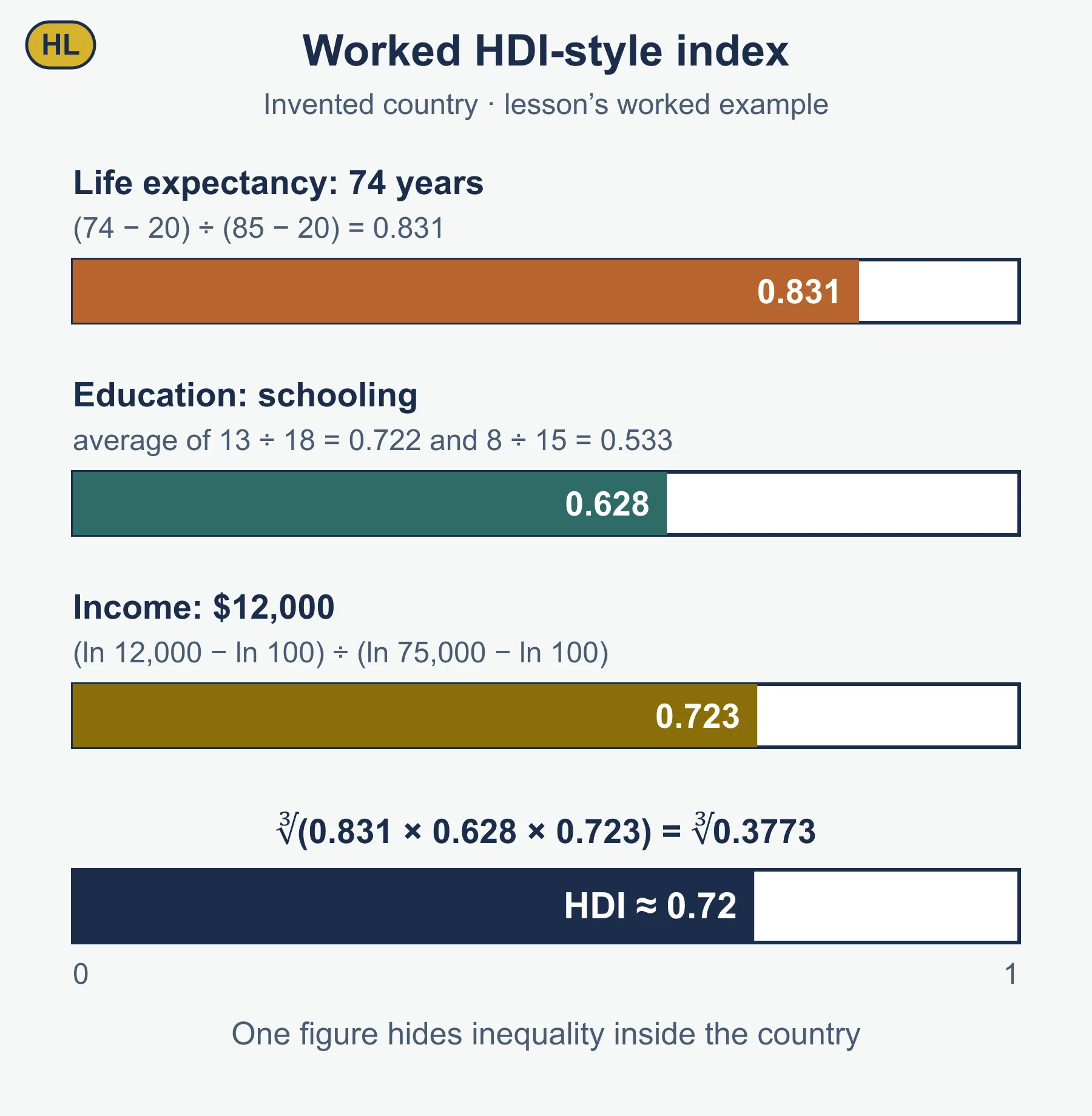
Condensed recall for 12.1 Development opportunities (Unit 5: Human development and diversity). For the full explanation and the worked HDI example, read the Human development and diversity study guide.
Measuring development
Development is improvement in people’s economic, social and political well-being, not only growth in income.
| Measure | Strength / limit |
|---|---|
| GNI per capita | Simple, but ignores distribution and non-monetary well-being |
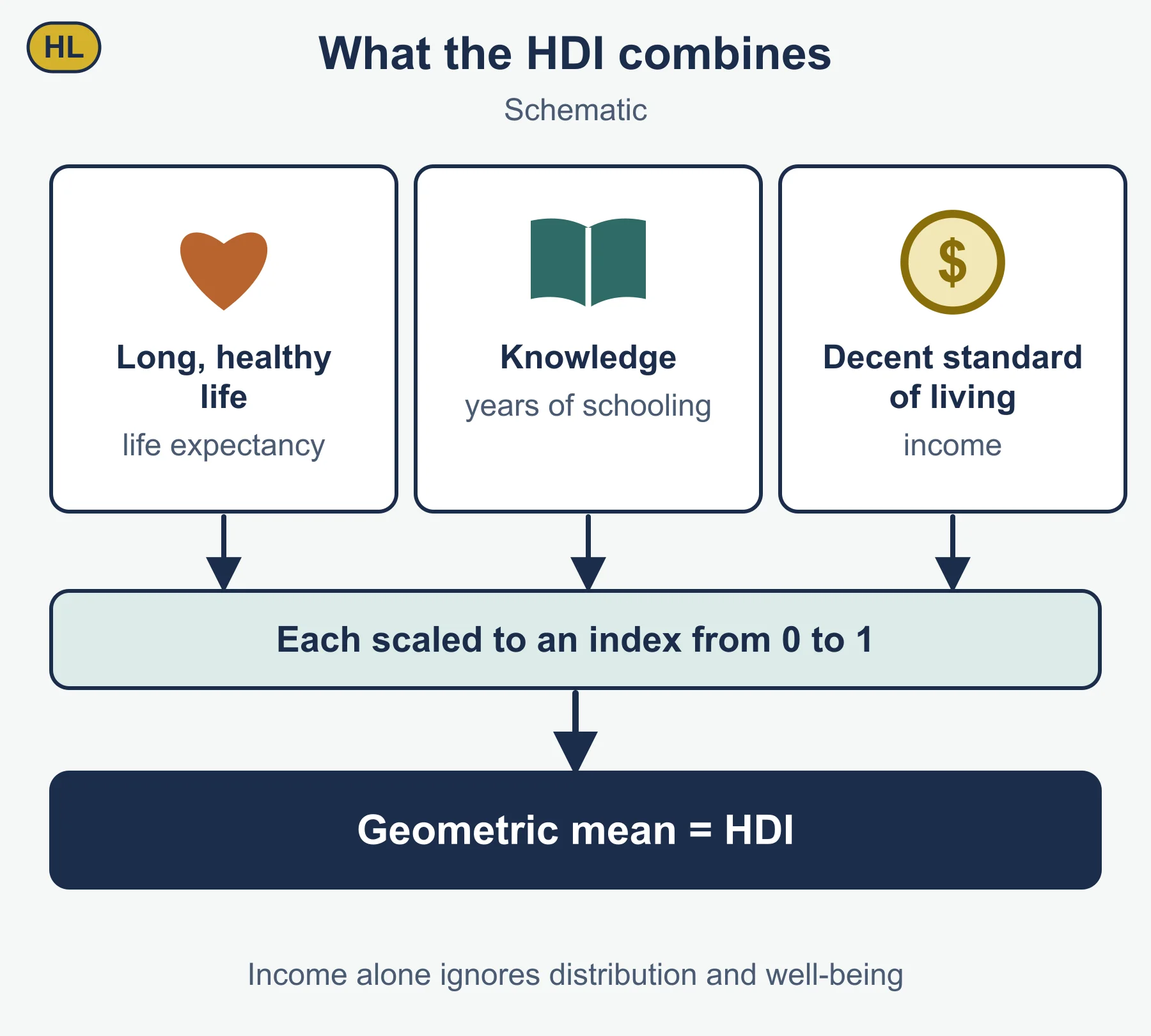
| Human Development Index (HDI) | Combines life expectancy, knowledge (years of schooling) and a decent standard of living (income); dimensions combined with a geometric mean; hides inequality, environmental cost and gender gaps unless adjusted |
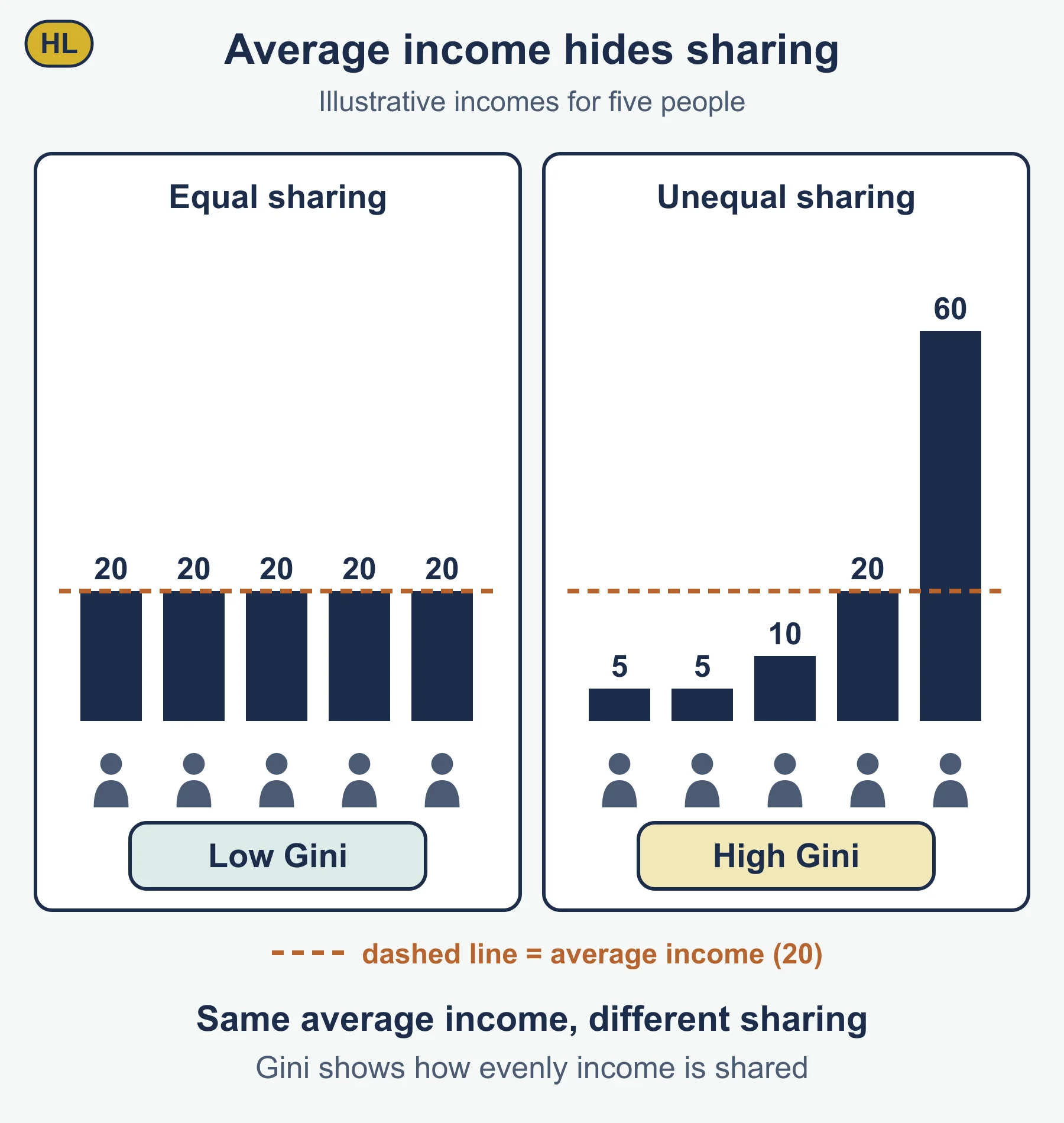
| Gini coefficient | Shows how evenly income is shared within a country |
| Other approaches | Gender equality, multidimensional poverty, happiness or well-being |
A country can rise on average income while inequality widens.
More measures to know:
| Measure | What it adds |
|---|---|
| GNI per capita at purchasing power parity (PPP) | Adjusts income for what money buys locally |
| Inequality-adjusted HDI | Lowers the HDI according to how unequally each dimension is shared |
| Gender Inequality Index | Reproductive health, empowerment and labour-market gaps between women and men |
| Multidimensional Poverty Index | Counts overlapping deprivations in health, education and living standards at household level |
| Gross National Happiness | Bhutan’s approach, weighting well-being, culture and environment alongside income |
Gini coefficient: 0 means perfect equality and 1 means one person has all the income. South Africa has one of the highest recorded values; Nordic countries are among the lowest.
HDI method in outline
Each dimension is converted to an index between 0 and 1 using fixed minimum and maximum values, and the three indices are combined with a geometric mean. A single figure says nothing about which regions or groups sit far below it.
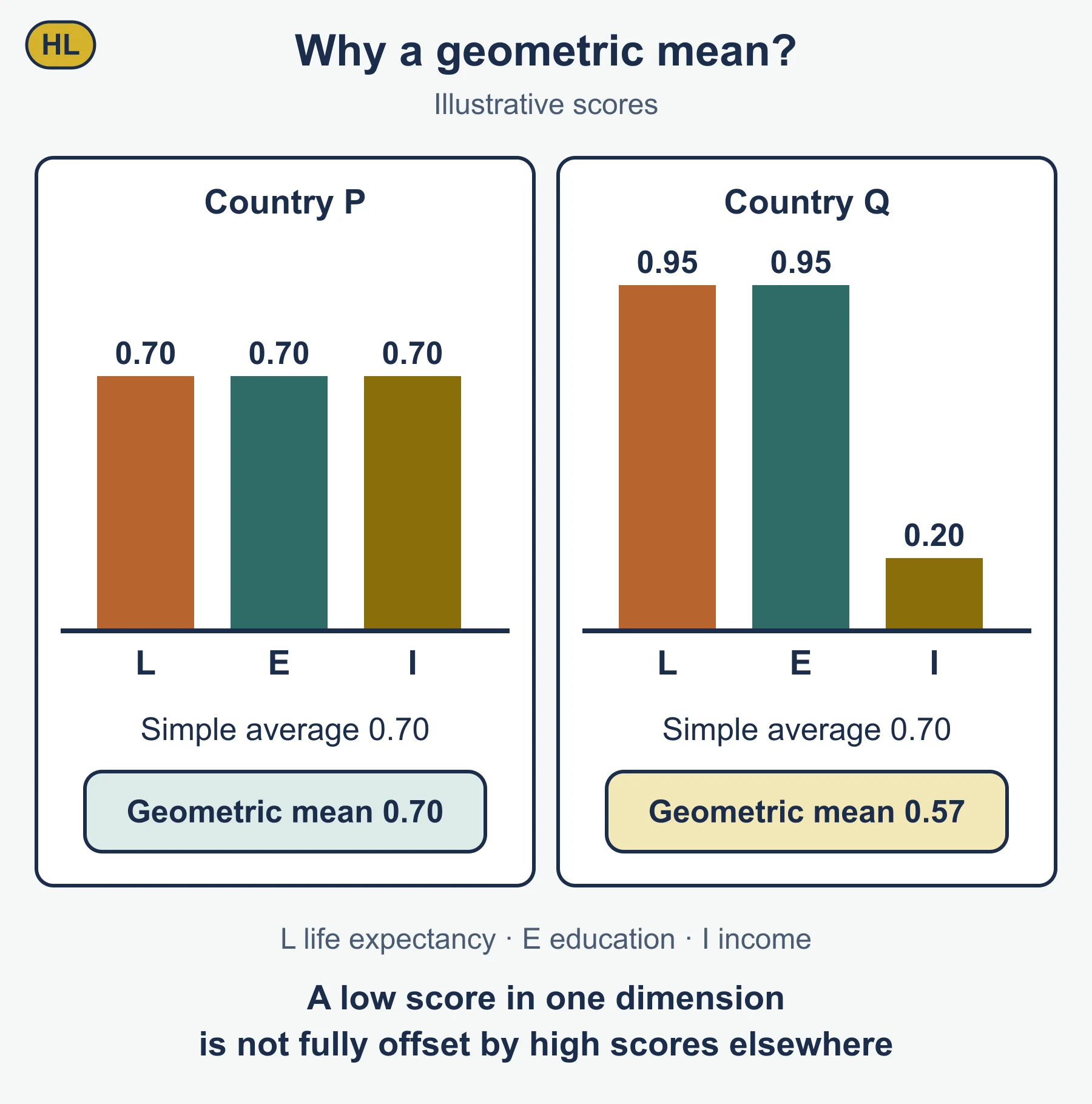
The geometric mean is used so that a very low score in one dimension cannot be fully offset by a high score in another.
Development goals
The Millennium Development Goals (2000 to 2015) were followed by the Sustainable Development Goals (17 goals, adopted in 2015 for 2030). Progress has been uneven: extreme poverty fell most sharply in East Asia, particularly China, while progress in much of sub-Saharan Africa has been slower, and the COVID-19 pandemic set back several goals.
Routes to development, and their costs
| Route | Cost or risk |
|---|---|
| Trade | Exposure to price changes and competition |
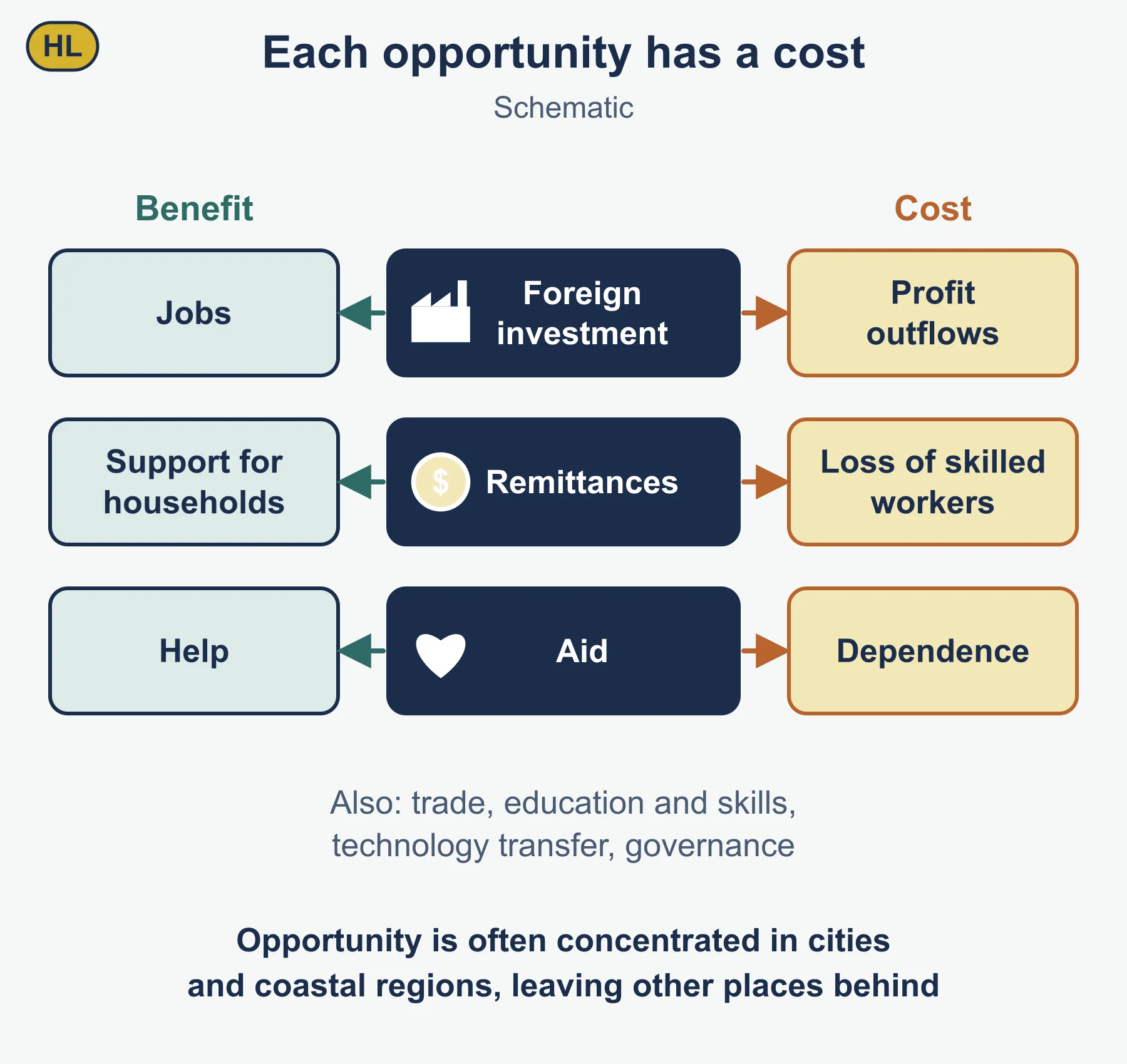
| Foreign direct investment | Jobs, but profit outflows |
| Aid | Can help, but may create dependence |
| Remittances | Support households, but may signal skilled emigration |
| Education and skills | Benefit depends on jobs being available |
| Technology transfer | Depends on local capacity |
| Governance | Quality of institutions shapes every other route |
Spatial inequality: opportunity is often concentrated in cities and coastal regions. Gender, ethnicity and age also affect who can take opportunities.
Examples of each route
- Trade-led growth: Bangladesh built a large export garment industry that employs millions, many of them women. The Rana Plaza factory collapse near Dhaka in 2013, which killed more than 1,100 workers, exposed the safety costs and led to a building-safety accord between brands and unions.
- Foreign direct investment: China’s Special Economic Zones, starting with Shenzhen in 1980, attracted foreign firms with tax breaks and infrastructure, transforming a small town into a major city. Gains were concentrated on the coast, widening inequality with inland provinces.
- Aid: bilateral (government to government), multilateral (through bodies such as the World Bank), NGO, and emergency versus long-term development aid. Tied aid, which must be spent on the donor’s goods or services, is criticised as serving donor interests.
- Debt relief: the Heavily Indebted Poor Countries initiative (1996) and the Multilateral Debt Relief Initiative (2005) cancelled debts for many low-income countries, freeing money for services, but conditions attached were criticised.
- Microfinance: the Grameen Bank in Bangladesh, founded by Muhammad Yunus (Nobel Peace Prize 2006), lends small sums mainly to women. Critics point to high interest rates and over-indebtedness in some markets.
- Remittances: in some countries, such as Nepal and Tajikistan, money sent home by migrant workers is equivalent to a large share of GDP. It funds food, schooling and housing, but depends on economic conditions in host countries.
Worked example: an income-share ratio (invented figures)
The poorest 20 per cent of households receive 4 per cent of national income; the richest 20 per cent receive 50 per cent.
- Ratio of top to bottom quintile = 50 / 4 = 12.5.
- Meaning: the average household in the richest fifth has 12.5 times the income of one in the poorest fifth.
- If average GNI per capita rose by 20 per cent while the bottom share fell to 3 per cent, the ratio would become 50 / 3, about 16.7: growth with widening inequality.
Model paragraph (evaluate)
“Shenzhen shows that foreign direct investment can drive extremely rapid development: manufacturing jobs raised incomes and drew millions of migrants. However, the benefits were concentrated in coastal China, and many migrant workers lacked urban residence rights and access to services. FDI was therefore highly effective for national growth but less effective at spreading opportunity evenly.”
Exam traps
- Equating development with income growth.
- Quoting HDI as if it shows inequality within a country.
- Listing routes without costs.
- Describing aid as a single thing rather than distinguishing its types.
- Assuming that a route which worked in one country will transfer to another without the same governance and timing.
Self-test
- Name the three HDI dimensions.
- Why does GNI per capita limit understanding of development?
- What does the Gini coefficient show?
- Give one benefit and one cost of foreign direct investment.
- What is spatial inequality?
- Why is the geometric mean used in the HDI?
- What does the Multidimensional Poverty Index measure?
- What is tied aid, and why is it criticised?
- Give one strength and one criticism of microfinance.
- What does a Gini coefficient of 0 mean?
- Why might remittances be a fragile route to development?
Answers: 1. Life expectancy, years of schooling and income. 2. It ignores distribution and non-monetary well-being. 3. How evenly income is shared within a country. 4. Jobs; profit outflows. 5. Opportunity concentrated in some places, such as cities and coasts, leaving others behind. 6. So a very low score in one dimension cannot be fully offset by a high score in another. 7. Overlapping household deprivations in health, education and living standards. 8. Aid that must be spent on the donor’s goods or services; it can serve donor interests more than recipients’ needs. 9. Strength: credit for people excluded from banks, often women; criticism: high interest and over-indebtedness. 10. Perfect equality. 11. They depend on jobs and policies in host countries, which can change suddenly.
More resources on this topic
Related resources
-
Subject guides
IB Diploma Programme Geography: Subject Overview
An overview of IB Diploma Programme Geography – interactions between individuals, societies and physical processes across time and space.
Geography · International Baccalaureate · IB
Read course guide -
Study guides
IB DP Geography: Unit 5: Human development and diversity – Study Guide
Development opportunities, changing identities and cultures, and local responses to global interactions in the Higher Level extension of IB Diploma Programme Geography.
Geography · International Baccalaureate · IB
Read guide -
Revision notes
IB DP Geography: 12.3 Local responses to global interactions – Revision Notes
Condensed IB DP Geography notes on 12.3: types of local response, heritage protection, local entrepreneurship and evaluating who gains and who loses, with a self-test.
Geography · International Baccalaureate · IB
Revise topic
Studying Geography?
This page is free and stays free. Marlbridge is not offering Geography classes at the moment, so there is no tuition to book for it. The free study resources stay open to everyone.
Get free revision emails (optional)
Occasional emails with practice questions, worked explanations and links to free resources for the qualification and subjects you choose. No spam, and you can unsubscribe from any email. The free tools on this site never need an email.