
Revision Notes
IB DP Geography: 12.3 Local responses to global interactions – Revision Notes
Condensed IB DP Geography notes on 12.3: types of local response, heritage protection, local entrepreneurship and evaluating who gains and who loses, with a self-test.
- Subject
- Geography
- Level
- IB
- Topic
- Unit 5: Human development and diversity
- Author
- Marlbridge Academic Team
- Updated
- Reviewed by
- Azam Siddique (what this means)
Aligned to International Baccalaureate IB Diploma Programme Geography (DP Geography), First assessments 2019. Official specification .
Syllabus page (what it covers and how it is assessed): IB Diploma Programme Geography.
Syllabus points this page covers
DP Geography
- 12.3 Local responses to global interactions
Condensed recall for 12.3 Local responses to global interactions (Unit 5: Human development and diversity). For the full explanation, read the Human development and diversity study guide.
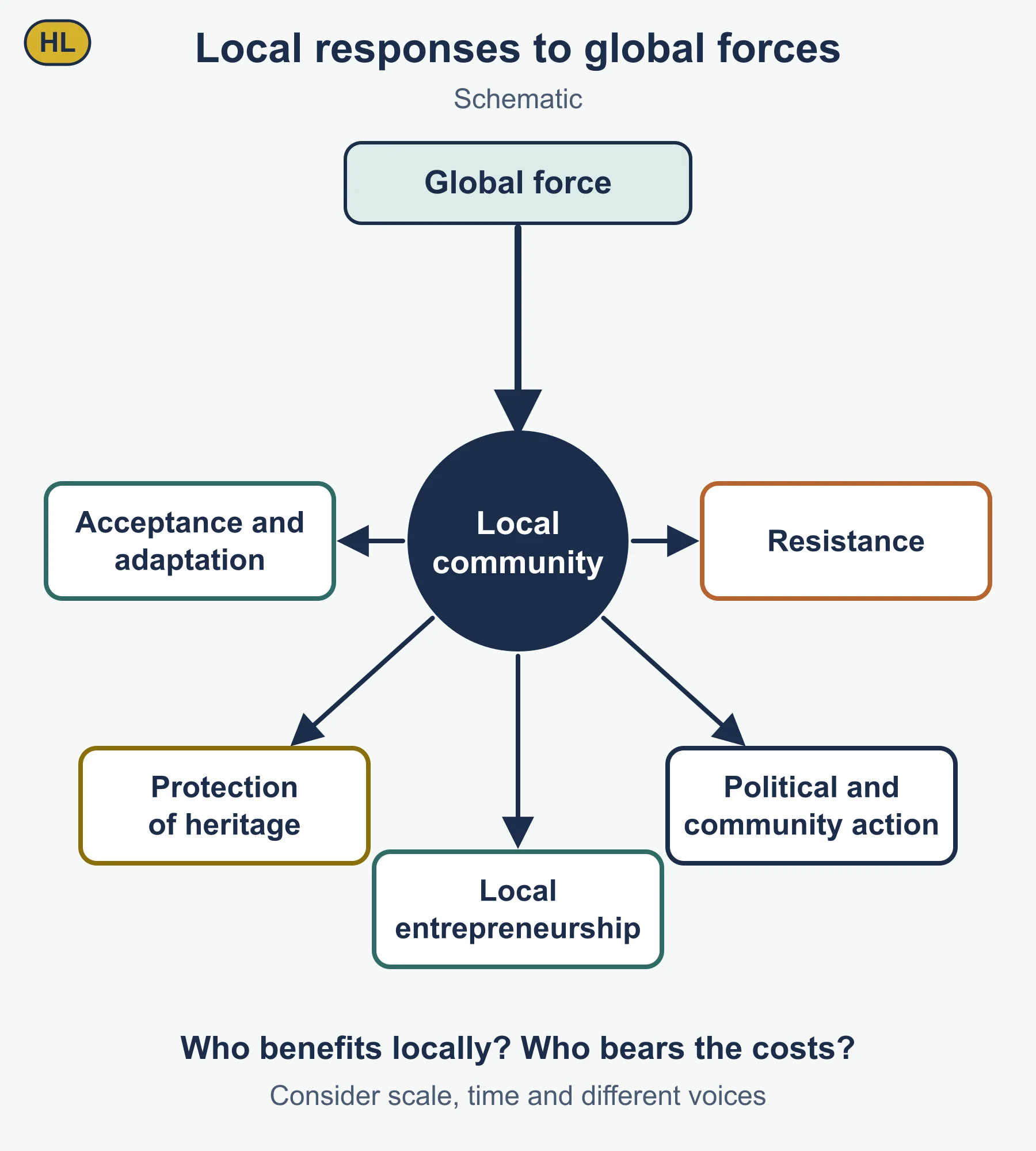
Local communities are not passive
| Type of response | Description |
|---|---|
| Acceptance and adaptation | Using new technology, markets or ideas to improve livelihoods |
| Resistance | Protest, boycotts or campaigns against corporations, policies or cultural change |
| Protection of heritage | Cultural quotas, language laws, protected designations for local products, heritage listing |
| Local entrepreneurship | Small firms using global platforms; cooperatives and fair trade schemes capturing more value locally |
| Political and community action | Local governments and civil society shaping how global investment is accepted |
Slow Food (founded in Italy in the 1980s) is a well-known movement defending local food culture.
Key terms
| Term | Meaning |
|---|---|
| Anti-globalisation movement | Campaigns against the power of TNCs, global institutions and free-trade rules |
| Alter-globalisation | Accepting global connection but campaigning for fairer rules |
| Protectionism | Government measures such as tariffs and quotas that shield local producers from foreign competition |
| Civil society | Groups outside government and business, such as NGOs, unions, faith groups and community organisations |
| Geographical indication | A legal label tying a product’s name to a place of origin and traditional method |
Examples of each response
- Resistance to a TNC: Plachimada, Kerala (India). Villagers protested from 2002 against a Coca-Cola bottling plant, blaming it for depleting and polluting their groundwater. The plant stopped production in 2004 after sustained protest and legal action. The case is used to show local resistance succeeding, though at the cost of local jobs and after years of conflict.
- Resistance to infrastructure: Standing Rock (USA), 2016. The Standing Rock Sioux and supporters protested against the Dakota Access oil pipeline near their water supply and sacred sites. The pipeline was completed, showing that high-profile resistance does not always stop a project.
- Protest against global institutions: large protests at the World Trade Organization meeting in Seattle in 1999 marked the rise of the anti-globalisation movement.
- Heritage protection: EU geographical indications protect names such as Champagne, Parmigiano Reggiano and Roquefort, so only producers from the named area using traditional methods can use them. France requires radio stations to play a quota of French-language songs.
- Managing tourism: Bhutan. Bhutan has long followed a “high value, low impact” tourism policy, charging visitors a daily fee to limit numbers and protect culture and environment.
- Fair trade and cooperatives: the Kuapa Kokoo cocoa farmers’ cooperative in Ghana co-owns the Divine Chocolate company, so farmers share in profits and decisions, not only in the price of beans.
- Local economic resilience: Transition Towns, a movement begun in Totnes in England in 2006, promotes local food, energy and, in some places, local currencies such as the Totnes Pound.
- Consumer boycotts: the boycott of Nestlé over the marketing of baby milk, which began in 1977, shows consumers in one country responding to a corporation’s behaviour in others.
Why responses differ between places
- Power and voice: well-organised or well-connected groups win attention; marginalised groups may be ignored.
- Economic dependence: communities that need the jobs a TNC brings may accept costs others reject.
- Legal systems: courts and land rights determine whether resistance can succeed.
- Media and digital networks: social media can turn a local protest into a global campaign, as at Standing Rock.
- Culture and identity: strong attachment to land, language or religion can motivate resistance.
The central evaluative question
Who benefits locally and who bears the costs? Consider:
- Scale: household, community, region, nation.
- Time: short-term gain, long-term loss.
- Voices: different groups within a place may disagree.
Applied to Plachimada: at the household scale, farmers regained water but lost jobs; at the national scale the case shaped debates about groundwater rights; over time, the plant’s closure ended production but compensation claims dragged on; and voices within a village can differ, for example between plant workers and farmers.
Measuring success
A local response can be judged against several criteria:
- Did it achieve its aim (for example stopping a project or winning compensation)?
- Who gained and who lost within the community?
- Was it lasting, or reversed later?
- Did it spread, inspiring similar action elsewhere?
Building a case-study bank
Keep detailed examples that show development gains, cultural change, and local resistance or adaptation, so detail can be reused across questions.
Model paragraph (evaluate)
“Kuapa Kokoo shows how a cooperative can capture more value from a global market: farmers receive fair trade premiums and share in Divine Chocolate’s profits, and the cooperative funds community projects. Yet fair trade remains a small part of global cocoa sales, so most Ghanaian cocoa farmers still sell into conventional supply chains. The response is effective for its members but limited in scale.”
Exam traps
- Treating a place as one uniform community.
- Describing responses with no evaluation of who gains.
- Assuming resistance succeeds, or that adaptation is always positive.
- Giving figures you cannot source; use general terms instead.
- Confusing protectionism (a government policy) with grassroots resistance.
Self-test
- Name four types of local response.
- Give two heritage protection tools.
- Where and when was Slow Food founded?
- State the central evaluative question.
- Which three dimensions should you consider in evaluation?
- What happened at Plachimada?
- What is a geographical indication? Give an example.
- Distinguish anti-globalisation from alter-globalisation.
- How does Kuapa Kokoo capture more value locally?
- Give two reasons why resistance succeeds in some places and not others.
- Why might residents of the same place disagree about a TNC?
Answers: 1. For example adaptation, resistance, heritage protection and entrepreneurship. 2. For example language laws and protected designations. 3. Italy, 1980s. 4. Who benefits locally and who bears the costs. 5. Scale, time and different voices within a place. 6. Villagers protested against a Coca-Cola bottling plant over groundwater, and it stopped production in 2004. 7. A legal label tying a product name to its place and method, such as Champagne. 8. Anti-globalisation opposes global integration; alter-globalisation seeks fairer global rules. 9. Farmers co-own Divine Chocolate and share in profits and decisions. 10. For example legal rights, organisation, media attention or economic dependence. 11. Some gain jobs while others bear environmental costs.
More resources on this topic
Related resources
-
Subject guides
IB Diploma Programme Geography: Subject Overview
An overview of IB Diploma Programme Geography – interactions between individuals, societies and physical processes across time and space.
Geography · International Baccalaureate · IB
Read course guide -
Revision notes
IB DP Geography: 12.2 Changing identities and cultures – Revision Notes
Condensed IB DP Geography notes on 12.2: culture and identity, diffusion, homogenisation, glocalisation, resistance and multiple identities, with a self-test.
Geography · International Baccalaureate · IB
Revise topic -
Revision notes
IB DP Geography: 12.1 Development opportunities – Revision Notes
Condensed IB DP Geography notes on 12.1: measuring development with GNI, HDI and Gini, routes to development and their costs, and spatial inequality, with a self-test.
Geography · International Baccalaureate · IB
Revise topic
Studying Geography?
This page is free and stays free. Marlbridge is not offering Geography classes at the moment, so there is no tuition to book for it. The free study resources stay open to everyone.
Get free revision emails (optional)
Occasional emails with practice questions, worked explanations and links to free resources for the qualification and subjects you choose. No spam, and you can unsubscribe from any email. The free tools on this site never need an email.