
Revision Notes
IB DP Geography: 9.2 Consequences of global climate change – Revision Notes
Condensed IB DP Geography notes on 9.2: commonly studied consequences of climate change and why vulnerability differs between places, with a self-test.
- Subject
- Geography
- Level
- IB
- Topic
- SL and HL core – Global climate – vulnerability and resilience
- Author
- Marlbridge Academic Team
- Updated
- Reviewed by
- Azam Siddique (what this means)
Aligned to International Baccalaureate IB Diploma Programme Geography (DP Geography), First assessments 2019. Official specification .
Syllabus page (what it covers and how it is assessed): IB Diploma Programme Geography.
Syllabus points this page covers
DP Geography
- 9.2 Consequences of global climate change
Condensed recall for 9.2 Consequences of global climate change (Unit 2: Global climate – vulnerability and resilience). For the full explanation, read the Global Climate study guide.
Commonly studied consequences
- Sea-level rise.
- Changing rainfall patterns.
- More frequent or intense extreme weather, such as heatwaves.
- Knock-on impacts on ecosystems, farming, water supply and human health.
How the physical consequences happen
| Consequence | Process |
|---|---|
| Sea-level rise | Thermal expansion of warming ocean water, plus meltwater from glaciers and the Greenland and Antarctic ice sheets. Melting floating sea ice adds almost nothing, because the ice already displaces its own weight of water |
| Changing rainfall | A warmer atmosphere holds more moisture, so heavy downpours tend to intensify, while circulation shifts can bring longer droughts to some regions |
| Heatwaves | A warmer baseline makes extreme high temperatures more likely and more intense |
| Glacier retreat | Mountain glaciers shrink, at first raising and then reducing the meltwater that rivers depend on in dry seasons |
| Ocean warming and acidification | Oceans absorb heat and carbon dioxide; lower pH harms shell-building organisms, and warm water causes coral bleaching |
| Cryosphere change | Arctic sea ice thins and shrinks; permafrost thaws |
Global mean sea level rose by about 20 centimetres between 1901 and 2018 (IPCC estimate), and the rate of rise has increased in recent decades.
Consequences for people and ecosystems
- Ecosystems: species shift towards the poles and uphill; seasonal timing (flowering, migration) changes. The Great Barrier Reef has suffered repeated mass coral bleaching since 2016.
- Farming and food: heat and drought reduce yields of staple crops in many warm regions, while some high-latitude areas may gain longer growing seasons. Changing rainfall makes rain-fed farming less predictable.
- Water supply: cities in the Andes, such as La Paz in Bolivia, and farming communities fed by Himalayan rivers depend partly on glacier meltwater, which becomes less reliable as glaciers retreat.
- Health: heat stress, especially among older people (the European heatwave of 2003 caused tens of thousands of excess deaths); and the possible spread of mosquito-borne diseases such as malaria and dengue into new areas.
- Settlement and migration: coastal erosion, flooding and salinisation can force people to move. There is no legal category of “climate refugee” under the 1951 Refugee Convention, so most climate-related movement is internal and unrecognised in law.
- Arctic communities: thawing permafrost damages buildings, roads and pipelines, and thinning sea ice disrupts traditional hunting.
Key terms
| Term | Meaning |
|---|---|
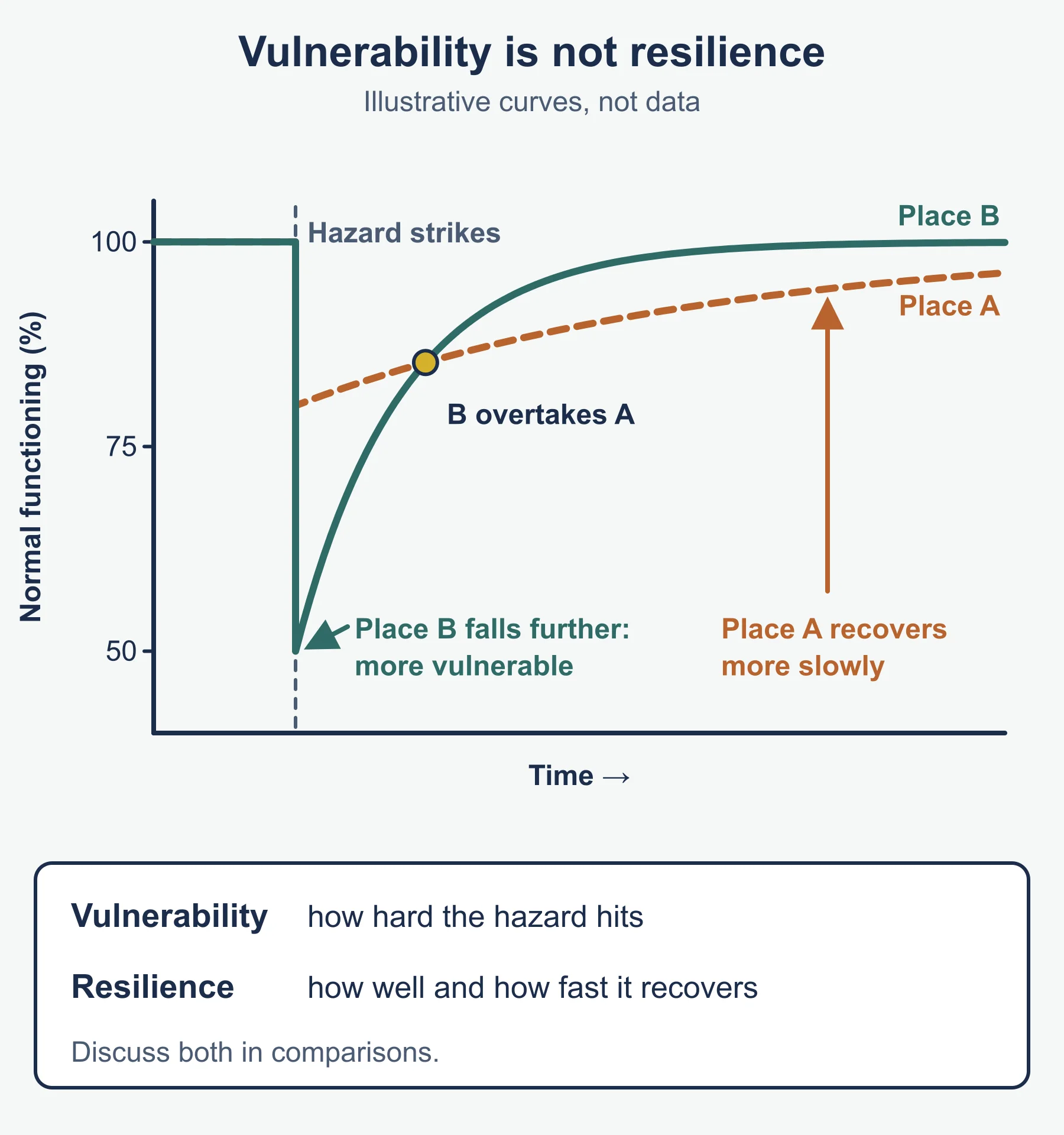
| Vulnerability | Degree to which a place, community or system is susceptible to harm from a climate hazard |
| Resilience | Capacity to absorb, recover from and adapt to climate-related disturbance |
Analysing vulnerability
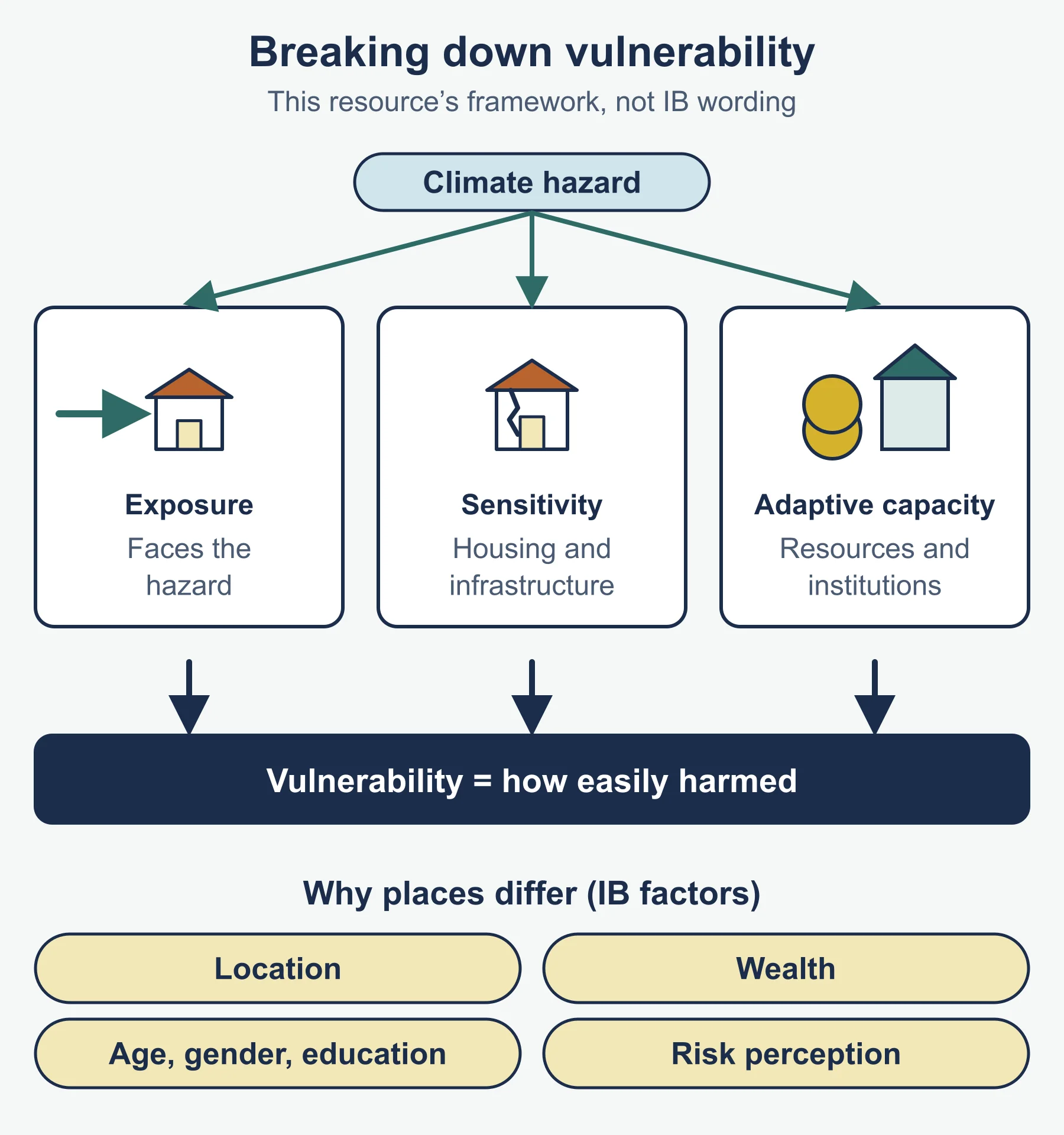
Marlbridge’s study guide breaks vulnerability into three parts. This is its own analytical framework, not IB wording.
- Exposure: the place faces the hazard.
- Sensitivity: how housing, infrastructure and people are affected.
- Adaptive capacity: resources and institutions available to respond.
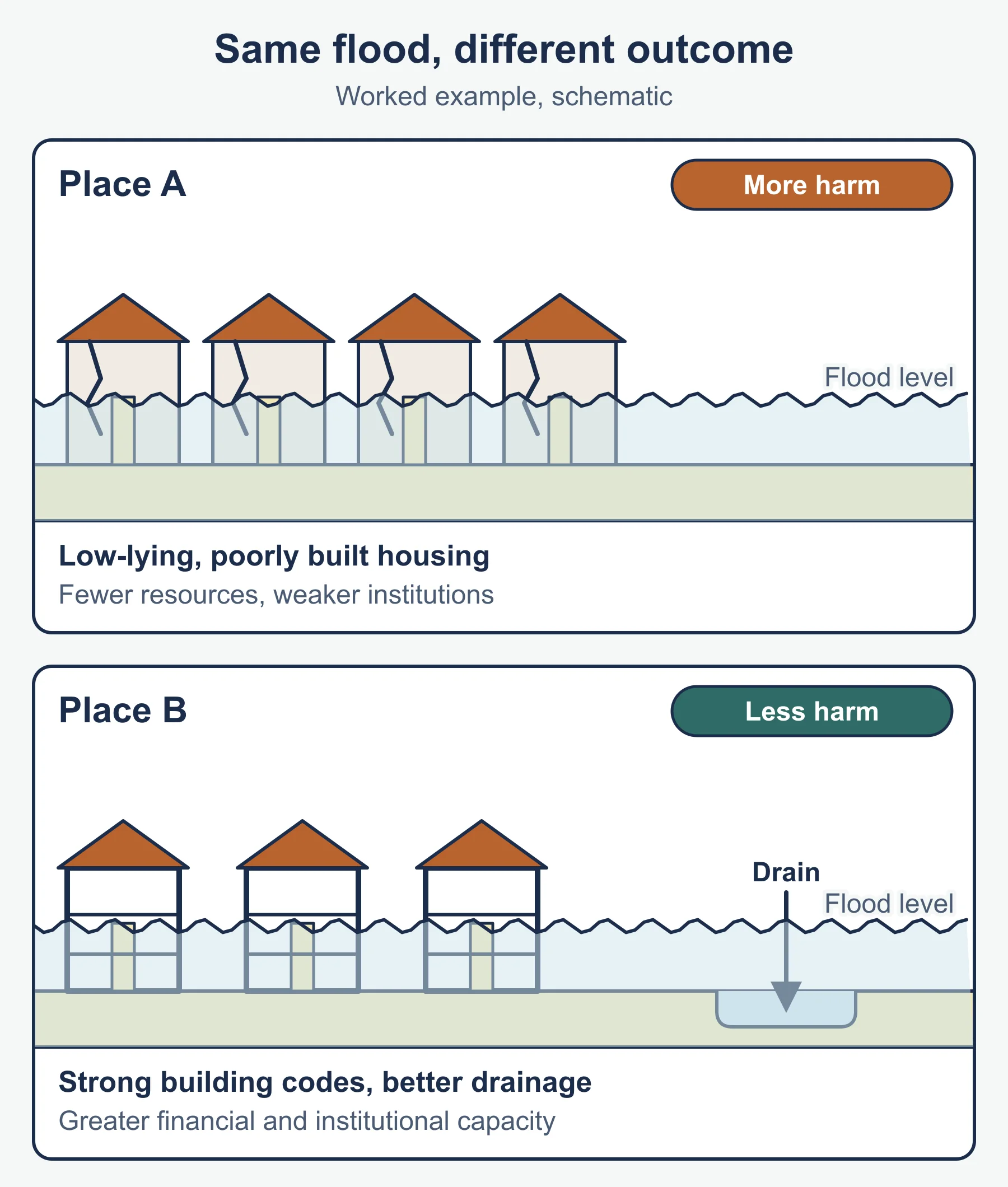
The same hazard gives different outcomes in different places. For example, two places facing a similar flood differ according to housing quality and building codes, drainage, economic resources and institutions. So vulnerability depends on exposure, sensitivity and adaptive capacity, not on hazard size alone.
Contrasting places facing sea-level rise
| Bangladesh | Netherlands | |
|---|---|---|
| Exposure | Low-lying delta of the Ganges, Brahmaputra and Meghna; cyclones and storm surges in the Bay of Bengal | About a quarter of the country lies below sea level |
| Sensitivity | Very high population density on the coast; many farm livelihoods hit by salt water entering soils and wells | Dense, valuable infrastructure, but strong building and drainage standards |
| Adaptive capacity | Limited national budget; but successful cyclone shelters and early-warning volunteers | High income and long experience: the Delta Works built after the 1953 North Sea flood, and the Room for the River programme |
Small island states such as Tuvalu, Kiribati and the Maldives face very high exposure, because most of their land lies only a metre or two above sea level, and they have small economies with few options for retreat. Kiribati bought land in Fiji in 2014, partly as insurance for future food security.
Factors behind differences
The IB guide names location, wealth, social differences such as age, gender and education, and risk perception as reasons people and places differ in exposure and vulnerability.
Applied examples: within a city, older people living alone are most at risk in heatwaves; where women have less access to information, money or mobility, they can face higher risk in some disasters; and people who have never experienced a flood may underestimate the danger and ignore warnings.
Model paragraph (compare vulnerability)
“Both Bangladesh and the Netherlands are low-lying deltas exposed to sea-level rise, but their vulnerability differs. The Netherlands has the wealth and institutions to build and maintain some of the world’s most advanced flood defences, whereas millions of Bangladeshis farm coastal land that is already affected by saltwater. Exposure is similar; sensitivity and adaptive capacity explain why the human consequences are likely to be far greater in Bangladesh.”
Exam traps
- Saying one place is “more vulnerable” without breaking down why.
- Describing consequences only for physical systems and ignoring people.
- Presenting the three-part framework as IB terminology.
- Using named consequences with invented figures; use general terms if you cannot recall data.
- Claiming that melting Arctic sea ice is the main cause of sea-level rise.
- Ignoring that some places may gain (for example longer growing seasons) while others lose.
Self-test
- List three consequences of climate change.
- Define vulnerability.
- Define resilience.
- Name the three parts of the vulnerability framework in the study guide.
- Why can the same flood hazard produce different outcomes?
- Give the two main causes of sea-level rise.
- Why does melting sea ice add very little to sea level?
- Why is glacier retreat a water-supply risk?
- What causes coral bleaching?
- Why are small island states especially vulnerable?
- Why is “climate refugee” a contested term?
Answers: 1. For example sea-level rise, changing rainfall and extreme weather. 2. The degree to which a place or system is susceptible to harm from a hazard. 3. The capacity to absorb, recover from and adapt to disturbance. 4. Exposure, sensitivity and adaptive capacity. 5. Housing quality, drainage, resources and institutions differ, so vulnerability differs. 6. Thermal expansion and melting land ice. 7. Floating ice already displaces its own weight of water. 8. Rivers fed by meltwater become less reliable in dry seasons once glaciers shrink. 9. Unusually warm water makes corals expel the algae that live in them. 10. Most land is very low-lying and their economies are small, with few options for retreat. 11. It has no legal status under the 1951 Refugee Convention and most movement is internal.
More resources on this topic
Related resources
-
Subject guides
IB Diploma Programme Geography: Subject Overview
An overview of IB Diploma Programme Geography – interactions between individuals, societies and physical processes across time and space.
Geography · International Baccalaureate · IB
Read course guide -
Study guides
IB DP Geography Core: Global Climate – Vulnerability and Resilience
Causes, consequences and responses – including vulnerability, resilience, adaptation and mitigation – in the compulsory Global Climate core theme of IB Diploma Programme Geography, examined in Paper 2 for every student regardless of which options a school teaches.
Geography · International Baccalaureate · IB
Read guide -
Practice questions
IB DP Geography Core: Global Climate – Vulnerability and Resilience – Practice Questions
Original practice questions with full worked answers on vulnerability, resilience, adaptation and mitigation, for the compulsory Global Climate core theme of IB Diploma Programme Geography.
Geography · International Baccalaureate · IB
Try questions
Studying Geography?
This page is free and stays free. Marlbridge is not offering Geography classes at the moment, so there is no tuition to book for it. The free study resources stay open to everyone.
Get free revision emails (optional)
Occasional emails with practice questions, worked explanations and links to free resources for the qualification and subjects you choose. No spam, and you can unsubscribe from any email. The free tools on this site never need an email.