
Revision Notes
IB DP Geography: 9.3 Responding to global climate change – Revision Notes
Condensed IB DP Geography notes on 9.3: adaptation versus mitigation, government-led and civil society responses, and disparities in climate risk, with a self-test.
- Subject
- Geography
- Level
- IB
- Topic
- SL and HL core – Global climate – vulnerability and resilience
- Author
- Marlbridge Academic Team
- Updated
- Reviewed by
- Azam Siddique (what this means)
Aligned to International Baccalaureate IB Diploma Programme Geography (DP Geography), First assessments 2019. Official specification .
Syllabus page (what it covers and how it is assessed): IB Diploma Programme Geography.
Syllabus points this page covers
DP Geography
- 9.3 Responding to global climate change
Condensed recall for 9.3 Responding to global climate change (Unit 2: Global climate – vulnerability and resilience). For the full explanation, read the Global Climate study guide.
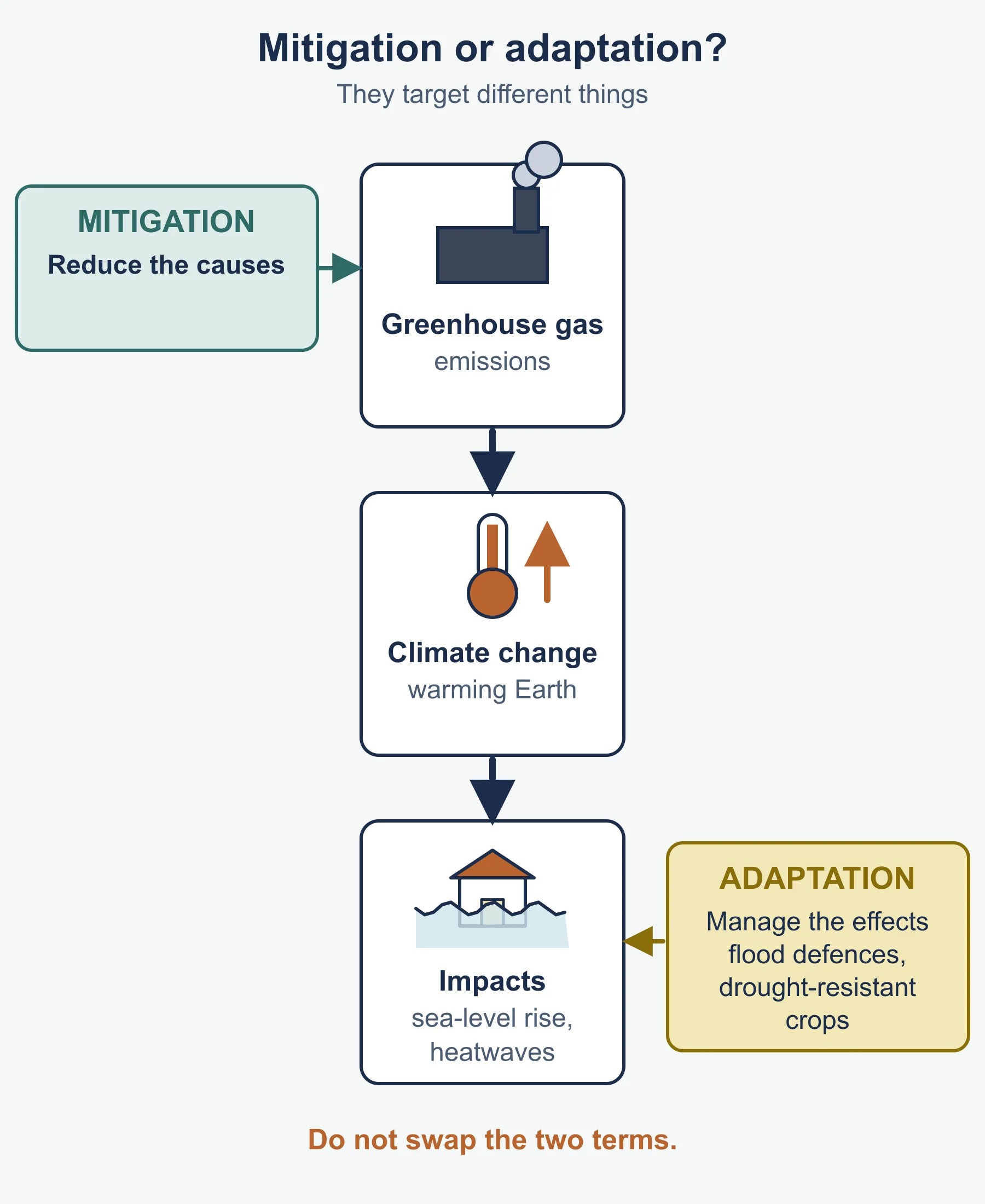
Adaptation versus mitigation
| Mitigation | Adaptation | |
|---|---|---|
| Target | The causes of climate change | The effects of climate change |
| Aim | Reduce emissions | Deliberate change in response to actual or expected impacts |
| Examples | Reducing greenhouse gas emissions | Flood defences, drought-resistant crops |
Never use the two terms interchangeably.
More examples to quote:
| Mitigation | Adaptation |
|---|---|
| Switching from coal to renewable electricity | The Netherlands’ Room for the River programme |
| Energy-efficient buildings and transport | Raised homes and plinths in flood-prone Bangladesh |
| Protecting and planting forests | Drought-tolerant seed varieties and water harvesting in the Sahel |
| Carbon capture and storage | Hulhumalé, a raised artificial island built by the Maldives |
Some actions do both: restoring mangroves stores carbon (mitigation) and protects coasts from storm surges (adaptation).
Government-led responses
- Global geopolitical efforts, recognising that sources of emissions may be spatially distant from the countries most affected.
- Carbon emissions offsetting and trading.
- Technology, including geo-engineering.
Global geopolitical efforts: timeline
| Year | Agreement or meeting | Key point |
|---|---|---|
| 1992 | UN Framework Convention on Climate Change (Rio Earth Summit) | Set the principle of “common but differentiated responsibilities” |
| 1997 | Kyoto Protocol | Binding targets for developed countries only; in force from 2005; the USA never ratified it |
| 2009 | Copenhagen summit | Widely seen as a failure to agree a binding successor |
| 2015 | Paris Agreement | Every party sets its own nationally determined contribution; aim to keep warming well below 2°C and pursue 1.5°C; targets reviewed and strengthened every five years |
| 2023 | COP28, Dubai | First agreement calling for a transition away from fossil fuels in energy systems |
The USA withdrew from the Paris Agreement under President Trump, rejoined in 2021 and announced a second withdrawal in 2025, showing how national politics affects global efforts. Evaluation: Paris includes everyone but its targets are voluntary, and current pledges are not enough to meet its goals.
Carbon trading and offsetting
- Cap and trade: the EU Emissions Trading System (from 2005) caps total emissions from power stations and heavy industry and lets firms buy and sell allowances. Early over-allocation of permits kept prices low; later reforms tightened the cap.
- Carbon tax: a direct price per tonne of carbon dioxide, used for example in Sweden since 1991.
- Offsetting: paying for emission cuts elsewhere, such as forest protection, under the Kyoto Protocol’s Clean Development Mechanism or voluntary markets. Critics question whether the cuts are real, permanent and additional (would they have happened anyway?).
Technology and geo-engineering
| Type | Examples | Concerns |
|---|---|---|
| Carbon dioxide removal | Afforestation, direct air capture, bioenergy with carbon capture | Expensive and unproven at scale; may compete for land |
| Solar radiation management | Injecting reflective aerosols into the stratosphere, mimicking a large volcanic eruption | Does not stop ocean acidification; could alter rainfall; sudden stopping would cause rapid warming; who decides? |
Civil society and corporate strategies
The IB guide asks for a case study of one country’s response to climate change, focusing on the actions of non-governmental stakeholders.
Non-governmental stakeholders include NGOs, youth movements, scientists, courts acting on citizens’ claims, businesses, investors, faith groups and local communities.
- Youth and protest movements: Fridays for Future grew from Greta Thunberg’s school strike in Sweden in 2018; Extinction Rebellion began in the UK the same year.
- Corporate action: company net-zero pledges, commitments to 100 per cent renewable electricity and investor pressure to divest from fossil fuels. Watch for greenwashing, where claims exceed real action.
Case-study outline: the Netherlands.
- The Urgenda Foundation, an NGO, sued the Dutch state; in 2019 the Supreme Court upheld an order for emissions to be cut by at least 25 per cent from 1990 levels by the end of 2020.
- The environmental group Milieudefensie sued Shell; a district court ordered deep emission cuts in 2021, but an appeal court overturned the order in 2024 while confirming that companies have a responsibility to reduce emissions.
- Businesses, cities and water boards also act on adaptation, building on centuries of flood management.
- Evaluation: litigation forced government action, but corporate cases show the limits of courts, and some groups, such as farmers opposing nitrogen rules, have pushed back against environmental policy.
Disparities in exposure and vulnerability
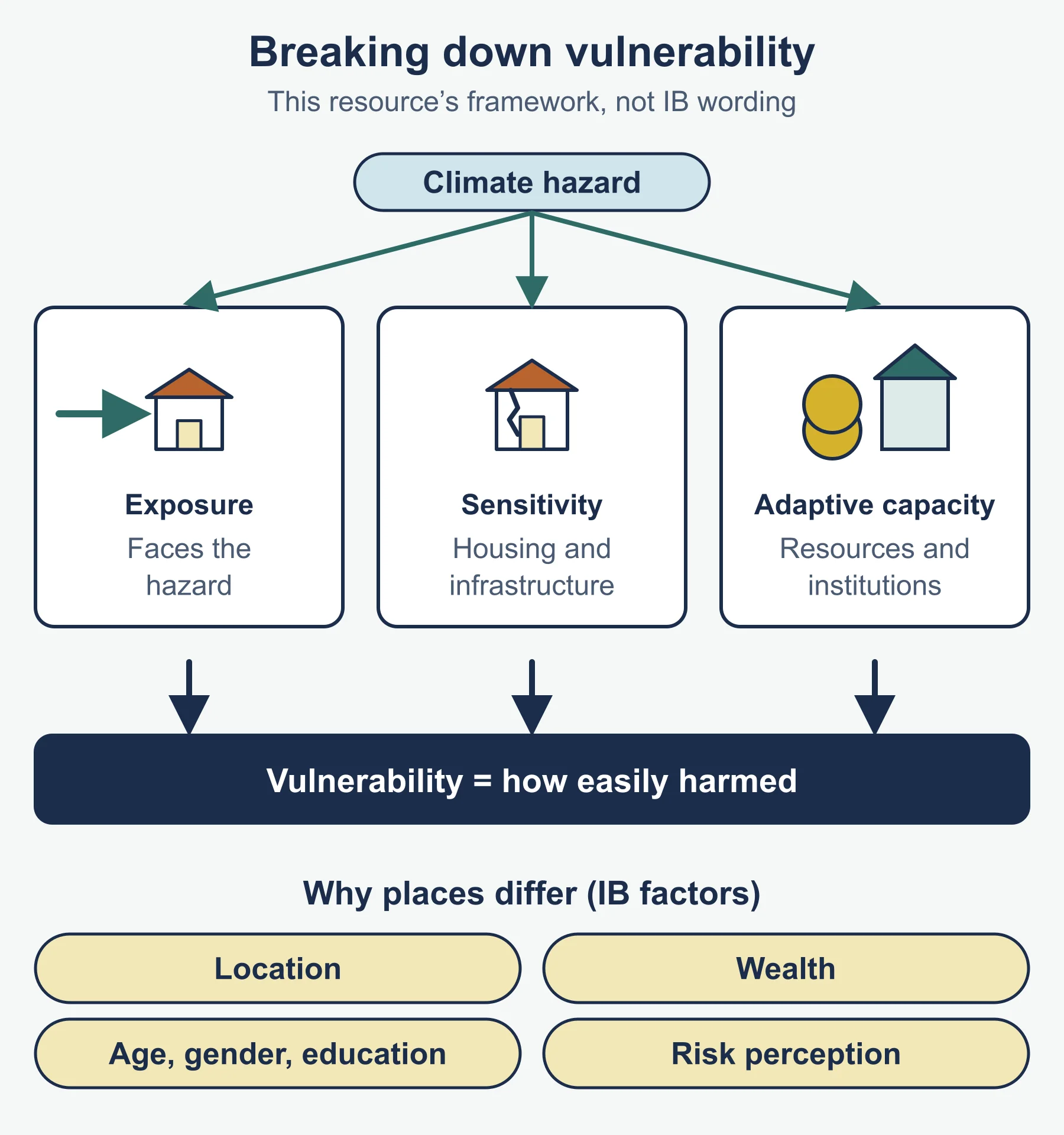
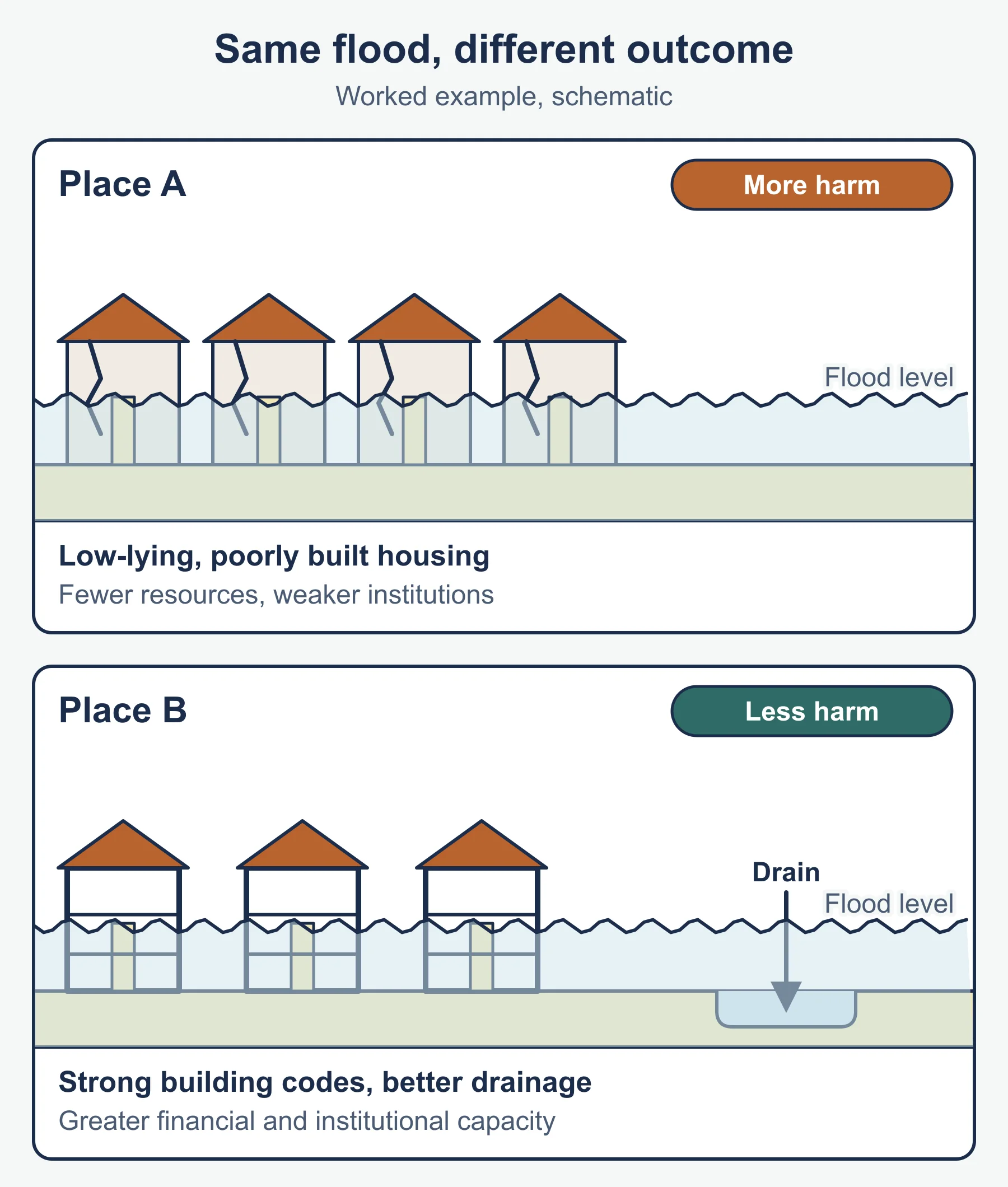
Differences in climate risk relate to location, wealth, social differences such as age, gender and education, and risk perception. The guide asks for detailed examples of two or more societies with contrasting vulnerability.
A useful pair is the Netherlands and Bangladesh: both are low-lying deltas, but the Netherlands has the wealth and institutions to fund advanced defences, while Bangladesh relies more on community preparedness and international finance.
Evaluating a response
Ask whether it targets cause or effect, who pays, who benefits, how long it lasts and whether it is fair between richer and poorer places.
Exam traps
- Mixing up adaptation and mitigation.
- Describing responses with no named place or stakeholder.
- Forgetting that responders and those most affected can be in different countries.
- Offering technology as a complete answer.
- Treating the Kyoto Protocol and Paris Agreement as the same kind of agreement.
- Using a government policy as the case study when the question asks for non-governmental stakeholders.
Self-test
- Distinguish adaptation from mitigation.
- Give an example of each.
- Name two government-led responses.
- What should a civil society case study focus on?
- Which factors explain disparities in climate risk?
- How did the Paris Agreement differ from the Kyoto Protocol?
- How does a cap-and-trade system work?
- Give one criticism of carbon offsetting.
- Name one carbon dioxide removal method and one solar radiation management method.
- What did the Urgenda case achieve?
- Give one action that is both mitigation and adaptation.
Answers: 1. Mitigation reduces the causes; adaptation manages the effects. 2. For example reducing emissions (mitigation) and flood defences (adaptation). 3. For example emissions trading and geo-engineering technology. 4. Actions of non-governmental stakeholders in one country. 5. Location, wealth, age, gender, education and risk perception. 6. Kyoto set binding targets for developed countries only; Paris asks every party to set its own contribution. 7. A cap limits total emissions and firms trade allowances within it. 8. The cuts may not be real, permanent or additional. 9. For example direct air capture; stratospheric aerosol injection. 10. A court order requiring the Dutch state to cut emissions by at least 25 per cent from 1990 levels by the end of 2020. 11. Restoring mangroves.
More resources on this topic
Related resources
-
Subject guides
IB Diploma Programme Geography: Subject Overview
An overview of IB Diploma Programme Geography – interactions between individuals, societies and physical processes across time and space.
Geography · International Baccalaureate · IB
Read course guide -
Revision notes
IB DP Geography: 9.1 Causes of global climate change – Revision Notes
Condensed IB DP Geography notes on 9.1: the energy balance, the greenhouse effect, volcanic dimming, albedo and positive feedback loops, with a self-test.
Geography · International Baccalaureate · IB
Revise topic -
Revision notes
IB DP Geography: 9.2 Consequences of global climate change – Revision Notes
Condensed IB DP Geography notes on 9.2: commonly studied consequences of climate change and why vulnerability differs between places, with a self-test.
Geography · International Baccalaureate · IB
Revise topic
Studying Geography?
This page is free and stays free. Marlbridge is not offering Geography classes at the moment, so there is no tuition to book for it. The free study resources stay open to everyone.
Get free revision emails (optional)
Occasional emails with practice questions, worked explanations and links to free resources for the qualification and subjects you choose. No spam, and you can unsubscribe from any email. The free tools on this site never need an email.