
Revision Notes
IB DP Geography: 13.2 Environmental risks – Revision Notes
Condensed IB DP Geography notes on 13.2: climate, biodiversity, pollution, pandemic and hazard risks, and the hazard, exposure and vulnerability and pressure and release models, with a self-test.
- Subject
- Geography
- Level
- IB
- Topic
- Unit 6: Global risks and resilience
- Author
- Marlbridge Academic Team
- Updated
- Reviewed by
- Azam Siddique (what this means)
Aligned to International Baccalaureate IB Diploma Programme Geography (DP Geography), First assessments 2019. Official specification .
Syllabus page (what it covers and how it is assessed): IB Diploma Programme Geography.
Syllabus points this page covers
DP Geography
- 13.2 Environmental risks
Condensed recall for 13.2 Environmental risks (Unit 6: Global risks and resilience). For the full explanation and the scoring heuristic, read the Global risks and resilience study guide.
Environmental risks
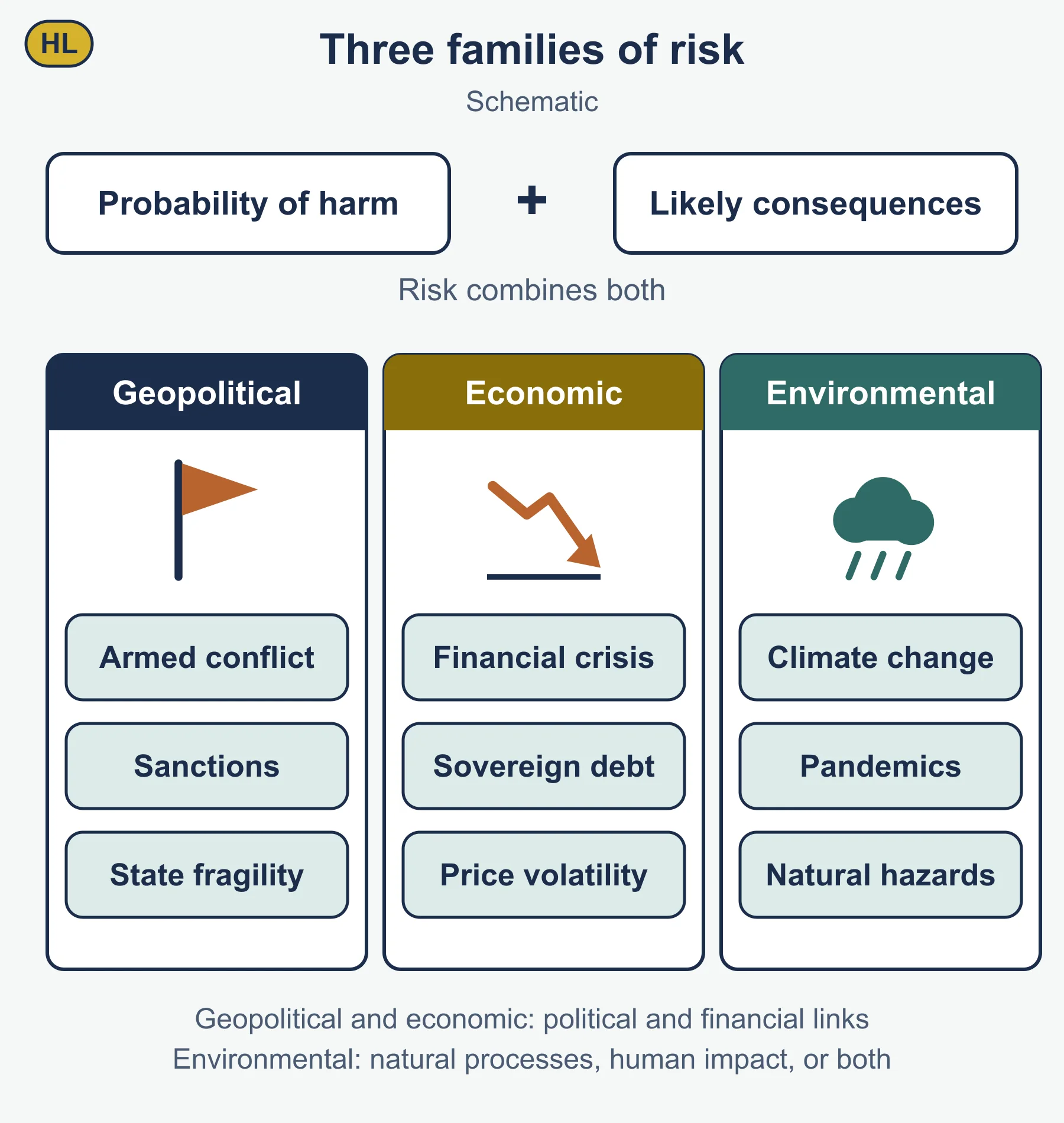
Risks arising from natural processes, human impact on the environment, or the interaction of the two.
| Risk | Key points |
|---|---|
| Climate change | Rising temperatures, changing rainfall, sea-level rise, more intense extremes; consequences for water, food, health and settlement |
| Biodiversity loss and ecosystem decline | Habitat loss, overexploitation and pollution weaken ecosystem services |
| Pollution and resource pressure | Air, water and plastic pollution, soil degradation, water scarcity |
| Disease and pandemics | Spread along travel and trade networks; impact depends on health systems and living conditions |
| Natural hazards | Earthquakes, storms, floods and droughts become disasters when they meet vulnerable populations |
Key terms
| Term | Meaning |
|---|---|
| Hazard | A natural or human-made event or process that could cause harm |
| Exposure | People and assets located where a hazard can reach them |
| Vulnerability | Characteristics that make people or places likely to suffer harm |
| Disaster | A hazard event that seriously disrupts a community beyond its ability to cope |
| Ecosystem services | Benefits people get from ecosystems: provisioning (food, timber), regulating (flood control, climate), cultural (recreation) and supporting (soil formation, nutrient cycling) |
| Zoonosis | A disease that passes from animals to people |
Models of risk
- Disaster risk depends on hazard, exposure and vulnerability, reduced by capacity to cope.
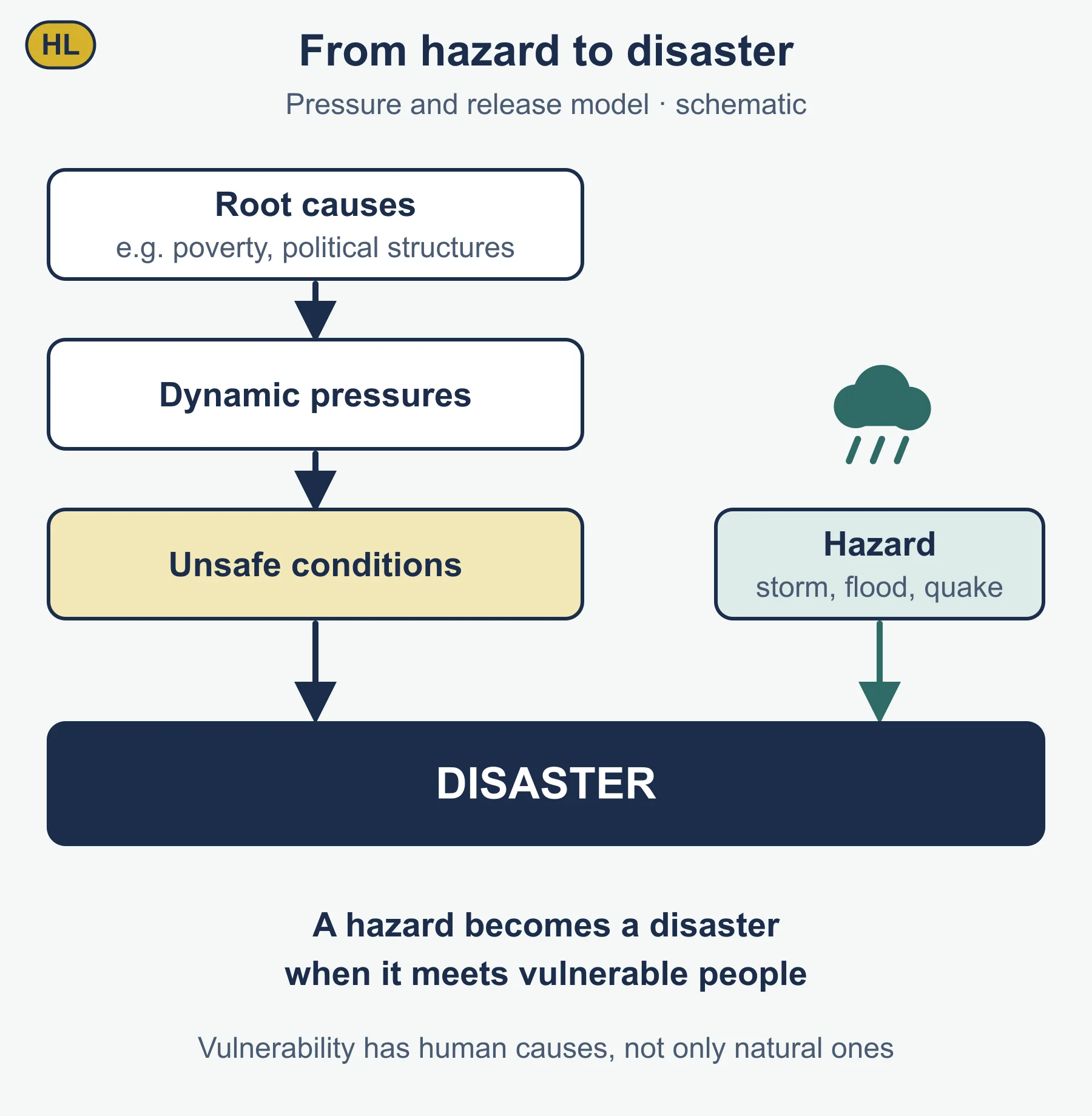
- Pressure and release model (Blaikie and colleagues): vulnerability results from root causes, such as poverty and political structures, that become dynamic pressures and unsafe conditions.
How the pressure and release chain works:
- Root causes: unequal access to power, structures and resources; political and economic systems.
- Dynamic pressures: processes that translate root causes into unsafe conditions, such as a lack of local institutions, training and investment, plus wider forces like rapid urbanisation, population growth, debt and deforestation.
- Unsafe conditions: the specific vulnerable situation, such as people living on unstable slopes, unreinforced buildings, low incomes and no warning system.
- The disaster happens where unsafe conditions meet the hazard. Release means reducing pressure by tackling each stage, not just the hazard.
Scoring heuristic (teaching tool, not an official formula)
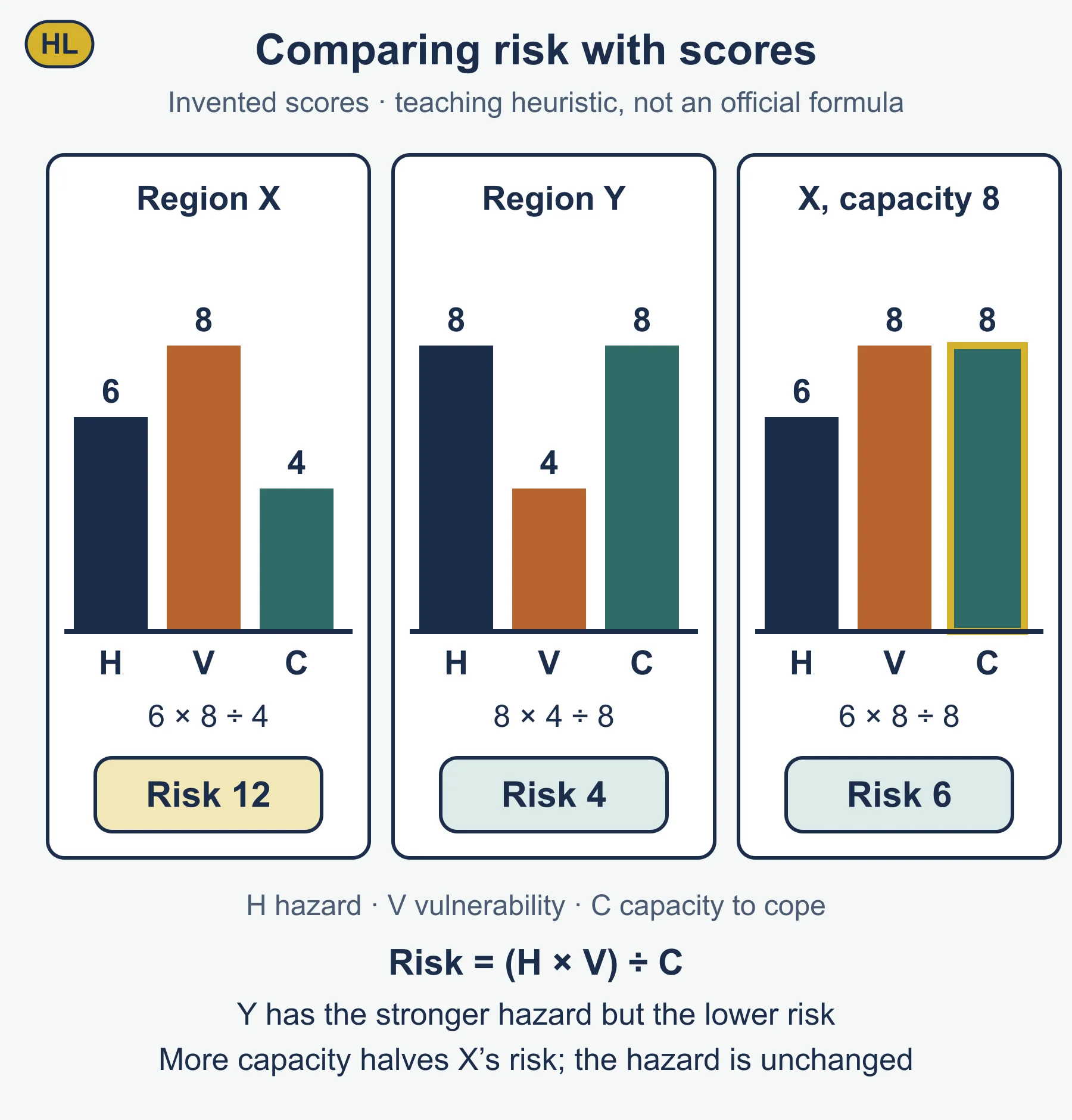
Risk score = (hazard x vulnerability) / capacity to cope, each scored 1 to 10, with invented regions:
- Region X: (6 x 8) / 4 = 12. Region Y: (8 x 4) / 8 = 4.
- Raising X’s capacity from 4 to 8 gives 48 / 8 = 6, halving its risk with no change in hazard.
Evaluate the method: scores are subjective, factors interact and one number hides variation within a region.
Case studies to know
- Haiti and Chile, 2010. Haiti’s magnitude 7.0 earthquake in January 2010 struck close to the capital, Port-au-Prince, and killed a very large number of people (estimates vary widely, from around 100,000 to over 200,000). Chile’s magnitude 8.8 earthquake the following month released far more energy but caused several hundred deaths. Chile’s building codes, governance and wealth explain most of the difference: a clear illustration of pressure and release.
- COVID-19. First identified in Wuhan, China, in late 2019, and declared a pandemic by the World Health Organization in March 2020. It spread fastest through well-connected hubs, then hit hardest where people had crowded housing, insecure work or weak health systems. Vaccines reached high-income countries long before many low-income ones, despite the COVAX sharing scheme.
- Southeast Asian haze. Fires used to clear forest and drained peatland in Indonesia, especially in 2015, spread thick smoke over Singapore and Malaysia, harming health and economies. The ASEAN Agreement on Transboundary Haze Pollution (2002) shows the difficulty of regional governance.
- Chernobyl, 1986. Radioactive fallout from the Ukrainian (then Soviet) reactor explosion spread across much of Europe, a classic transboundary risk.
- Plastic pollution. Plastic waste travels on ocean currents and accumulates in gyres such as the Great Pacific Garbage Patch; negotiations on a global plastics treaty began in 2022.
- Biodiversity loss. Deforestation in the Amazon removes carbon storage and regulating services and opens forest edges where people and wildlife come into closer contact, which is one way new zoonotic diseases can emerge.
Transboundary nature
Environmental risks often cross borders, so one country’s actions can create risks for another. This links the subtopic to global governance.
Because no single government controls the source, transboundary risks need agreements, monitoring and trust between states. The free-rider problem (a state benefiting from others’ action without acting itself) weakens many agreements.
Model paragraph (examine)
“The contrast between Haiti and Chile in 2010 shows that disaster risk depends more on vulnerability than on hazard size. Chile’s earthquake was far larger, but strict building codes and effective emergency services kept deaths low. In Haiti, root causes such as long-term poverty and weak governance had produced unsafe conditions, such as poorly built concrete housing in a dense capital, so a smaller hazard caused a far greater disaster.”
Exam traps
- Calling any natural hazard a disaster; a disaster needs vulnerable people.
- Quoting the scoring heuristic as an official formula.
- Naming a risk without explaining who is most exposed and why.
- Comparing hazards by magnitude alone and ignoring vulnerability.
- Quoting precise death tolls you cannot support; say “estimates vary” where they do.
Self-test
- Name three environmental risks.
- State the factors in disaster risk.
- What are the stages of the pressure and release model?
- Why is the scoring heuristic only a teaching tool?
- Why are environmental risks often transboundary?
- Distinguish a hazard from a disaster.
- Name the four types of ecosystem service.
- Why did Chile’s 2010 earthquake kill far fewer people than Haiti’s?
- Give two reasons COVID-19 impacts differed between places.
- What is the free-rider problem?
- What does “release” mean in the pressure and release model?
Answers: 1. For example climate change, biodiversity loss and pandemics. 2. Hazard, exposure and vulnerability, reduced by capacity to cope. 3. Root causes, dynamic pressures and unsafe conditions. 4. Scores are subjective and a single number hides variation. 5. Their effects cross borders, so one country’s actions affect others. 6. A hazard is a potentially harmful event; a disaster is when it seriously disrupts a community beyond its ability to cope. 7. Provisioning, regulating, cultural and supporting. 8. Better building codes, governance and resources. 9. For example health system capacity, crowded housing, connectivity or vaccine access. 10. A state benefiting from others’ action without acting itself. 11. Reducing vulnerability by tackling root causes, pressures and unsafe conditions.
More resources on this topic
Related resources
-
Subject guides
IB Diploma Programme Geography: Subject Overview
An overview of IB Diploma Programme Geography – interactions between individuals, societies and physical processes across time and space.
Geography · International Baccalaureate · IB
Read course guide -
Revision notes
IB DP Geography: 13.1 Geopolitical and economic risks – Revision Notes
Condensed IB DP Geography notes on 13.1: defining risk, geopolitical and economic risks, interdependence as a transmission mechanism and unequal exposure, with a self-test.
Geography · International Baccalaureate · IB
Revise topic -
Study guides
IB DP Geography: Unit 6: Global risks and resilience – Study Guide
Geopolitical, economic and environmental risks, and local and global resilience, as studied in the Higher Level extension of IB Diploma Programme Geography.
Geography · International Baccalaureate · IB
Read guide
Studying Geography?
This page is free and stays free. Marlbridge is not offering Geography classes at the moment, so there is no tuition to book for it. The free study resources stay open to everyone.
Get free revision emails (optional)
Occasional emails with practice questions, worked explanations and links to free resources for the qualification and subjects you choose. No spam, and you can unsubscribe from any email. The free tools on this site never need an email.