
Revision Notes
IB DP Geography: 13.1 Geopolitical and economic risks – Revision Notes
Condensed IB DP Geography notes on 13.1: defining risk, geopolitical and economic risks, interdependence as a transmission mechanism and unequal exposure, with a self-test.
- Subject
- Geography
- Level
- IB
- Topic
- Unit 6: Global risks and resilience
- Author
- Marlbridge Academic Team
- Updated
- Reviewed by
- Azam Siddique (what this means)
Aligned to International Baccalaureate IB Diploma Programme Geography (DP Geography), First assessments 2019. Official specification .
Syllabus page (what it covers and how it is assessed): IB Diploma Programme Geography.
Syllabus points this page covers
DP Geography
- 13.1 Geopolitical and economic risks
Condensed recall for 13.1 Geopolitical and economic risks (Unit 6: Global risks and resilience). For the full explanation, read the Global risks and resilience study guide.
Definition
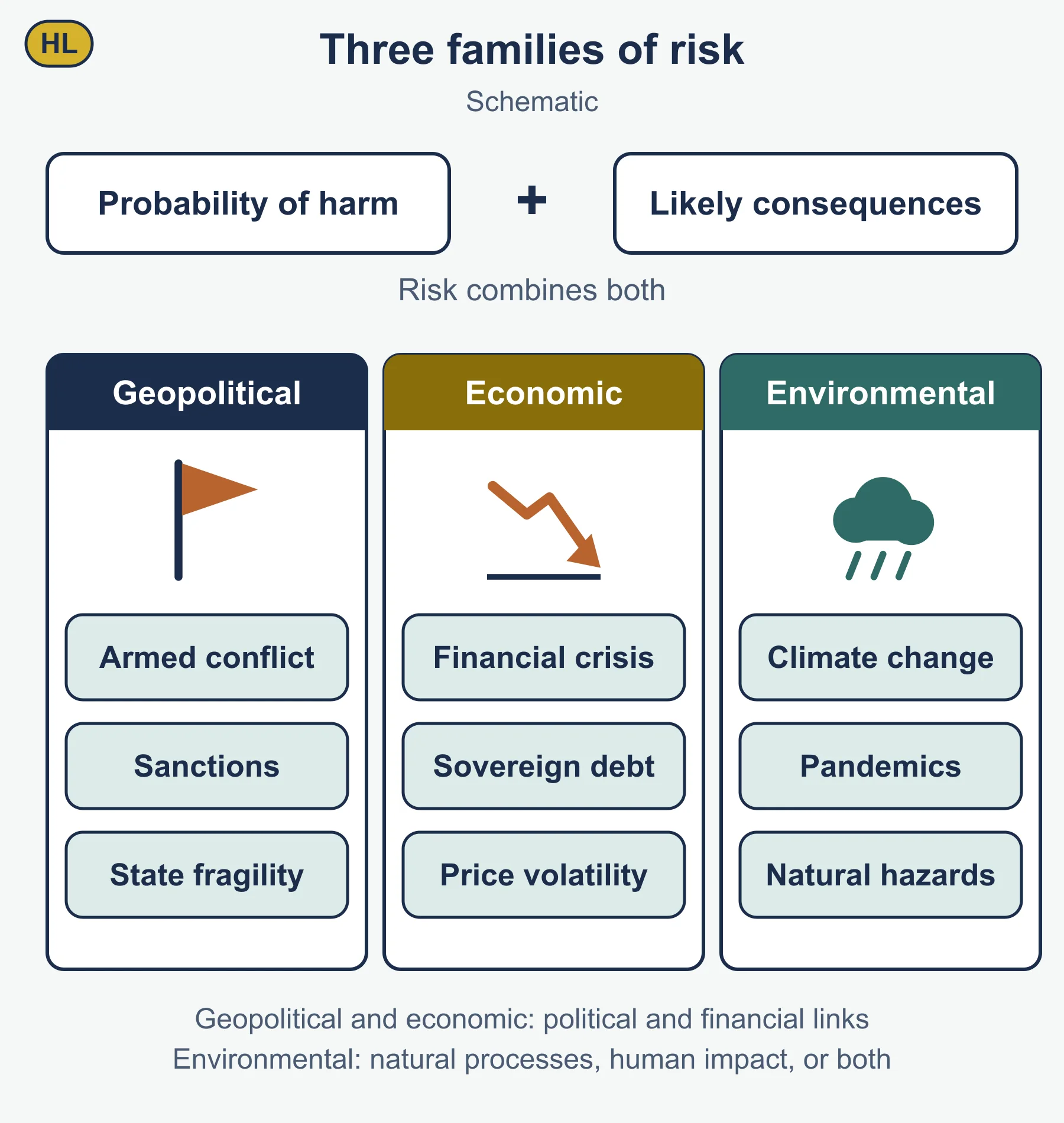
A risk is the probability of a harmful event combined with its likely consequences. Geopolitical and economic risks arise from political and financial relationships rather than from physical processes.
Types
| Geopolitical | Economic |
|---|---|
| Armed conflict | Financial crises |
| Terrorism | Sovereign debt problems |
| Tension over borders and resources | Volatile commodity prices |
| State fragility | Unemployment |
| Sanctions | Trade disputes |
| Weakening international cooperation |
- Conflict can displace populations, disrupt trade routes and damage food and energy security.
- The global financial crisis that began in 2007 to 2008 is a standard example of a shock spreading through connected financial systems.
Two further risks that cut across both columns:
- Cyber risk: attacks on networks and infrastructure. The WannaCry ransomware attack (2017) disrupted computers in many countries, including parts of the UK’s National Health Service.
- Supply-chain concentration: when one place dominates production of something essential. Taiwan, for example, makes most of the world’s most advanced semiconductors, so tension in that region is a global economic risk.
Key terms
| Term | Meaning |
|---|---|
| Interdependence | Places relying on each other through trade, finance and supply chains |
| Contagion | A shock spreading from one market or country to others |
| Systemic risk | The risk that failure of one part brings down a whole system |
| Chokepoint | A narrow route through which a large share of trade must pass |
| Sovereign debt | Money owed by a national government |
| Commodity dependence | Reliance on one or a few raw-material exports for income |
Case studies to know
- Global financial crisis, 2007 to 2009. Risky US mortgage lending was packaged into securities sold to banks worldwide. When house prices fell, losses spread through the banking system; the collapse of Lehman Brothers in September 2008 triggered panic and a global recession. Iceland’s banking system collapsed. Responses included bank rescues, interest-rate cuts, stimulus spending and tighter banking rules. Exposure differed: export-dependent economies were hit by falling demand, while some with little connection to global finance were less directly affected.
- Eurozone debt crisis, from 2010. Greece and other countries could not borrow affordably and received rescue loans conditional on austerity, leading to deep recession and very high unemployment, particularly among young people.
- Russia’s full-scale invasion of Ukraine, 2022. Ukraine is a major grain exporter, so blocked Black Sea shipping raised food prices for import-dependent countries in North Africa and the Middle East. The Black Sea Grain Initiative (July 2022 to July 2023) temporarily reopened exports. Europe’s reliance on Russian gas led to sharp energy price rises and a rapid shift to imported liquefied natural gas.
- Shipping chokepoints. The container ship Ever Given blocked the Suez Canal for about six days in March 2021, holding up hundreds of ships. From late 2023, attacks on ships in the Red Sea led many shipping lines to divert around the Cape of Good Hope, adding time and cost. The Strait of Hormuz carries a large share of the world’s seaborne oil.
- Commodity dependence. Venezuela’s economy relied overwhelmingly on oil exports; when oil prices fell sharply from 2014, combined with poor economic management, the country suffered hyperinflation, shortages and large-scale emigration. Zambia’s dependence on copper creates similar exposure.
Transmission and exposure
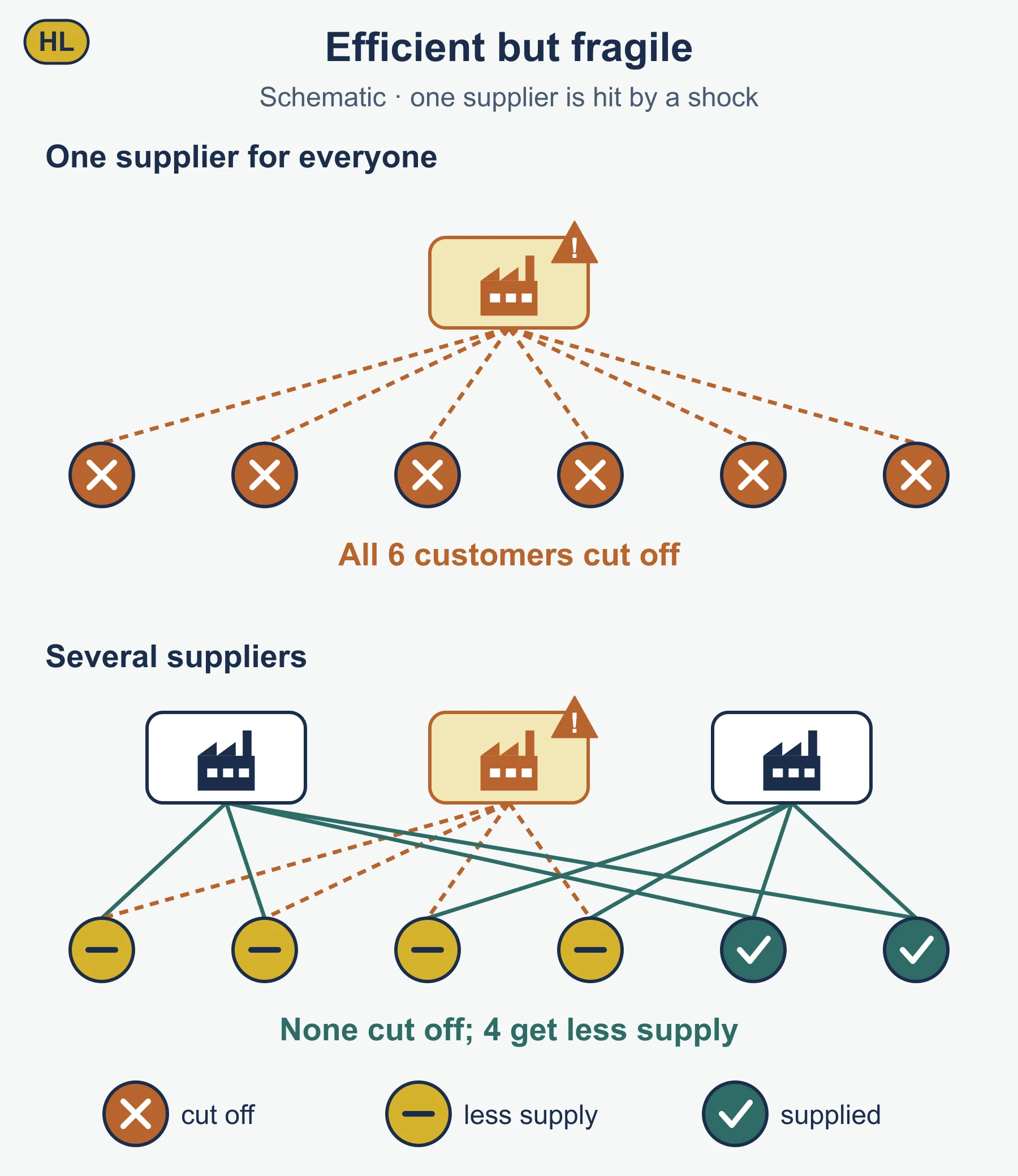
- Interdependence is the transmission mechanism: heavy reliance on a single supplier, market or route makes a system efficient but fragile.
- Unequal exposure: states with weak institutions, narrow export bases or heavy debt tend to be more vulnerable and less able to recover.
Efficiency versus resilience: just-in-time supply chains keep little stock to cut costs, so a single disruption spreads quickly. Many firms and governments now favour just-in-case stocks, diversified suppliers and moving production closer to home, which costs more but reduces risk.
Analysing a risk
For each risk identify the source, the groups affected, the scale at which it operates and the responses available, from diplomacy and peacekeeping to financial regulation and debt relief.
| Step | Applied to the 2022 grain shock |
|---|---|
| Source | War and blocked Black Sea ports |
| Groups affected | Poorer households in grain-importing countries, Ukrainian farmers |
| Scale | Local (farms), national (Ukraine’s economy), global (food prices) |
| Responses | Diplomatic grain corridor, food aid, alternative overland export routes |
Model paragraph (to what extent)
“Interdependence spread the 2008 financial crisis from US housing to banks worldwide, showing that connection can amplify risk. Yet the same connections allowed coordinated responses, as central banks cut interest rates together and the G20 agreed stimulus measures. Interdependence therefore transmits shocks but also creates the means to respond, and the balance depends on whether institutions cooperate.”
Exam traps
- Naming risks without linking them to consequences for people.
- Treating a risk as only local when it travels through connected systems.
- Describing the financial crisis with invented figures.
- Ignoring that exposure differs between states.
- Assuming interdependence only increases risk; it can also deter conflict and enable responses.
Self-test
- Define risk.
- Give two geopolitical and two economic risks.
- How does interdependence transmit shocks?
- Which states are more vulnerable?
- What four things should you identify for each risk?
- What is a chokepoint? Give an example.
- Why did the war in Ukraine affect food prices far away?
- What event in September 2008 deepened the financial crisis?
- Why is commodity dependence risky?
- Distinguish just-in-time from just-in-case supply chains.
- What is contagion?
Answers: 1. The probability of a harmful event combined with its likely consequences. 2. For example conflict and sanctions; financial crises and commodity price volatility. 3. Reliance on one supplier, market or route spreads a failure through the system. 4. Those with weak institutions, narrow export bases or heavy debt. 5. Source, groups affected, scale and available responses. 6. A narrow route through which much trade passes, such as the Suez Canal or Strait of Hormuz. 7. Ukraine is a major grain exporter and shipping was blocked, so import-dependent countries faced higher prices. 8. The collapse of Lehman Brothers. 9. Income collapses when the price of that one commodity falls. 10. Just-in-time keeps minimal stock for efficiency; just-in-case holds reserves and diversifies suppliers for resilience. 11. A shock spreading from one market or country to others.
More resources on this topic
Related resources
-
Subject guides
IB Diploma Programme Geography: Subject Overview
An overview of IB Diploma Programme Geography – interactions between individuals, societies and physical processes across time and space.
Geography · International Baccalaureate · IB
Read course guide -
Study guides
IB DP Geography: Unit 6: Global risks and resilience – Study Guide
Geopolitical, economic and environmental risks, and local and global resilience, as studied in the Higher Level extension of IB Diploma Programme Geography.
Geography · International Baccalaureate · IB
Read guide -
Revision notes
IB DP Geography: 13.3 Local and global resilience – Revision Notes
Condensed IB DP Geography notes on 13.3: resilience, adaptation and mitigation, responses at local, national and global scales, and why resilience is unevenly available, with a self-test.
Geography · International Baccalaureate · IB
Revise topic
Studying Geography?
This page is free and stays free. Marlbridge is not offering Geography classes at the moment, so there is no tuition to book for it. The free study resources stay open to everyone.
Get free revision emails (optional)
Occasional emails with practice questions, worked explanations and links to free resources for the qualification and subjects you choose. No spam, and you can unsubscribe from any email. The free tools on this site never need an email.