
Revision Notes
IB DP Geography: 13.3 Local and global resilience – Revision Notes
Condensed IB DP Geography notes on 13.3: resilience, adaptation and mitigation, responses at local, national and global scales, and why resilience is unevenly available, with a self-test.
- Subject
- Geography
- Level
- IB
- Topic
- Unit 6: Global risks and resilience
- Author
- Marlbridge Academic Team
- Updated
- Reviewed by
- Azam Siddique (what this means)
Aligned to International Baccalaureate IB Diploma Programme Geography (DP Geography), First assessments 2019. Official specification .
Syllabus page (what it covers and how it is assessed): IB Diploma Programme Geography.
Syllabus points this page covers
DP Geography
- 13.3 Local and global resilience
Condensed recall for 13.3 Local and global resilience (Unit 6: Global risks and resilience). For the full explanation, read the Global risks and resilience study guide.
Key terms
| Term | Meaning |
|---|---|
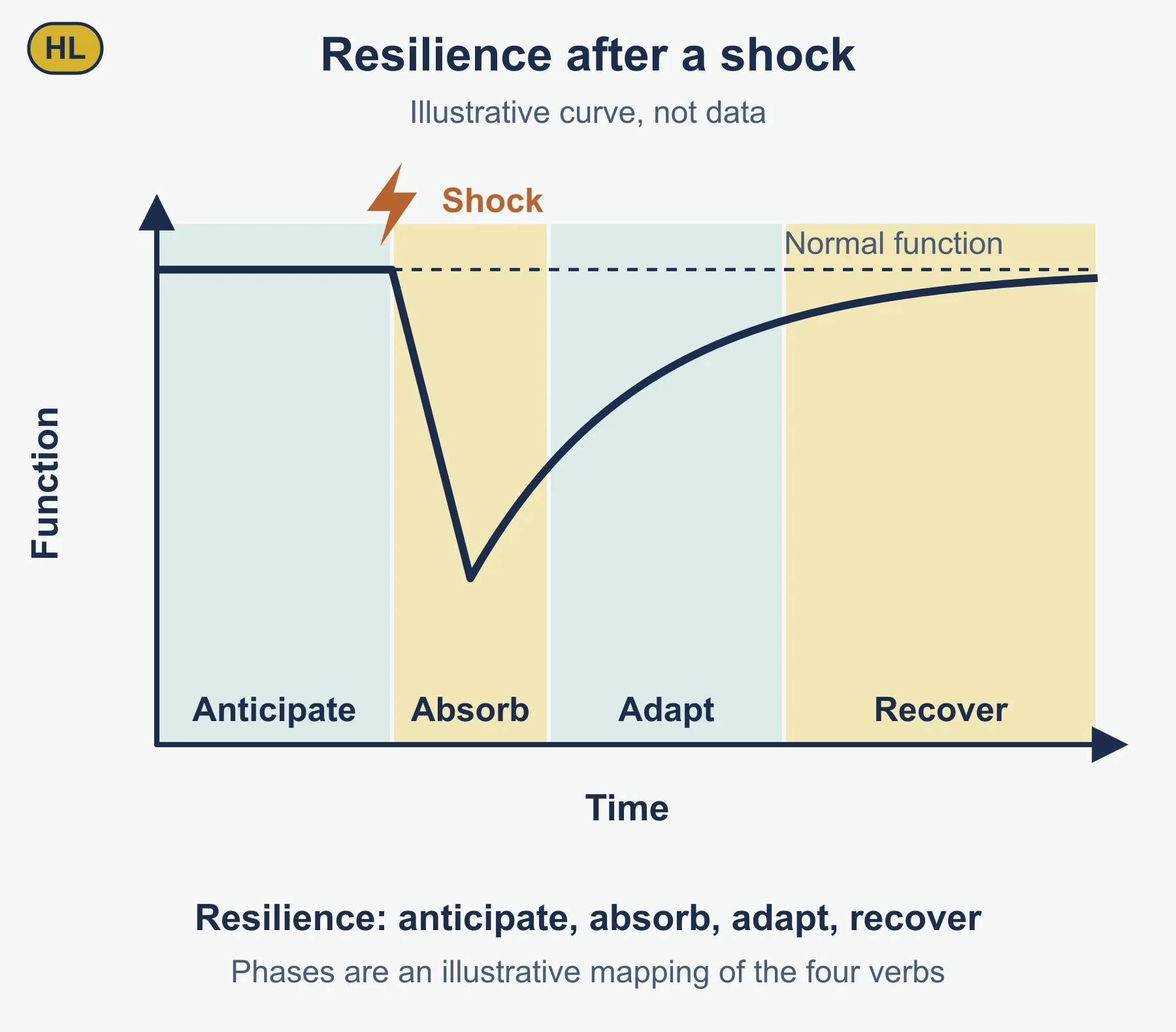
| Resilience | Capacity of a person, community or system to anticipate, absorb, adapt to and recover from shocks |
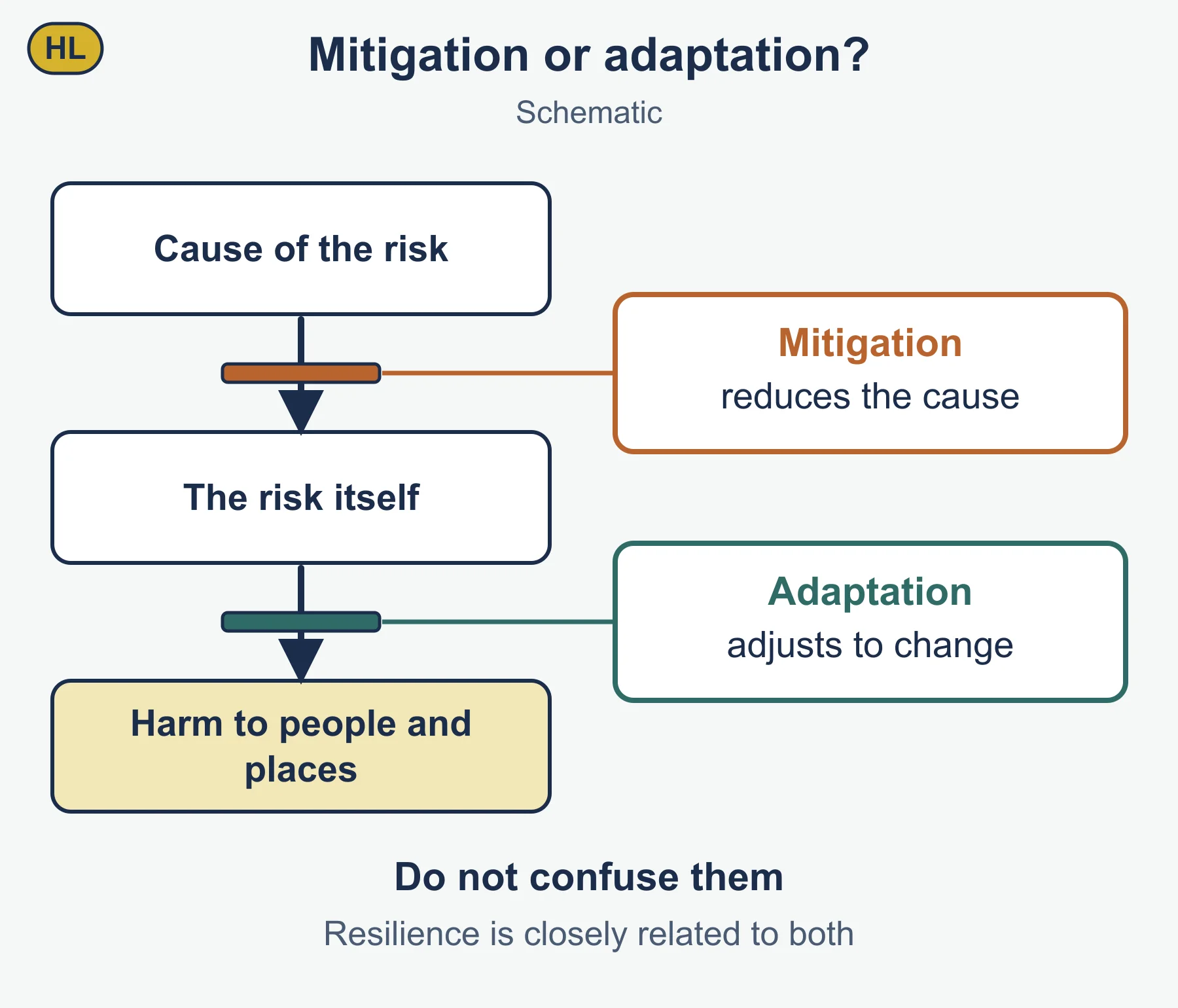
| Adaptation | Adjusting to expected change |
| Mitigation | Reducing the cause of the risk |
More terms to use precisely:
| Term | Meaning |
|---|---|
| Redundancy | Spare capacity or back-up systems, so one failure does not stop everything |
| Diversification | Spreading activity across several sources, products, suppliers or markets |
| Risk transfer | Passing the financial cost of a shock to others, as with insurance or catastrophe bonds |
| Maladaptation | A response that reduces risk now but increases it later or for other people |
| Build back better | Using recovery to reduce future vulnerability, not just restore what was lost |
Resilience is sometimes described as “bouncing back”, but many writers prefer “bouncing forward”: recovering to a stronger position than before the shock.
Responses by scale
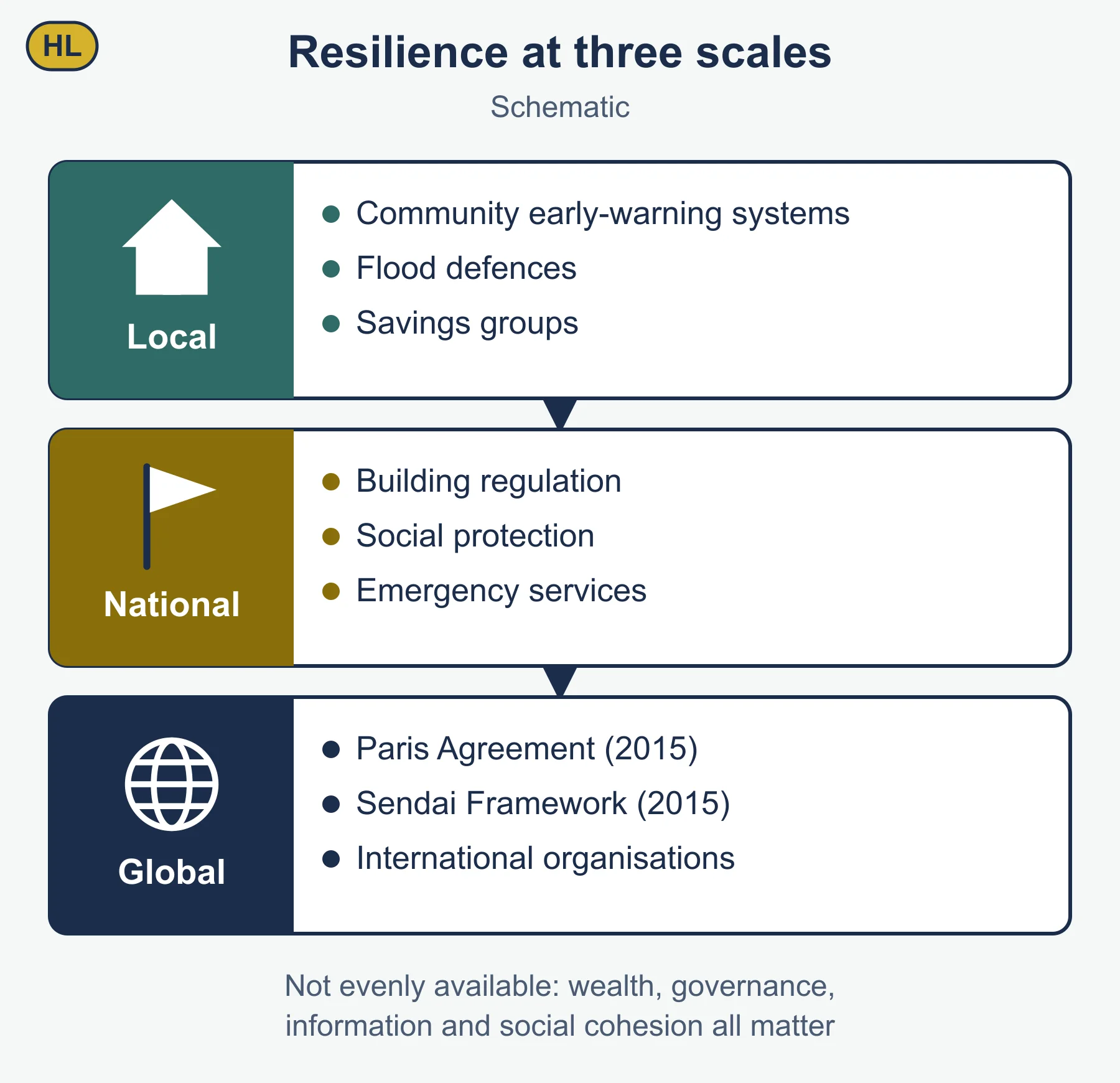
| Scale | Examples |
|---|---|
| Local | Community early-warning systems, flood defences and building standards, diversified livelihoods, savings groups, local knowledge and social networks |
| National | Planning and building regulation, social protection, emergency services, investment in infrastructure and institutions |
| Global | Agreements and frameworks such as the Paris Agreement on climate change and the Sendai Framework for Disaster Risk Reduction (both adopted in 2015); international organisations and financial institutions |
Case studies by scale
- Local: Bangladesh’s cyclone preparedness. The Cyclone Preparedness Programme, set up in 1972 after the catastrophic 1970 Bhola cyclone, trains tens of thousands of community volunteers to spread warnings and help people reach raised cyclone shelters. Deaths from major cyclones have fallen dramatically, from hundreds of thousands in 1970 to a few thousand in Cyclone Sidr (2007), even though exposure has grown. Limits: livelihoods, crops and homes are still lost, and some people, especially women caring for children or livestock, have been reluctant to leave.
- National: Japan. Strict earthquake building codes, regular drills and a nationwide earthquake early-warning system (operating since 2007) reduce risk. Yet the 2011 Tohoku tsunami overtopped many sea walls, showing that defences designed for an expected event can fail against a larger one.
- National: Singapore’s water. Singapore built resilience against dependence on imported water through its “Four National Taps”: local catchment, imported water from Malaysia, recycled wastewater (NEWater, from 2003) and desalination.
- National: the Netherlands. The Room for the River programme lowered floodplains, moved dykes back and created overflow channels so rivers could flood safely in chosen areas instead of raising walls ever higher.
- Economic: diversification. Gulf states such as the United Arab Emirates (through Dubai’s trade, aviation, tourism and finance) and Saudi Arabia (its Vision 2030 plan, launched in 2016) aim to reduce dependence on oil revenue.
The global frameworks
- Sendai Framework (2015 to 2030): succeeded the Hyogo Framework (2005 to 2015). It has seven global targets and four priorities: understanding disaster risk; strengthening disaster risk governance; investing in disaster risk reduction; and enhancing preparedness and “build back better” in recovery. It shifted the focus from managing disasters to managing risk.
- Paris Agreement (2015): countries set their own nationally determined contributions, aiming to keep warming well below 2°C and pursue efforts to limit it to 1.5°C. A loss and damage fund for vulnerable countries was agreed at COP27 (2022) and set up at COP28 (2023).
- Global health: the World Health Organization’s International Health Regulations (2005) require countries to report and respond to public health emergencies; COVID-19 exposed gaps in preparedness and vaccine sharing.
- Finance: the IMF provides emergency lending; insurance pools such as African Risk Capacity give member governments rapid payouts after drought.
Resilience is unevenly available
Wealth, governance, information and social cohesion all affect it.
Within one country, resilience varies by income, age, gender, disability and legal status: informal workers and undocumented migrants may be excluded from social protection, and people without insurance or savings take longer to recover.
Evaluating resilience measures
Weigh:
- Who pays for resilience.
- Whether measures reduce the underlying cause or only the symptoms.
- Whether short-term protection can create long-term vulnerability.
- Top-down measures: often well funded but poorly matched to local needs.
- Community-based measures: fit local needs well but may lack resources.
A classic example of short-term protection creating long-term vulnerability is the levee effect: building defences encourages development behind them, so when an extreme event overtops them the losses are larger. Supply chains offer an economic parallel: just-in-time systems cut costs but leave firms with no buffer when a shock hits.
Model paragraph (evaluate)
“Bangladesh’s community-based cyclone warnings have been highly effective at saving lives because volunteers know local people and places, and shelters are close at hand. However, they do less to protect livelihoods, so poor households may still be pushed deeper into poverty after each storm. Combining local warnings with national social protection and global climate finance would build resilience to both loss of life and loss of income.”
Exam traps
- Using resilience, adaptation and mitigation as synonyms.
- Describing only one scale of response.
- Assuming a well-funded measure works well locally.
- Judging a measure by its cost alone, without asking whether it fits local needs.
- Measuring success only by deaths avoided and ignoring economic and social recovery.
Self-test
- Define resilience.
- Distinguish adaptation from mitigation.
- Give one local and one global response.
- When were the Paris Agreement and Sendai Framework adopted?
- Why is resilience unevenly available?
- What is maladaptation? Give an example.
- Name the four priorities of the Sendai Framework.
- Why has Bangladesh’s cyclone death toll fallen?
- How has Singapore made its water supply more resilient?
- What is risk transfer?
- What did COP27 agree on loss and damage?
Answers: 1. The capacity to anticipate, absorb, adapt to and recover from shocks. 2. Adaptation adjusts to expected change; mitigation reduces the cause. 3. For example community early warning (local) and the Paris Agreement (global). 4. Both in 2015. 5. Wealth, governance, information and social cohesion differ between places. 6. A response that reduces risk now but increases it later or for others, such as the levee effect. 7. Understanding disaster risk, strengthening governance, investing in risk reduction, and preparedness with build back better. 8. Volunteer warning systems and cyclone shelters. 9. Through four sources: local catchment, imports, recycled water and desalination. 10. Passing the financial cost of a shock to others, for example through insurance. 11. To establish a fund for vulnerable countries, which was set up at COP28.
More resources on this topic
Related resources
-
Subject guides
IB Diploma Programme Geography: Subject Overview
An overview of IB Diploma Programme Geography – interactions between individuals, societies and physical processes across time and space.
Geography · International Baccalaureate · IB
Read course guide -
Revision notes
IB DP Geography: 13.2 Environmental risks – Revision Notes
Condensed IB DP Geography notes on 13.2: climate, biodiversity, pollution, pandemic and hazard risks, and the hazard, exposure and vulnerability and pressure and release models, with a self-test.
Geography · International Baccalaureate · IB
Revise topic -
Revision notes
IB DP Geography: 13.1 Geopolitical and economic risks – Revision Notes
Condensed IB DP Geography notes on 13.1: defining risk, geopolitical and economic risks, interdependence as a transmission mechanism and unequal exposure, with a self-test.
Geography · International Baccalaureate · IB
Revise topic
Studying Geography?
This page is free and stays free. Marlbridge is not offering Geography classes at the moment, so there is no tuition to book for it. The free study resources stay open to everyone.
Get free revision emails (optional)
Occasional emails with practice questions, worked explanations and links to free resources for the qualification and subjects you choose. No spam, and you can unsubscribe from any email. The free tools on this site never need an email.