
Revision Notes
IB DP Geography: 11.1 Global interactions and global power – Revision Notes
Condensed IB DP Geography notes on 11.1: hard, soft and economic power, state and non-state actors, core and periphery, shifting power and interdependence, with a self-test.
- Subject
- Geography
- Level
- IB
- Topic
- Unit 4: Power, places and networks
- Author
- Marlbridge Academic Team
- Updated
- Reviewed by
- Azam Siddique (what this means)
Aligned to International Baccalaureate IB Diploma Programme Geography (DP Geography), First assessments 2019. Official specification .
Syllabus page (what it covers and how it is assessed): IB Diploma Programme Geography.
Syllabus points this page covers
DP Geography
- 11.1 Global interactions and global power
Condensed recall for 11.1 Global interactions and global power (Unit 4: Power, places and networks). For the full explanation, read the Power, places and networks study guide.
Power
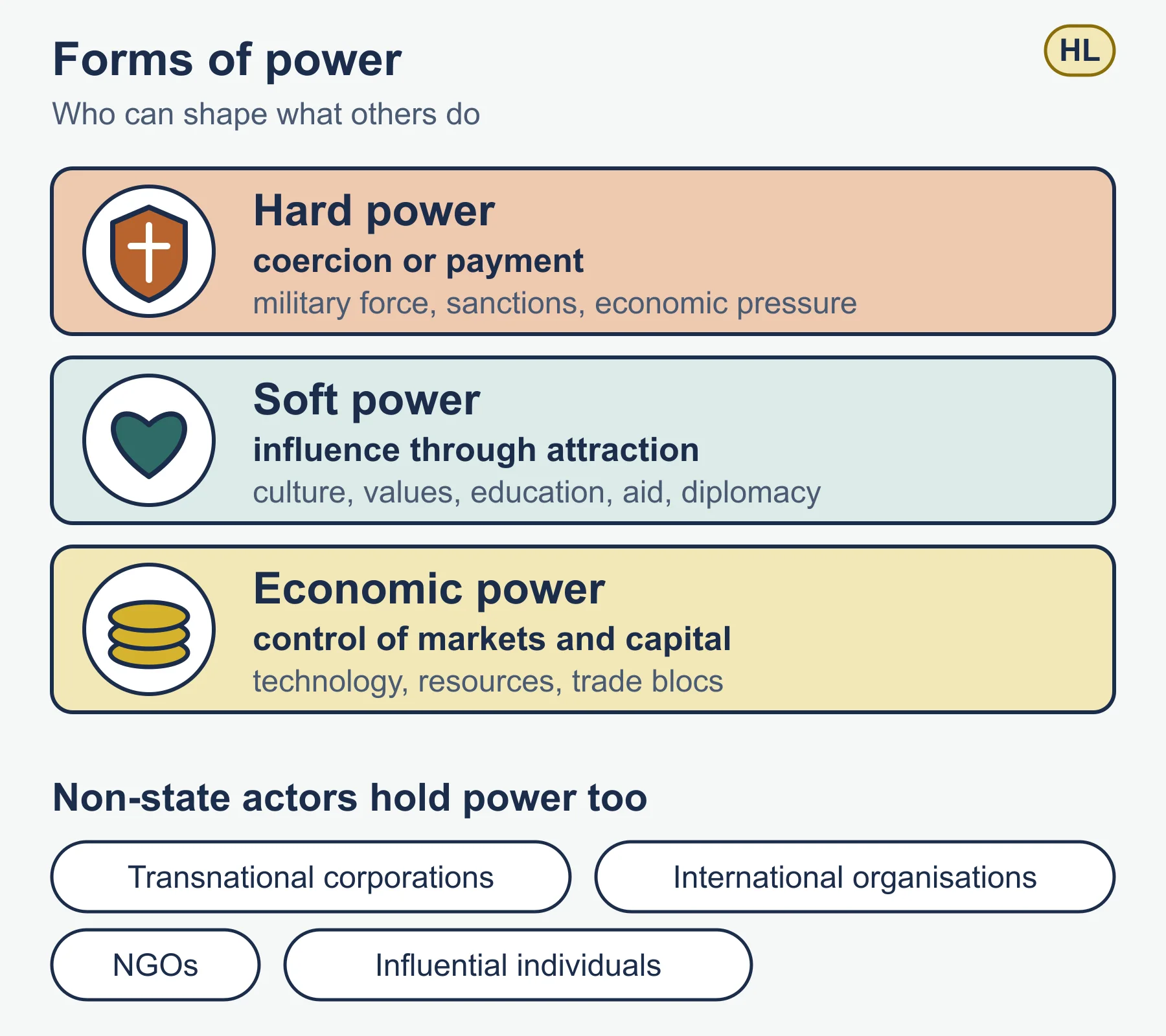
Power is the ability of a state, organisation or group to influence the behaviour of others or to shape outcomes.
| Form | Meaning |
|---|---|
| Hard power | Coercion or payment: military force, sanctions, economic pressure |
| Soft power | Influence through attraction (term associated with Joseph Nye): culture, values, education, aid, diplomacy |
| Economic power | Control of markets, capital, technology and resources; membership of institutions such as trade blocs |
Nye later used smart power for the skilful combination of hard and soft power.
Measuring power
No single indicator captures power, so combine several:
- Economic: size of GDP, share of world trade, control of finance and currency (the US dollar’s role in world trade and reserves gives the USA unusual financial influence).
- Military: spending, nuclear weapons, overseas bases, ability to project force.
- Demographic and resource: population size, energy and mineral reserves.
- Political: seats and votes in global institutions.
- Cultural: reach of films, music, universities, languages and brands.
Who holds power
- States are often grouped as superpowers, emerging powers and dependent or peripheral states, but treat the categories as a debate, not a fixed list.
- Non-state actors: transnational corporations (TNCs), international organisations, non-governmental organisations and influential individuals.
- Power is plural and contested.
Global groupings and institutions
| Grouping | Points to know |
|---|---|
| United Nations Security Council | Five permanent members (China, France, Russia, the UK and the USA) each hold a veto, reflecting the power balance after the Second World War |
| G7 | Group of major high-income economies |
| G20 | Includes major emerging economies; leaders’ summits since 2008, during the financial crisis |
| BRICS | Brazil, Russia, India, China and South Africa, enlarged from 2024 with further members such as Egypt, Ethiopia, Iran and the United Arab Emirates |
| IMF and World Bank | Set up at Bretton Woods in 1944; voting shares are weighted by financial contribution, so the USA can block major decisions |
| WTO | Created in 1995 to set and enforce trade rules |
| NATO | Military alliance founded in 1949 |
Evaluation point: institutions created by the post-war powers still reflect that era, which is why emerging powers press for reform or build alternatives.
Rising power: China
China illustrates changing power. Economic growth since reforms began in 1978 made it the world’s leading manufacturing and trading nation. The Belt and Road Initiative (announced 2013) funds ports, railways and power stations in many countries, extending China’s economic and political influence. China also helped found the Asian Infrastructure Investment Bank (operating from 2016). Critics raise concerns about debt and dependence; supporters point to badly needed infrastructure. Soft power efforts include Confucius Institutes and international media.
Non-state power
- TNCs: the annual revenues of the largest corporations exceed the GDP of many countries; they shape jobs, tax bases and technology. Technology firms also control platforms through which information flows.
- NGOs such as Amnesty International or Greenpeace influence agendas through campaigning.
- Individuals: business leaders, philanthropists and activists can shift debates and funding.
Useful ideas
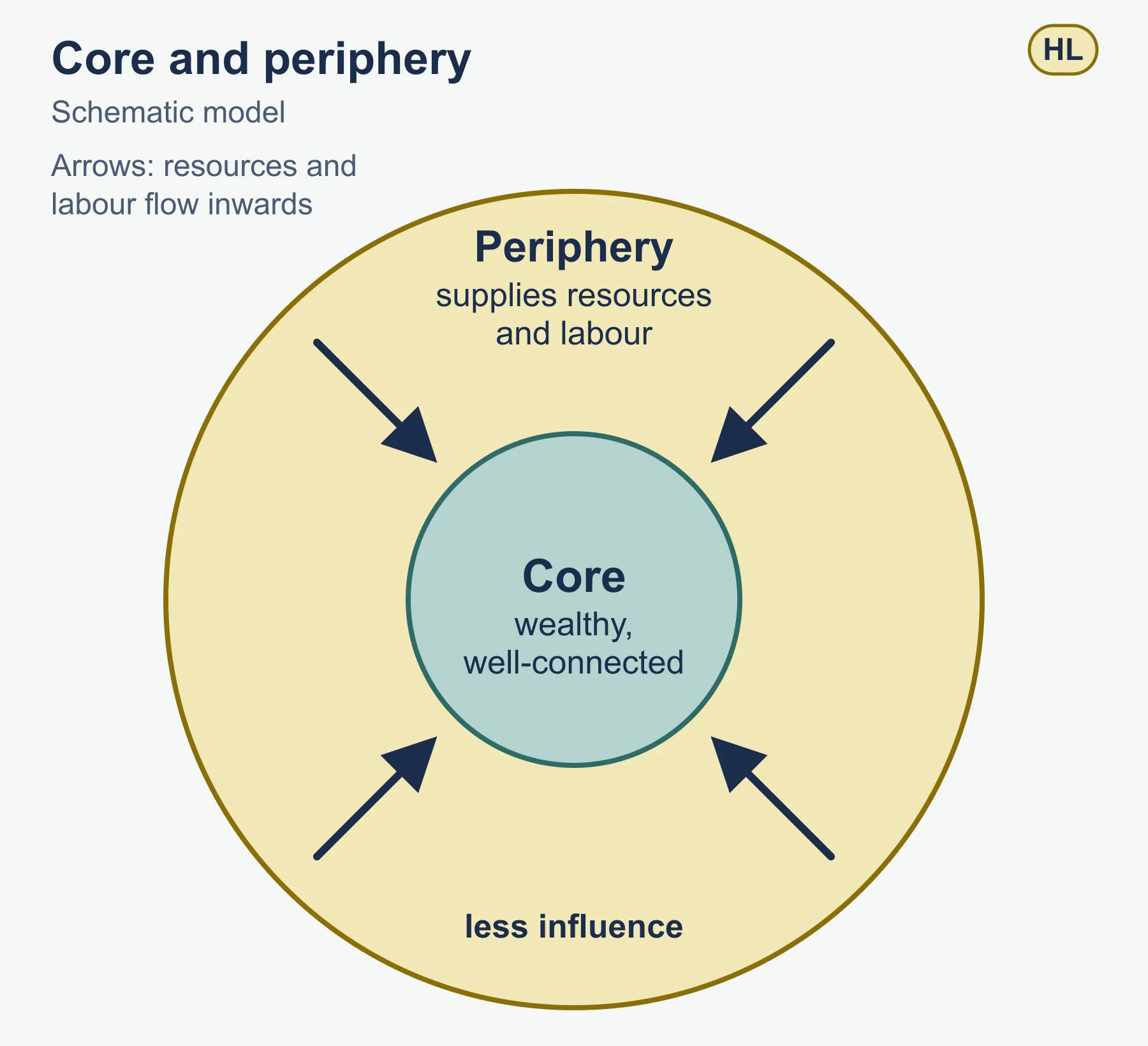
- Core and periphery: a core of wealthy, well-connected places and a periphery that supplies resources or labour and has less influence.
- Changing power over time: power shifts as economies grow, alliances change and technology alters who can project influence.
- Mackinder’s heartland idea (1904): an early geopolitical theory linking physical geography to power; know it as a historical example and criticise it as dated.
- Interdependence: heavy trade and investment bind states together, which can restrain conflict but also transmits shocks.
World-systems theory (Immanuel Wallerstein, 1970s) adds a semi-periphery between core and periphery: countries such as Brazil or India that have some core-like industries alongside peripheral features. Countries can move between categories over time.
Shifts in the global balance: colonial empires before the mid-20th century; a bipolar Cold War world led by the USA and the Soviet Union; a period of US dominance after 1991; and today’s debate about a multipolar world.
Criticisms of Mackinder: air power, missiles and cyberspace reduce the importance of controlling a land heartland, and the theory reflects a European imperial viewpoint.
Model paragraph (discuss)
“The USA still holds unmatched military reach and financial influence through the dollar, yet China’s Belt and Road Initiative shows economic power being converted into political influence across Asia and Africa. Power is therefore becoming more multipolar in trade and infrastructure, while remaining concentrated in finance and military capacity.”
Exam traps
- Treating power as only military.
- Treating superpower categories as fixed.
- Ignoring non-state actors.
- Describing Mackinder without criticism.
- Measuring power with one indicator, such as GDP alone.
- Forgetting that institutions’ rules can lock in the power of earlier eras.
Self-test
- Distinguish hard power from soft power.
- Name three non-state actors.
- Define core and periphery.
- Give one effect of interdependence.
- Why criticise Mackinder’s heartland idea?
- What is smart power?
- Which countries hold a veto on the UN Security Council?
- What does the semi-periphery mean in world-systems theory?
- Give one argument for and one against the Belt and Road Initiative.
- Why do emerging powers seek reform of the IMF and World Bank?
- Give three indicators you could combine to measure power.
Answers: 1. Hard power coerces or pays; soft power attracts through culture, values and diplomacy. 2. For example TNCs, NGOs and international organisations. 3. A wealthy, well-connected core and a periphery supplying resources or labour with less influence. 4. It can restrain conflict but also transmit shocks. 5. It is an early theory and is dated. 6. Combining hard and soft power skilfully. 7. China, France, Russia, the UK and the USA. 8. Countries with a mix of core and peripheral features. 9. For: infrastructure investment; against: debt and dependence concerns. 10. Voting shares reflect older financial contributions, giving them less say than their economic weight. 11. For example GDP, military spending and cultural reach.
More resources on this topic
Related resources
-
Subject guides
IB Diploma Programme Geography: Subject Overview
An overview of IB Diploma Programme Geography – interactions between individuals, societies and physical processes across time and space.
Geography · International Baccalaureate · IB
Read course guide -
Revision notes
IB DP Geography: 11.2 Global networks and flows – Revision Notes
Condensed IB DP Geography notes on 11.2: networks, flows, time-space compression, hubs, gatekeepers and global production networks, with a self-test.
Geography · International Baccalaureate · IB
Revise topic -
Revision notes
IB DP Geography: 11.3 Human and physical influences on global interactions – Revision Notes
Condensed IB DP Geography notes on 11.3: human and physical influences on connection, barriers and filters, and the gravity model with a worked example, with a self-test.
Geography · International Baccalaureate · IB
Revise topic
Studying Geography?
This page is free and stays free. Marlbridge is not offering Geography classes at the moment, so there is no tuition to book for it. The free study resources stay open to everyone.
Get free revision emails (optional)
Occasional emails with practice questions, worked explanations and links to free resources for the qualification and subjects you choose. No spam, and you can unsubscribe from any email. The free tools on this site never need an email.