
Revision Notes
IB DP Geography: 11.3 Human and physical influences on global interactions – Revision Notes
Condensed IB DP Geography notes on 11.3: human and physical influences on connection, barriers and filters, and the gravity model with a worked example, with a self-test.
- Subject
- Geography
- Level
- IB
- Topic
- Unit 4: Power, places and networks
- Author
- Marlbridge Academic Team
- Updated
- Reviewed by
- Azam Siddique (what this means)
Aligned to International Baccalaureate IB Diploma Programme Geography (DP Geography), First assessments 2019. Official specification .
Syllabus page (what it covers and how it is assessed): IB Diploma Programme Geography.
Syllabus points this page covers
DP Geography
- 11.3 Human and physical influences on global interactions
Condensed recall for 11.3 Human and physical influences on global interactions (Unit 4: Power, places and networks). For the full explanation, read the Power, places and networks study guide.
Influences on connection
| Human | Physical |
|---|---|
| Government policy and trade agreements | Coasts and navigable rivers |
| Political stability | Mountain and desert barriers |
| Infrastructure investment | Climate |
| Transport cost | Natural harbours |
| Language and cultural ties | Resource endowment |
| Colonial history, skilled labour |
Physical geography rarely decides outcomes alone, because technology and policy can overcome many barriers, but it shapes starting conditions.
Political influences in more detail
| Influence | Example | Effect on interaction |
|---|---|---|
| Trading blocs | The EU single market (1993), USMCA (which replaced NAFTA in 2020), Mercosur, the African Continental Free Trade Area (trading from 2021) | Lower tariffs and shared rules raise trade between members, but can divert trade from outsiders |
| Special Economic Zones | Shenzhen, China (1980) | Tax breaks and infrastructure attract foreign investment |
| Leaving a bloc | The UK left the EU on 31 January 2020 | New customs checks and paperwork added friction to UK-EU trade |
| Protectionism | Rising tariffs between the USA and China from 2018 | Firms rerouted supply chains through third countries |
| Open borders | The Schengen Area allows passport-free travel between most participating European countries | Easier movement of people, tourists and workers |
| Sanctions | Western sanctions on Russia after 2022 | Cut access to finance, technology and some markets |
Colonial history and language: former colonial ties still shape migration, trade and media flows, for example between France and francophone West Africa, or the UK and Commonwealth countries. A shared language reduces the cost of doing business.
Physical influences in more detail
- Landlocked states: the UN recognises a group of landlocked developing countries that face extra transport costs and depend on neighbours’ ports and good relations. Bolivia lost its coastline to Chile in the War of the Pacific (1879 to 1884) and still relies on Chilean and other foreign ports. Ethiopia has used Djibouti’s port for most of its trade since its border war with Eritrea (1998 to 2000), and a new electric railway to Djibouti opened in the late 2010s.
- Counter-example: Switzerland is landlocked but very wealthy and well connected, showing that policy, finance, skills and good relations with neighbours can outweigh physical location.
- Strategic location: Singapore sits on the Strait of Malacca, one of the world’s busiest shipping lanes, which helped it become a global port and financial hub.
- Canals: the Suez Canal (opened 1869) and Panama Canal (1914) are human responses to physical barriers. Panama’s canal depends on rainfall-fed lakes for its locks; drought in 2023 forced limits on the number of ships passing through, a reminder that physical conditions still matter.
- Climate change and the Arctic: shrinking sea ice is opening the Northern Sea Route along Russia’s coast for longer each summer, which could shorten some Asia-Europe journeys.
- Resource endowment: oil, gas and minerals draw investment and trade (for example Gulf states) but can tie a country to volatile prices.
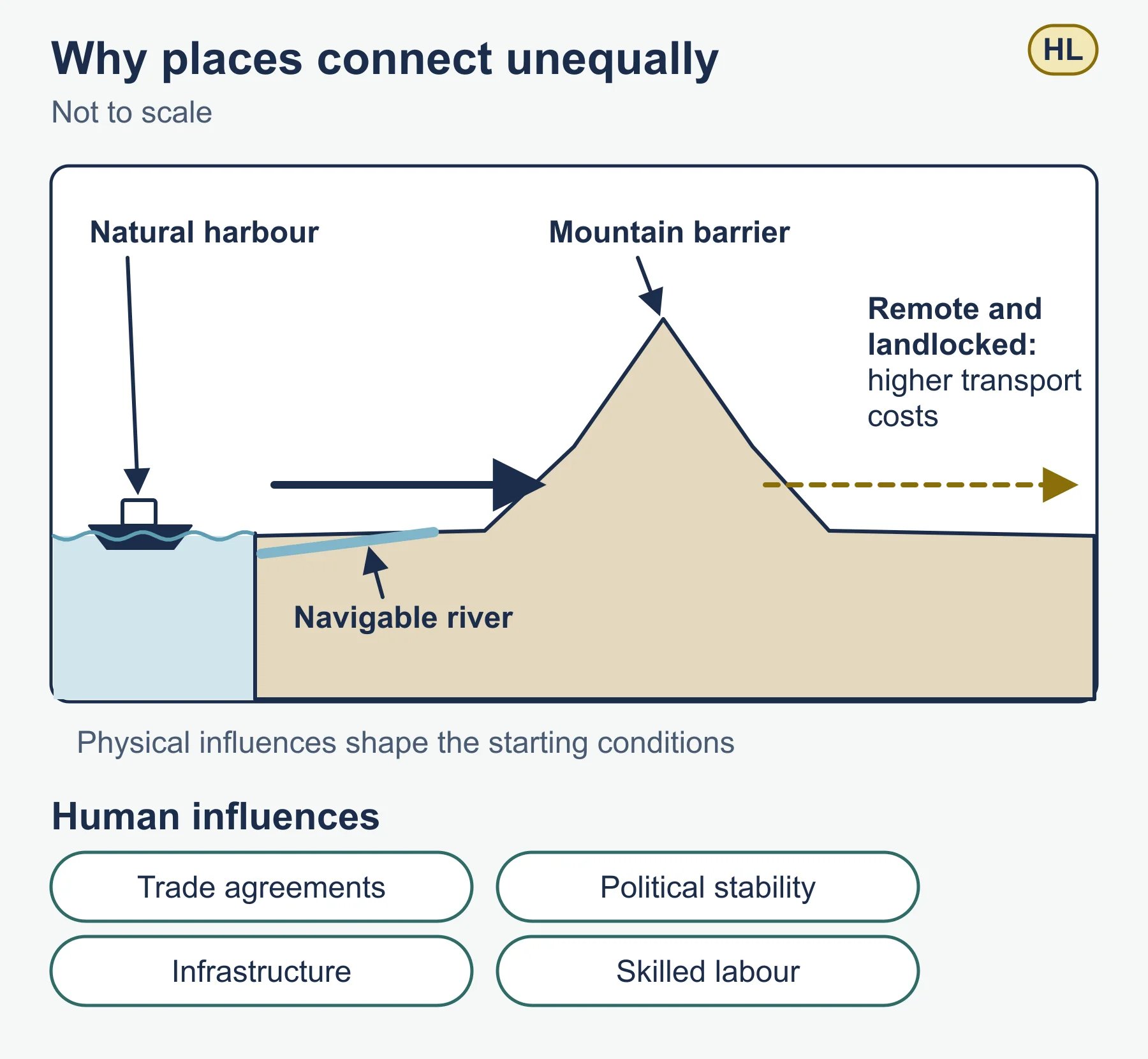
Distance, barriers and filters
- Remote or landlocked places often face higher transport costs and lower participation in trade.
- Barriers and filters: tariffs, border controls, censorship and conflict slow or block flows.
A barrier stops a flow; a filter lets some flows through and blocks others. Visa systems filter migrants by skill; internet censorship filters information by content; tariffs filter goods by type. Distance decay is the general tendency for interaction to fall as distance rises, though time-space compression has weakened it for information and finance much more than for bulky goods.
Gravity model
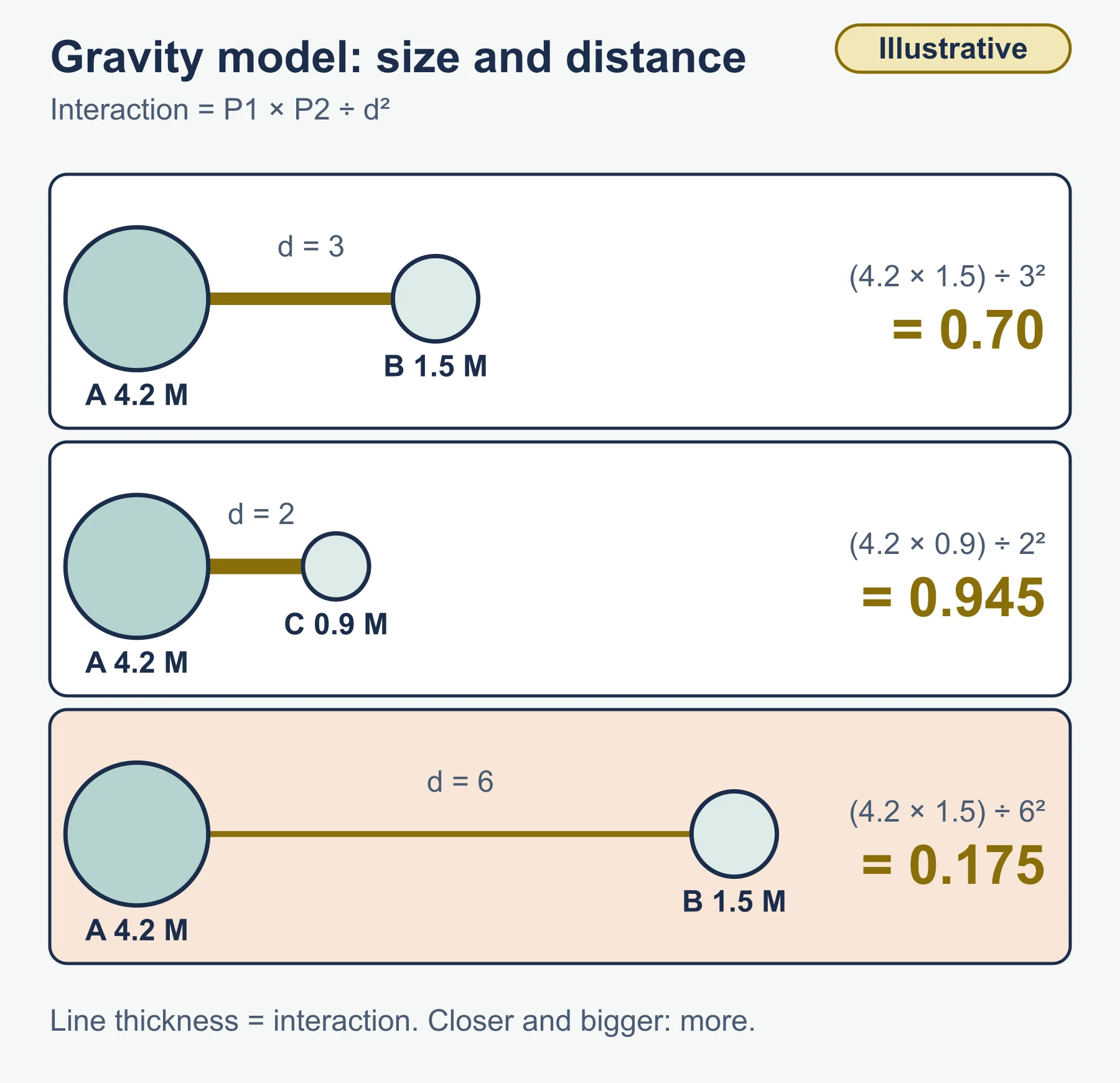
Interaction between two places is proportional to the product of their sizes divided by the square of the distance: interaction = (P1 x P2) / d squared.
Worked example (invented figures; P in millions, d in hundreds of km):
- A (4.2) and B (1.5), d = 3: 6.3 / 9 = 0.70.
- A (4.2) and C (0.9), d = 2: 3.78 / 4 = 0.945.
- C is smaller than B but nearer, so the model predicts more A-C interaction.
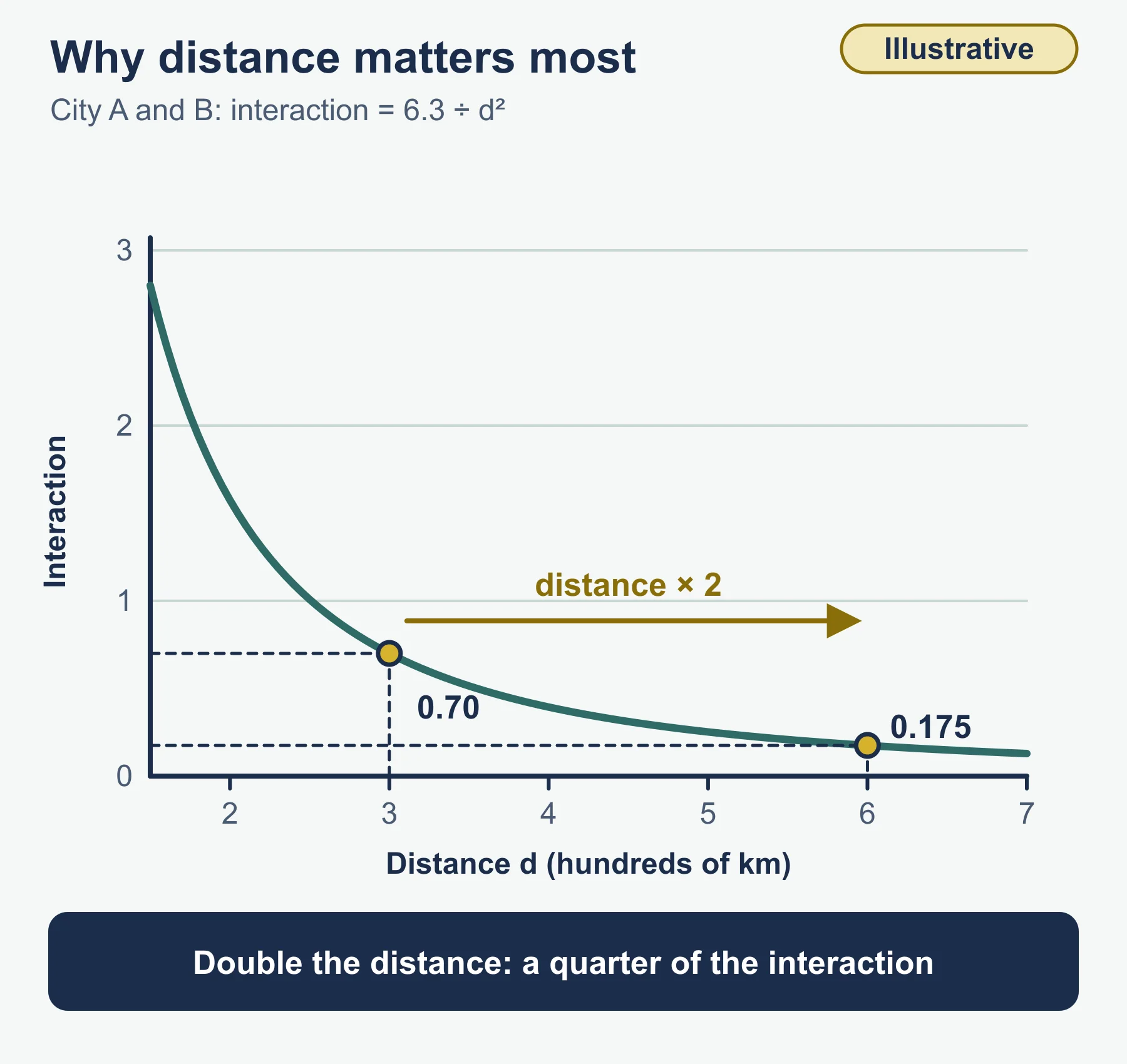
- Doubling A-B distance (d = 6): 6.3 / 36 = 0.175, a quarter of the original.
Further practice (invented figures): if the A-C distance halved to d = 1, interaction would be 3.78 / 1 = 3.78, four times its original value of 0.945. If C’s population doubled to 1.8 million at the original distance, interaction would be (4.2 x 1.8) / 4 = 1.89, exactly double. Size scales the result in proportion; distance scales it by the square.
A useful adaptation is to replace distance in kilometres with travel time or cost, because a high-speed rail link or low-cost airline can make a far city “closer” than a near one.
Limits: ignores political borders, language, transport quality and trade agreements, so real pairs can interact more or less than predicted.
Model paragraph (to what extent)
“Physical geography still influences connection: Ethiopia’s lack of a coastline makes it dependent on Djibouti’s port and adds cost to its trade. However, Switzerland is also landlocked yet among the best-connected economies in the world, because stable government, skilled labour and agreements with neighbouring states outweigh its location. Human factors therefore usually decide how far a physical disadvantage limits interaction.”
Exam traps
- Suggesting that physical geography alone determines connection.
- Forgetting to square the distance in the gravity model.
- Applying the model without commenting on its assumptions.
- Treating barriers and filters as the same.
- Giving a trading bloc as an example without saying what it changed.
Self-test
- Give two human and two physical influences on global interactions.
- State the gravity model.
- What happens to predicted interaction if distance doubles?
- Give one limit of the gravity model.
- Name one barrier or filter.
- Distinguish a barrier from a filter.
- Why is Switzerland a useful counter-example?
- How did drought affect the Panama Canal in 2023?
- What happens to predicted interaction if one place’s population doubles?
- Why might travel time be better than distance in the gravity model?
- Give one effect of a trading bloc on non-members.
Answers: 1. Human: trade agreements, infrastructure; physical: coasts, mountain barriers. 2. Interaction = (P1 x P2) / d squared. 3. It falls to a quarter. 4. It ignores borders, language or trade agreements. 5. For example a tariff or border control. 6. A barrier stops a flow; a filter lets some flows through and blocks others. 7. It is landlocked but wealthy and well connected, so physical location is not decisive. 8. Low water levels forced limits on the number of ships passing through. 9. It doubles. 10. Transport links change how accessible places really are. 11. Trade can be diverted away from them.
More resources on this topic
Related resources
-
Subject guides
IB Diploma Programme Geography: Subject Overview
An overview of IB Diploma Programme Geography – interactions between individuals, societies and physical processes across time and space.
Geography · International Baccalaureate · IB
Read course guide -
Study guides
IB DP Geography: Unit 4: Power, places and networks – Study Guide
Global power, networks and flows, and the human and physical influences on global interactions, taught for the Higher Level extension of IB Diploma Programme Geography.
Geography · International Baccalaureate · IB
Read guide -
Revision notes
IB DP Geography: 11.1 Global interactions and global power – Revision Notes
Condensed IB DP Geography notes on 11.1: hard, soft and economic power, state and non-state actors, core and periphery, shifting power and interdependence, with a self-test.
Geography · International Baccalaureate · IB
Revise topic
Studying Geography?
This page is free and stays free. Marlbridge is not offering Geography classes at the moment, so there is no tuition to book for it. The free study resources stay open to everyone.
Get free revision emails (optional)
Occasional emails with practice questions, worked explanations and links to free resources for the qualification and subjects you choose. No spam, and you can unsubscribe from any email. The free tools on this site never need an email.