
Revision Notes
IB DP Geography: 11.2 Global networks and flows – Revision Notes
Condensed IB DP Geography notes on 11.2: networks, flows, time-space compression, hubs, gatekeepers and global production networks, with a self-test.
- Subject
- Geography
- Level
- IB
- Topic
- Unit 4: Power, places and networks
- Author
- Marlbridge Academic Team
- Updated
- Reviewed by
- Azam Siddique (what this means)
Aligned to International Baccalaureate IB Diploma Programme Geography (DP Geography), First assessments 2019. Official specification .
Syllabus page (what it covers and how it is assessed): IB Diploma Programme Geography.
Syllabus points this page covers
DP Geography
- 11.2 Global networks and flows
Condensed recall for 11.2 Global networks and flows (Unit 4: Power, places and networks). For the full explanation, read the Power, places and networks study guide.
Key terms
| Term | Meaning |
|---|---|
| Network | Nodes (places) linked by connections |
| Flow | Movement along those links of goods, capital, people, ideas, data or services |
| Time-space compression | David Harvey’s phrase for technology shrinking the effective distance between places |
| Node / hub | Places such as global cities, ports and airports that concentrate flows and influence |
| Gatekeeper | Governments, institutions and corporations deciding who can access a network |
| Global production network | TNCs place design, assembly and sales in different countries by cost and market |
Further terms:
| Term | Meaning |
|---|---|
| Foreign direct investment (FDI) | A firm investing in long-term operations (factories, offices) in another country |
| Portfolio investment | Buying shares or bonds abroad without controlling the business; can leave quickly |
| Official development assistance (ODA) | Government aid on concessional terms |
| Remittances | Money migrants send to families in their home country |
| Digital divide | Unequal access to internet and digital technology |
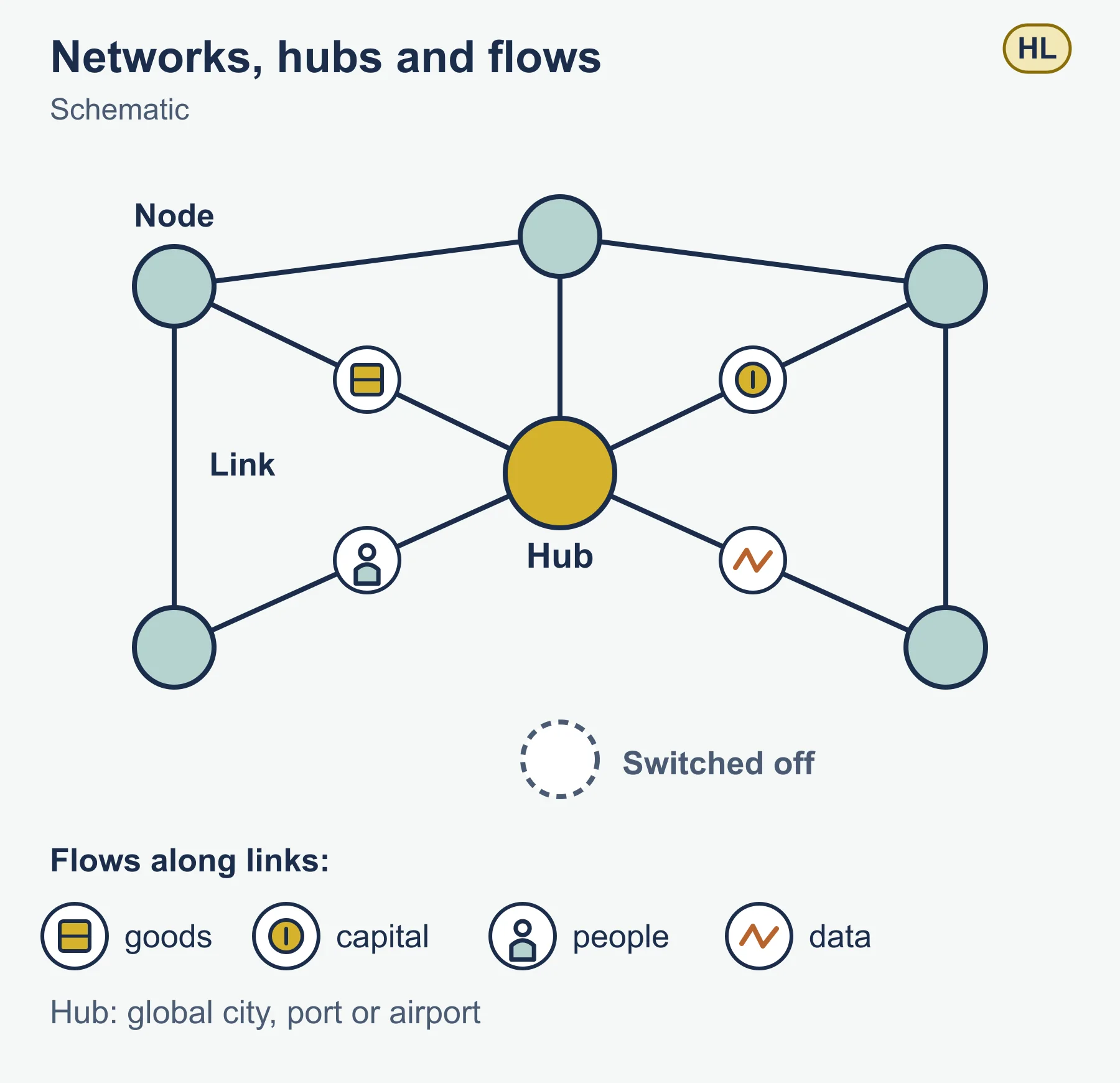
Types of flow
- Trade in goods and services.
- Foreign direct investment.
- Remittances.
- Migration and tourism.
- Information and communication.
- Culture.
Globalisation can be described as the intensification of these flows and the growing connection of distant places.
What has accelerated flows
- Containerisation (from the 1950s): standard steel boxes moved between ships, trains and lorries slashed handling costs. Shipping now carries around 80 per cent of world trade by volume.
- Air transport: cheaper flights expanded tourism, business travel and fast air freight of high-value goods.
- Submarine fibre-optic cables carry the great majority of international internet traffic, which is why landing points and cable routes are strategically important.
- Deregulation: lower tariffs and freer movement of capital since the 1980s.
Financial flows compared
| Flow | Who benefits | Risks |
|---|---|---|
| FDI | Jobs, technology and taxes for host countries | Profits sent abroad; firms can relocate |
| Portfolio investment | Capital for growth | Can flow out suddenly in a crisis |
| ODA | Funds for health, education and infrastructure | Few donors meet the UN target of 0.7 per cent of gross national income; can be tied to donor interests |
| Remittances | Go directly to households | Depend on host-country jobs and migration rules |
For low- and middle-income countries as a group, remittances now exceed official development aid, making them one of the most important financial flows to the developing world.
Global production network: the smartphone
A widely studied example is Apple’s iPhone. It is designed in California; components such as memory chips, displays and processors come from firms in countries including South Korea, Japan, Taiwan and the USA; and much final assembly has been done in China by contract manufacturers such as Foxconn, with some production more recently moving to India and Vietnam. Most of the value is captured by design, branding and software rather than by assembly, so a phone’s “made in” label hides where the money goes. Worker suicides at Foxconn plants in 2010 drew attention to labour conditions at the assembly stage.
Evaluation: the network gives assembly countries jobs and a route into manufacturing, but keeps high-value activities in the core; it is efficient but exposed to tariffs, disasters and geopolitical tension.
Connection and power
- Well-connected hubs gain influence; poorly connected places can be described as switched off from the main networks.
- Gatekeepers link power back to connection.
- Measuring connection: indices of globalisation combine economic, social and political indicators. Always comment on what an index leaves out.
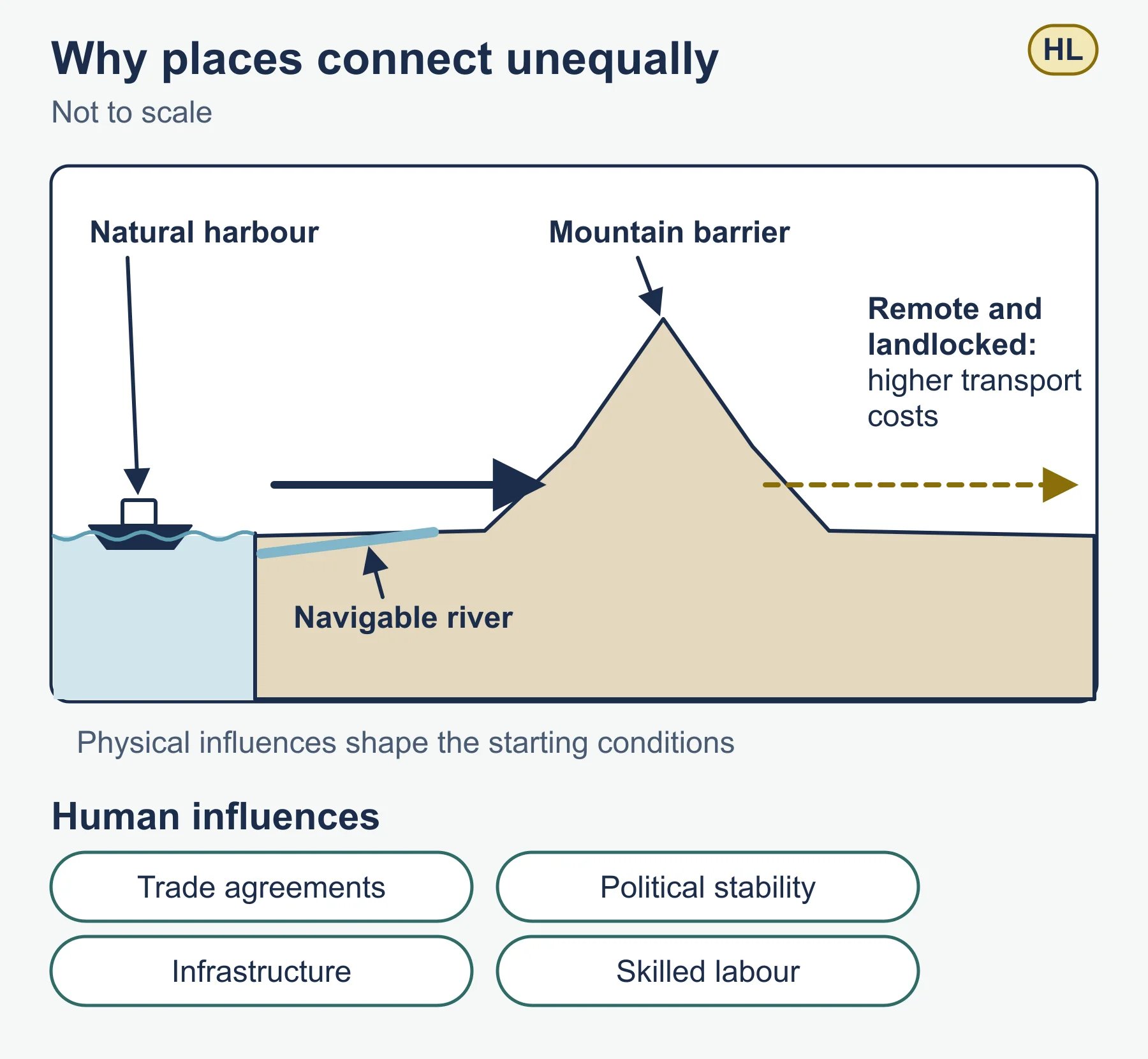
Hubs: Singapore and Rotterdam (ports), Dubai (aviation and logistics), London and New York (finance). Switched-off places include some landlocked or conflict-affected states with little infrastructure, and remote rural areas within otherwise well-connected countries.
Evaluating a globalisation index: the KOF Globalisation Index (from ETH Zurich) combines economic, social and political measures. Small, open economies such as Singapore, the Netherlands, Switzerland and Belgium tend to score highly. Limits: national averages hide internal divides; weighting of indicators is a choice; some flows (illicit finance, informal remittances) are hard to measure; and the index measures connection, not whether it is beneficial.
Gatekeepers in action
- Governments control visas, capital controls and internet access (China’s online censorship system, often called the Great Firewall, filters information flows).
- Corporations control platforms, app stores and search results.
- Institutions such as the WTO set trade rules; credit-rating agencies influence who can borrow.
Exam traps
- Confusing a network (the structure) with a flow (the movement).
- Assuming globalisation connects every place equally.
- Quoting an index without evaluating it.
- Naming flows with no located example.
- Treating FDI and portfolio investment as the same.
- Assuming the country of assembly captures most of the value of a product.
Self-test
- Distinguish a network from a flow.
- List four types of flow.
- What is time-space compression?
- What is a gatekeeper?
- What is a global production network?
- Why did containerisation matter?
- Distinguish FDI from portfolio investment.
- Why are remittances important to developing countries as a group?
- Where is most of the value of a smartphone captured?
- Give two limits of a globalisation index.
- What is the digital divide?
Answers: 1. A network is nodes and links; a flow is what moves along them. 2. For example trade, foreign direct investment, remittances and information. 3. Technology shrinking the effective distance between places. 4. A government, institution or corporation that decides who can access a network. 5. Production split across countries by TNCs according to costs and markets. 6. It cut the cost and time of moving goods between transport modes. 7. FDI is long-term investment in operations; portfolio investment buys shares or bonds without control and can leave quickly. 8. They now exceed official aid and go directly to households. 9. In design, branding and software. 10. For example national averages hide internal divides, and weighting is a choice. 11. Unequal access to internet and digital technology.
More resources on this topic
Related resources
-
Subject guides
IB Diploma Programme Geography: Subject Overview
An overview of IB Diploma Programme Geography – interactions between individuals, societies and physical processes across time and space.
Geography · International Baccalaureate · IB
Read course guide -
Revision notes
IB DP Geography: 11.3 Human and physical influences on global interactions – Revision Notes
Condensed IB DP Geography notes on 11.3: human and physical influences on connection, barriers and filters, and the gravity model with a worked example, with a self-test.
Geography · International Baccalaureate · IB
Revise topic -
Study guides
IB DP Geography: Unit 4: Power, places and networks – Study Guide
Global power, networks and flows, and the human and physical influences on global interactions, taught for the Higher Level extension of IB Diploma Programme Geography.
Geography · International Baccalaureate · IB
Read guide
Studying Geography?
This page is free and stays free. Marlbridge is not offering Geography classes at the moment, so there is no tuition to book for it. The free study resources stay open to everyone.
Get free revision emails (optional)
Occasional emails with practice questions, worked explanations and links to free resources for the qualification and subjects you choose. No spam, and you can unsubscribe from any email. The free tools on this site never need an email.