
Revision Notes
IGCSE Accounting: Accounting concepts, ethics, technology and sustainability (Cambridge 0452) – Revision Notes
Condensed revision notes on accounting concepts, ethical principles, digital records and data storage for Cambridge IGCSE Accounting 0452, 2027-2029.
- Subject
- Accounting
- Level
- IGCSE, O LEVELS
- Topic
- Accounting concepts and modern practice
- Author
- Marlbridge Academic Team
- Updated
- Reviewed by
- Javaid Iqbal Sabri (what this means)
Aligned to Cambridge IGCSE O Level Accounting (0452, 7707), 2027-2029. Official specification (IGCSE) ; Official specification (O Level) .
Syllabus page (what it covers and how it is assessed): Cambridge IGCSE Accounting; Cambridge O Level Accounting.
Syllabus points this page covers
0452
- 7.1 Accounting concepts
- 7.2 Ethical considerations
- 7.3 Technology and sustainability
7707
- 7.1 Accounting concepts
- 7.2 Ethical considerations
- 7.3 Technology and sustainability
Found an error? Report a correction.
Want a teacher for this? Marlbridge teaches Accounting online. Request a free trial class.
Syllabus edition note. This resource follows the Cambridge IGCSE Accounting 0452 syllabus (and Cambridge O Level Accounting 7707, which has the same subject content for the same series) for exams in 2027, 2028 and 2029 (version 1), first examined in the March 2027 series in India and the June 2027 series elsewhere. If you sit 0452 in November 2026, you sit the 2026 syllabus (version 2), which differs: Paper 1 has 35 multiple-choice marks in 1 hour 15 minutes, not 40 marks in 1 hour 30 minutes; Topic 7 is “Accounting principles and policies”, without 7.2 Ethical considerations or 7.3 Technology and sustainability; 4.4 is “Irrecoverable debts and provision for doubtful debts”; income statements are named instead of statements of profit or loss; three-column running balance accounts are not required; Clubs and societies is 5.4 and Manufacturing accounts 5.5; and 6.3 is “Inter-firm comparison”. For this topic, the 2026 syllabus calls the same ten items accounting principles, and its 7.2 is Accounting policies (the influence of international accounting standards and the objectives of comparability, relevance, reliability and understandability), which the 2027-2029 syllabus removes. If you sit in November 2026, work from the 2026 syllabus on the Cambridge International website.
Quick recall for the final weeks. For explanations and fuller worked examples, use the study guide. These notes cover sections 7.1 Accounting concepts, 7.2 Ethical considerations and 7.3 Technology and sustainability of the Cambridge IGCSE Accounting 0452 syllabus for exams in 2027, 2028 and 2029 (version 1). All candidates follow the same content. Test yourself with the practice questions, the older concepts revision notes, the Cambridge IGCSE Accounting hub, the printable checklist and the free 10-minute diagnostics. Amounts are in dollars.
Answer pattern
The syllabus tells candidates to use the marks for each question as a guide to the length of answer. For each point, give: the term, what it means, how it shows up in this business, and the effect on the figures or the people affected.
7.1 Spot the concept
| Clue in the question | Concept | What it requires |
|---|---|---|
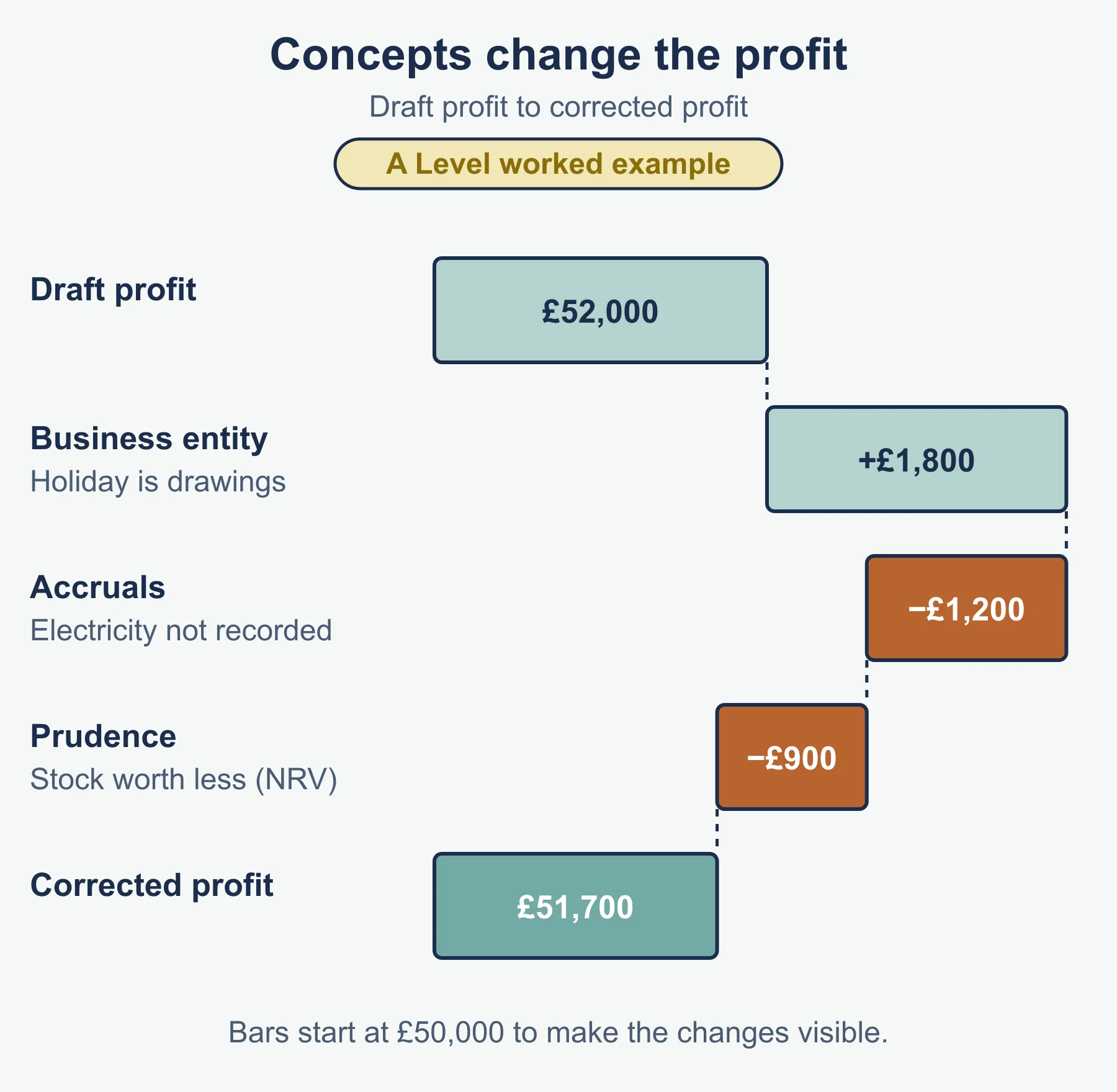
| Owner’s personal bill paid by the business | Business entity | Record as drawings |
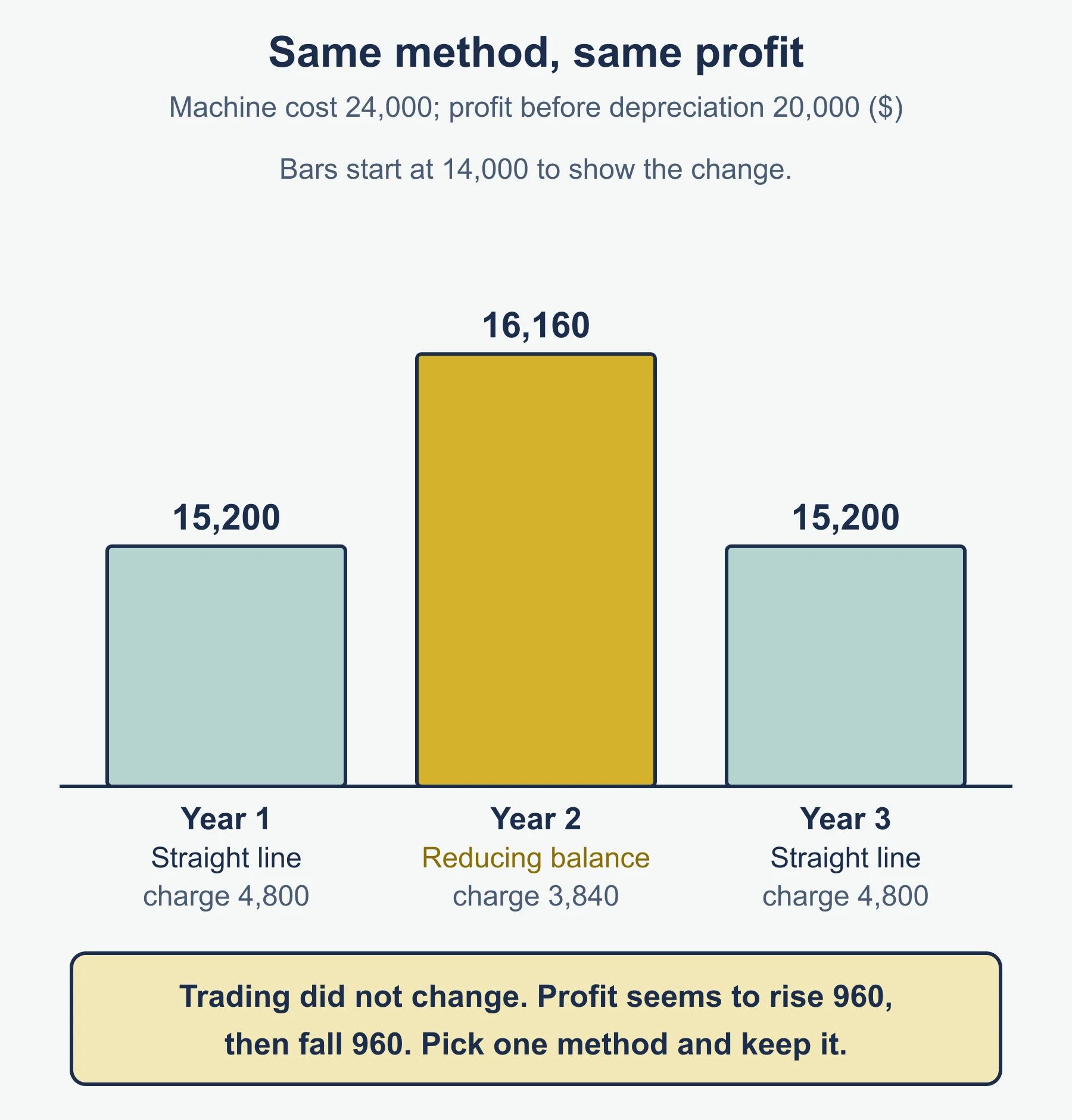
| Same method as last year | Consistency | Do not change without good reason |
| Debit and credit of equal value | Duality | Both sides recorded |
| Business expected to carry on trading | Going concern | Spread asset cost over useful life |
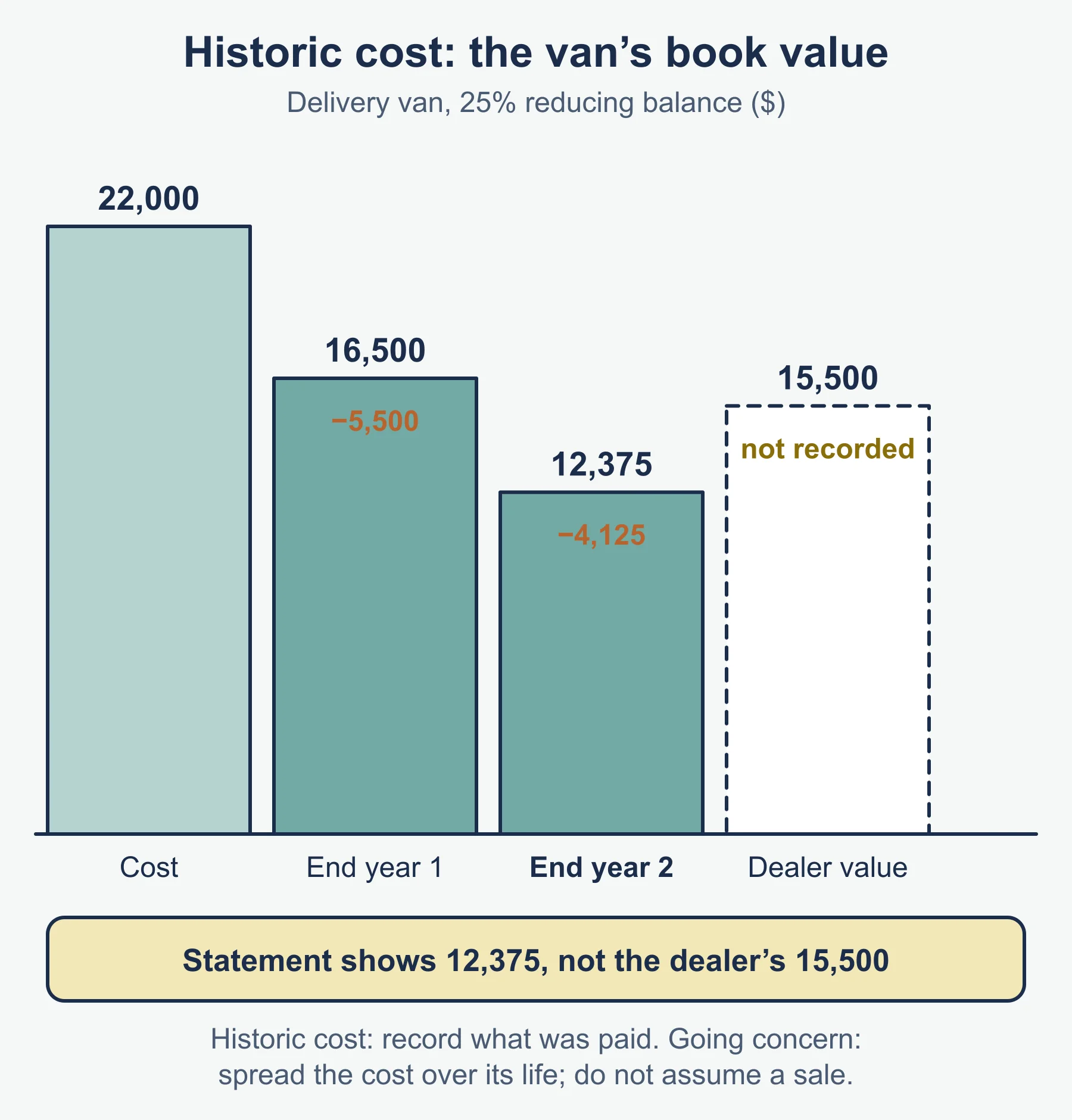
| Price actually paid | Historic cost | Do not record a rise in market value |
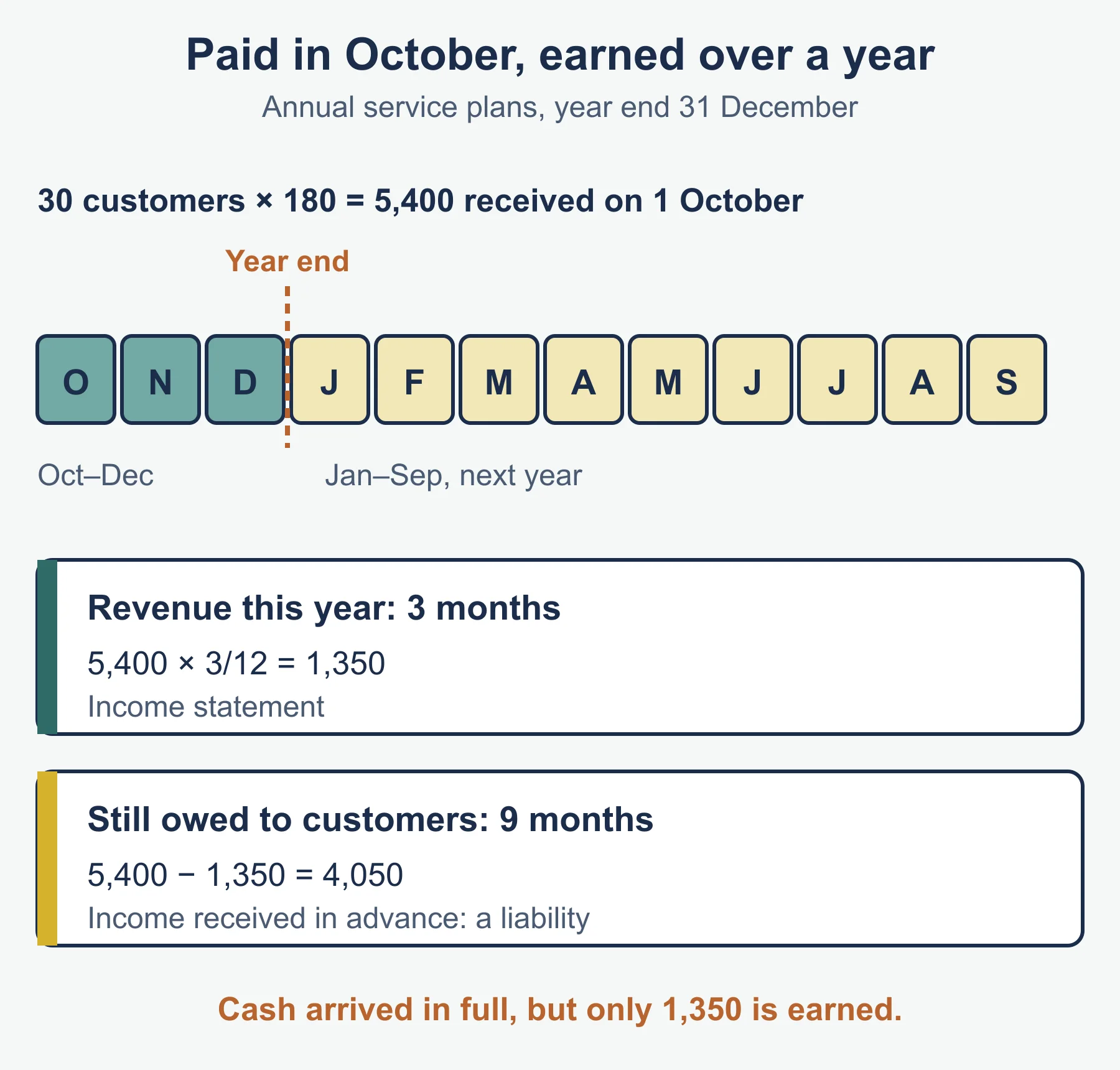
| Cost belongs to this year though paid next year | Matching / accruals | Accrue or prepay |
| Tiny item, little effect on decisions | Materiality | Simple treatment, such as expense |
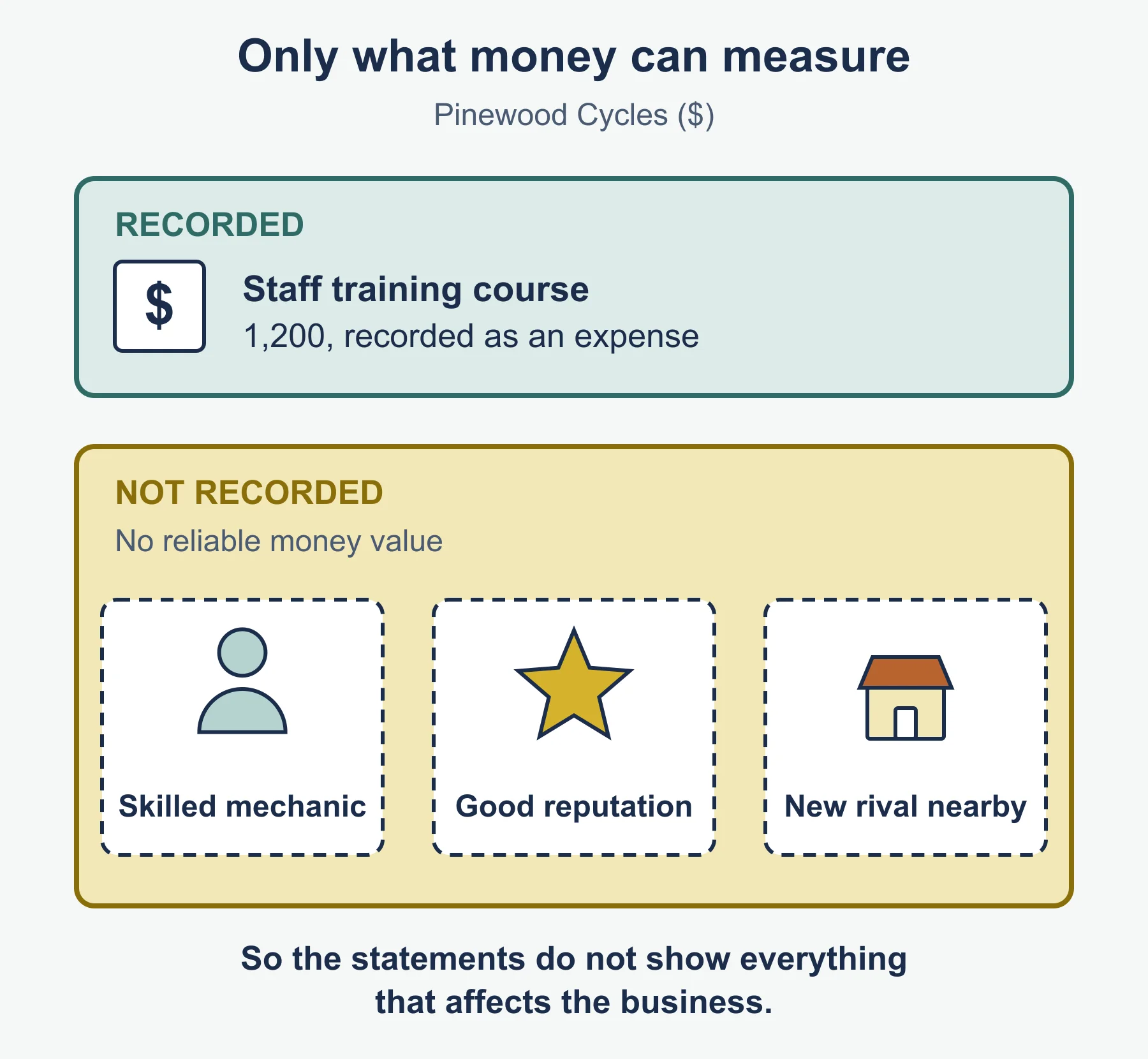
| Staff skill, reputation | Money measurement | Not recorded |
| Expected loss, possible gain | Prudence | Recognise loss now, gain when earned |
| Goods supplied, customer owes payment | Realisation | Revenue earned now |
Concepts behind procedures
- Accruals, prepayments and depreciation come from matching / accruals.
- Allowances for irrecoverable debts and the inventory rule come from prudence.
- Drawings come from business entity; double entry comes from duality.
- Cost less depreciation comes from historic cost and going concern.
Method boxes
Accrual or prepayment, step by step
- Find the period the payment covers.
- Work out the share that falls in this year (months used / months paid for).
- Expense = share in this year. Any remainder is prepaid. Any unpaid cost for this year is accrued.
- Show accruals and prepayments as the syllabus names them in the statement of financial position (other payables, other receivables).
Reminder: annual insurance of 2,400 paid on 1 October for 12 months, year end 31 December. Used = 2,400 x 3/12 = 600. Prepaid = 2,400 - 600 = 1,800.
Reminder: electricity paid in the year is 5,200, including 400 for last year’s final bill, and 650 is owed at the year end. Expense = 5,200 - 400 + 650 = 5,450.
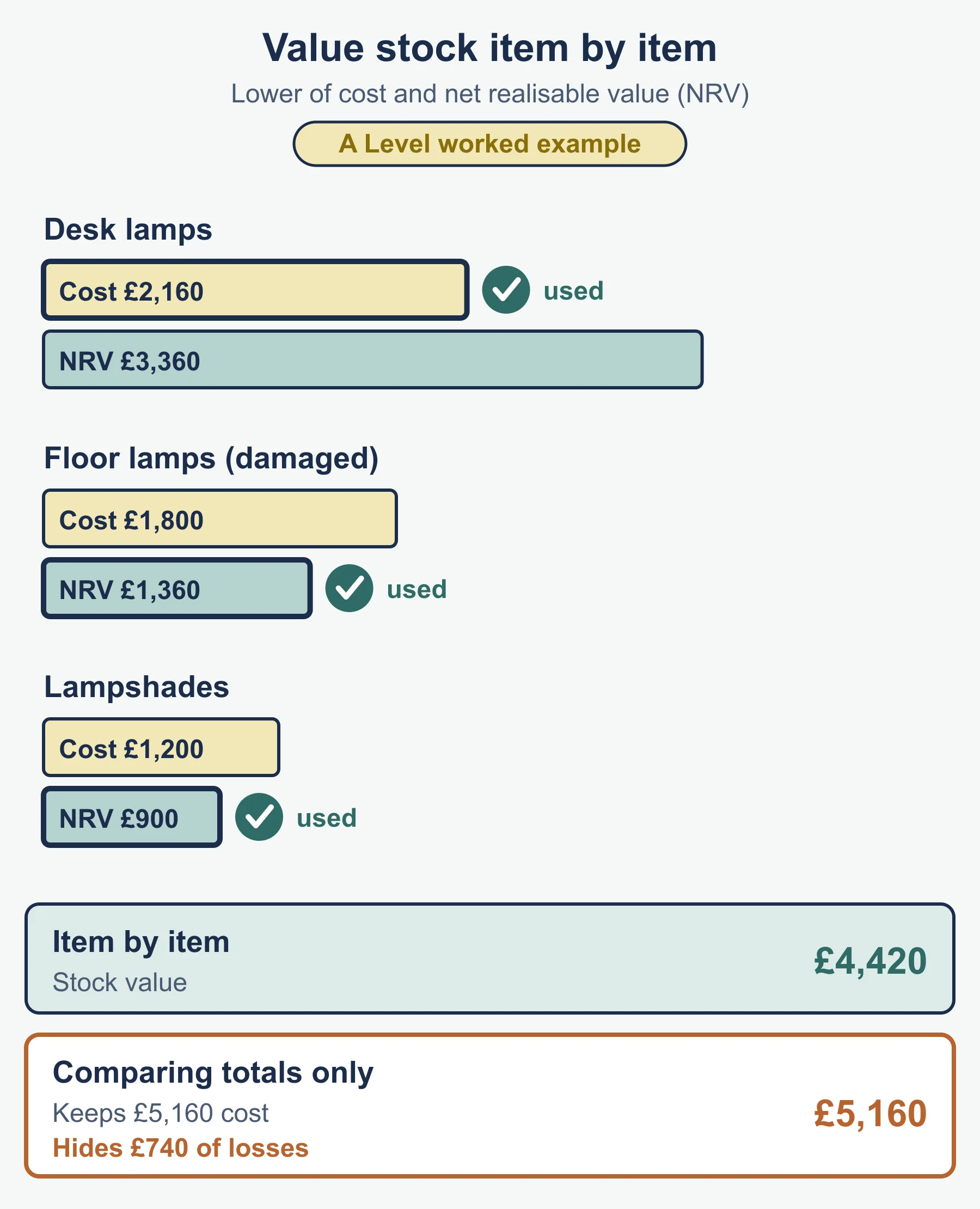
Inventory at the lower of cost and net realisable value
- Total cost for the item or line.
- Total net realisable value (selling price less costs of selling).
- Use the lower. The difference reduces profit.
Reminder: 18 units cost 25 each and could net 21 each. Cost 450; net realisable value 378; use 378; profit falls by 72.
Allowance for irrecoverable debts
- Write off debts known to be irrecoverable first.
- Apply the percentage to the remaining trade receivables.
- Compare with the existing allowance. Charge the increase; credit back a decrease.
Reminder: trade receivables 8,000 less 300 written off = 7,700. Allowance at 4% = 308. Existing allowance 250, so charge 58.
Must-know distinctions
| Pair | Difference |
|---|---|
| Matching and realisation | Matching assigns costs and revenue to the right period; realisation says when revenue counts as earned |
| Prudence and materiality | Prudence stops profit being overstated; materiality only simplifies small items |
| Historic cost and going concern | Cost is the starting value; going concern is why cost can be spread by depreciation |
| Integrity and objectivity | Integrity is honesty; objectivity is freedom from bias and pressure |
| Confidentiality and professional behaviour | One protects information; the other covers laws and reputation |
| Safe and sustainable storage | Safe protects the data; sustainable limits waste and energy while keeping records usable |
7.2 Ethical considerations
Need: others rely on figures they cannot check; pressure to change profit; access to private information; a standard set in advance.
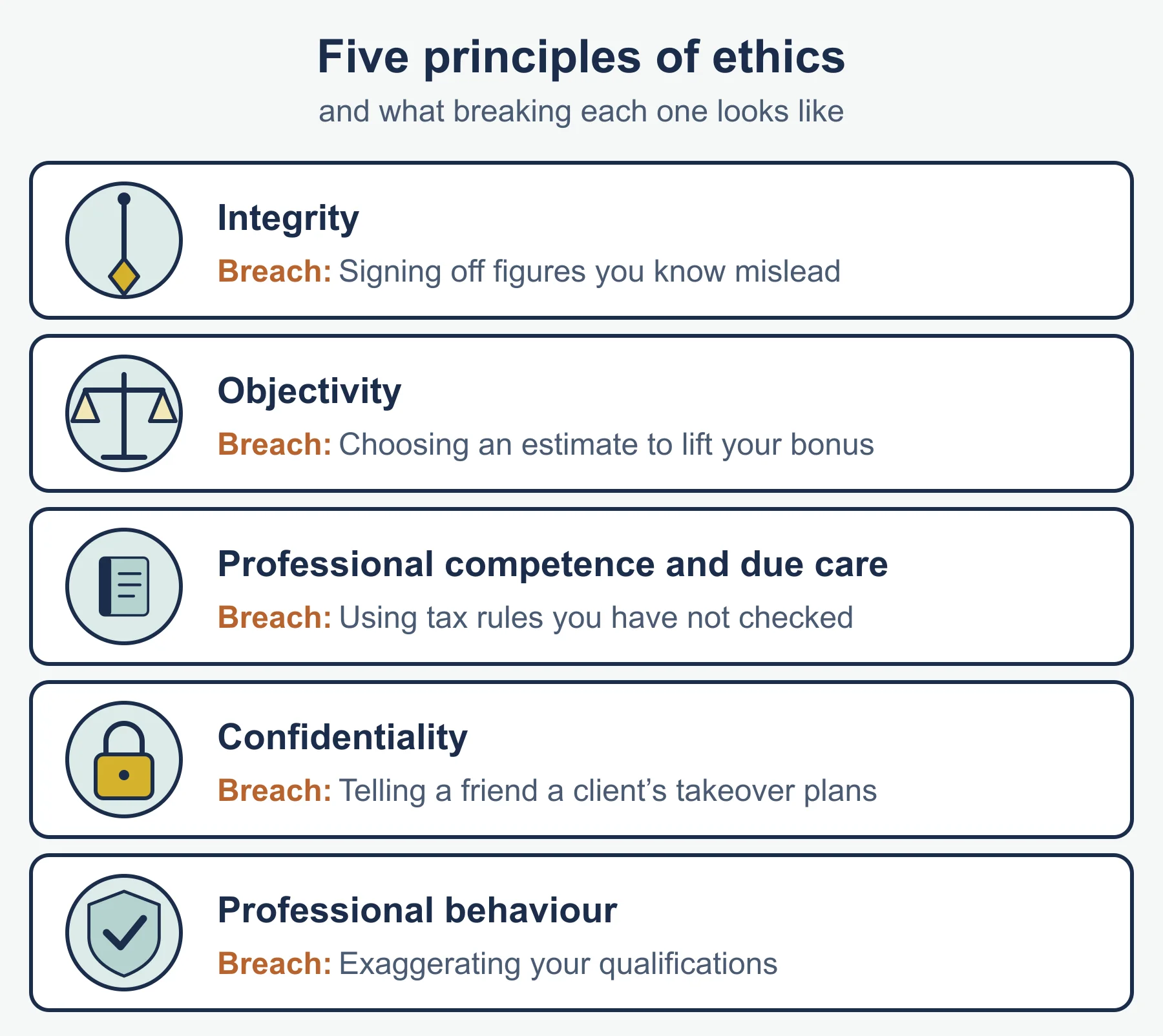
| Principle | Cue |
|---|---|
| Integrity | Honest, no misleading figures |
| Objectivity | No bias, conflicts or pressure |
| Professional competence and due care | Skills kept current, careful work |
| Confidentiality | No disclosure or misuse of information |
| Professional behaviour | Laws followed, profession’s reputation protected |
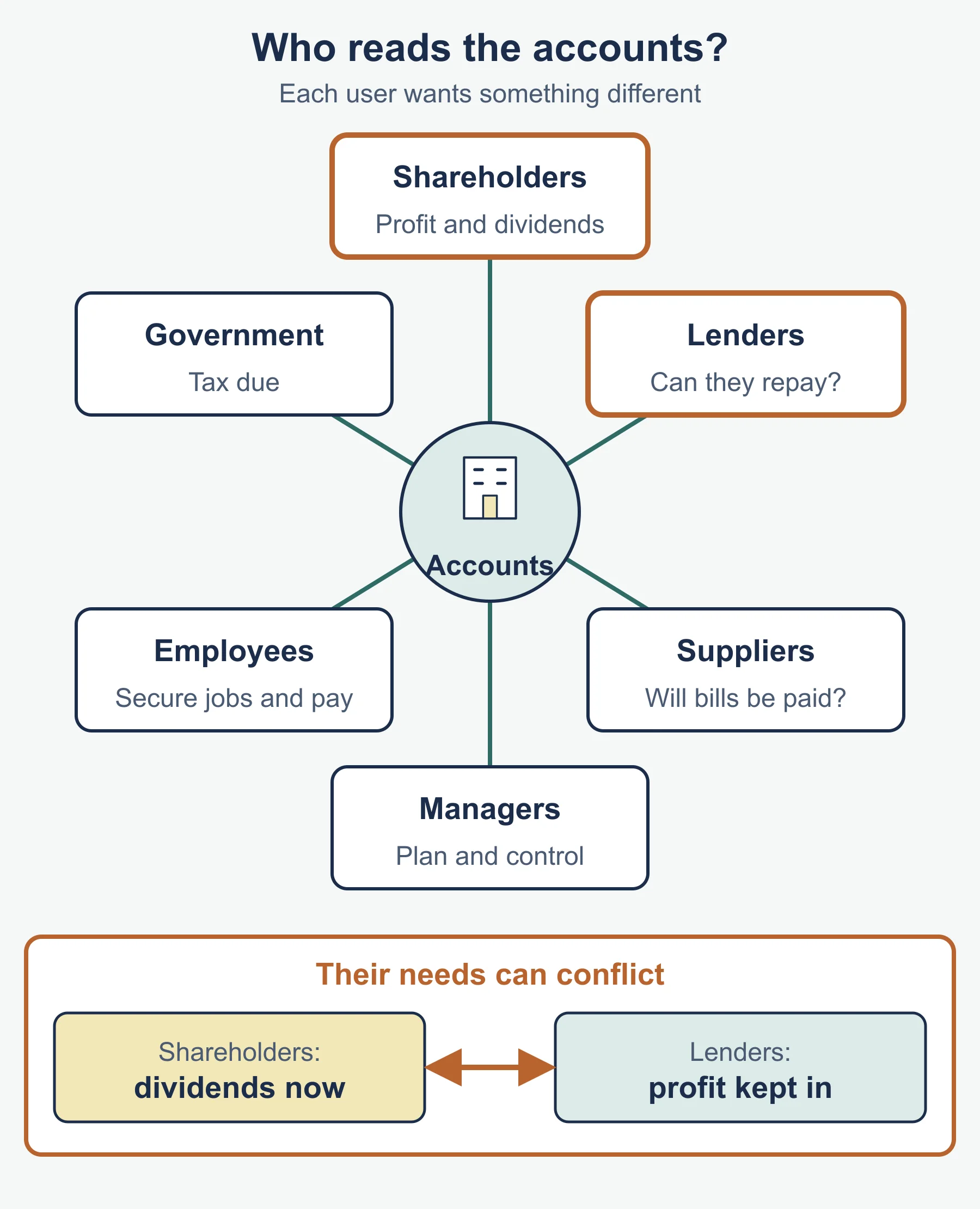
Significance (stakeholders): owners and investors, lenders, suppliers, employees, tax authority. Society: public funds from tax, trust in financial information, jobs and lending decisions that rest on honest figures.
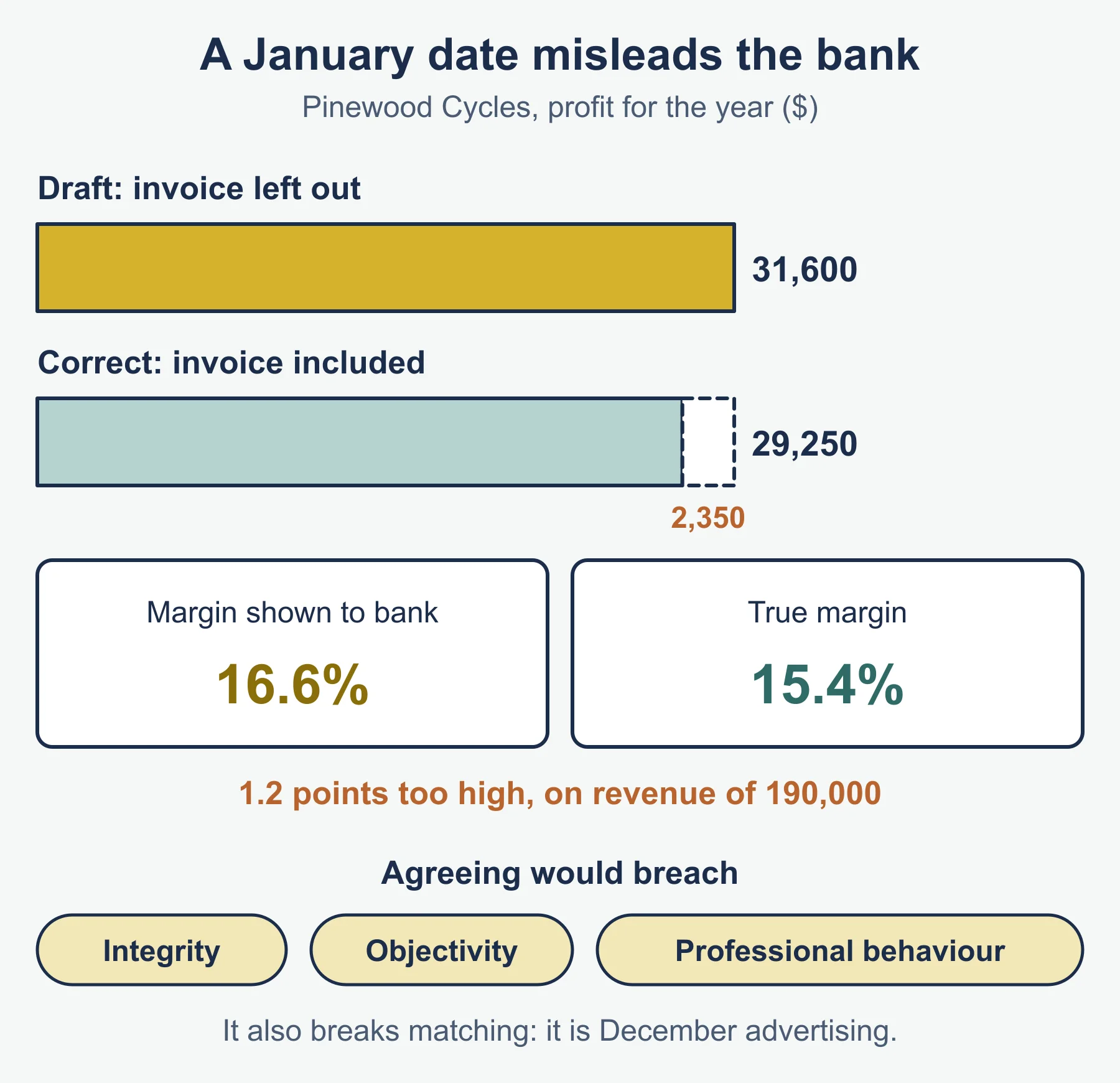
Worked reminder: draft profit is 18,400 after a 640 personal holiday was charged to travel expenses. Business entity makes it drawings, so profit is 18,400 + 640 = 19,040 and drawings rise by 640. Leaving it as an expense to cut tax would also challenge integrity and professional behaviour.
Applying it to a dilemma: state the pressure, name the concept being broken, name two principles with a reason each, quantify the overstatement or understatement, say who is harmed, then give a proper course of action.
7.3 Technology and sustainability
- Digital applications: may be used for all or part of the records. Faster posting and totals and fewer arithmetic slips, but cost, training and the same input error carried forward. No named software is needed.
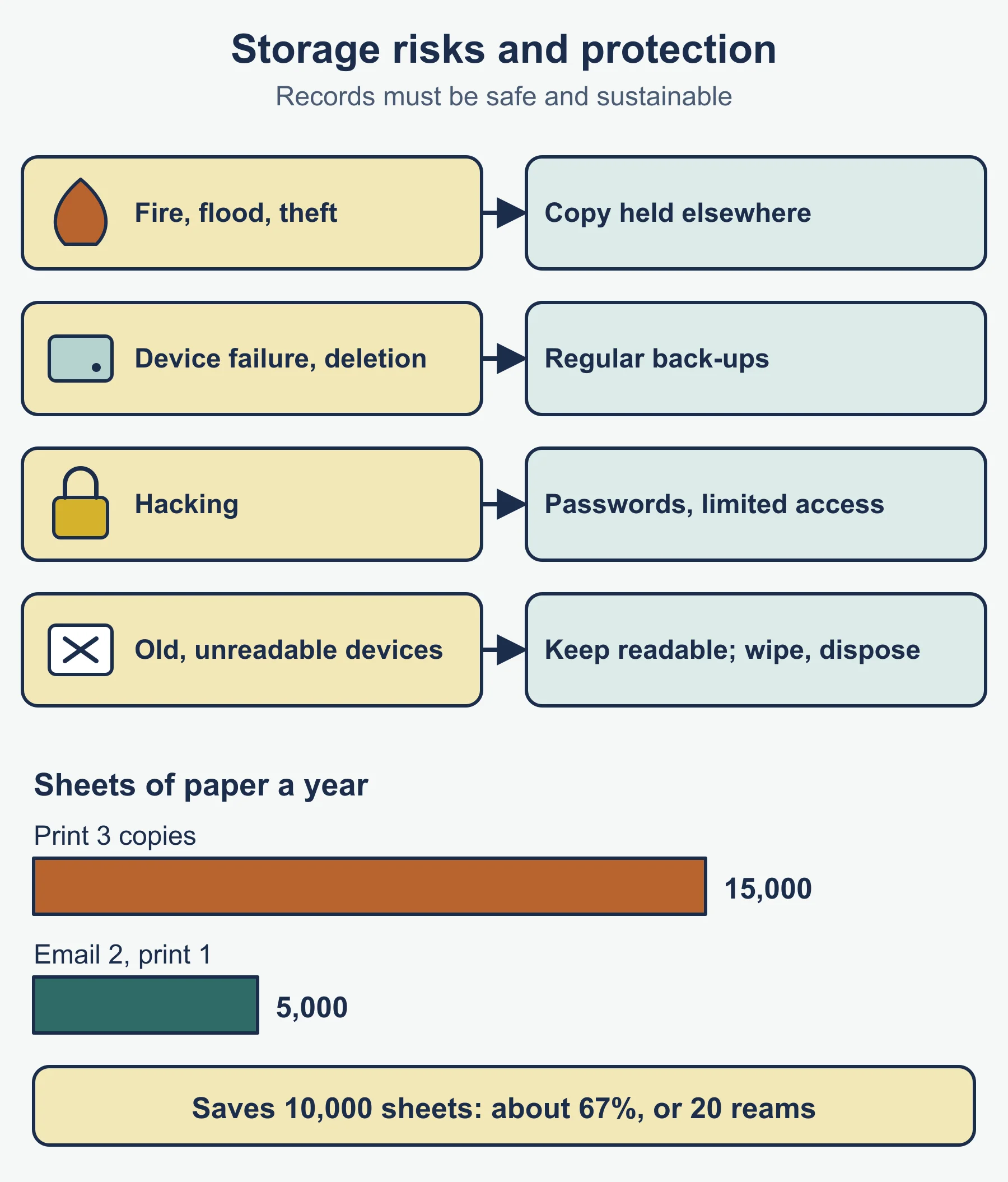
- Store safely: complete, accurate, available and protected from loss and unauthorised access.
- Store sustainably: print less, avoid duplicate copies, keep formats readable, dispose of old devices responsibly once data is removed.
- Risks of poor storage: data loss, hacking or fraud, exposure of confidential information, penalties, cost of rebuilding records, loss of trust, waste.
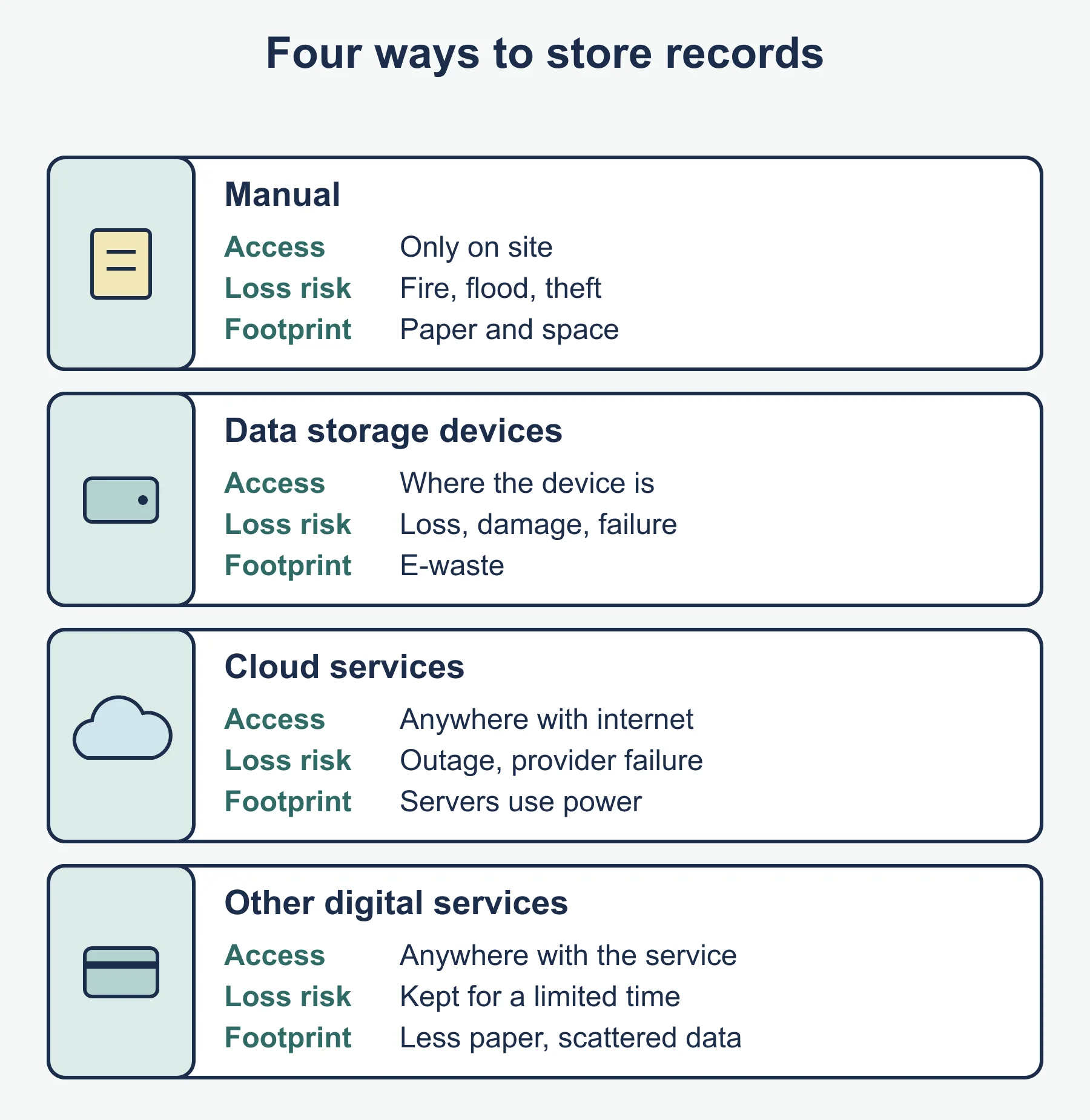
| Storage system | Main advantage | Main disadvantage |
|---|---|---|
| Manual | No power or internet needed | Bulky and slow to search or copy |
| Data storage devices | Fast, large capacity, business holds the data | Small devices lost or fail; back-ups needed |
| Cloud services | Remote access; provider keeps equipment | Needs internet; continuing cost; third party |
| Other digital services | Records created automatically | Data scattered; depends on each service |
Most businesses combine methods. Working copies on a data storage device, a second copy in a cloud service and paper originals of key documents survive more events than a single method. Name a type, give an advantage, give a disadvantage, then link to the business described.
Quick self-test
- Which concept requires wages for the last week of December to be included in this year’s expenses although they are paid in January?
- A sale is agreed on 31 December and the goods are delivered on 2 January. In which year is the revenue recorded?
- An accountant uses supplier prices seen in a client’s records to negotiate a deal for herself. Which principle does she breach?
- Annual insurance of 2,400 is paid on 1 October for 12 months. How much is prepaid at 31 December?
- Eighteen units cost 25 each and have a net realisable value of 21 each. At what value are they included in inventory?
- Shop fittings cost 9,000 and accumulated depreciation is 3,600. A replacement would now cost 11,000. At what amount are they shown?
- Name the four types of storage system in 7.3.
- Give one risk of keeping the only copy of the records on a small data storage device.
- State one way using digital invoices can improve sustainability.
- Which two principles are most directly challenged when an owner pressures an accountant to change profit?
Answers
- Matching / accruals.
- The following year, because the goods have not passed to the customer (realisation).
- Confidentiality.
- 1,800.
- 378, the lower of cost (450) and net realisable value (378).
- 5,400 (9,000 - 3,600); the replacement cost is not used (historic cost).
- Manual, data storage devices, cloud services, other digital services.
- For example loss, theft, damage or device failure, so the records could not be recovered.
- For example less paper and printing, or less physical storage space.
- Integrity and objectivity.
Where marks are usually lost
- Writing a definition of a concept but never applying it to the figures given.
- Mixing up matching and realisation.
- Saying prudence means reducing profit on purpose.
- Using market or replacement value where historic cost applies.
- Calculating a prepayment using the wrong number of months.
- Naming a principle without saying how it applies to the situation.
- Giving advantages of a storage system but no disadvantage when the question asks to discuss.
- Naming a software package, which the syllabus does not require.
Frequently asked questions
What are the five ethical principles for accountants? The five principles are integrity, objectivity, professional competence and due care, confidentiality and professional behaviour. In an answer, name the principle and say how it applies to the situation.
What are the four types of data storage system? The four types are manual books, devices, cloud services and other digital services. Manual books work without power but are slow to search, devices are fast but small ones are easily lost, and cloud services give remote access at a continuing cost and depend on a third party.
Why should accounting data be stored sustainably? Storage has environmental costs, including paper, printing, discarded devices and the electricity used by devices and remote servers. Reducing printing and choosing efficient storage cuts these costs.
What does the historic cost concept mean? Historic cost means an asset is recorded at what was paid for it, not at its market or replacement value. Using market value where historic cost applies is a common error.
How should you answer a “discuss” question on storage systems? Give both advantages and disadvantages of the storage type and reach a view. Listing only advantages does not answer a discuss question.
Official syllabus
Cambridge IGCSE Accounting 0452 syllabus for exams in 2027, 2028 and 2029, version 1, published by Cambridge University Press & Assessment (Cambridge International Education). Sections 7.1 to 7.3.
Get free revision emails (optional)
Occasional emails with practice questions, worked explanations and links to free resources for the qualification and subjects you choose. No spam, and you can unsubscribe from any email. The free tools on this site never need an email.
Related resources
-
Revision notes
IGCSE Accounting: Analysis and Interpretation — Revision Notes
Quick recall for Cambridge IGCSE Accounting 0452 Topic 6: ten ratios, reading them, profit versus cash, comparing businesses, users and statement limits.
Accounting · Cambridge · IGCSE, O Level
Revise topic -
Study guides
IGCSE Accounting: Accounting Concepts and Modern Practice (Cambridge 0452)
Cambridge IGCSE Accounting 0452 Topic 7 guide: applying the ten concepts in the records, the five ethical principles, digital records and safe data storage.
Accounting · Cambridge · IGCSE, O Level
Read guide -
Practice questions
IGCSE Accounting: Accounting Concepts and Modern Practice — Practice Questions
Exam-style practice with worked answers on the ten concepts, ethical principles, digital records and data storage for Cambridge IGCSE Accounting 0452 Topic 7.
Accounting · Cambridge · IGCSE, O Level
Try questions
Related articles
-
teaching
A Level tuition in Dubai: Cambridge or Pearson Edexcel International A Level?
Schools in Dubai and Abu Dhabi teach either Cambridge International AS & A Level or Pearson Edexcel International A Level. How the two are structured, why it matters for tuition, and how online classes from Lahore work.
9 October 2026
-
curriculum guides
Choosing subjects at IGCSE and A Level
How subject choices at 14 and 16 affect university options later, and how to keep pathways open without overloading a timetable.
28 July 2026
Studying this with a teacher
Working through Accounting IGCSE, O LEVELS?
This page is free and stays free. If you would rather be taught it, Marlbridge runs Accounting classes one-to-one and in small groups of up to 15, online in your own time zone. The first trial class is free. WhatsApp replies within an hour (8am–11pm Pakistan time, every day); email the same day.
Cambridge Accounting teachers at Marlbridge

