
Study Guides
IGCSE Accounting: Accounting concepts, ethics, technology and sustainability (Cambridge 0452)
Example-led study guide to the ten accounting concepts, five ethical principles, digital records and data storage for Cambridge IGCSE Accounting 0452.
- Subject
- Accounting
- Level
- IGCSE, O LEVELS
- Topic
- Accounting concepts and modern practice
- Author
- Marlbridge Academic Team
- Updated
- Reviewed by
- Javaid Iqbal Sabri (what this means)
Aligned to Cambridge IGCSE O Level Accounting (0452, 7707), 2027-2029. Official specification (IGCSE) ; Official specification (O Level) .
Syllabus page (what it covers and how it is assessed): Cambridge IGCSE Accounting; Cambridge O Level Accounting.
Syllabus points this page covers
0452
- 7.1 Accounting concepts
- 7.2 Ethical considerations
- 7.3 Technology and sustainability
7707
- 7.1 Accounting concepts
- 7.2 Ethical considerations
- 7.3 Technology and sustainability
Found an error? Report a correction.
Want a teacher for this? Marlbridge teaches Accounting online. Request a free trial class.
Syllabus edition note. This resource follows the Cambridge IGCSE Accounting 0452 syllabus (and Cambridge O Level Accounting 7707, which has the same subject content for the same series) for exams in 2027, 2028 and 2029 (version 1), first examined in the March 2027 series in India and the June 2027 series elsewhere. If you sit 0452 in November 2026, you sit the 2026 syllabus (version 2), which differs: Paper 1 has 35 multiple-choice marks in 1 hour 15 minutes, not 40 marks in 1 hour 30 minutes; Topic 7 is “Accounting principles and policies”, without 7.2 Ethical considerations or 7.3 Technology and sustainability; 4.4 is “Irrecoverable debts and provision for doubtful debts”; income statements are named instead of statements of profit or loss; three-column running balance accounts are not required; Clubs and societies is 5.4 and Manufacturing accounts 5.5; and 6.3 is “Inter-firm comparison”. For this topic, the 2026 syllabus calls the same ten items accounting principles, and its 7.2 is Accounting policies (the influence of international accounting standards and the objectives of comparability, relevance, reliability and understandability), which the 2027-2029 syllabus removes. If you sit in November 2026, work from the 2026 syllabus on the Cambridge International website.
This study guide covers sections 7.1 Accounting concepts, 7.2 Ethical considerations and 7.3 Technology and sustainability of the Cambridge IGCSE Accounting 0452 syllabus for exams in 2027, 2028 and 2029 (version 1). All candidates follow the same content, so there are no tier labels. It teaches through one invented business, Pinewood Cycles, owned by Haleem Bashir. The earlier Accounting Concepts and Modern Practice study guide covers the same sections with different examples. All amounts are in dollars.
Related pages: revision notes, practice questions, the Cambridge IGCSE Accounting hub, the printable checklist and the free 10-minute diagnostics. Many concepts explain Accounting Procedures.
What you must cover
| Section | Points the syllabus lists | Here |
|---|---|---|
| 7.1 | The ten accounting concepts, from business entity to realisation | Sections 1 to 4 |
| 7.2 | Need for an ethical framework; five fundamental principles; significance to stakeholders and society | Section 5 |
| 7.3 | Digital applications; safe and sustainable storage and its risks; four storage types with advantages and disadvantages | Section 6 |
The syllabus says you do not need to know any specific accounting software package.
1. Duality and business entity
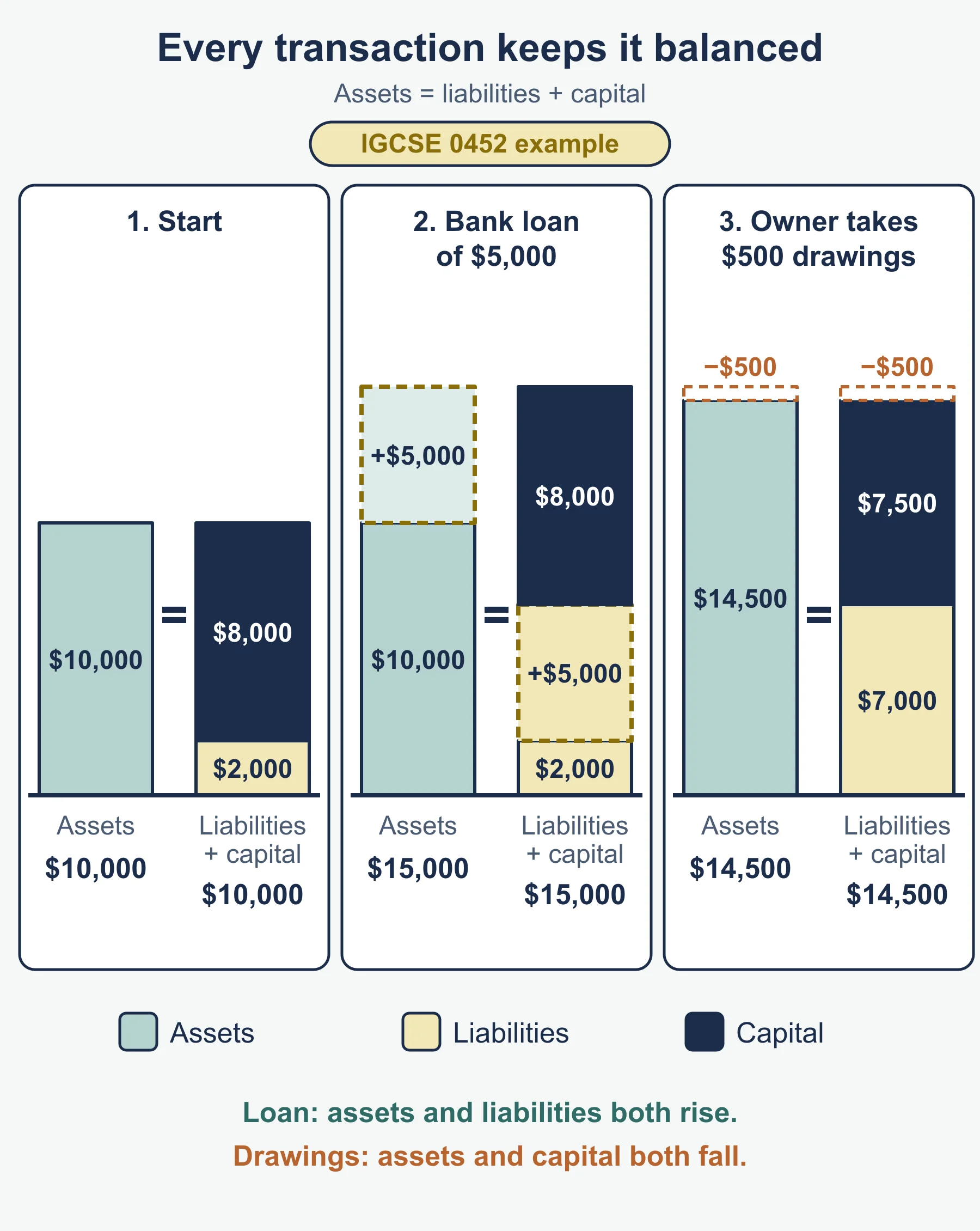
Duality says every transaction has two sides of equal value. Business entity says the business is a separate unit from its owner, so only the business’s own transactions go in its books.
Haleem starts Pinewood Cycles on 1 March. Four transactions show both concepts.
| Transaction | Debit | Credit | Effect on assets = liabilities + capital |
|---|---|---|---|
| Haleem pays 20,000 into a new business bank account | Bank 20,000 | Capital 20,000 | Assets +20,000; capital +20,000 |
| Buys shop equipment for 4,800 on credit | Equipment 4,800 | Trade payables 4,800 | Assets +4,800; liabilities +4,800 |
| Pays 1,500 of that invoice by bank transfer | Trade payables 1,500 | Bank 1,500 | Assets -1,500; liabilities -1,500 |
| Takes 600 from the bank for a family trip | Drawings 600 | Bank 600 | Assets -600; capital -600 |
Check the equation after the four lines. Bank is 20,000 - 1,500 - 600 = 17,900 and equipment is 4,800, so assets are 22,700. Trade payables are 4,800 - 1,500 = 3,300 and capital is 20,000 - 600 = 19,400, so liabilities plus capital are also 22,700. The two sides agree because each line changed both sides equally. The family trip is not a business expense: business entity makes it drawings.
2. Matching / accruals and realisation
Matching / accruals puts revenue and the costs of earning it in the period they belong to, whatever the cash timing. Realisation recognises revenue when the goods or services have been provided and the customer is committed to pay.
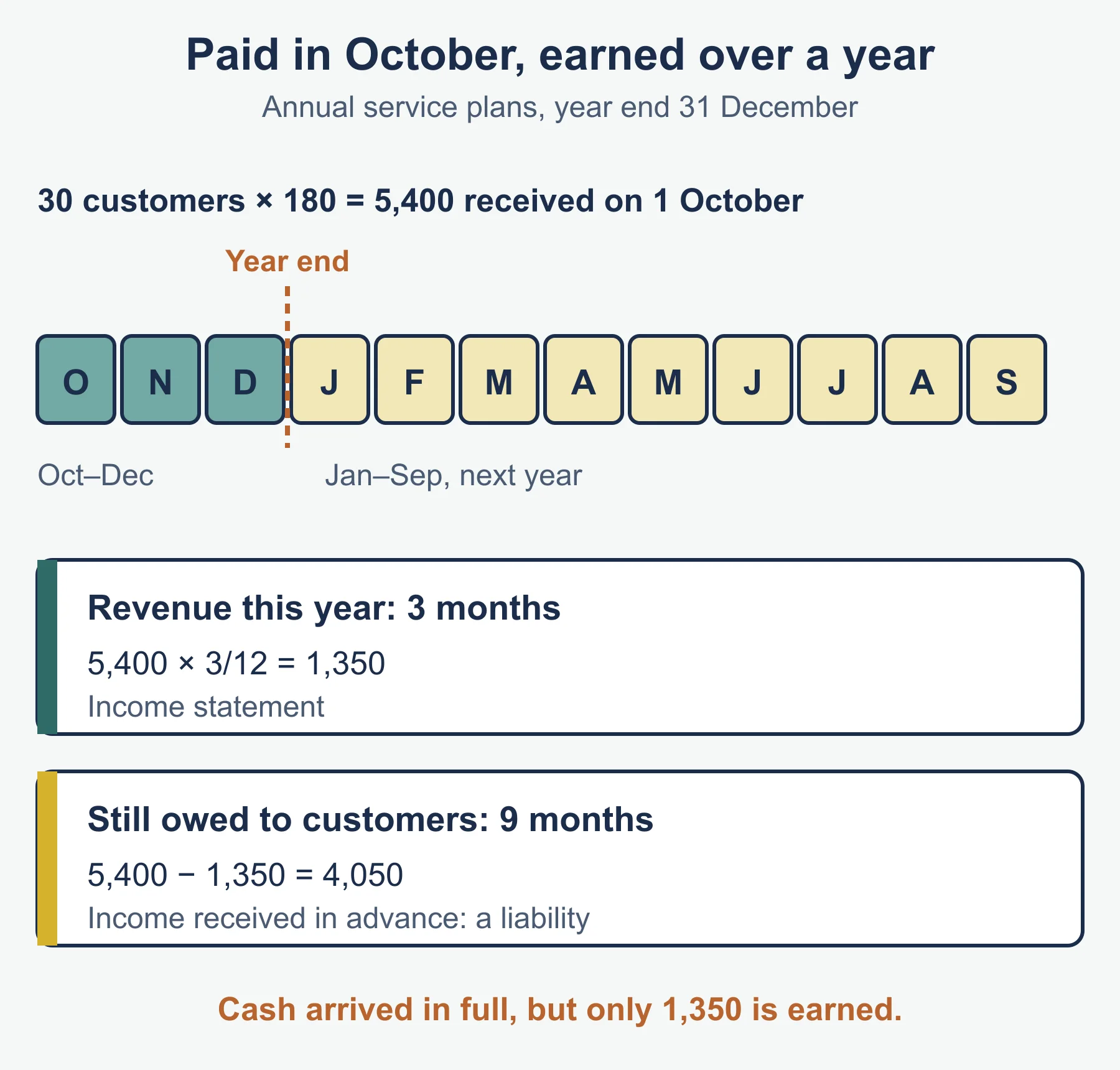
Pinewood Cycles sells annual service plans at 180 each. On 1 October 30 customers buy a plan and pay in full, so cash received is 30 x 180 = 5,400. The year ends on 31 December, so three of the twelve months have been provided.
| Step | Working | Amount |
|---|---|---|
| Revenue earned this year | 5,400 x 3/12 | 1,350 |
| Income received in advance | 5,400 - 1,350 | 4,050 |
Only 1,350 is this year’s revenue. The rest is a liability, because the shop still owes nine months of servicing. A bicycle sold on 29 December but delivered on 3 January is next year’s revenue.
3. Prudence, materiality and consistency
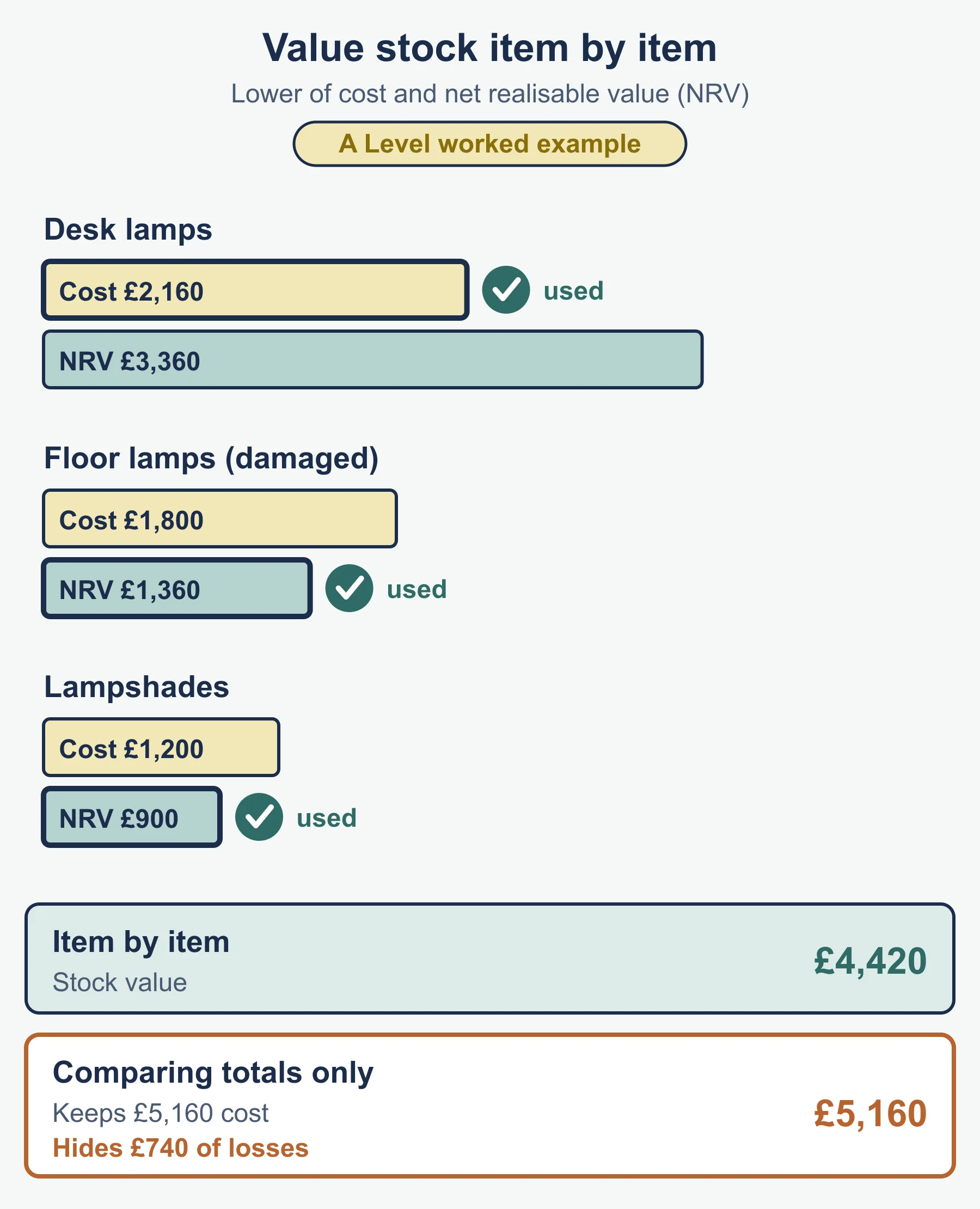
Prudence means do not overstate profit or assets, and do recognise expected losses promptly. A common use is valuing inventory at the lower of cost and net realisable value. Pinewood Cycles’ closing inventory is compared line by line.
| Line | Units | Cost per unit | Net realisable value per unit | Total cost | Total NRV | Value used |
|---|---|---|---|---|---|---|
| Mountain bikes | 6 | 310 | 280 | 1,860 | 1,680 | 1,680 |
| Helmets | 40 | 18 | 25 | 720 | 1,000 | 720 |
| Child seats | 12 | 22 | 15 | 264 | 180 | 180 |
| Total | 2,844 | 2,580 |
Inventory falls by 2,844 - 2,580 = 264, so profit falls by 264. Helmets could sell for more than they cost, but that gain is not recorded until they are sold.
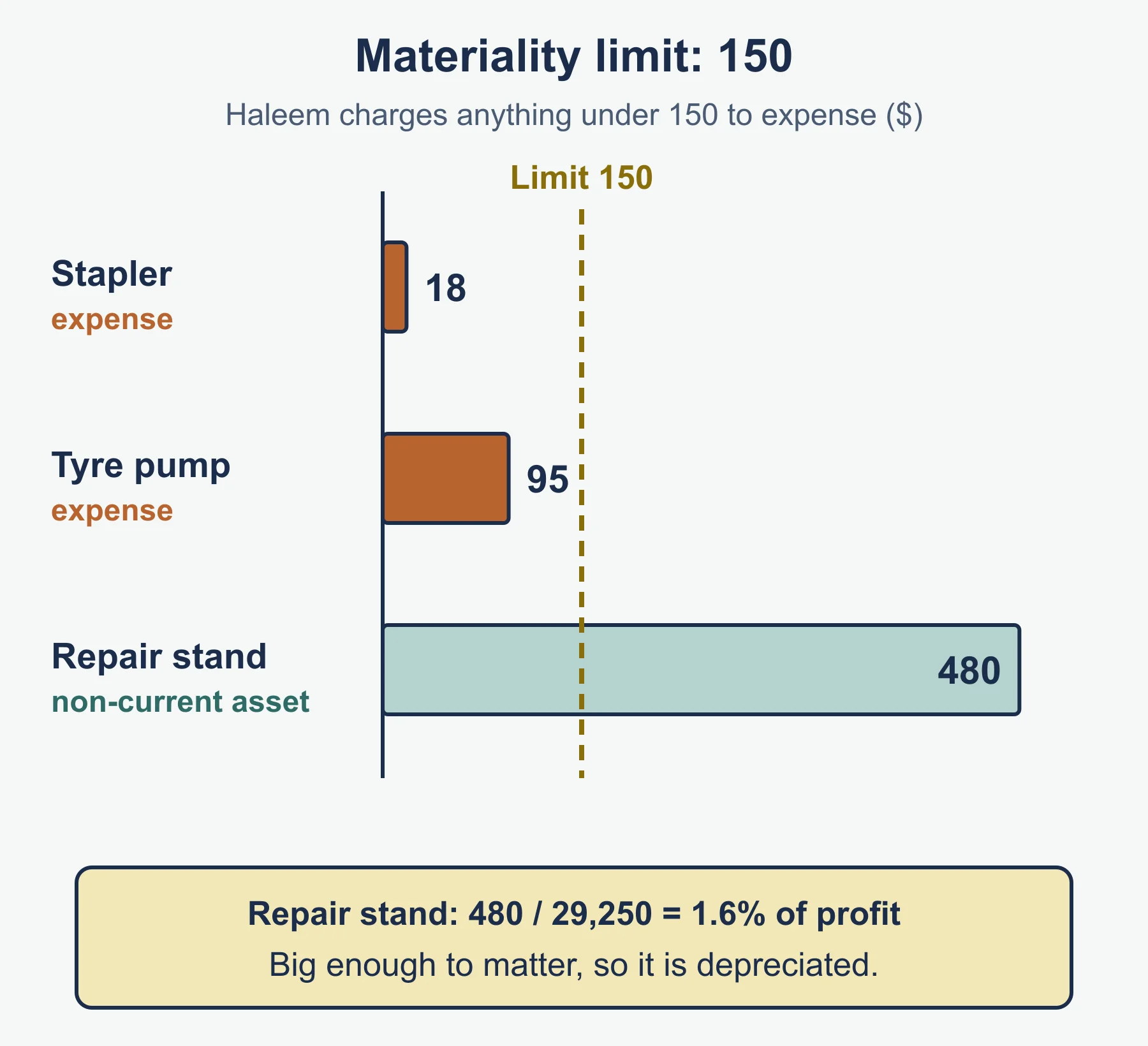
Materiality lets items too small to change a user’s decisions be treated simply. Haleem decides that anything costing under 150 is charged to expense even if it lasts years. A stapler at 18 and a tyre pump at 95 are expenses. A repair stand at 480 is recorded as a non-current asset and depreciated, which is 480 / 29,250 = 1.6% of the year’s profit, large enough to matter. A much larger business might set a higher limit, because materiality depends on size.
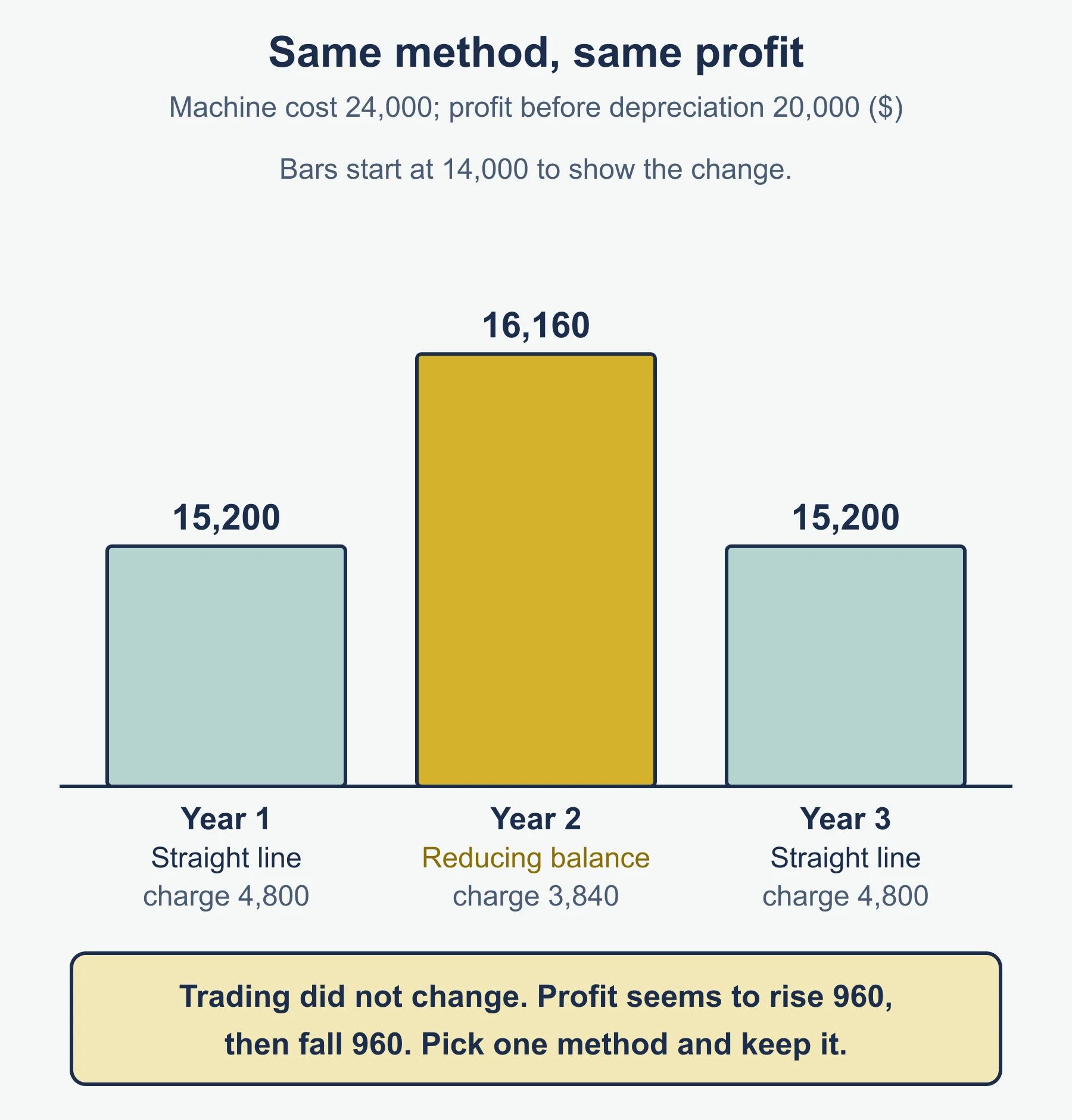
Consistency means the same treatment from year to year. A machine costing 24,000 gives profit of 20,000 before depreciation each year. Straight line at 20% of cost charges 4,800, so profit is 15,200 every year. If year 2 switched to reducing balance at 20%, the charge would be 19,200 x 20% = 3,840 and profit 16,160; back on straight line in year 3, profit returns to 15,200. Trading did not change, yet profit seems to rise by 960 then fall by 960.
4. Historic cost, going concern and money measurement
Historic cost records an asset at what was paid. Going concern assumes the business will keep trading for the foreseeable future. Money measurement records only items that can be reliably measured in money.
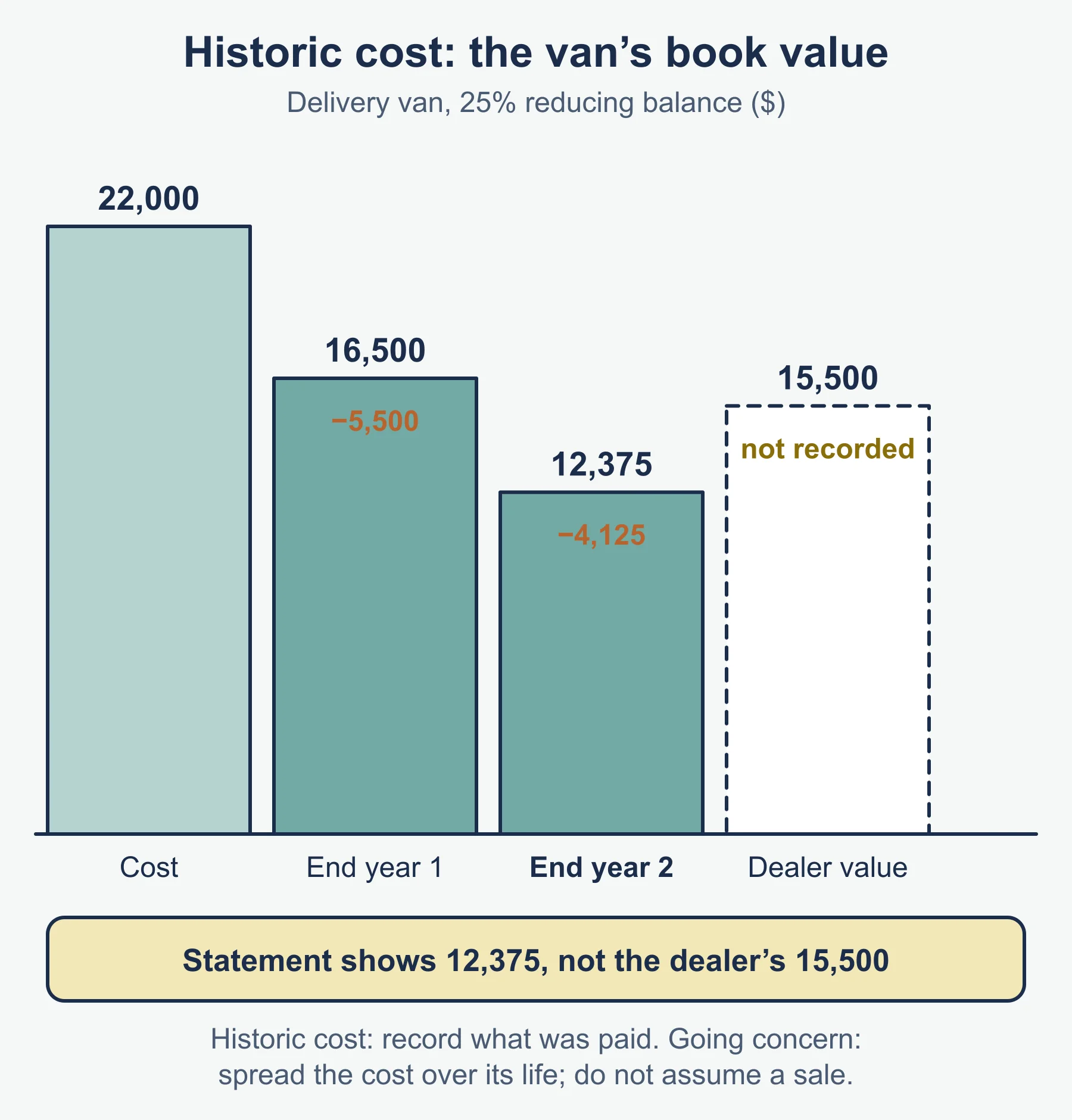
Pinewood Cycles’ delivery van cost 22,000 and is depreciated at 25% on the reducing balance each year. Depreciation is 22,000 x 25% = 5,500 in year 1, leaving 16,500, then 16,500 x 25% = 4,125 in year 2, leaving a net book value of 12,375. A dealer values the van at 15,500, yet the statement of financial position shows 12,375. As a going concern, the business spreads the van’s cost over its useful life, and historic cost means a higher market value is not recorded. If Haleem planned to close the shop within weeks, the assumption would fail and the expected sale value would become the more relevant figure.
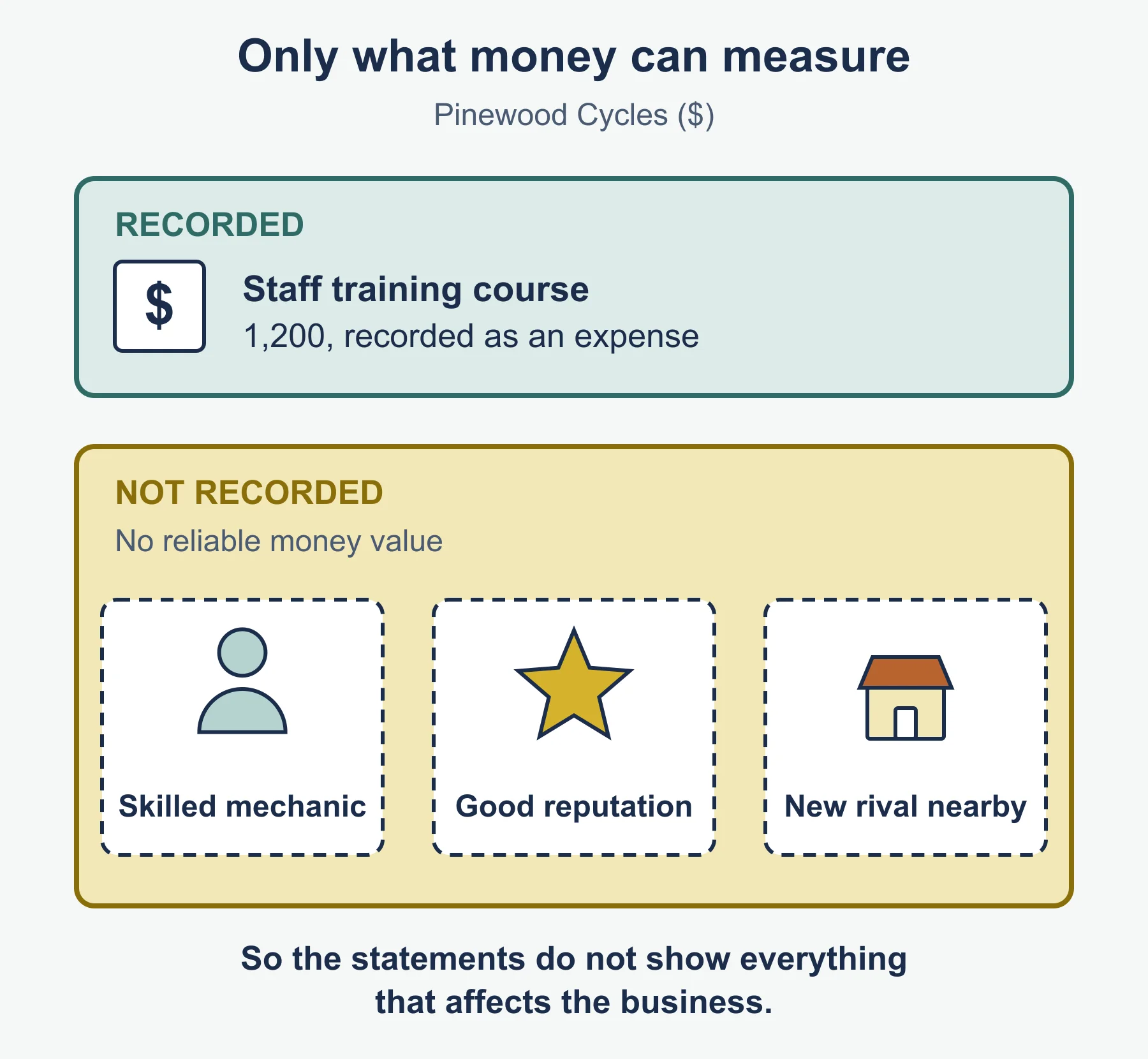
Money measurement explains what is left out. Haleem’s experienced mechanic, the shop’s good reputation and a new rival nearby cannot be reliably valued in money, so none is recorded. The 1,200 paid for a staff training course is recorded, as an expense. The statements therefore do not show everything that affects the business.
5. Ethical considerations (7.2)
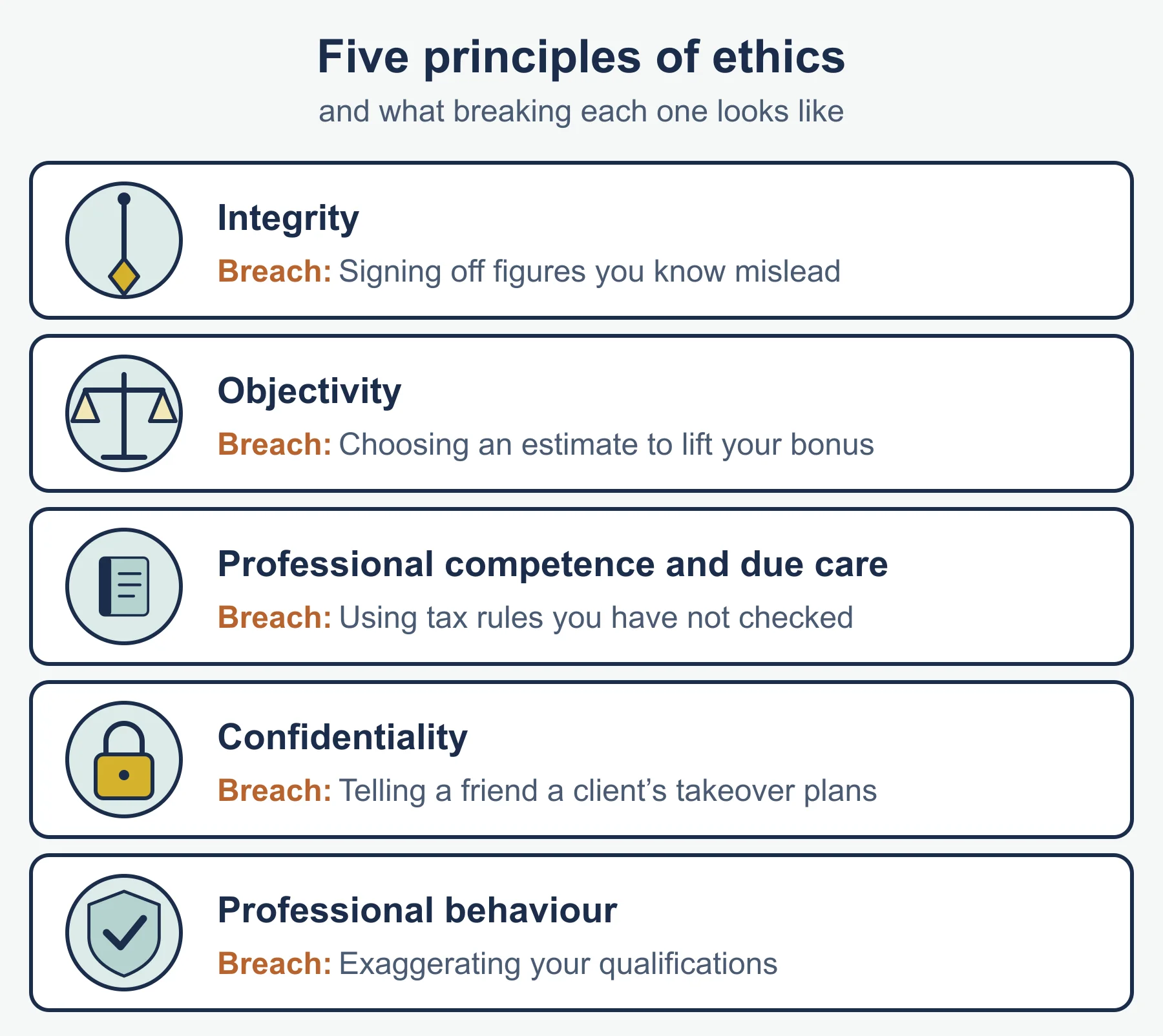
The need for a framework. Others rely on accountants’ figures but cannot check them, accountants may face pressure, and they handle private information. A framework sets the standard in advance, so it applies whoever asks.
| Principle | Meaning in your own words | A situation where it applies |
|---|---|---|
| Integrity | Be honest and straightforward | Refusing to record an invoice from a supplier who does not exist |
| Objectivity | Do not let bias, a conflict of interest or pressure decide your judgement | Asking someone else to review a debt owed by your own cousin |
| Professional competence and due care | Have the skills, keep them current and work carefully | Reading the rules before preparing an unfamiliar statement |
| Confidentiality | Do not pass on or misuse information gained through your work | Not telling a supplier what a rival customer paid |
| Professional behaviour | Obey the law and avoid actions that damage the profession’s reputation | Declining to hide income from the tax authority |
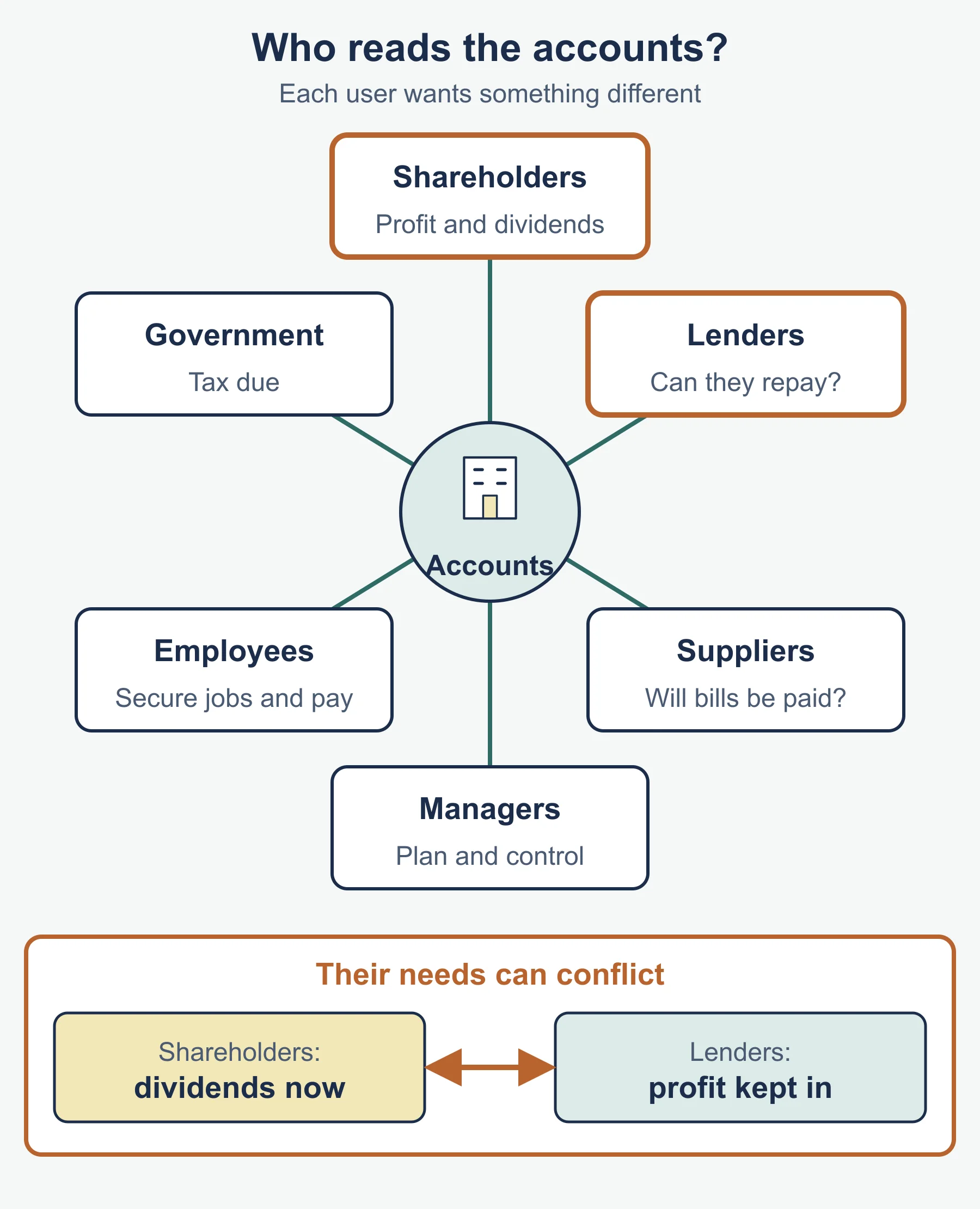
Significance to stakeholders and society. Each group decides from the figures, so false figures harm each differently.
| Group | Harm if the framework is not applied |
|---|---|
| Owners and investors | Money put into a weaker business than it appeared |
| Lenders | Loans that cannot be repaid |
| Suppliers | Credit given and then unpaid |
| Employees | Jobs lost when hidden problems surface |
| Tax authority and society | Less tax collected for public services; weaker trust in financial information |
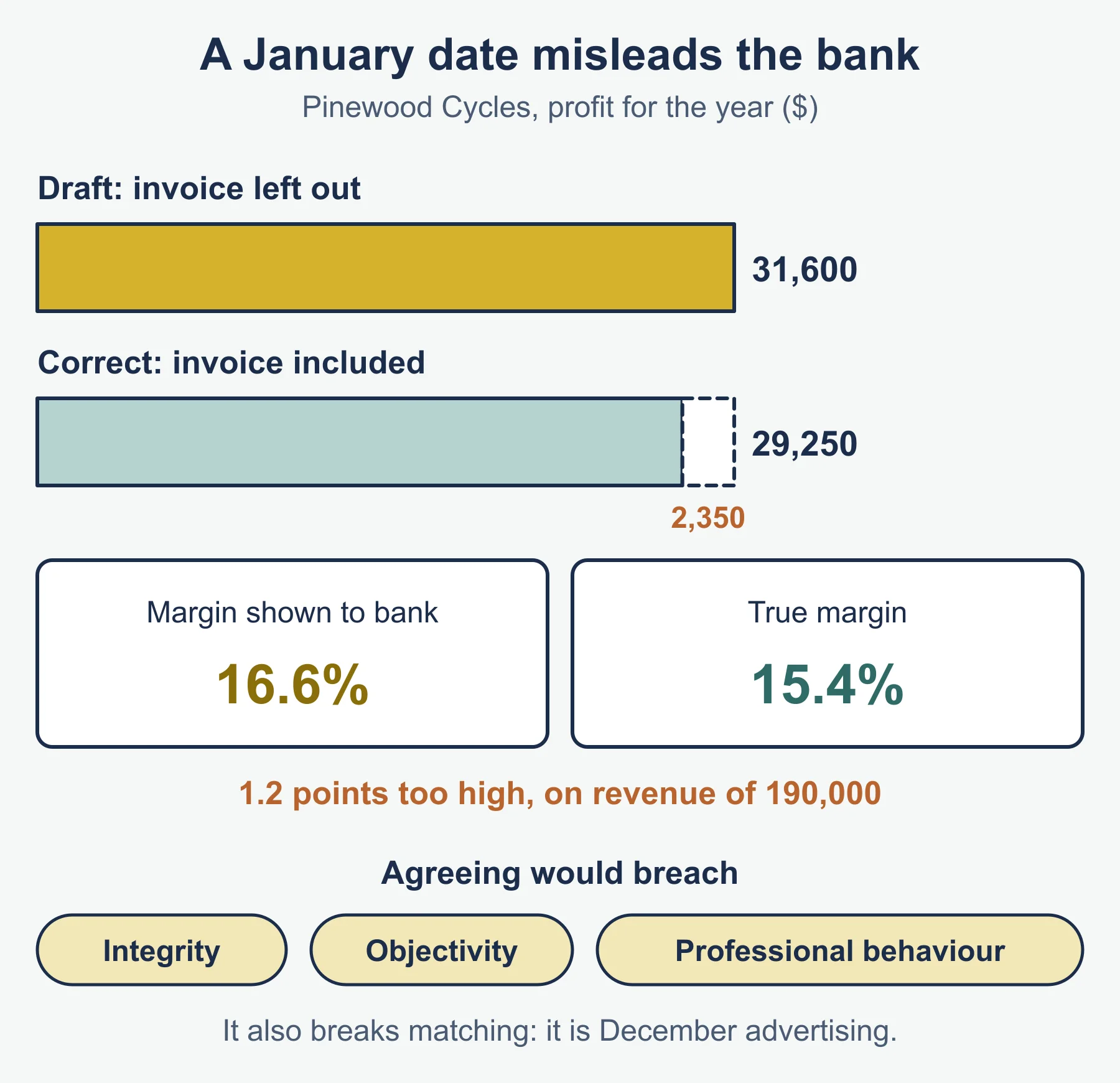
Worked example. Pinewood Cycles’ draft profit for the year ended 31 December is 31,600 on revenue of 190,000. A 2,350 invoice for a December advertising campaign is unrecorded. Haleem asks the book-keeper to date it January so the profit looks better for a bank loan.
| Measure | Draft | Correct |
|---|---|---|
| Profit for the year | 31,600 | 31,600 - 2,350 = 29,250 |
| Profit for the year as % of revenue | 31,600 / 190,000 = 16.6% | 29,250 / 190,000 = 15.4% |
The advertising belongs to this year, so leaving it out breaks matching / accruals. Agreeing would breach integrity (knowingly misleading), objectivity (giving way to pressure) and probably professional behaviour (misleading a lender). The sound response is to explain why the invoice must be recorded and produce only the correct figures. The bank would otherwise lend on a margin 1.2 percentage points too high.
6. Technology and sustainability (7.3)
Digital applications for all or part of the records. A business may keep everything digitally or only some books, for example sales invoices on a spreadsheet and a handwritten petty cash book. Software can post both sides of an entry, update totals and produce a trial balance quickly. The cost is training, set-up, reliance on the system and the risk that one wrong input is repeated everywhere.
Why store data safely. Records are needed for the statements, collecting debts, lenders, tax enquiries and evidence. Safe storage keeps them complete, accurate, available and protected from loss or unauthorised access, which supports confidentiality.
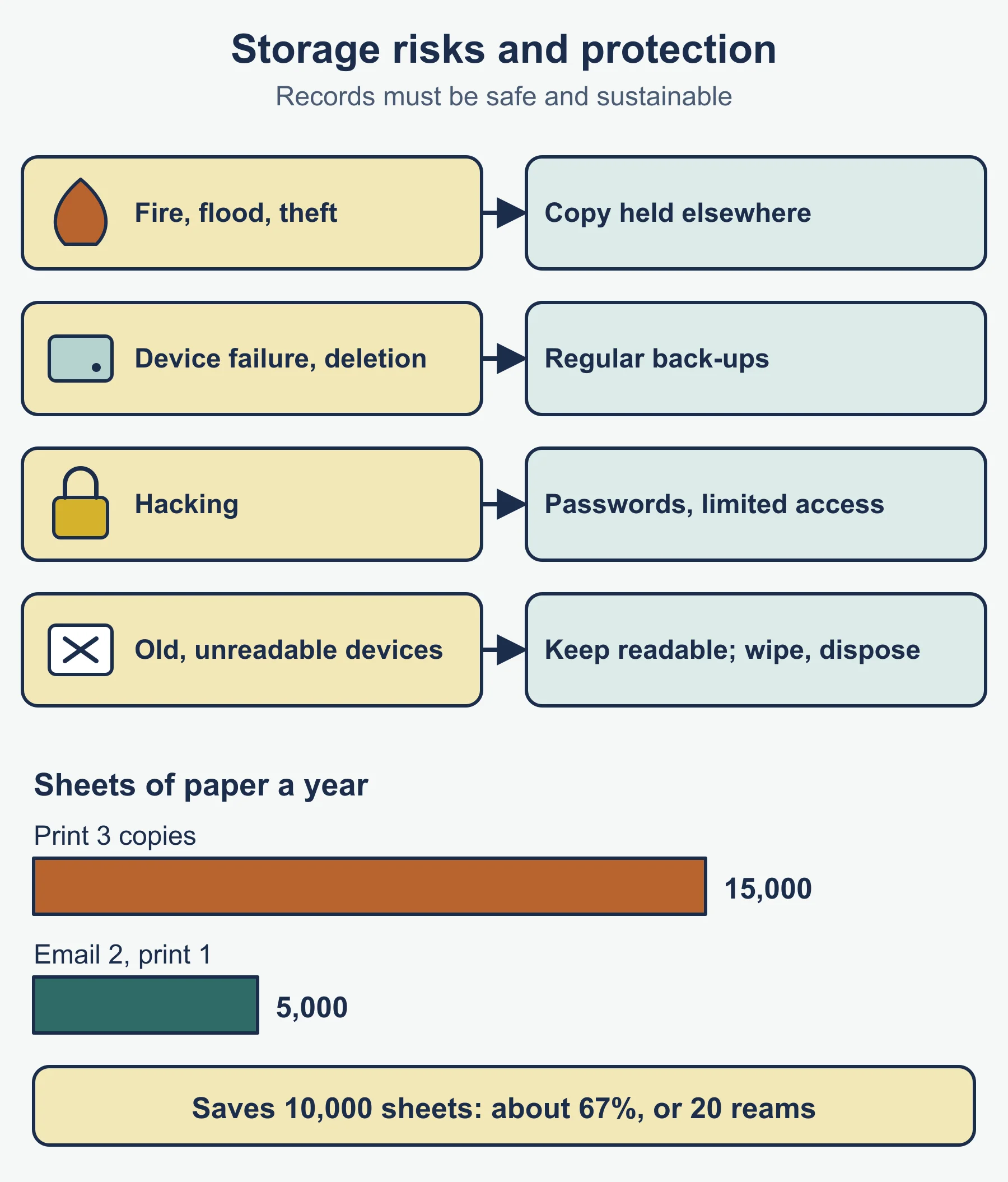
Why store data sustainably. Storage has environmental costs: paper, printing, discarded devices and the electricity devices and remote servers use. Printing three copies of 20 invoices a day for 250 days uses 15,000 sheets; emailing two copies and printing one uses 5,000, saving 10,000 (about 67%), or 20 reams of 500.
| Risk of poor storage | Possible result | Protective measure |
|---|---|---|
| Fire, flood or theft | All records lost | Copy held at another place |
| Device failure or accidental deletion | Recent entries lost | Regular back-ups |
| Hacking or unauthorised access | Records altered, customer details exposed | Passwords and limited access |
| Old devices unreadable or discarded | Records inaccessible; waste | Keep records readable; wipe data and dispose of devices responsibly |
Penalties, rebuilding costs and lost trust are further risks.
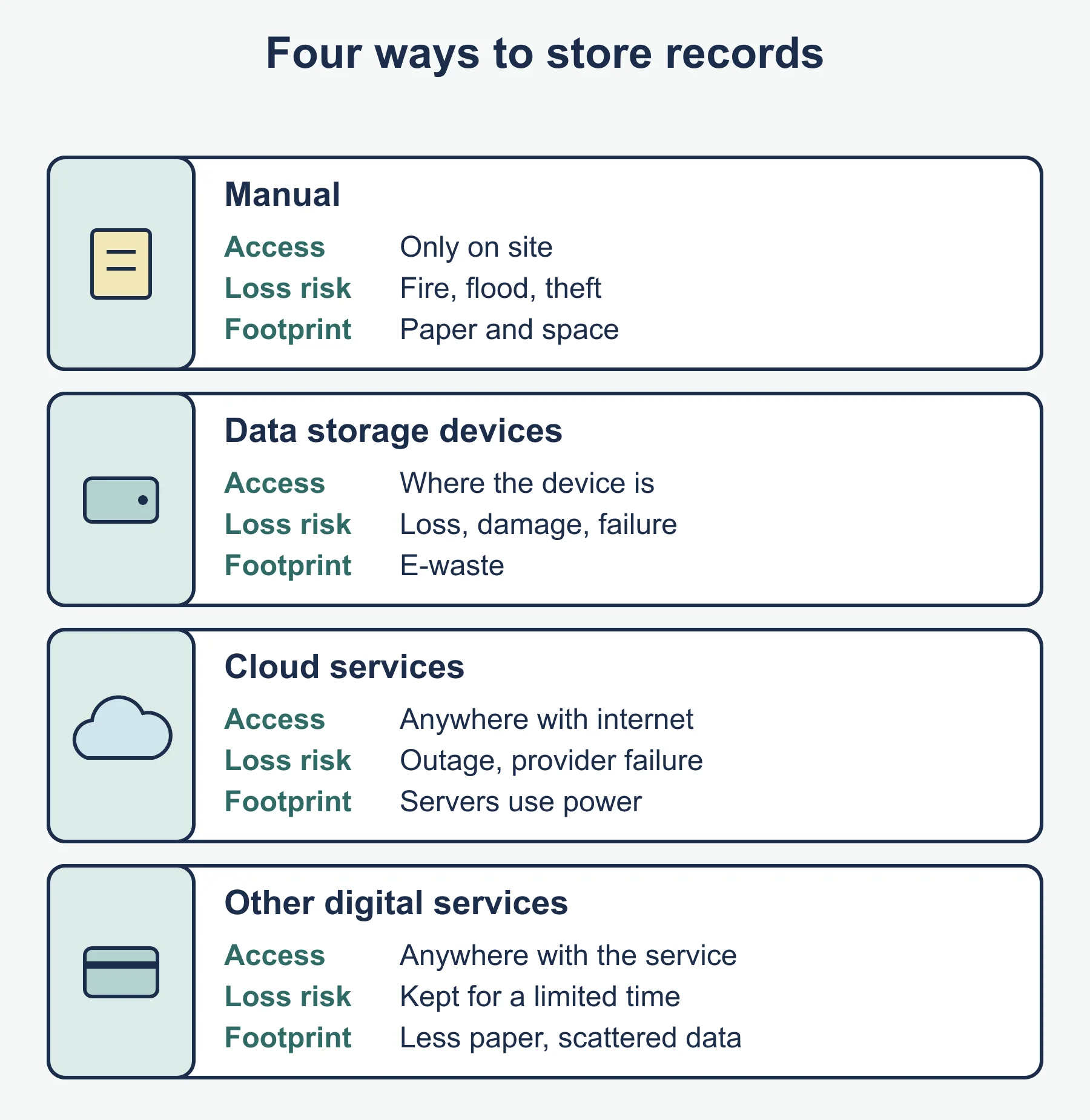
The four types of storage system, compared:
| Manual | Data storage devices | Cloud services | Other digital services | |
|---|---|---|---|---|
| Access | Only on site | Where the device is | Anywhere with internet | Anywhere with the service |
| Loss risk | Fire, flood, theft | Loss, damage, failure | Outage, provider failure | Records may be kept for a limited time |
| Sustainability | Paper and space | E-waste | Servers use power | Less paper but scattered data |
Manual books work without power but are slow to search and hard to copy. Devices are fast, but small ones are easily lost. Cloud services give remote access and off-site safety at a continuing cost, depending on a third party. Other digital services, such as online banking, create records automatically but spread data across systems. Most businesses use a mix.
Common errors
- Defining a concept without linking it to the figures in the question.
- Treating prudence as understating profit rather than not overstating it.
- Using market value instead of historic cost.
- Listing only advantages when asked to discuss a storage type.
Frequently asked questions
What are the ten accounting concepts in Cambridge IGCSE Accounting 0452? For exams in 2027 to 2029, section 7.1 covers duality, business entity, matching (accruals), realisation, prudence, materiality, consistency, historic cost, going concern and money measurement. Answers should apply each concept to the figures in the question.
What is the difference between matching and realisation? Matching (accruals) puts revenue and the costs of earning it in the period they belong to, whatever the cash timing. Realisation recognises revenue when goods or services have been provided and the customer is committed to pay, so cash received in advance is a liability.
Why do accountants need an ethical framework? Others rely on accountants’ figures but cannot check them, accountants may face pressure, and they handle private information. A framework sets the standard in advance, so it applies whoever is asking.
Why should accounting data be stored safely? Records are needed for the financial statements, collecting debts, lenders, tax enquiries and evidence. Safe storage keeps them complete, accurate, available and protected from loss or unauthorised access, which also supports confidentiality.
Do you need to know specific accounting software for 0452? No. The syllabus says you do not need to know any specific accounting software package, so answers should describe what digital applications do rather than naming a product.
Official syllabus
Cambridge IGCSE Accounting 0452 syllabus for exams in 2027, 2028 and 2029, version 1, published by Cambridge University Press & Assessment (Cambridge International Education). Sections 7.1 to 7.3.
Get free revision emails (optional)
Occasional emails with practice questions, worked explanations and links to free resources for the qualification and subjects you choose. No spam, and you can unsubscribe from any email. The free tools on this site never need an email.
Related resources
-
Revision notes
IGCSE Accounting: Analysis and Interpretation — Revision Notes
Quick recall for Cambridge IGCSE Accounting 0452 Topic 6: ten ratios, reading them, profit versus cash, comparing businesses, users and statement limits.
Accounting · Cambridge · IGCSE, O Level
Revise topic -
Practice questions
IGCSE Accounting: Accounting concepts, ethics, technology and sustainability (Cambridge 0452) – Practice Questions
Original practice questions with worked answers on accounting concepts, ethical principles, digital records and storage for Cambridge IGCSE Accounting.
Accounting · Cambridge · IGCSE, O Level
Try questions -
Revision notes
IGCSE Accounting: Accounting concepts, ethics, technology and sustainability (Cambridge 0452) – Revision Notes
Condensed revision notes on accounting concepts, ethical principles, digital records and data storage for Cambridge IGCSE Accounting 0452, 2027-2029.
Accounting · Cambridge · IGCSE, O Level
Revise topic
Related articles
-
teaching
A Level tuition in Dubai: Cambridge or Pearson Edexcel International A Level?
Schools in Dubai and Abu Dhabi teach either Cambridge International AS & A Level or Pearson Edexcel International A Level. How the two are structured, why it matters for tuition, and how online classes from Lahore work.
9 October 2026
-
curriculum guides
Choosing subjects at IGCSE and A Level
How subject choices at 14 and 16 affect university options later, and how to keep pathways open without overloading a timetable.
28 July 2026
Studying this with a teacher
Working through Accounting IGCSE, O LEVELS?
This page is free and stays free. If you would rather be taught it, Marlbridge runs Accounting classes one-to-one and in small groups of up to 15, online in your own time zone. The first trial class is free. WhatsApp replies within an hour (8am–11pm Pakistan time, every day); email the same day.
Cambridge Accounting teachers at Marlbridge

