
Study Guides
IGCSE Business: Business and the international economy (Cambridge 0264)
Study guide to globalisation, tariffs, quotas, MNCs, external costs and benefits and exchange rates for Cambridge IGCSE Business 0264, with examples.
- Subject
- Business
- Level
- IGCSE
- Topic
- External influences on business activity
- Author
- Marlbridge Academic Team
- Updated
- Reviewed by
- Salman Ahmad (what this means)
Aligned to Cambridge IGCSE Business (0264), For examination in 2027, 2028 and 2029. Official specification .
Syllabus page (what it covers and how it is assessed): Cambridge IGCSE Business.
Syllabus points this page covers
0264
- 6.2 Business and the international economy
Found an error? Report a correction.
Need help with this topic? Request a free trial class for IGCSE Business (0450 / 0264).
This guide covers section 6.2 (Business and the international economy) of the Cambridge IGCSE Business 0264 syllabus for examination in 2027, 2028 and 2029. Both papers are based on all the subject content, so this topic can appear in short answers, data responses and the case study. Use it with the revision notes and the practice questions. The course hub, the printable checklist and the free diagnostics show where to go next.
All businesses, people and countries below are invented. Money is in dollars ($).
What this section covers
| Syllabus point | What you must be able to do |
|---|---|
| 6.2.1 | Give reasons for globalisation; explain opportunities and threats for businesses; explain import tariffs and import quotas and their effects on businesses |
| 6.2.2 | Explain the advantages to a business of becoming a multinational company (MNC); explain advantages and disadvantages for the country where an MNC is located |
| 6.2.3 | Explain external costs and external benefits of business decisions |
| 6.2.4 | Explain appreciation and depreciation of an exchange rate and how changes affect businesses that import and export |
The syllabus adds a note: candidates will not be assessed on exchange rate calculations. This guide therefore treats exchange rates in words only.
6.2.1 The importance of globalisation
Globalisation is the growing connection between the economies of different countries, so that goods, services, money, people and ideas move across borders more easily. This is the standard meaning. The syllabus does not give a wording, so explain it in your own words.
Reasons for globalisation
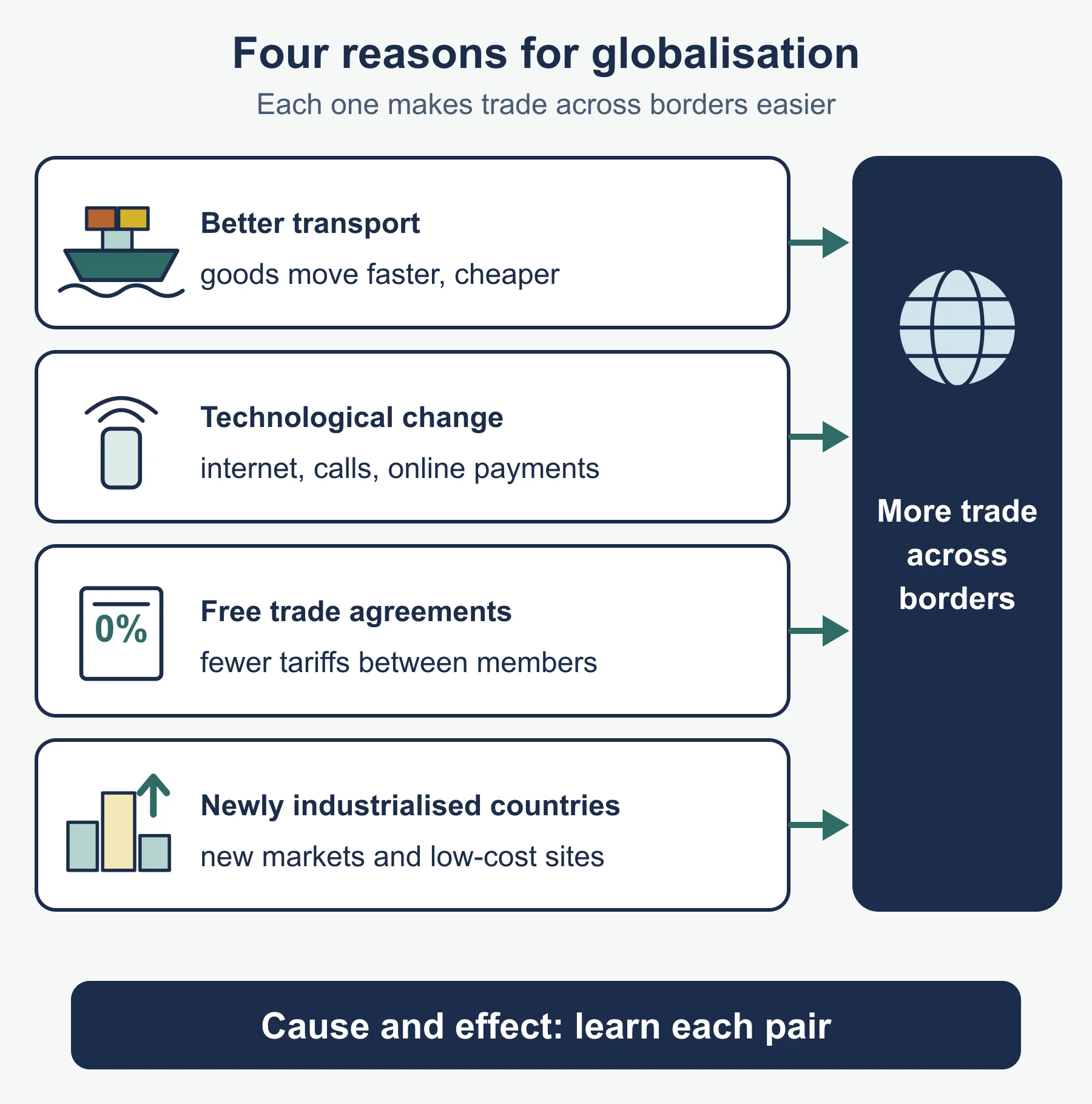
The syllabus lists four reasons. Learn each as a cause with an effect.
- Improved transport links. Container ships, bigger aircraft and better roads and ports move goods faster and at lower cost per item. A product made far away can now reach a customer at a competitive price.
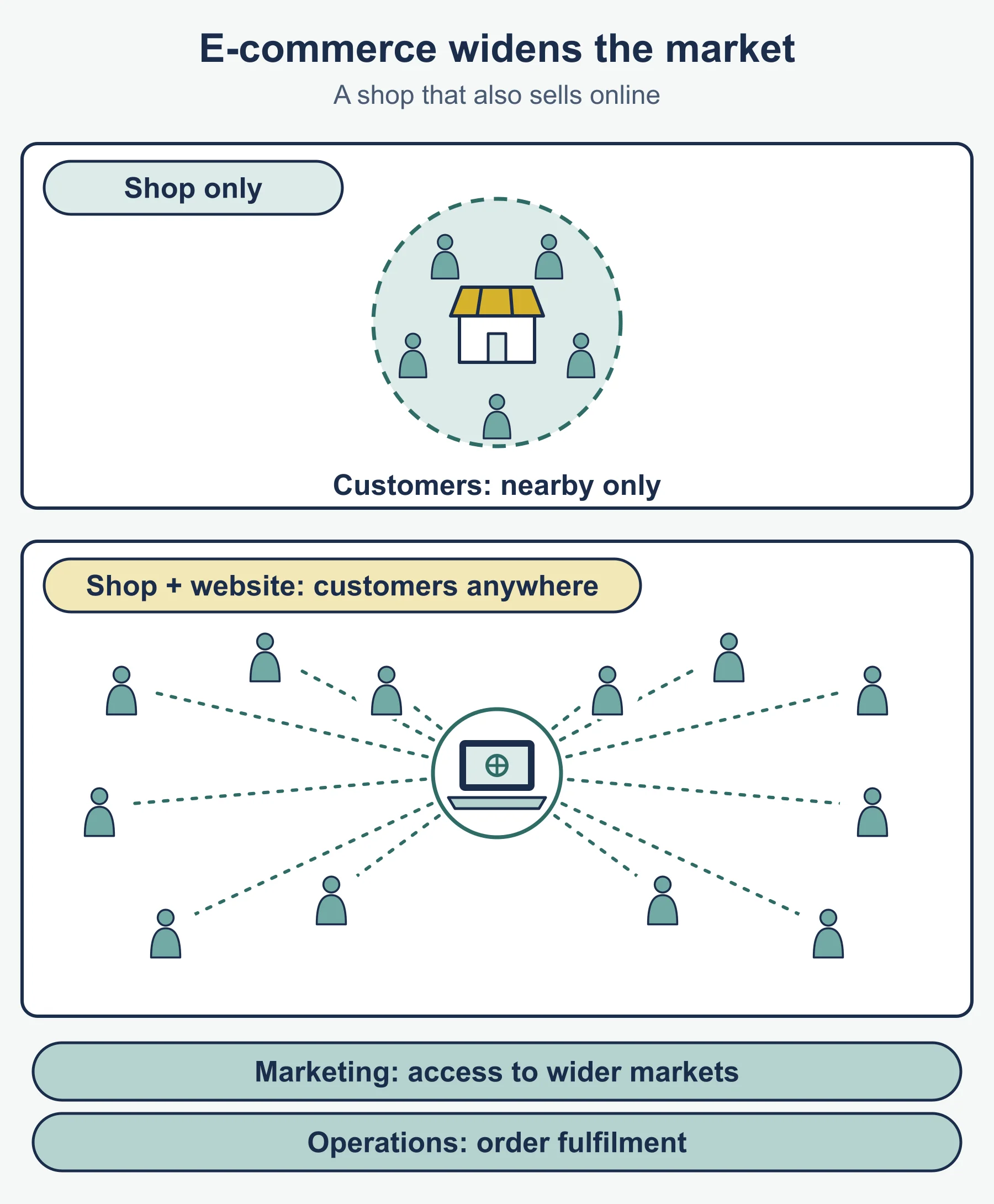
- Technological change, including communication. The internet, video calls and online payments let a firm find customers and suppliers abroad, manage staff in several countries and sell without a shop in each market.
- Free trade agreements. Countries in an agreement reduce or remove trade barriers such as tariffs between them. Selling to those countries becomes cheaper, so trade grows.
- Newly industrialised countries. These are countries whose manufacturing has grown quickly. They offer large new markets as incomes rise, and low-cost sites for production and supply.
Opportunities and threats for businesses
| Opportunities | Threats |
|---|---|
| New markets and more customers, so higher sales revenue | More competition from foreign firms, including in the home market |
| Cheaper supplies and labour from abroad, so lower costs | Imports at low prices can cut the market share of local firms |
| Economies of scale from a larger output | Reliance on distant suppliers can lead to delays and disruption |
| Wider choice of suppliers and ideas | Costs of adapting products, language and marketing for each market |
| Spreading risk across several markets | Changes in tariffs, quotas or exchange rates outside the firm’s control |
In an answer, name the opportunity or threat, then link it to the business in the question. “More competition” earns little. “Imported frames at lower prices make it harder for Imbrook Cycles to keep its prices at the current level” shows application.
Import tariffs and import quotas
An import tariff is a tax on imported goods. An import quota is a cap on how many units of a good may enter the country in a set time. Governments use both to protect local producers, to raise money (tariffs) or to respond to what other countries do.
Effects on businesses:
| Import tariff | Import quota | |
|---|---|---|
| Importing business | Pays a higher cost per unit; profit falls unless it raises its price | Cannot buy more than the limit, so output or sales may be capped; may need to find another supplier |
| Local producer of the same good | Imports become dearer, so it competes more easily and may sell more | Fewer imports are on sale, so it may sell more and could raise its price |
| Exporter selling into the country | Product costs more for customers there, so sales may fall | Cannot sell more than the quota, whatever the demand |
| Customers | Face higher prices | Face less choice and often higher prices |
Worked example: a tariff
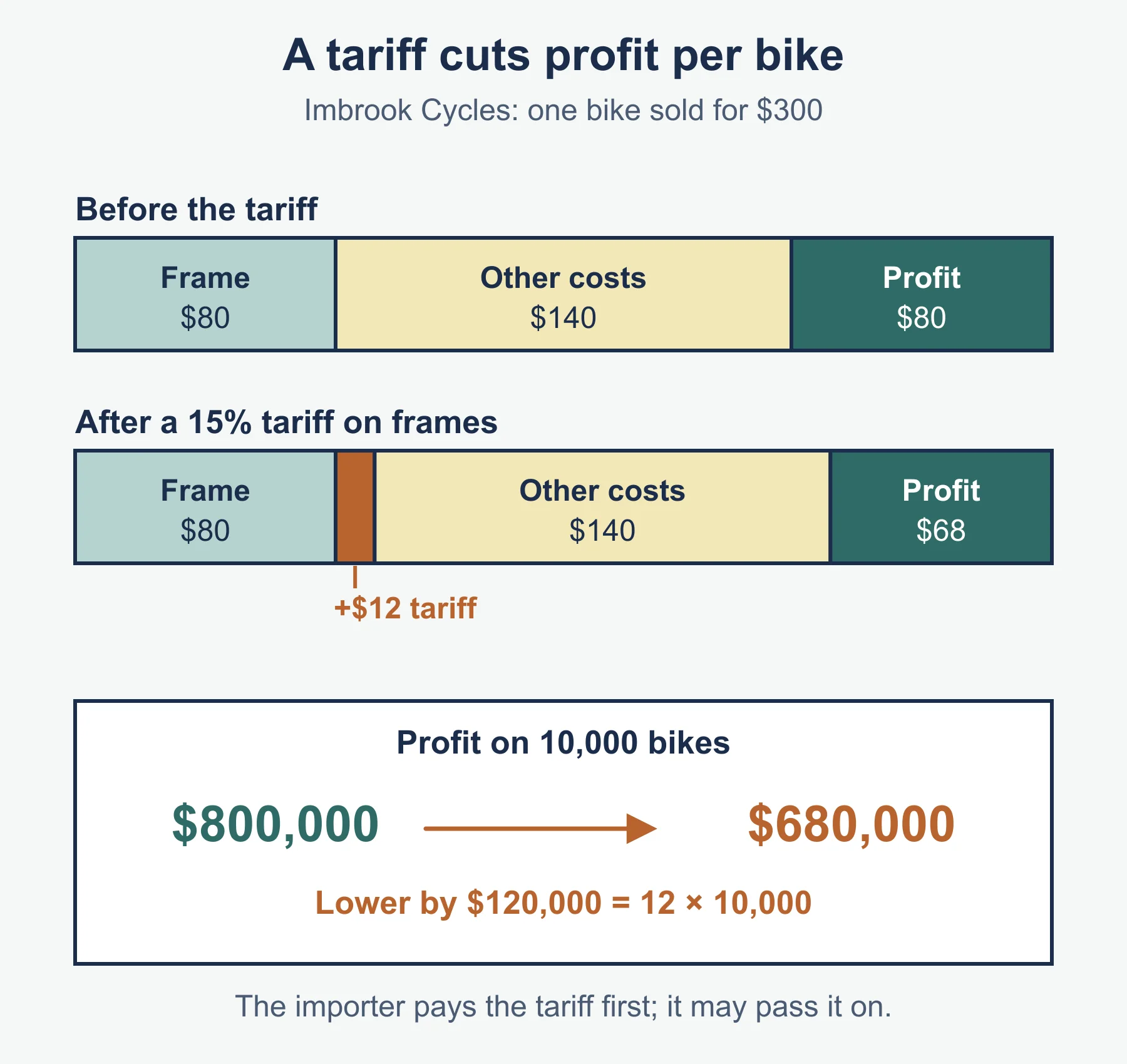
Imbrook Cycles imports 10,000 bicycle frames a year at 80 each. It assembles each bike with other costs of 140 and sells it for 300. The government adds a tariff of 15% on imported frames.
- Tariff per frame = 15% of 80 = 12, so the new cost per frame is 92.
- Profit per bike before the tariff = 300 - 80 - 140 = 80. After the tariff = 300 - 92 - 140 = 68.
- Total profit before = 80 x 10,000 = 800,000. After = 68 x 10,000 = 680,000.
- Profit falls by 120,000, which is 15% of the original figure. (The extra cost is 12 x 10,000 = 120,000.)
Imbrook could raise its price, switch to a supplier inside a free trade agreement, buy frames from a local maker or absorb the cost. Each has a cost: a higher price may lose customers, and a new supplier may mean lower quality or a longer lead time.
Worked example: a quota
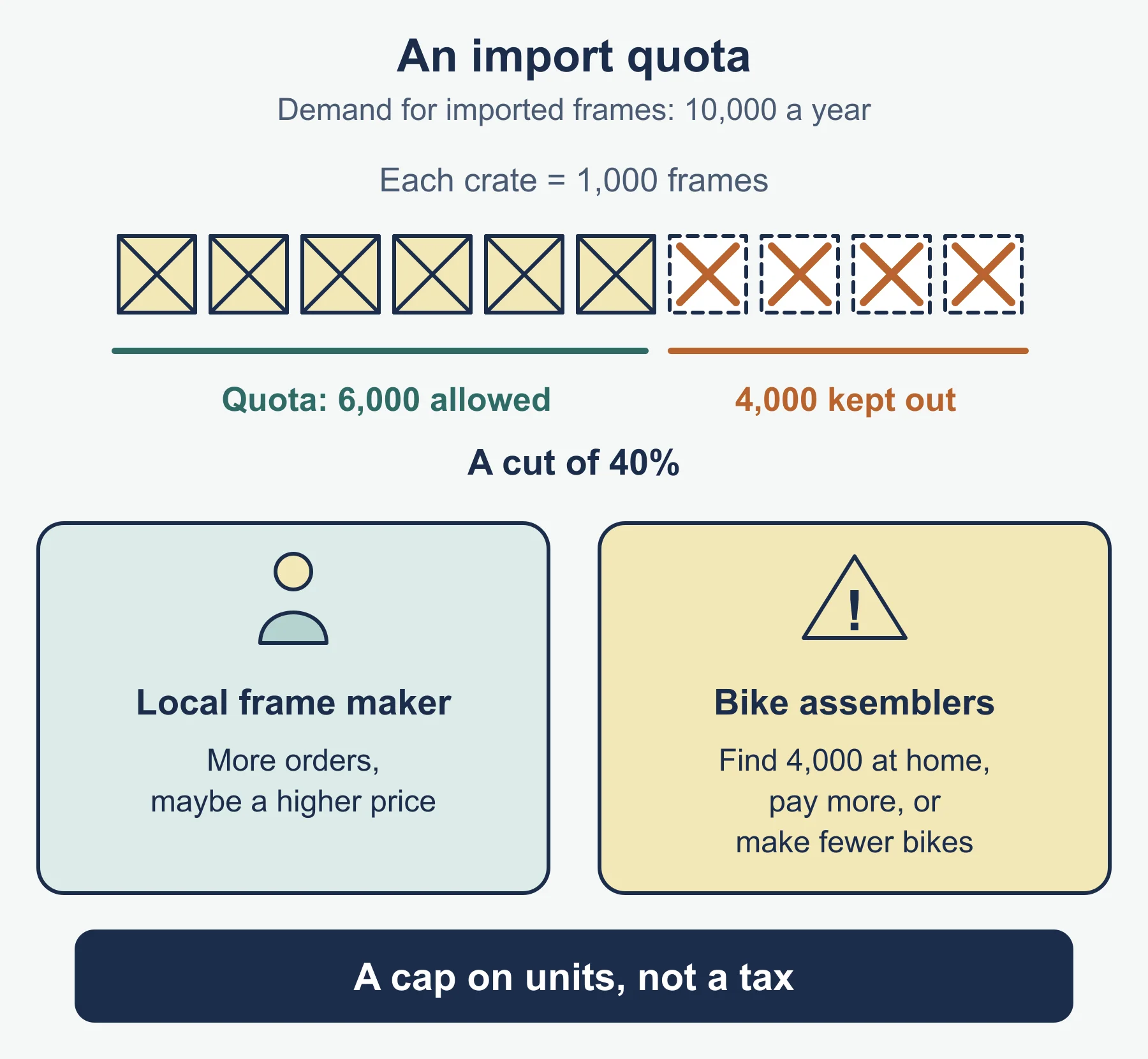
Last year, demand for imported frames in a country was 10,000. A quota now limits imports to 6,000, a cut of 40%. A local frame maker faces fewer rivals and can expect more orders and perhaps a higher price. Bike assemblers who relied on imports must find the other 4,000 frames at home, pay more or make fewer bikes.
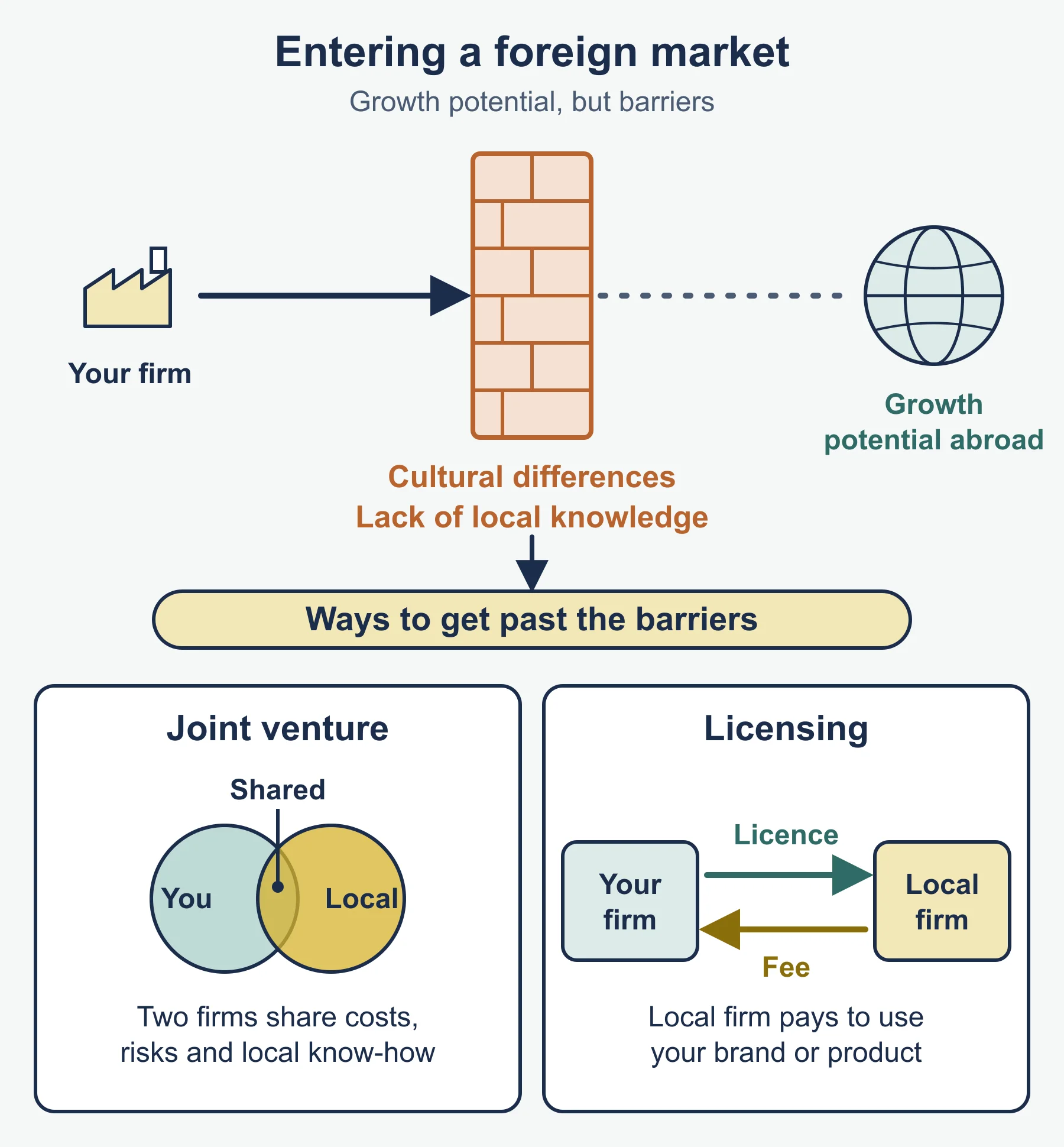
6.2.2 Multinational companies (MNCs)
A multinational company (MNC) is a business that has operations, such as factories, offices or shops, in more than one country. It is usually run from a head office in one country. This is the standard meaning.
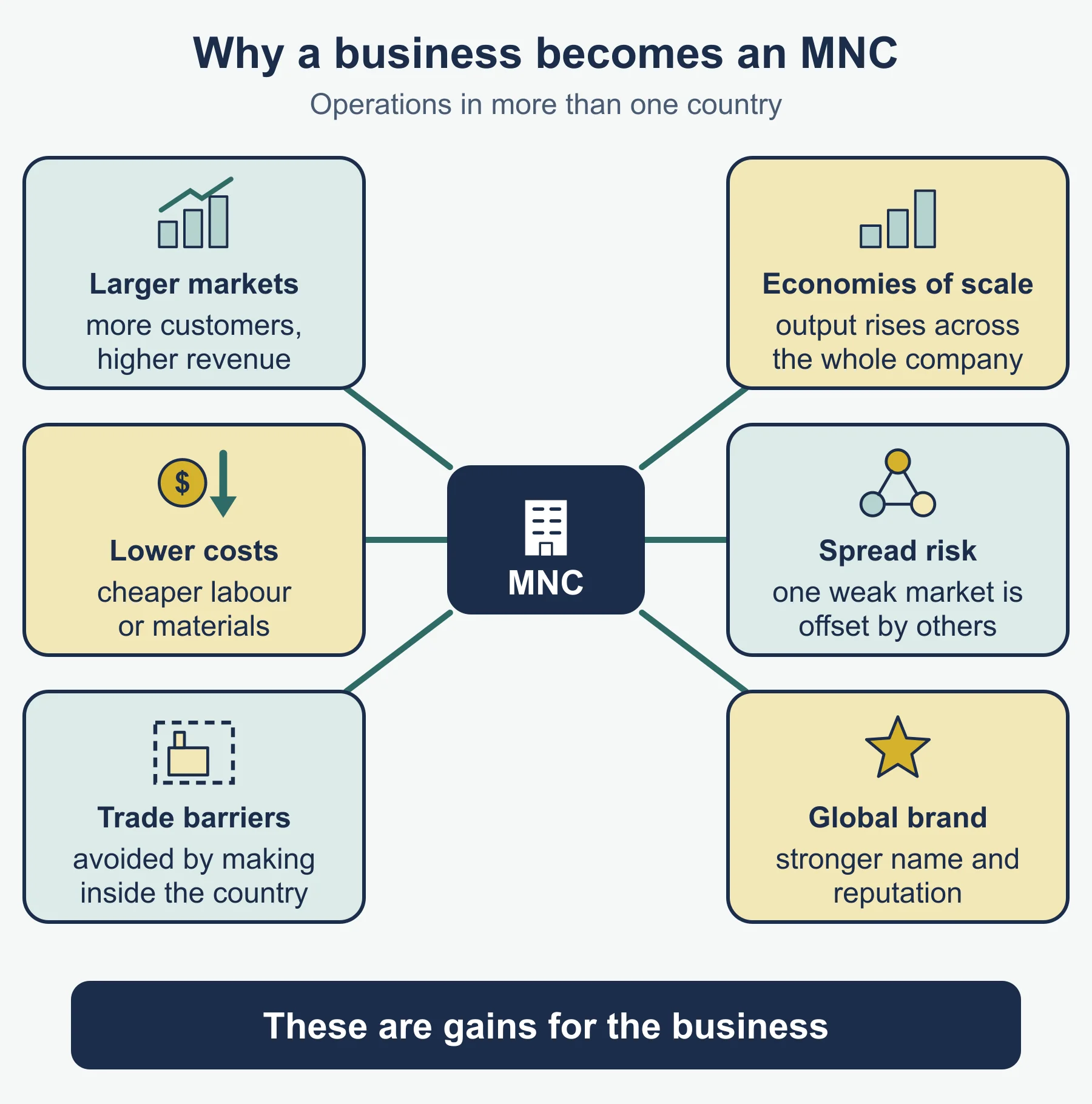
Advantages to a business of becoming an MNC
- Access to larger markets, so higher sales revenue and growth.
- Lower costs, from cheaper labour or materials, or from producing close to customers and cutting transport costs.
- Avoiding trade barriers. A factory inside a country is not subject to the import tariff or quota on goods brought in from outside.
- Economies of scale, as output rises across the whole company.
- Spreading risk. A fall in demand in one country can be offset by sales elsewhere.
- Stronger brand and reputation as a global name.
Advantages for the country where an MNC is located
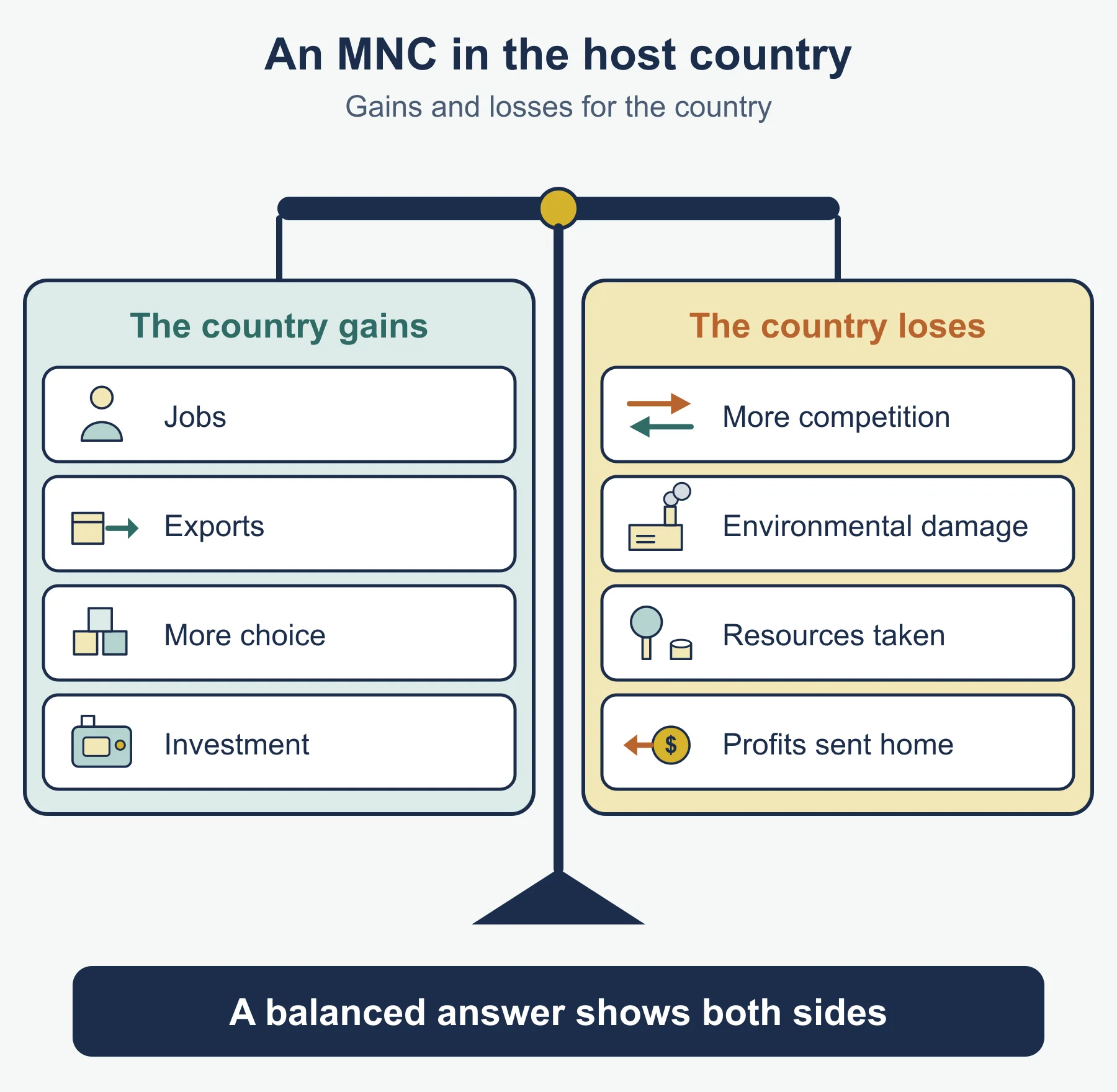
The syllabus gives four examples: jobs, exports, increased choice and investment.
- Jobs. The MNC hires local workers, and suppliers and shops nearby gain work too. Incomes and spending rise.
- Exports. If the MNC sells part of its output abroad, the country earns income from overseas buyers.
- Increased choice. Consumers can buy goods and services that were not available before, often at lower prices.
- Investment. The MNC pays for buildings, machinery and training, which may also help local firms.
Disadvantages for the country where an MNC is located
The syllabus gives four examples: increased competition, environmental damage, exploitation of natural resources and repatriation of profits.
- Increased competition. Local firms may lose customers or close because the MNC has more finance and a stronger brand.
- Environmental damage. Factories can cause pollution, waste and congestion.
- Exploitation of natural resources. The MNC may extract minerals, timber or water faster than the country benefits, leaving little behind.
- Repatriation of profits. Profits are sent back to the home country of the MNC, so the host country does not keep that income.
Worked example: a host country
Galtree Foods, based in Zemora, opens a processing plant in a smaller country. The plant employs 600 local people and buys fruit from local farmers, and the farmers’ incomes rise. However, the plant sends most of its profit to head office, and a local jam maker loses sales because shops stock the cheaper imported brand. A balanced answer says the country gains jobs and investment but loses some income through repatriation and may see local competitors struggle.
6.2.3 External costs and benefits
When a business makes a decision, it has private costs (what it pays itself) and private benefits (what it gains). Its decisions can also affect other people who are not part of the transaction.
- External costs are costs of a business decision that fall on other people or on society, not on the business. Examples: noise, pollution, traffic and damage to roads.
- External benefits are benefits of a business decision that go to other people or society, not to the business. Examples: workers trained by the firm who later raise skills in the area, or a new road that helps nearby shops.
Worked example
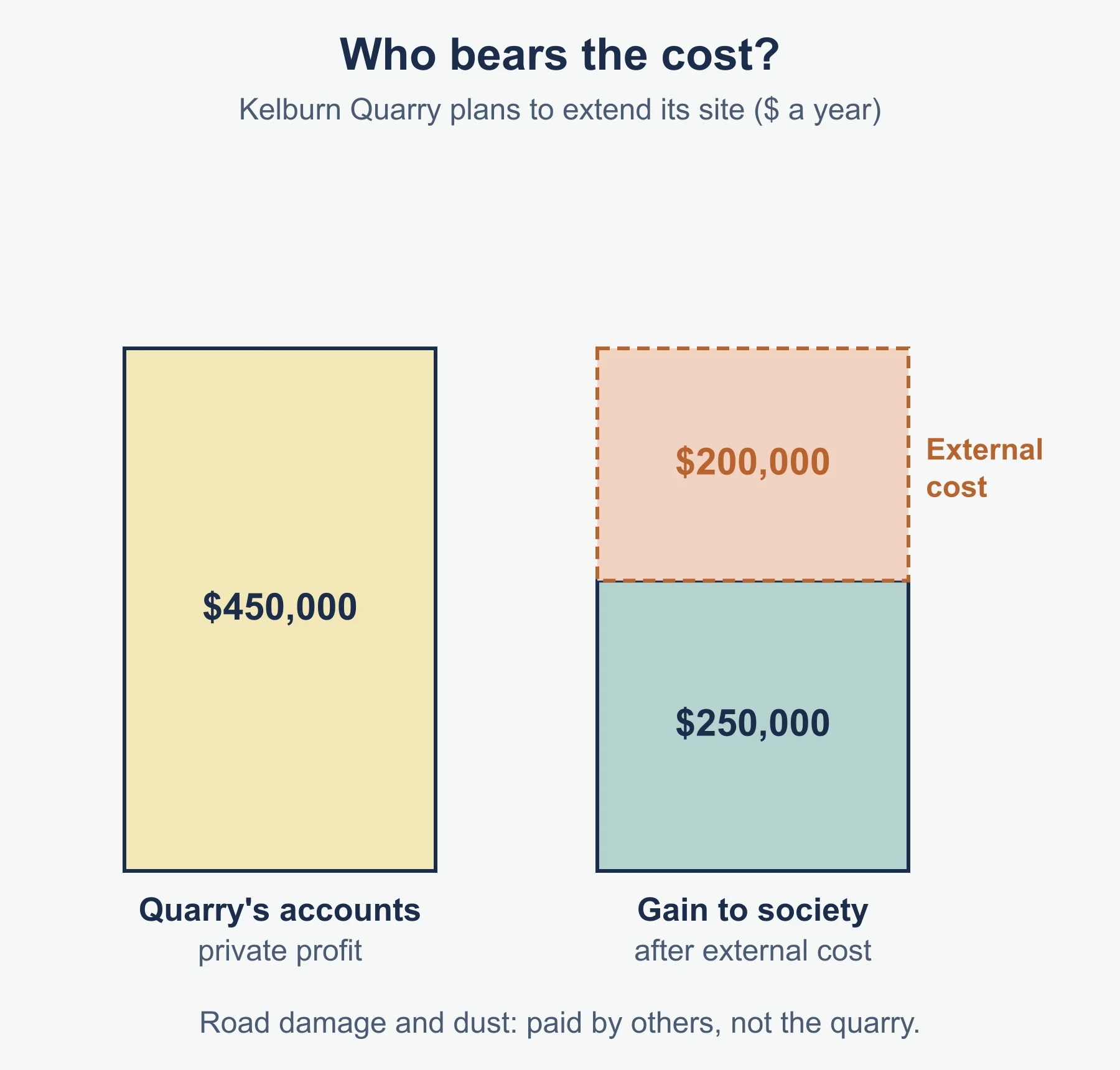
Kelburn Quarry plans to extend its site. It expects a private profit of 450,000 a year. Lorries will damage local roads and dust will affect nearby farms. The council estimates these costs at 200,000 a year, which the quarry does not pay.
- External cost = 200,000.
- Profit after counting the external cost = 450,000 - 200,000 = 250,000.
The quarry’s own accounts show 450,000, but the community bears 200,000 of cost. The figure of 250,000 is the gain to society as a whole.
Not all effects are bad. If the quarry paid to resurface a road that other drivers also use, that is an external benefit. When you evaluate, compare the size of external costs and benefits and ask who bears or gains from them.
6.2.4 Exchange rates
An exchange rate is the value of one currency measured in another currency. The syllabus asks for two ideas.
- Appreciation means a currency becomes worth more against other currencies. It buys more foreign currency than before.
- Depreciation means a currency becomes worth less against other currencies. It buys less foreign currency than before.
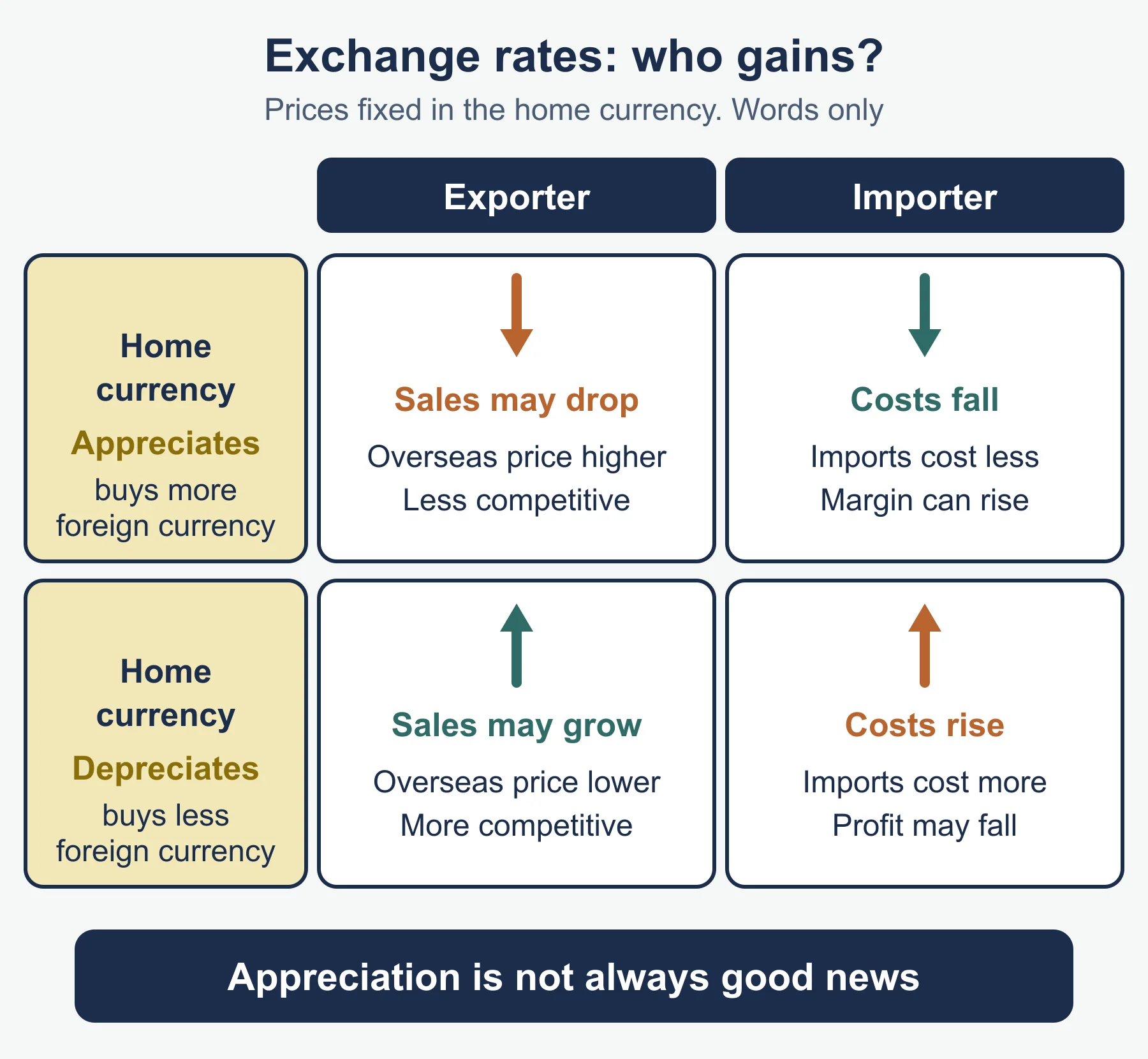
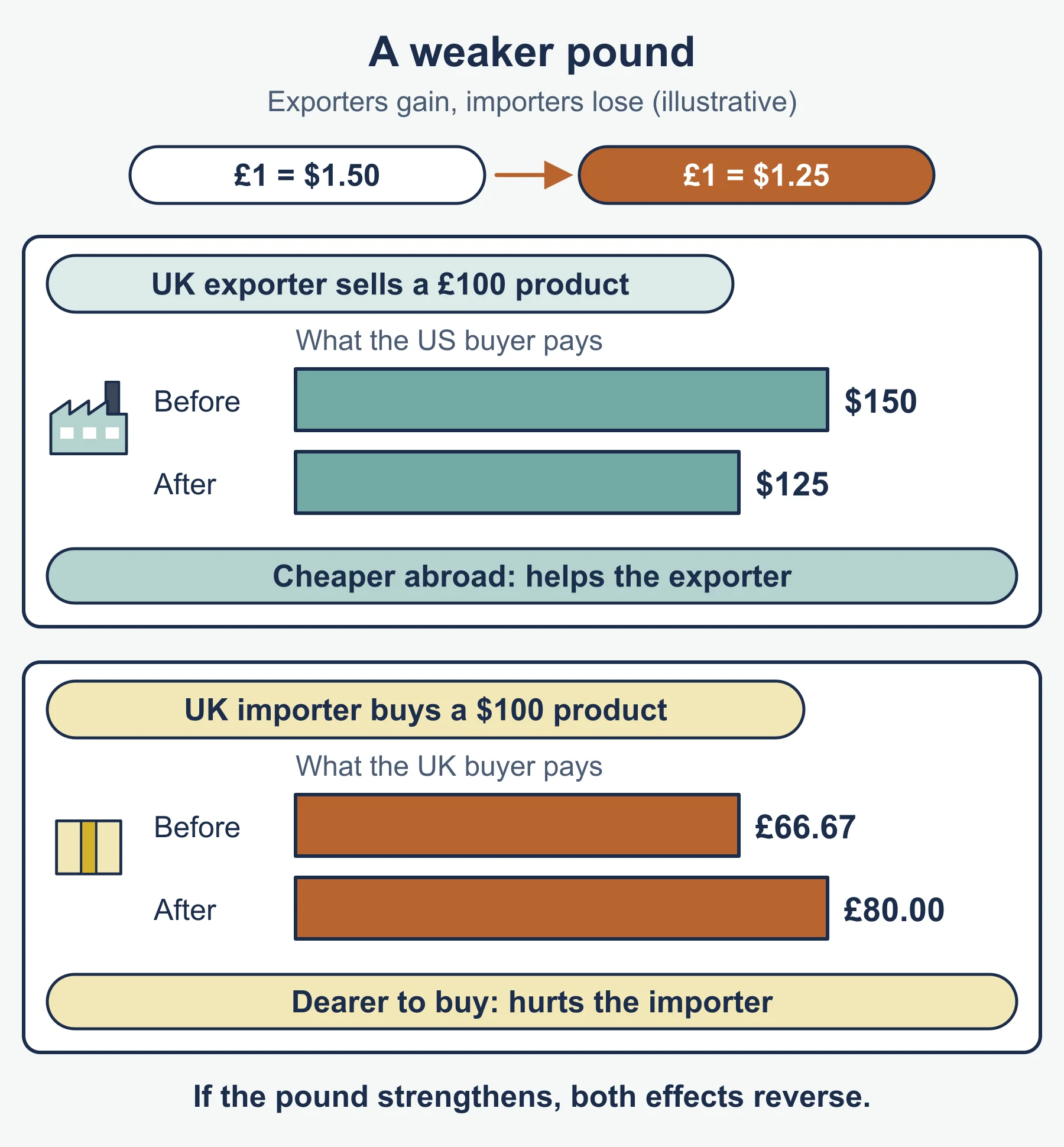
The effects depend on whether the business imports, exports or both. The table assumes a business based in the home country, with prices fixed in the home currency.
| Change | Effect on exporters | Effect on importers |
|---|---|---|
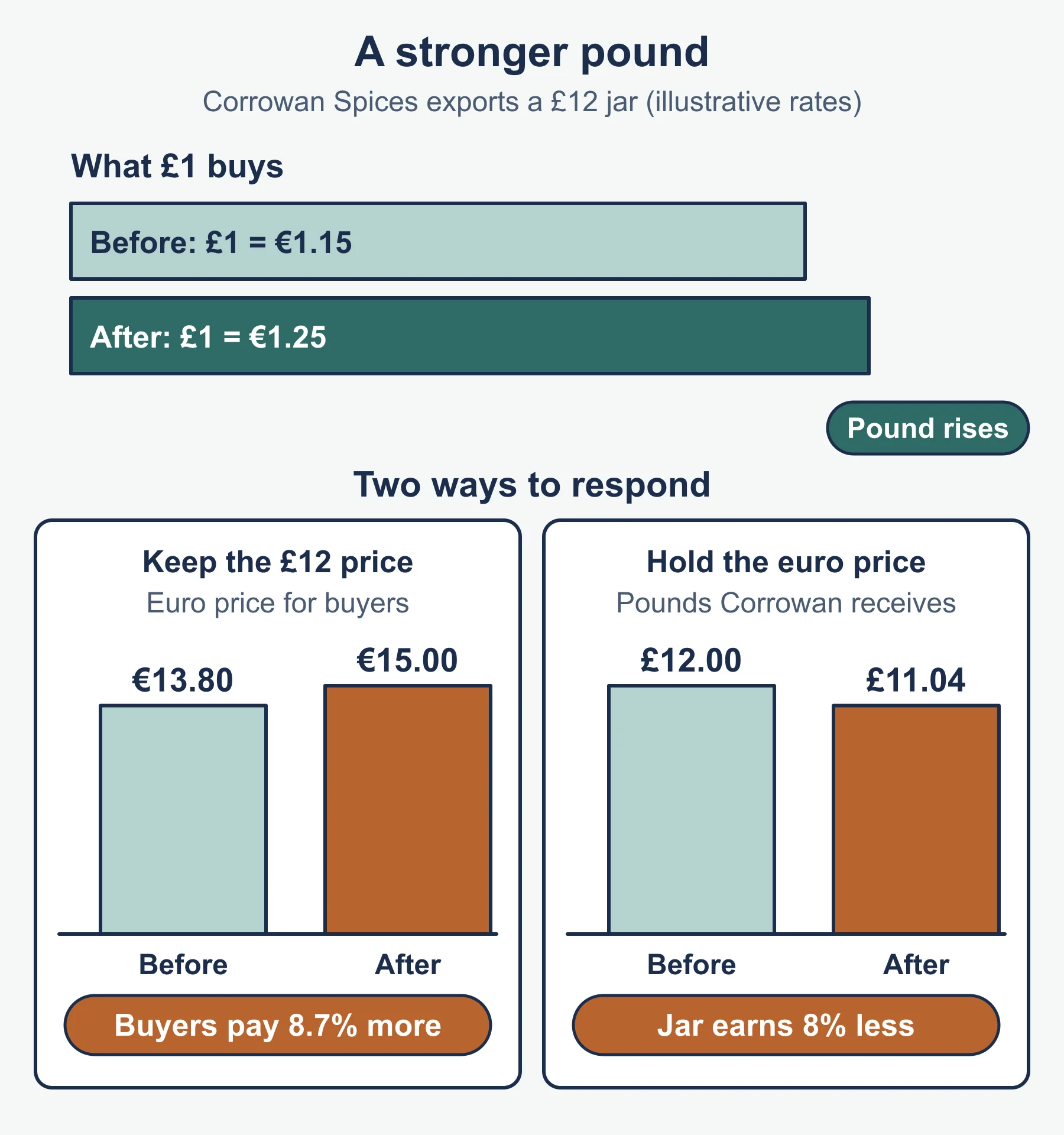
| Home currency appreciates | Price to overseas customers is higher, so competitiveness falls and sales may drop | Imports cost less in home currency, so costs fall and profit margins can rise |
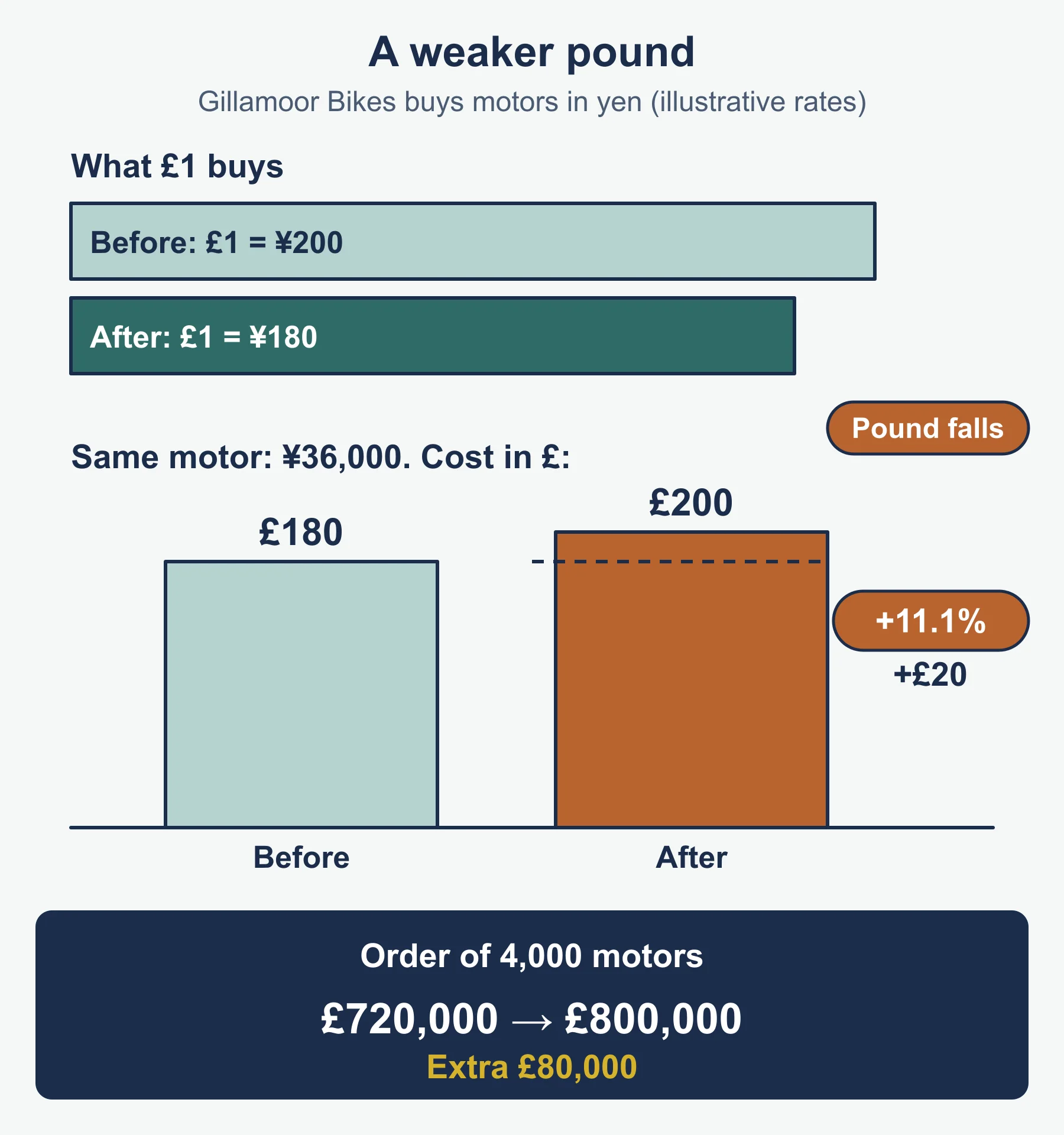
| Home currency depreciates | Price to overseas customers is lower, so competitiveness rises and sales may grow | Imports cost more in home currency, so costs rise and profit may fall |
Link the change to price, costs or competitiveness, the three effects named in the syllabus, and say what the business might do next. An exporter facing a stronger currency could cut costs or look for new markets. An importer facing a weaker currency could look for local suppliers.
Worked example (in words)
Deverill Pottery makes plates in a country whose currency has just appreciated. Its clay is bought locally, but half its sales are exports. Overseas shoppers now pay more for each plate, so its products are less competitive against rivals. Sales abroad may fall. The firm might lower its profit margin to hold its price, but that cuts profit. The effect on a business that mostly imports its materials would be the reverse.
No conversion sums are needed here, because exchange rate calculations are not assessed.
Common errors
- Writing “tariffs ban imports”. A tariff is a tax and a quota is a limit. Neither bans.
- Confusing who pays a tariff. The importer pays it first, but the cost may be passed on to customers.
- Describing MNC effects without saying whether the point is for the business or for the host country.
- Calling repatriation of profits a cost to the MNC. It is a loss of income to the host country.
- Giving an environmental or social cost without saying that others, not the firm, bear it. That is what makes it external.
- Mixing up appreciation and depreciation, or assuming appreciation is always good news. It helps importers and hurts exporters.
Where to go next
Test yourself with the practice questions and revise with the revision notes. Check your overall progress against the printable checklist and the course hub.
Frequently asked questions
What are the four reasons for globalisation in IGCSE Business? The syllabus lists improved transport links, technological change including communication, free trade agreements, and newly industrialized countries.
What is a multinational company? A multinational company (MNC) is a business that has operations, such as factories, offices or shops, in more than one country.
What are the advantages to a business of becoming an MNC? Advantages include access to larger markets, lower costs, avoiding trade barriers, economies of scale, spreading risk and a stronger global brand.
What are the advantages of an MNC for a host country? The syllabus gives four examples: jobs, exports, increased choice and investment.
What is the difference between private costs and external costs? Private costs are what a business pays itself. External costs are costs of its decisions that are borne by others, such as the local community, which is what makes them external.
Official syllabus
Aligned to section 6.2 of the Cambridge IGCSE Business 0264 syllabus for examination in 2027, 2028 and 2029, published by Cambridge University Press & Assessment (Cambridge International Education).
Get free revision emails (optional)
Occasional emails with practice questions, worked explanations and links to free resources for the qualification and subjects you choose. No spam, and you can unsubscribe from any email. The free tools on this site never need an email.
Related resources
-
Practice questions
IGCSE Business: Business and the international economy (Cambridge 0264) – Practice Questions
Original practice questions with worked answers on globalisation, tariffs, MNCs, external costs and exchange rates for Cambridge IGCSE Business 0264.
Business · Cambridge · IGCSE
Try questions -
Revision notes
IGCSE Business: Business and the international economy (Cambridge 0264) – Revision Notes
Condensed revision notes on globalisation, tariffs, quotas, MNCs, external costs and benefits and exchange rates for Cambridge IGCSE Business 0264.
Business · Cambridge · IGCSE
Revise topic -
Study guides
IGCSE Business: Economic issues (Cambridge 0264)
Study guide to the business cycle, taxes, government spending and interest rates for Cambridge IGCSE Business 0264, with worked examples.
Business · Cambridge · IGCSE
Read guide
Related articles
-
teaching
A Level tuition in Dubai: Cambridge or Pearson Edexcel International A Level?
Schools in Dubai and Abu Dhabi teach either Cambridge International AS & A Level or Pearson Edexcel International A Level. How the two are structured, why it matters for tuition, and how online classes from Lahore work.
9 October 2026
-
curriculum guides
Choosing subjects at IGCSE and A Level
How subject choices at 14 and 16 affect university options later, and how to keep pathways open without overloading a timetable.
28 July 2026
Studying this with a teacher
Working through Business IGCSE?
This page is free and stays free. If you would rather be taught it, Marlbridge runs Business classes one-to-one and in small groups of up to 15, online in your own time zone. The first trial class is free. WhatsApp replies within an hour (8am–11pm Pakistan time, every day); email the same day.
Cambridge Business teachers at Marlbridge

