
Revision Notes
O Level Business: Analysis of accounts (Cambridge 7115) – Revision Notes
Condensed notes on profitability, liquidity, the five ratios and users of accounts, with a self-test, for Cambridge O Level Business Studies 7115 5.5.
- Subject
- Business
- Level
- O LEVELS
- Topic
- Financial information and decisions
- Author
- Marlbridge Academic Team
- Updated
- Reviewed by
- Salman Ahmad (what this means)
Aligned to Cambridge O Level Business (7115), For examination in 2026. Official specification .
Syllabus page (what it covers and how it is assessed): Cambridge O Level Business.
Syllabus points this page covers
7115
- 5.5 Analysis of accounts
Found an error? Report a correction.
Need help with this topic? Request a free trial class for O Level Business (7115).
These are quick revision notes for section 5.5, Analysis of accounts, in the Cambridge O Level Business Studies 7115 syllabus for examination in 2026. For full explanations and a worked two-year example, read the study guide. Test yourself with the practice questions. Other links: Cambridge O Level Business hub, printable checklist, free diagnostics and the wider topic practice page.
Syllabus map
| Point | Content |
|---|---|
| 5.5.1 | Concept and importance of profitability |
| 5.5.2 | Concept and importance of liquidity |
| 5.5.3 | Gross profit margin, profit margin, return on capital employed, current ratio, acid test ratio: calculate and analyse |
| 5.5.4 | Needs of different users of accounts and ratio analysis; how results might be used to decide, for example whether to lend to or invest in the business |
The syllabus gives no formulas for this section. The formulas below are the standard forms.
Definitions
- Profitability: how well a business earns profit compared with its revenue or the capital invested in it.
- Liquidity: the ability to pay short-term debts when they are due.
- Gross profit: revenue − cost of sales.
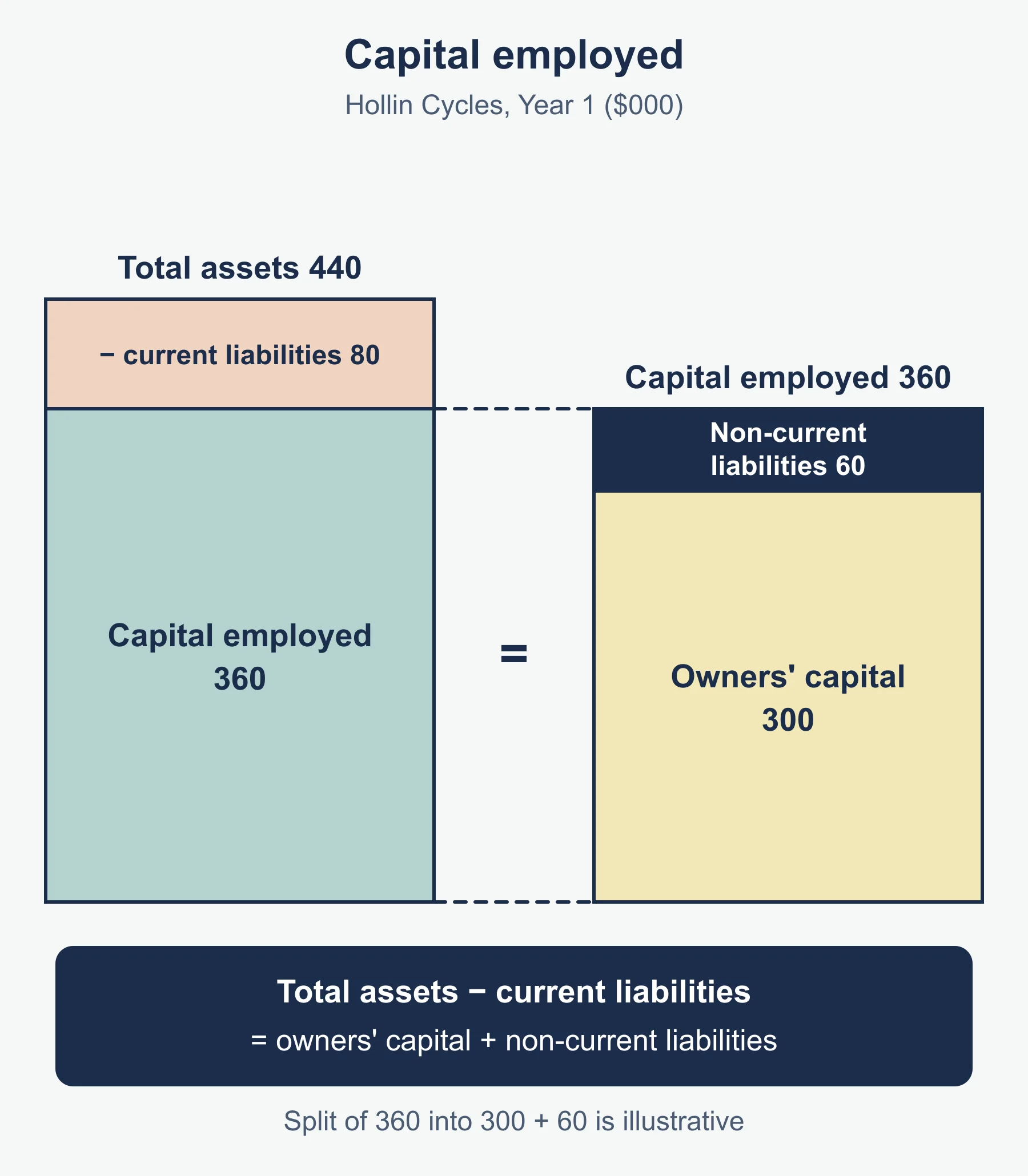
- Capital employed: long-term finance in the business; standard form is total assets − current liabilities.
- Current assets: assets expected to become cash within a year, such as inventories, receivables and cash.
- Current liabilities: debts due within a year.
Formulas
| Ratio | Standard form | Unit | Group |
|---|---|---|---|
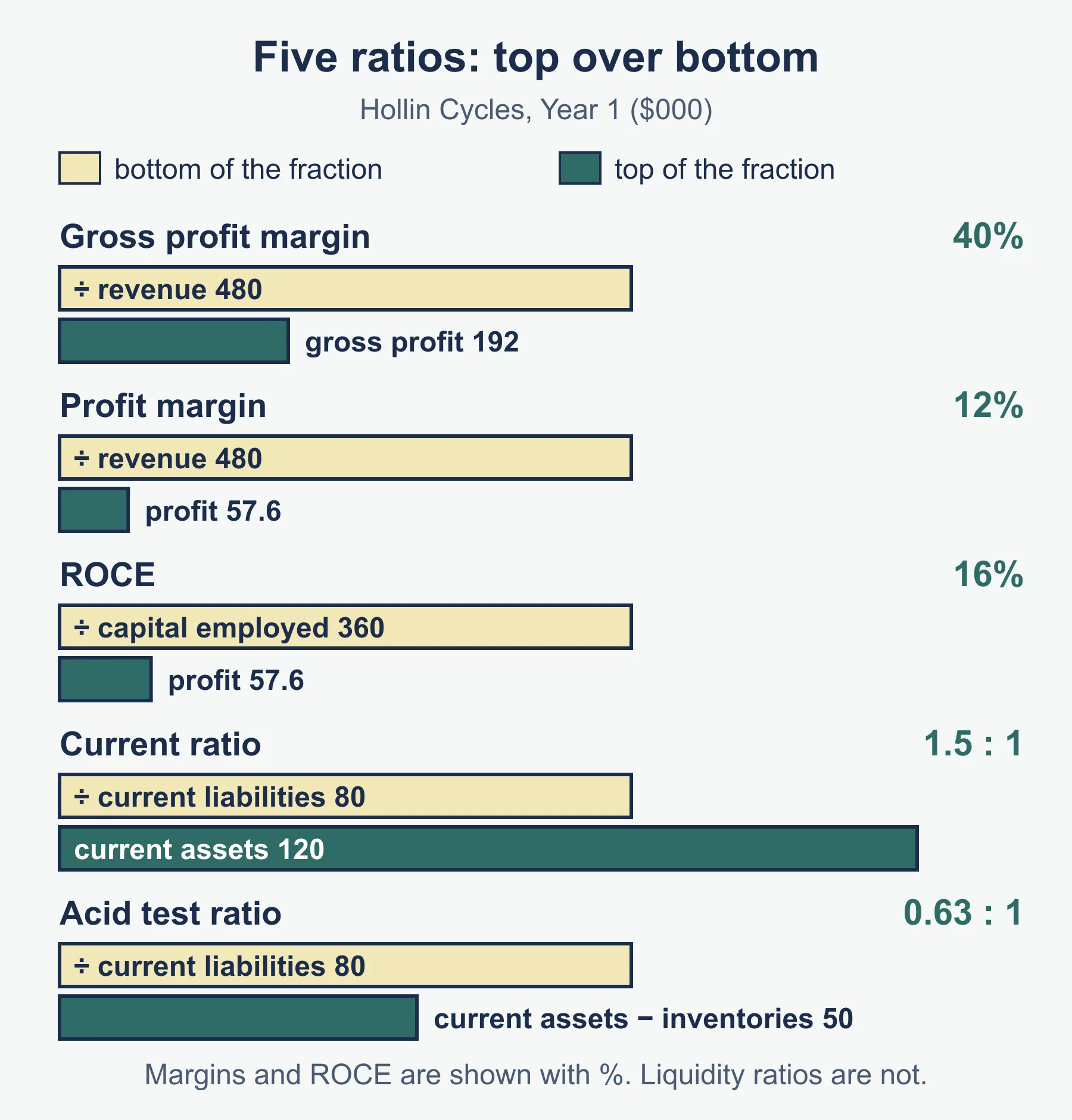
| Gross profit margin | gross profit ÷ revenue × 100 | % | Profitability |
| Profit margin | profit ÷ revenue × 100 | % | Profitability |
| ROCE | profit ÷ capital employed × 100 | % | Profitability |
| Current ratio | current assets ÷ current liabilities | ratio (1.5 : 1) | Liquidity |
| Acid test ratio | (current assets − inventories) ÷ current liabilities | ratio (0.8 : 1) | Liquidity |
Method in steps
Calculating any ratio:
- Write the formula.
- Pick the right figures from the data. Check each one is the item the formula needs.
- Substitute and calculate.
- Add the unit: % for the first three, none or “: 1” for the last two.
- Say what the result means for this business.
Analysing a change:
- State the direction and size of the change.
- Give a reason linked to the case, such as costs, prices, borrowing or slow payment by customers.
- State the effect on the business or on a user.
- Where asked to justify, support a view with the figures and reach a conclusion.
Worked reminder: Aldwick Pottery
Aldwick Pottery has revenue 90 000, cost of sales 54 000, profit 13 500, capital employed 90 000, current assets 36 000 (of which inventories 18 000) and current liabilities 24 000.
- Gross profit = 90 000 − 54 000 = 36 000. Gross profit margin = 36 000 ÷ 90 000 × 100 = 40%.
- Profit margin = 13 500 ÷ 90 000 × 100 = 15%.
- ROCE = 13 500 ÷ 90 000 × 100 = 15%.
- Current ratio = 36 000 ÷ 24 000 = 1.5.
- Acid test ratio = (36 000 − 18 000) ÷ 24 000 = 0.75.
Reading it: the pottery keeps 40 cents of each dollar of revenue as gross profit and 15 cents as profit, so overheads take 25 cents. It can cover its short-term debts 1.5 times, but half of its current assets are inventories, so the acid test ratio is lower at 0.75.
Rearranging works too. A business with revenue of 80 000 and a gross profit margin of 25% made a gross profit of 20 000. A business aiming at an ROCE of 12% on capital employed of 150 000 needs a profit of 18 000.
Why profitability and liquidity matter
Profitability matters because:
- owners and shareholders expect a reward for taking risk
- retained profit can fund growth without borrowing
- lenders want to see that interest can be paid
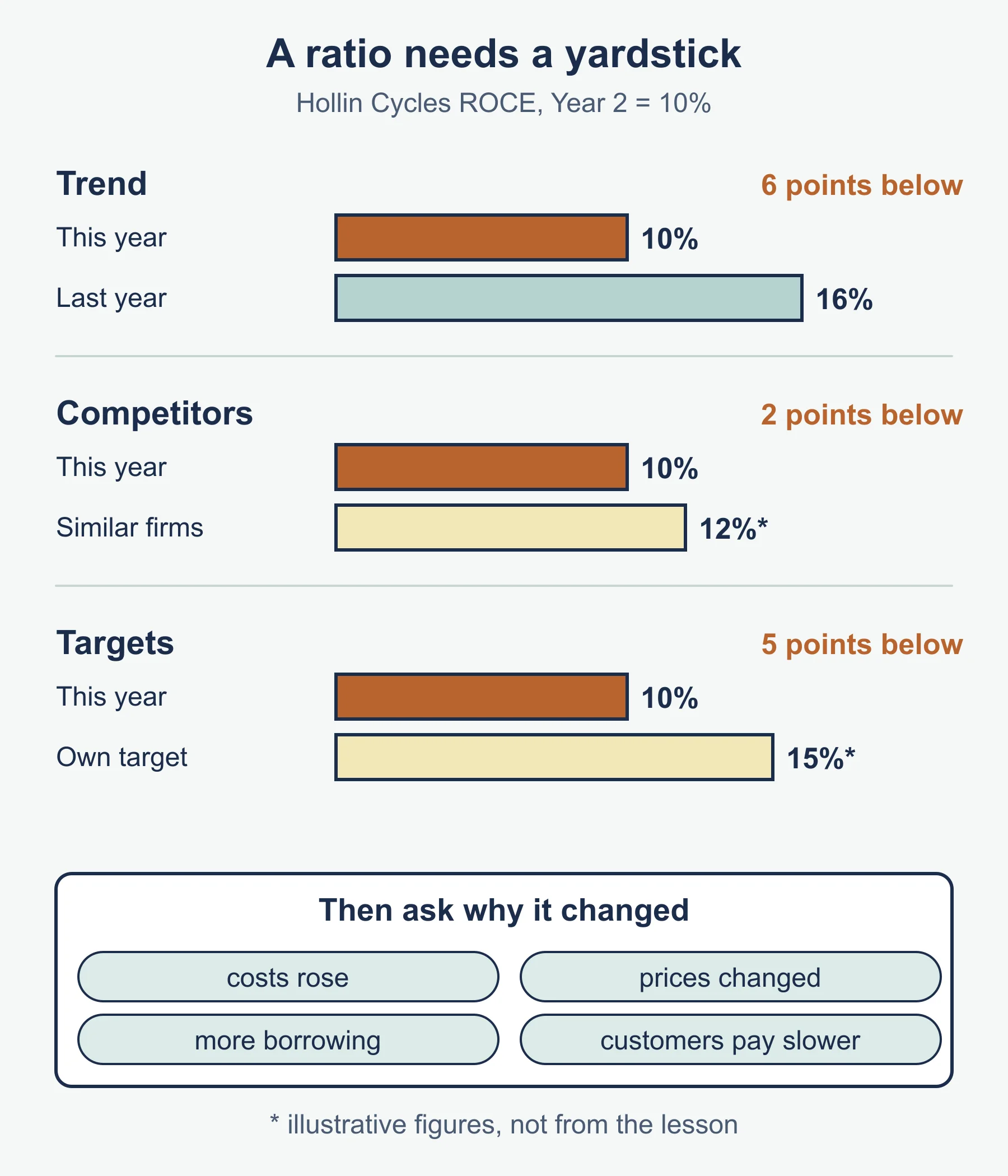
- a falling trend warns of rising costs or weak pricing
Liquidity matters because:
- wages, suppliers and bills must be paid on time
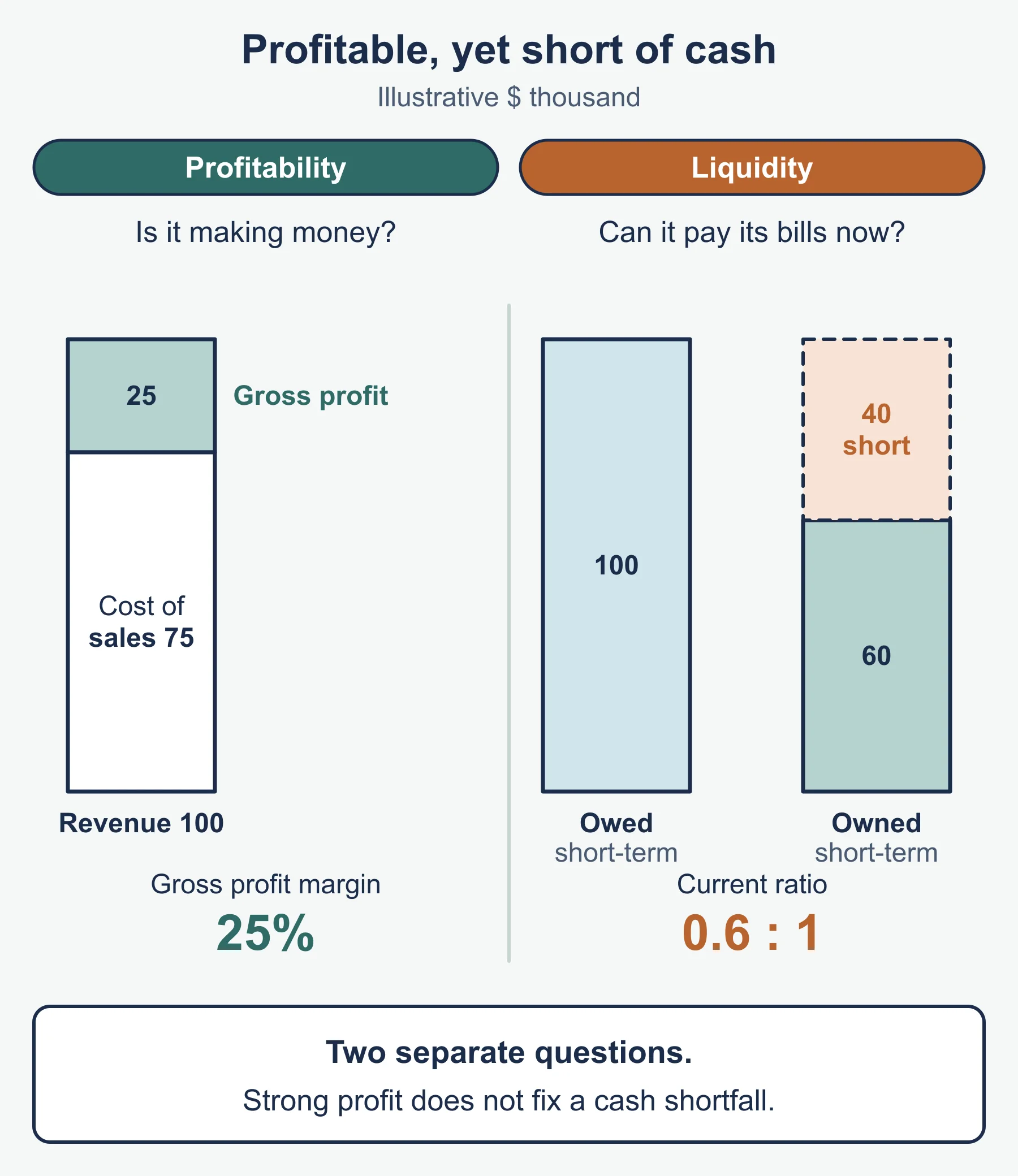
- a business short of cash may have to stop trading even if it is profitable
- a profit on paper can be tied up in inventories or unpaid invoices from customers
Command words for this topic
| Command word | What it asks for | Typical use here |
|---|---|---|
| Define | Give the precise meaning | Define liquidity |
| State | Express clearly, no extra detail | State the formula |
| Identify | Name or select | Identify a user of accounts |
| Calculate | Work out from the figures given | Calculate ROCE |
| Outline | Set out the main points | Outline what a lender wants to know |
| Explain | Give reasons, with evidence | Explain why liquidity fell |
| Justify | Support a case with evidence or argument | Justify a decision to lend |
For explain and justify answers, use a chain: the figure, what it means, why it matters to this user or business, and your conclusion.
Interpreting ratios: what a change suggests
| Change | Possible causes | Possible effect |
|---|---|---|
| Gross profit margin falls | Supplier prices up; prices cut or discounts; wastage | Less left to cover overheads |
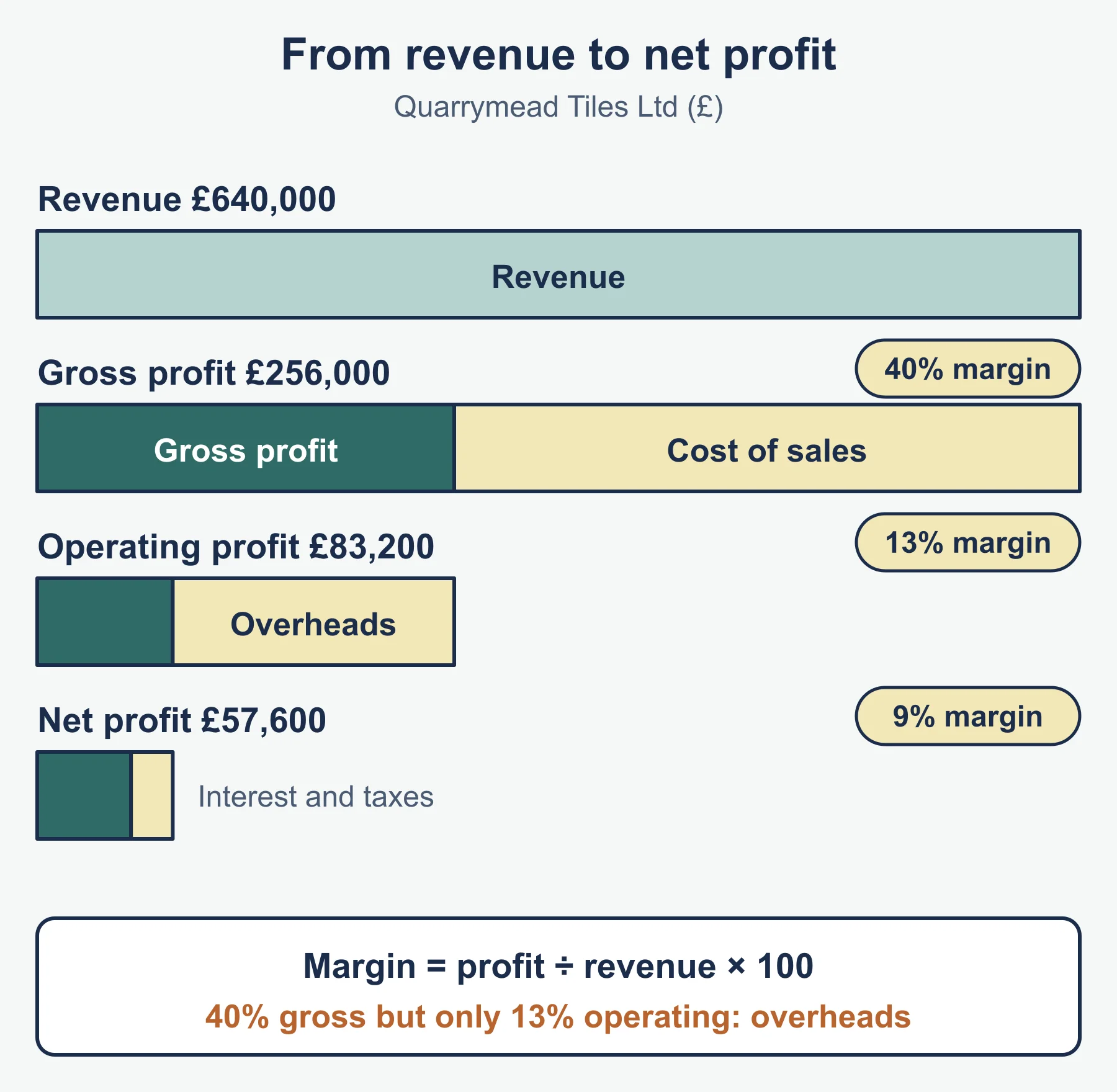
| Profit margin falls, gross margin steady | Overheads up (rent, wages, marketing) | Lower return to owners |
| ROCE falls | Profit down, or more capital added without extra profit | Investors may look elsewhere |
| Current ratio falls | Cash spent, more short-term borrowing, bills rising | Harder to pay debts on time |
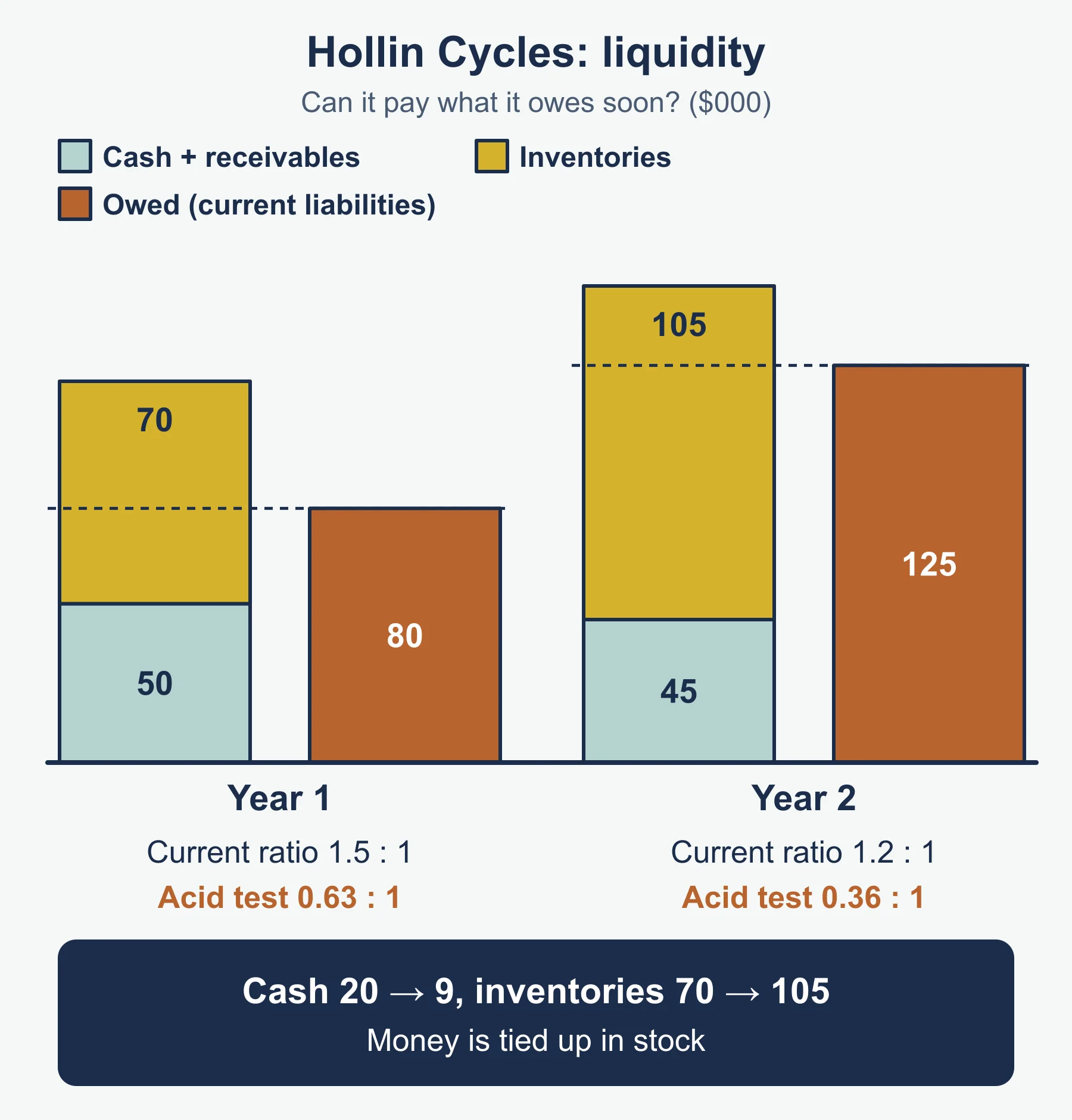
| Acid test ratio falls | Inventories growing while cash falls | Hidden liquidity risk |
Always compare with an earlier year, a competitor or a target. One figure alone is hard to judge.
Users of accounts
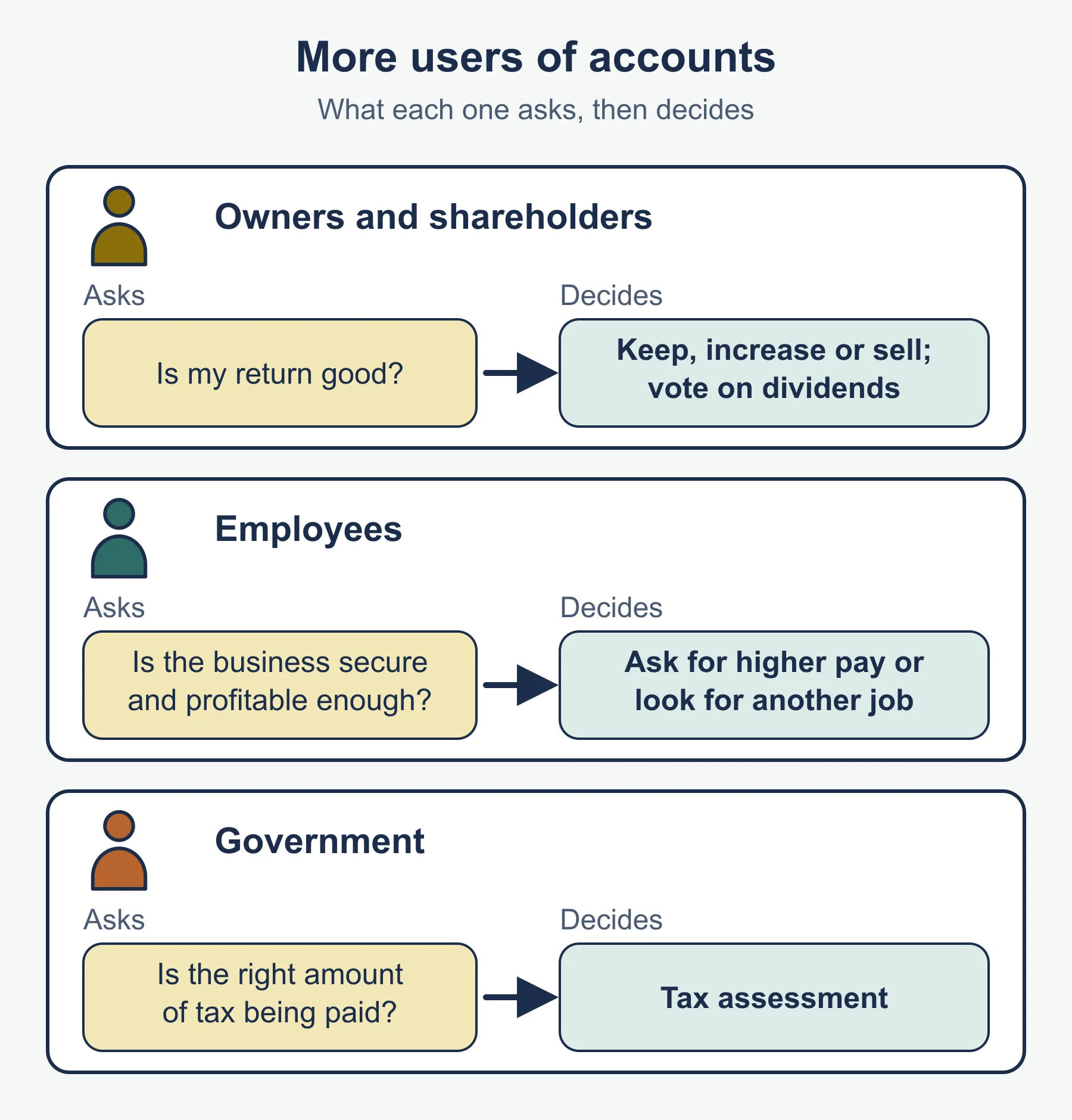
| User | Looks mainly at | Possible decision |
|---|---|---|
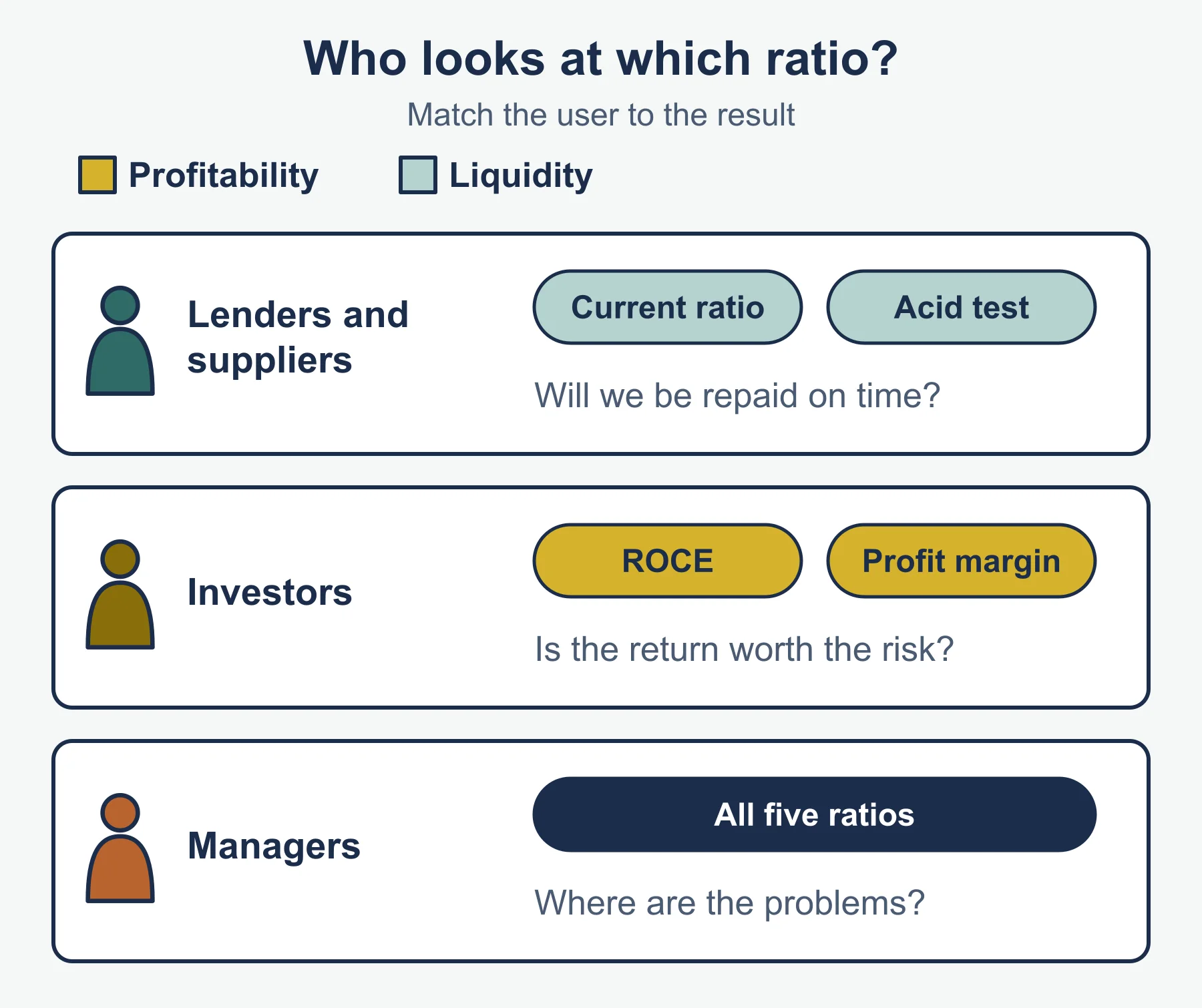
| Owner or shareholder | ROCE, profit margin | Keep, add to or withdraw investment |
| Potential investor | ROCE, profit margin | Whether to invest |
| Bank or other lender | Liquidity, profit | Whether to lend, how much, what terms |
| Supplier | Current ratio, acid test | Whether to give credit |
| Manager | All five ratios | Control costs, set prices, plan |
| Employee | Profit trend | Pay claims, job security |
| Government | Profit | Tax due |
Case-study approach
When a case gives figures for two years, work in this order:
- Calculate only the ratios the question asks for, and show each formula.
- Put the two years side by side and describe the trend in one sentence per ratio.
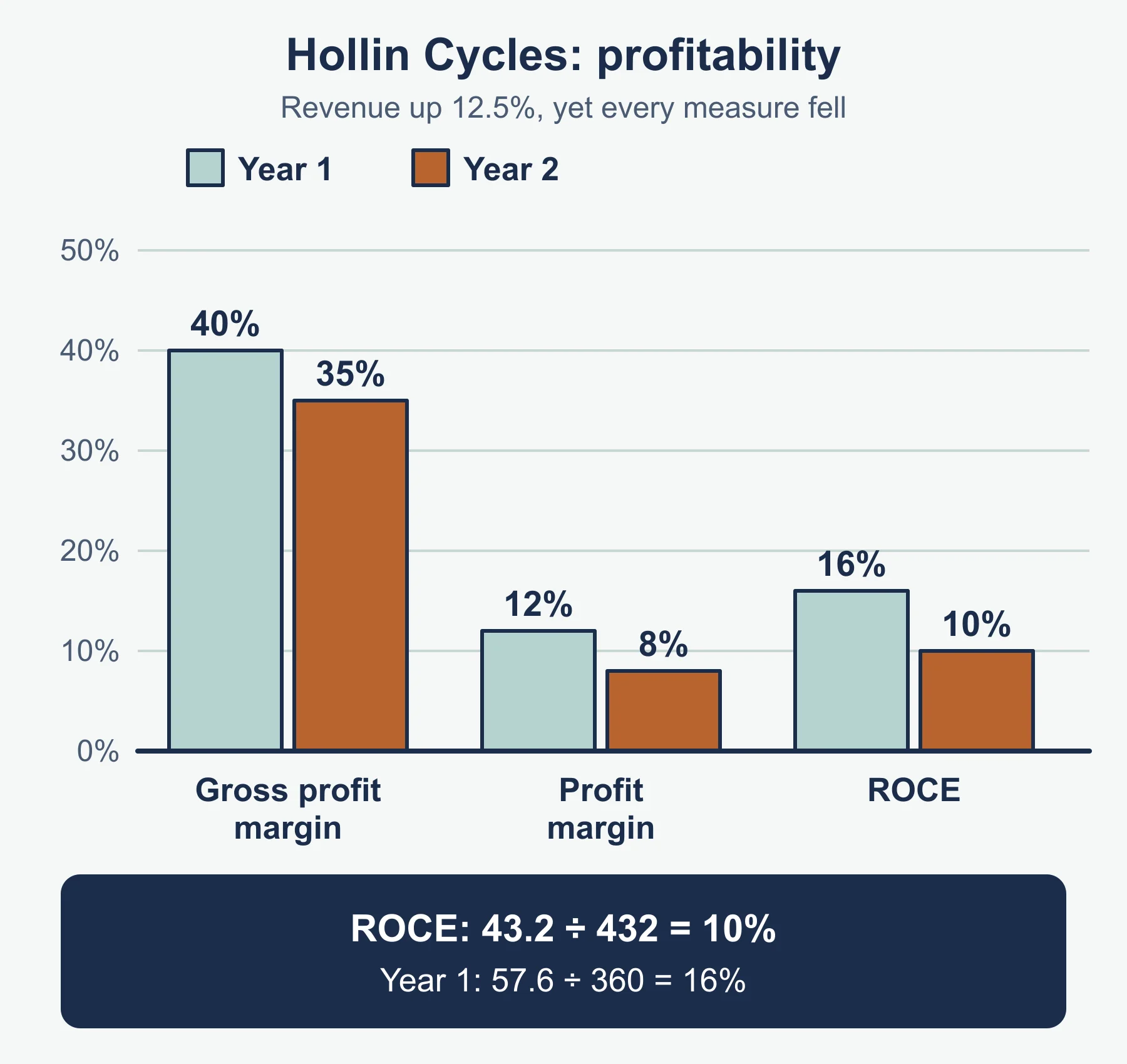
- Link ratios together. Falling ROCE with rising capital employed suggests new money has not yet earned a return. Falling acid test ratio with rising inventories suggests cash has been tied up in stock.
- Name the user in the question and pick the two or three results that matter most to them.
- Finish with a clear decision and one reason, and note what extra information would help, such as competitor figures.
Must-know distinctions
- Profitability and liquidity: profit is earned over a period; liquidity is the ability to pay bills now. A business can have one without the other.
- Gross profit margin and profit margin: the first allows only for cost of sales; the second for all costs.
- Current ratio and acid test ratio: the acid test leaves out inventories.
- Profit margin and ROCE: the first compares profit with revenue; the second with capital.
Quick self-test
- Define liquidity.
- A business has revenue 240 000 and cost of sales 180 000. Calculate gross profit margin.
- Profit is 21 000 on revenue of 300 000. Calculate profit margin.
- Profit is 36 000 and capital employed is 240 000. Calculate ROCE.
- Current assets are 60 000 and current liabilities are 40 000. Calculate the current ratio.
- Inventories are 25 000 within the current assets in question 5. Calculate the acid test ratio.
- Which of the five ratios would a supplier deciding on credit terms probably look at first?
- State why a falling ROCE might worry a shareholder.
- Gross profit margin stays at 30% but profit margin falls from 12% to 7%. Where does the problem lie?
- A business has a current ratio of 2.2 but an acid test ratio of 0.5. What does this suggest?
Answers
- The ability of a business to pay its short-term debts when they fall due.
- Gross profit = 60 000. Margin = 60 000 ÷ 240 000 × 100 = 25%.
- 21 000 ÷ 300 000 × 100 = 7%.
- 36 000 ÷ 240 000 × 100 = 15%.
- 60 000 ÷ 40 000 = 1.5.
- (60 000 − 25 000) ÷ 40 000 = 0.875, so about 0.88.
- Current ratio and acid test ratio (liquidity), to see if invoices will be paid.
- The business earns less on the money invested, so the return to owners may be falling.
- In overheads, not in the cost of sales.
- Most current assets are inventories. The business looks liquid, but may struggle to pay debts quickly if inventories sell slowly.
Check of the calculations: 60 000 ÷ 240 000 = 0.25; 21 000 ÷ 300 000 = 0.07; 36 000 ÷ 240 000 = 0.15; 35 000 ÷ 40 000 = 0.875.
Where marks are usually lost
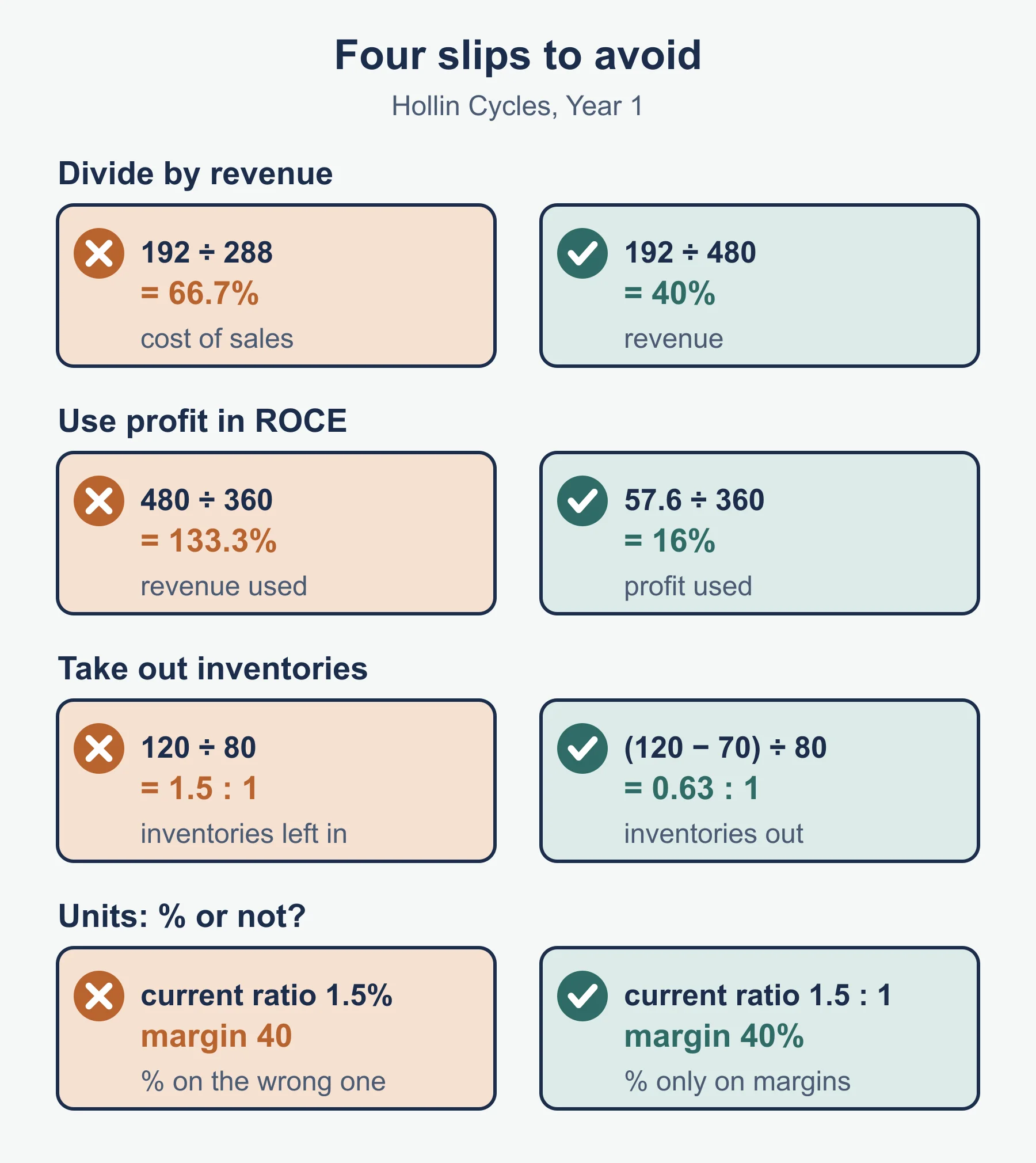
- Using revenue instead of profit for ROCE, or cost of sales as the divisor for margin.
- Forgetting to subtract inventories in the acid test ratio.
- Giving a margin or ROCE without the % sign, or putting % on a current ratio.
- Stating a figure and stopping, with no explanation of what it means.
- Giving causes that do not fit the business in the case.
- Naming a user but not the ratio or decision.
- Treating profit and cash as the same thing.
- Judging a ratio with nothing to compare it with.
Frequently asked questions
How do you calculate the acid test ratio for O Level Business 7115? Acid test ratio = (current assets − inventories) ÷ current liabilities, shown as a ratio such as 0.8 : 1. Inventories are removed because they are the current asset slowest and least certain to turn into cash.
How do you calculate return on capital employed? ROCE = (profit ÷ capital employed) × 100. Capital employed is total assets minus current liabilities, which equals owners’ capital plus non-current liabilities.
Is a high current ratio always good? No. A result far above what is usual for the industry can mean cash or inventories are sitting idle, and there is no single ideal figure for every business.
Which ratios matter most to lenders and investors? A lender or supplier cares most about liquidity, through the current ratio and acid test ratio, and about profit that can cover interest. An investor cares most about ROCE and profit margin.
Official syllabus
Cambridge O Level Business Studies 7115 syllabus for examination in 2026, Cambridge International, section 5.5.
Get free revision emails (optional)
Occasional emails with practice questions, worked explanations and links to free resources for the qualification and subjects you choose. No spam, and you can unsubscribe from any email. The free tools on this site never need an email.
Related resources
-
Study guides
O Level Business: Business finance: needs and sources (Cambridge 7115)
Why businesses need finance and where it comes from: internal, external, short-term and long-term sources, for Cambridge O Level Business.
Business · Cambridge · O Level
Read guide -
Practice questions
O Level Business: Business finance: needs and sources (Cambridge 7115) – Practice Questions
Original questions with worked answers on why businesses need finance and how to choose between sources of finance, for Cambridge O Level Business.
Business · Cambridge · O Level
Try questions -
Revision notes
O Level Business: Business finance: needs and sources (Cambridge 7115) – Revision Notes
Condensed revision notes on why businesses need finance and the main sources of finance, with a self-test, for Cambridge O Level Business.
Business · Cambridge · O Level
Revise topic
Related articles
-
teaching
A Level tuition in Dubai: Cambridge or Pearson Edexcel International A Level?
Schools in Dubai and Abu Dhabi teach either Cambridge International AS & A Level or Pearson Edexcel International A Level. How the two are structured, why it matters for tuition, and how online classes from Lahore work.
9 October 2026
-
curriculum guides
Choosing subjects at IGCSE and A Level
How subject choices at 14 and 16 affect university options later, and how to keep pathways open without overloading a timetable.
28 July 2026
Studying this with a teacher
Working through Business O LEVELS?
This page is free and stays free. If you would rather be taught it, Marlbridge runs Business classes one-to-one and in small groups of up to 15, online in your own time zone. The first trial class is free. WhatsApp replies within an hour (8am–11pm Pakistan time, every day); email the same day.
Cambridge Business teachers at Marlbridge

