
Revision Notes
OCR A Level Biology A: Enzymes (H420) – Revision Notes
Revision notes on enzyme action, rate factors, Q₁₀, cofactors, coenzymes, inhibitors and PAG4 enzyme practicals for OCR A Level Biology A (H420), section 2.1.4.
- Subject
- Biology
- Level
- A LEVELS
- Topic
- Enzymes
- Author
- Marlbridge Academic Team
- Updated
- Reviewed by
- Hina Mogul (what this means)
Aligned to OCR A Level Biology (H420), Version 4.1 (April 2026), for first assessment in 2025. Official specification .
Syllabus page (what it covers and how it is assessed): OCR A Level Biology.
Syllabus points this page covers
H420
- 2.1.4 Enzymes
Found an error? Report a correction.
Need help with this topic? Request a free trial class for A Level Biology (H420).
These notes condense learning outcomes 2.1.4(a) to (f) of the OCR A Level Biology A specification (H420, Version 4.1, April 2026, first assessment 2025), including the PAG4 practical work on rates of enzyme-controlled reactions. The course sits on the OCR A Level Biology hub; tick off outcomes on the printable checklist. Protein structure, which underpins everything here, is in the proteins revision notes, and industrial use of enzymes returns in the immobilised enzymes revision notes. Practical technique is summarised in the practical endorsement revision notes, and the free diagnostics show gaps quickly.
Key definitions
| Term | Meaning |
|---|---|
| Enzyme | A globular protein that acts as a biological catalyst, speeding up a reaction without being used up |
| Metabolism | All the chemical reactions in an organism; anabolic reactions build molecules, catabolic reactions break them down |
| Activation energy | The minimum energy needed for a reaction to start |
| Active site | The region of the enzyme, a small number of amino acids, that binds the substrate |
| Specificity | Each enzyme catalyses one reaction (or one type) because only substrates complementary to its active site can bind |
| Denaturation | A permanent change to the tertiary structure, and so the active site, so the substrate no longer fits |
| Cofactor | A non-protein substance some enzymes need in order to work |
| Coenzyme | An organic, non-protein cofactor, often made from a vitamin |
| Inhibitor | A substance that reduces the rate of an enzyme-controlled reaction |
Enzymes and metabolism: 2.1.4(a), (b)
- Almost every metabolic reaction is enzyme-controlled. Without enzymes, reactions at body temperature would be far too slow to sustain life.
- Enzymes affect structure as well as function: they build structural molecules (for example collagen in connective tissue, cellulose in plant cell walls) and they drive processes such as respiration, photosynthesis and digestion.
- Effects show at cellular level (for example a pathway inside one cell) and whole-organism level (for example digestion supplying the whole body, or growth).
- A missing or faulty enzyme can disrupt a whole pathway and the phenotype of the organism.
| Intracellular enzyme | Extracellular enzyme | |
|---|---|---|
| Where it acts | Inside the cell that made it | Outside the cell, after secretion by exocytosis |
| H420 example | Catalase | Amylase |
| Reaction | 2H₂O₂ → 2H₂O + O₂ | Starch → maltose (hydrolysis) |
| Why it matters | Hydrogen peroxide is a toxic by-product of metabolism | Starch molecules are too large to enter cells; the smaller products can be absorbed |
| Where found | Many cells, for example liver cells | Salivary glands and pancreas, acting in the mouth and small intestine |
After amylase, maltase (on the small intestine lining) hydrolyses maltose to glucose, which is absorbed.
Mechanism of enzyme action: 2.1.4(c)
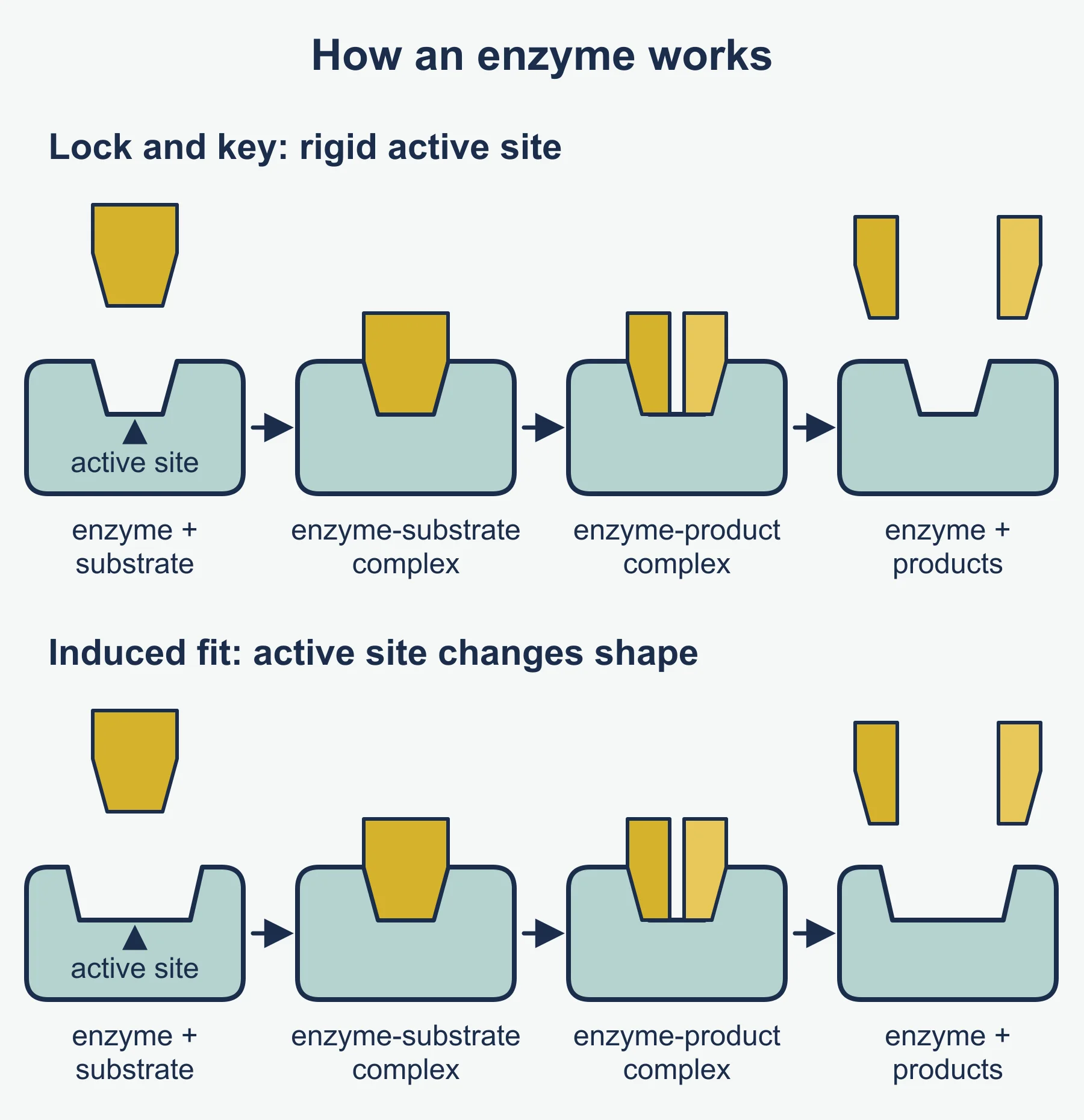
- The enzyme’s tertiary structure gives the active site its specific shape.
- A substrate with a complementary shape collides with and binds to the active site.
- An enzyme–substrate complex forms.
- The reaction takes place, giving an enzyme–product complex.
- The products leave; the enzyme is unchanged and can be reused.
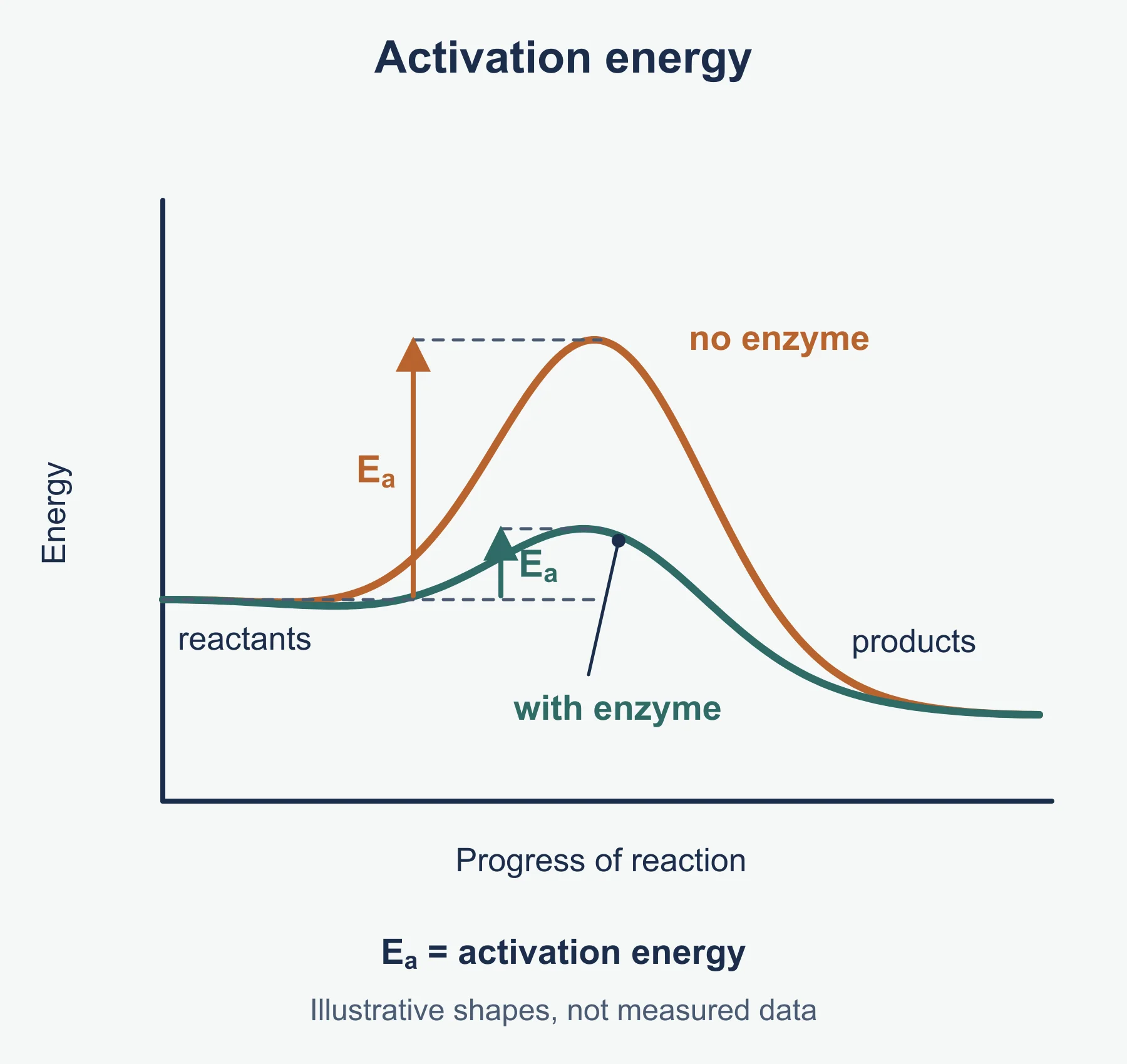
The enzyme lowers the activation energy, for example by holding substrates close together in the right orientation, or by putting strain on bonds within the substrate.
| Lock and key hypothesis | Induced-fit hypothesis | |
|---|---|---|
| Active site | Rigid; exactly complementary to the substrate | Changes shape slightly as the substrate binds |
| Explains | Specificity | Specificity, plus how bonds in the substrate are strained, lowering activation energy |
| Status | Earlier, simpler model | The currently accepted model, based on later evidence |
The switch from lock and key to induced fit is an example of a model being revised as new evidence appeared.
Factors affecting enzyme activity: 2.1.4(d)(i)
Temperature
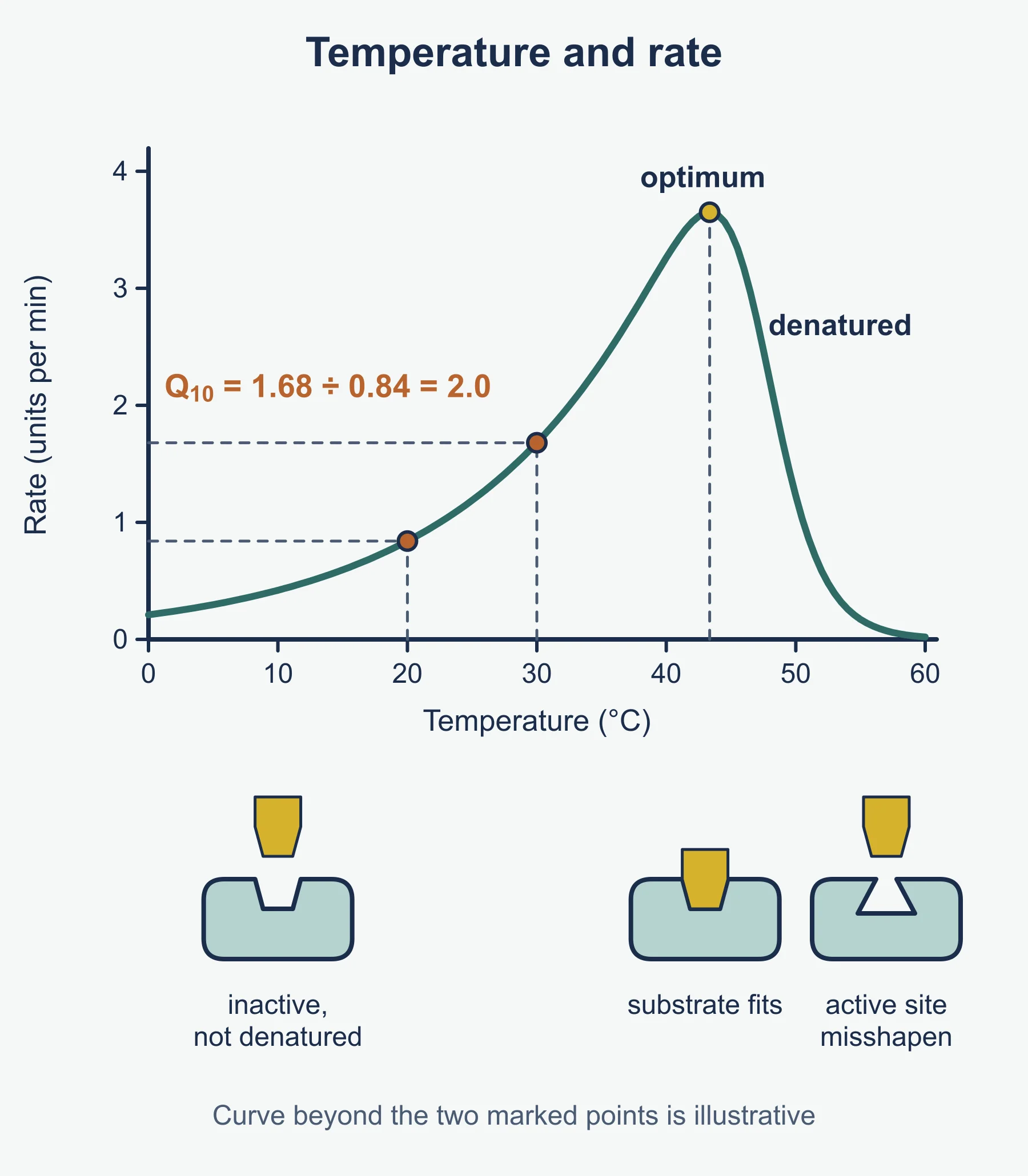
- Rising temperature gives enzyme and substrate molecules more kinetic energy, so there are more frequent successful collisions and more enzyme–substrate complexes form.
- The rate is highest at the optimum temperature.
- Above the optimum, vibrations break hydrogen and ionic bonds in the tertiary structure. The active site changes shape and the enzyme denatures; the rate falls steeply.
- At low temperature the enzyme is inactive but not denatured; activity returns when it warms.
- Enzymes from organisms in hot environments (thermophiles) have higher optima, often with more disulfide bonds holding their structure; those from cold environments have more flexible structures and lower optima.
Temperature coefficient (Q₁₀)
- Q₁₀ = R2 ÷ R1, where R1 is the rate at one temperature and R2 the rate at a temperature 10 °C higher.
- Q₁₀ has no units. Below the optimum, enzyme-controlled reactions typically have a Q₁₀ of about 2, so the rate roughly doubles for each 10 °C rise.
- Above the optimum the value falls, because denaturation outweighs the extra kinetic energy.
pH
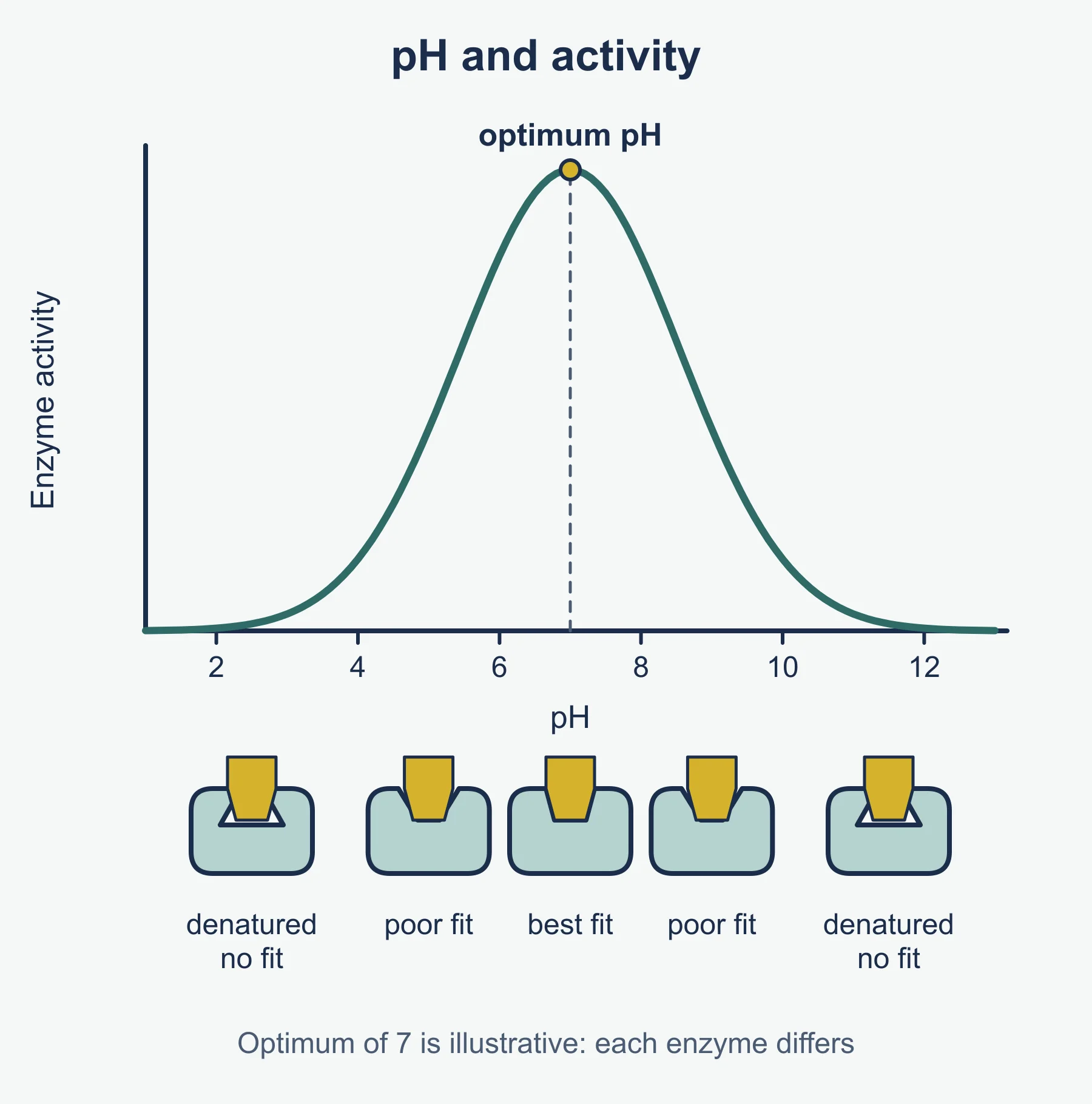
- Each enzyme has an optimum pH. Pepsin in the stomach works best at about pH 2; many enzymes, including salivary amylase, work best near pH 7.
- H⁺ and OH⁻ ions interfere with the ionic and hydrogen bonds that hold the tertiary structure, and change the charges on R groups in the active site, so the substrate binds less well.
- Small changes either side of the optimum reduce activity and may be reversible; extreme pH denatures the enzyme.
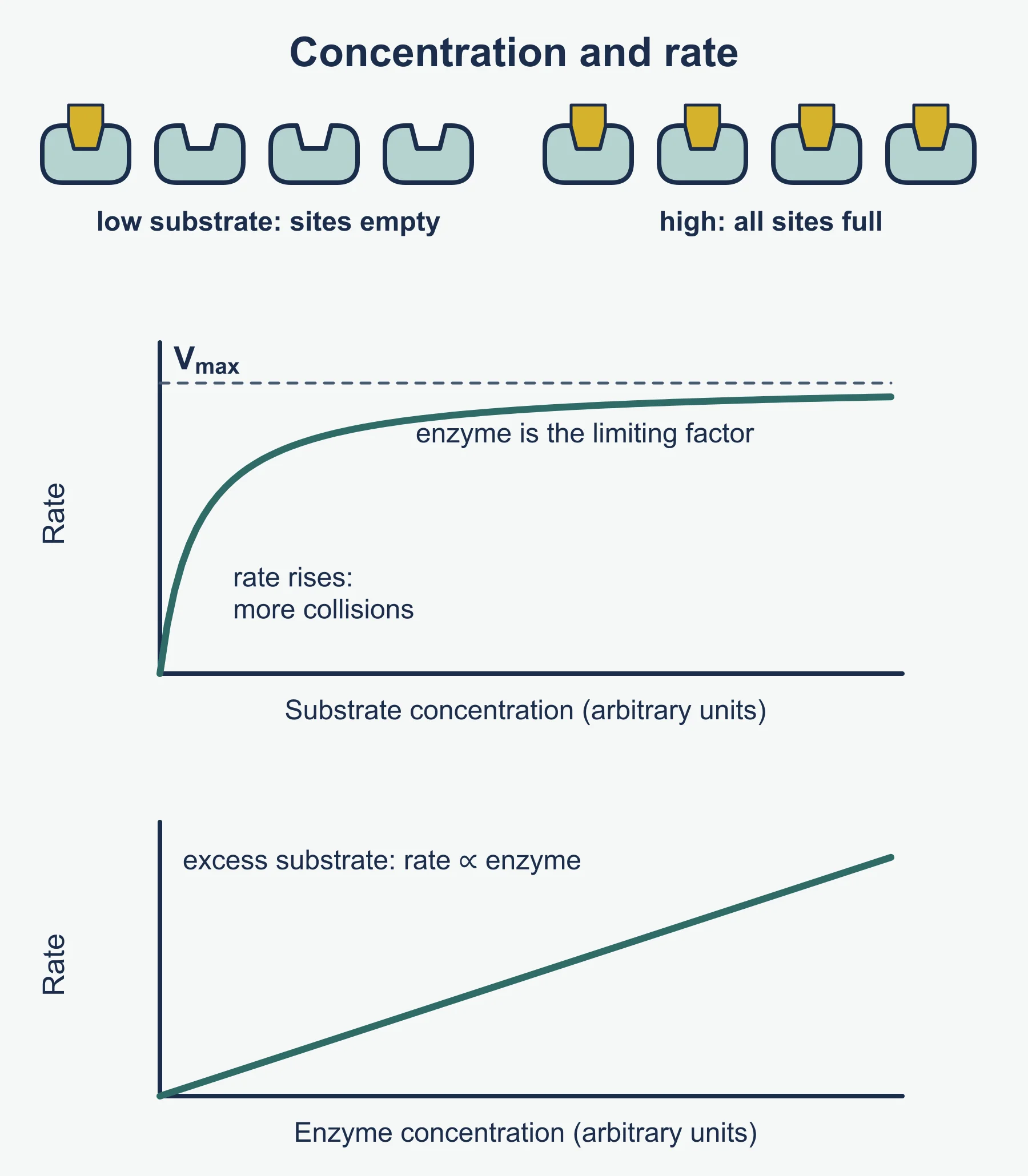
Substrate concentration (enzyme amount fixed)
- The rate rises as substrate concentration increases, because more enzyme–substrate complexes form.
- The curve levels off at the maximum rate (Vmax) when all active sites are occupied. Enzyme concentration is then the limiting factor.
Enzyme concentration (substrate in excess)
- The rate is proportional to enzyme concentration, because there are more active sites available.
- If substrate becomes limited, the rate levels off; substrate concentration is then the limiting factor.
Practical investigations (PAG4): 2.1.4(d)(ii)
| Reaction | What to measure | Rate |
|---|---|---|
| Catalase + hydrogen peroxide | Volume of oxygen collected in a gas syringe or upturned measuring cylinder, at set times | Initial rate from the gradient at the start (cm³ s⁻¹) |
| Amylase + starch | Time until a sample no longer turns iodine solution blue-black (spotting tile) | 1 ÷ time (s⁻¹) |
| Amylase + starch, quantitative | Absorbance of iodine–starch colour with a colorimeter | Change in absorbance per unit time |
| Trypsin + milk protein suspension | Time for the cloudy suspension to clear, or absorbance falling | 1 ÷ time (s⁻¹) |
Method in steps (substrate concentration with catalase)
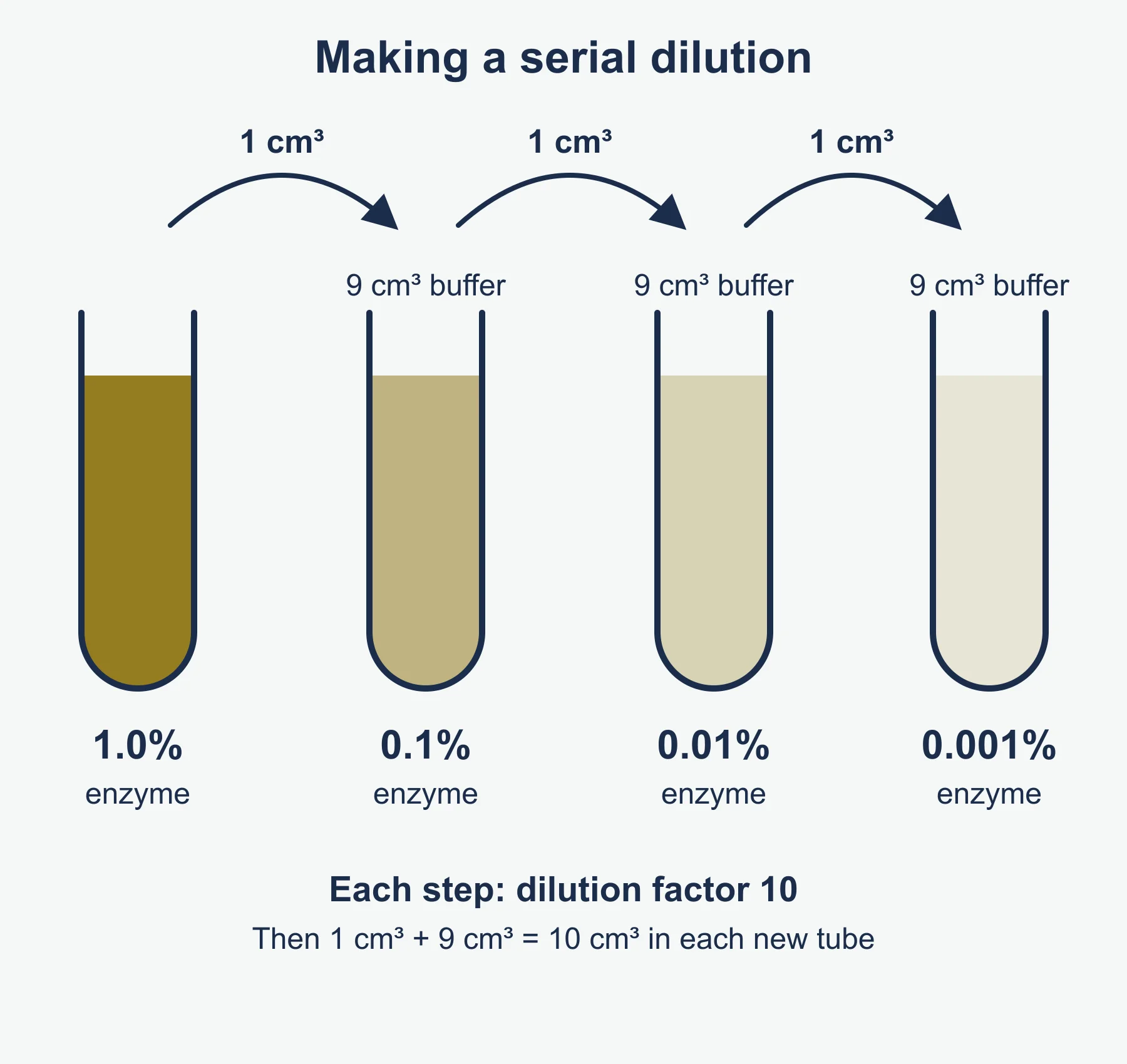
- Make a range of hydrogen peroxide concentrations by serial dilution or by proportional dilution of a stock solution.
- Keep the same volume of catalase source (yeast suspension or equal discs of potato), the same temperature (thermostatic water bath) and the same pH (buffer solution).
- Equilibrate both solutions at the bath temperature before mixing.
- Mix, start the timer at once and record the gas volume at regular intervals.
- Repeat each concentration at least three times, and calculate a mean, ignoring anomalies.
- Plot volume against time; draw a tangent at t = 0 to find each initial rate. Then plot initial rate against concentration.
- Temperature investigations: water baths at, for example, 20, 30, 40, 50 and 60 °C; buffer to fix pH.
- pH investigations: a range of buffer solutions; water bath to fix temperature.
- Controls: boiled (denatured) enzyme in place of active enzyme shows any change is due to enzyme activity.
- Data logging: an oxygen sensor or colorimeter linked to a data logger gives continuous readings, and software can calculate gradients.
- Why initial rate? Later the substrate is used up and products build up, so the rate falls for reasons other than the variable under test.
Cofactors and coenzymes: 2.1.4(e)
- Inorganic cofactors (ions) help the substrate bind or the reaction proceed. H420 example: the chloride ion (Cl⁻) is a cofactor for amylase; it helps form a correctly shaped active site.
- Coenzymes are organic cofactors, often carrying atoms or groups between reactions. Many are made from vitamins, which is why vitamins are needed in the diet.
| Coenzyme | Vitamin source | Role |
|---|---|---|
| NAD | Nicotinamide (vitamin B3) | Carries hydrogen in respiration |
| FAD | Riboflavin (vitamin B2) | Carries hydrogen in respiration |
| Coenzyme A | Pantothenic acid (vitamin B5) | Carries acetyl groups in respiration |
- Prosthetic group: a cofactor tightly and permanently bound to the enzyme, for example Zn²⁺ in carbonic anhydrase.
- In PAG4 you could compare amylase activity with and without added chloride ions.
Inhibitors: 2.1.4(f)
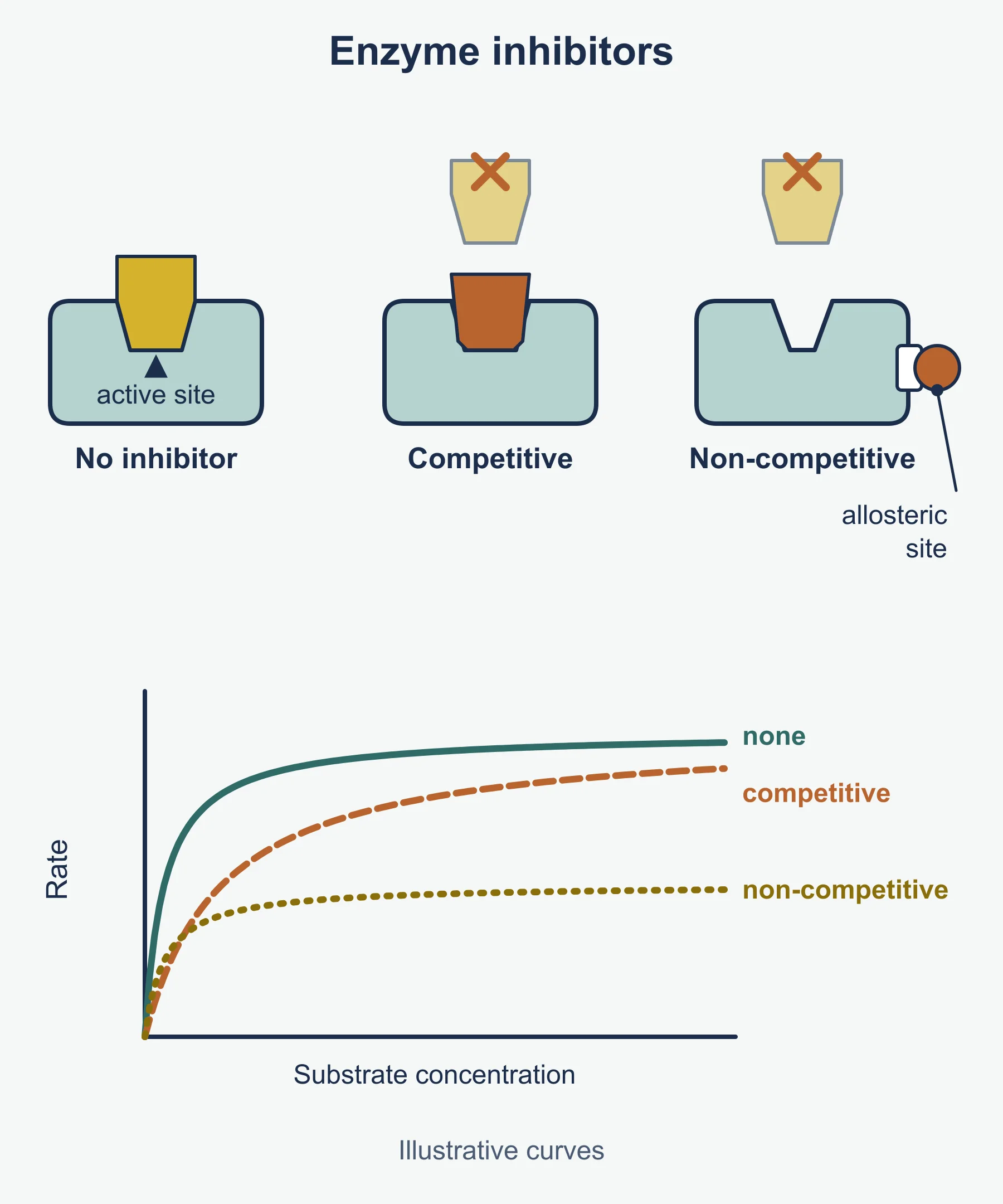
| Competitive | Non-competitive | |
|---|---|---|
| Binding site | The active site | Another site (an allosteric site) |
| Shape | Similar to the substrate | Not similar to the substrate |
| Effect | Blocks substrate from the active site | Changes the shape of the active site, so substrate cannot bind |
| More substrate | Reduces the effect; Vmax can still be reached | Does not overcome it; Vmax is lowered |
| Example | Statins inhibit an enzyme in cholesterol synthesis | Many metabolic poisons |
- Reversible inhibitors bind by weak bonds such as hydrogen and ionic bonds, and can leave the enzyme.
- Non-reversible inhibitors bind permanently (often by covalent bonds) or denature the enzyme. Examples: aspirin permanently inactivates the COX enzymes that make prostaglandins; penicillin irreversibly inhibits an enzyme that builds bacterial cell walls; heavy metal ions such as Hg²⁺ disrupt the tertiary structure.
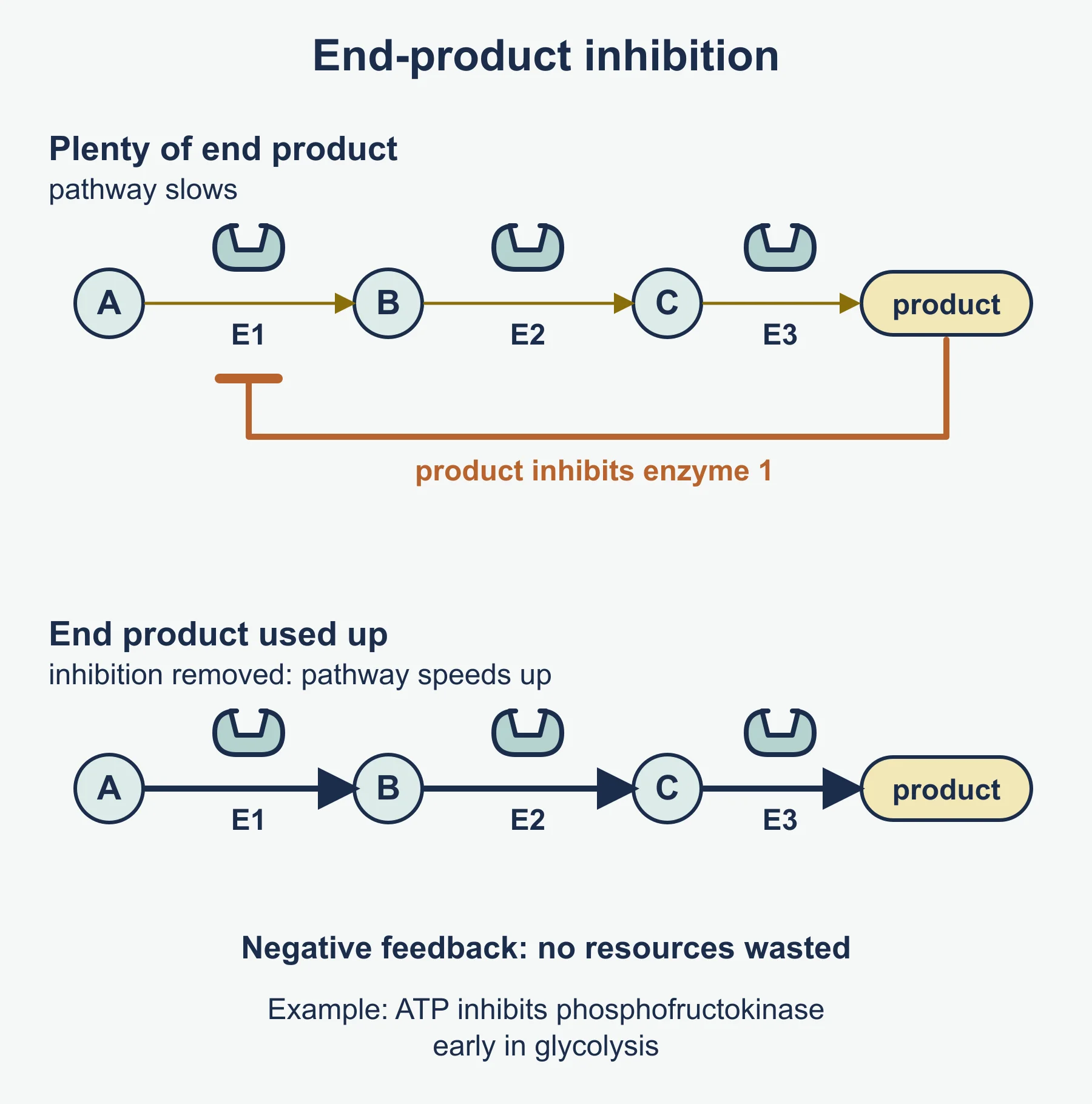
- End-product inhibition: the final product of a pathway inhibits an enzyme near the start, usually non-competitively and reversibly. When product levels rise, production slows; when they fall, the enzyme becomes active again. Example: ATP inhibits phosphofructokinase in glycolysis.
- Precursor activation: some enzymes are made as inactive precursors (for example pepsinogen, activated to pepsin by stomach acid) so they do not damage the cells that make them.
- In PAG4, add a range of inhibitor concentrations and compare rates with an uninhibited control.
Worked reminders
Q₁₀. A reaction runs at 0.42 cm³ s⁻¹ at 25 °C and 0.84 cm³ s⁻¹ at 35 °C. Q₁₀ = 0.84 ÷ 0.42 = 2.0.
Using Q₁₀. With Q₁₀ = 2, a rate of 3.0 units at 20 °C becomes about 6.0 at 30 °C and 12 at 40 °C, as long as the enzyme has not denatured.
Initial rate. The tangent at t = 0 passes through (0, 0) and (20 s, 15 cm³). Initial rate = 15 ÷ 20 = 0.75 cm³ s⁻¹.
Rate from time. Starch disappears after 125 s. Rate = 1 ÷ 125 = 0.008 s⁻¹ (8.0 × 10⁻³ s⁻¹).
Serial dilution. 1 cm³ of 1.0 mol dm⁻³ stock plus 9 cm³ water gives 0.1 mol dm⁻³; repeat with the new solution to get 0.01 mol dm⁻³.
Proportional dilution. For 10 cm³ of 0.6 mol dm⁻³ from 1.0 mol dm⁻³ stock: 6 cm³ stock plus 4 cm³ water.
Writing good answers
- Name the bonds. “High temperature breaks hydrogen and ionic bonds in the tertiary structure” scores; “the enzyme is killed” does not.
- Link shape to binding. Always finish the chain: active site changes shape, substrate no longer complementary, fewer enzyme–substrate complexes, rate falls.
- Use collision language for temperature and concentration: kinetic energy, frequency of successful collisions.
- Say what is limiting on the plateau of a graph.
- Quote data with units when describing a graph, and compare values either side of the optimum.
Must-know distinctions
- Lock and key (rigid site) versus induced fit (site moulds round the substrate).
- Intracellular (catalase) versus extracellular (amylase).
- Cofactor (any non-protein helper) versus coenzyme (organic, often from a vitamin) versus prosthetic group (permanently bound).
- Competitive (active site, beaten by more substrate) versus non-competitive (elsewhere, not beaten by more substrate).
- Reversible versus non-reversible inhibition.
- Inactive at low temperature (reversible) versus denatured at high temperature (permanent).
Quick self-test
- Name the H420 example of an intracellular enzyme and write the equation for its reaction.
- Why is amylase described as extracellular?
- Name the two complexes formed during an enzyme-catalysed reaction.
- How does the induced-fit hypothesis explain the lowering of activation energy?
- Why does the rate level off at high substrate concentration?
- Rates are 1.5 units at 30 °C and 3.6 units at 40 °C. Calculate Q₁₀.
- Why does extreme pH reduce enzyme activity?
- Which ion acts as a cofactor for amylase?
- Why are vitamins needed for some enzyme-controlled reactions?
- A graph with inhibitor present reaches the same maximum rate as the control at very high substrate concentration. Which type of inhibitor is present?
- What is end-product inhibition, and why is it useful?
- In a catalase experiment, why is a boiled enzyme control set up?
Answers
- Catalase: 2H₂O₂ → 2H₂O + O₂.
- It is secreted and acts outside the cells that make it (for example in the mouth or small intestine).
- The enzyme–substrate complex and the enzyme–product complex.
- The active site changes shape as the substrate binds, which puts strain on bonds in the substrate so they break more easily.
- All the active sites are occupied, so enzyme concentration becomes the limiting factor.
- 3.6 ÷ 1.5 = 2.4.
- H⁺ or OH⁻ ions disrupt ionic and hydrogen bonds in the tertiary structure, changing the active site so the substrate no longer fits; the enzyme may denature.
- The chloride ion, Cl⁻.
- Many coenzymes, such as NAD from vitamin B3, are made from vitamins.
- A competitive inhibitor.
- The final product of a pathway inhibits an enzyme early in it; this matches production to need and avoids wasting resources.
- To show the oxygen is produced by enzyme activity and not by another process.
Where marks are usually lost
- Saying the enzyme or the active site is “killed”, or that enzymes are “used up”.
- Writing that the substrate and active site are the “same shape” instead of complementary.
- Explaining the fall above the optimum without mentioning the tertiary structure or active site.
- Describing a plateau without saying that all active sites are occupied, or naming the wrong limiting factor.
- Giving Q₁₀ with units, or dividing the lower rate by the higher.
- Stating that a non-competitive inhibitor binds to the active site.
- Measuring a mean rate over the whole reaction instead of the initial rate.
- Forgetting to equilibrate solutions at the test temperature before mixing.
Frequently asked questions
Why should you not say an enzyme is “killed” at high temperature? Enzymes are proteins, not living things, so they cannot be killed. Above the optimum, increased vibration breaks bonds holding the tertiary structure, the active site changes shape and is no longer complementary to the substrate, and the enzyme is denatured.
How do you calculate Q₁₀ correctly? Divide the rate at the higher temperature by the rate at the temperature 10 °C lower. Q₁₀ is a ratio, so it has no units, and dividing the lower rate by the higher one is a common error.
What is the difference between a competitive and a non-competitive inhibitor? A competitive inhibitor has a shape similar to the substrate and binds to the active site, competing with the substrate. A non-competitive inhibitor binds elsewhere on the enzyme, changing the shape of the active site, so it does not bind to the active site itself.
Why is the initial rate measured in enzyme practicals? The initial rate is taken at the start, before substrate is used up and the reaction slows, so it gives a fair comparison between conditions. Using a mean rate over the whole reaction is a common way to lose marks in PAG4 questions.
What should you say when a rate graph levels off? Explain that a factor other than the one on the x-axis is now limiting; when substrate concentration is no longer limiting, it is because all the active sites are occupied. Describing the plateau without naming the limiting factor does not earn the mark.
Official syllabus
OCR Level 3 Advanced GCE in Biology A (H420) specification, Version 4.1 (April 2026), first assessment 2025, published by OCR. Module 2.1.4 Enzymes, statements (a) to (f), with PAG4 (rates of enzyme-controlled reactions).
Get free revision emails (optional)
Occasional emails with practice questions, worked explanations and links to free resources for the qualification and subjects you choose. No spam, and you can unsubscribe from any email. The free tools on this site never need an email.
Related resources
-
Study guides
OCR A Level Biology A: Enzymes (H420)
OCR A Level Biology A (H420) 2.1.4 study guide: enzyme mechanism, induced fit, pH and temperature, the temperature coefficient, cofactors, inhibitors and PAG4.
Biology · OCR · A Level
Read guide -
Practice questions
OCR A Level Biology A: Enzymes (H420) – Practice Questions
Original OCR A Level Biology A (H420) 2.1.4 questions with answers: induced fit, temperature and pH, temperature coefficient, serial dilutions and inhibitors.
Biology · OCR · A Level
Try questions -
Exam preparation
OCR A Level Biology A: Preparing for Two 100-Mark Papers and a Synoptic Third
How OCR A Level Biology A (H420) is assessed: two 100-mark papers, a synoptic Paper 3, the separate Practical Endorsement and a routine for unfamiliar data.
Biology · OCR · A Level
Read guide
Related articles
-
study skills
How to revise for a science examination
Most science revision fails because it rereads notes instead of retrieving them. A practical method for revising physics, chemistry and biology in the weeks before a paper.
14 July 2026
-
teaching
A Level tuition in Dubai: Cambridge or Pearson Edexcel International A Level?
Schools in Dubai and Abu Dhabi teach either Cambridge International AS & A Level or Pearson Edexcel International A Level. How the two are structured, why it matters for tuition, and how online classes from Lahore work.
9 October 2026
Studying this with a teacher
Working through Biology A LEVELS?
This page is free and stays free. If you would rather be taught it, Marlbridge runs Biology classes one-to-one, online in your own time zone. One-to-one only for this course: Rs 6,000 per class in Pakistan, with other currencies on the fees page. The first trial class is free. WhatsApp replies within an hour (8am–11pm Pakistan time, every day); email the same day.
OCR Biology teachers at Marlbridge


