
Revision Notes
OCR A Level Business: Accounting and financial considerations (H431) – Revision Notes
Condensed revision notes on accounting and financial considerations for OCR A Level Business H431: formulas, definitions, method steps and a self-test.
- Subject
- Business
- Level
- A LEVELS
- Topic
- Accounting and financial considerations
- Author
- Marlbridge Academic Team
- Updated
- Reviewed by
- Salman Ahmad (what this means)
Aligned to OCR A Level Business (H431), Version 2.1 (January 2026), for first assessment in 2017; final assessment summer 2027. Official specification .
Syllabus page (what it covers and how it is assessed): OCR A Level Business.
Syllabus points this page covers
H431
- 6 Accounting and financial considerations (whole topic)
Found an error? Report a correction.
Need help with this topic? Request a free trial class for A Level Business (H431).
Condensed notes for topic 6, Accounting and financial considerations, in OCR A Level Business H431 (Version 2.1, January 2026; final assessment summer 2027). Full explanations and worked examples are in the study guide; test yourself with the practice questions. See also measures of performance and forecasting. Links: OCR A Level Business hub, checklist and free 10-minute diagnostics.
Topic map
- Accounting and finance within a business environment: objectives, sources of finance, accounting concepts.
- Management accounting: costs, revenue and profit; break-even; investment appraisal; budgets and variances; cash-flow; working capital.
- Financial accounting: income statements; statement of financial position and depreciation; ratio analysis.
- External influences on accounting and finance.
- The finance strategy.
Objectives and sources of finance
- Accounting and finance objectives are measurable finance targets (profit, cash-flow, ROCE, gearing). Needed for control, comparison and to support the business objective.
- Evaluate by stakeholder: owners (return), lenders (security), managers (clear targets).
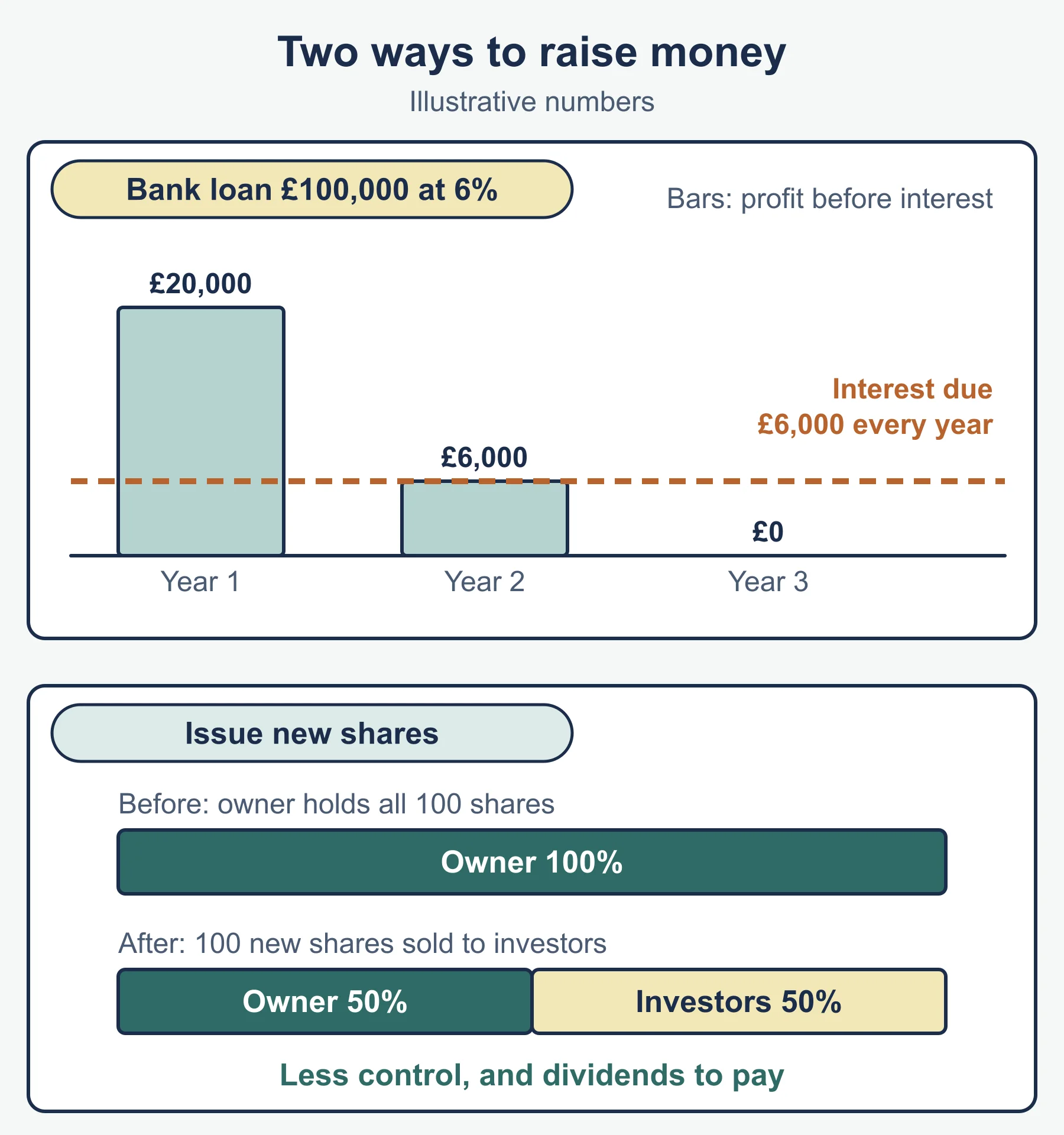
- Internal sources: retained profit, sale of non-current assets, tighter working capital. External: shares, loans, debentures, overdraft, trade credit, leasing, factoring, venture capital.
- Short-term: overdraft, trade credit, factoring. Long-term: shares, loans, debentures, retained profit.
| Factor on choice of finance | Ask |
|---|---|
| Time | How long is the money needed? |
| Legal structure | Can this business issue shares? |
| Quantitative | How much, at what interest, can it repay? |
| Qualitative | Loss of control? Attitude to risk? |
| External influences | Interest rates, economy, credit availability? |
Accounting concepts
- True and fair view: accounts free from material error and bias.
- GAAP: Generally Accepted Accounting Practice (specific rules not required).
- Conventions: consistency, going concern, accruals (matching), materiality, objectivity, prudence (conservatism), realisation.
- Apply them by naming the convention, then linking it to the case: for example prudence means providing for a likely bad debt; accruals means putting a cost in the period it helps earn revenue.
- Evaluate: they give comparable, reliable accounts, but allow judgement and can understate value (prudence).
Costs, revenue and profit
| Term | Meaning or formula |
|---|---|
| Total cost | fixed + variable |
| Average cost | total cost / output |
| Total revenue | price x quantity |
| Average revenue | total revenue / quantity = price |
| Profit | total revenue - total cost |
| Direct cost | traced to a unit |
| Indirect cost | supports several units |
| Overheads | indirect running costs |
- Cost centre: collects costs. Profit centre: earns revenue and costs, so profit can be measured.
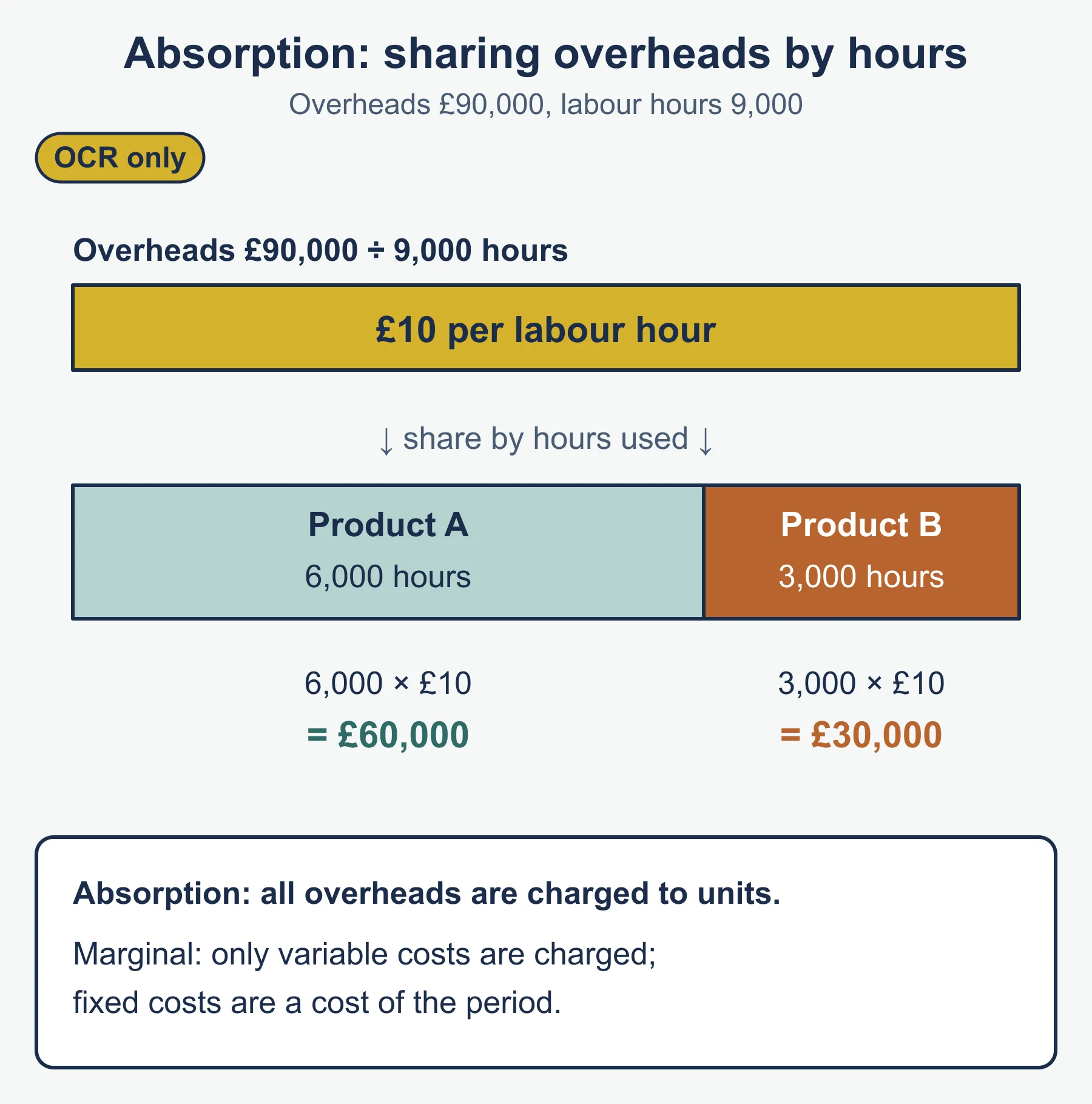
- Full costing: all costs charged to units. Absorption costing: overheads added by a rate (for example overheads / total hours). Marginal costing: only variable costs per unit; fixed costs are a period cost.
- Allocation of overheads changes reported product profit, and so pricing and drop decisions.
Break-even analysis
| Item | Calculation |
|---|---|
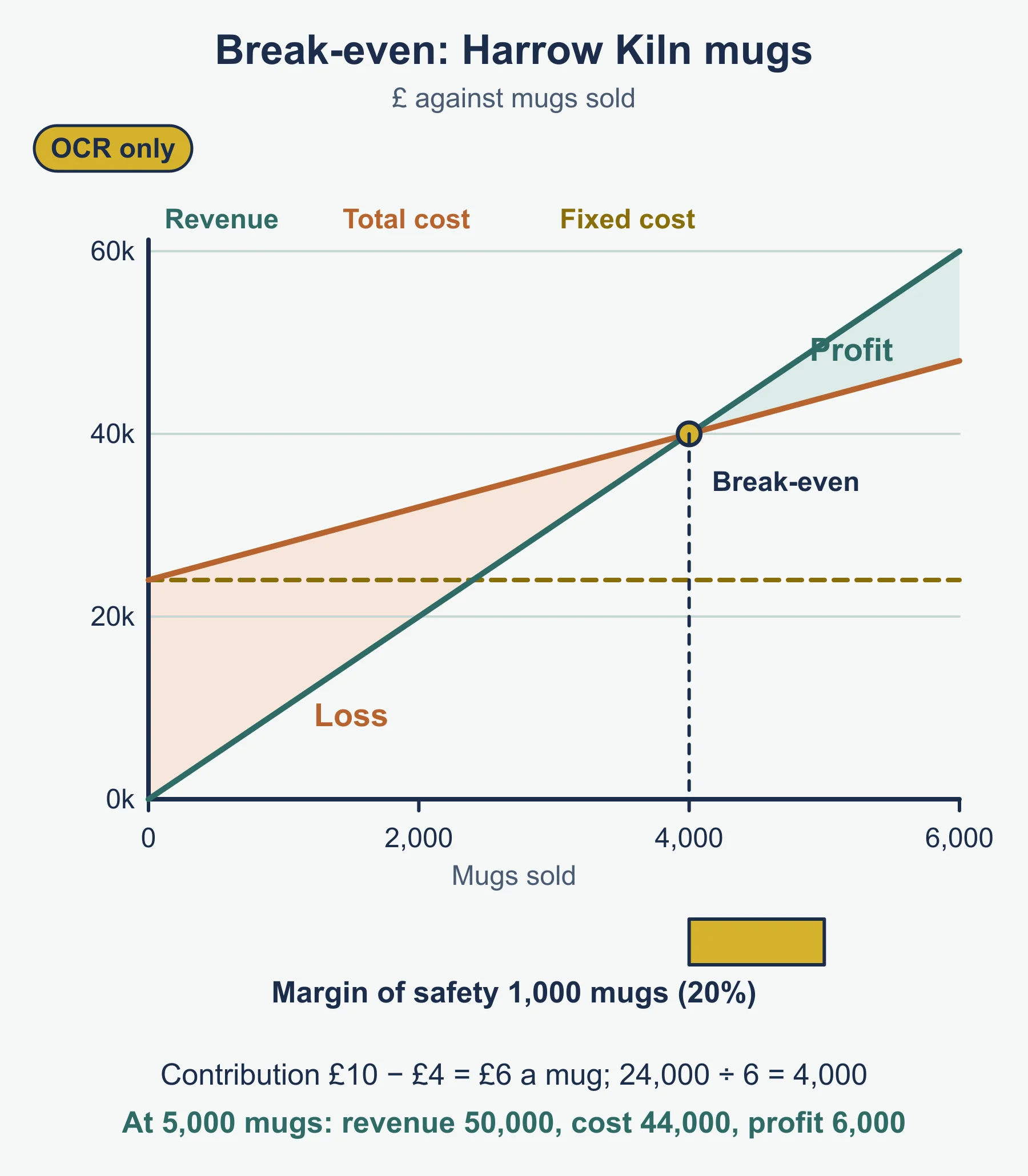
| Contribution per unit | selling price less variable cost per unit |
| Break-even output | fixed costs divided by contribution per unit |
| Margin of safety | expected or actual sales volume less the break-even volume |
| Target profit output | fixed costs plus the profit wanted, divided by contribution per unit |
Method in steps for a change question:
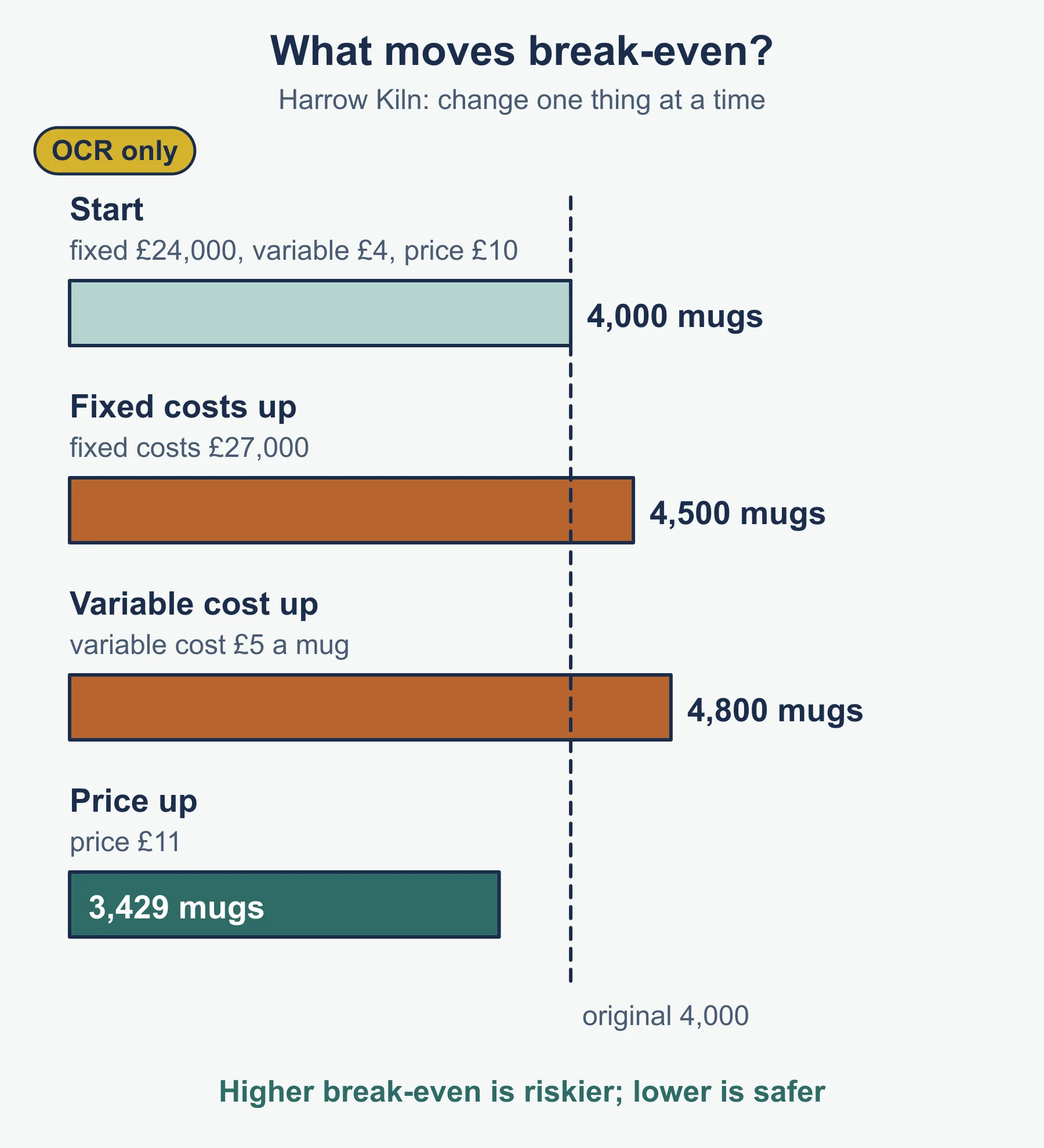
- Work out the new fixed cost, variable cost or price.
- Recalculate contribution, then break-even.
- Compare with the old break-even and the margin of safety.
- Judge: is the change realistic, and what happens to demand?
- Stepped fixed cost: jumps at output thresholds, such as extra premises.
- Graph: fixed cost line is flat; total cost starts at fixed cost; revenue starts at the origin; crossing is break-even.
- Lower break-even: raise price, cut variable cost, cut fixed cost; each has a trade-off.
- Special order: accept if contribution is positive, there is spare capacity and regular sales are unaffected.
- Limits: assumes constant price and costs, and that all output is sold.
Investment appraisal
| Method | How | Main weakness |
|---|---|---|
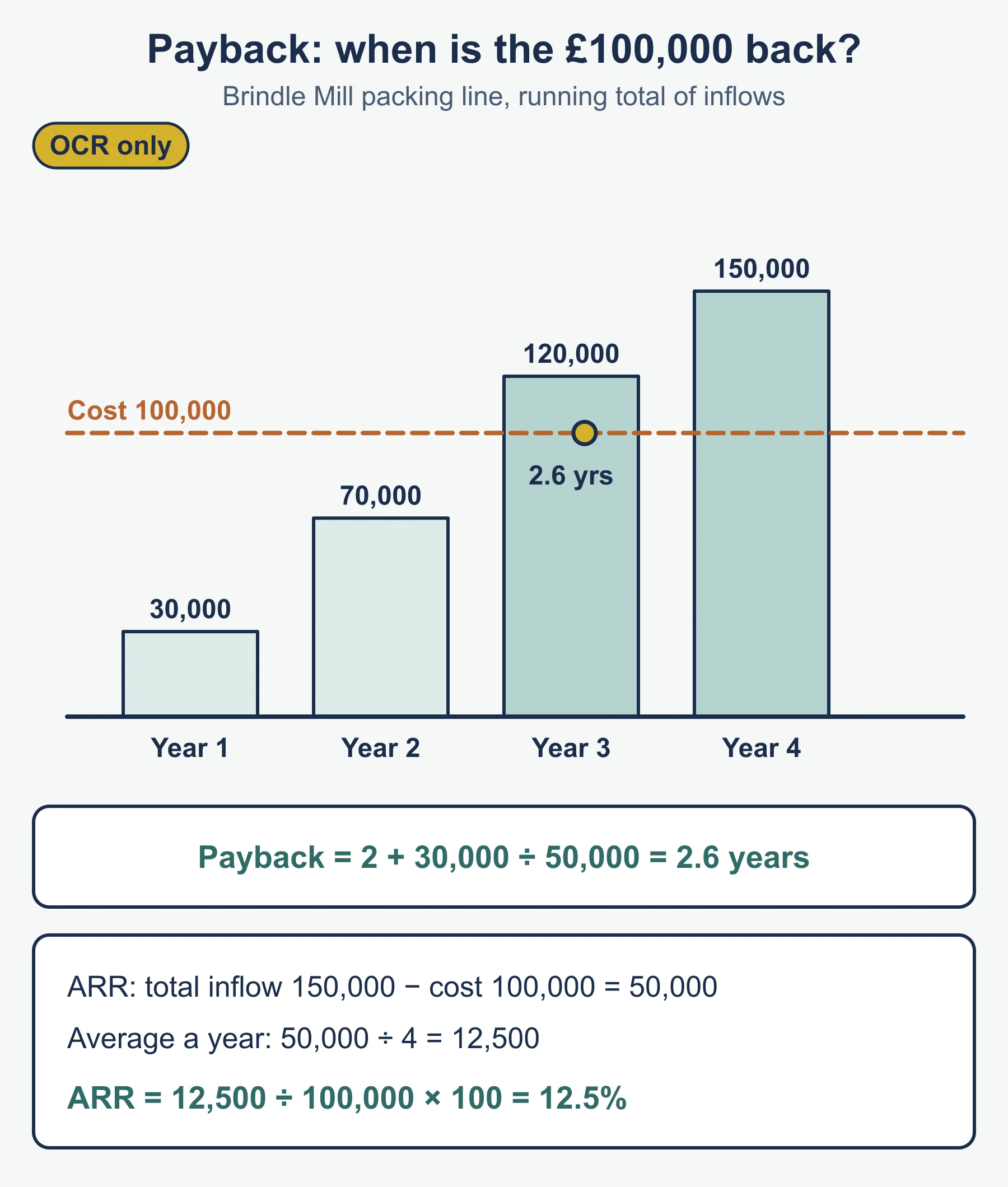
| Payback | time for cumulative inflows to equal cost | ignores later cash and timing |
| ARR | (total inflow - cost) / years / cost x 100 | ignores timing |
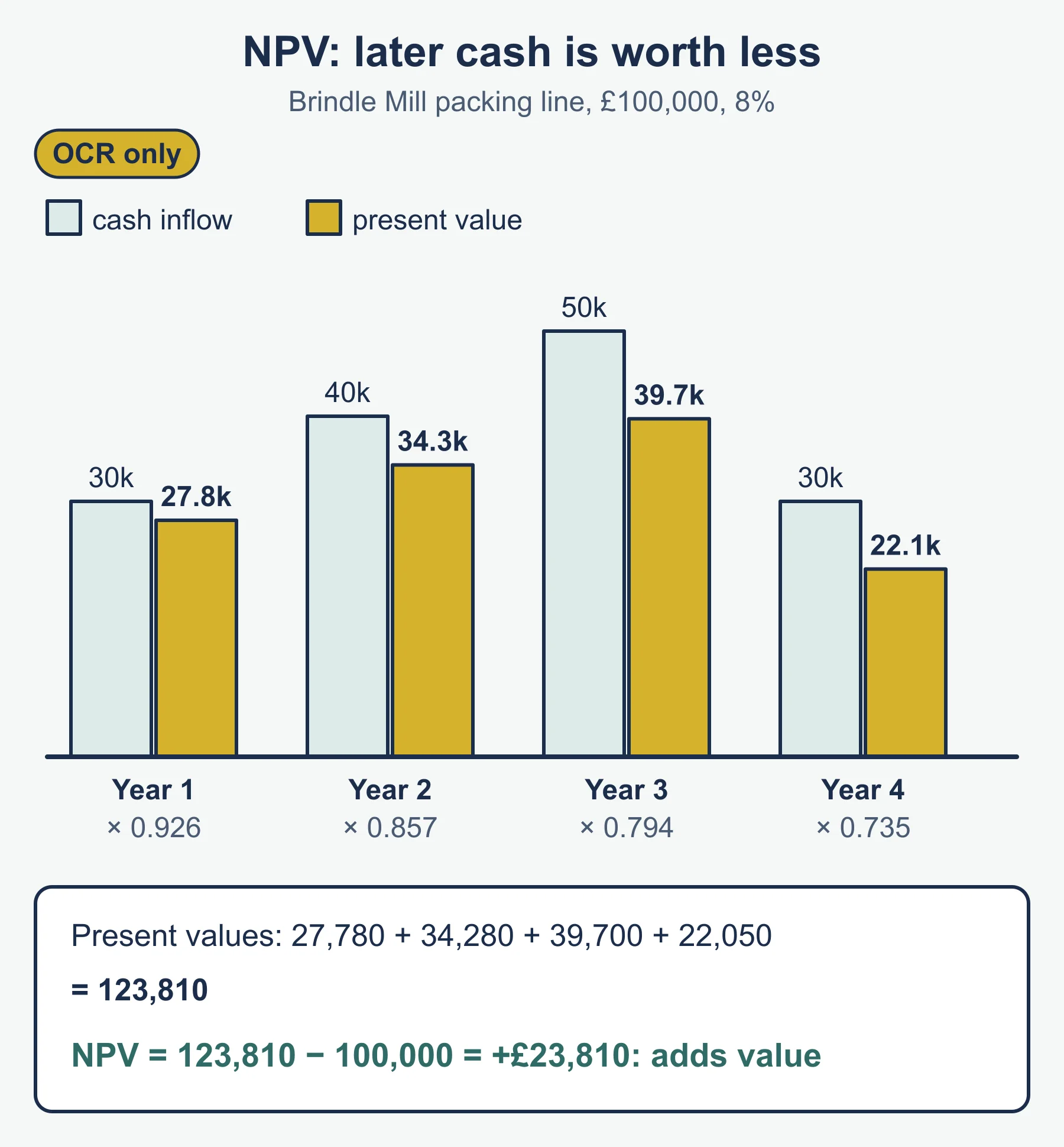
| NPV | sum of discounted inflows - cost | needs a discount rate |
- Purpose: judge whether a project is worth its cost and choose between projects.
- Positive NPV adds value; accept if the rate is realistic.
- Qualitative aspects: risk, staff, brand, strategic fit, environmental impact. Recommend by balancing both.
Budgets and variances
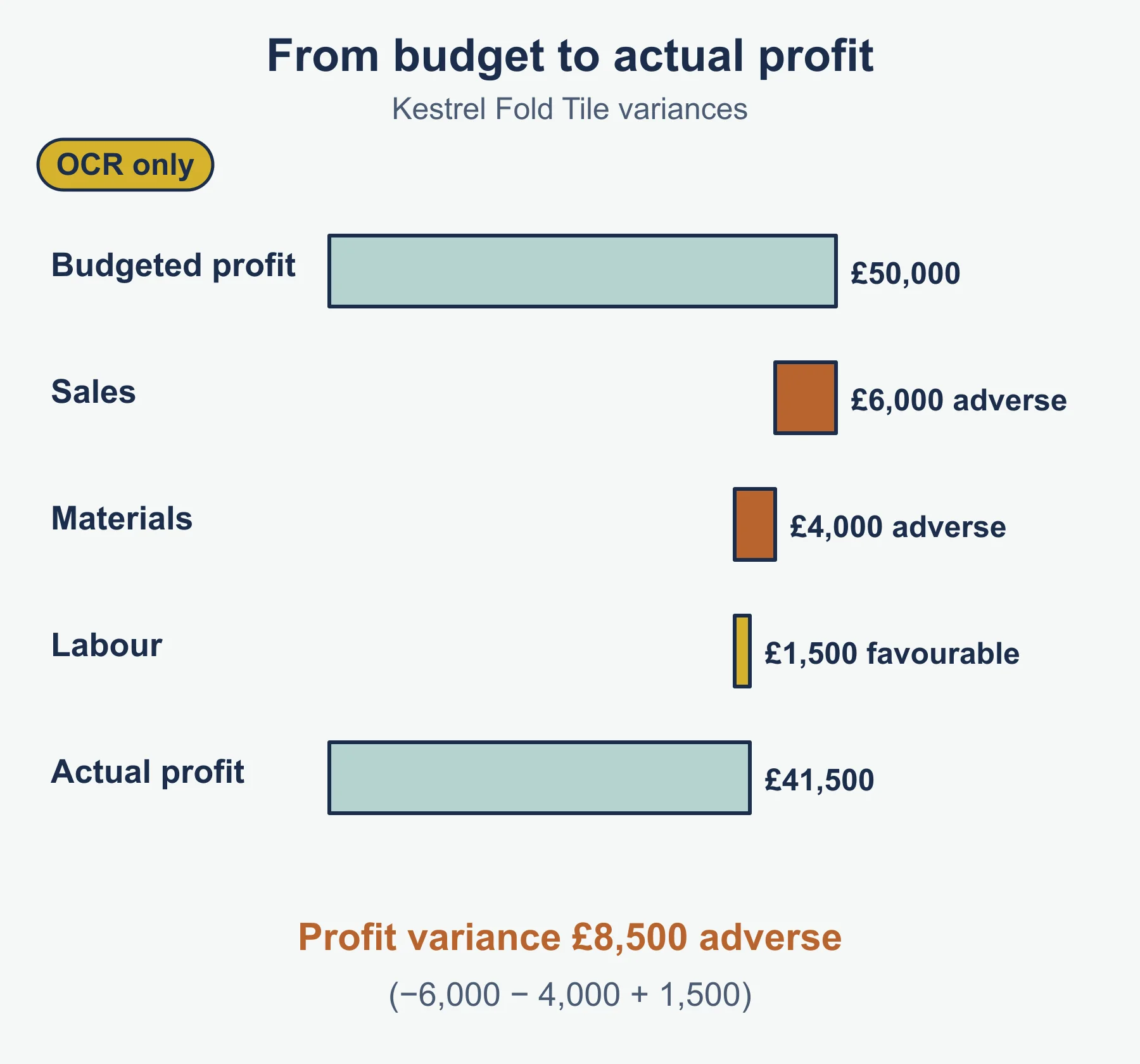
- Budget: plan for a future period. Variance: actual minus budget, labelled favourable (raises profit) or adverse (lowers profit).
- Higher revenue than planned is favourable, while higher costs than planned are adverse.
- Benefits: control, coordination, motivation. Risks: unrealistic targets, rigid, imposed budgets, variances not investigated.
Cash-flow and working capital
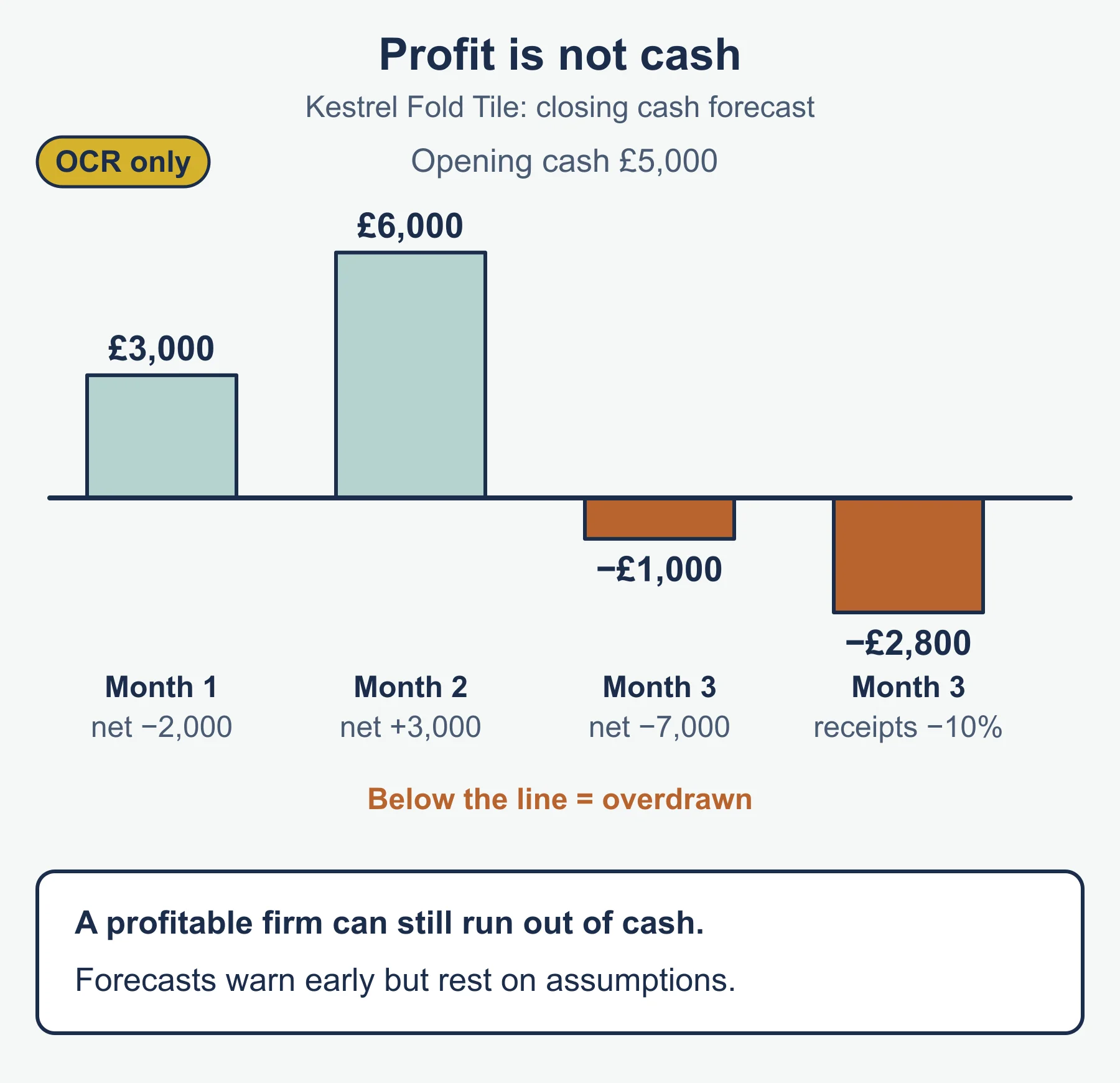
- Cash-flow forecast: future receipts and payments. Cash-flow statement: what happened.
- Cash-flow is money moving; profit is revenue minus costs, including credit sales and non-cash items such as depreciation.
- Layout: opening balance + receipts - payments = closing balance, which becomes next month’s opening balance.
- If revenue falls, receipts fall, so closing cash falls by the same amount each month it applies.
- Fixes: overdraft, delay payments, speed up collection, cut inventory, sale and leaseback, cut costs. Evaluate cost, risk and speed.
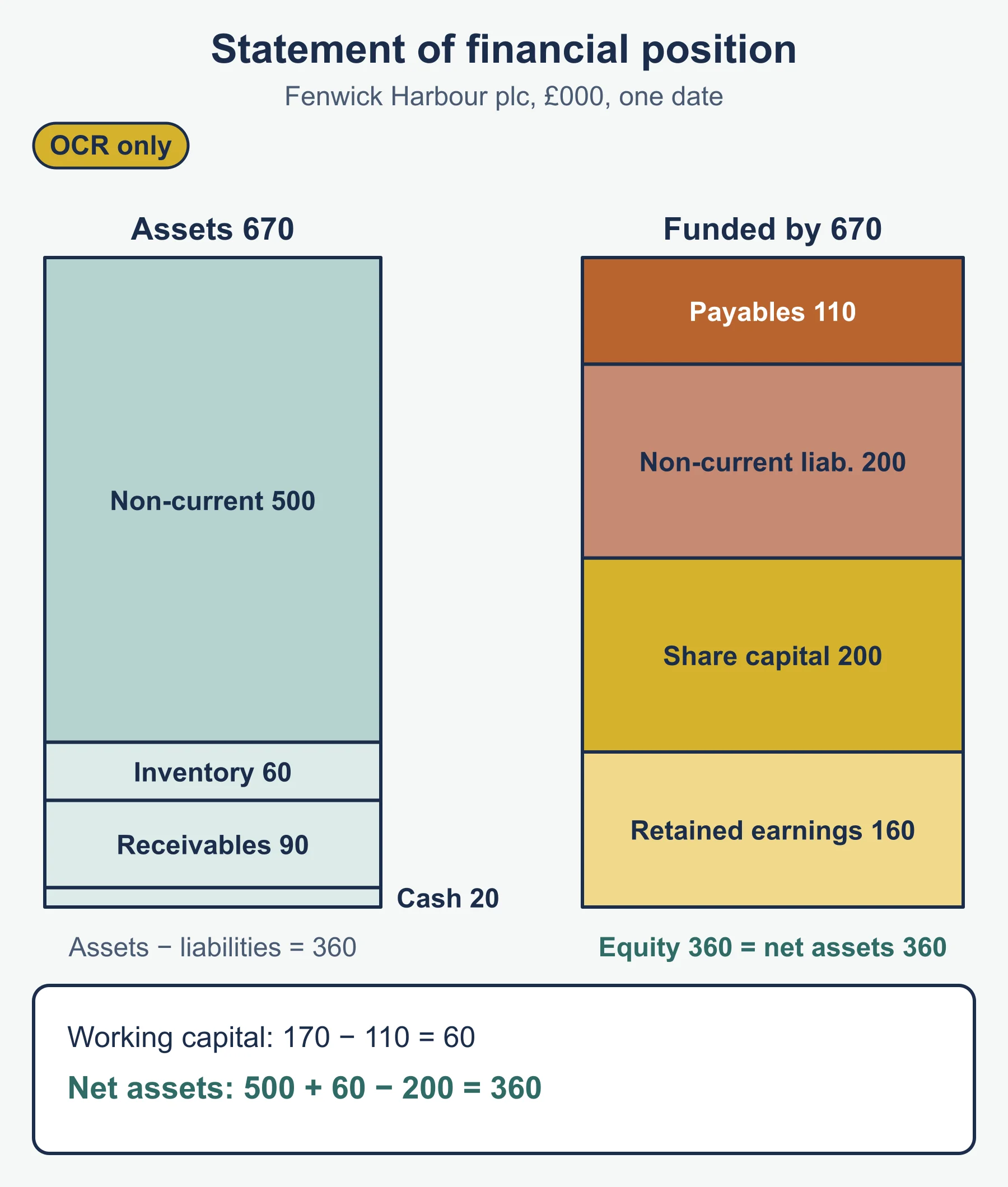
- Working capital = current assets - current liabilities. Working capital cycle: cash out for inventory, then production, sale, credit period, cash in.
Final accounts
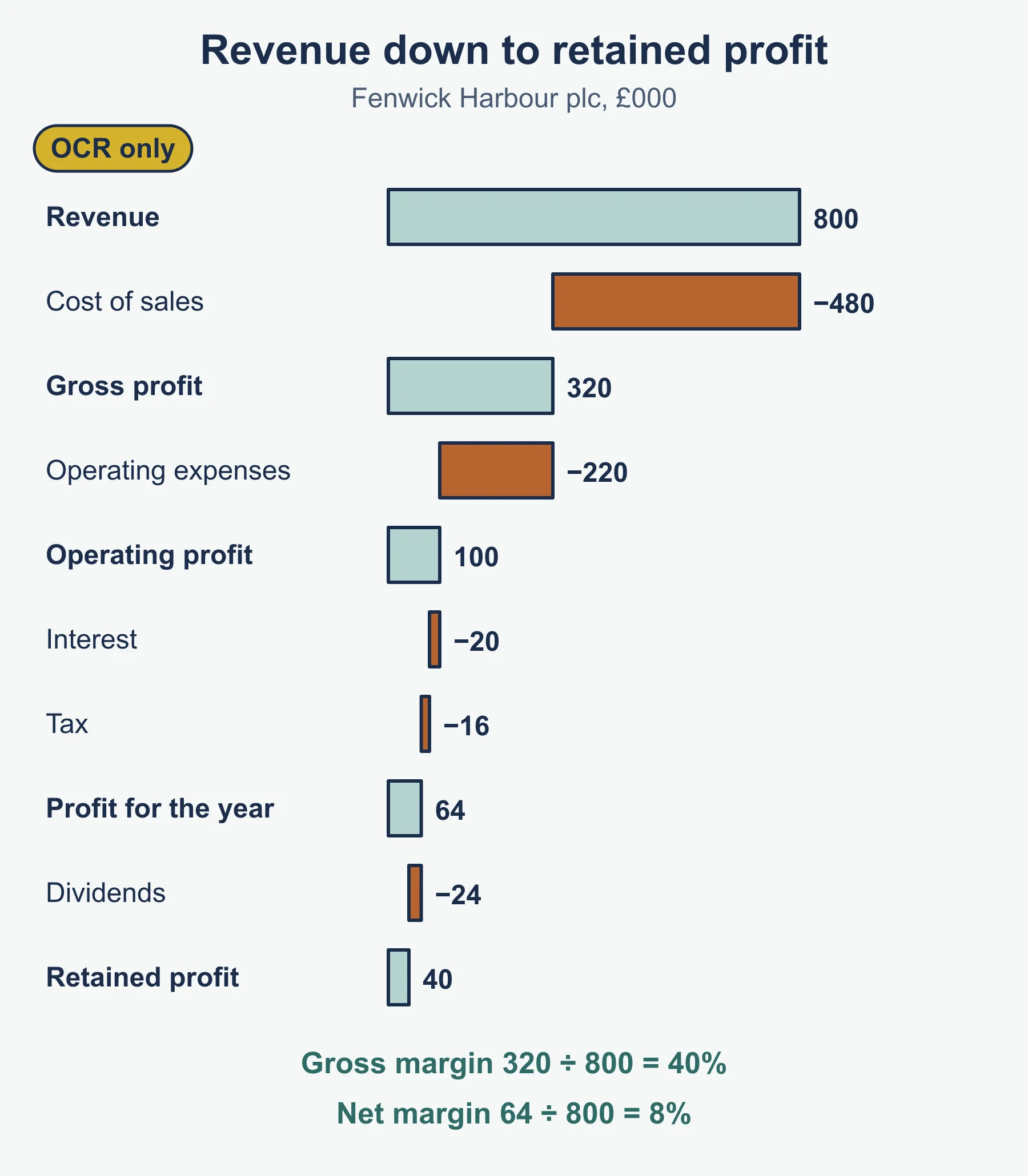
Income statement layout, top to bottom: revenue; less cost of sales gives gross profit; less operating expenses gives operating profit; less interest gives profit before tax (PBT); taking off tax gives profit for the year; taking off dividends gives retained profit.
Statement of financial position layout: start with non-current assets, add current assets (cash, receivables, inventory), deduct current liabilities (payables) to show working capital, deduct non-current liabilities to reach net assets, and match this to equity (share capital plus retained earnings). Net assets always equal total equity.
- Asset valuation: non-current assets at cost less depreciation; inventory at cost or net realisable value, whichever is lower; receivables less bad debts; patents and goodwill intangible and subjective; investments at cost or market value.
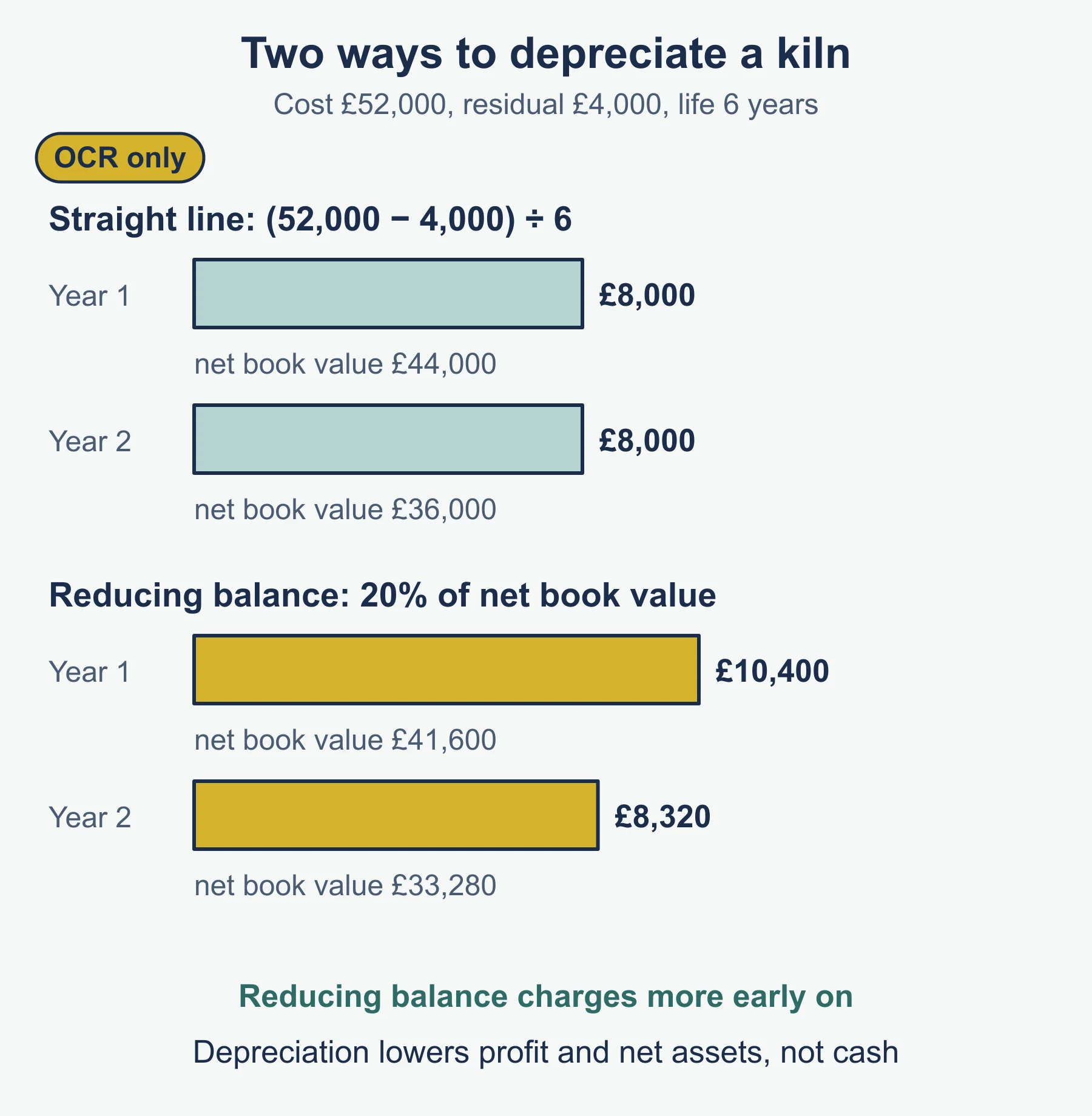
- Depreciation: straight line = (cost - residual value) / life. Reducing balance = fixed percentage of net book value. Provision matches cost to use and avoids overstated profit. It reduces profit and asset value, not cash.
Ratios
| Group | Ratio | Standard form |
|---|---|---|
| Liquidity | Current ratio | current assets over current liabilities |
| Acid test | current assets excluding inventory, over current liabilities | |
| Solvency | Gearing | non-current liabilities / capital employed x 100 |
| Interest cover | operating profit / interest | |
| Efficiency | Debtor turnover | receivables / revenue x 365 |
| Creditor turnover | payables / cost of sales x 365 | |
| Non-current assets turnover | revenue / non-current assets | |
| Stock turnover | cost of sales / inventory | |
| Profitability | Gross profit margin | gross profit over revenue, then x 100 |
| Net profit margin | profit for the year over revenue, then x 100 | |
| ROCE | operating profit / capital employed x 100 | |
| Return on equity | profit for the year / equity x 100 | |
| Shareholder | Dividend per share | dividends / number of shares |
| Dividend yield | dividend per share / share price x 100 | |
| Earnings per share | profit for the year / number of shares | |
| Price/earnings | share price / earnings per share |
Capital employed = equity + non-current liabilities. These are standard forms; use the form your course or the question gives and state it. Evaluate the financial position by comparing with earlier years, competitors and targets, and say which stakeholder cares.
External influences and finance strategy
- Social, legal, ethical, environmental, economic, political, technological, international: for each, name the influence and its effect on finance (for example interest rates change borrowing costs; exchange rates change overseas income).
- Financial strategy: objectives, funding mix, investment, budgets and controls. Recommend with a stated risk and justify against the business’s size, gearing and outlook.
Quick self-test
- Fixed costs £18,000, price £9, variable cost £5: find break-even output.
- Actual output is 8,000 and break-even is 6,000: find the margin of safety as units and as a percentage of output.
- A machine costs £30,000, residual value £3,000, life 5 years. Find the straight line charge.
- Find the first two years’ reducing balance depreciation at 30% on £20,000, and the net book value after year 2.
- Current assets £54,000, inventory £18,000, current liabilities £36,000: find the current ratio and acid test.
- A cost budget of £15,000 has actual cost £16,200. State the variance.
- A £30,000 project returns £12,000 a year. Find payback.
- A £40,000 project returns £56,000 in total over four years. Find ARR.
- Dividend per share is 6p and the share price is £1.50. Find the dividend yield.
- Non-current liabilities are £90,000 and equity £210,000. Find gearing.
- Distinguish cash-flow from profit.
- Define the working capital cycle.
Answers
- 18,000 / 4 = 4,500 units.
- 8,000 - 6,000 = 2,000 units; 2,000 / 8,000 = 25%.
- 27,000 / 5 = £5,400.
- Year 1: 20,000 x 0.30 = £6,000; year 2: 14,000 x 0.30 = £4,200; net book value £9,800.
- 54,000 / 36,000 = 1.5; 36,000 / 36,000 = 1.0.
- £1,200 adverse.
- Cumulative 12,000, 24,000, 36,000, so 2 + 6,000/12,000 = 2.5 years.
- Profit 16,000 over four years is 4,000 a year; 4,000 / 40,000 = 10%.
- 6 / 150 x 100 = 4%.
- 90,000 / (210,000 + 90,000) x 100 = 30%.
- Cash-flow is money actually received and paid; profit is revenue less costs, which includes credit sales and non-cash items, so a profitable business can still run short of cash.
- The time from paying for inventory, through production, sale and the credit period, to receiving cash from customers.
Where marks are usually lost
- Using the wrong base: gearing needs capital employed, not equity alone.
- Quoting a ratio without units (times, days, %) or without interpreting it.
- Treating depreciation as cash leaving the business.
- Labelling variances by arithmetic sign instead of effect on profit.
- Giving break-even in pounds when the question asks for units.
- Listing sources of finance without linking the choice to the business in the case.
- Reaching a recommendation without weighing both sides and the qualitative factors.
- Forgetting to carry closing cash into next month’s opening balance.
Frequently asked questions
Does depreciation reduce a business’s cash? No. Depreciation spreads the cost of a non-current asset over its useful life, lowering reported profit and net assets, but no cash leaves the business when it is charged.
What units should ratio answers have? Give each ratio its unit, such as times, days or %, and interpret what it shows. A ratio quoted without units or interpretation earns less.
How do you calculate break-even output for OCR A Level Business H431? Break-even output = fixed costs ÷ contribution per unit, where contribution per unit = price − variable cost. Give the answer in units when the question asks for units, not in pounds.
What should a sources of finance recommendation include? Link the choice to the business in the case, weigh both sides and include qualitative factors such as loss of control and attitude to risk, not only the cost.
Official syllabus
OCR Level 3 Advanced GCE in Business (H431), Version 2.1 (January 2026), topic 6, Accounting and financial considerations. Published by OCR.
Get free revision emails (optional)
Occasional emails with practice questions, worked explanations and links to free resources for the qualification and subjects you choose. No spam, and you can unsubscribe from any email. The free tools on this site never need an email.
Related resources
-
Study guides
OCR A Level Business: Accounting and financial considerations (H431)
Whole-topic study guide to accounting and financial considerations for OCR A Level Business H431: costs, break-even, budgets, accounts and ratios.
Business · OCR · A Level
Read guide -
Practice questions
OCR A Level Business: Accounting and financial considerations (H431) – Practice Questions
Original practice questions with worked answers on accounting and financial considerations for OCR A Level Business H431, from break-even to ratios.
Business · OCR · A Level
Try questions -
Study guides
OCR A Level Business: Ansoff's matrix and Conflicts in business decision making (H431)
Study guide to Ansoff's matrix and to conflicts between decision making tools for OCR A Level Business, with two fully worked examples.
Business · OCR · A Level
Read guide
Related articles
-
teaching
A Level tuition in Dubai: Cambridge or Pearson Edexcel International A Level?
Schools in Dubai and Abu Dhabi teach either Cambridge International AS & A Level or Pearson Edexcel International A Level. How the two are structured, why it matters for tuition, and how online classes from Lahore work.
9 October 2026
-
curriculum guides
Choosing subjects at IGCSE and A Level
How subject choices at 14 and 16 affect university options later, and how to keep pathways open without overloading a timetable.
28 July 2026
Studying this with a teacher
Working through Business A LEVELS?
This page is free and stays free. If you would rather be taught it, Marlbridge runs Business classes one-to-one, online in your own time zone. One-to-one only for this course: Rs 6,000 per class in Pakistan, with other currencies on the fees page. The first trial class is free. WhatsApp replies within an hour (8am–11pm Pakistan time, every day); email the same day.
OCR Business teachers at Marlbridge
