
Revision Notes
OCR A Level Chemistry A: Acids, 2.1.4 (H432) – Revision Notes
Revision notes for OCR A Level Chemistry A 2.1.4 Acids: formulae, strong and weak acids, neutralisation equations, titration method and a self-test.
- Subject
- Chemistry
- Level
- A LEVELS
- Topic
- Foundations in chemistry
- Author
- Marlbridge Academic Team
- Updated
- Reviewed by
- Nouman Ahmed (what this means)
Aligned to OCR A Level Chemistry (H432), Version 3.1 (May 2026), for first assessment in 2017. Official specification .
Syllabus page (what it covers and how it is assessed): OCR A Level Chemistry.
Syllabus points this page covers
H432
- 2.1.4 Acids
Found an error? Report a correction.
Need help with this topic? Request a free trial class for A Level Chemistry (H432).
For the full explanation, read the 2.1.4 Acids study guide first. These notes are for the final weeks.
They cover section 2.1.4, Acids, of the OCR A Level Chemistry A (H432) specification, Version 3.1 (May 2026), for first assessment in 2017. The section sits in Module 2, Foundations in chemistry, and has five learning outcomes, (a) to (e). The assessment overview says components 01 and 02 both assess Module 2, and component 03 assesses all six modules. H432 is the full A level.
Course hub: OCR A Level chemistry. Progress tracker: printable checklist. Gap finder: free diagnostics. Exam-style practice: 2.1.4 practice questions. The calculations rest on Amount of substance (2.1.3). Later, the quantitative side of weak acids appears in Acids, bases and buffers.
The five outcomes at a glance
| Outcome | What you must be able to do |
|---|---|
| (a) | Give formulae of common acids and alkalis; link acids to H⁺ and alkalis to OH⁻ in aqueous solution |
| (b) | Explain strong and weak acids qualitatively, in terms of relative dissociation |
| (c) | Describe neutralisation as H⁺ + OH⁻ → H₂O, and as acid + base → salt, with full equations |
| (d) | Know the techniques for making a standard solution and carrying out a titration (PAG2) |
| (e) | Do structured and non-structured titration calculations, including unfamiliar acids and bases |
(a) Formulae and ions
| Acid | Formula | Alkali | Formula |
|---|---|---|---|
| Hydrochloric | HCl | Sodium hydroxide | NaOH |
| Sulfuric | H₂SO₄ | Potassium hydroxide | KOH |
| Nitric | HNO₃ | Ammonia (aqueous) | NH₃ |
| Ethanoic | CH₃COOH |
- An acid releases H⁺ ions in aqueous solution.
- An alkali releases OH⁻ ions in aqueous solution.
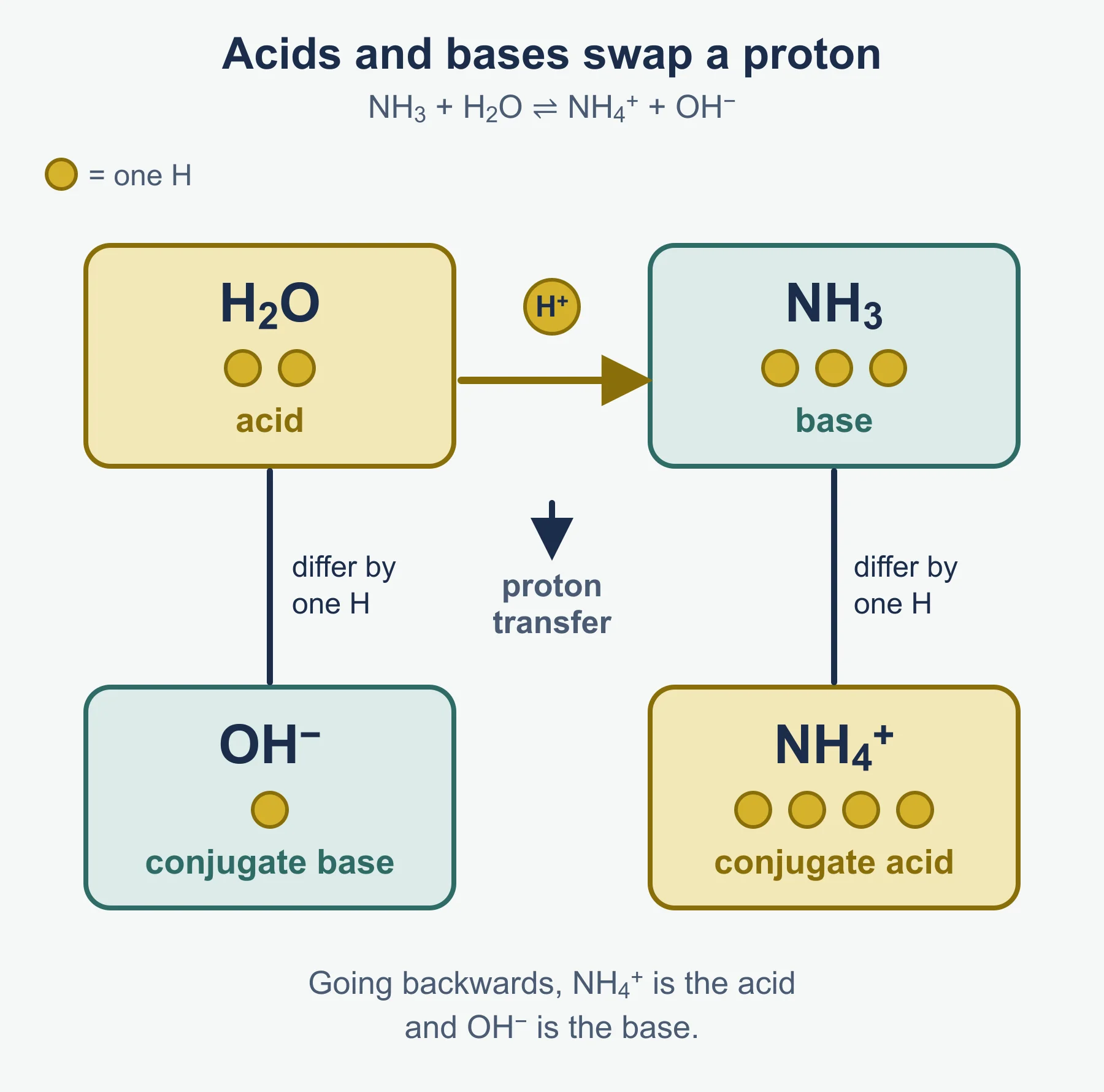
- NaOH and KOH supply OH⁻ directly. Ammonia produces it by reacting with water: NH₃ + H₂O ⇌ NH₄⁺ + OH⁻.
- A base neutralises an acid. An alkali is a base that dissolves in water. Every alkali is a base; CuO and CaCO₃ are bases but not alkalis.
- Salt names follow the acid: hydrochloric gives chlorides, sulfuric gives sulfates, nitric gives nitrates, ethanoic gives ethanoates.
(b) Strong and weak acids
| Strong acid | Weak acid | |
|---|---|---|
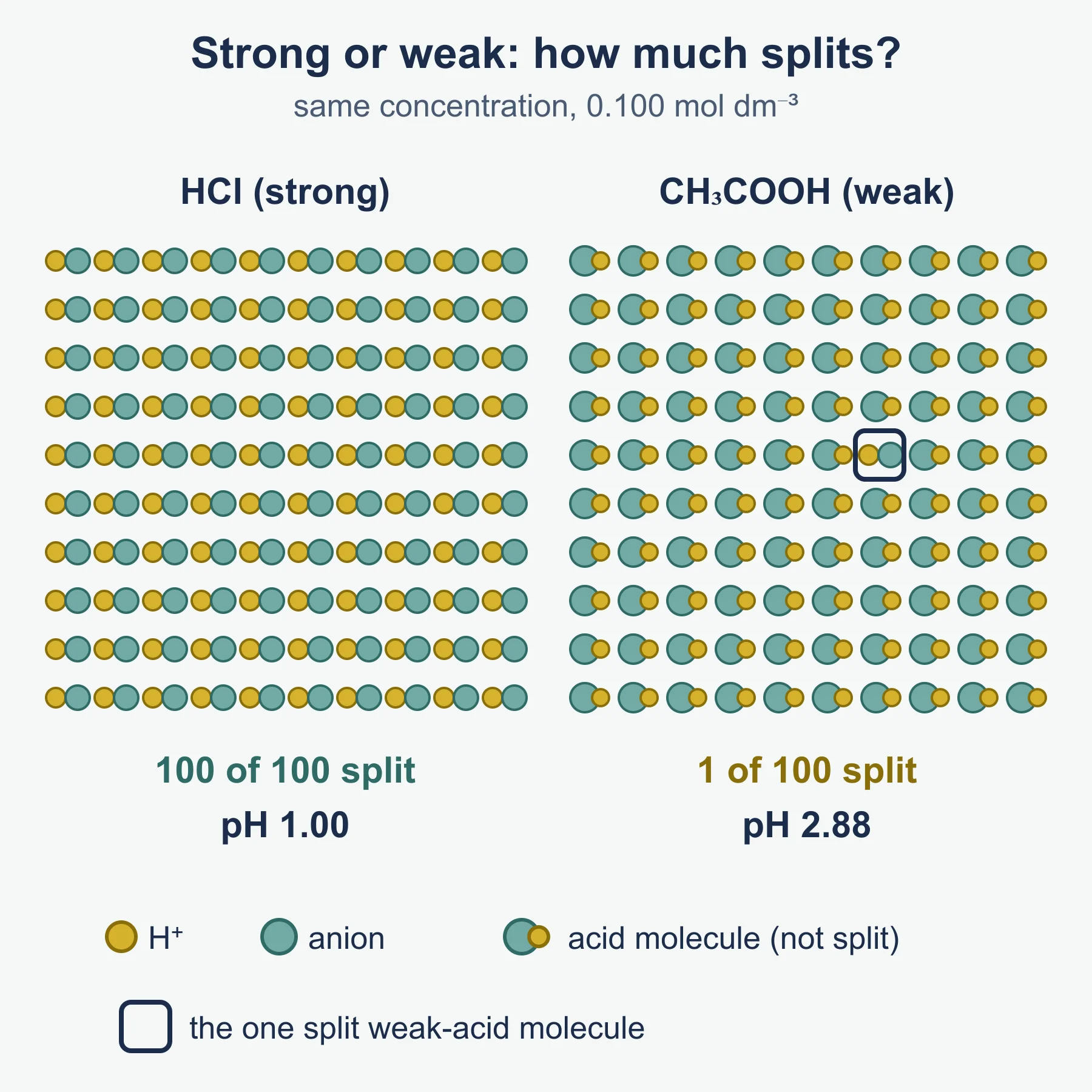
| Dissociation | Almost completely dissociated | Partially dissociated |
| Arrow | → | ⇌ |
| Example | HCl → H⁺ + Cl⁻ | CH₃COOH ⇌ CH₃COO⁻ + H⁺ |
| Mostly present as | Ions | Undissociated molecules |
Strength and concentration are different ideas.
- Strength is the extent of dissociation. It is a property of the acid.
- Concentration is the amount dissolved per dm³. It is a property of the solution.
- A dilute strong acid and a concentrated weak acid can both exist. Do not call the concentrated weak acid “stronger”.
- Equal volumes of equal-concentration HCl and CH₃COOH contain the same amount of acid. They neutralise the same amount of alkali, because the equilibrium in the weak acid shifts to release more H⁺ as H⁺ is used up.
(c) Neutralisation
Ionic equation for any acid with an alkali: H⁺(aq) + OH⁻(aq) → H₂O(l)
| Reactants | Products | Example (full equation) |
|---|---|---|
| Acid + alkali | Salt + water | H₂SO₄ + 2KOH → K₂SO₄ + 2H₂O |
| Acid + metal oxide | Salt + water | MgO + 2HNO₃ → Mg(NO₃)₂ + H₂O |
| Acid + carbonate | Salt + water + carbon dioxide | Na₂CO₃ + H₂SO₄ → Na₂SO₄ + H₂O + CO₂ |
| Acid + ammonia | Ammonium salt only | NH₃ + HCl → NH₄Cl |
Method in steps for a full equation:
- Name the salt: metal (or NH₄⁺) from the base, anion from the acid.
- Write the salt formula so the charges balance, for example Mg²⁺ with NO₃⁻ gives Mg(NO₃)₂.
- Add the other products: H₂O for oxides and alkalis, H₂O and CO₂ for carbonates.
- Balance, then add state symbols if asked.
Ammonia has no water product because it adds H⁺ to form NH₄⁺ rather than removing it as H₂O.
(d) Techniques
Making a standard solution
A standard solution has an accurately known concentration. Worked reminder: 250.0 cm³ of 0.0500 mol dm⁻³ sodium carbonate, Na₂CO₃ (M = 106.0 g mol⁻¹).
n = 0.2500 dm³ × 0.0500 mol dm⁻³ = 0.01250 mol
m = 0.01250 mol × 106.0 g mol⁻¹ = 1.325 g- Weigh the solid by difference, using a weighing bottle or boat on a balance.
- Tip it into a beaker and add distilled water, stirring until it dissolves.
- Transfer to a volumetric flask through a funnel. Wash the beaker and funnel into the flask with distilled water.
- Fill until the bottom of the meniscus touches the mark.
- Stopper and invert several times to mix.
Titration
- Rinse the burette with the solution it will hold, then fill it, including below the tap. Remove the funnel.
- Measure the aliquot (for example 25.0 cm³) with a pipette into a conical flask. Add a few drops of indicator.
- Do a rough titration first, then repeat with dropwise addition near the end point.
- Read the burette at the bottom of the meniscus, at eye level.
- Repeat until titres agree closely (concordant). Average only those.
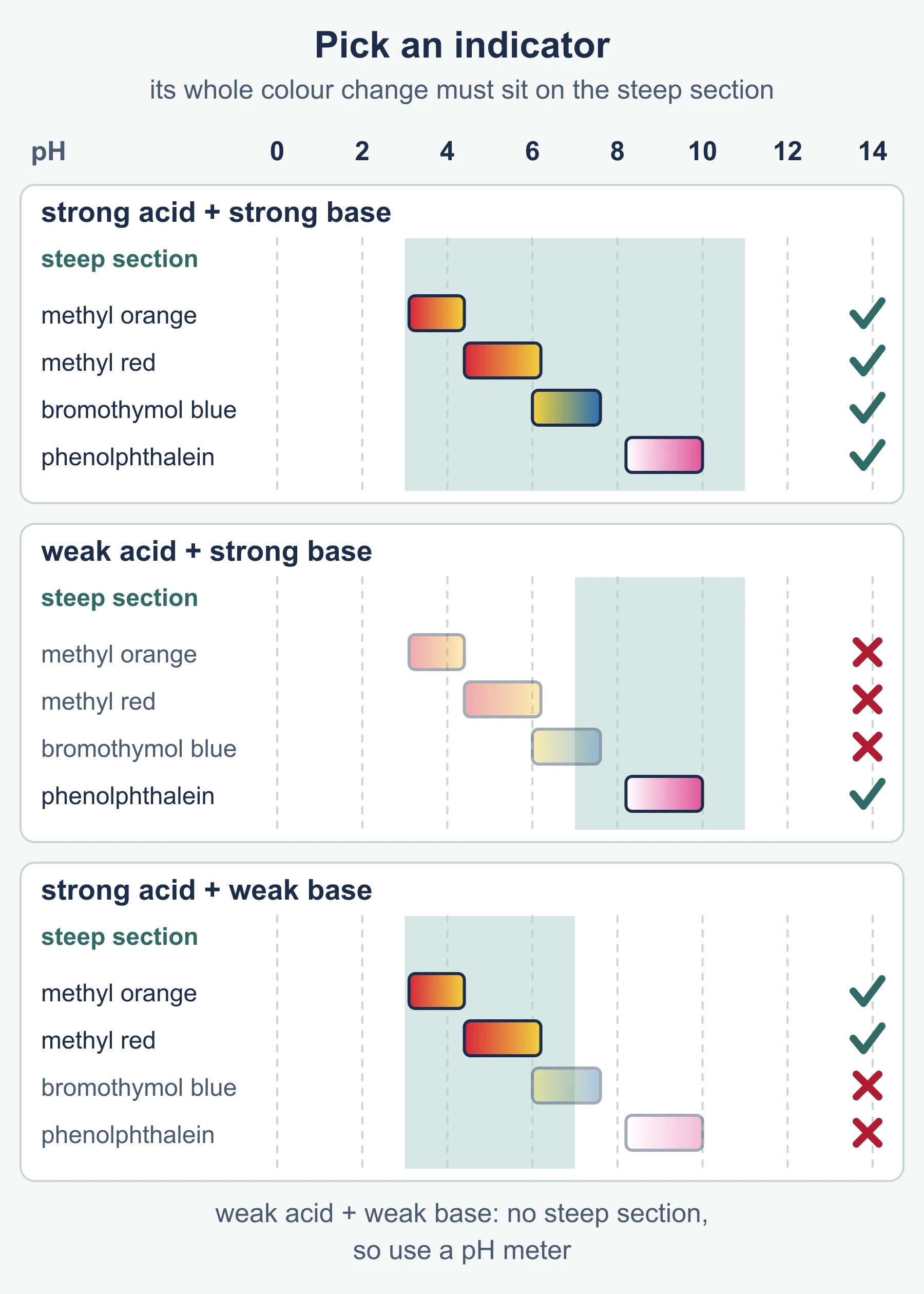
Indicator colours: methyl orange is red in acid and yellow in alkali. Phenolphthalein is colourless in acid and pink in alkali.
(e) Calculations
Method in steps:
- Write the balanced equation.
- Moles of the known solution = concentration × volume (dm³).
- Use the equation ratio to find moles of the unknown.
- Divide by its volume (dm³) for concentration. Multiply by M for g dm⁻³.
- If the sample was diluted or made up to a larger volume, scale up at the end.
Common ratios:
| Reaction | Ratio |
|---|---|
| HCl or HNO₃ with NaOH or KOH | 1 : 1 |
| H₂SO₄ with NaOH or KOH | 1 : 2 |
| 2HCl with Ca(OH)₂ | 2 : 1 |
| H₂SO₄ with NH₃ | 1 : 2 |
| 2HCl with Na₂CO₃ | 2 : 1 |
Worked reminder: an alkali that releases two OH⁻
Ca(OH)₂ + 2HNO₃ → Ca(NO₃)₂ + 2H₂O. A 25.0 cm³ sample of limewater is titrated with 0.0500 mol dm⁻³ HNO₃. Titres: 19.10 (rough), 18.45, 18.35 and 18.40 cm³.
mean of concordant titres = (18.45 + 18.35 + 18.40) / 3 = 18.40 cm³
n(HNO₃) = 0.01840 dm³ × 0.0500 = 9.20 × 10⁻⁴ mol
n(Ca(OH)₂) = 9.20 × 10⁻⁴ / 2 = 4.60 × 10⁻⁴ mol
c = 4.60 × 10⁻⁴ / 0.0250 dm³ = 0.0184 mol dm⁻³
g dm⁻³ = 0.0184 × 74.1 = 1.36 g dm⁻³
Back titration (non-structured style)
Use it when a base is insoluble or reacts slowly.
- Add a known excess of acid to the sample.
- Titrate the leftover acid with standard alkali.
- Moles reacted with the sample = moles added minus moles left over.
- Convert to the sample using the equation ratio.
Unfamiliar acids and bases
You will not be given the method. Write the equation from the information in the question: a dibasic acid H₂X releases two H⁺, so it reacts 1 : 2 with NaOH. Treat it like any other ratio.
Must-know distinctions
- Base and alkali: all alkalis are bases, not all bases are alkalis.
- Strong and concentrated: strength is extent of dissociation; concentration is amount per dm³.
- Rough and accurate titres: the rough titre guides you but is not averaged.
- Moles of acid and moles of H⁺: H₂SO₄ gives up to two H⁺ per molecule, so the ratio changes.
Quick self-test
- Give the formula of nitric acid and the ion that makes it an acid in water.
- Why is aqueous ammonia classed as an alkali?
- In one sentence, what makes an acid weak?
- Write the full equation for magnesium oxide with nitric acid.
- Write the full equation for sodium carbonate with sulfuric acid.
- Write the equation for ammonia with hydrochloric acid and name the product.
- What mass of Na₂CO₃ (M = 106.0) is needed for 500.0 cm³ of 0.0200 mol dm⁻³ solution?
- What volume of 0.125 mol dm⁻³ H₂SO₄ neutralises 20.0 cm³ of 0.250 mol dm⁻³ KOH?
- Titres of 13.10 (rough), 12.20 and 12.30 cm³ are recorded. What is the mean titre to use?
- What volume of 0.0500 mol dm⁻³ HCl neutralises 25.0 cm³ of 0.0300 mol dm⁻³ Ba(OH)₂?
- A student says a 0.001 mol dm⁻³ solution of HCl is a weaker acid than 1 mol dm⁻³ ethanoic acid. Is the wording correct?
Answers
- HNO₃; it releases H⁺.
- It produces OH⁻ by reacting with water: NH₃ + H₂O ⇌ NH₄⁺ + OH⁻.
- It is only partially dissociated in aqueous solution.
- MgO + 2HNO₃ → Mg(NO₃)₂ + H₂O
- Na₂CO₃ + H₂SO₄ → Na₂SO₄ + H₂O + CO₂
- NH₃ + HCl → NH₄Cl; ammonium chloride.
- n = 0.5000 × 0.0200 = 0.0100 mol; m = 0.0100 × 106.0 = 1.06 g.
- n(KOH) = 0.0200 × 0.250 = 5.00 × 10⁻³ mol; n(H₂SO₄) = 2.50 × 10⁻³ mol; V = 2.50 × 10⁻³ / 0.125 = 0.0200 dm³ = 20.0 cm³.
- Mean of 12.20 and 12.30 = 12.25 cm³; the rough titre is excluded.
- n(OH⁻) = 2 × 0.0300 × 0.0250 = 1.50 × 10⁻³ mol; n(HCl) is the same; V = 1.50 × 10⁻³ / 0.0500 = 0.0300 dm³ = 30.0 cm³.
- No. HCl is a strong acid; the solution is dilute. Strength is about dissociation, and the comparison should be of concentration.
Where marks are usually lost
- Writing “weak acid = low pH” or “less acidic” instead of “partially dissociated”.
- Writing a single arrow for a weak acid, or an equilibrium arrow for HCl.
- Omitting CO₂ or H₂O from a carbonate equation, or writing H₂O as a product of ammonia with an acid.
- Forgetting that H₂SO₄ reacts 1 : 2 with a monohydroxide, so the answer is out by a factor of two.
- Averaging the rough titre, or titres that do not agree closely.
- Using cm³ in n = c × V without dividing by 1000.
- Describing a standard solution made by adding water to a measuring cylinder or by filling to the mark in the beaker.
- Calling every base an alkali.
- Forgetting to scale up when only an aliquot of a made-up solution was titrated.
Frequently asked questions
What is the difference between a base and an alkali in OCR A Level Chemistry? A base neutralises an acid, and an alkali is a base that dissolves in water to release OH⁻ ions. Every alkali is a base, but copper(II) oxide and calcium carbonate are bases that are not alkalis.
What is the difference between a strong acid and a concentrated acid? Strength is the extent of dissociation and is a property of the acid. Concentration is the amount dissolved per dm³ and is a property of the solution.
Do HCl and CH₃COOH of the same concentration neutralise the same amount of alkali? Yes. Equal volumes of equal-concentration HCl and CH₃COOH contain the same amount of acid, so they neutralise the same amount of alkali even though their strengths differ.
What ratio does sulfuric acid react in with sodium hydroxide? H₂SO₄ reacts 1 : 2 with a monohydroxide such as NaOH, because it gives up to two H⁺ ions per molecule. Missing this puts the answer out by a factor of two.
Official syllabus
OCR A Level Chemistry A (H432) specification, Version 3.1 (May 2026), for first assessment in 2017, section 2.1.4 Acids, learning outcomes (a) to (e), with additional guidance PAG2 and HSW4. Published by OCR.
Get free revision emails (optional)
Occasional emails with practice questions, worked explanations and links to free resources for the qualification and subjects you choose. No spam, and you can unsubscribe from any email. The free tools on this site never need an email.
Related resources
-
Exam preparation
OCR A Level Chemistry A: Mapping Modules to Papers 1, 2 and 3
How OCR A Level Chemistry A H432 Papers 1, 2 and 3 divide the modules, why Paper 3 is synoptic, the Practical Endorsement and a multi-step calculation routine.
Chemistry · OCR · A Level
Read guide -
Study guides
Amount of Substance: The Mole, Empirical Formulae and Gas Calculations
OCR A Level Chemistry A H432 2.1.3 guide: the mole, empirical and molecular formulae, hydrated salts, gas volumes, pV = nRT, percentage yield and atom economy.
Chemistry · OCR · A Level
Read guide -
Practice questions
OCR A Level Chemistry: Amount of Substance — Practice Questions
Original exam-style practice questions with full worked answers on moles, the ideal gas equation, titrations and percentage yield for OCR A Level Chemistry.
Chemistry · OCR · A Level
Try questions
Related articles
-
study skills
How to revise for a science examination
Most science revision fails because it rereads notes instead of retrieving them. A practical method for revising physics, chemistry and biology in the weeks before a paper.
14 July 2026
-
teaching
A Level tuition in Dubai: Cambridge or Pearson Edexcel International A Level?
Schools in Dubai and Abu Dhabi teach either Cambridge International AS & A Level or Pearson Edexcel International A Level. How the two are structured, why it matters for tuition, and how online classes from Lahore work.
9 October 2026
Studying this with a teacher
Working through Chemistry A LEVELS?
This page is free and stays free. If you would rather be taught it, Marlbridge runs Chemistry classes one-to-one, online in your own time zone. One-to-one only for this course: Rs 6,000 per class in Pakistan, with other currencies on the fees page. The first trial class is free. WhatsApp replies within an hour (8am–11pm Pakistan time, every day); email the same day.
OCR Chemistry teachers at Marlbridge

