
Revision Notes
OCR GCSE Business: People (J204) – Revision Notes
Condensed recall notes for section 3 People in OCR GCSE Business J204: structures, communication, recruitment, motivation, training and law.
- Subject
- Business
- Level
- GCSE
- Topic
- Business activity, marketing and people
- Author
- Marlbridge Academic Team
- Updated
- Reviewed by
- Salman Ahmad (what this means)
Aligned to OCR GCSE Business (J204), Version 2.0 (January 2026), for first assessment in 2019. Official specification .
Syllabus page (what it covers and how it is assessed): OCR GCSE Business.
Syllabus points this page covers
J204
- 3 People
Found an error? Report a correction.
Need help with this topic? Request a free trial class for GCSE Business (J204).
These are condensed notes for section 3 People (3.1 to 3.7) of the OCR GCSE (9-1) Business J204 specification, Version 2.0 (January 2026), part of Business 1: business activity, marketing and people (J204/01). For full explanations read the People study guide, then try the People practice questions.
Other pages: OCR GCSE Business hub, printable checklist, free diagnostics, the topic-level revision notes and the topic-level study guide.
3.1 Role of human resources
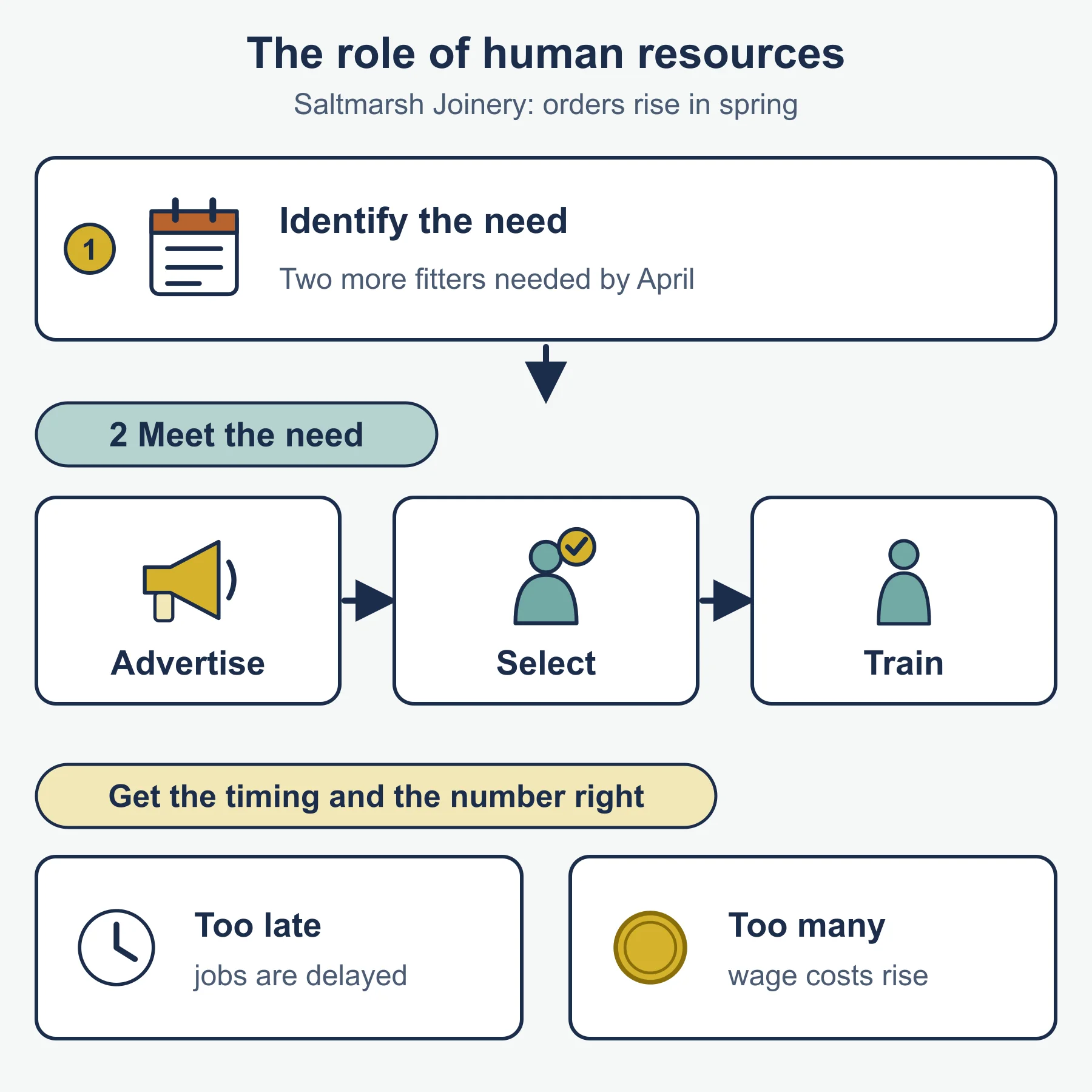
Purpose: identify and meet the human resource needs of a business.
- Identify: how many staff, which skills, when.
- Meet: recruit, select, motivate, train and keep them.
- Example: Birchwood Bikes, an invented repair shop, expects a busy summer. It must spot the need for a second mechanic in May, not in July.
3.2 Structures and ways of working
Terms (general meanings; the specification lists the terms without definitions)
| Term | Short definition |
|---|---|
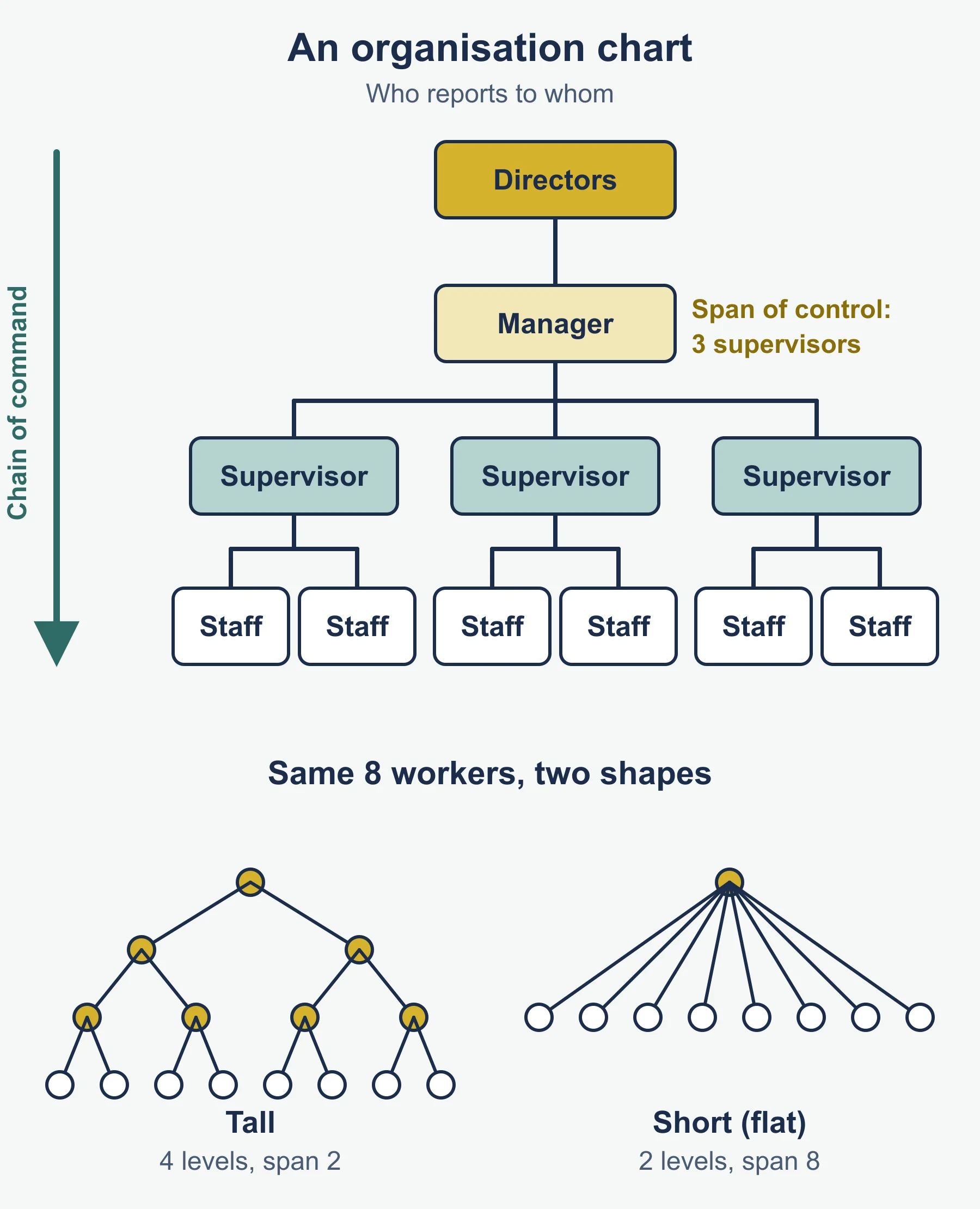
| Chain of command | Route that authority and instructions follow down the levels |
| Span of control | How many subordinates one manager directly supervises |
| Subordinates | Staff a manager is in charge of |
| Authority | Power to make decisions and give instructions |
| Delegation | Passing a task and the authority for it down the structure |
Tall v flat
| Tall | Flat | |
|---|---|---|
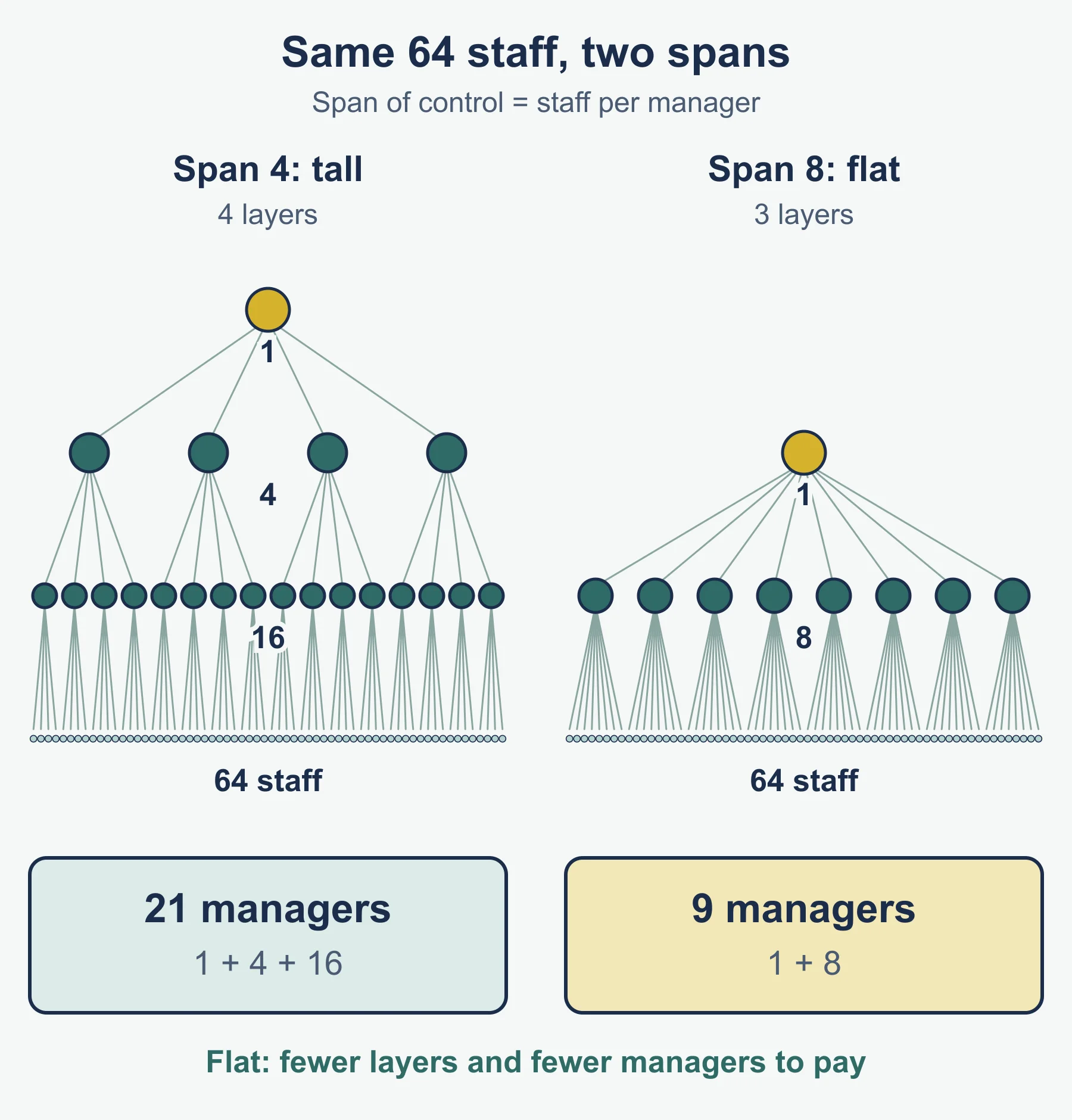
| Layers | Many | Few |
| Span | Narrow | Wide |
| Communication | Slower, risk of distortion | Faster |
| Promotion | Many steps | Few steps |
| Delegation | Less | More |
A quick check: with a span of 5 and 125 staff at the bottom, the layers are 1, 5, 25, 125. That is four layers. Five managers each supervising 25 staff would give 1, 5, 125, only three.
Why structures differ
- Business size, type of work, skills of staff and how much control the owner wants.
- Effective communication: instructions and information must reach the right people quickly.
- Different job roles and responsibilities need to be clear.
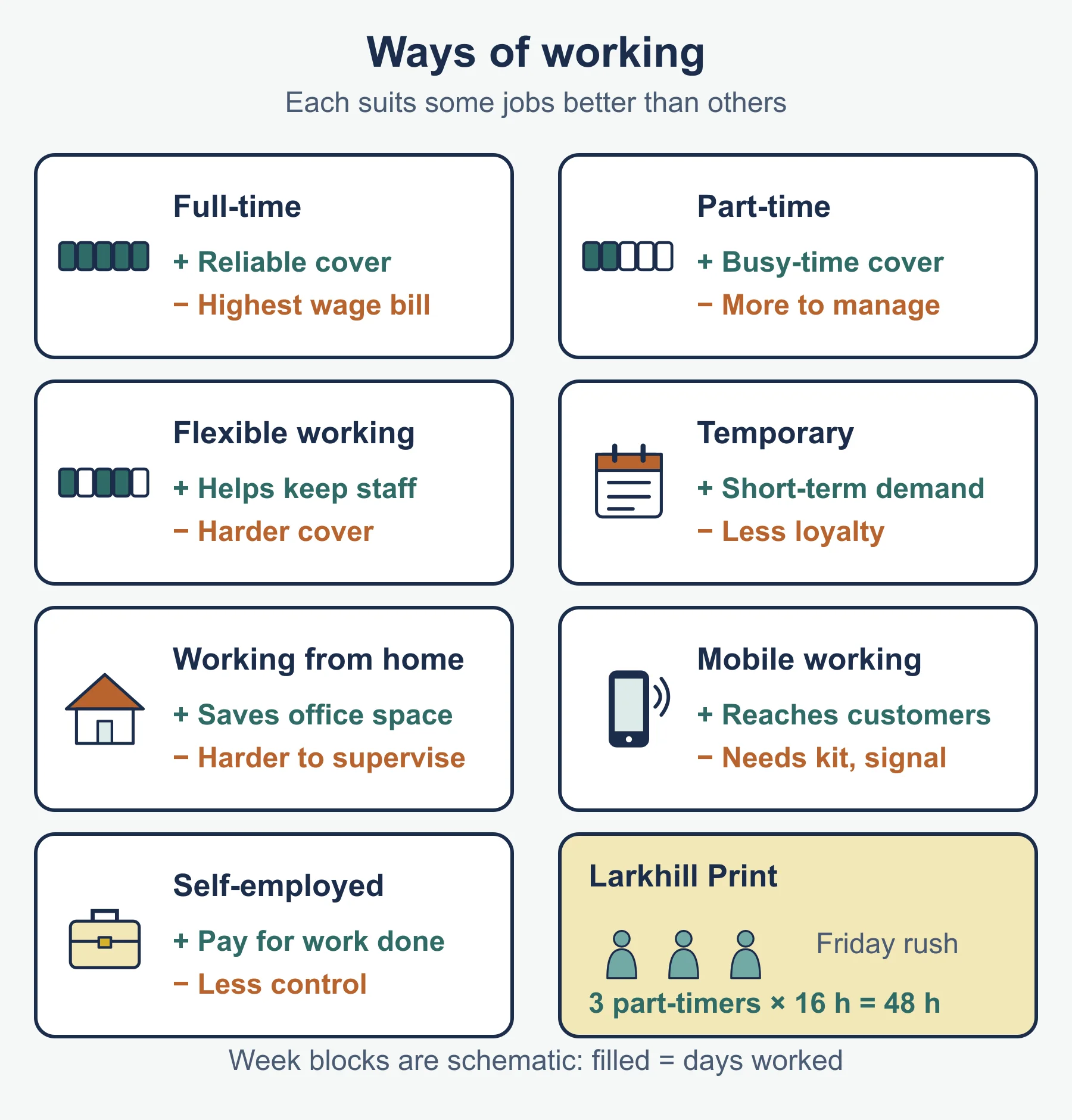
Ways of working
| Way (general meanings) | One-line meaning | Key plus | Key minus |
|---|---|---|---|
| Full-time | Normal full week | Reliable cover | Highest cost |
| Part-time | Fewer hours | Matches busy times | More people to manage |
| Flexible working | Hours agreed to suit both | Attracts and keeps staff | Rota harder |
| Temporary | Fixed period | Short-term demand | Less loyalty |
| Working from home | Job done at home | Less office space | Harder supervision |
| Working whilst mobile | Working on the move | Reaches customers | Needs equipment and signal |
| Self-employed | Runs own business | Pay for work done only | Less control |
3.3 Communication
Methods: letter, email, text, phone, meeting/presentation, social media, website.
| Choose… | When |
|---|---|
| Letter | Formal record needed |
| Detail plus a written record | |
| Text | Short and urgent |
| Phone | Quick two-way answer |
| Meeting/presentation | Discussion with a group |
| Social media | Public, fast customer contact |
| Website | Information open at all hours |
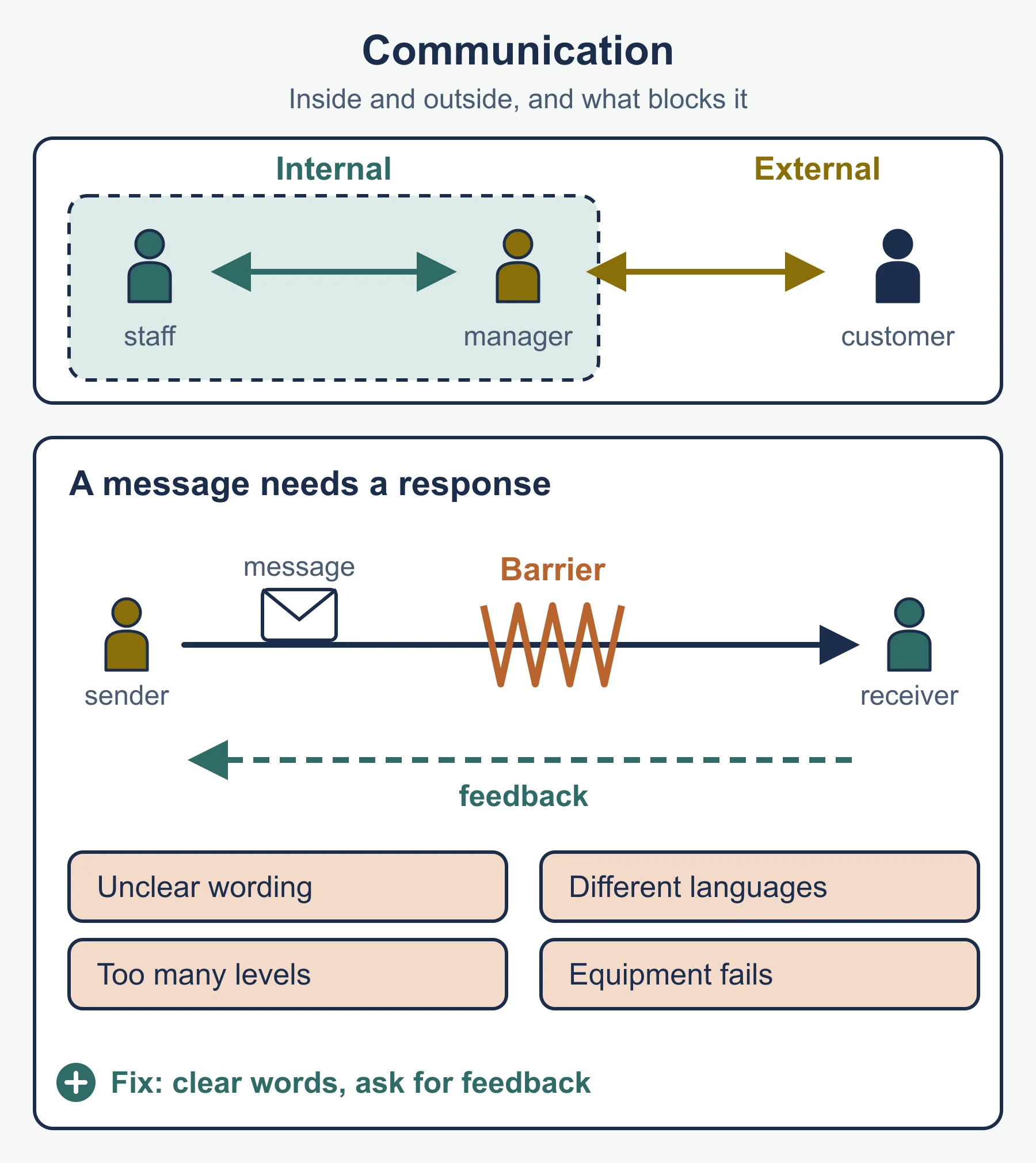
Importance: staff know what to do; fewer errors; better decisions; customers served well.
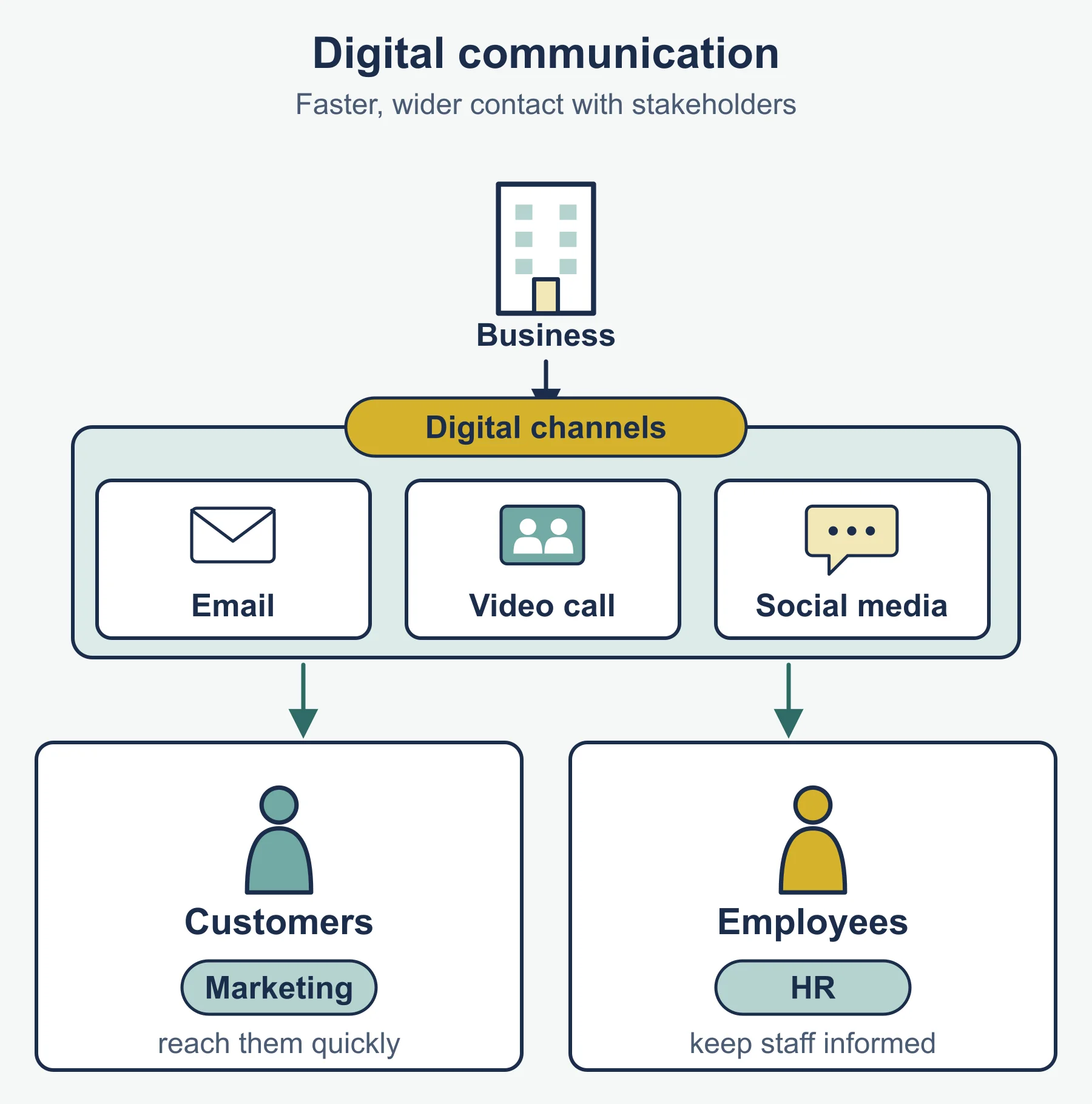
Digital influence: faster messages, remote working, cheap reach to wide markets, instant customer feedback. Risks: information overload, data security, equipment costs and training.
3.4 Recruitment and selection
Why recruit: replace employees who leave, business growth, skill gaps.
| Internal | External |
|---|---|
| Promotion or move of existing staff | Adverts, job websites, agencies |
| Cheaper, quicker, known candidate | Wider choice, new ideas |
| Narrow choice, leaves a vacancy | Slower, dearer, unknown candidate |
- Job description: what the job involves.
- Person specification: what the candidate needs to be like.
Selection methods: CV, application form, letter of application, interviews, tests, group activities, references.
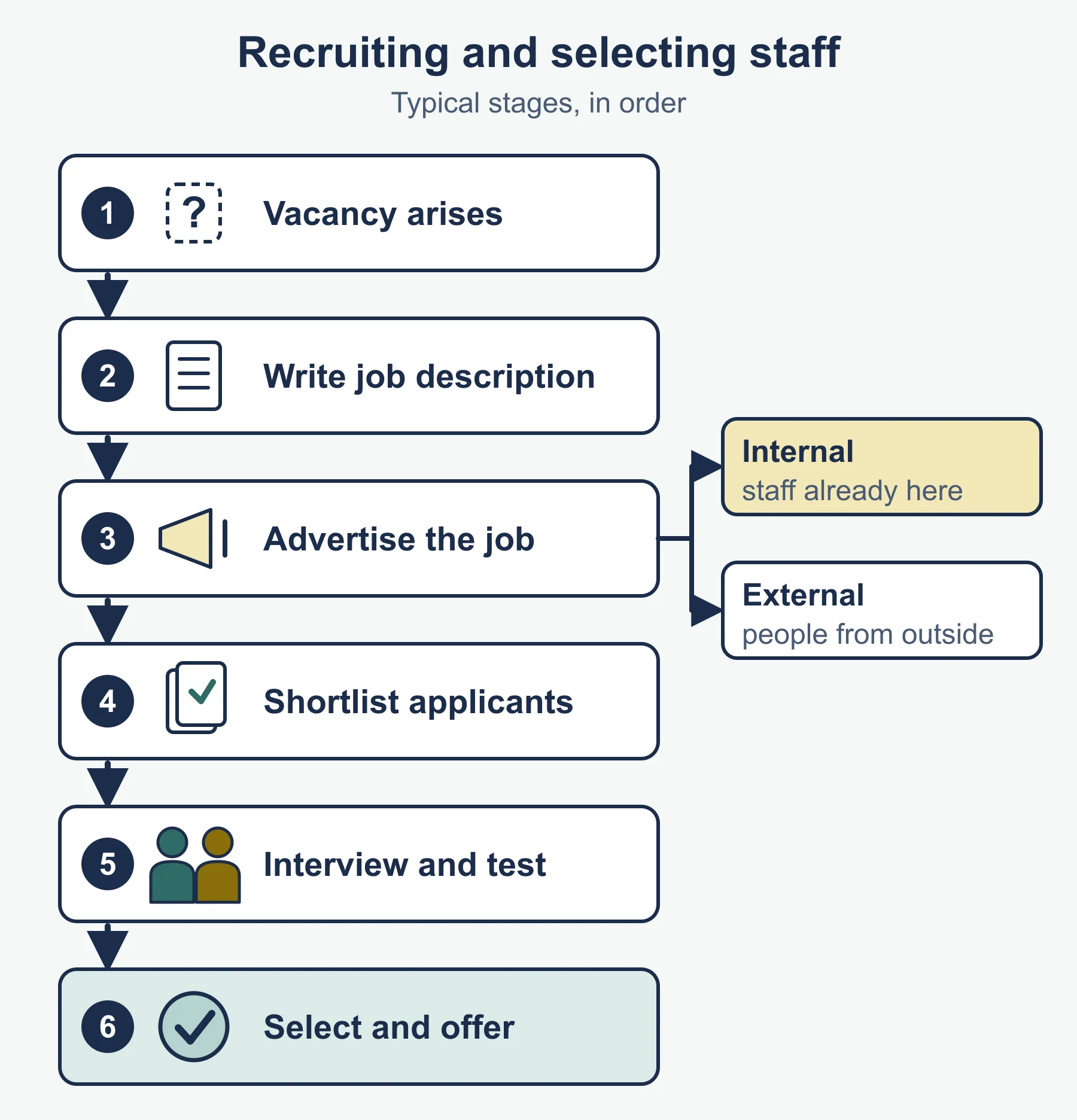
Method in steps:
- Spot the vacancy and its reason.
- Write the job description and person specification.
- Choose internal or external methods.
- Shortlist from CVs, forms or letters.
- Select using interviews, tests, group activities and references.
Matching method to need: a rare skill points to external recruitment and a test; a team leader post points to internal promotion and an interview.
3.5 Motivation and retention
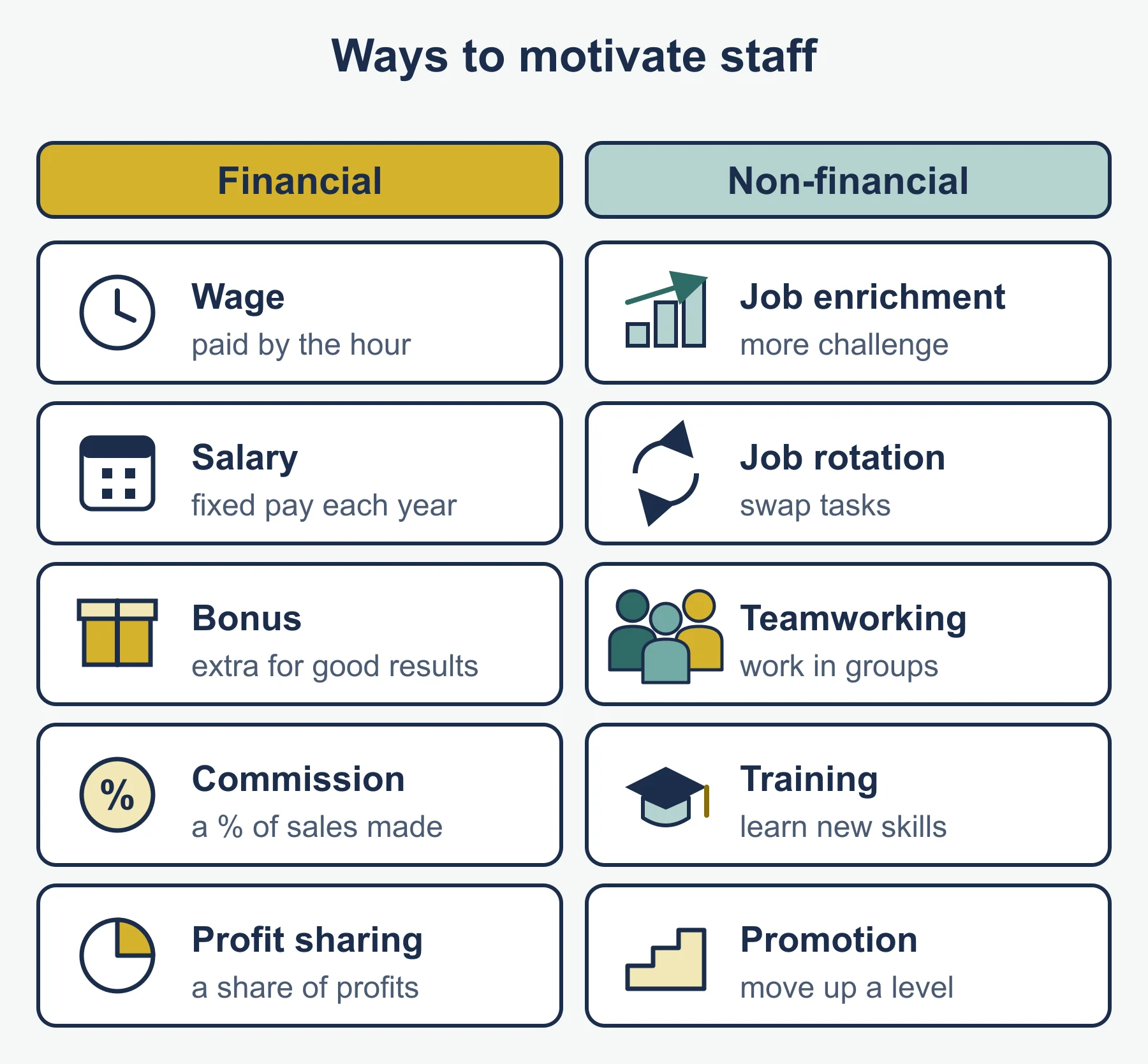
| Financial | Non-financial |
|---|---|
| Pay | Praise |
| Bonuses | Award schemes |
| Profit sharing | Working environment |
| Fringe benefits |
Small calculations to practise:
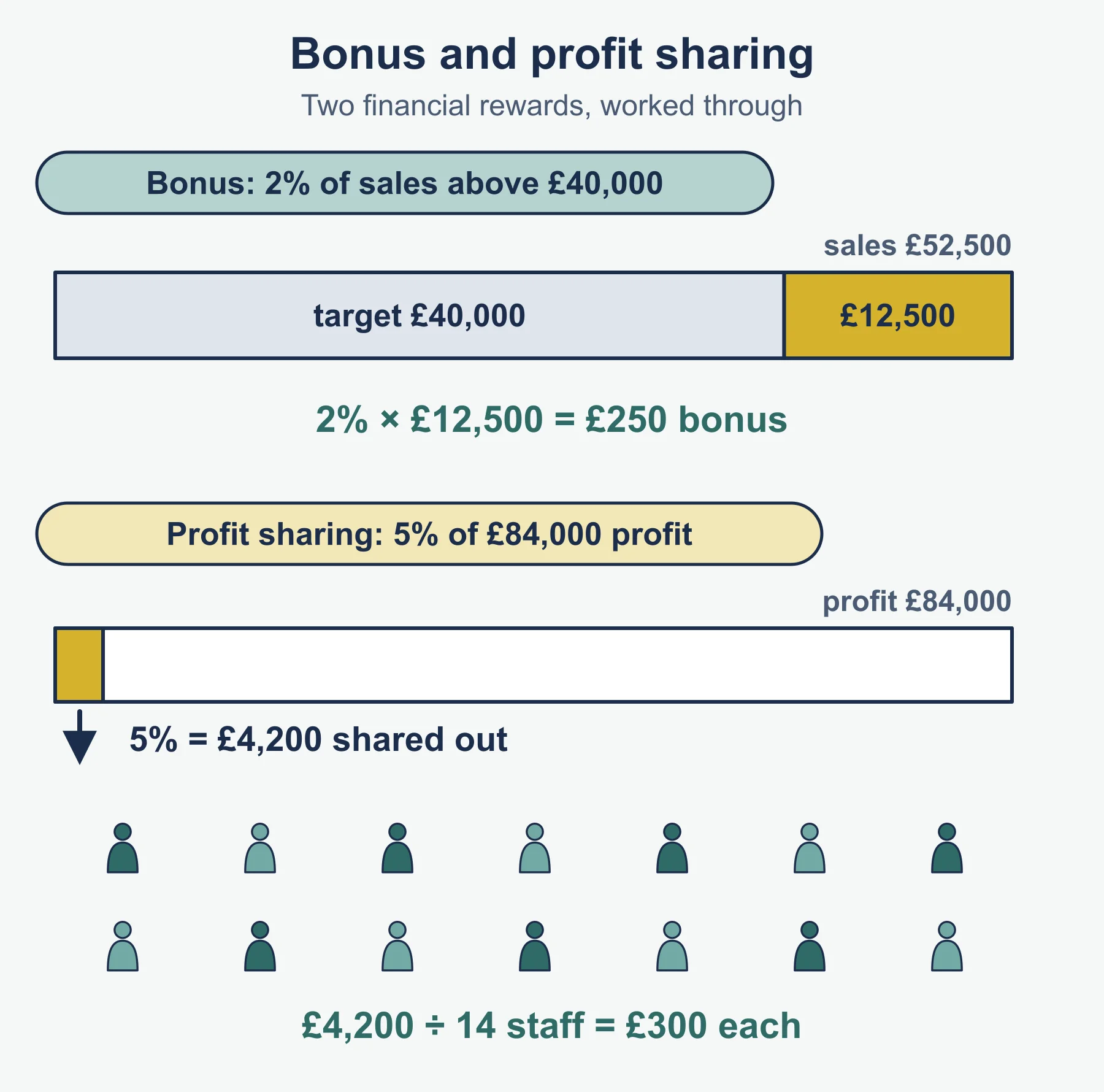
- Bonus: 3% of sales above £30,000, with sales of £44,000, is 3% of £14,000 = £420.
- Profit sharing: 5% of £90,000 profit is £4,500; split between 12 staff, £375 each.
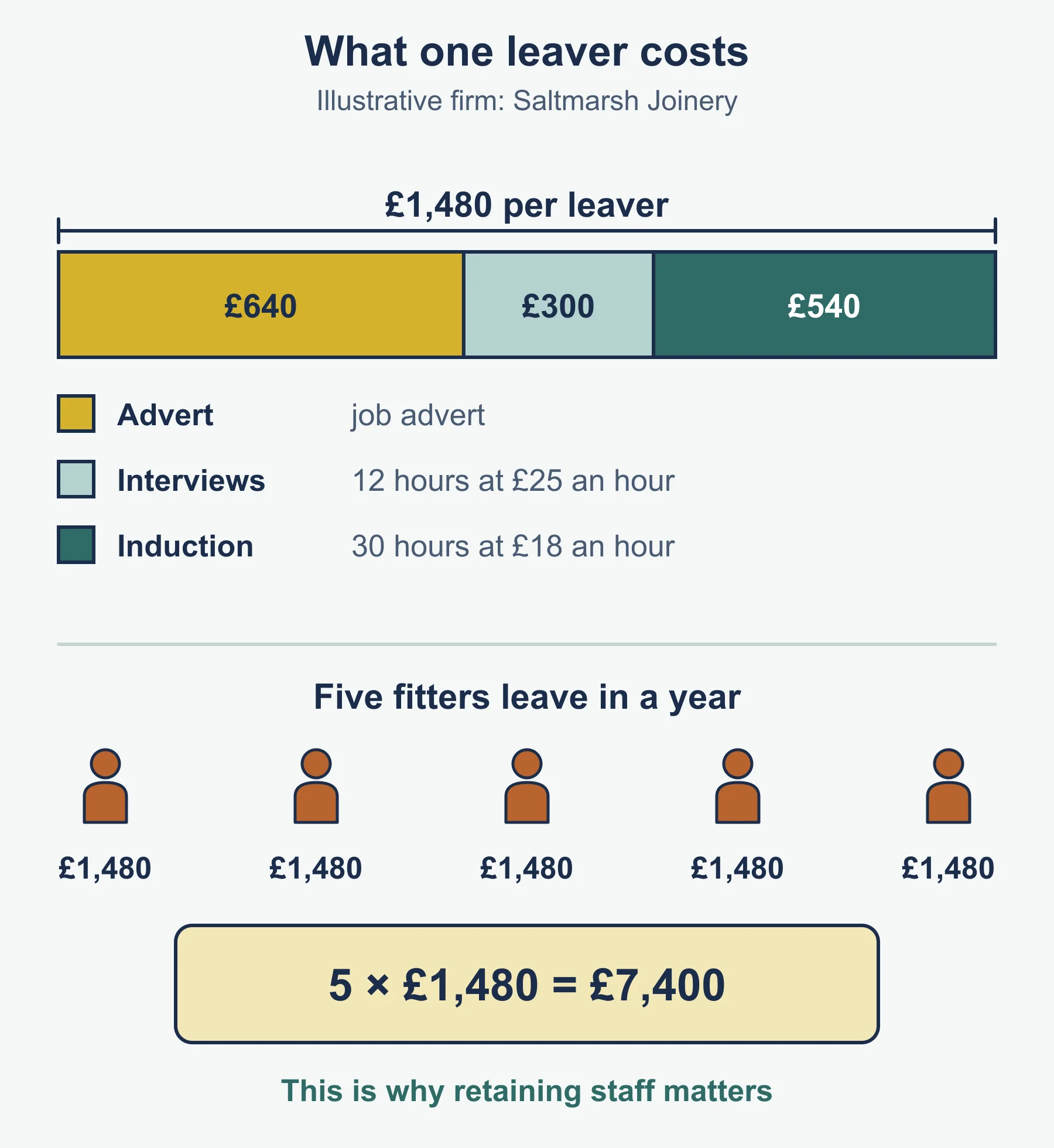
- Leavers: 3 leavers at £1,200 each to replace costs £3,600.
Why motivation matters: better performance and helps retention. Why retention matters: staff already know the business and customers, and the business saves the time and expense of recruitment.
3.6 Training and development
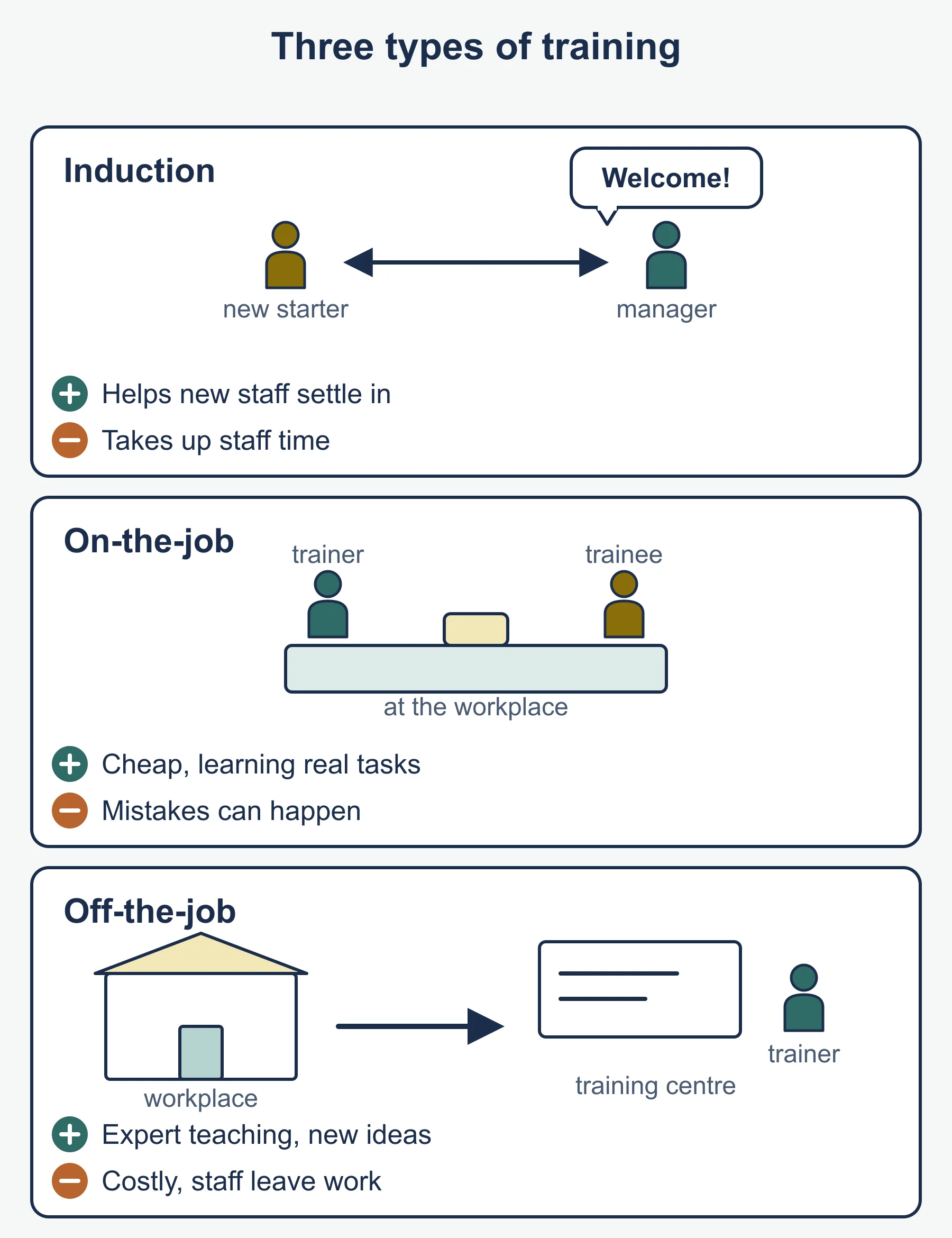
| Method | Meaning | Plus | Minus |
|---|---|---|---|
| Induction | Introduction to the business | Quick settling in | Takes time |
| On-the-job | Learn while working | Cheap, relevant | Slower output, bad habits |
| Off-the-job | Learn away from work | Specialist | Costly, time away |
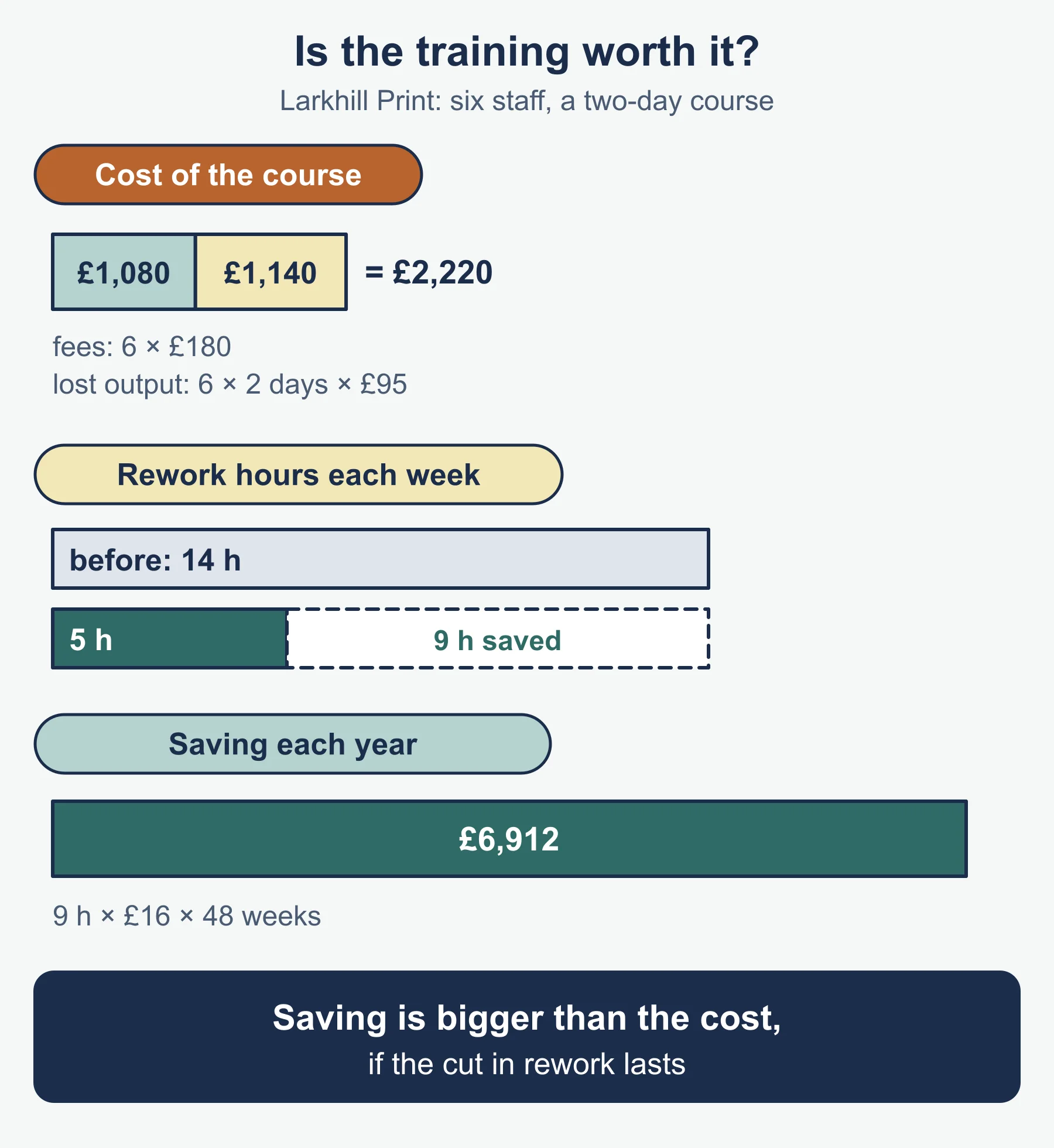
Why train: development of the business, productivity, skill shortages, customer service, motivation and retention.
Staff development: vocational and academic qualifications, apprenticeships.
| Benefits to employees | Benefits to businesses |
|---|---|
| New skills and qualifications | More skilled workforce |
| Promotion chances | Easier to fill senior roles |
| Confidence | Higher motivation and retention |
3.7 Employment law
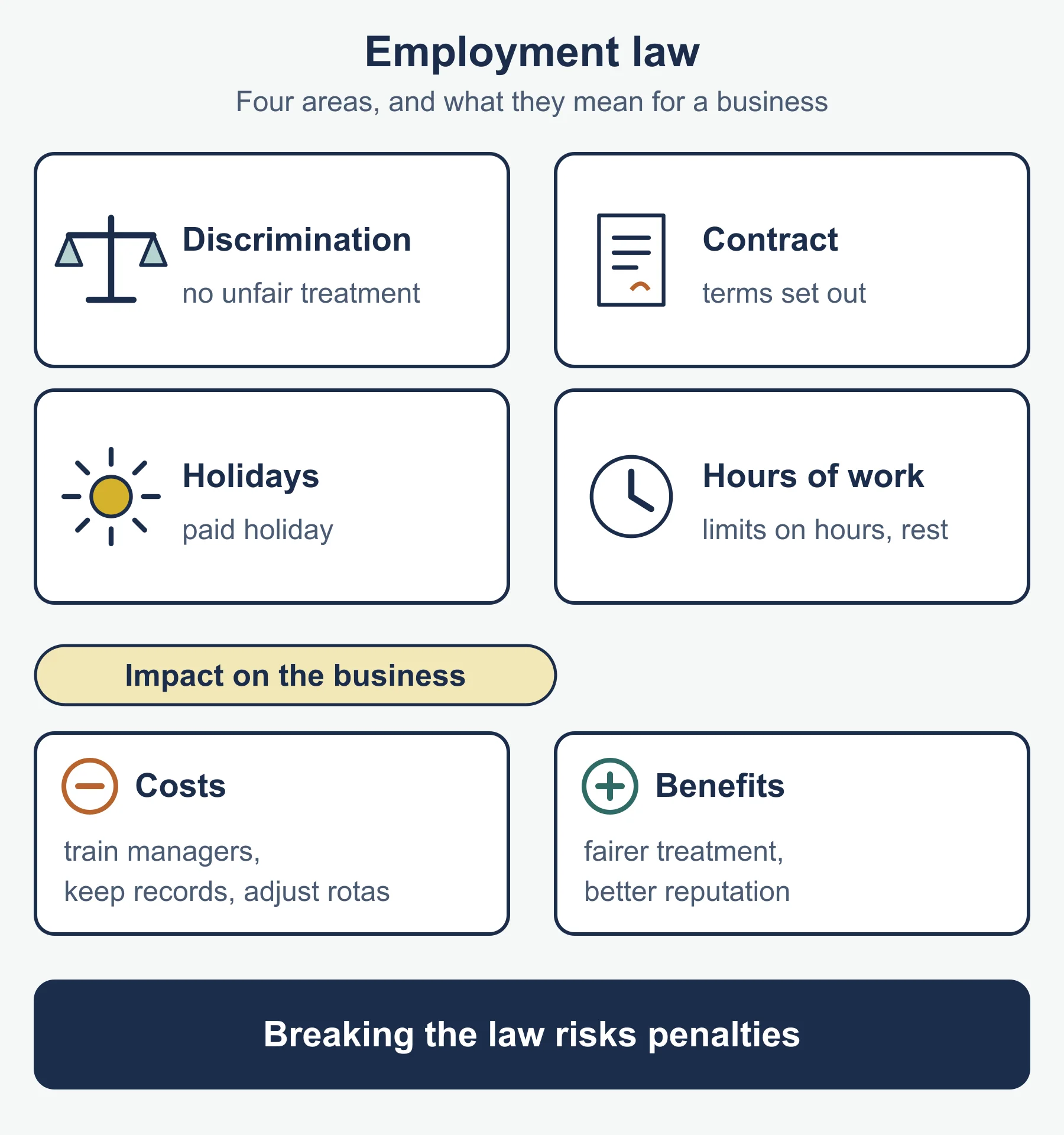
The specification names the four areas below but no Acts or details, so this table is general wording. Describe how current legislation affects recruitment and employment in general terms.
| Area | Impact in general terms |
|---|---|
| Discrimination | Fair treatment in recruitment and at work; decisions on ability to do the job |
| Right to a contract | Terms of employment must be set out |
| Holidays | Paid holiday to plan for |
| Hours of work | Rules on hours limit what a business can ask |
Business impact: higher admin and training costs, versus fairer treatment and a stronger reputation.
Case-study skills
Use the command word to set the shape of your answer.
| Command word | What to do |
|---|---|
| State, identify | Give the point; no explanation needed |
| Define | Give the exact meaning of the term |
| Calculate | Show the working, then the answer with units |
| Explain | Make a point, then say why or what follows |
| Analyse | Build a chain: point, effect on the business, consequence |
| Evaluate, justify | Weigh both sides, then reach a reasoned judgement that refers to the business |
| Recommend | Choose an option and support it |
A reliable chain for people questions: name the method, link it to the business in the stem (its size, its staff, its customers), explain the effect, then say whether the effect is likely to be large or small and why. Time, cost and the needs of the particular business are the usual deciding factors.
Worked reminder: Birchwood Bikes must choose between promoting a current mechanic and advertising externally. Internal route: cheaper and faster, and the person is known, but it leaves a vacancy and brings no new ideas. External route: more choice and new skills, but dearer and riskier. If the shop needs a wheel-building specialist that nobody has, external recruitment is better; if it needs a reliable shift leader, promotion is more likely to suit.
Must-know distinctions
- Span of control is about numbers of subordinates; chain of command is about the line of authority.
- Recruitment is finding applicants; selection is choosing between them.
- Job description is the job; person specification is the person.
- Induction suits people who have just joined; on-the-job and off-the-job methods can be used with anyone.
- Training is for the current job; development looks wider.
- Financial motivation is money or money-linked; non-financial is not.
Quick self-test
- State what is meant by span of control.
- State two reasons a business might recruit.
- Identify one internal and one external recruitment method.
- Name two ways of working other than full-time.
- A manager has 3 team leaders, each in charge of 5 staff. What is the manager’s span of control?
- Calculate a bonus of 3% on sales above £30,000 when sales are £44,000.
- State two financial methods of motivation.
- Give one benefit of on-the-job training and one drawback.
- Explain one way employment law may affect a business’s recruitment.
- Explain why retaining staff may save a business money.
Answers
- The number of subordinates who report directly to a manager.
- Any two of: replace employees who leave, business growth, skill gaps.
- Internal: promoting or moving a current employee. External: an advert on a job website.
- Any two of: part-time, flexible working, temporary work, working from home, working whilst mobile, self-employed.
- 3, because the manager’s direct subordinates are the three team leaders.
- 3% of £14,000 = £420.
- Any two of: pay, bonuses, profit sharing, fringe benefits.
- Benefit: cheap and relevant to the actual job. Drawback: the trainer may pass on bad habits or output may slow.
- Anti-discrimination rules mean the business must advertise and select on ability to do the job, not on personal characteristics, so adverts and interview questions need care.
- Staying staff already know the business and customers, and the business avoids the time and expense of advertising, interviewing and inducting replacements.
Where marks are usually lost
- Giving the definition of span of control as “how many people are in the business”.
- Listing methods without applying them to the business in the case study.
- Mixing up recruitment and selection.
- Writing “better pay” as a non-financial method.
- Calling every part-timer or home worker self-employed.
- Not weighing both sides when asked to evaluate or justify.
- Describing employment law in detail you are unsure of instead of keeping to general impact.
- Forgetting units or the working in a calculation.
Frequently asked questions
What is span of control? Span of control is the number of subordinates who report directly to a manager. It is not the number of people in the whole business, which is a common wrong definition.
What is the difference between a job description and a person specification? A job description sets out what the job involves, such as its title, duties and responsibilities. A person specification sets out what the candidate needs to have, such as skills, qualifications and experience.
What are the main reasons a business recruits? In OCR GCSE Business (J204) the three reasons are to replace employees who leave, because of business growth, and to fill skill gaps.
Why does employee retention matter? Retained staff already know the business and its customers, and keeping them saves the time and cost of recruiting and training replacements. Motivation helps retention, and both support the business’s performance.
Official syllabus
OCR GCSE (9-1) Business J204, Version 2.0 (January 2026), published by OCR, section 3 People.
Get free revision emails (optional)
Occasional emails with practice questions, worked explanations and links to free resources for the qualification and subjects you choose. No spam, and you can unsubscribe from any email. The free tools on this site never need an email.
Related resources
-
Practice questions
OCR GCSE Business: Business Activity, Marketing and People — Practice Questions
Original OCR GCSE Business J204/01 practice with worked answers: a 15-question multiple-choice Section A plus questions on enterprise, marketing and people.
Business · OCR · GCSE
Try questions -
Revision notes
OCR GCSE Business: Business Activity, Marketing and People — Revision Notes
Condensed recall notes on business purpose, ownership, market research, the marketing mix, motivation and organisation for OCR GCSE Business J204.
Business · OCR · GCSE
Revise topic -
Study guides
OCR GCSE Business: Business activity (J204)
Study guide to section 1 Business activity in OCR GCSE (9-1) Business: enterprise, planning, ownership, objectives, stakeholders and growth.
Business · OCR · GCSE
Read guide
Related articles
-
teaching
A Level tuition in Dubai: Cambridge or Pearson Edexcel International A Level?
Schools in Dubai and Abu Dhabi teach either Cambridge International AS & A Level or Pearson Edexcel International A Level. How the two are structured, why it matters for tuition, and how online classes from Lahore work.
9 October 2026
-
curriculum guides
Choosing subjects at IGCSE and A Level
How subject choices at 14 and 16 affect university options later, and how to keep pathways open without overloading a timetable.
28 July 2026
Studying this with a teacher
Working through Business GCSE?
This page is free and stays free. If you would rather be taught it, Marlbridge runs Business classes one-to-one, online in your own time zone. One-to-one only for this course: Rs 6,000 per class in Pakistan, with other currencies on the fees page. The first trial class is free. WhatsApp replies within an hour (8am–11pm Pakistan time, every day); email the same day.
OCR Business teachers at Marlbridge
