
Study Guides
OCR GCSE Business: People (J204)
A full study guide to section 3 People in OCR GCSE (9-1) Business J204: structures, communication, recruitment, motivation, training and employment law.
- Subject
- Business
- Level
- GCSE
- Topic
- Business activity, marketing and people
- Author
- Marlbridge Academic Team
- Updated
- Reviewed by
- Salman Ahmad (what this means)
Aligned to OCR GCSE Business (J204), Version 2.0 (January 2026), for first assessment in 2019. Official specification .
Syllabus page (what it covers and how it is assessed): OCR GCSE Business.
Syllabus points this page covers
J204
- 3 People
Found an error? Report a correction.
Need help with this topic? Request a free trial class for GCSE Business (J204).
This guide teaches section 3 People (topics 3.1 to 3.7) of the OCR GCSE (9-1) Business J204 specification, Version 2.0 (January 2026). The content sits in Business 1: business activity, marketing and people (J204/01), and the specification says learners also draw on it for the synoptic questions in Business 2.
Use it with the OCR GCSE Business hub, the printable checklist and the free diagnostics. The wider topic page is the Business activity, marketing and people study guide. For quick recall use the People revision notes, then test yourself with the People practice questions. Earlier general material is in the topic-level revision notes and the topic-level practice set.
What section 3 covers
| Topic | What you need to be able to do |
|---|---|
| 3.1 The role of human resources | Explain the purpose of human resources: identifying and meeting the human resource needs of a business |
| 3.2 Organisational structures and different ways of working | Tall and flat structures; organisation chart terms; why structures differ; ways of working |
| 3.3 Communication in business | Methods, importance, and the influence of digital communication |
| 3.4 Recruitment and selection | Why, how (internal and external), and selection methods |
| 3.5 Motivation and retention | Financial and non-financial methods; why motivation and retention matter |
| 3.6 Training and development | Training methods, why businesses train, staff development and its benefits |
| 3.7 Employment law | The impact of current legislation on recruitment and employment |
3.1 The role of human resources
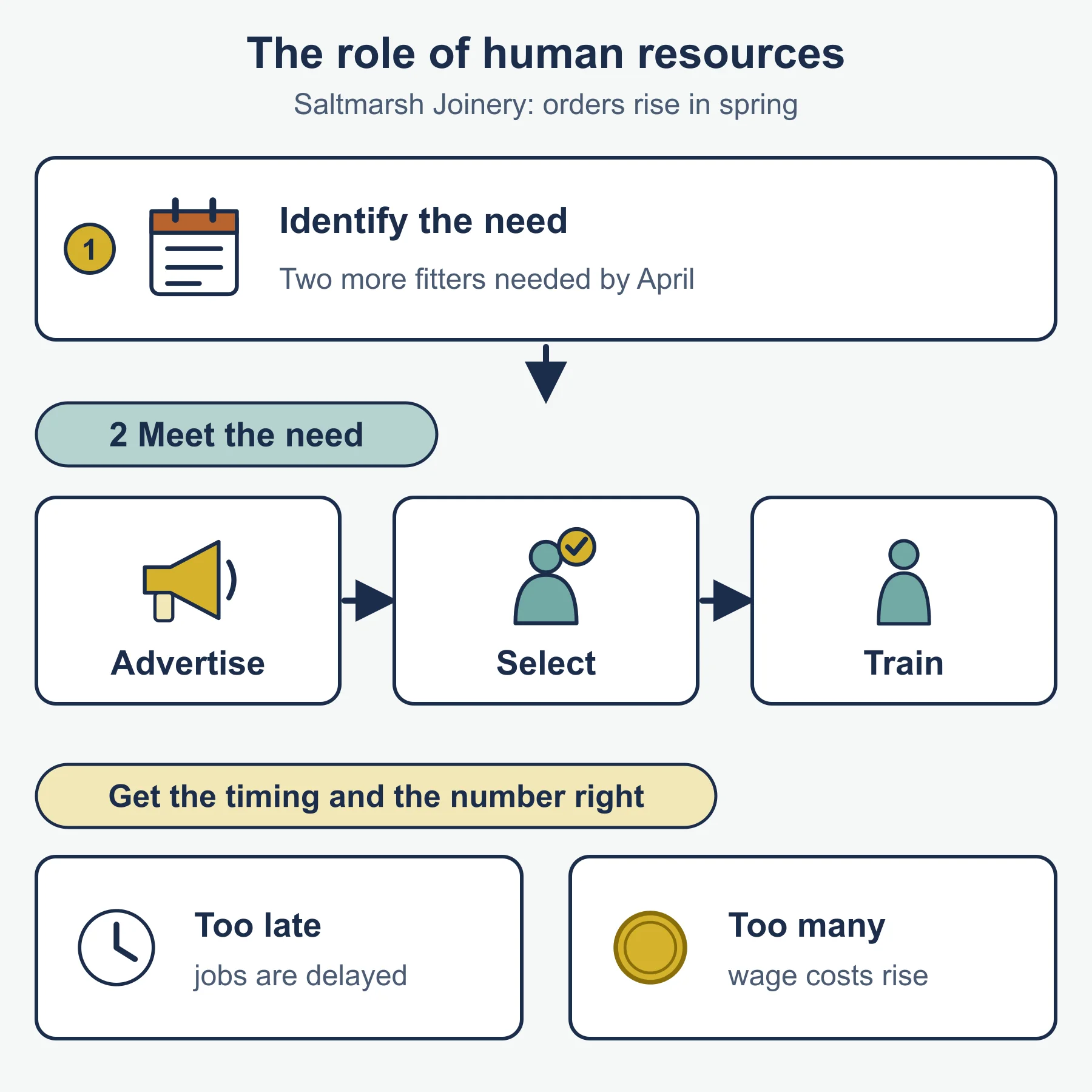
The purpose of human resources is to identify and meet the human resource needs of a business. That means working out how many people the business needs, with which skills, when, and then making sure they are found, kept and equipped to do the work.
Take Saltmarsh Joinery, an invented firm making fitted kitchens. Orders rise in spring. Human resources must spot that the workshop will need two more fitters by April (identifying the need) and then advertise, select and train them (meeting the need). Hiring late delays jobs; hiring too many raises wage costs.
3.2 Organisational structures and ways of working
Tall and flat structures
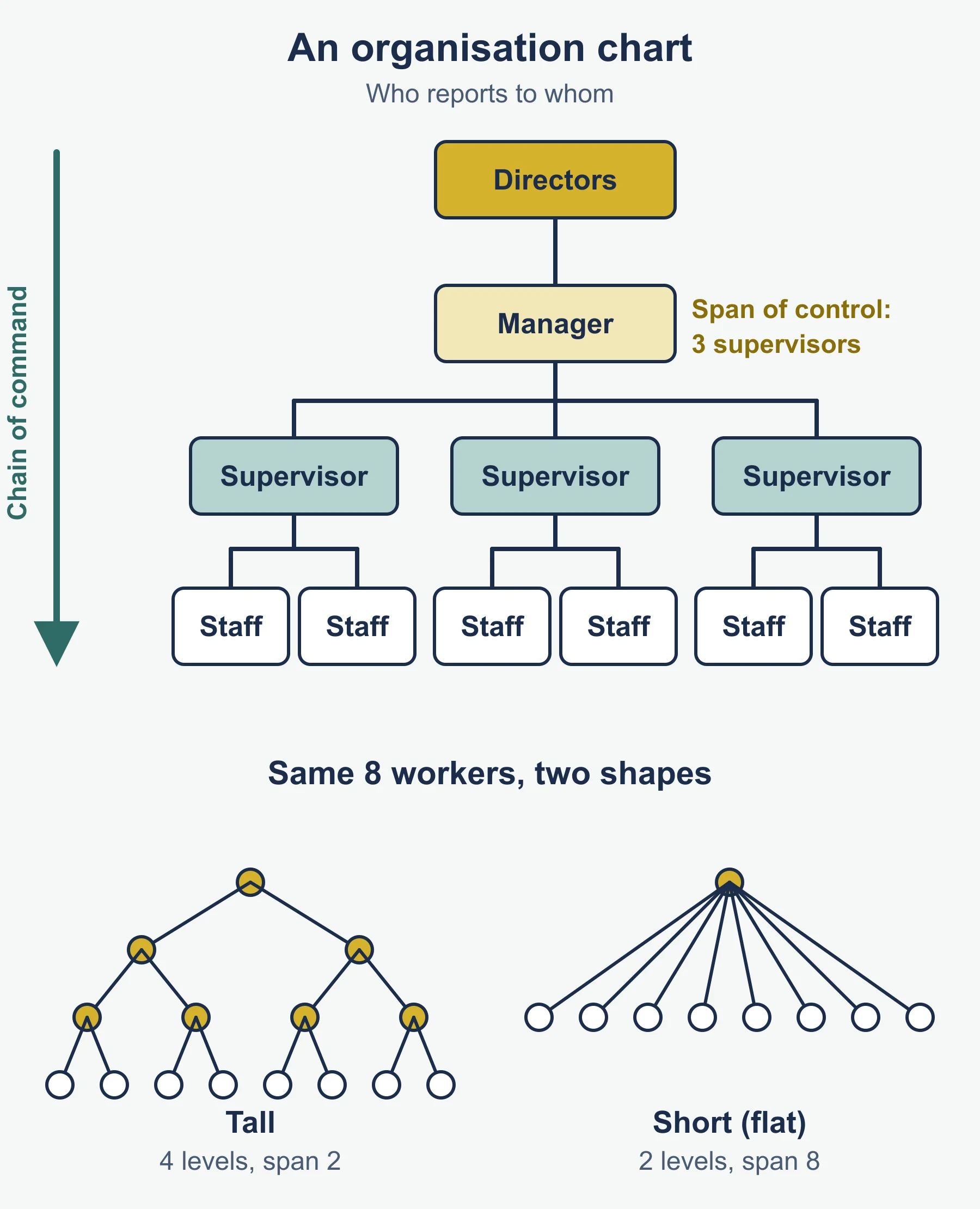
An organisation chart shows how a business is arranged. The specification lists these terms but gives no definitions, so the meanings below are general wording, not OCR’s:
| Term | Meaning (general wording) |
|---|---|
| Chain of command | The route along which authority and instructions pass downwards through the levels, showing who reports to whom |
| Span of control | How many subordinates a single manager directly supervises |
| Subordinates | The staff a manager is directly in charge of |
| Authority | The power to make decisions and give instructions |
| Delegation | Passing a task, and the authority to carry it out, to someone lower in the structure |
A tall structure has many levels and usually a narrow span of control. A flat structure has few levels and usually a wide span.
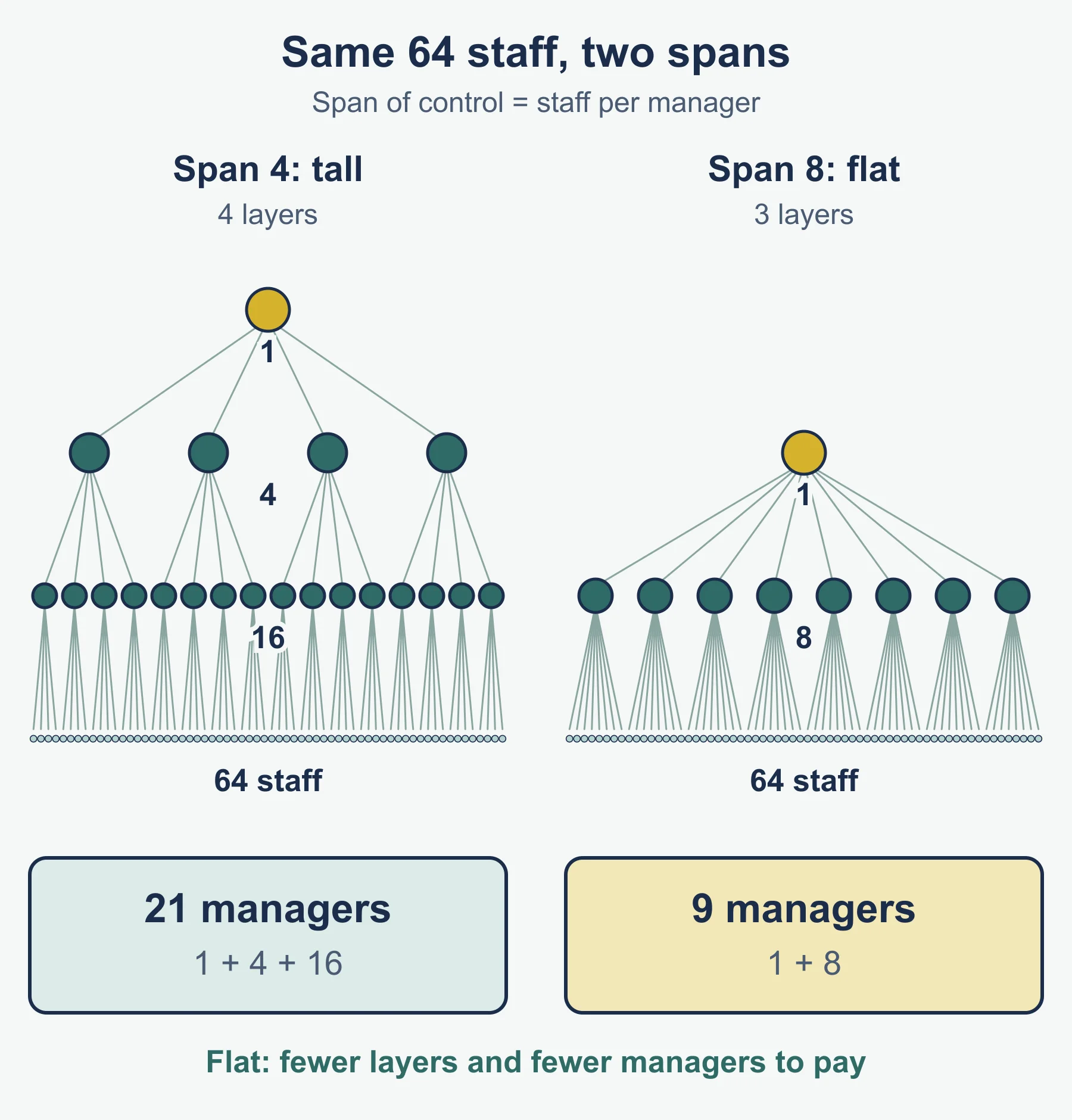
Suppose a business has 64 staff at the bottom of its chart. With a span of control of 4, the layers are 1 at the top, 4, then 16, then 64: four layers. With a span of 8, the layers are 1, 8, 64: three layers. The flat version needs 9 managers above the bottom layer, the tall version needs 21.
| Tall | Flat | |
|---|---|---|
| Communication | Messages pass through many levels, so slower and may be distorted | Fewer levels, so quicker and clearer |
| Supervision | Close, because spans are narrow | Looser, so staff have more freedom |
| Promotion | Many steps, so clear career path | Few steps, so fewer chances to move up |
| Management cost | More managers to pay | Fewer managers to pay |
| Delegation | Less needed | Needed, because managers cannot do everything |
Why businesses have different structures
Structure should fit the business: a design studio with 6 staff needs no long chain of command, while a large food factory may want narrow spans. Size, the type of work, the skills of staff and how much control owners want all matter. Effective communication is the test of a good structure: if decisions and instructions reach people quickly and accurately, the structure is working. Different job roles and responsibilities must be clear, so each person knows what they are accountable for and who they report to.
Ways of working
The meanings, benefits and drawbacks here are general explanations, not OCR wording.
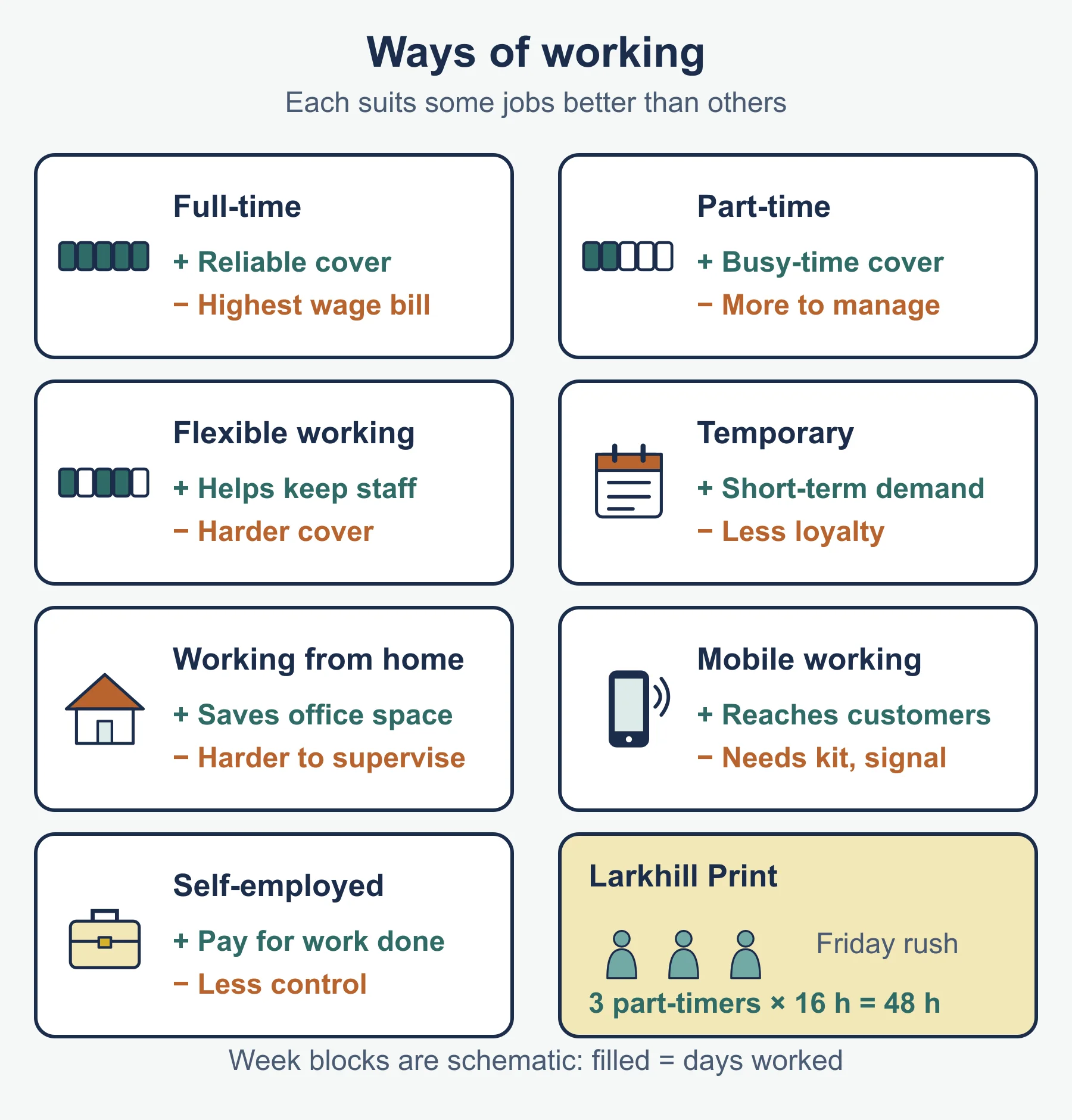
| Way of working | General meaning | Benefit to business | Possible drawback |
|---|---|---|---|
| Full-time | Works the normal full week set by the business | Reliable cover, staff build skills | Highest wage bill; less flexible |
| Part-time | Works fewer hours than full-time | Cover at busy times; lower cost when quiet | More people to manage and train |
| Flexible working | Hours or pattern agreed to suit worker and business | Helps recruit and keep staff | Harder to schedule cover |
| Temporary work | Employed for a limited period | Meets short-term demand without long commitment | Less loyalty; training may be wasted |
| Working from home | Does the job from home | Saves office space; widens recruitment | Harder to supervise; communication needs effort |
| Working whilst mobile | Works while travelling or on the move, for example sales staff using phones and tablets | Customers reached on site | Needs equipment and reliable signal |
| Self-employed | Runs their own business and is hired for the work | Business pays only for work done | Less control over how and when work is done |
Example: Larkhill Print, an invented printer, uses three part-timers for 16 hours each. That gives 48 hours of extra cover for the Friday rush.
3.3 Communication in business
Methods you need: letter, email, text, phone, meeting/presentation, social media and website.
| Method | Good for | Weakness |
|---|---|---|
| Letter | Formal records, contracts, official notices | Slow, costly |
| Detailed messages and attachments, with a written record | Can be unread or ignored; tone is easily misjudged | |
| Text | Short, urgent alerts | Little detail; informal |
| Phone | Quick two-way discussion | No written record unless noted |
| Meeting/presentation | Discussing, explaining and deciding with many people | Takes time; costs working hours |
| Social media | Reaching customers publicly, quick replies | Messages are public; needs monitoring |
| Website | Information available at any hour | Needs updating; one-way unless it has contact tools |
Why communication matters
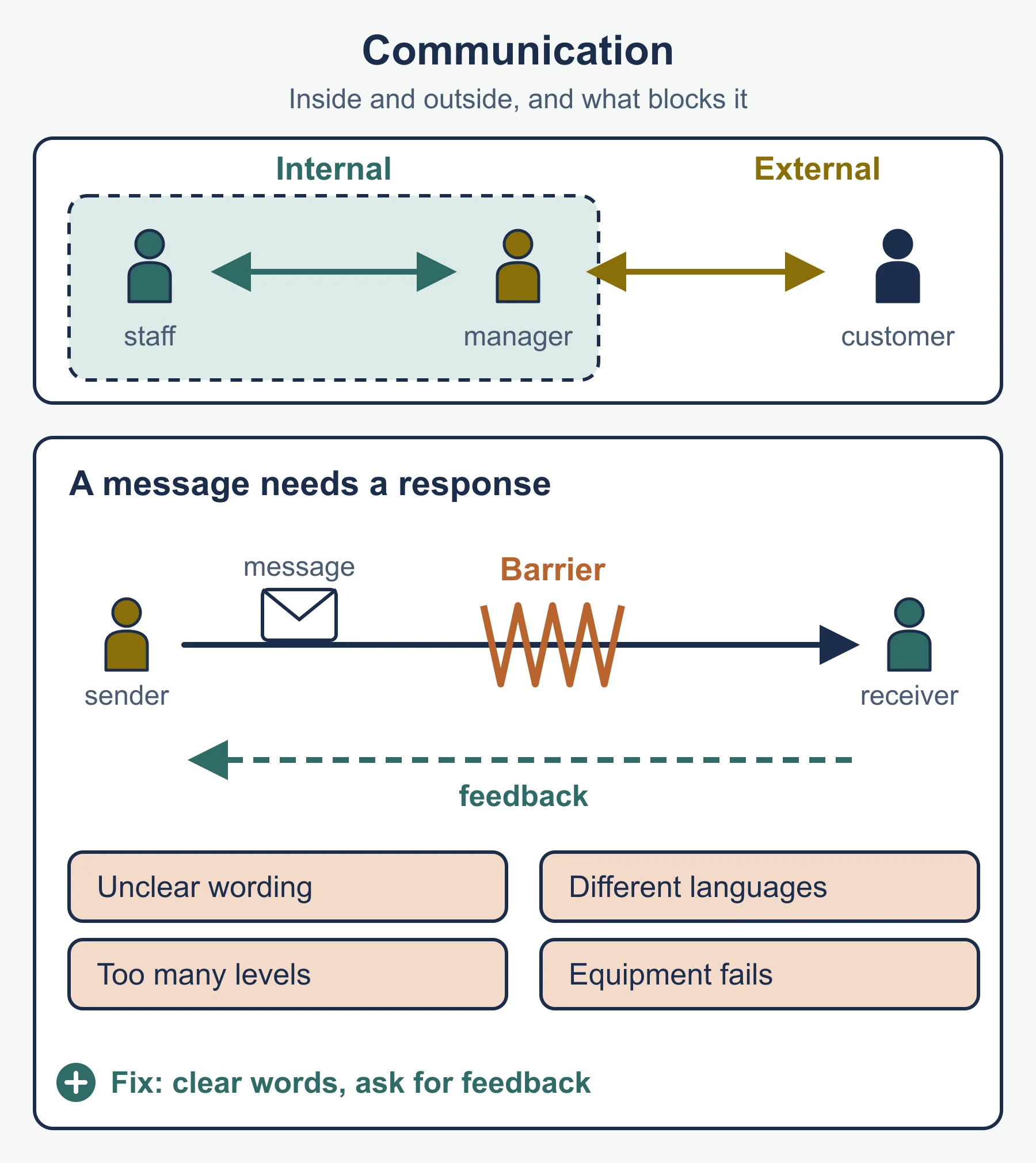
Good communication tells staff what to do, supports sound decisions, helps customers get answers and reduces mistakes. Poor communication causes delays, errors and lost sales.
The influence of digital communication
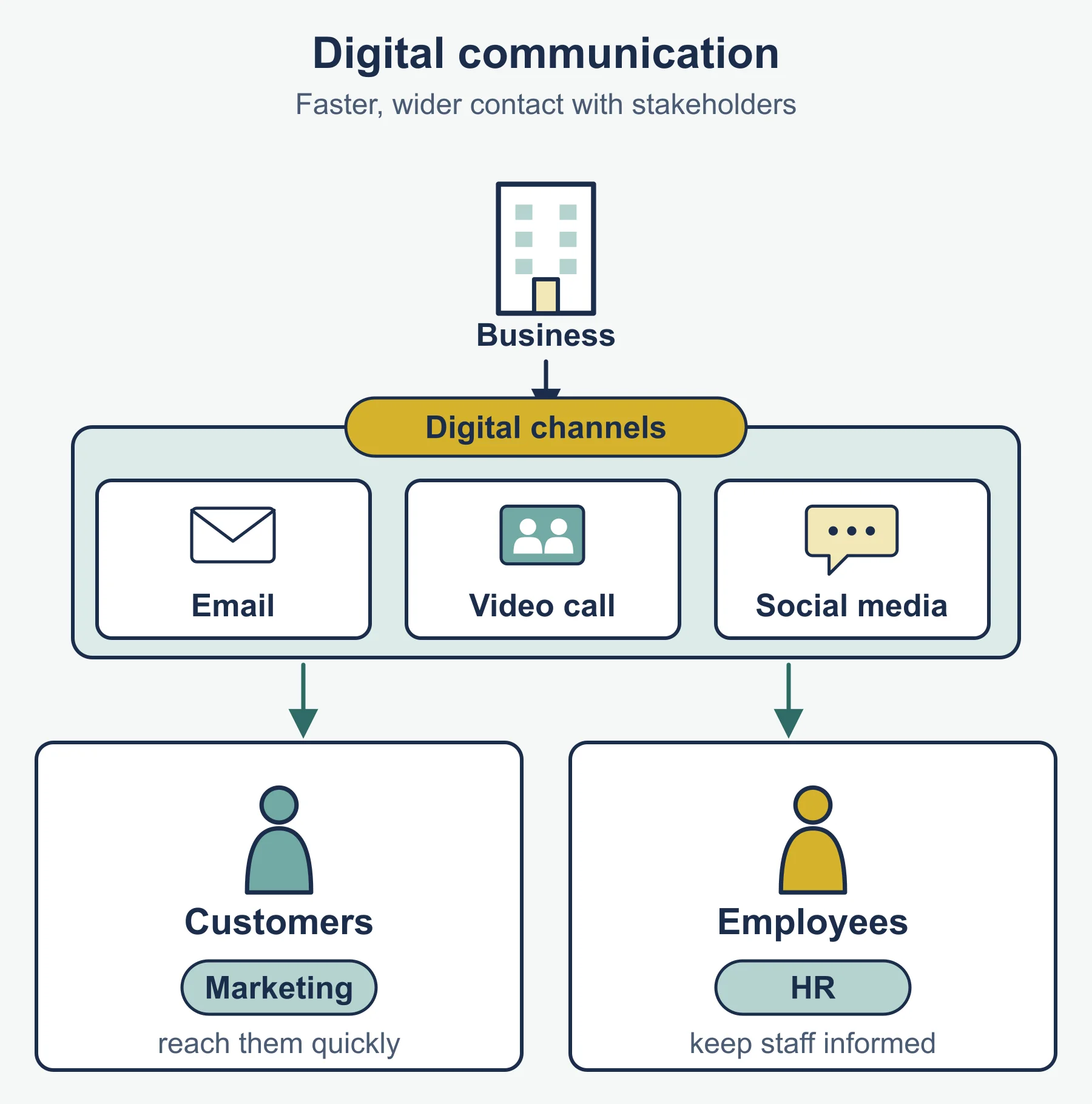
Digital methods have changed business activity. Email, messaging and video meetings let staff work from home or whilst mobile. Websites and social media let a small business reach a wide market cheaply. Customers can complain or praise in public at once, so a business must reply quickly. On the other side, staff may face information overload, security risks if data is mishandled, and the cost of equipment and training.
3.4 Recruitment and selection
Why businesses recruit
Three reasons you must know: to replace employees who leave, because of business growth, and to fill skill gaps.
Recruitment methods
| Internal methods | External methods |
|---|---|
| Notice board or intranet advert; promotion of existing staff | Newspaper or trade press adverts, job websites, recruitment agencies, advert on own website |
| Cheaper and faster; candidate already known and motivated by promotion | Wider choice of candidates; fresh ideas and skills |
| Limited choice; leaves another vacancy; no new ideas | Slower and more expensive; candidate less known |
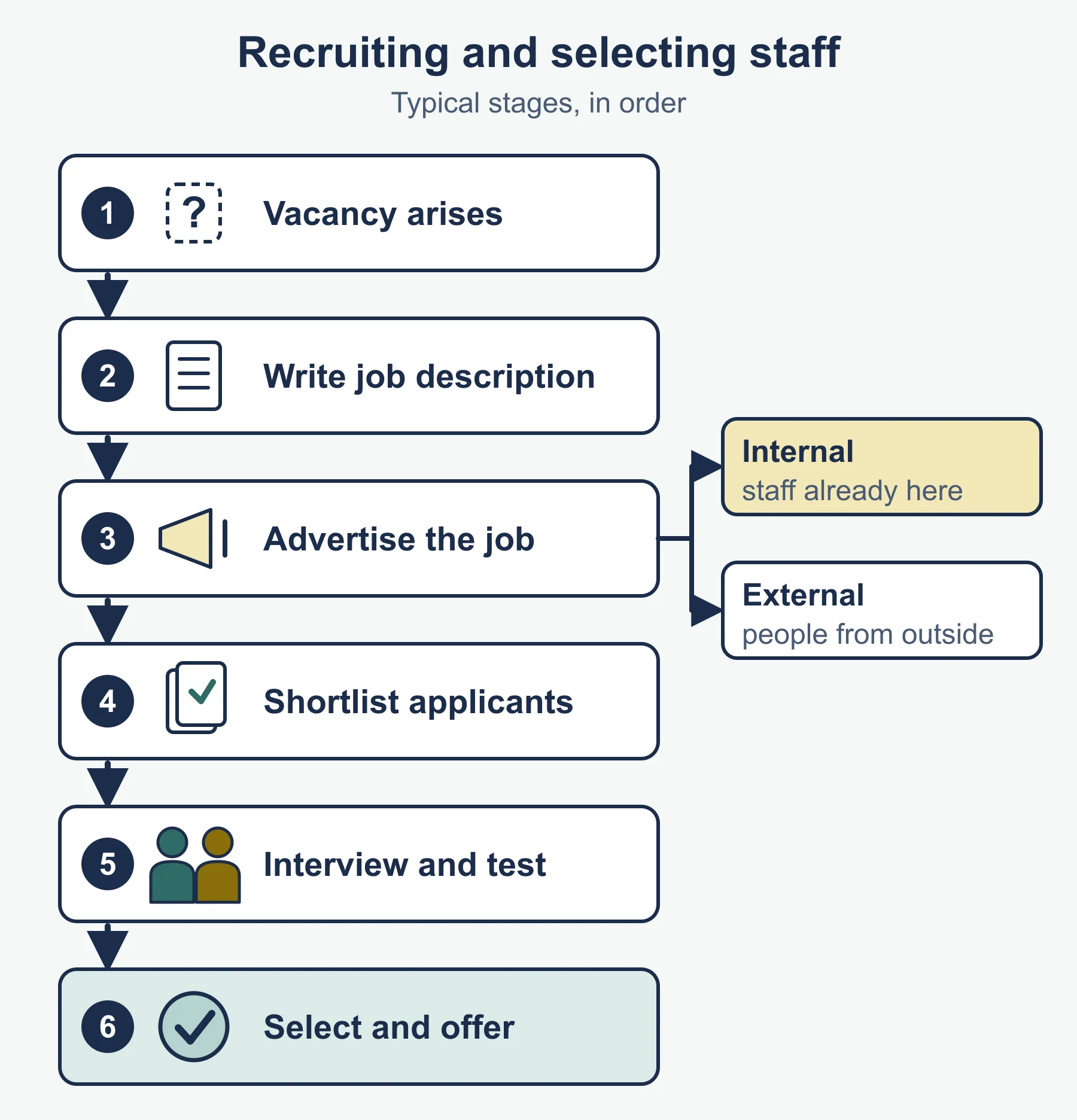
Choose the method to fit the need. A joinery firm needing a specialist machinist, which nobody on site can do, must recruit externally. A supervisor vacancy could be filled internally, rewarding good staff.
A job description sets out the title, duties and responsibilities of the job. A person specification sets out the qualities, skills, experience and qualifications the ideal candidate needs.
Methods of selection
| Method | Use | Limitation |
|---|---|---|
| CV | Summary of experience and qualifications | Candidate controls content |
| Application form | Same questions for everyone, easy to compare | Takes time to complete and read |
| Letter of application | Shows motivation and written skill | Hard to compare; may be help from others |
| Interview | Meets candidate, tests communication | Costly in time; first impressions may bias |
| Tests | Checks a skill or aptitude directly | Test must match the job |
| Group activities | Shows teamwork and leadership | Quiet candidates may be undervalued |
| References | Check past performance from a former employer | May be unhelpful or too positive |
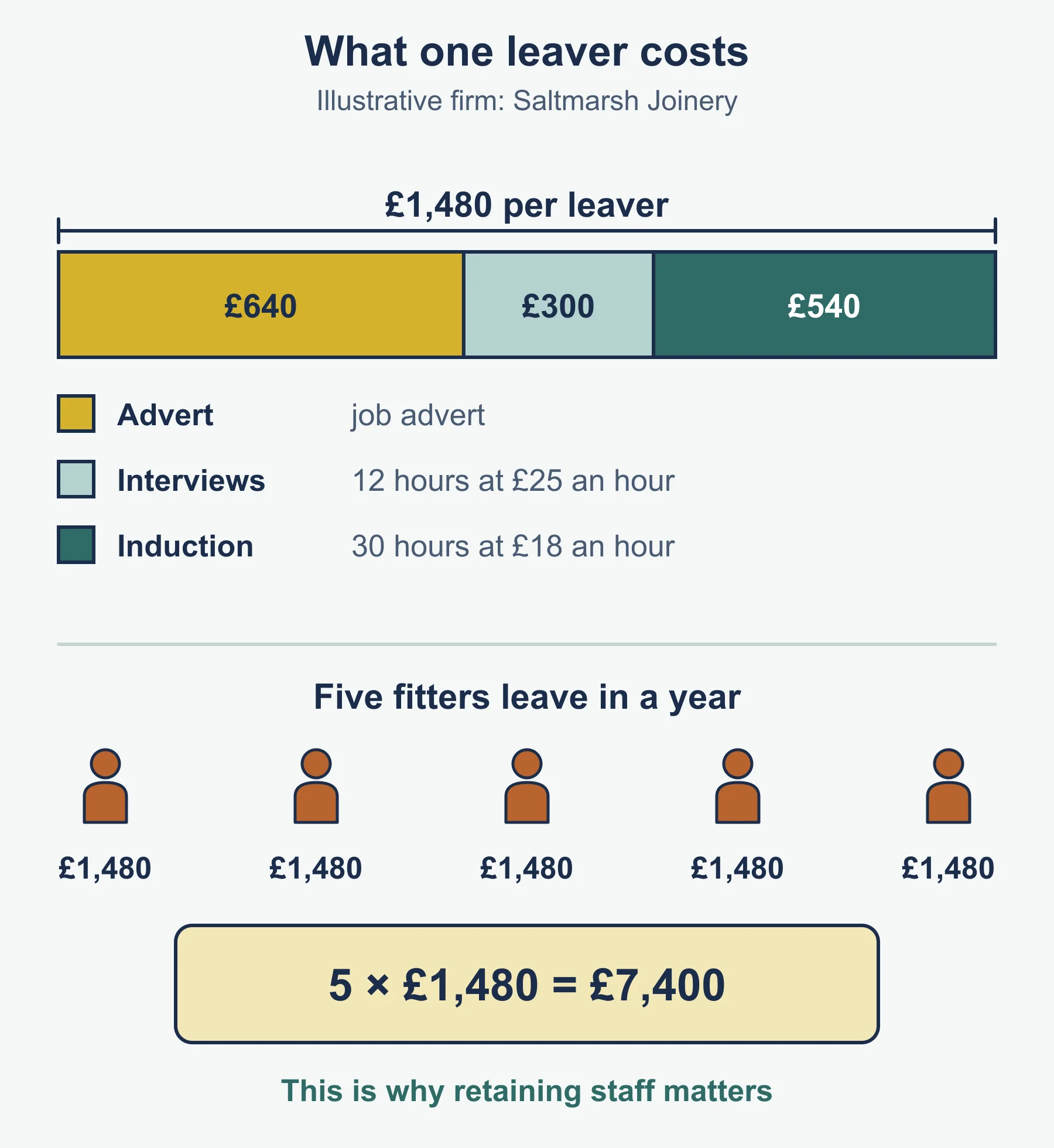
Example cost of replacing one leaver at Saltmarsh Joinery: advert £640, plus 12 hours of interview time at £25 an hour (£300), plus 30 hours of supervised induction at £18 an hour (£540). Total: £1,480. If five fitters leave in a year, the cost is £7,400. This is why retention matters.
3.5 Motivation and retention
Motivation is the desire to do a good job.
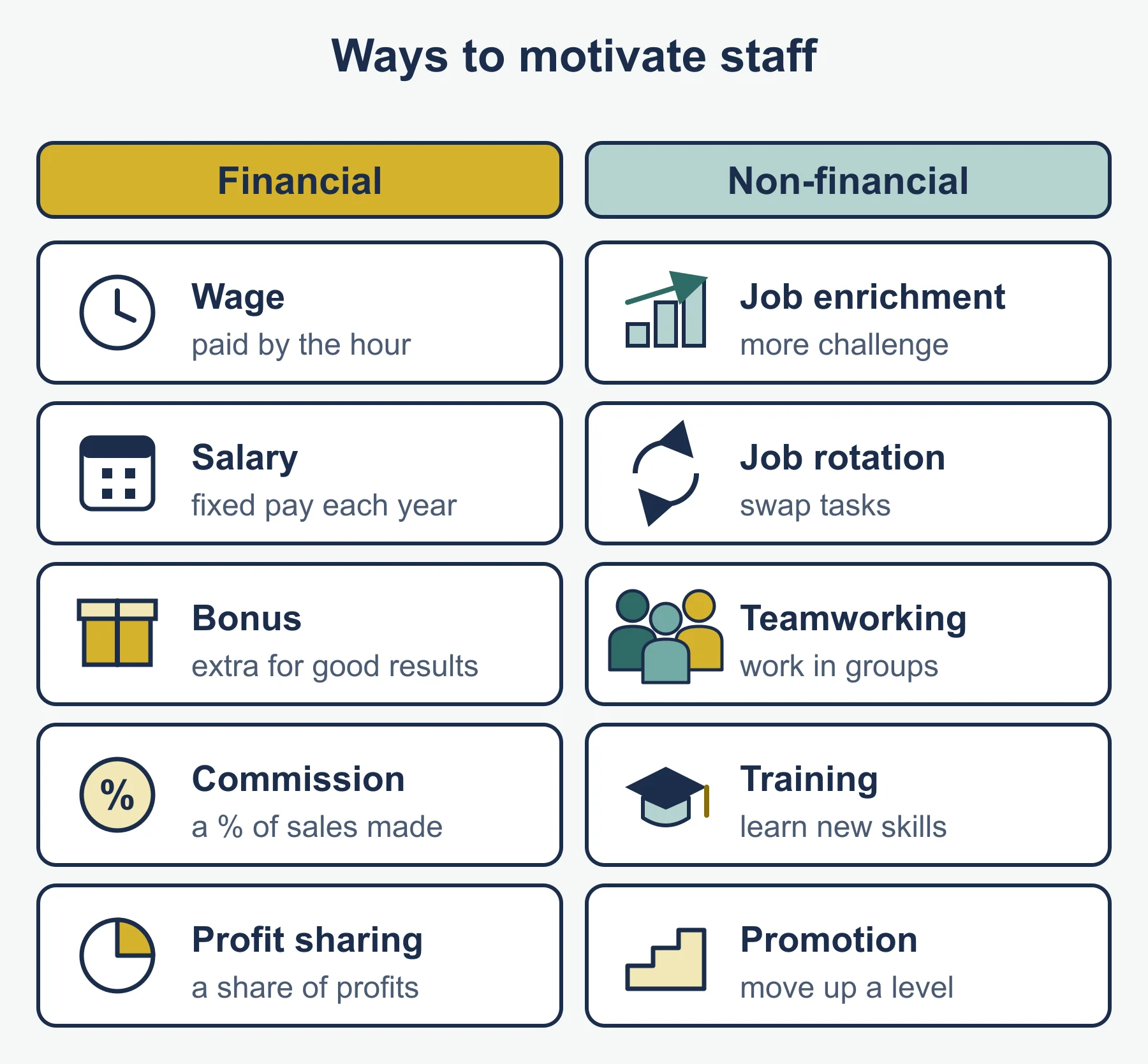
Financial methods
| Method | How it works |
|---|---|
| Pay | Wages or salary; the basic reward |
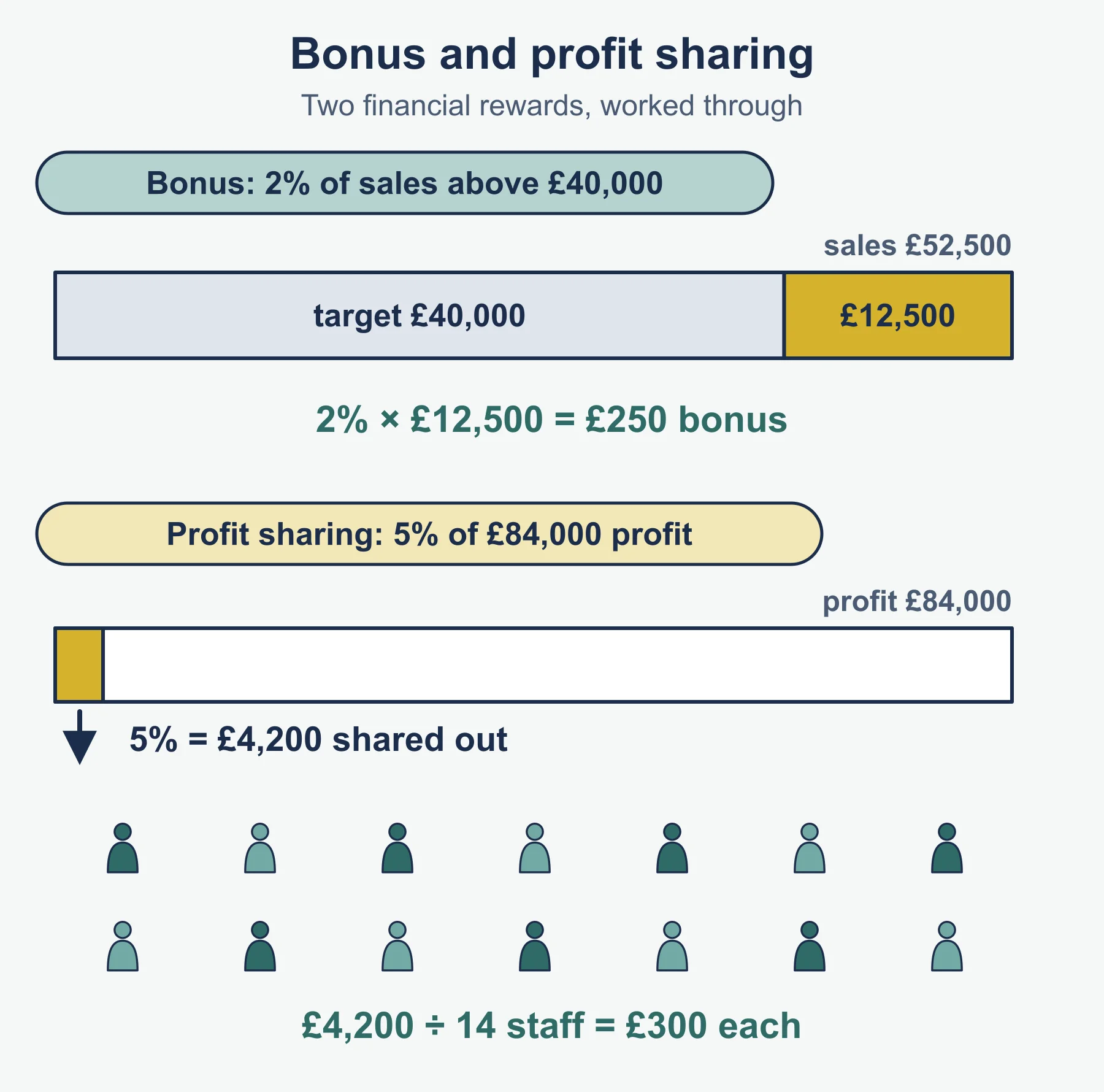
| Bonuses | Extra payment for meeting a target. Example: 2% of sales above £40,000; sales of £52,500 give 2% of £12,500 = £250 |
| Profit sharing | A share of profit divided among staff. Example: 5% of £84,000 profit is £4,200; shared equally among 14 staff this is £300 each |
| Fringe benefits | Extras such as a company car, discount or pension contribution |
Non-financial methods
Praise, award schemes (for example employee of the month) and the working environment (safe, comfortable, well equipped). They cost less but may not suit someone who is struggling to pay bills.
Why motivation and retention matter
Motivated employees perform better: more output, fewer mistakes, better service. Employee retention means keeping staff. Retained staff are already familiar with the business and customers, and the business saves the time and expense of recruitment, as the £1,480 example shows. Motivation therefore supports retention, and both support the business’s performance.
3.6 Training and development
Training methods
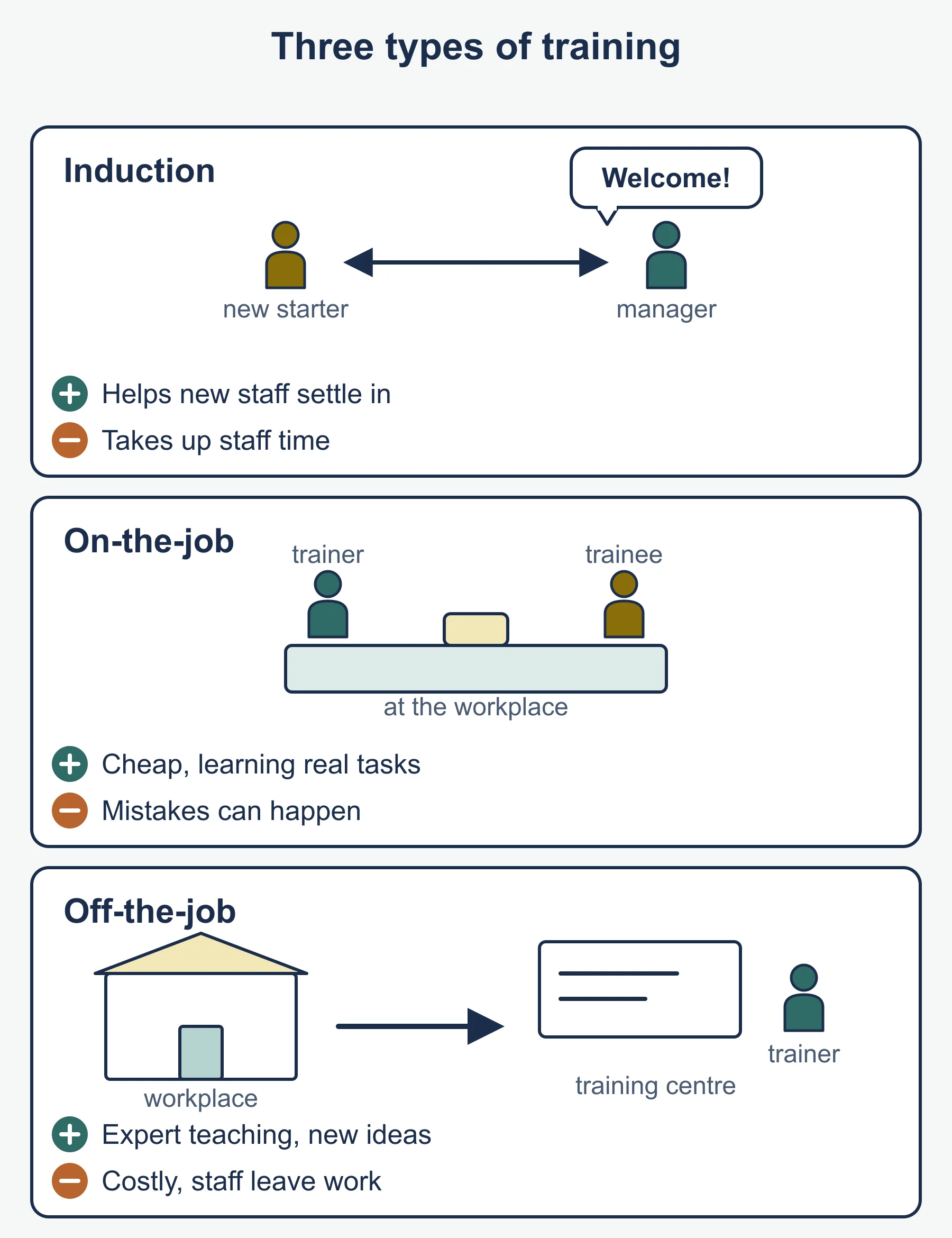
| Method | Meaning | Advantage | Disadvantage |
|---|---|---|---|
| Induction | Introduction to the business, rules, safety, people | Settles new staff quickly | Takes the time of existing staff |
| On-the-job | Learning while doing the actual job, with a colleague | Cheap, relevant | Trainer may pass on bad habits; slows output |
| Off-the-job | Learning away from the workplace, for example at a college or course | Wider, specialist input | Costly; staff away from work |
Why businesses train
Reasons: development of the business, improved productivity, skill shortages, better customer service, and motivation and retention.
Staff development
Staff development is wider than training for today’s job. It includes vocational and academic qualifications and apprenticeships.
Benefits to employees: new skills, qualifications, better promotion chances, more confidence. Benefits to businesses: a more skilled workforce, ability to fill senior roles from within, higher motivation. Costs include fees, time away from work and the risk that trained staff leave.
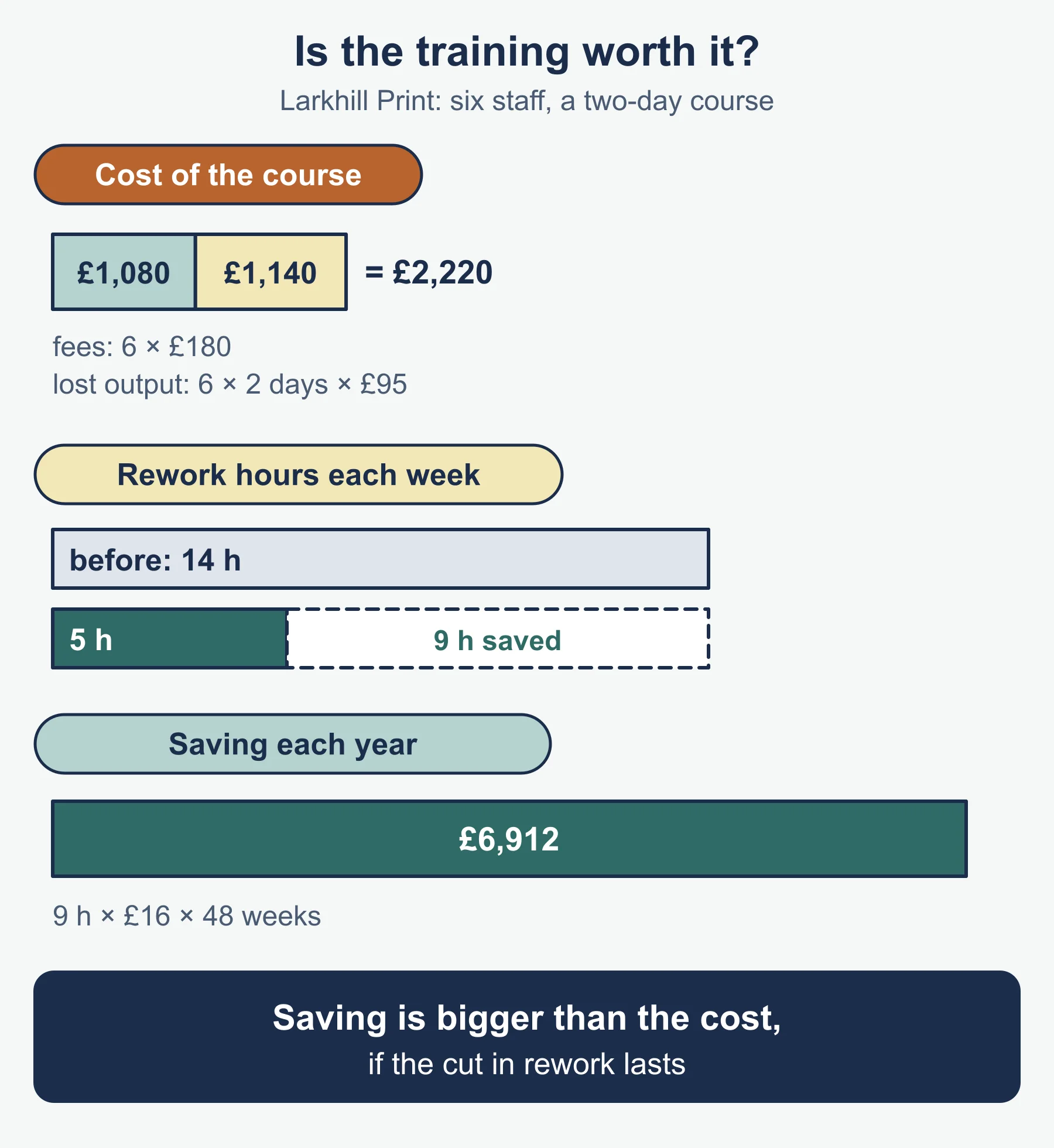
Worked example (Larkhill Print): six staff attend a two-day off-the-job course at £180 each, so £1,080 in fees. Lost output is £95 per person per day: 6 × 2 × £95 = £1,140. Total cost £2,220. The course cuts rework from 14 to 5 hours a week at £16 an hour for 48 weeks, a saving of £6,912 a year. The saving is higher than the cost, although you should say the estimate depends on the cut in rework lasting.
3.7 Employment law
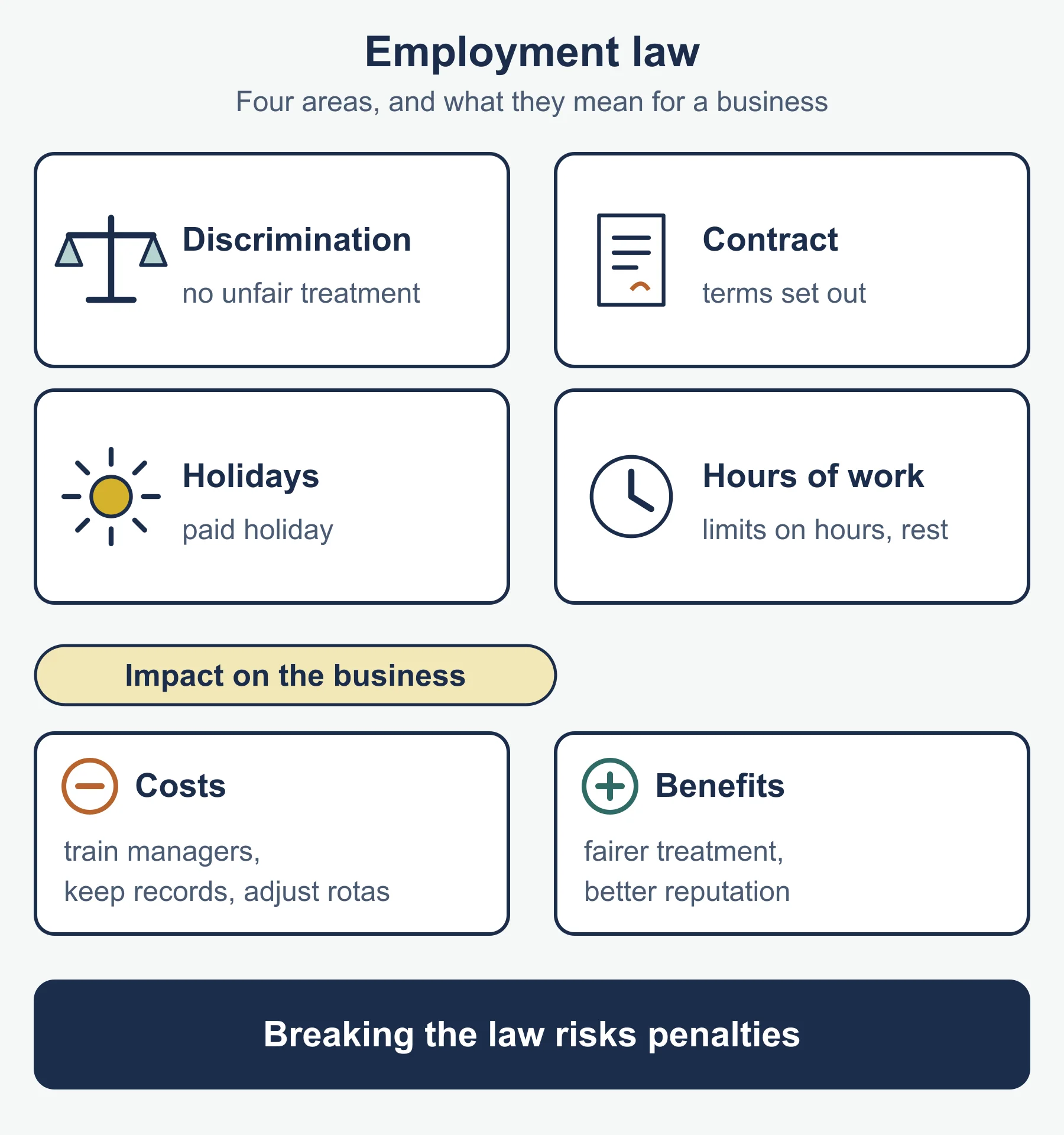
The specification asks for the impact of current legislation on recruitment and employment, with points on discrimination, employees’ right to a contract, holidays and hours of work. It names no Acts or details, so the descriptions below are general, not legal or syllabus wording.
- Discrimination. A business must not treat people unfairly in recruitment or at work because of personal characteristics. It must write adverts, shortlist and promote on ability to do the job.
- Right to a contract. Employees are entitled to a contract setting out the terms of their employment.
- Holidays. Employees have a right to paid holiday, which the business must plan for.
- Hours of work. There are rules on working hours and rest, so a business cannot simply demand any hours.
Impact: businesses must train managers, keep records and adjust rotas, which raises costs. Benefits include fairer treatment and a better reputation; breaking the law risks penalties.
Common errors
- Confusing span of control (subordinates reporting to one manager) with chain of command (the line of authority).
- Saying a flat structure has no managers; it has fewer levels.
- Calling any home-based worker self-employed. Working from home is a way of working; self-employed is about who they work for.
Frequently asked questions
What is the purpose of human resources in a business? The purpose of human resources is to identify and meet the human resource needs of a business. That means working out how many staff and which skills are needed and when, then recruiting, selecting, motivating, training and keeping them.
What areas of employment law are in OCR GCSE Business J204? The specification asks about the impact of legislation on discrimination, employees’ right to a contract, holidays and hours of work. It names no specific Acts, so answers should describe the impact in general terms.
What is the difference between span of control and chain of command? Span of control is the number of subordinates who report directly to one manager. Chain of command is the line of authority through which instructions pass from the top of the business down.
Why does digital communication matter to a business? Email, messaging and video meetings let staff work flexibly or remotely and send messages quickly. Digital channels also give cheap reach to wide markets and instant feedback from customers.
Official syllabus
OCR GCSE (9-1) Business J204, Version 2.0 (January 2026), published by OCR, section 3 People.
Get free revision emails (optional)
Occasional emails with practice questions, worked explanations and links to free resources for the qualification and subjects you choose. No spam, and you can unsubscribe from any email. The free tools on this site never need an email.
Related resources
-
Practice questions
OCR GCSE Business: People (J204) – Practice Questions
Original practice questions with worked answers on section 3 People in OCR GCSE Business J204, using short-answer, calculation and case-study items.
Business · OCR · GCSE
Try questions -
Revision notes
OCR GCSE Business: People (J204) – Revision Notes
Condensed recall notes for section 3 People in OCR GCSE Business J204: structures, communication, recruitment, motivation, training and law.
Business · OCR · GCSE
Revise topic -
Practice questions
OCR GCSE Business: Business Activity, Marketing and People — Practice Questions
Original OCR GCSE Business J204/01 practice with worked answers: a 15-question multiple-choice Section A plus questions on enterprise, marketing and people.
Business · OCR · GCSE
Try questions
Related articles
-
teaching
A Level tuition in Dubai: Cambridge or Pearson Edexcel International A Level?
Schools in Dubai and Abu Dhabi teach either Cambridge International AS & A Level or Pearson Edexcel International A Level. How the two are structured, why it matters for tuition, and how online classes from Lahore work.
9 October 2026
-
curriculum guides
Choosing subjects at IGCSE and A Level
How subject choices at 14 and 16 affect university options later, and how to keep pathways open without overloading a timetable.
28 July 2026
Studying this with a teacher
Working through Business GCSE?
This page is free and stays free. If you would rather be taught it, Marlbridge runs Business classes one-to-one, online in your own time zone. One-to-one only for this course: Rs 6,000 per class in Pakistan, with other currencies on the fees page. The first trial class is free. WhatsApp replies within an hour (8am–11pm Pakistan time, every day); email the same day.
OCR Business teachers at Marlbridge
