
Study Guides
OxfordAQA International AS and A-level English Language (9670): Section A: Learning Language
OxfordAQA 9670 Unit 3 Section A: language learning from early childhood to the teenage years, writing development, EAL learners and analysing data.
- Subject
- English
- Level
- A LEVEL
- Topic
- Unit 3 – Language Variation
- Author
- Marlbridge Academic Team
- Updated
- Reviewed by
- Ammar Bilal (what this means)
Aligned to OxfordAQA A Level English (9670), Version 5.2, for International AS exams from May/June 2018, A-level from May/June 2019. Official specification .
Syllabus page (what it covers and how it is assessed): OxfordAQA A Level English Language.
Found an error? Report a correction.
Need help with this topic? Request a free trial class for A Level English Language (9670).
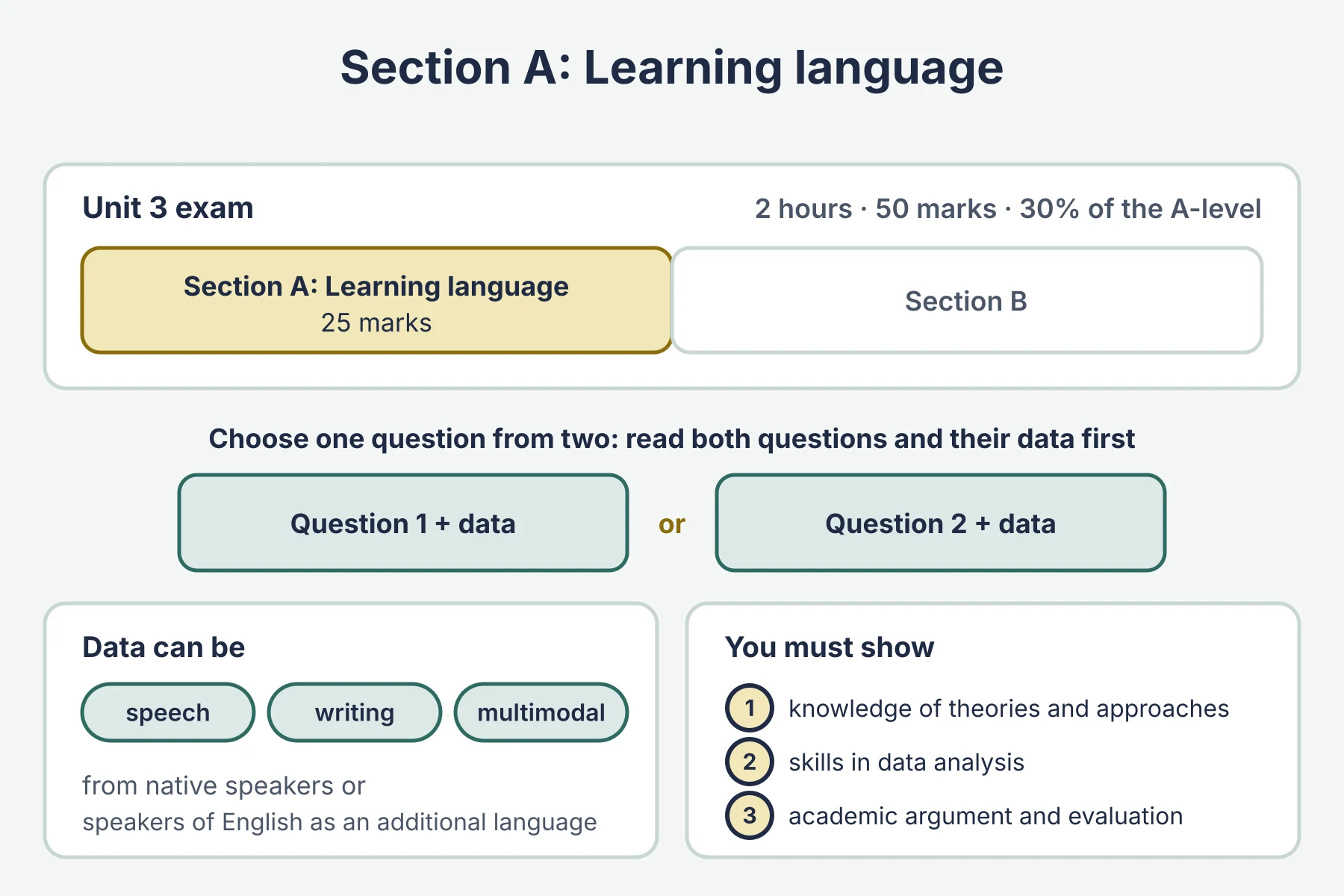
Section A of Unit 3, Language variation, in the OxfordAQA International AS and A-level English Language specification (9670) is specification section 3.3.1 Learning language. The specification defines the topic broadly: it includes early language acquisition in young children and later language development in teenagers. Each question gives you data as a starting point, which could be speech, writing or multimodal texts produced by native speakers or speakers of English as an additional language (EAL). This guide covers the parts of that range students most often under-prepare: development after early childhood, writing, EAL learners and multimodal data.
What the section requires
Unit 3 is a 2-hour exam worth 50 marks and 30% of the International A-level. Section A is worth 25 marks, and you answer one question from a choice of two. Across the unit, the specification asks you to show three things:
- knowledge of the academic topic area, including different theories and approaches;
- skills in data analysis;
- skills in academic argument and evaluation of ideas.
The choice matters. Read both questions and their data before deciding: one may suit your strengths in spoken data, the other in writing or EAL.
The span of development
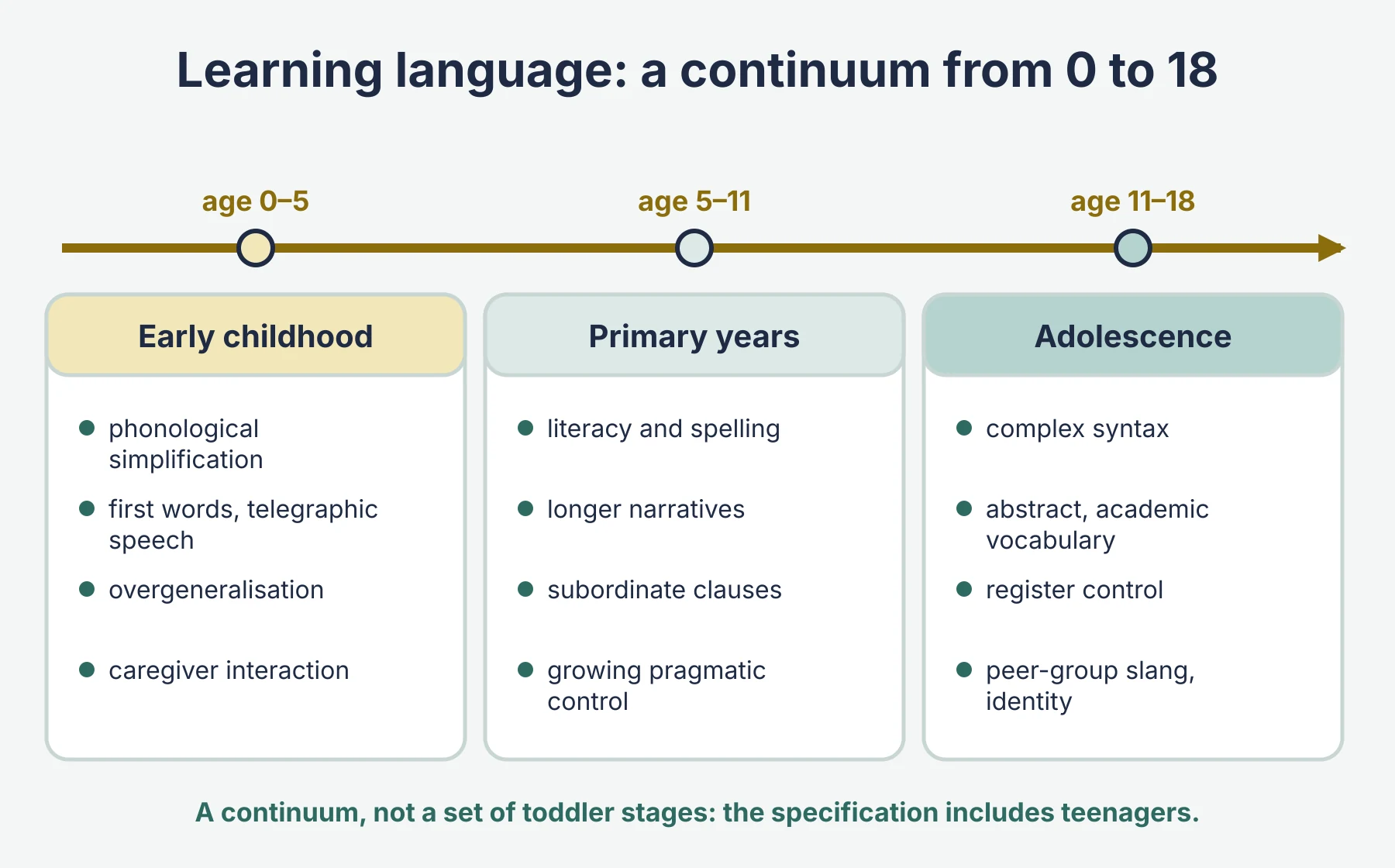
Think of learning language as a continuum, not a set of toddler stages.
| Period | Typical focus in data |
|---|---|
| Early childhood (0-5) | Phonological simplification, first words, telegraphic speech, overgeneralisation, caregiver interaction |
| Primary years (5-11) | Literacy, spelling development, longer narratives, subordinate clauses, growing pragmatic control |
| Adolescence (11-18) | Complex syntax, abstract and academic vocabulary, register control, peer-group slang, identity |
Early stages are covered in the Unit 3 Language Variation study guide; the sections below concentrate on later development, writing and EAL.
Later development in children and teenagers
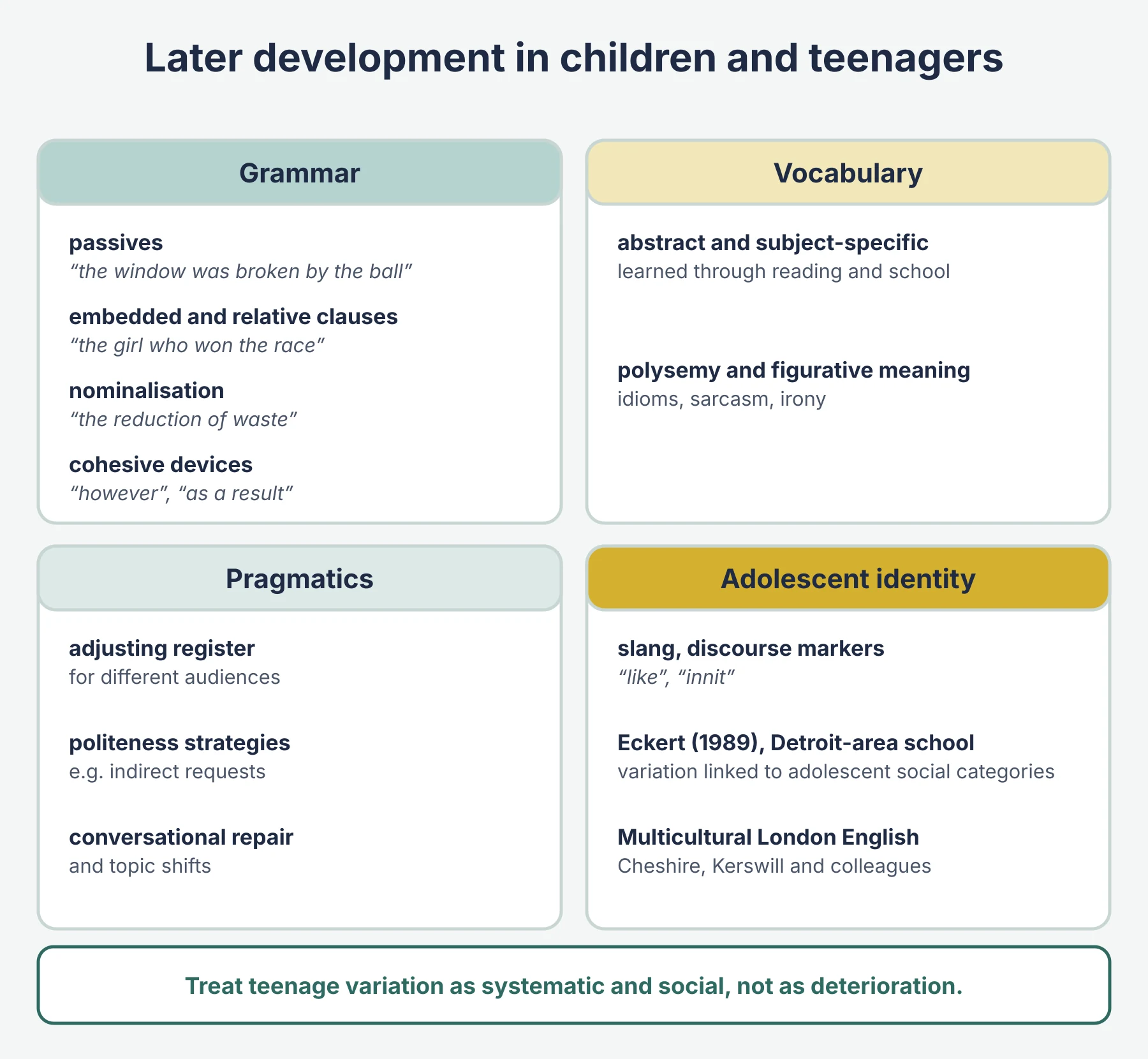
Grammar. Development continues long after the telegraphic stage. Watch for:
- passive constructions (“the window was broken by the ball”), which children often misinterpret, especially when either noun could be the agent, well into the primary years;
- embedded and relative clauses (“the girl who won the race”);
- nominalisation in academic writing (“the reduction of waste” rather than “we reduced waste”);
- cohesive devices beyond “and then”: “however”, “as a result”, “on the other hand”.
Vocabulary. Growth shifts from everyday to abstract and subject-specific lexis, much of it learned through reading and schooling rather than conversation. Teenagers also acquire polysemy and figurative meaning: idioms, sarcasm and irony.
Pragmatics. Older children and teenagers learn to adjust register for different audiences, use politeness strategies such as indirect requests, and manage conversational repair and topic shifts. Understanding sarcasm develops through middle childhood.
Adolescent language and identity. Teenage speech is a resource for identity. Slang, discourse markers (“like”, “innit”) and new pronunciations often spread among adolescents first. Penelope Eckert’s work in a Detroit-area high school (1989) linked language variation to adolescent social categories. Research on Multicultural London English by Jenny Cheshire, Paul Kerswill and colleagues showed young people in multilingual areas developing a new variety drawing on several languages. In analysis, treat teenage variation as systematic and social, not as deterioration.
Writing development
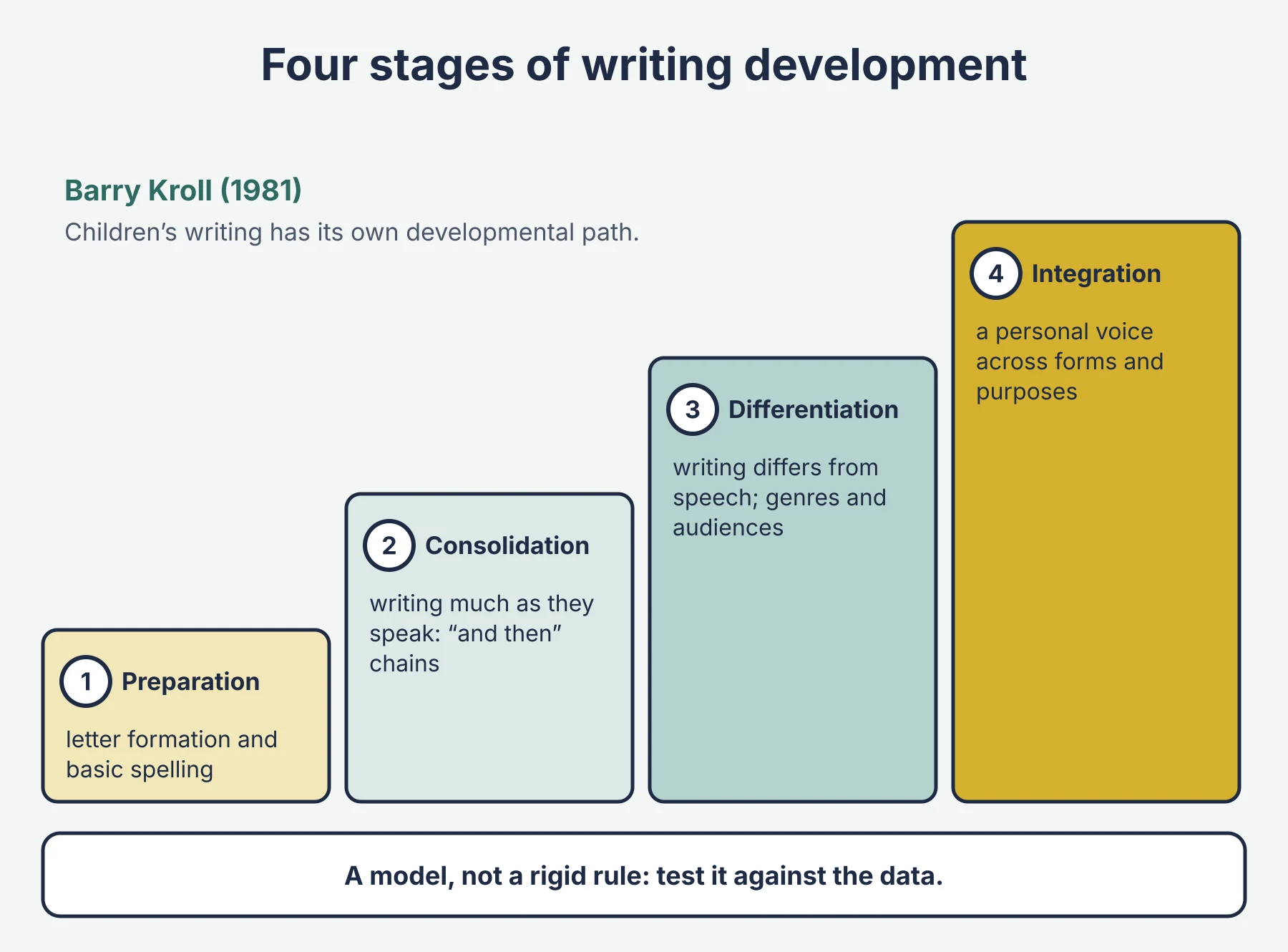
Children’s writing has its own developmental path.
Barry Kroll’s model (1981) proposes four stages:
- Preparation: mastering letter formation and basic spelling.
- Consolidation: writing much as they speak, with informal tone and “and then” chains.
- Differentiation: recognising that writing differs from speech, and using different genres and audiences.
- Integration: a personal voice controlled across forms and purposes.
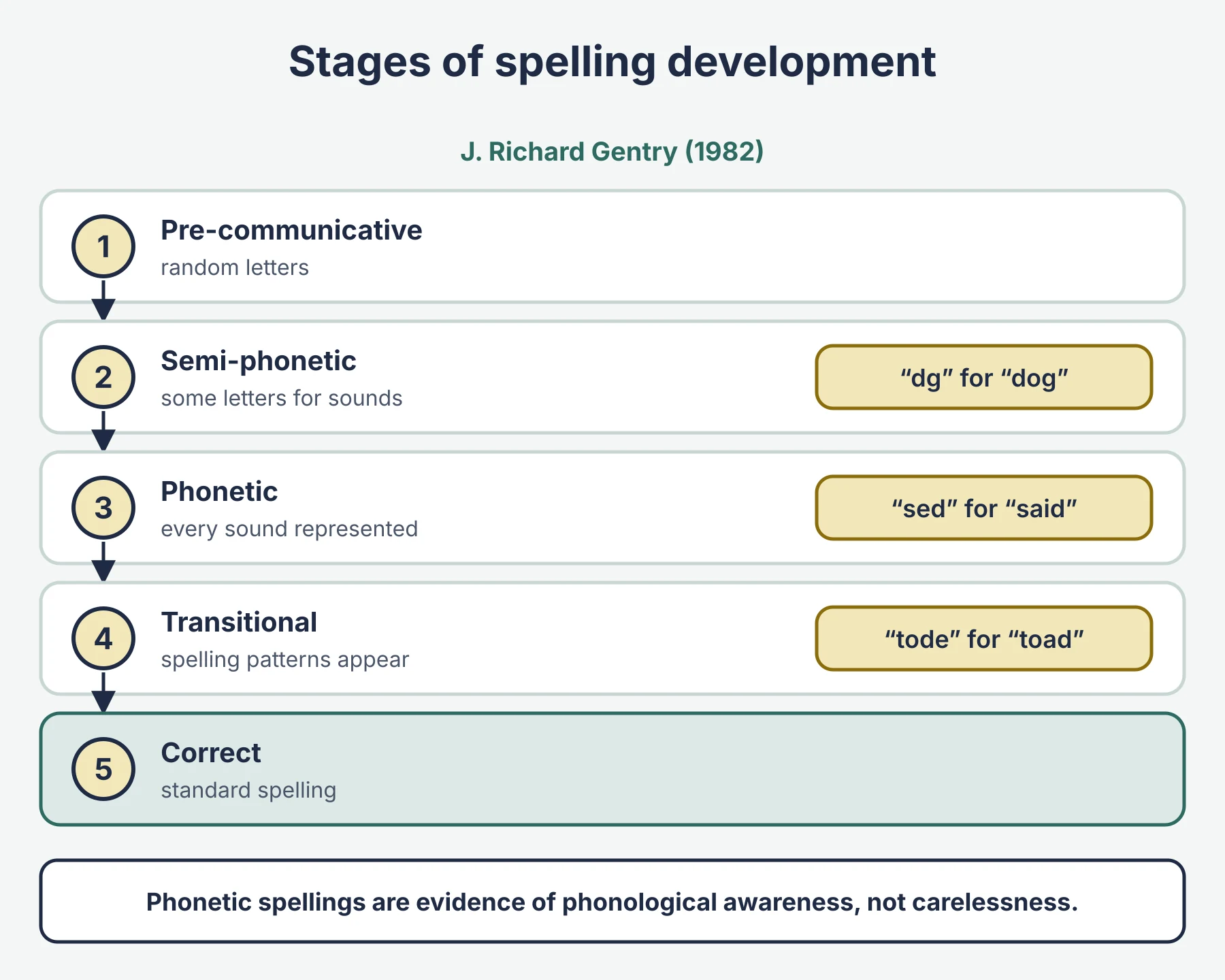
Spelling development is often described in stages, for example by J. Richard Gentry (1982): pre-communicative (random letters), semi-phonetic (some letters for sounds, “dg” for “dog”), phonetic (every sound represented, “sed” for “said”), transitional (spelling patterns appear, “tode” for “toad”) and correct. Phonetic spellings are evidence of a child’s phonological awareness, not carelessness.
What to analyse in writing data: spelling patterns, punctuation, sentence structure and length, cohesion, genre conventions, awareness of audience, and the influence of teaching (a story that starts “Once upon a time” shows genre learning from reading).
EAL learners
Data may come from speakers learning English as an additional language. Concepts:
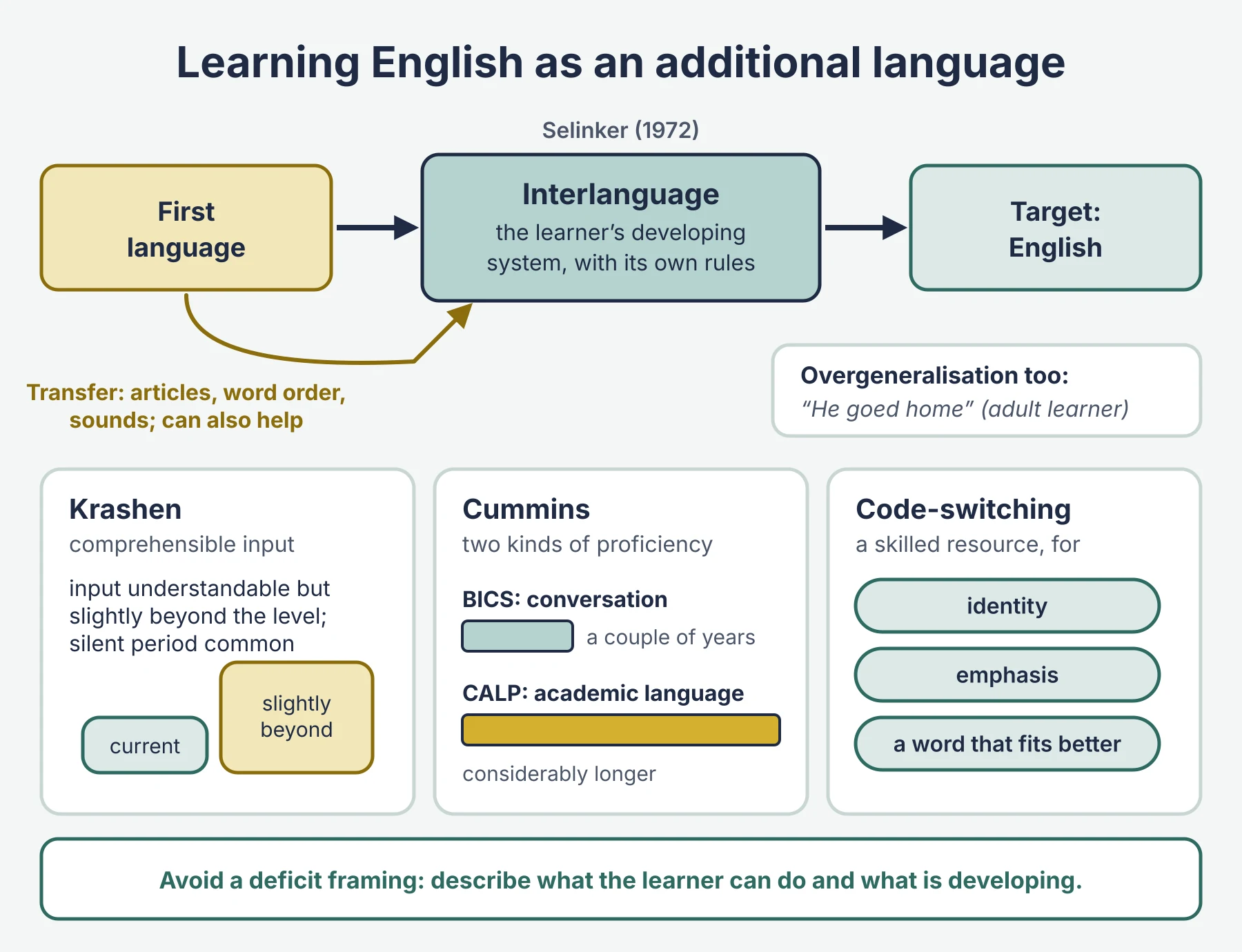
- Interlanguage (Larry Selinker, 1972): the learner’s developing system, with its own rules, between the first language and the target.
- Transfer: features of the first language carried into English, such as article use, word order, or pronunciation of particular sounds. Transfer can help (shared vocabulary) as well as produce non-target forms.
- Overgeneralisation occurs in EAL learning too: “He goed home” may appear in an adult learner’s speech.
- Comprehensible input: Stephen Krashen argued that acquisition depends on input that is understandable but slightly beyond the learner’s current level. A silent period, when a learner listens more than speaks, is common.
- BICS and CALP: Jim Cummins distinguished basic interpersonal communicative skills, often developed within a couple of years, from cognitive academic language proficiency, which takes considerably longer. A fluent conversationalist may still find academic writing difficult.
- Code-switching between languages is a skilled resource, often used for identity, emphasis or a word that fits better.
Avoid a deficit framing. Describe what the learner can do, what system they are using, and what is developing.
Multimodal data
Data may include text messages, social media posts or presentations. Here look at how young people combine writing with speech-like features: abbreviations, emoji, non-standard spelling for effect (“sooo”), and punctuation used for tone. David Crystal’s Txtng: The Gr8 Db8 (2008) argued that texting has not damaged literacy, and research by Clare Wood and colleagues found no evidence that children’s use of textisms harmed their spelling. Deliberate non-standard forms require knowledge of the standard forms they play with.
Worked example
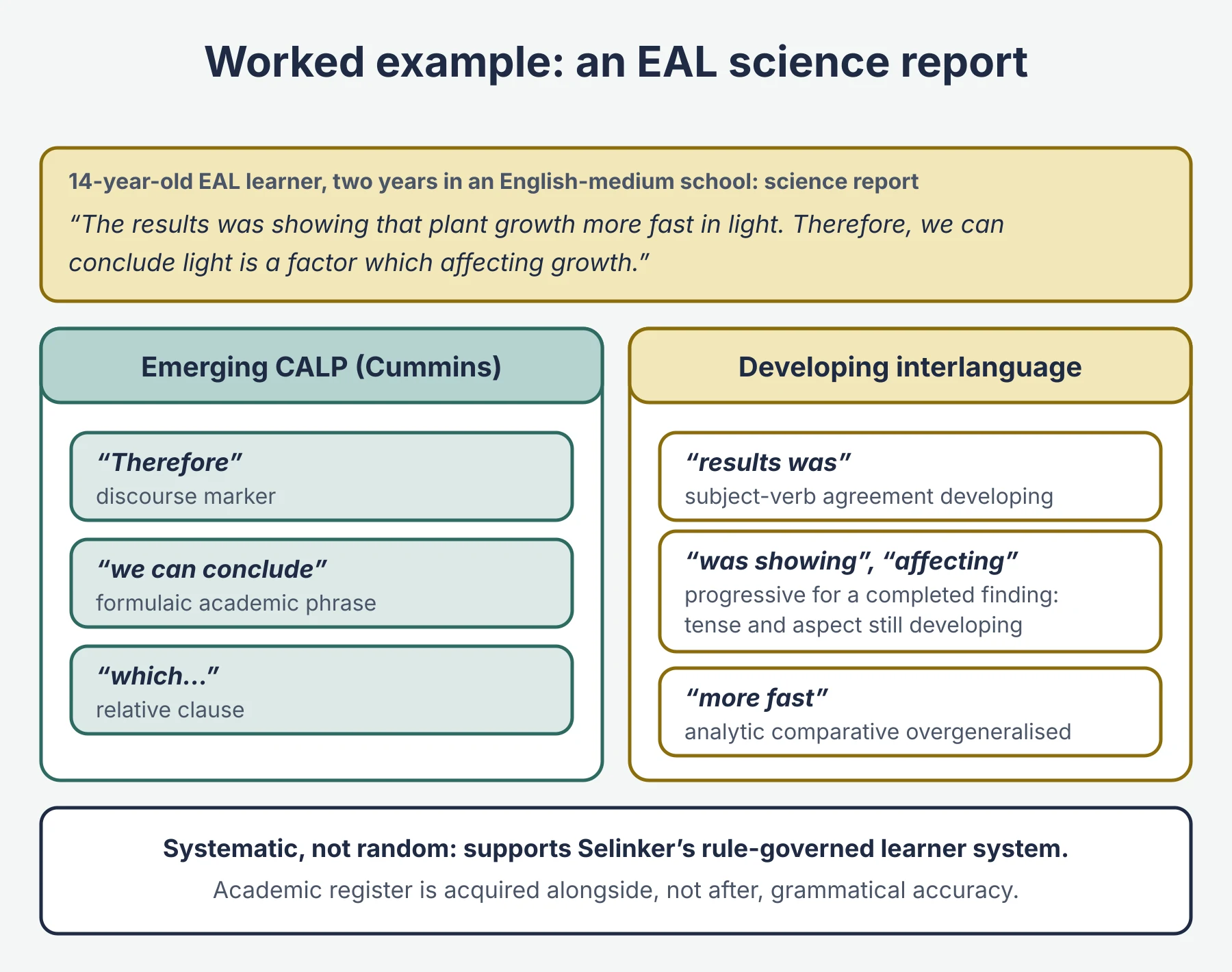
Data (original, invented): a 14-year-old EAL learner, two years in an English-medium school, writes in a science report: “The results was showing that plant growth more fast in light. Therefore, we can conclude light is a factor which affecting growth.”
Analysis:
The writer controls features of academic genre: the discourse marker “Therefore”, the formulaic “we can conclude” and the relative clause “which…” show emerging CALP in Cummins’s terms. Non-target forms are systematic rather than random. Subject-verb agreement (“results was”) and the progressive used for a completed finding (“was showing”, “affecting”) suggest an interlanguage in which tense and aspect marking are still developing, possibly influenced by a first language that marks these differently. “More fast” overgeneralises the analytic comparative rule. The data support Selinker’s view of a rule-governed learner system, and they show academic register being acquired alongside, not after, grammatical accuracy.
Common mistakes
- Revising only toddler stages when the specification includes teenagers.
- Calling EAL or teenage forms “mistakes” without explaining the system behind them.
- Ignoring writing and multimodal data in revision.
- Applying a stage model as a rigid rule.
- Listing theories without testing them against the data.
- Choosing a question without reading both sets of data.
Exam technique
Open by describing the data’s context: speaker or writer, age, language background, purpose. Organise the body by language level or theme, combining data, concept and evaluation in each paragraph. Weigh theories rather than reciting them, and finish with a judgement about what the data most clearly show about how language is learned.
Keep going
Related resources
-
Practice questions
OxfordAQA International AS and A-level English Language (9670): Section A: Learning Language – Practice Questions
Original practice for OxfordAQA 9670 Unit 3 Learning Language: child, teenage and EAL data, writing development and theory evaluation, with full answers.
English · OxfordAQA · A Level
Try questions -
Revision notes
OxfordAQA International AS and A-level English Language (9670): Section A: Learning Language – Revision Notes
Recall notes for OxfordAQA 9670 Unit 3 Learning Language: child and teenage development, writing and spelling stages, EAL concepts and analysing varied data.
English · OxfordAQA · A Level
Revise topic -
Study guides
OxfordAQA International AS and A-level English Language (9670): Section B: International English
OxfordAQA 9670 Unit 3 Section B: world Englishes and English as a lingua franca, standards, ownership and intelligibility, and how to argue an issue.
English · OxfordAQA · A Level
Read guide
Get free revision emails (optional)
Occasional emails with practice questions, worked explanations and links to free resources for the qualification and subjects you choose. No spam, and you can unsubscribe from any email. The free tools on this site never need an email.