
Revision Notes
OxfordAQA International AS and A-level English Language (9670): Section A: Learning Language – Revision Notes
Recall notes for OxfordAQA 9670 Unit 3 Learning Language: child and teenage development, writing and spelling stages, EAL concepts and analysing varied data.
- Subject
- English
- Level
- A LEVEL
- Topic
- Unit 3 – Language Variation
- Author
- Marlbridge Academic Team
- Updated
- Reviewed by
- Ammar Bilal (what this means)
Aligned to OxfordAQA A Level English (9670), Version 5.2, for International AS exams from May/June 2018, A-level from May/June 2019. Official specification .
Syllabus page (what it covers and how it is assessed): OxfordAQA A Level English Language.
Found an error? Report a correction.
Need help with this topic? Request a free trial class for A Level English Language (9670).
Condensed recall for specification section 3.3.1 Learning language of OxfordAQA International AS and A-level English Language (9670). For explanations and a worked EAL example, use the Learning Language study guide.
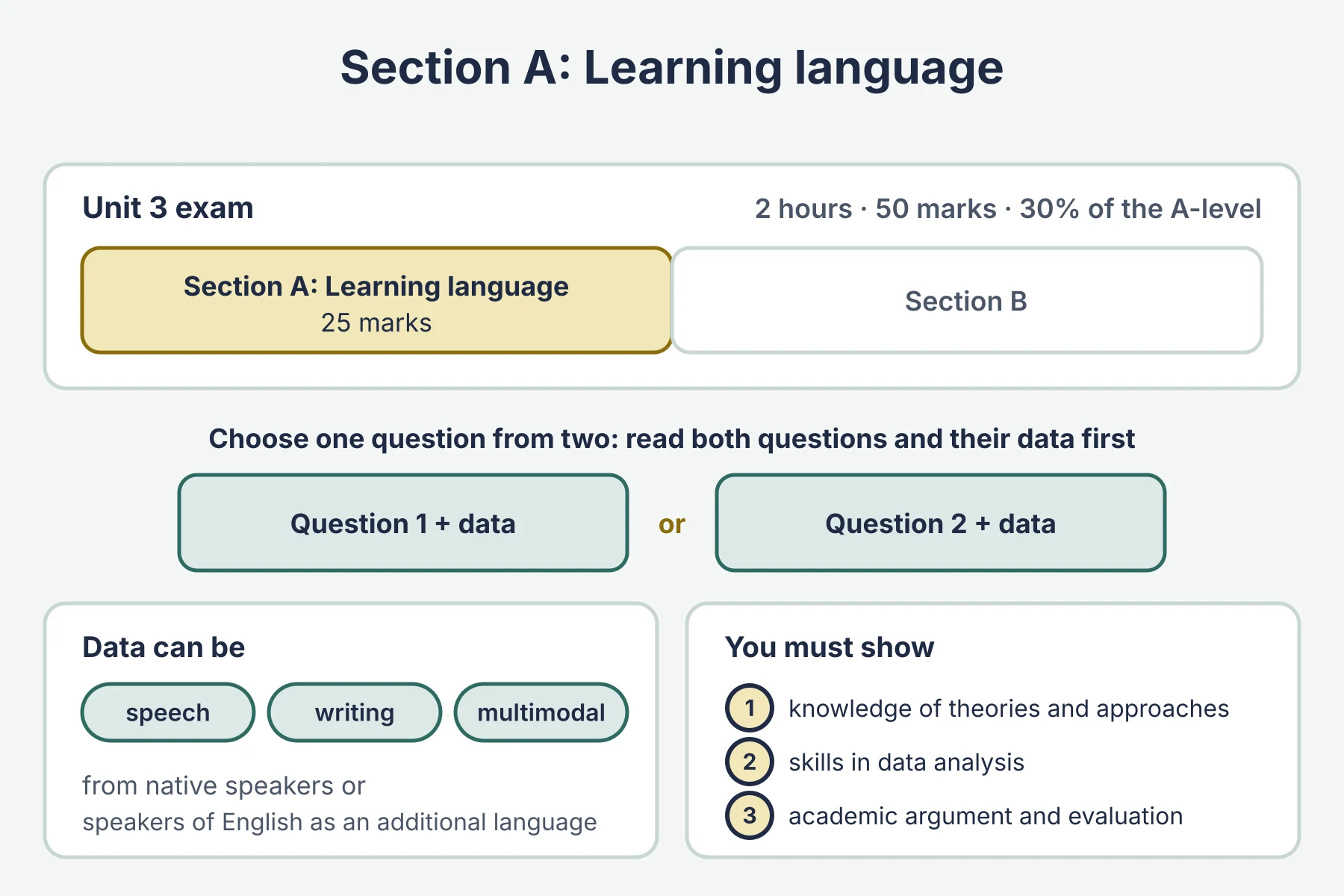
The task in brief
- Unit 3: 2 hours, 50 marks, 30% of the International A-level. Section A is worth 25 marks.
- One question from a choice of two, each with data as a starting point.
- Topic covers early acquisition in young children and later development in teenagers.
- Data: speech, writing or multimodal texts by native or EAL speakers.
- Show topic knowledge (theories and approaches), data analysis, and academic argument with evaluation.
Early childhood: quick recall
- Pre-verbal, holophrastic, two-word, telegraphic, post-telegraphic.
- Overgeneralisation (“runned”), overextension, phonological simplification.
- Theories: behaviourist (Skinner), nativist (Chomsky), cognitive (Piaget), social interactionist (Bruner).
- Caregiver features: recasts, expansions, questions, repetition.
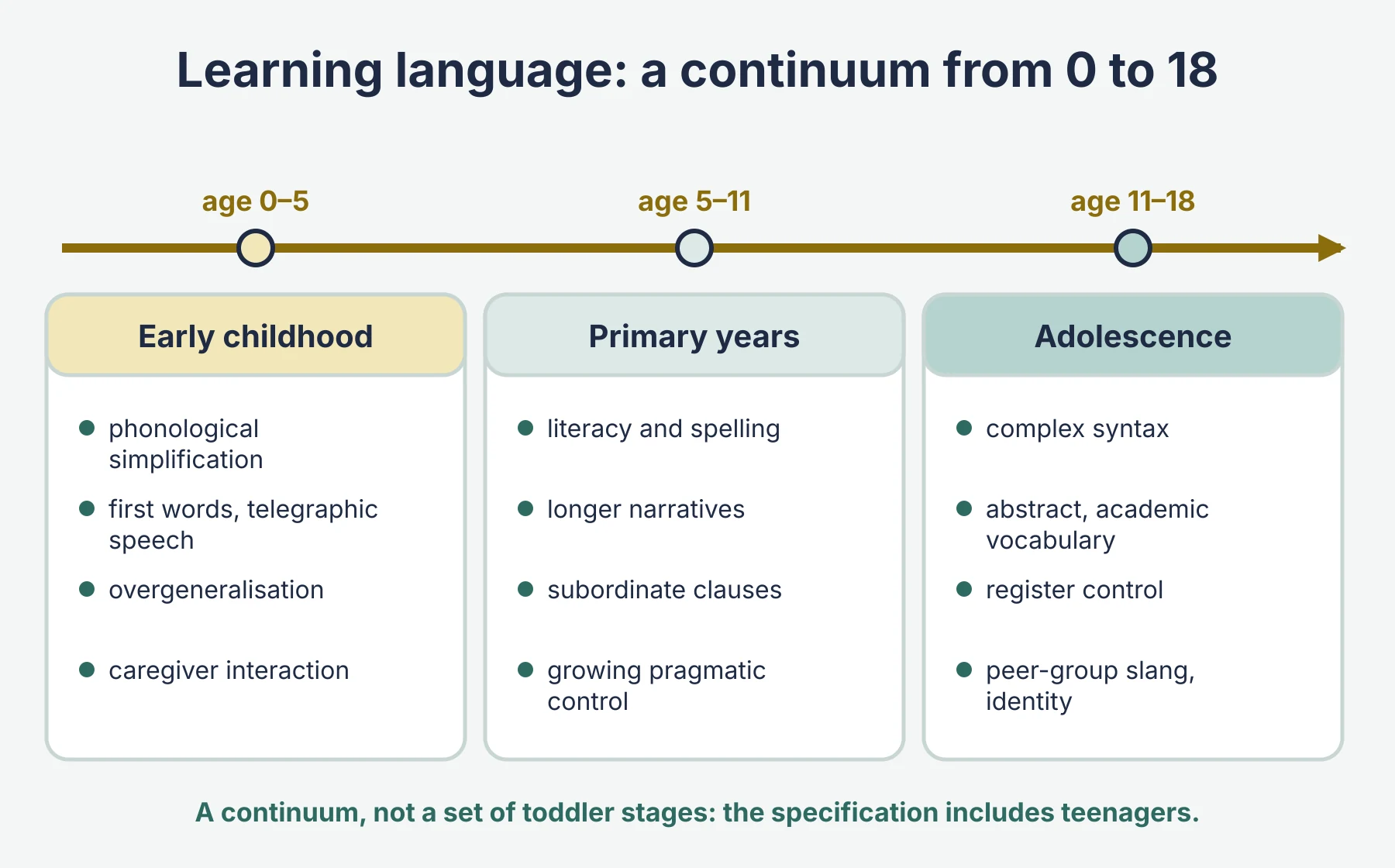
Later development (5-18)
| Area | What develops | Evidence in data |
|---|---|---|
| Grammar | Passives, relative and embedded clauses, nominalisation | “The bridge, which was built in 1900, was repaired” |
| Cohesion | Beyond “and then” | “However”, “as a result”, “on the other hand” |
| Vocabulary | Abstract, academic and subject lexis; idiom; polysemy | “photosynthesis”, “on the fence” |
| Pragmatics | Register shifts, indirect requests, irony and sarcasm, repair | “Would you mind if I…?” |
| Identity | Peer-group slang and discourse markers | “like”, “innit”, new coinages |
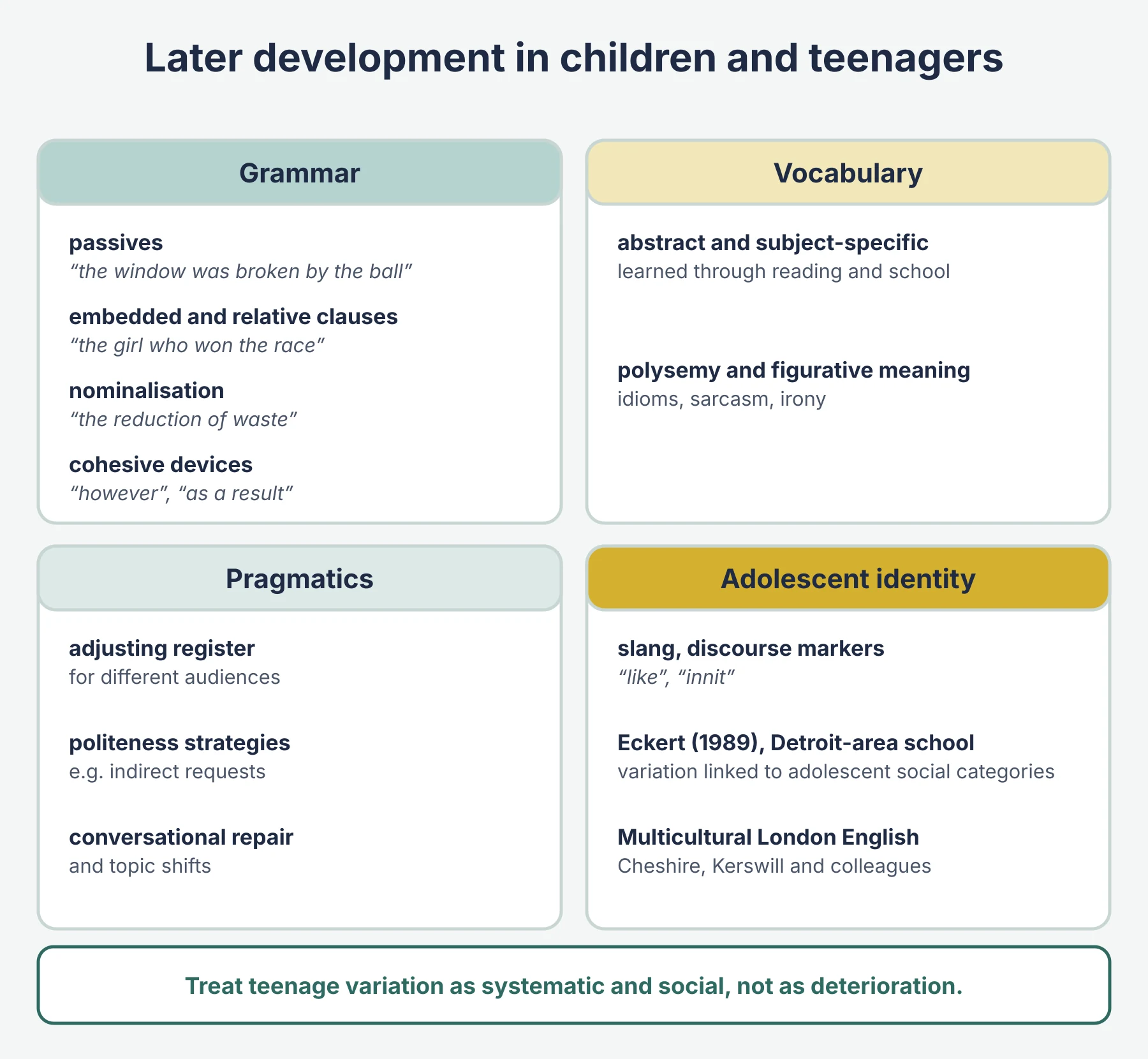
Adolescent language
- Slang and new forms often spread among teenagers first.
- Eckert (1989): language variation linked to adolescent social categories in a Detroit-area high school.
- Multicultural London English (Cheshire, Kerswill and colleagues): a new variety among young people in multilingual areas.
- Treat variation as social and systematic, not as decline.
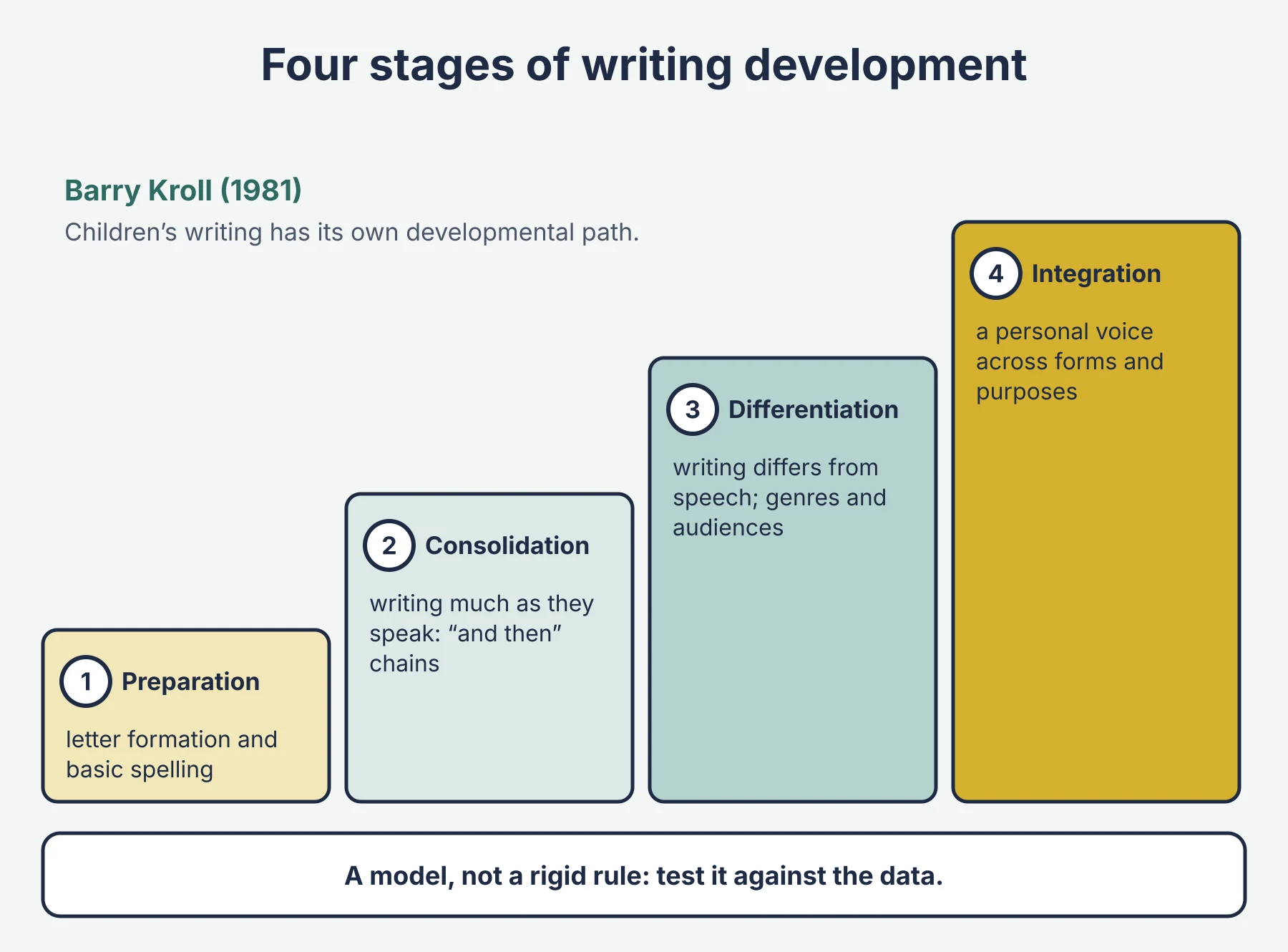
Writing development
Kroll (1981)
- Preparation: letter formation, basic spelling.
- Consolidation: writing like speech.
- Differentiation: writing distinguished from speech; genre awareness.
- Integration: a controlled personal voice across forms.
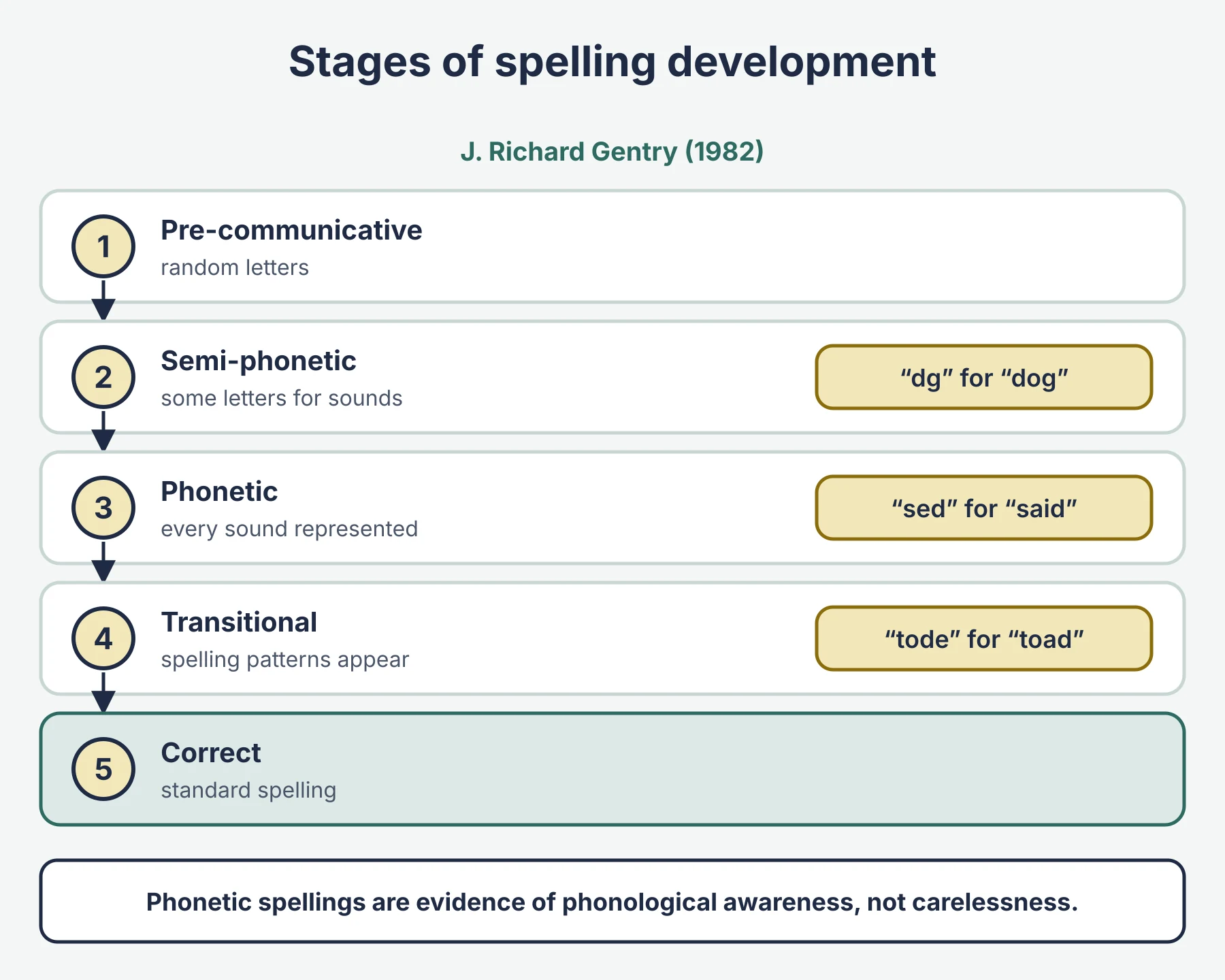
Spelling stages (Gentry, 1982): pre-communicative, semi-phonetic, phonetic, transitional, correct.
What to analyse: spelling patterns, punctuation, sentence structure, cohesion, genre conventions, audience awareness, influence of teaching and reading.
EAL learners
| Concept | Meaning |
|---|---|
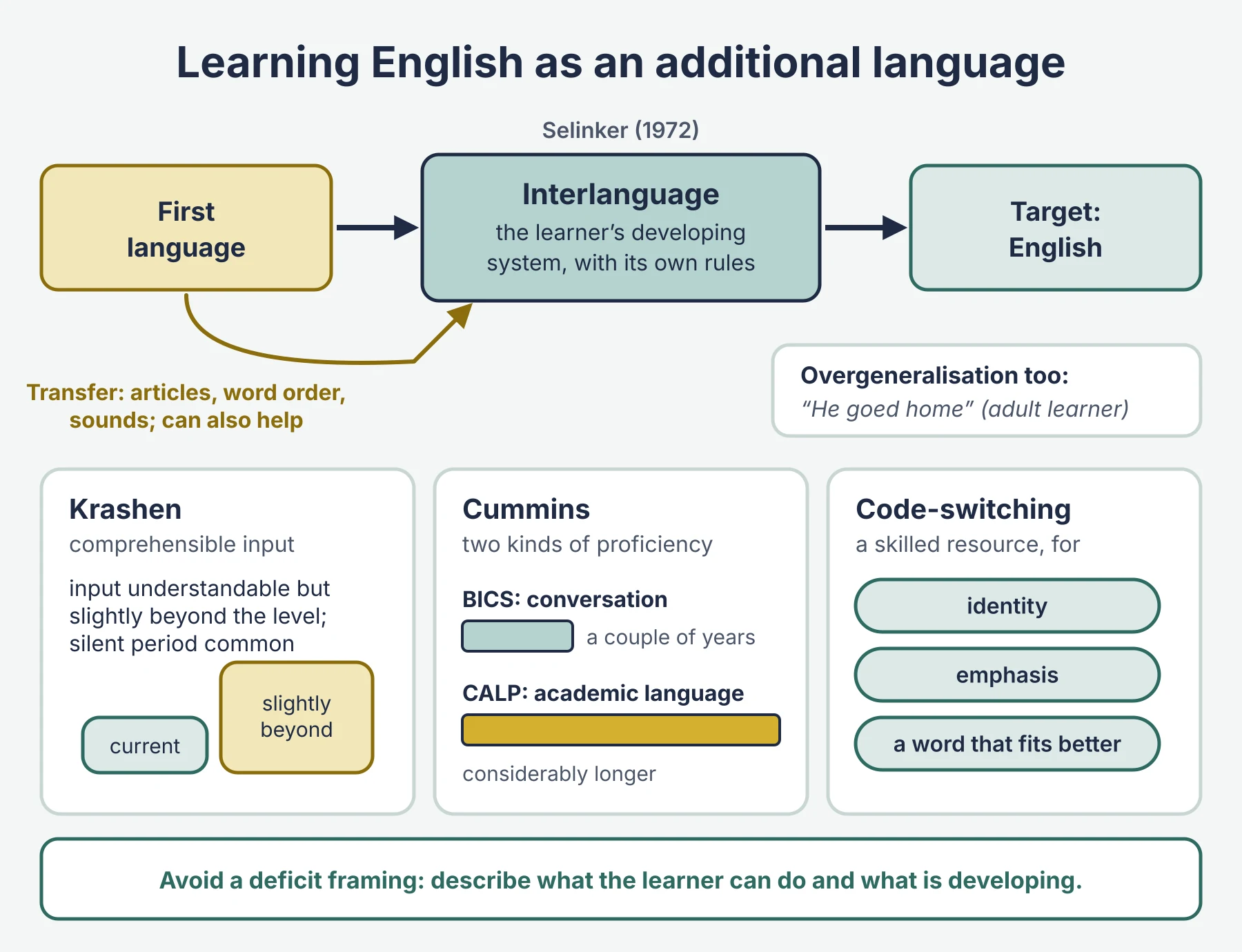
| Interlanguage (Selinker, 1972) | The learner’s rule-governed developing system between first language and target |
| Transfer | First-language features carried into English; can help or produce non-target forms |
| Overgeneralisation | Applying a rule too widely (“goed”, “more fast”) |
| Comprehensible input (Krashen) | Input just beyond the learner’s current level drives acquisition |
| Silent period | A phase of listening more than speaking |
| BICS and CALP (Cummins) | Conversational fluency develops faster than academic language proficiency |
| Code-switching | Moving between languages as a resource for identity, emphasis or precision |
Multimodal data
- Abbreviations, emoji, expressive spelling (“sooo”), punctuation for tone.
- Crystal (2008): texting has not damaged literacy; playing with spelling needs knowledge of the standard.
- Research by Clare Wood and colleagues found no evidence that textism use harmed children’s spelling.
Analysis method
- Context: age, language background, mode, purpose, audience.
- Select three to five features across levels.
- Name and quote each precisely.
- Explain what the learner can do and what is developing.
- Evaluate a theory or model against the evidence.
- Judge what the data most clearly show.
Model analytical sentences
- Child writing: “Sed” represents every sound in “said”, showing phonetic spelling: the child has strong phonological awareness but has not yet learned that this common word is irregular.
- Teenage speech: The discourse marker “lowkey” hedges the claim “I failed”, softening it in a peer-approved style and marking the speaker as part of a shared adolescent register.
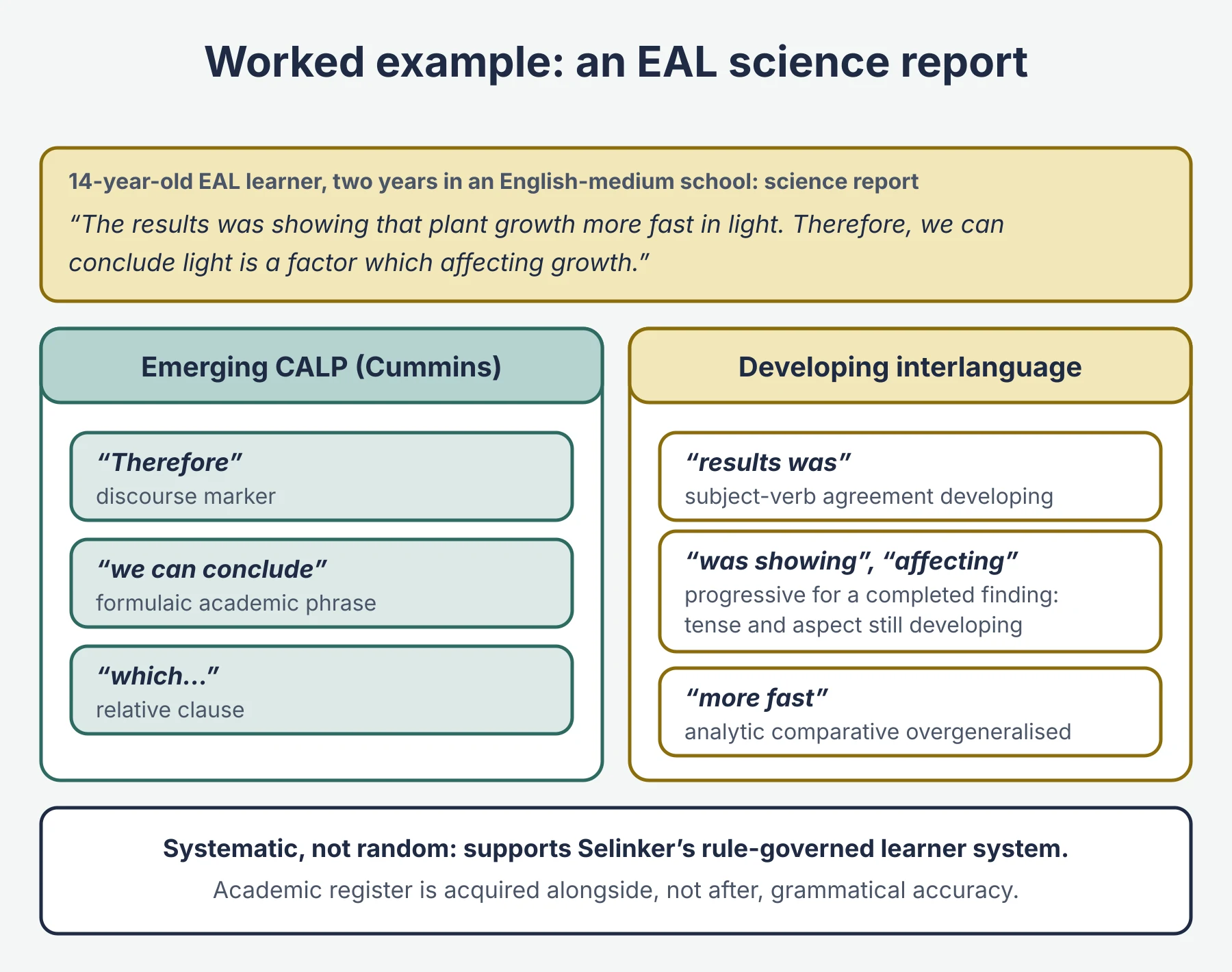
- EAL speech: “Yesterday I go” marks time with the adverb but not the verb, a systematic interlanguage feature that may reflect first-language transfer rather than random error.
Choosing between the two questions
- Read both questions and both data sets before deciding.
- Prefer the data where you can find features across several language levels.
- Prefer the question whose claim you can evaluate, not just describe.
- Check you know at least two concepts or theories that fit the data.
Exam traps
- Revising only toddler stages.
- Labelling EAL or teenage forms as errors.
- Ignoring writing or multimodal data.
- Stage models applied rigidly.
- Theories recited rather than tested.
- Choosing a question without reading both sets of data.
Self-test
- What two age ranges does the specification include?
- What kinds of data may be provided?
- How many questions do you answer in Section A?
- Name Kroll’s four stages.
- What does a phonetic spelling such as “sed” show?
- Define interlanguage.
- Give one example of positive and one of negative transfer.
- What is the difference between BICS and CALP?
- What is a silent period?
- Give two features of later grammatical development.
- What did Eckert’s high-school research link?
- Why does Crystal argue texting does not damage literacy?
Answers: 1. Early acquisition in young children and later development in teenagers. 2. Speech, writing or multimodal texts, from native or EAL speakers. 3. One, from a choice of two. 4. Preparation, consolidation, differentiation, integration. 5. That the child represents each sound they hear, showing phonological awareness. 6. Selinker’s term for a learner’s developing, rule-governed system between the first language and the target. 7. Positive: a cognate word shared with the first language; negative: article omission carried over from a first language without articles. 8. BICS are conversational skills, developed relatively quickly; CALP is academic language proficiency, which takes longer. 9. A phase in which a new learner listens and understands more than they speak. 10. Any two: passives; relative and embedded clauses; nominalisation; wider cohesive devices. 11. Language variation and adolescent social categories. 12. Because deliberate non-standard spellings depend on knowing the standard forms, so texting can involve literacy skills rather than replace them.
Try the Learning Language practice questions, then review the whole unit with the Unit 3 revision notes.
Related resources
-
Study guides
OxfordAQA International AS and A-level English Language (9670): Section B: International English
OxfordAQA 9670 Unit 3 Section B: world Englishes and English as a lingua franca, standards, ownership and intelligibility, and how to argue an issue.
English · OxfordAQA · A Level
Read guide -
Practice questions
OxfordAQA International AS and A-level English Language (9670): Section B: International English – Practice Questions
Original practice for OxfordAQA 9670 Unit 3 International English: world Englishes, lingua franca research, standards debates and issue essays, with answers.
English · OxfordAQA · A Level
Try questions -
Revision notes
OxfordAQA International AS and A-level English Language (9670): Section B: International English – Revision Notes
Recall notes for OxfordAQA 9670 Unit 3 International English: world Englishes, English as a lingua franca, key models, the standards debate and essay method.
English · OxfordAQA · A Level
Revise topic
Get free revision emails (optional)
Occasional emails with practice questions, worked explanations and links to free resources for the qualification and subjects you choose. No spam, and you can unsubscribe from any email. The free tools on this site never need an email.