
Revision Notes
OxfordAQA International AS and A-level English Language (9670): Section B: International English – Revision Notes
Recall notes for OxfordAQA 9670 Unit 3 International English: world Englishes, English as a lingua franca, key models, the standards debate and essay method.
- Subject
- English
- Level
- A LEVEL
- Topic
- Unit 3 – Language Variation
- Author
- Marlbridge Academic Team
- Updated
- Reviewed by
- Ammar Bilal (what this means)
Aligned to OxfordAQA A Level English (9670), Version 5.2, for International AS exams from May/June 2018, A-level from May/June 2019. Official specification .
Syllabus page (what it covers and how it is assessed): OxfordAQA A Level English Language.
Found an error? Report a correction.
Need help with this topic? Request a free trial class for A Level English Language (9670).
Condensed recall for specification section 3.3.2 International English of OxfordAQA International AS and A-level English Language (9670). For explanations and a model paragraph, use the International English study guide.
The task in brief
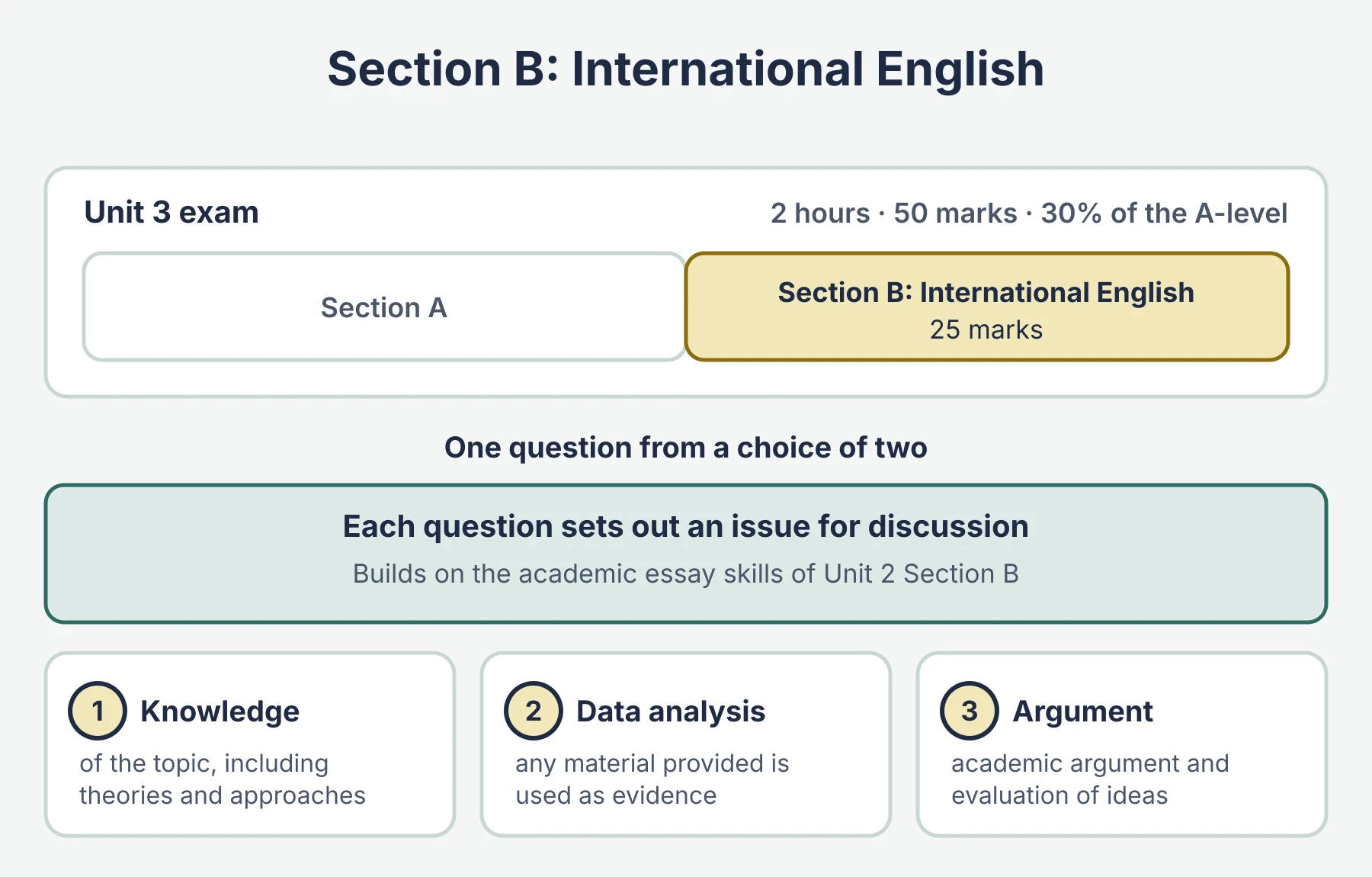
- Unit 3: 2 hours, 50 marks, 30% of the International A-level. Section B is worth 25 marks.
- One question from a choice of two. Questions set out an issue for discussion.
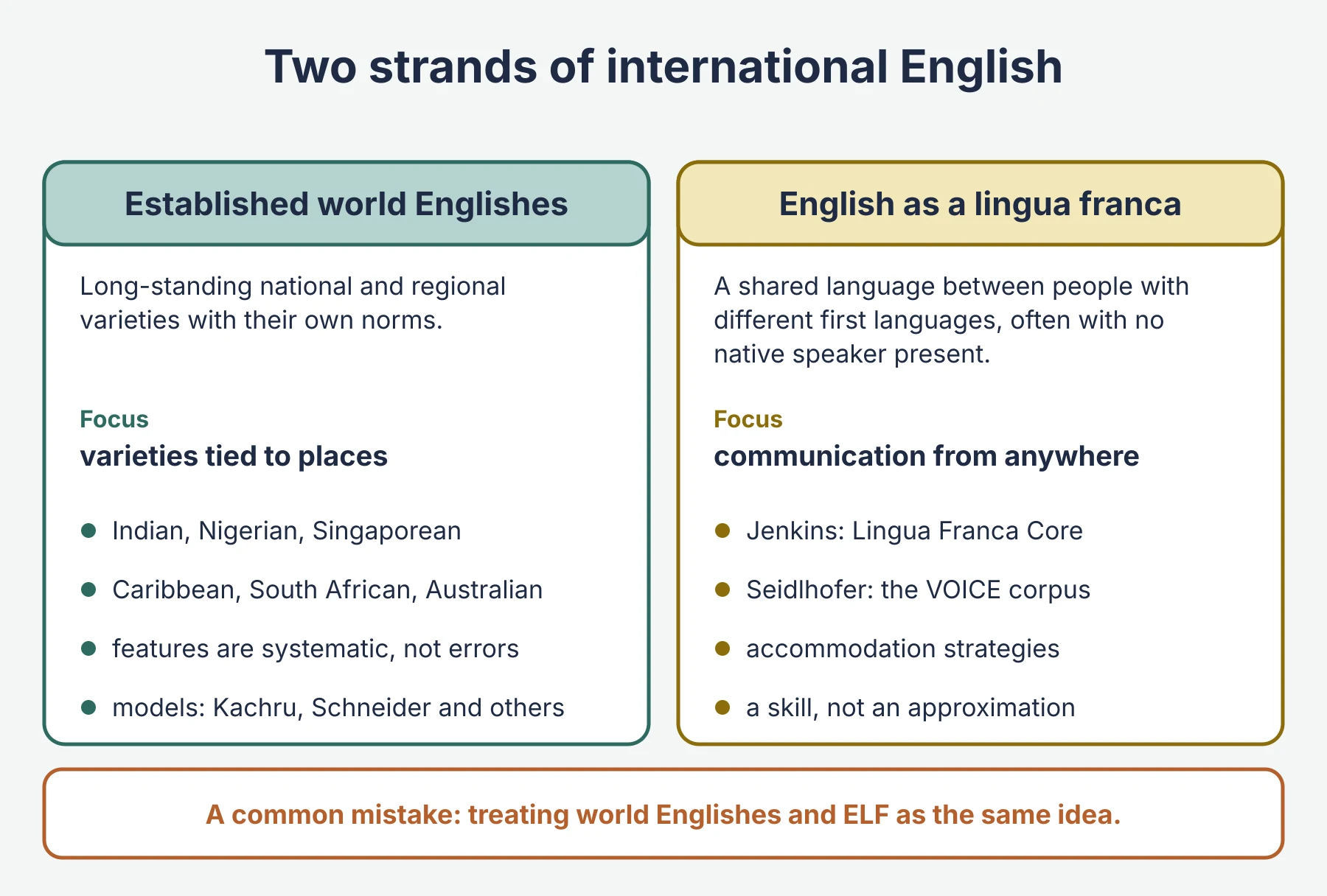
- “International English” covers established world English and English as a global lingua franca.
- Builds on Unit 2 Section B essay skills: thesis, evidence, counter-argument, judgement.
Two strands, kept distinct
| World Englishes | English as a lingua franca (ELF) | |
|---|---|---|
| Focus | Varieties tied to places and communities | Communication between speakers of different first languages |
| Unit of study | A national or regional variety | An interaction |
| Key question | Are local norms legitimate? | What makes communication succeed? |
| Example | Nigerian English, Singapore English | A meeting of engineers from Brazil, Korea and Germany |
Models
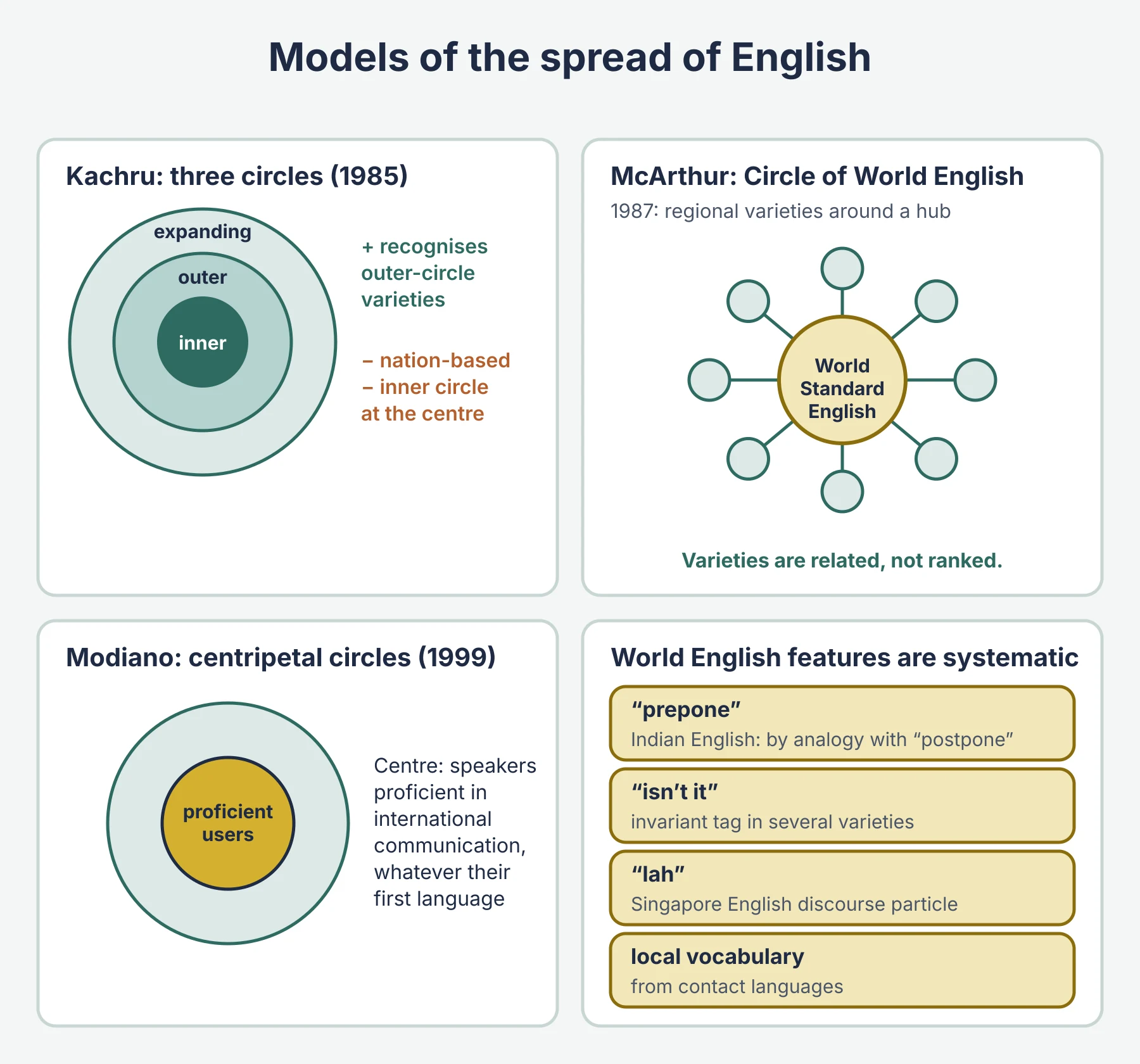
- Kachru (1985): inner, outer and expanding circles. Strength: legitimises outer-circle varieties. Limits: nation-based; inner circle stays central; misses ELF.
- McArthur (1987): Circle of World English; World Standard English at the hub, regional varieties around it.
- Modiano (1999): centripetal circles; proficiency in international communication at the centre, not nativeness.
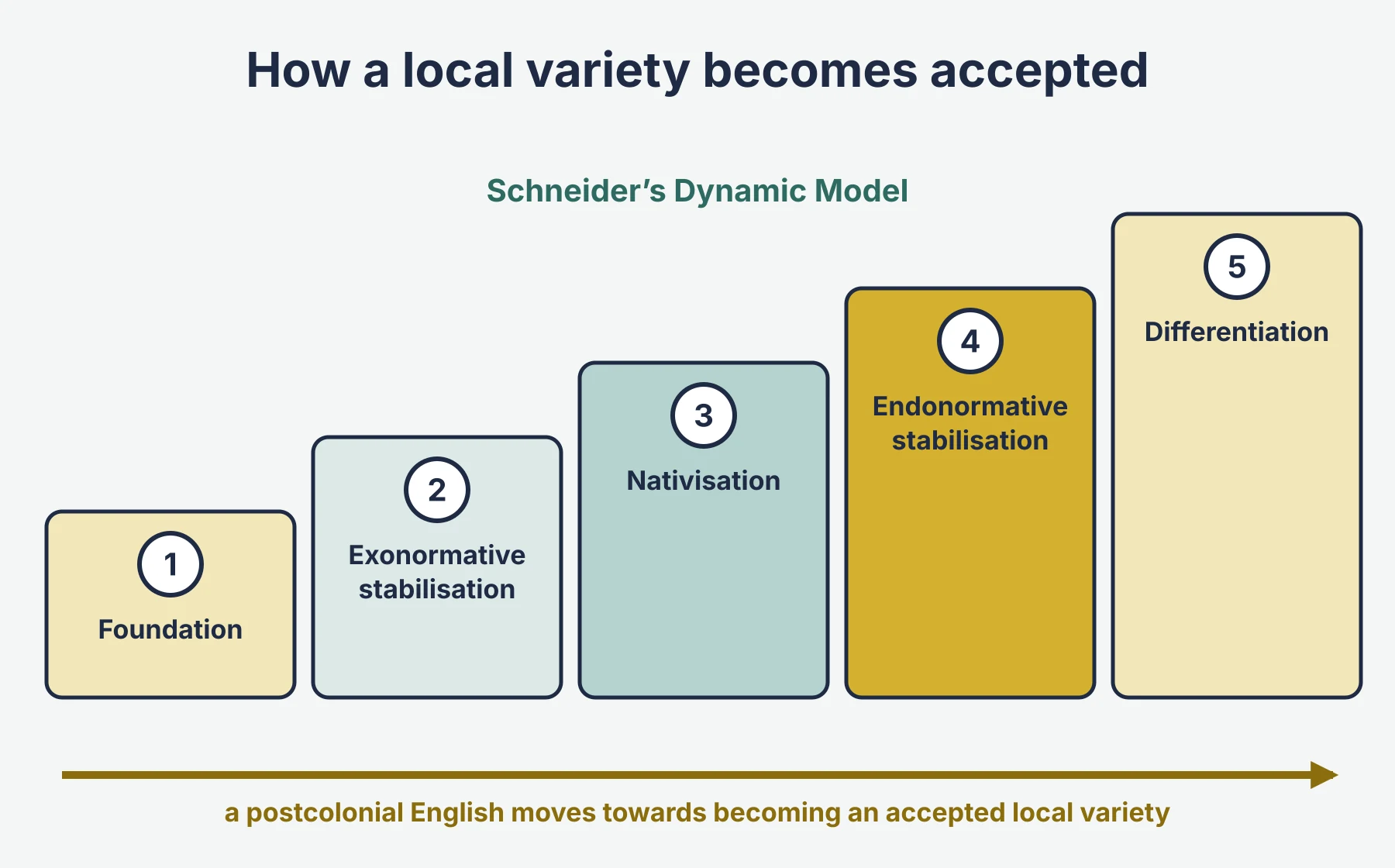
- Schneider: Dynamic Model; foundation, exonormative stabilisation, nativisation, endonormative stabilisation, differentiation.
ELF research
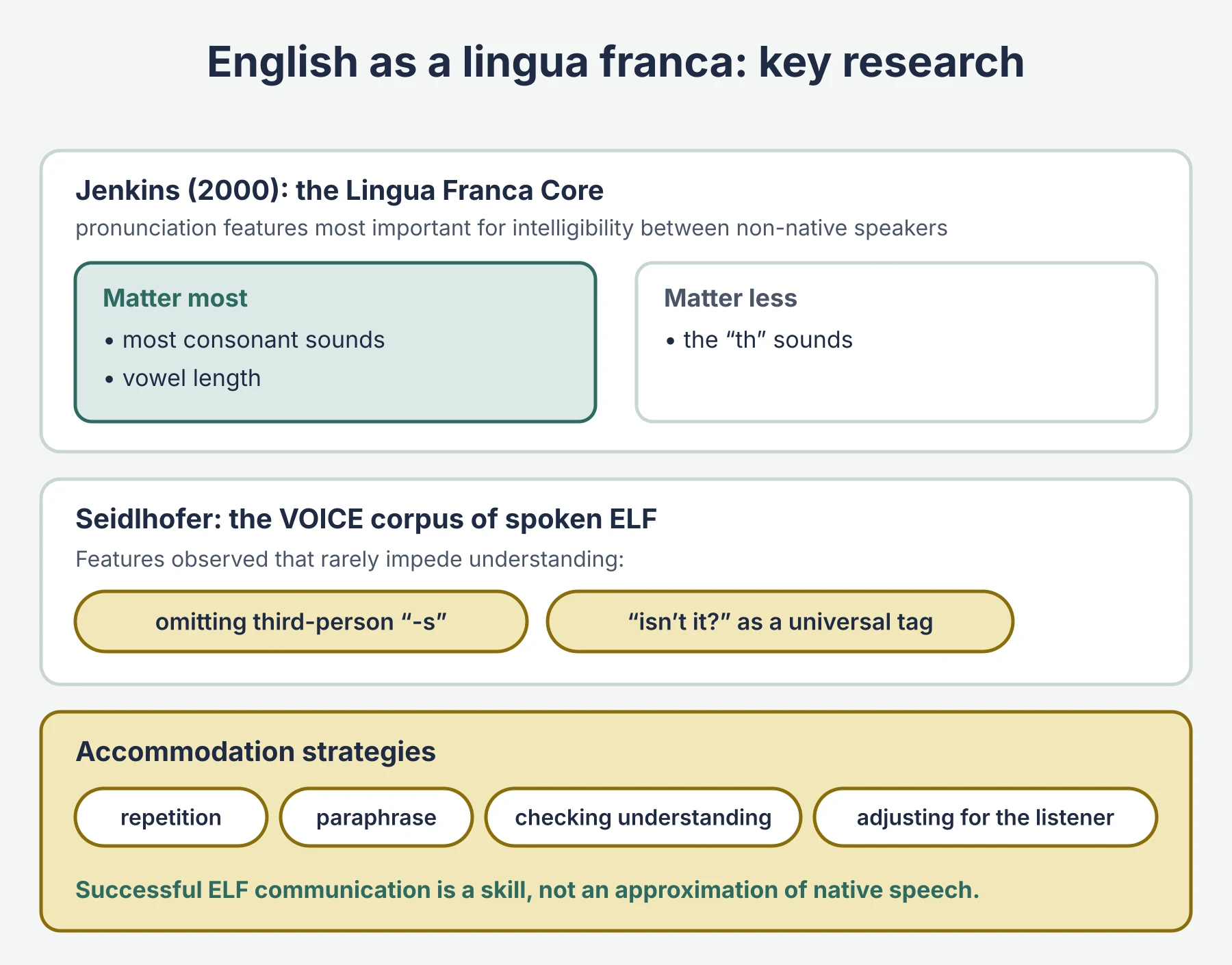
- Jenkins (2000): Lingua Franca Core; the pronunciation features that matter most for intelligibility between non-native speakers. The “th” sounds are less critical.
- Seidlhofer: VOICE corpus of spoken ELF; observed features such as omitting third-person “-s” and an invariant “isn’t it?” tag that rarely impede understanding.
- Accommodation strategies: repetition, paraphrase, clarification requests, checking understanding.
Debates
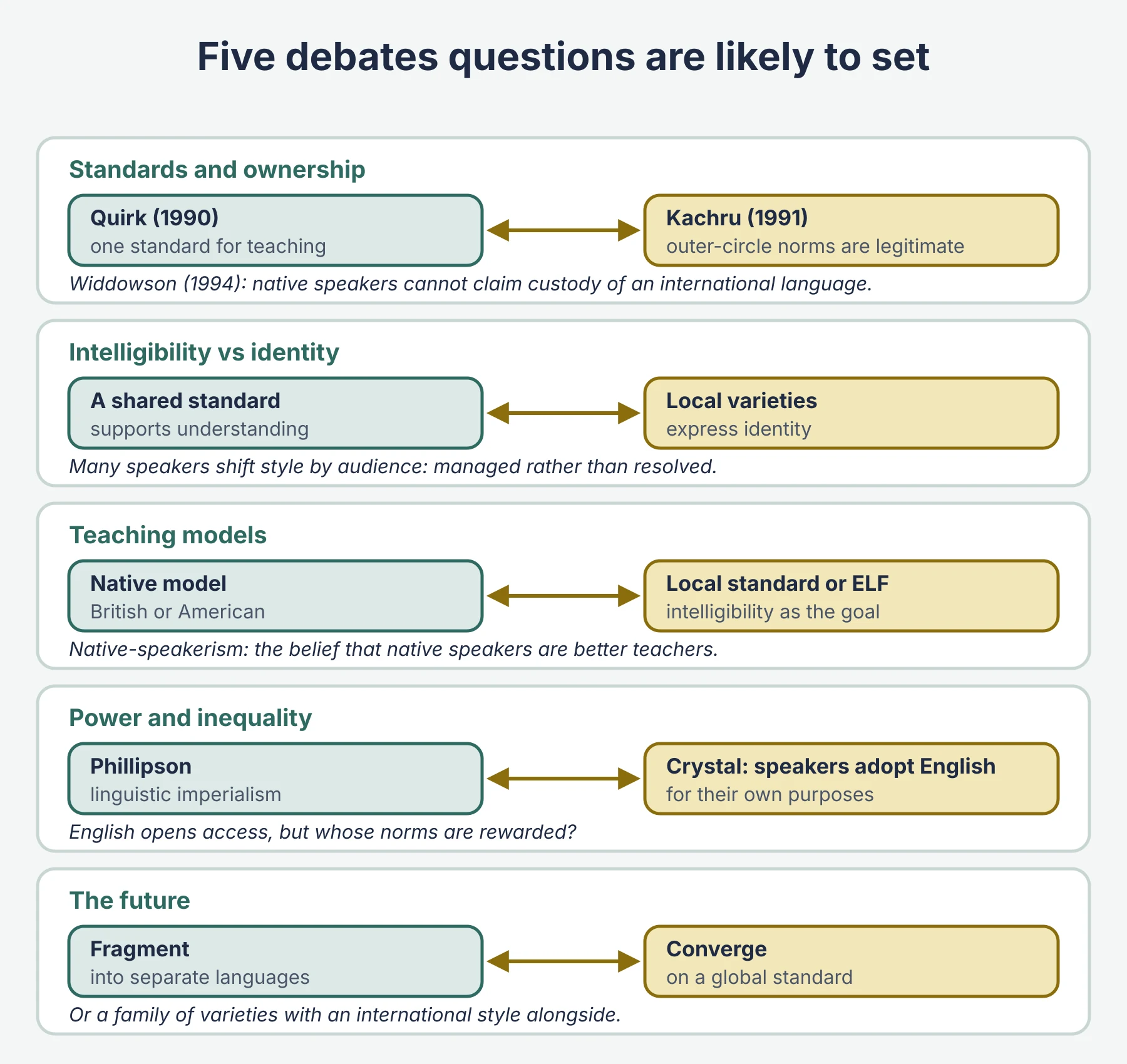
| Debate | Position A | Position B |
|---|---|---|
| Standards | Quirk (1990): a single standard for teaching | Kachru (1991): outer-circle varieties have their own norms |
| Ownership | Native speakers as norm-providers | Widdowson (1994): no group owns an international language |
| Intelligibility v identity | Shared standard aids understanding | Local varieties express identity; speakers can shift between styles |
| Teaching models | Native-speaker model (British or American) | Local standard or ELF intelligibility; critique of native-speakerism |
| Power | Phillipson: linguistic imperialism | Crystal: speakers adopt English for their own purposes |
| Future | Fragmentation into separate languages | Continued family of varieties with an international style |
Key terms
| Term | Meaning |
|---|---|
| Lingua franca | A shared language between speakers with different first languages |
| World Englishes | The plural, legitimate varieties of English around the world |
| Endonormative | Norms drawn from within the community |
| Exonormative | Norms imported from outside |
| Intelligibility | Being understood by the listener |
| Accommodation | Adjusting speech to aid a listener’s understanding |
| Native-speakerism | The belief that native speakers are inherently better models or teachers |
| Nativisation | Development of local features in a transplanted variety |
Example features (systematic, not errors)
- Indian English “prepone” (bring forward), by analogy with “postpone”.
- Invariant tag “isn’t it?” in several varieties and in ELF.
- Singapore English discourse particle “lah”.
- Local loanwords from contact languages.
Essay method
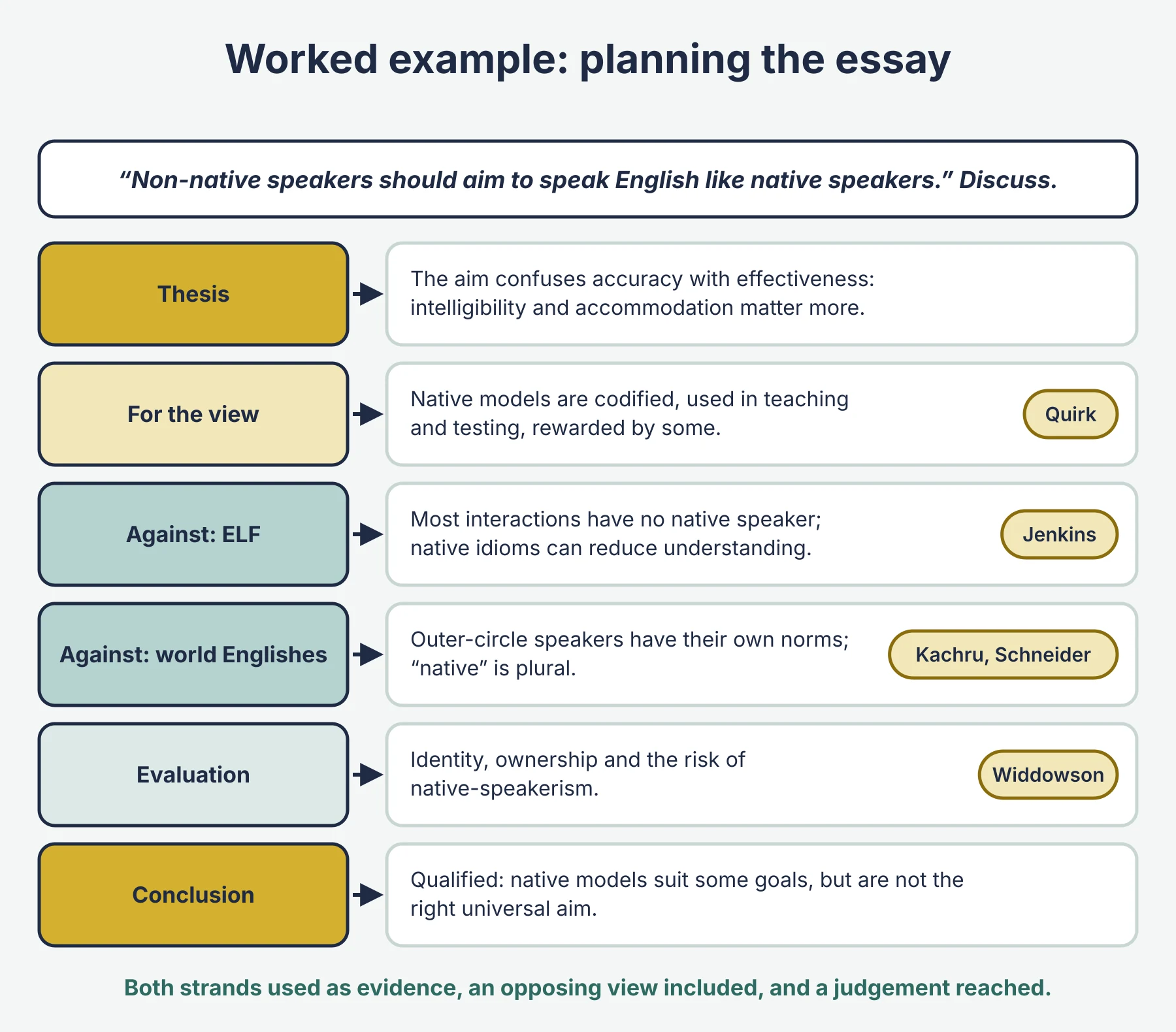
- Restate the issue as a claim to test.
- Thesis in the introduction.
- Paragraphs drawing on both strands, each with a concept, study or example.
- A counter-argument that you take seriously.
- A judgement that answers the issue.
- Use any material the question provides as evidence.
Model argument sentences
- Thesis: The claim that learners should copy native speakers rests on an outdated picture of who uses English; for most international users, intelligibility and accommodation matter more.
- Evidence: Jenkins’s Lingua Franca Core suggests that only certain pronunciation features affect understanding between non-native speakers, so native-like “th” sounds are not a priority.
- Counter: Nevertheless, native models remain embedded in testing and publishing, so learners may have practical reasons to aim for them.
- Judgement: The native model is therefore one option for particular goals, not a universal standard.
Exam traps
- Merging world Englishes and ELF.
- Kachru described but not evaluated.
- Local or ELF features called errors.
- A descriptive survey instead of an argument.
- Unsourced numbers of speakers.
- Provided material ignored.
Self-test
- What two ideas does the specification’s label “international English” include?
- What does a Section B question set out?
- Which earlier skills does this section build on?
- Give one strength and one limitation of Kachru’s model.
- What does Modiano put at the centre of his model?
- What is the Lingua Franca Core?
- Give two features observed in ELF that rarely impede understanding.
- Summarise the Quirk-Kachru debate.
- What did Widdowson argue about ownership?
- Define native-speakerism.
- Give one argument for a native-speaker teaching model and one against.
- Why is “prepone” not an error?
Answers: 1. Established world English and the more recent expansion of English globally as a lingua franca. 2. An issue for discussion. 3. The academic argument skills of Unit 2 Section B. 4. Strength: it recognises outer-circle varieties as legitimate. Limitation: any one of nation-based, inner circle central, misses ELF. 5. Speakers proficient in international communication, whatever their first language. 6. Jenkins’s set of pronunciation features most important for intelligibility between non-native speakers. 7. Omitting third-person “-s”; using “isn’t it?” as an invariant tag. 8. Quirk argued for a single standard for teaching; Kachru replied that outer-circle varieties have their own legitimate norms. 9. That native speakers cannot claim custody of an international language. 10. The belief that native speakers are inherently better models or teachers. 11. For: widely codified and used in testing. Against: most interactions involve non-native speakers, so intelligibility matters more. 12. It is a systematic coinage formed by analogy, established within a variety with its own norms.
Try the International English practice questions, then review the whole unit with the Unit 3 revision notes.
Related resources
-
Study guides
OxfordAQA International AS and A-level English Language (9670): Section A: Learning Language
OxfordAQA 9670 Unit 3 Section A: language learning from early childhood to the teenage years, writing development, EAL learners and analysing data.
English · OxfordAQA · A Level
Read guide -
Practice questions
OxfordAQA International AS and A-level English Language (9670): Section A: Learning Language – Practice Questions
Original practice for OxfordAQA 9670 Unit 3 Learning Language: child, teenage and EAL data, writing development and theory evaluation, with full answers.
English · OxfordAQA · A Level
Try questions -
Revision notes
OxfordAQA International AS and A-level English Language (9670): Section A: Learning Language – Revision Notes
Recall notes for OxfordAQA 9670 Unit 3 Learning Language: child and teenage development, writing and spelling stages, EAL concepts and analysing varied data.
English · OxfordAQA · A Level
Revise topic
Get free revision emails (optional)
Occasional emails with practice questions, worked explanations and links to free resources for the qualification and subjects you choose. No spam, and you can unsubscribe from any email. The free tools on this site never need an email.