
Study Guides
OxfordAQA International AS and A-level English Language (9670): Section B: International English
OxfordAQA 9670 Unit 3 Section B: world Englishes and English as a lingua franca, standards, ownership and intelligibility, and how to argue an issue.
- Subject
- English
- Level
- A LEVEL
- Topic
- Unit 3 – Language Variation
- Author
- Marlbridge Academic Team
- Updated
- Reviewed by
- Ammar Bilal (what this means)
Aligned to OxfordAQA A Level English (9670), Version 5.2, for International AS exams from May/June 2018, A-level from May/June 2019. Official specification .
Syllabus page (what it covers and how it is assessed): OxfordAQA A Level English Language.
Found an error? Report a correction.
Need help with this topic? Request a free trial class for A Level English Language (9670).
Section B of Unit 3, Language variation, in the OxfordAQA International AS and A-level English Language specification (9670) is specification section 3.3.2 International English. The specification takes “international English” as a label covering two ideas: established world English (the long-standing varieties of English around the world) and the more recent expansion of English globally as a lingua franca. Questions set out an issue for discussion, and the section builds on the skills developed in Section B of Unit 2, the academic essay. This guide explains the two strands, the debates that connect them, and how to turn knowledge into an argued answer.
What the section requires
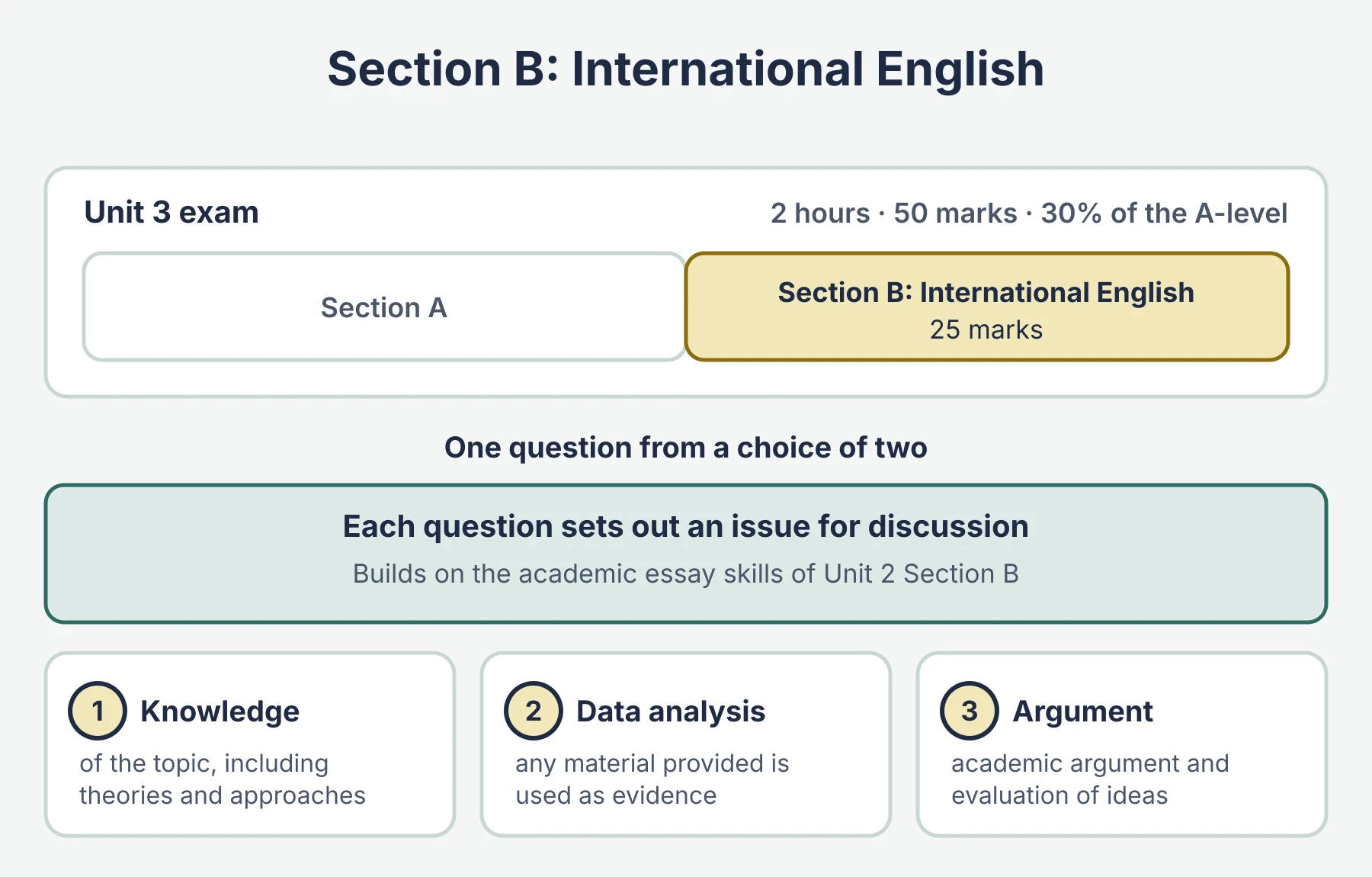
Unit 3 is a 2-hour exam worth 50 marks and 30% of the International A-level. Section B is worth 25 marks, and you answer one question from a choice of two. Across the unit you need knowledge of the topic, including different theories and approaches; skills in data analysis; and skills in academic argument and evaluation of ideas. Any data or material a question provides should be used as evidence, not just mentioned.
Strand 1: established world Englishes
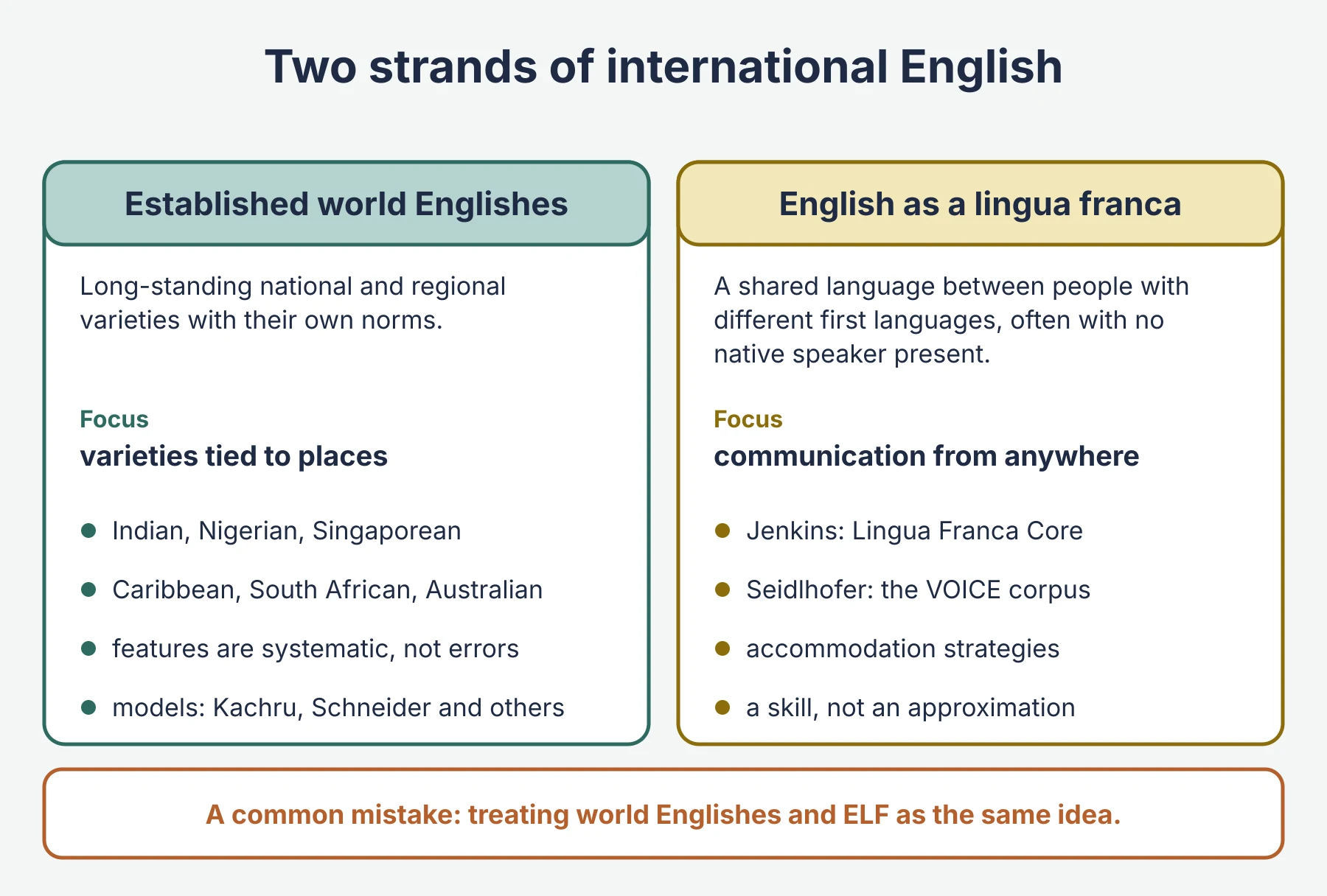
World Englishes are national and regional varieties with their own norms: Indian, Nigerian, Singaporean, Caribbean, South African, Australian and many more.
Models of the spread
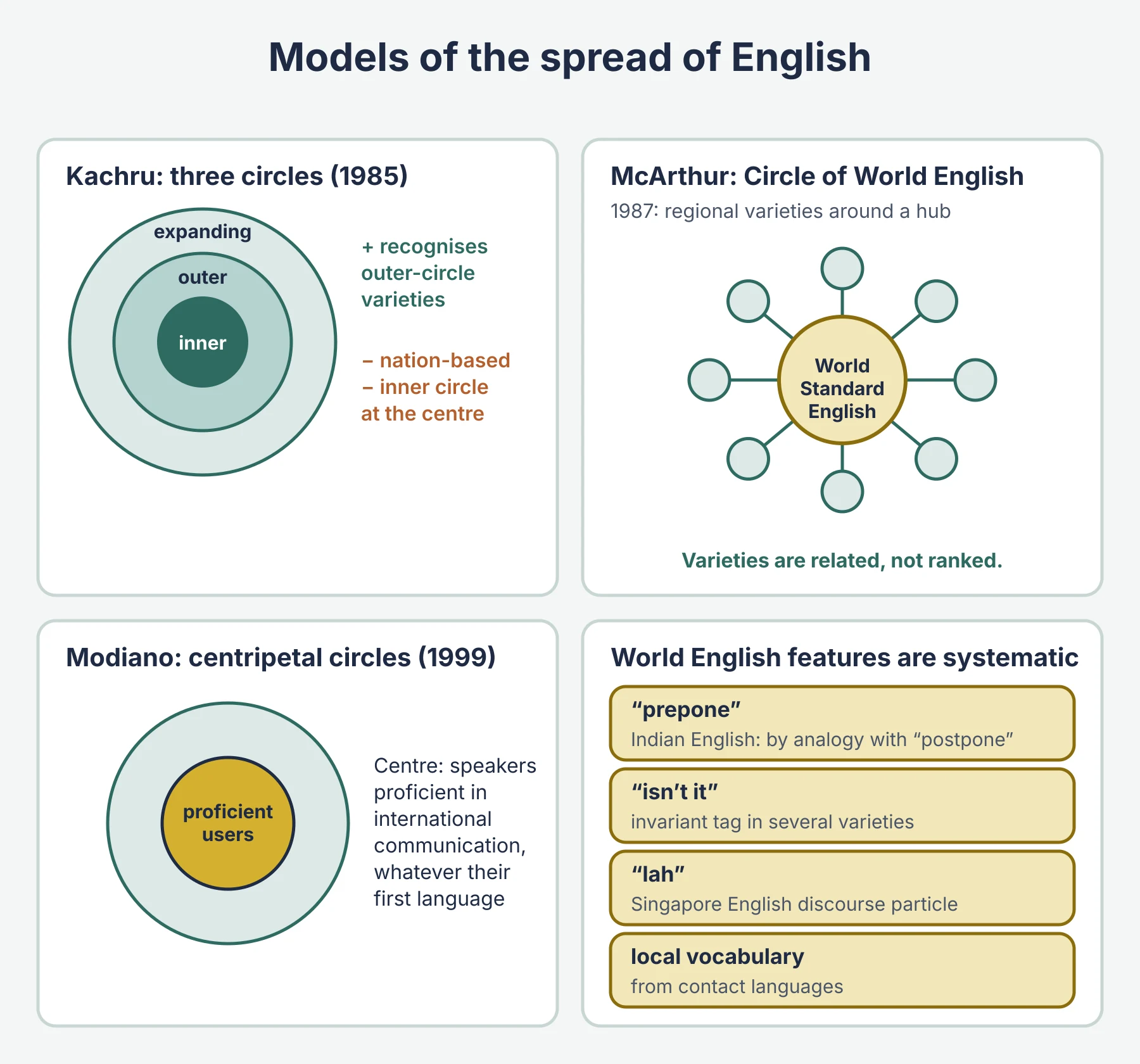
- Kachru’s three circles (1985): inner (English as the main first language), outer (institutional role after colonial history) and expanding (foreign-language use). Valuable for recognising outer-circle varieties; criticised for being nation-based and for keeping the inner circle at the centre.
- McArthur’s Circle of World English (1987): a wheel with “World Standard English” at the hub and regional standards and varieties around it, presenting varieties as related rather than ranked.
- Modiano’s centripetal circles (1999): places at the centre speakers who are proficient in international communication, whatever their first language, rather than native speakers.
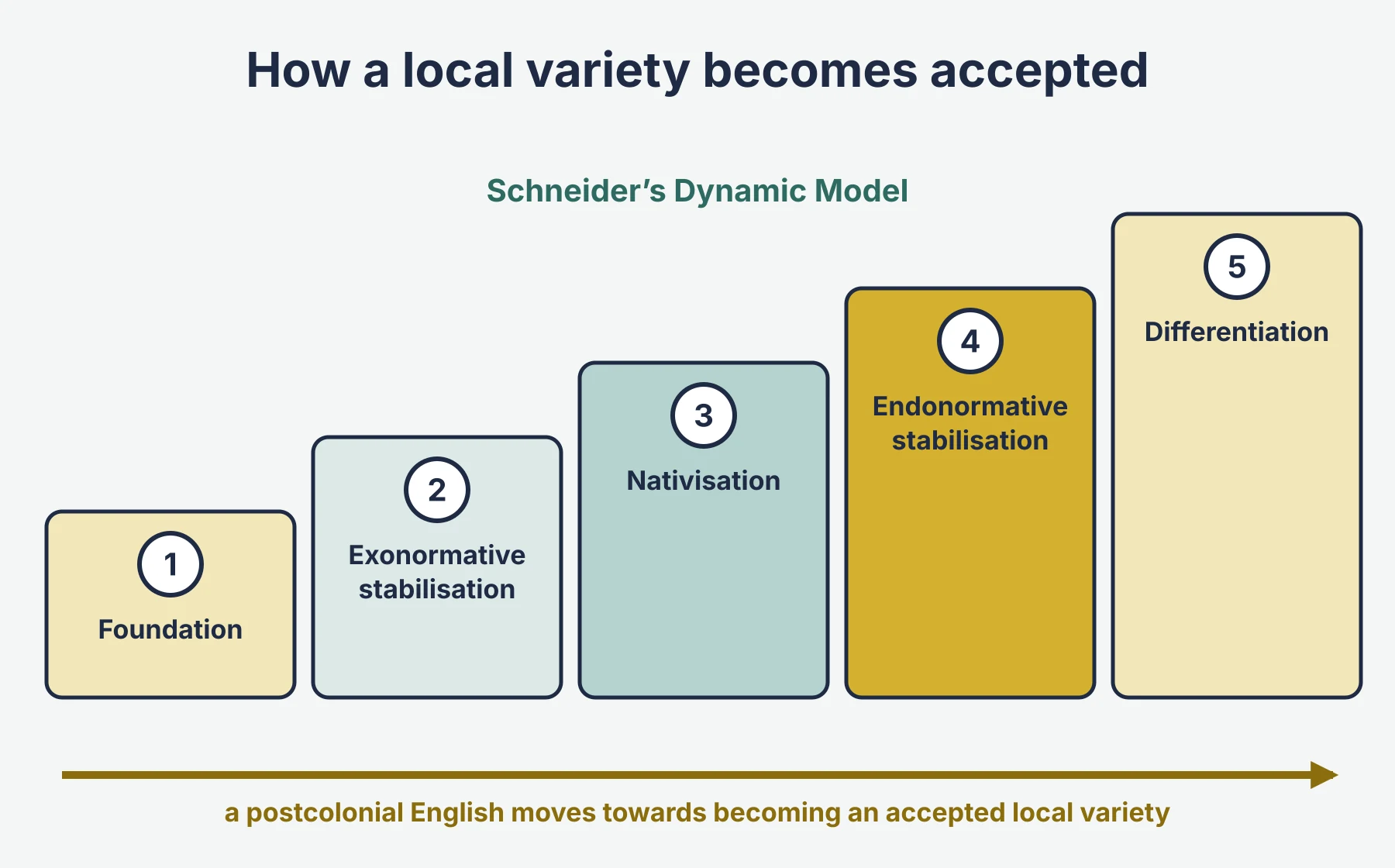
- Schneider’s Dynamic Model: postcolonial Englishes move from foundation to exonormative stabilisation, nativisation, endonormative stabilisation and differentiation, explaining how a local variety becomes accepted.
Features of world Englishes are systematic, not errors. Examples you can use: Indian English “prepone” (to bring forward), coined by analogy with “postpone”; the invariant tag “isn’t it” used in several varieties; Singapore English discourse particles such as “lah”; local vocabulary from contact languages.
Strand 2: English as a lingua franca (ELF)
A lingua franca is a shared language between people with different first languages. Non-native users of English are widely agreed to outnumber native speakers, and many English conversations take place with no native speaker present.
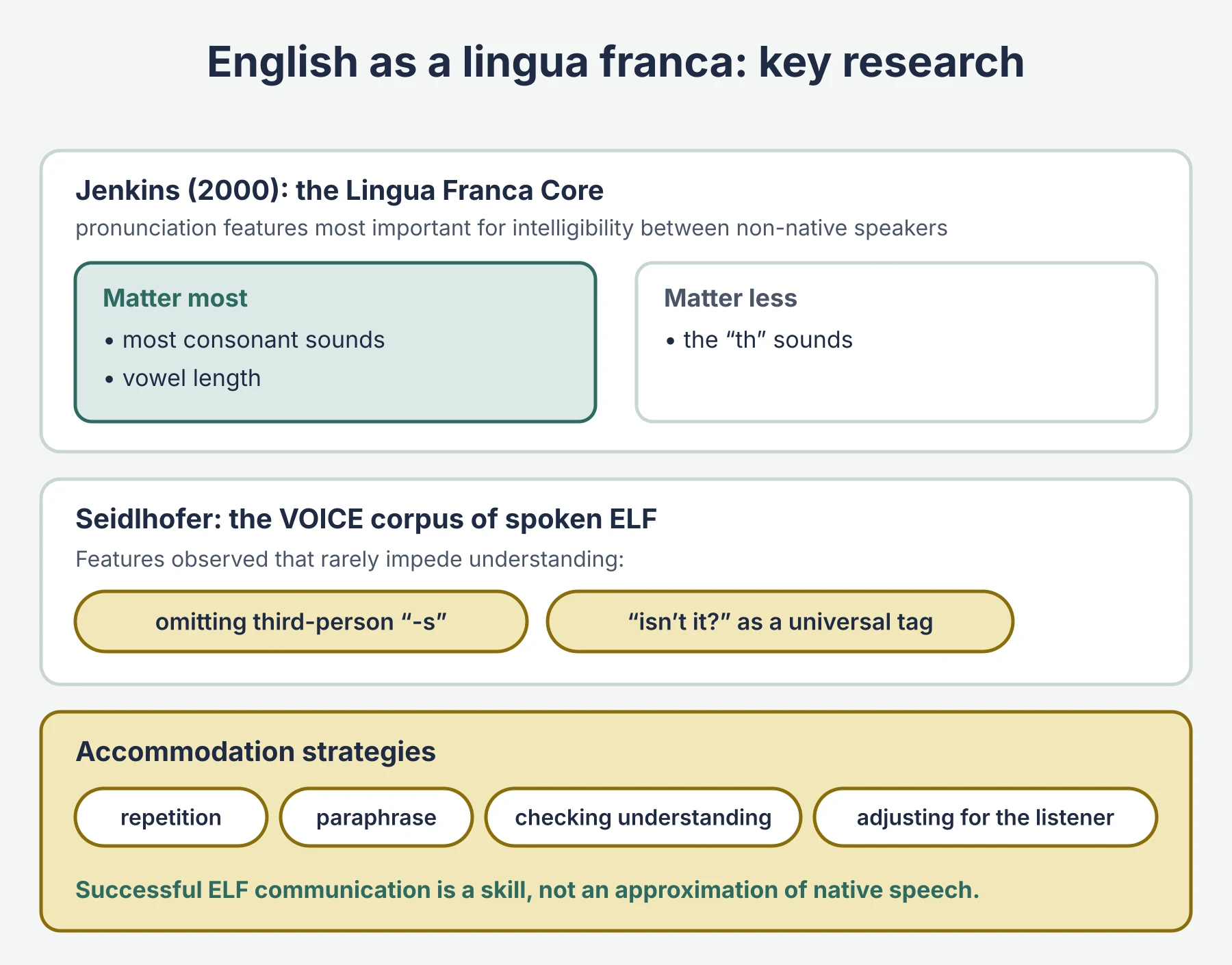
- Jennifer Jenkins (2000) proposed a Lingua Franca Core: the pronunciation features most important for intelligibility between non-native speakers, such as most consonant sounds and vowel length, while features such as the “th” sounds matter less.
- Barbara Seidlhofer led the compilation of the VOICE corpus of spoken ELF interactions. ELF research has observed features that rarely impede understanding, such as omitting third-person “-s” or using “isn’t it?” as a universal tag.
- ELF researchers stress accommodation strategies: repetition, paraphrase, checking understanding and adjusting speech for the listener. Successful ELF communication is a skill, not an approximation of native speech.
The difference between the two strands matters. World Englishes research focuses on varieties tied to places and communities; ELF research focuses on communication between speakers from anywhere.
The connecting debates
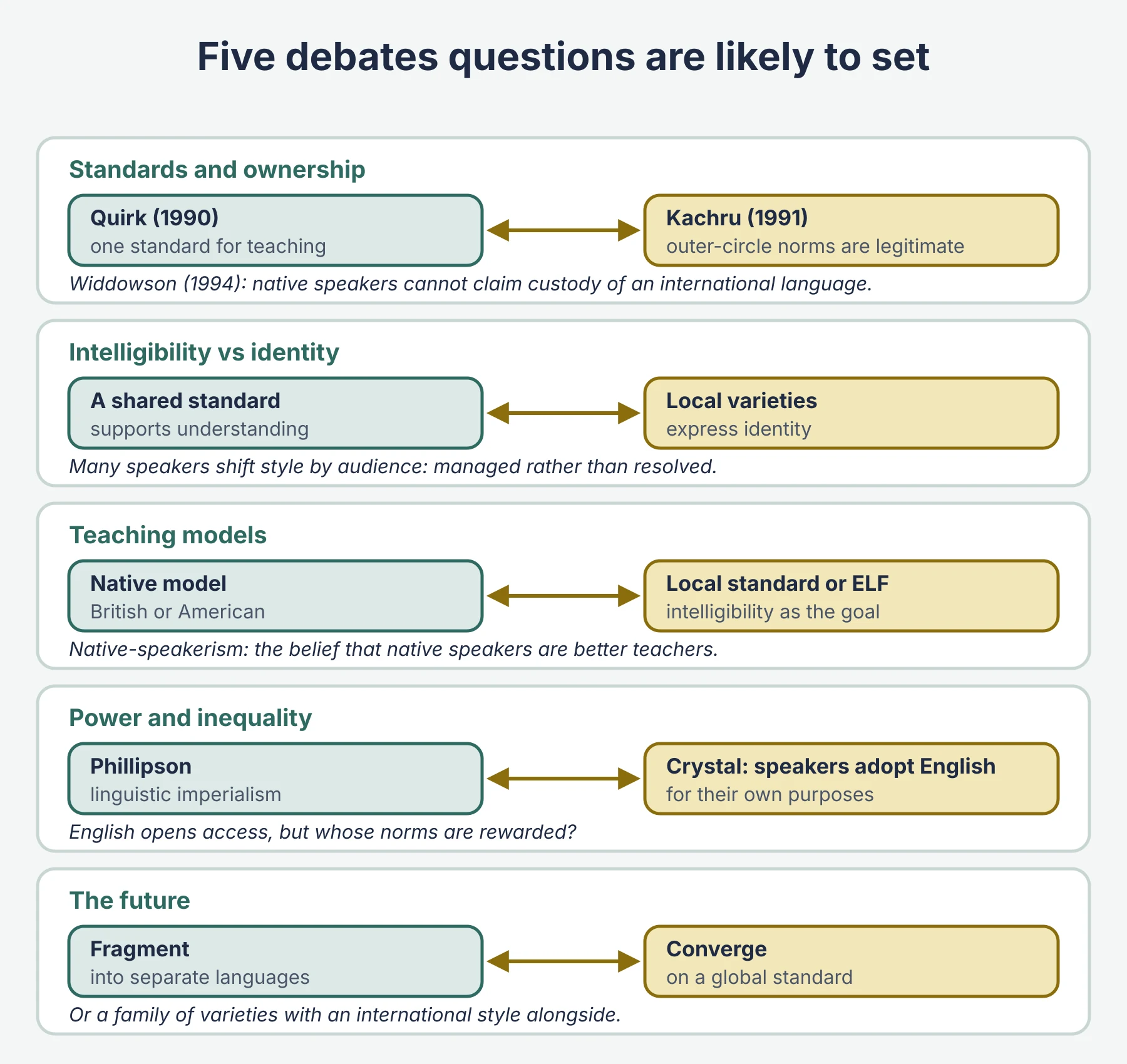
These are the issues questions are likely to set out.
Standards and ownership
In a well-known exchange in the journal English Today, Randolph Quirk (1990) argued for a single standard as the basis for teaching English as a foreign language, while Braj Kachru (1991) answered that outer-circle varieties have their own legitimate norms. Henry Widdowson’s article “The ownership of English” (1994) argued that native speakers cannot claim custody of an international language. Ask: who decides what counts as correct?
Intelligibility against identity
A shared standard supports mutual understanding; local varieties express identity. Do speakers need one, the other or both? Many speakers shift between a local variety and a more international style depending on audience, so the tension may be managed rather than resolved.
Teaching and assessment models
Should learners aim for a native-speaker model (British or American), a local standard, or ELF intelligibility? The choice affects accent teaching, materials and which teachers are valued. The term native-speakerism describes the belief that native speakers are inherently better teachers.
Power and inequality
English can open access to education and work, but the spread of English raises questions about the status of other languages and about whose norms are rewarded. Arguments about linguistic imperialism (Phillipson) and about speakers adopting English for their own purposes (Crystal) give opposing frames.
The future
Will English fragment into separate languages, converge on a global standard, or continue as a family of varieties with an international style alongside? Each position can be supported, so evaluation is essential.
Worked example
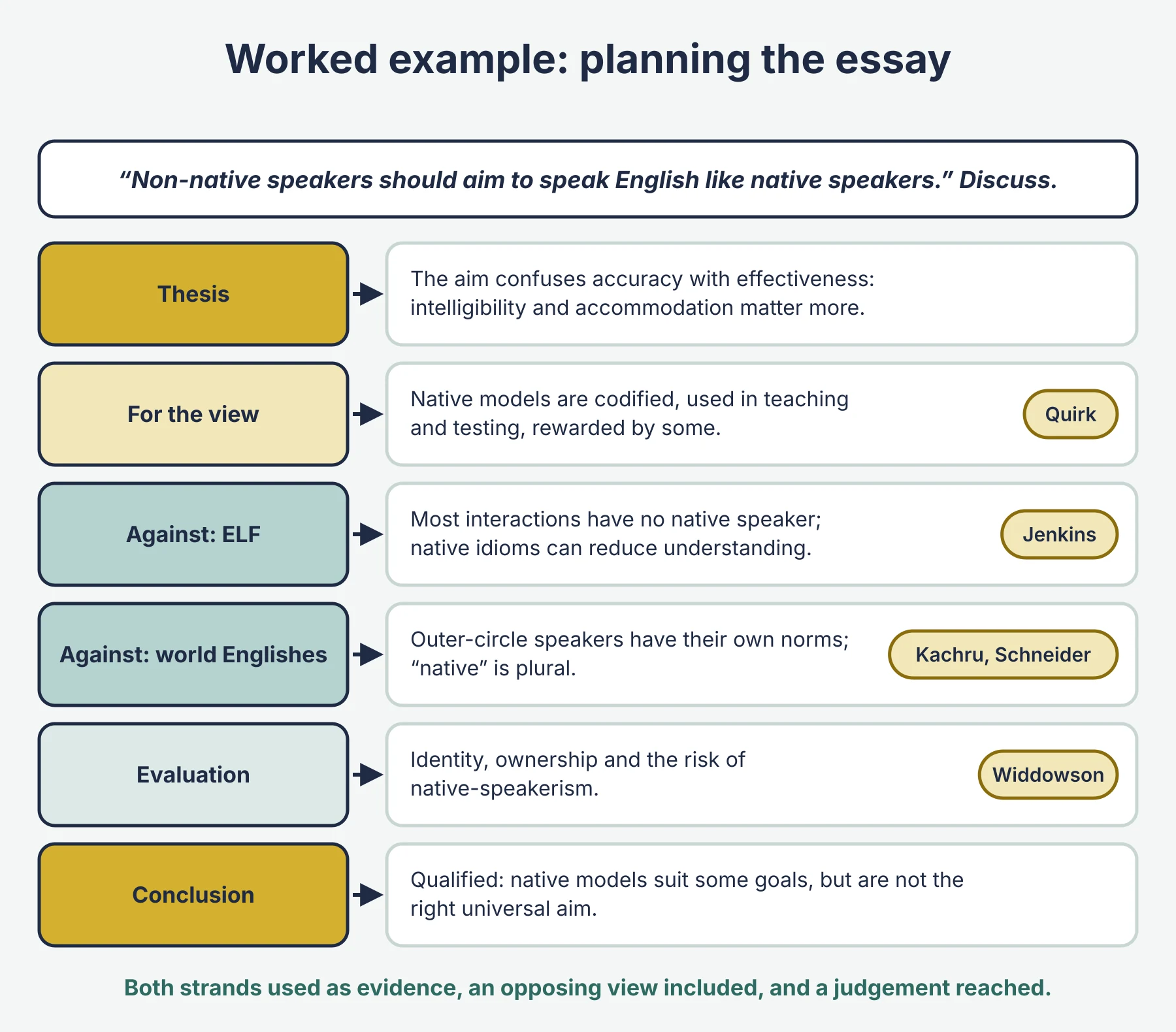
Issue (original, written for this guide): “Non-native speakers should aim to speak English like native speakers.” Discuss.
Plan:
- Thesis: the aim confuses accuracy with effectiveness; for most users of international English, intelligibility and accommodation matter more than native-like speech.
- For the view: native models are widely codified and used in teaching and testing; some employers and institutions reward them (link to Quirk’s position).
- Against, ELF: most interactions involve no native speakers; Jenkins’s Lingua Franca Core shows which features affect intelligibility; native idioms can reduce understanding.
- Against, world Englishes: outer-circle speakers have their own norms (Kachru; Schneider’s endonormative stabilisation); “native” is plural.
- Evaluation: identity, ownership (Widdowson) and the risk of native-speakerism.
- Conclusion: a qualified answer: native models may suit some goals, but they are not the right universal aim.
Model paragraph (point 3):
The strongest objection to the view is that it misreads how English is now used. Much international communication in English takes place between speakers who share neither a first language nor a native-speaker model, so the relevant measure is whether they understand each other. Jenkins’s Lingua Franca Core suggests that intelligibility depends on a limited set of pronunciation features, and that features native speakers treat as essential, such as the “th” sounds, rarely cause misunderstanding. Indeed, native speakers can be the least intelligible participants in such interactions when they use idioms or fast connected speech without accommodating. If the goal is effective communication, then, the native speaker is not the obvious model.
Using any material provided
If a question includes data, such as a transcript of an international meeting, a news report on a language policy or comments about accents, treat it as evidence. Quote it briefly, name the features or attitudes it shows, and connect it to a strand and a debate. A transcript in which speakers repeat, paraphrase and check understanding is evidence for ELF as skilled communication; a comment complaining about “incorrect” local usage is evidence of exonormative attitudes.
Common mistakes
- Treating world Englishes and ELF as the same idea.
- Describing Kachru’s model without evaluating it or mentioning alternatives.
- Calling local or ELF features errors.
- Writing a descriptive survey when the question sets out an issue to argue.
- Claiming numbers of speakers without a reliable source; use qualitative claims instead.
- Ignoring any data the question provides.
Exam technique
Treat the issue as a claim to test. State a thesis, use both strands of the topic as evidence, include an opposing view, and reach a judgement. Use the Unit 2 essay skills: hedged claims, accurate citation, precise terminology and a conclusion that answers the question.
Keep going
Related resources
-
Practice questions
OxfordAQA International AS and A-level English Language (9670): Section B: International English – Practice Questions
Original practice for OxfordAQA 9670 Unit 3 International English: world Englishes, lingua franca research, standards debates and issue essays, with answers.
English · OxfordAQA · A Level
Try questions -
Revision notes
OxfordAQA International AS and A-level English Language (9670): Section B: International English – Revision Notes
Recall notes for OxfordAQA 9670 Unit 3 International English: world Englishes, English as a lingua franca, key models, the standards debate and essay method.
English · OxfordAQA · A Level
Revise topic -
Study guides
OxfordAQA International AS and A-level English Language (9670): Section A: Learning Language
OxfordAQA 9670 Unit 3 Section A: language learning from early childhood to the teenage years, writing development, EAL learners and analysing data.
English · OxfordAQA · A Level
Read guide
Get free revision emails (optional)
Occasional emails with practice questions, worked explanations and links to free resources for the qualification and subjects you choose. No spam, and you can unsubscribe from any email. The free tools on this site never need an email.