
Revision Notes
OxfordAQA International AS and A-level English Language (9670): Section A: Understanding Texts – Revision Notes
Recall notes for OxfordAQA 9670 Unit 1 Section A: audience, purpose, genre and mode, constructed readers, interdiscursivity, hybrid modes and comparing texts.
- Subject
- English
- Level
- AS LEVEL
- Topic
- Unit 1 – Language and Context
- Author
- Marlbridge Academic Team
- Updated
- Reviewed by
- Ammar Bilal (what this means)
Aligned to OxfordAQA A Level English (9670), Version 5.2, for International AS exams from May/June 2018, A-level from May/June 2019. Official specification .
Syllabus page (what it covers and how it is assessed): OxfordAQA A Level English Language.
Found an error? Report a correction.
Need help with this topic? Request a free trial class for A Level English Language (9670).
Condensed recall for specification section 3.1.1 Section A: Understanding texts of OxfordAQA International AS and A-level English Language (9670). For the language levels and a worked example on the whole unit, use the Unit 1 Language and Context study guide.
The task in brief
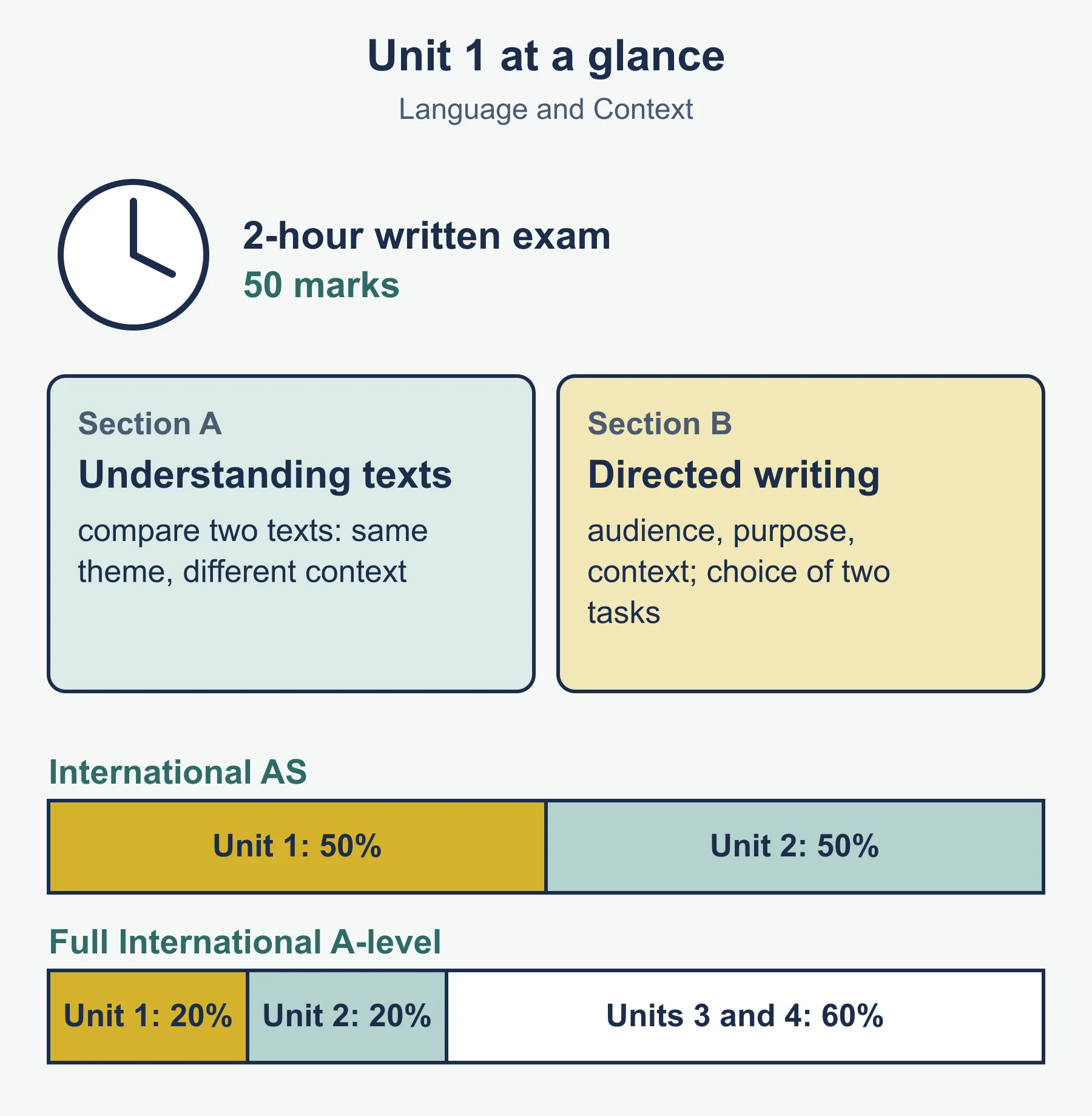
- Unit 1 is a 2-hour exam worth 50 marks; Section A is worth 25.
- One compulsory analysis of two texts linked by a common theme.
- The texts’ original audiences, purposes, genres and modes may differ.
- You are credited for identifying the language that contributes to audience, purpose, genre and mode.
- Section B’s directed writing uses the same texts, so close reading here pays off twice.
Likely text types
Advertising and promotional material; informative booklets and flyers; news and magazine articles; blogs, forums and other web material; spontaneous speech; planned formal speech; other non-fiction and reference material. Prepare for at least one spoken or digital text.
Audience: what to look for
| Signal | What it suggests |
|---|---|
| Unexplained technical terms, acronyms | Specialist audience |
| Glossed terms (“insulin, a hormone that…”) | Non-specialist audience |
| Short sentences, concrete lexis, exclamations | Children, or a general audience |
| Forms of address (“folks”, “colleagues”, “Dear parents”) | Relationship and tenor |
| Direct “you” addressing a mass audience | Synthetic personalisation (Fairclough) |
| Presuppositions (“You already know the feeling…”) | A constructed reader with assumed experiences |
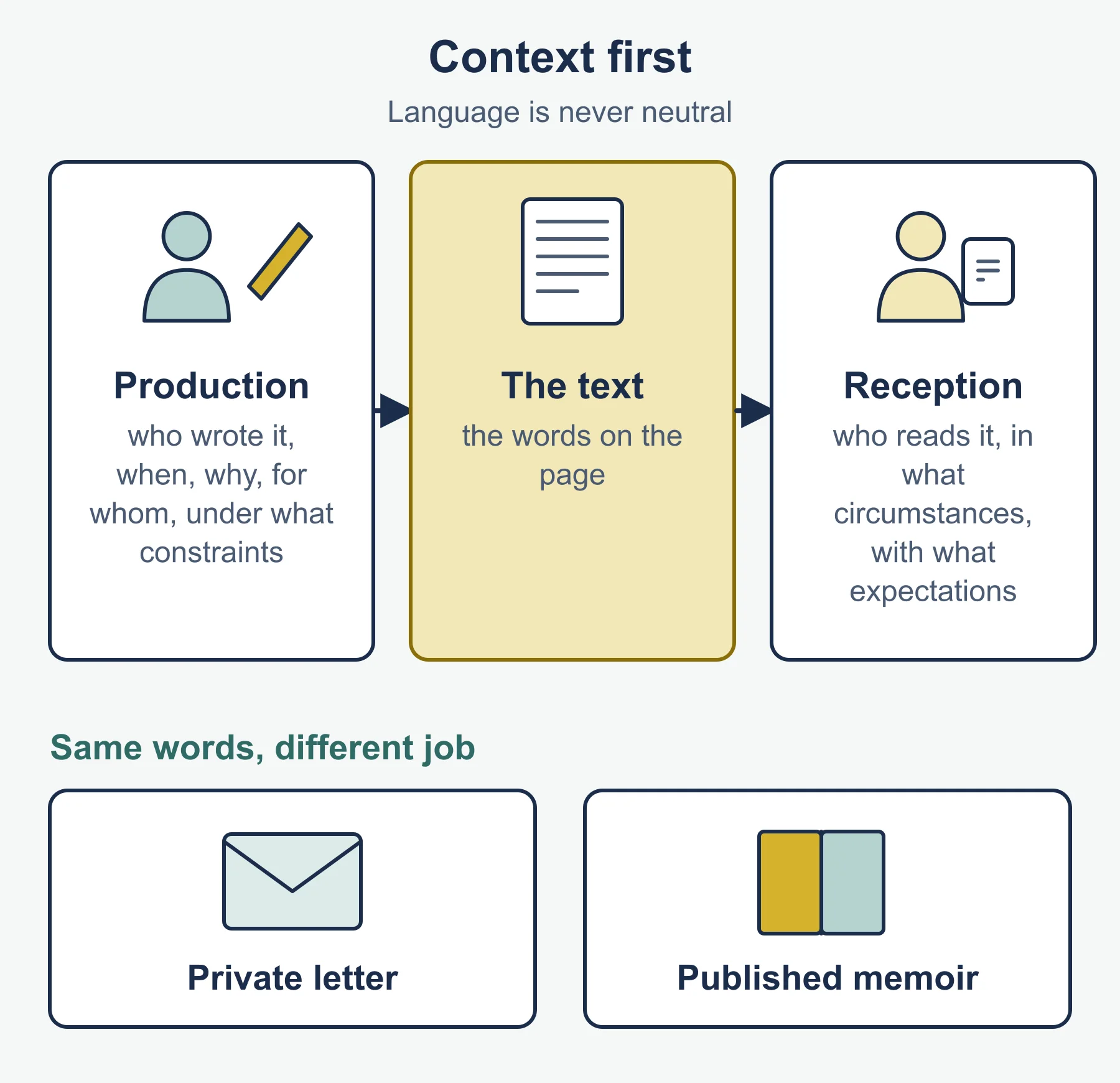
Constructed, idealised reader: the reader a text builds through its address and assumptions. Describe that reader, then quote the language that constructs them.
Purpose: what to look for
- Primary purpose and purposes that serve it: inform in order to persuade; entertain in order to sell.
- Multi-purpose spoken and electronic messages: one post or one spoken turn can inform, persuade, build relationships and entertain at once.
- Evidence: imperatives and calls to action (persuade or instruct); declaratives with figures (inform); humour and wordplay (entertain); thanks, greetings, inclusive “we” (relationship).
Genre: what to look for
- Classifying features: headline, byline, standfirst (news); hyperlinks, menus, “read more” (web); numbered steps (instructions); greeting and sign-off (letters, broadcasts).
- Intertextuality: reference to another text, such as a headline echoing a song title.
- Interdiscursivity: mixing discourses within one text, such as a bank advert using the language of friendship.
- Explain what a borrowed discourse brings with it: warmth, authority, fun, trust.
Mode: the continuum
| More speech-like | More writing-like |
|---|---|
| Real-time, unplanned | Planned, edited |
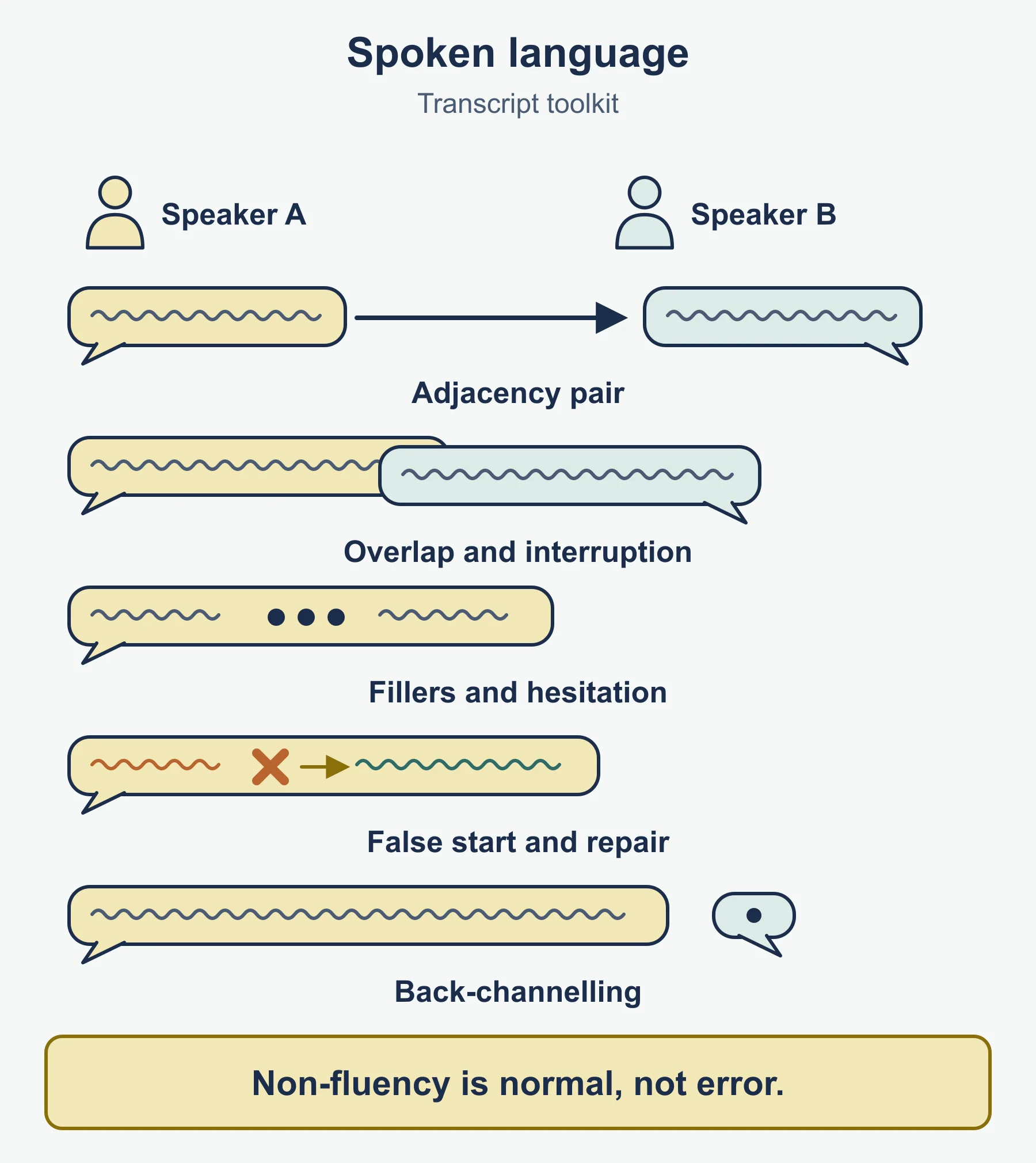
| Fillers, false starts, repairs | Complete, fluent sentences |
| Deixis tied to the situation | Explicit reference |
| Interactive, with feedback | One-way |
| Prosody | Punctuation and layout |
Hybrid modes in new communication contexts: messaging (written but rapid and interactive), podcasts and video diaries (spoken but often scripted or edited), live blogs (written in real time), emoji standing in for facial expression.
Key terms
| Term | Meaning |
|---|---|
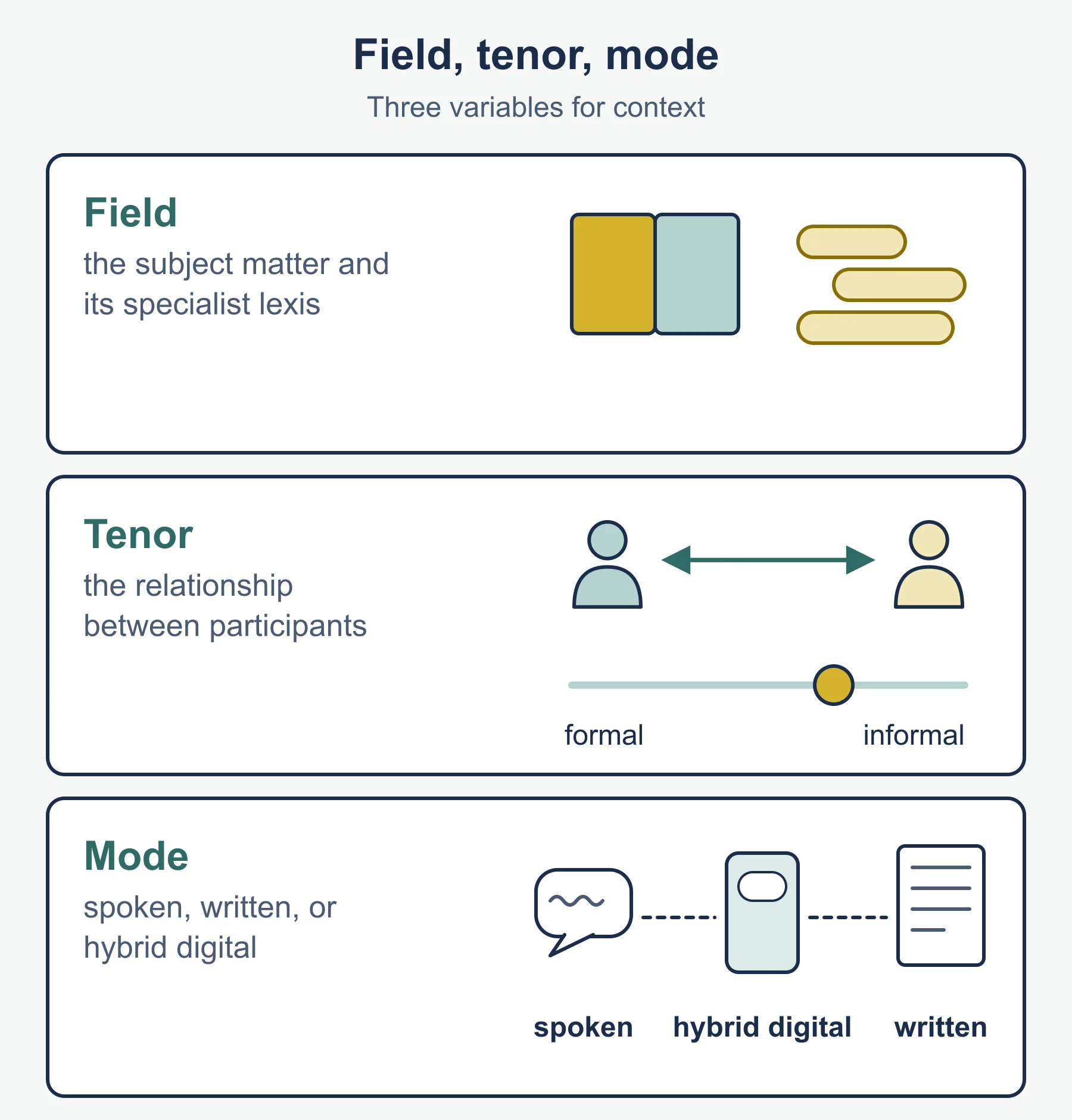
| Field, tenor, mode | Subject matter; relationship between participants; channel of communication |
| Synthetic personalisation | Addressing a mass audience as though each reader were an individual |
| Constructed reader | The reader a text assumes and builds through its language |
| Intertextuality | A text referring to or echoing another text |
| Interdiscursivity | A text mixing the discourses or conventions of different genres |
| Deixis | Words whose meaning depends on context: “this”, “here”, “now” |
| Multimodal | Combining language with images, layout, sound or other modes |
| Non-fluency features | Normal features of unplanned speech: fillers, pauses, repairs |
Comparison structure
- Overview: theme, and each text’s audience, purpose, genre and mode in two or three sentences.
- Body by aspect or issue, each paragraph covering both texts with comparative connectives: whereas, by contrast, similarly, both, while.
- Every feature explained by context: why this choice for this audience, purpose, genre or mode.
- Conclusion: the main similarity and difference.
Exam traps
- Text A then Text B, with comparison only in the last paragraph.
- “The audience is anyone who reads it.”
- A single purpose for a clearly mixed text.
- Spoken versus written as a simple binary, missing hybrid features.
- Non-fluency described as error.
- Genre features named but not explained.
- Feature-spotting without context.
Self-test
- How many texts does Section A contain, and what links them?
- Name the four aspects of context the specification credits.
- What is a constructed, idealised reader?
- Give one linguistic signal of a non-specialist audience.
- What does the specification say about spoken and electronic messages and purpose?
- Define intertextuality and give an example.
- Define interdiscursivity and give an example.
- Give two features of a hybrid mode in a messaging app.
- What is synthetic personalisation?
- Why should you organise the answer by aspect rather than text by text?
- How does Section A connect with Section B?
Answers: 1. Two texts, linked by a common theme. 2. Audience, purpose, genre and mode. 3. The reader a text builds and assumes through its address, presuppositions and references. 4. Technical terms glossed or explained (also short sentences and concrete lexis). 5. That many are multi-purpose, doing several jobs at once. 6. A text referring to another text, such as a headline echoing a film title. 7. Mixing the discourses of different genres in one text, such as a bank advertisement using the informal language of friendship. 8. Any two: written but interactive turn- taking; informal, speech-like lexis and ellipsis; emoji for facial expression; rapid, unedited replies. 9. Addressing a mass audience as though each reader were an individual, usually through direct “you”. 10. Because the task is a comparison, and paragraphs that discuss both texts show the similarities and differences directly. 11. The Section B writing task transforms some or all of the Section A material into a new text.
Practise with the Understanding Texts practice questions, review the frameworks in the Unit 1 revision notes, and see how the same texts feed the writing task in the Unit 1 Directed Writing study guide.
Related resources
-
Practice questions
OxfordAQA International AS and A-level English Language (9670): Section B: Directed Writing – Practice Questions
Original practice for OxfordAQA 9670 Unit 1 Section B: decoding briefs, transforming register and mode, genre conventions and sustained style, with answers.
English · OxfordAQA · AS Level
Try questions -
Revision notes
OxfordAQA International AS and A-level English Language (9670): Section B: Directed Writing – Revision Notes
Recall notes for OxfordAQA 9670 Unit 1 Section B: decoding a brief, transforming source material, genre conventions by form and sustaining one style.
English · OxfordAQA · AS Level
Revise topic -
Practice questions
OxfordAQA International A-Level English Language Unit 1: Language and Context — Practice Questions
Original practice with worked answers on audience, purpose, genre and mode and on directed writing, for OxfordAQA International AS English Language 9670 Unit 1.
English · OxfordAQA · AS Level
Try questions
Get free revision emails (optional)
Occasional emails with practice questions, worked explanations and links to free resources for the qualification and subjects you choose. No spam, and you can unsubscribe from any email. The free tools on this site never need an email.