
Revision Notes
OxfordAQA International AS and A-level English Language (9670): Section B: Directed Writing – Revision Notes
Recall notes for OxfordAQA 9670 Unit 1 Section B: decoding a brief, transforming source material, genre conventions by form and sustaining one style.
- Subject
- English
- Level
- AS LEVEL
- Topic
- Unit 1 – Language and Context
- Author
- Marlbridge Academic Team
- Updated
- Reviewed by
- Ammar Bilal (what this means)
Aligned to OxfordAQA A Level English (9670), Version 5.2, for International AS exams from May/June 2018, A-level from May/June 2019. Official specification .
Syllabus page (what it covers and how it is assessed): OxfordAQA A Level English Language.
Found an error? Report a correction.
Need help with this topic? Request a free trial class for A Level English Language (9670).
Condensed recall for specification section 3.1.2 Section B: Directed writing of OxfordAQA International AS and A-level English Language (9670). For the full planning method and a worked example, use the Unit 1 Directed Writing study guide.
The task in brief
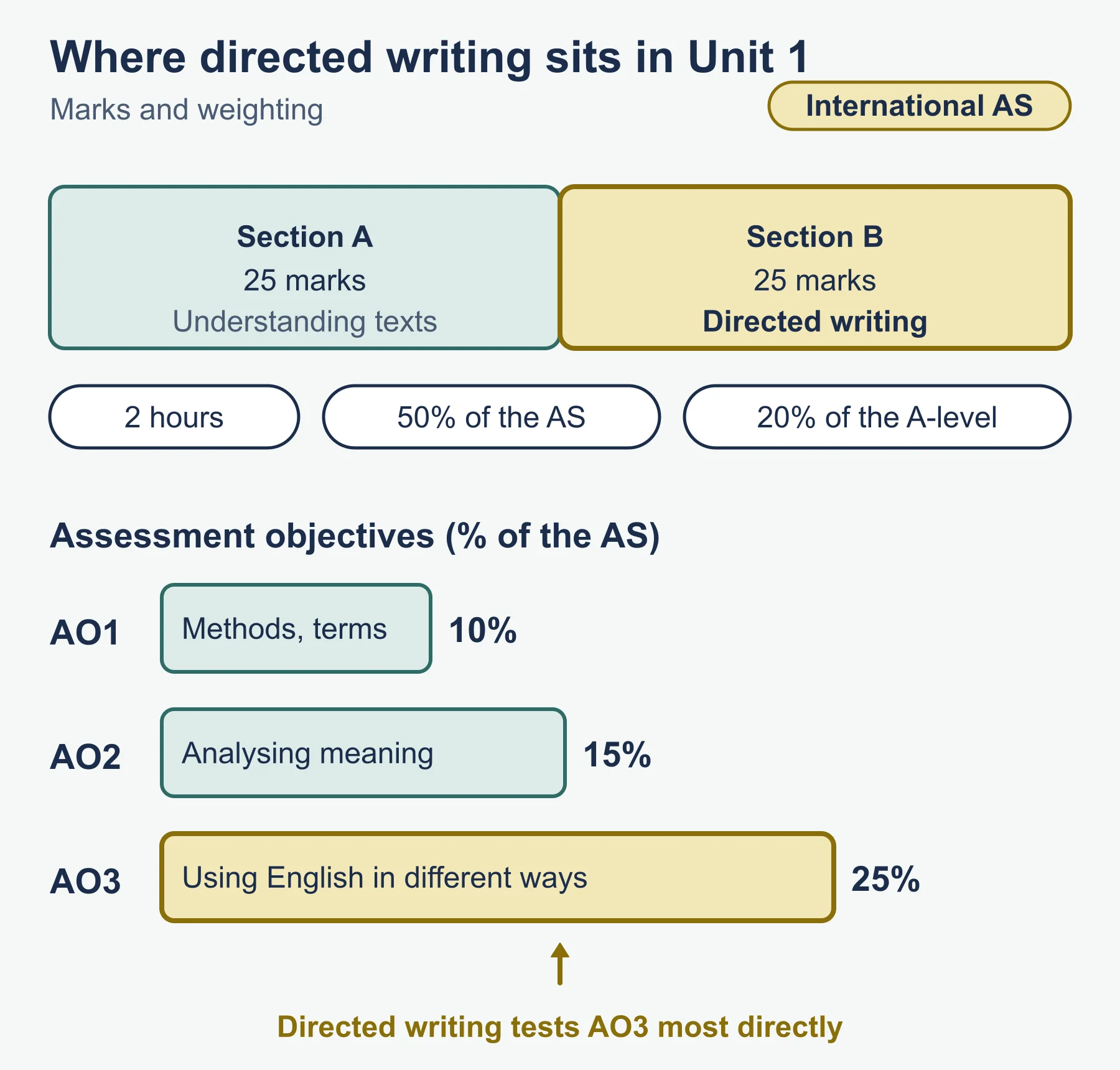
- Section B is worth 25 of Unit 1’s 50 marks.
- One writing task from a choice of two. The two options offer different uses of the source material.
- You write to a specific brief, transforming some or all of the Section A material into a new text.
- You are credited for sustaining a style appropriate to the task chosen.
- No commentary: your understanding is shown in the writing itself.
- AO3, using English in different ways, carries the largest weighting in Unit 1.
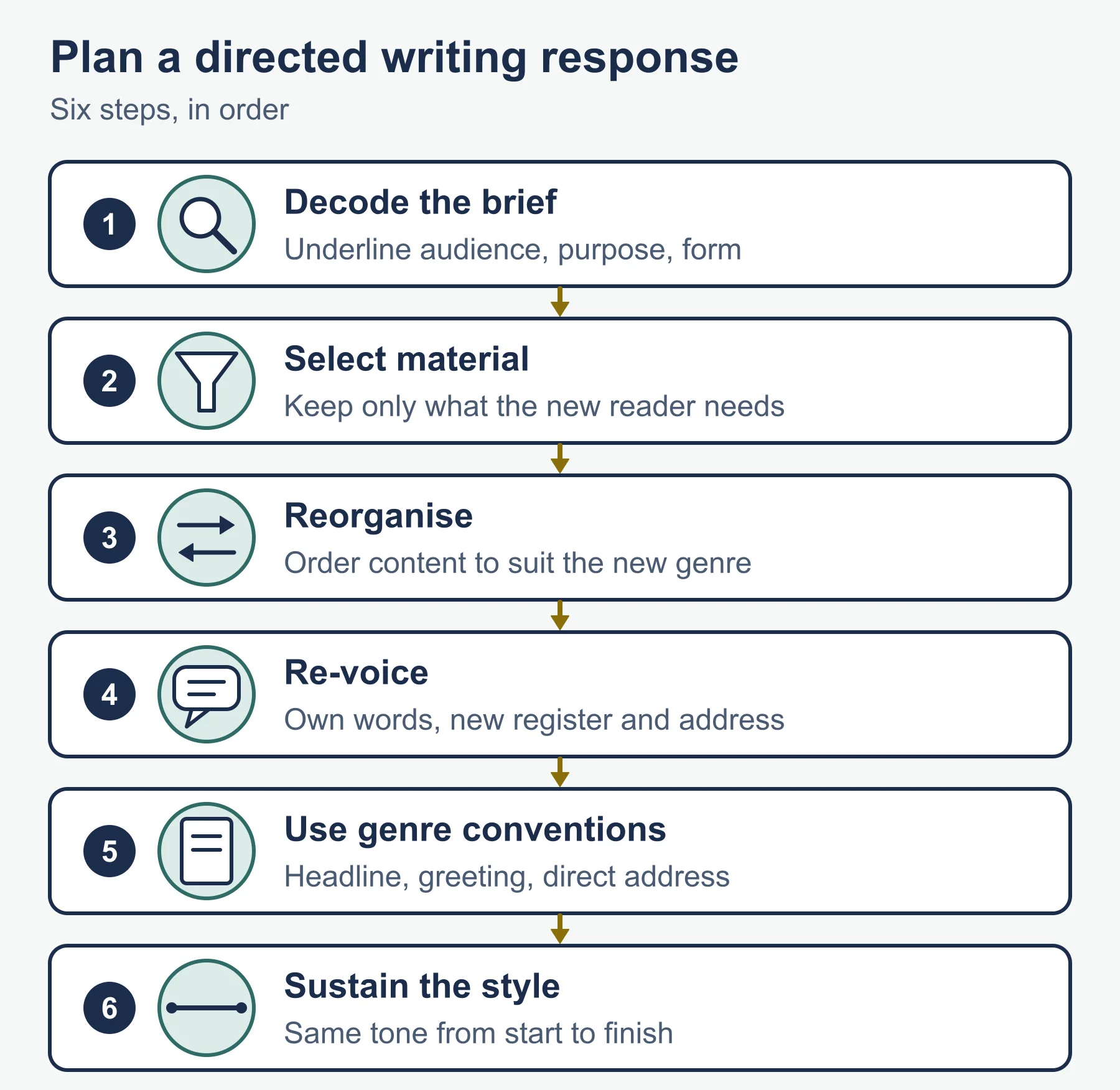
Decode the brief: four questions
| Question | Note it as | It decides |
|---|---|---|
| Who will read or hear this? | Audience: age, knowledge, relationship | Register, vocabulary, assumed knowledge |
| What must it do? | Purpose: inform, persuade, advise, entertain, or a mix | Structure and sentence functions |
| What kind of text is it? | Genre | Conventions the reader expects |
| Spoken, written or hybrid? | Mode | Sentence length, cohesion, layout, address |
Also note where it will appear (a school website, a local radio slot) and who is speaking (the persona).
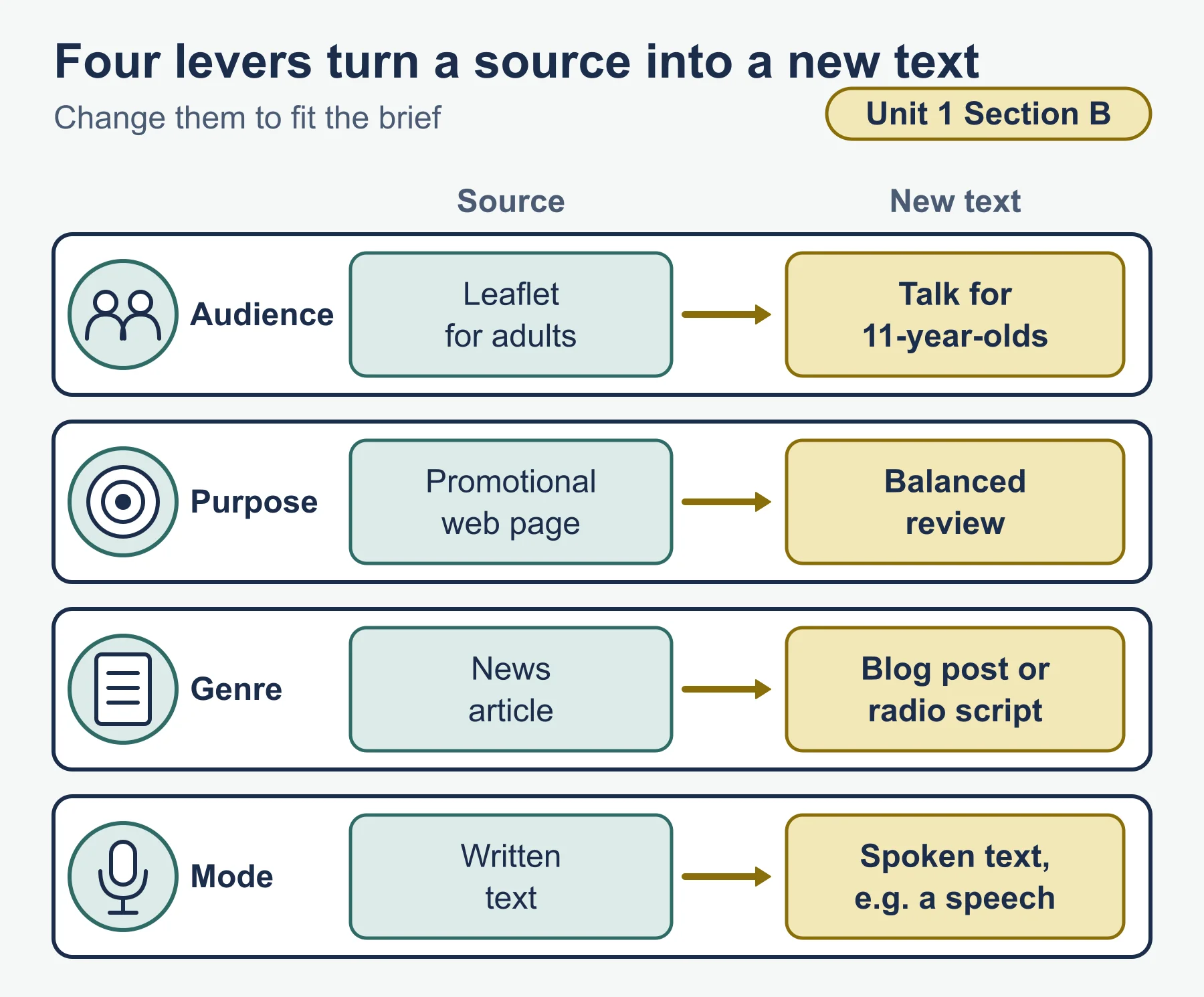
Transformation levers
- Select: keep only material that serves the new purpose.
- Reorder: lead with what the new reader needs most.
- Re-register: adjust formality and tenor, e.g. a technical report becomes plain advice.
- Re-voice: new persona, new pronouns (“we” for an organisation; “I” for a personal blog).
- Re-mode: written to spoken needs signposting, repetition and direct address; spoken to written needs complete sentences and explicit reference instead of deixis.
- Re-genre: add the target form’s conventions and remove the source’s.
Genre conventions bank
| Form | Conventions to include |
|---|---|
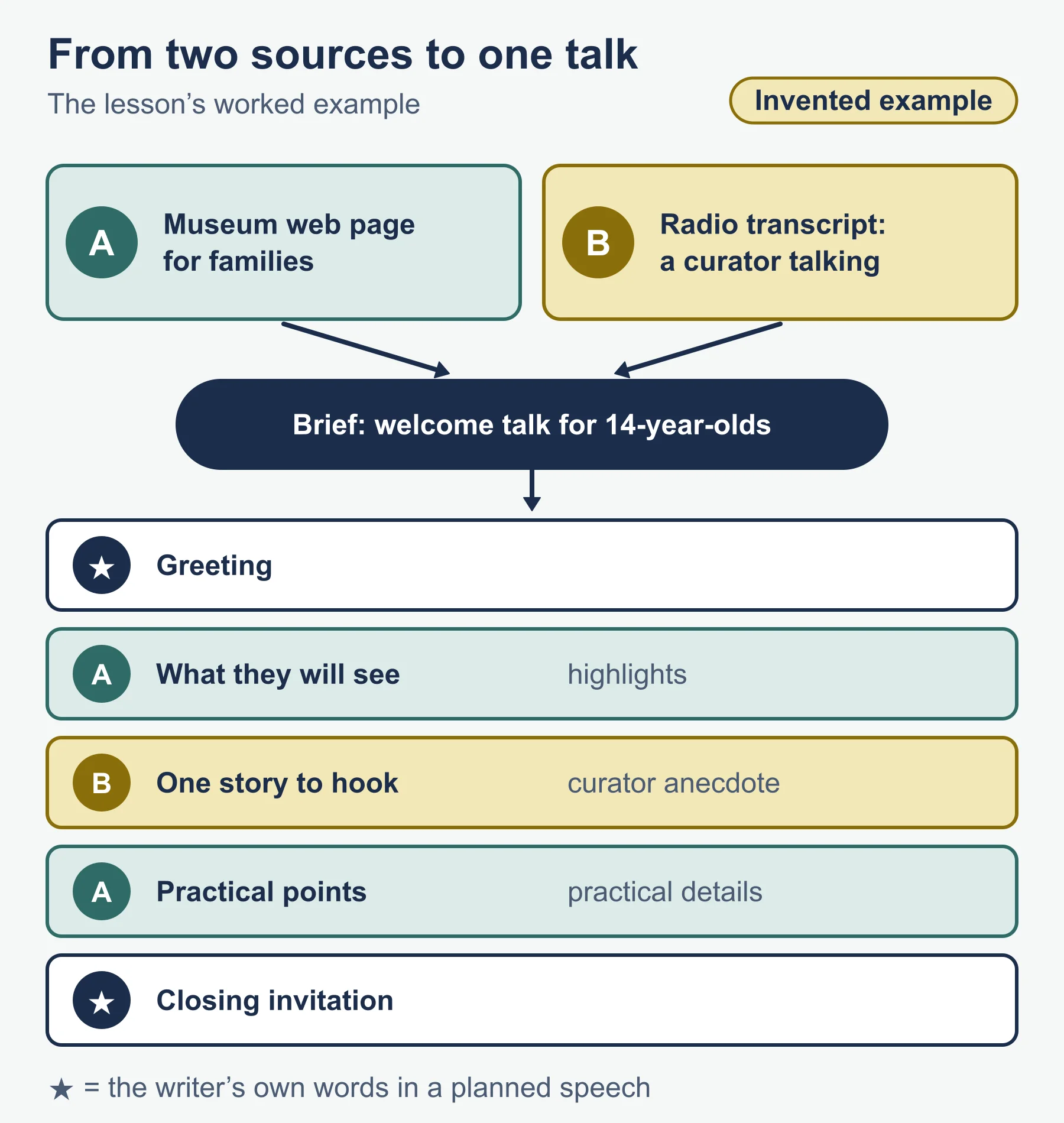
| Speech or talk | Greeting, signposting (“First…”, “Finally…”), direct address, rhetorical questions, repetition, a memorable close |
| Podcast or radio script | Introduction of speaker and topic, conversational discourse markers, short sentences, sign-off |
| Blog post | Title, personal anecdote, informal tenor, subheadings, an invitation to comment |
| Feature article | Headline, standfirst, lively opening, quotation, balanced development, closing reflection |
| Leaflet | Heading, subheadings, bullet points, imperatives, contact or next-step information |
| Formal letter or email | Salutation, purpose stated early, paragraphed points, polite close |
| Review | Context, criteria, evidence, verdict |
| Diary or journal | Date, first person, reflective present concerns, informal ellipsis |
Sustaining a style
- Fix two or three style markers before writing (e.g. second-person address, short sentences, light humour) and check each paragraph uses them.
- Keep the persona consistent: a teenage blogger does not suddenly use bureaucratic lexis.
- Keep tense and person stable unless a shift is deliberate.
- Watch the ending: many responses drift back into essay register in the last paragraph.
- Keep cohesion appropriate to mode: spoken texts use signposts; written texts can use paragraph structure.
Before-and-after transformations
| Source (written, formal) | Target (spoken talk to 12-year-olds) |
|---|---|
| “Participation in regular physical activity is associated with improved concentration.” | “Here’s something cool: when you move more, your brain actually gets better at focusing.” |
| “Visitors are requested to refrain from touching the exhibits.” | “One rule today: look with your eyes, not your hands.” |
| Source (spoken transcript) | Target (written article) |
|---|---|
| “so we just (.) we sort of started it in the garage really” | “The business began, modestly, in a garage.” |
Choosing between the two tasks
- Pick the task whose reader you can picture clearly.
- Check the source material gives you enough content for that task.
- Prefer the task where you know the genre conventions well enough to sustain them throughout.
Exam traps
- Writing an analysis or summary instead of a new text.
- Lifting phrases or structure from the sources.
- A “speech” that reads like an essay; a “leaflet” without headings.
- Register that starts right and drifts.
- Including every source detail instead of selecting.
- Adding a commentary that the task does not ask for.
- Ignoring where the text will appear.
Self-test
- How many Section B tasks are there, and how many do you answer?
- What must the writing be based on?
- What does the specification say you are credited for?
- Is a commentary required?
- Name the four context headings you should decode in the brief.
- Give three conventions of a speech.
- What must change when you turn a spoken transcript into a written article?
- What is re-voicing?
- Give two ways to keep a style consistent.
- Transform for a leaflet: “It is strongly recommended that residents sort their recycling prior to collection.”
- Why should you not use every detail from the sources?
Answers: 1. Two; you answer one. 2. A transformation of some or all of the material in Section A. 3. The ability to sustain a style of writing appropriate to the task chosen. 4. No. 5. Audience, purpose, genre and mode. 6. Any three: greeting, signposting, direct address, rhetorical questions, repetition, a memorable close. 7. Spoken features such as fillers, repairs and deixis are replaced by complete sentences, explicit reference and written conventions such as paragraphs and a headline. 8. Giving the text a new persona and point of view, with pronouns and tone to match. 9. Any two: fix style markers in advance and check each paragraph; keep persona, tense and person stable; check the ending does not drift into essay register. 10. For example: “Sort your recycling before collection day.” 11. Because selection for the new purpose is part of transformation; irrelevant detail weakens the new text.
Practise with the Directed Writing practice questions and revise the source analysis in the Understanding Texts revision notes.
Related resources
-
Practice questions
OxfordAQA International A-Level English Language Unit 1: Language and Context — Practice Questions
Original practice with worked answers on audience, purpose, genre and mode and on directed writing, for OxfordAQA International AS English Language 9670 Unit 1.
English · OxfordAQA · AS Level
Try questions -
Revision notes
OxfordAQA International A-Level English Language Unit 1: Language and Context — Revision Notes
Condensed notes on language frameworks, discourse, register, spoken language and directed writing for OxfordAQA International AS English Language 9670 Unit 1.
English · OxfordAQA · AS Level
Revise topic -
Study guides
OxfordAQA International A-Level English Language: Language and Context (9670)
OxfordAQA International AS English Language 9670 Unit 1 Language and Context: the compulsory two-text comparison, directed writing and the assessment format.
English · OxfordAQA · AS Level
Read guide
Get free revision emails (optional)
Occasional emails with practice questions, worked explanations and links to free resources for the qualification and subjects you choose. No spam, and you can unsubscribe from any email. The free tools on this site never need an email.