
Study Guides
OxfordAQA International A-Level English Literature (9675): Unit 1 Section A, Elizabethan and Jacobean Tragedy
How to answer the passage-based Section A question on Elizabethan and Jacobean tragedy in OxfordAQA 9675 Unit 1, with a method, model paragraph and pitfalls.
- Subject
- English Literature
- Level
- AS LEVEL
- Topic
- Unit 1 – Aspects of Dramatic Tragedy
- Author
- Marlbridge Academic Team
- Updated
- Reviewed by
- Ammar Bilal (what this means)
Aligned to OxfordAQA A Level English Literature (9675), Version 5.3, for International AS exams from May/June 2018, A-level from May/June 2019. Official specification .
Syllabus page (what it covers and how it is assessed): OxfordAQA A Level English Literature.
Syllabus points this page covers
9675 (AS Level)
- Section A: Elizabethan and Jacobean tragedy
Found an error? Report a correction.
Need help with this topic? Request a free trial class for A Level English Literature (9675).
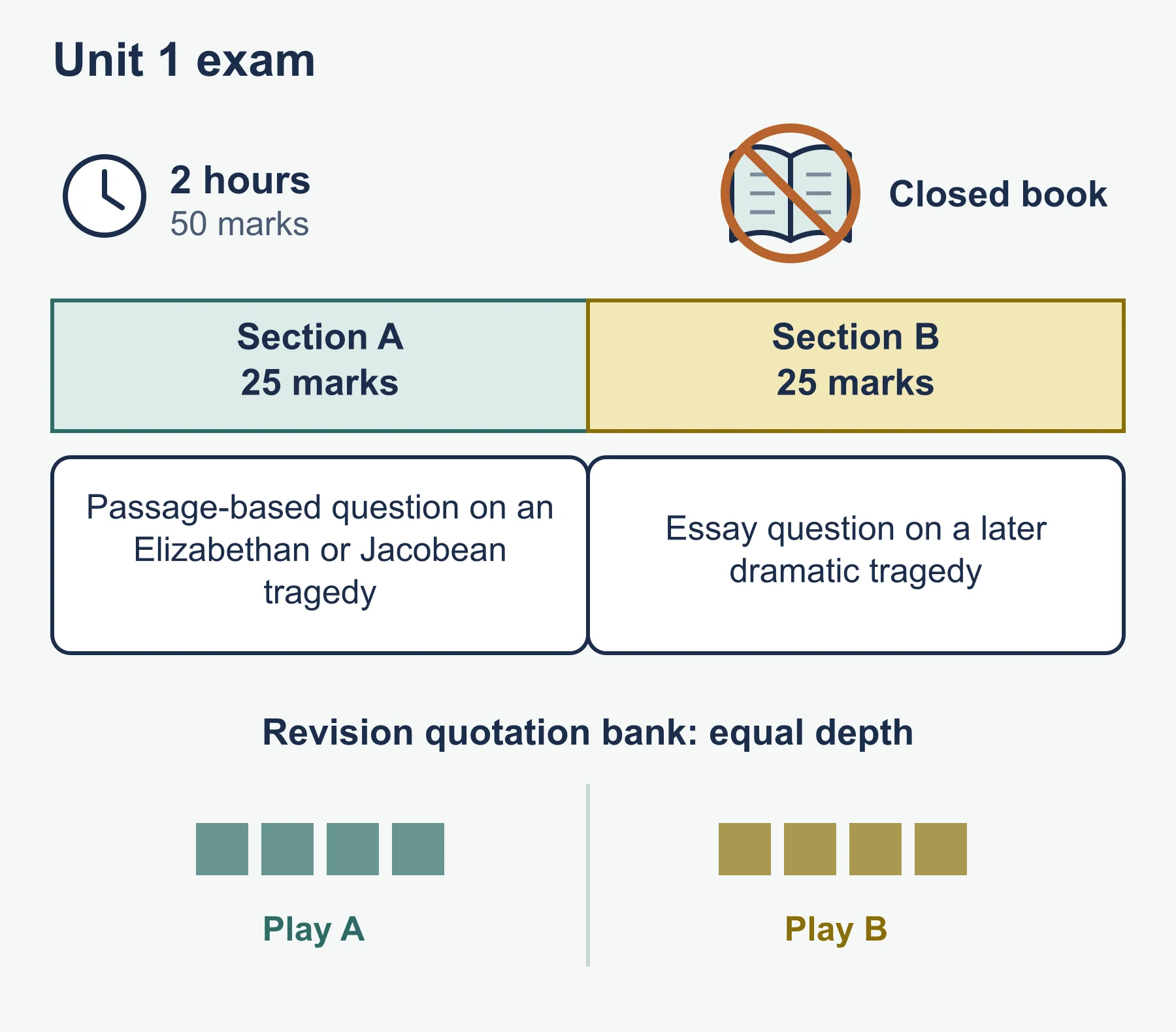
Section A of Unit 1 Aspects of Dramatic Tragedy in OxfordAQA International AS and A-level English Literature (9675) is a single passage-based question, worth 25 of the unit’s 50 marks, on the Elizabethan or Jacobean tragedy your centre has chosen. This guide goes deeper than the Aspects of Dramatic Tragedy unit overview: it is about reading one printed passage as tragedy, connecting it to the whole play, and doing both from memory in a closed-book exam.
What Section A covers
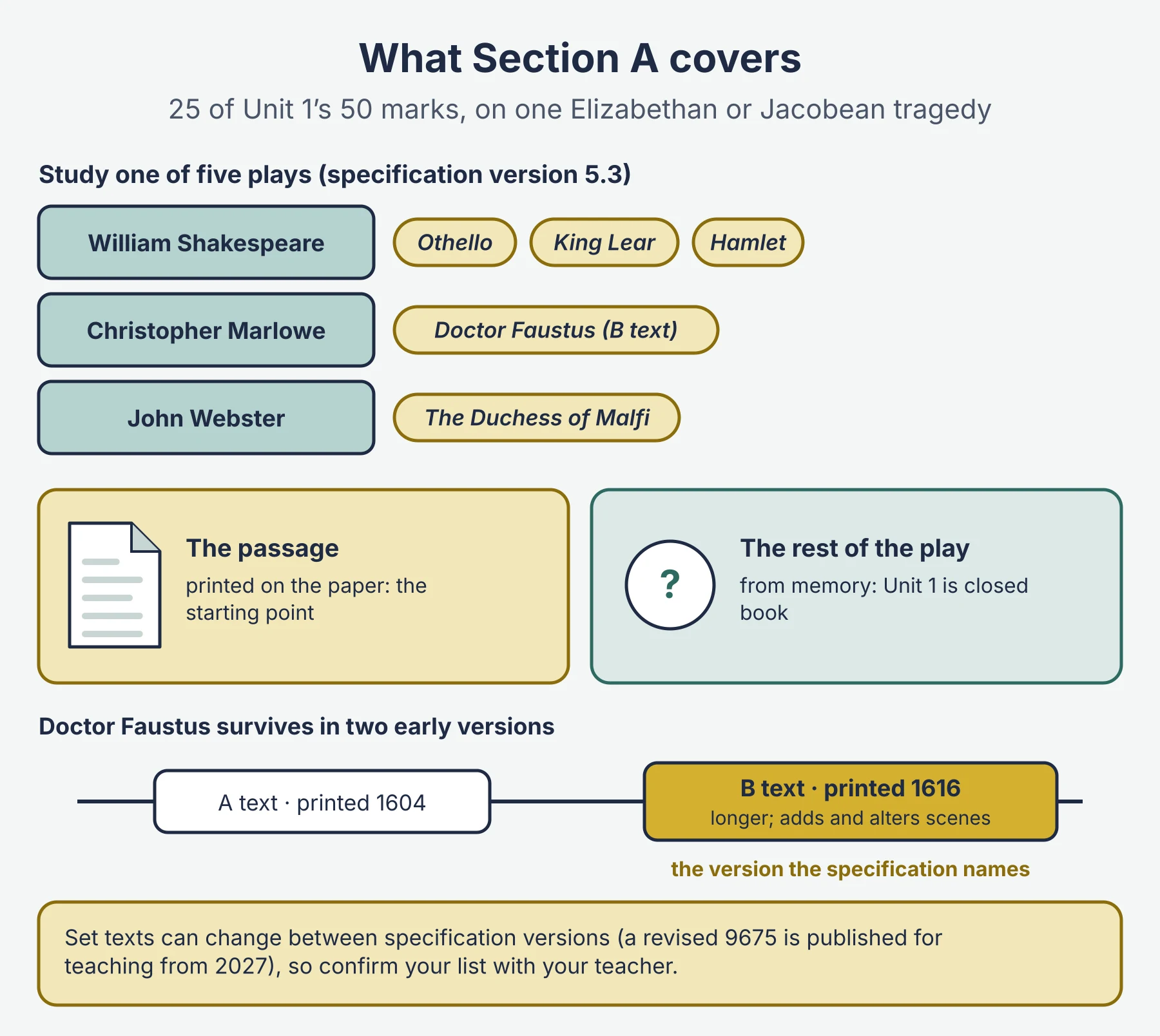
Version 5.3 of the specification lists five Section A plays, of which you study one:
| Playwright | Play |
|---|---|
| William Shakespeare | Othello, King Lear, Hamlet |
| Christopher Marlowe | Doctor Faustus (B text) |
| John Webster | The Duchess of Malfi |
The specification says Section A questions “will use a passage as a starting point”. The passage is printed on the paper; everything else you say about the play must come from memory, because Unit 1 is closed book. Set texts can change between specification versions (a revised 9675 is published for teaching from 2027), so confirm your list with your teacher.
The B text of Doctor Faustus matters: the play survives in two early versions, the A text (printed 1604) and the longer B text (printed 1616), which adds and alters scenes. Learn the version the specification names, and check that your edition prints it.
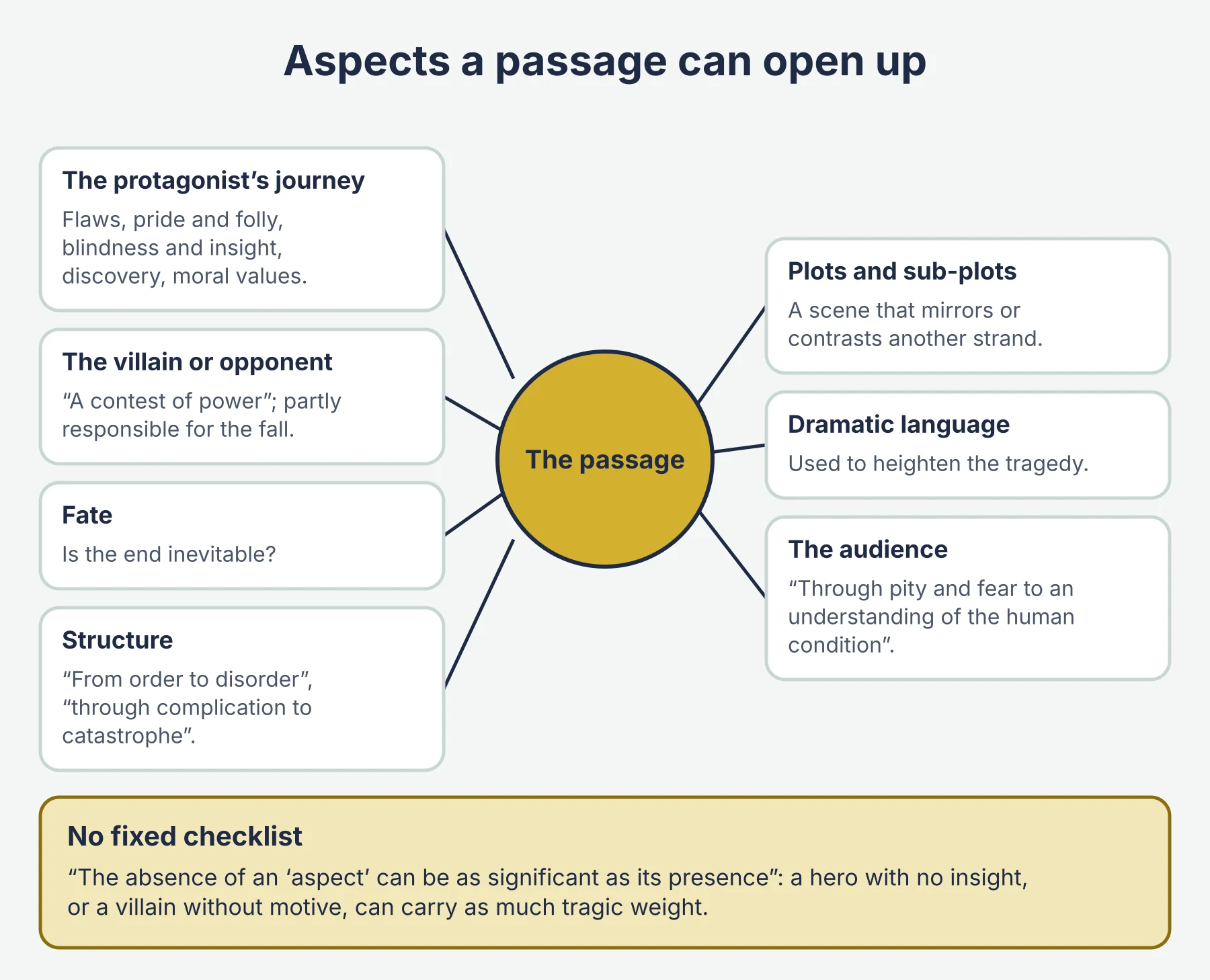
The aspects of tragedy a passage can open up
The specification gives no fixed checklist but suggests areas worth exploring. For a passage, the most productive are:
- the protagonist’s journey towards death: flaws, pride and folly, blindness and insight, discovery and learning, moral values;
- the tragic villain or opponent, who engages the hero in “a contest of power” and is partly responsible for the fall;
- fate, and whether the end is inevitable;
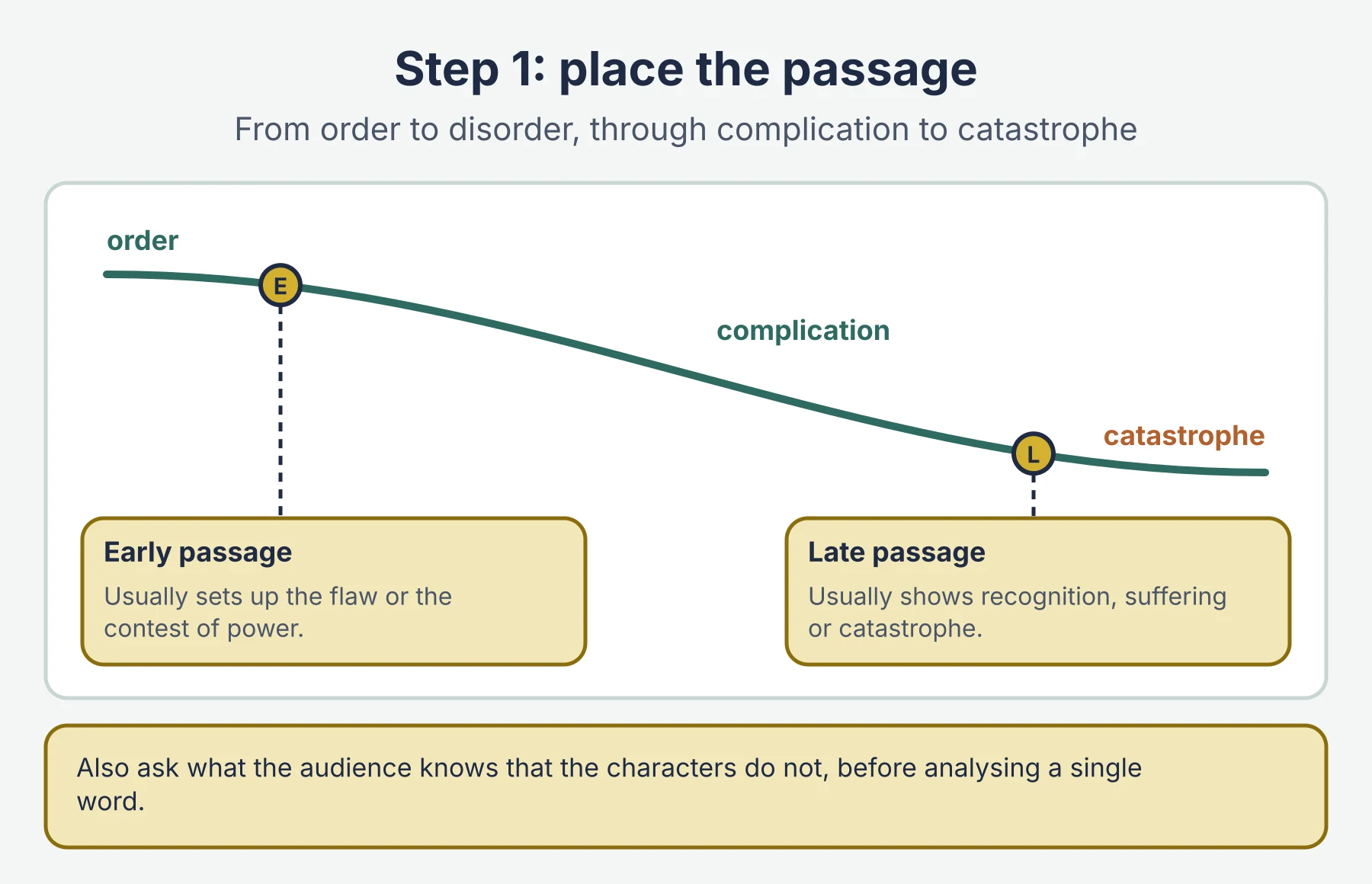
- structure: where the passage sits in the movement “from order to disorder”, “through complication to catastrophe”;
- plots and sub-plots, and how a scene mirrors or contrasts with another strand;
- dramatic language used to heighten the tragedy;
- the audience, moved “through pity and fear to an understanding of the human condition”.
The specification also notes that “the absence of an ‘aspect’ can be as significant as its presence”. A passage in which the hero has no insight at all, or a villain who seems to act without motive, can carry as much tragic weight as a passage that ticks a convention.
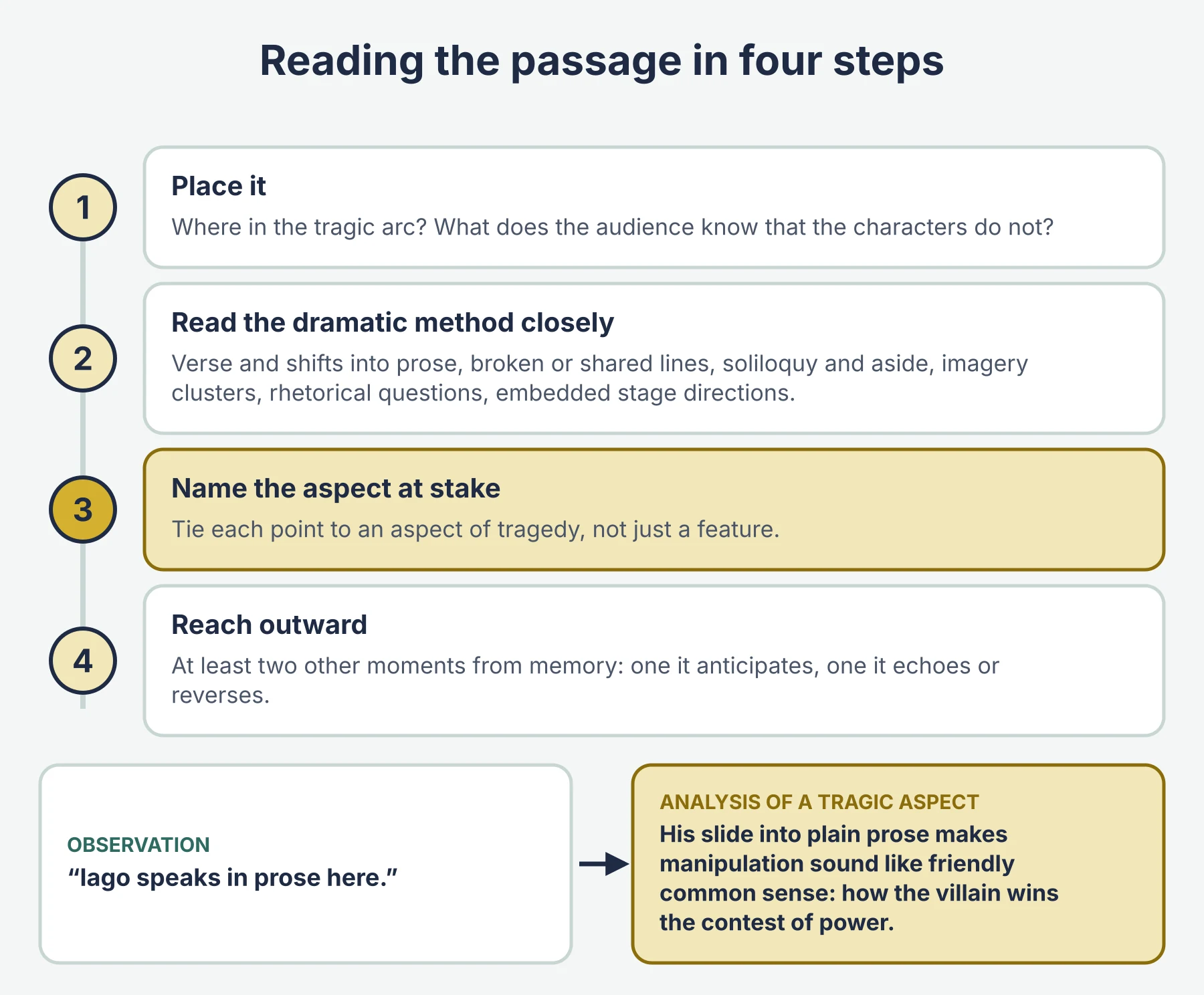
Reading the passage: a four-step method
1. Place it. Before analysing a word, decide where the passage falls in the tragic arc and what the audience knows that the characters do not. A scene from early in the play usually sets up the flaw or the contest of power; a late scene usually shows recognition, suffering or catastrophe.
2. Read the dramatic method closely. Look at the verse and any shift into prose, broken or shared lines, soliloquy and aside, imagery clusters, rhetorical questions, and embedded stage directions (lines that tell an actor to kneel, look or hold something). Early modern texts print few stage directions, so the dialogue is the best evidence of what the audience sees.
3. Name the aspect at stake. Tie each point to an aspect of tragedy. “Iago speaks in prose here” is an observation; “Iago’s slide into plain prose makes his manipulation sound like friendly common sense, which is how the villain wins the contest of power” is analysis of a tragic aspect.
4. Reach outward. Link the passage to at least two other moments you know from memory: a moment it anticipates, and one it echoes or reverses. This is how you show the significance of the passage “in relation to” the tragedy as a whole.
Context the passage can carry
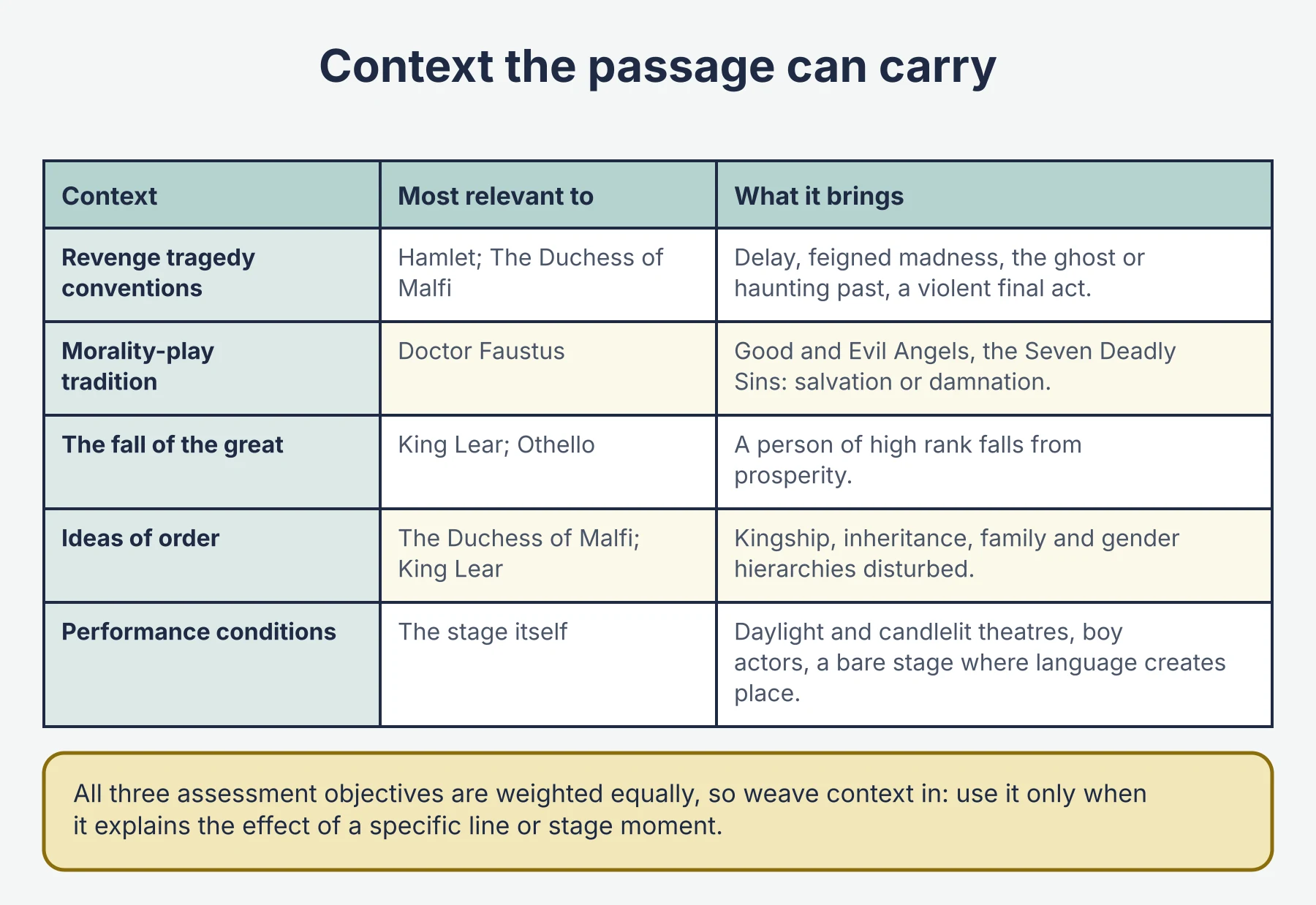
All three assessment objectives are weighted equally in every 9675 question, so context (part of AO1) needs to be woven in, not added as a paragraph of history. Contexts that genuinely change how a Section A passage reads include:
- Revenge tragedy conventions, relevant to Hamlet and The Duchess of Malfi: delay, feigned madness, the ghost or the haunting past, and a violent final act.
- The morality-play tradition behind Doctor Faustus: the Good and Evil Angels and the show of the Seven Deadly Sins come from older drama about the choice between salvation and damnation.
- The fall of the great, an old tradition in which a person of high rank falls from prosperity; it shapes the public tragedies of Lear and Othello.
- Ideas of order: kingship, inheritance, the family and gender hierarchies, which the Duchess’s secret marriage to her steward Antonio and Lear’s division of his kingdom both disturb.
- Performance conditions: daylight outdoor playhouses and candlelit indoor theatres, boy actors in female roles, and a bare stage on which language had to create place and darkness.
Use a context only when it explains the effect of a specific line or stage moment.
Worked example on an original passage
The passage below is original, written for this guide in the style of Jacobean tragedy. It is not from any set play.
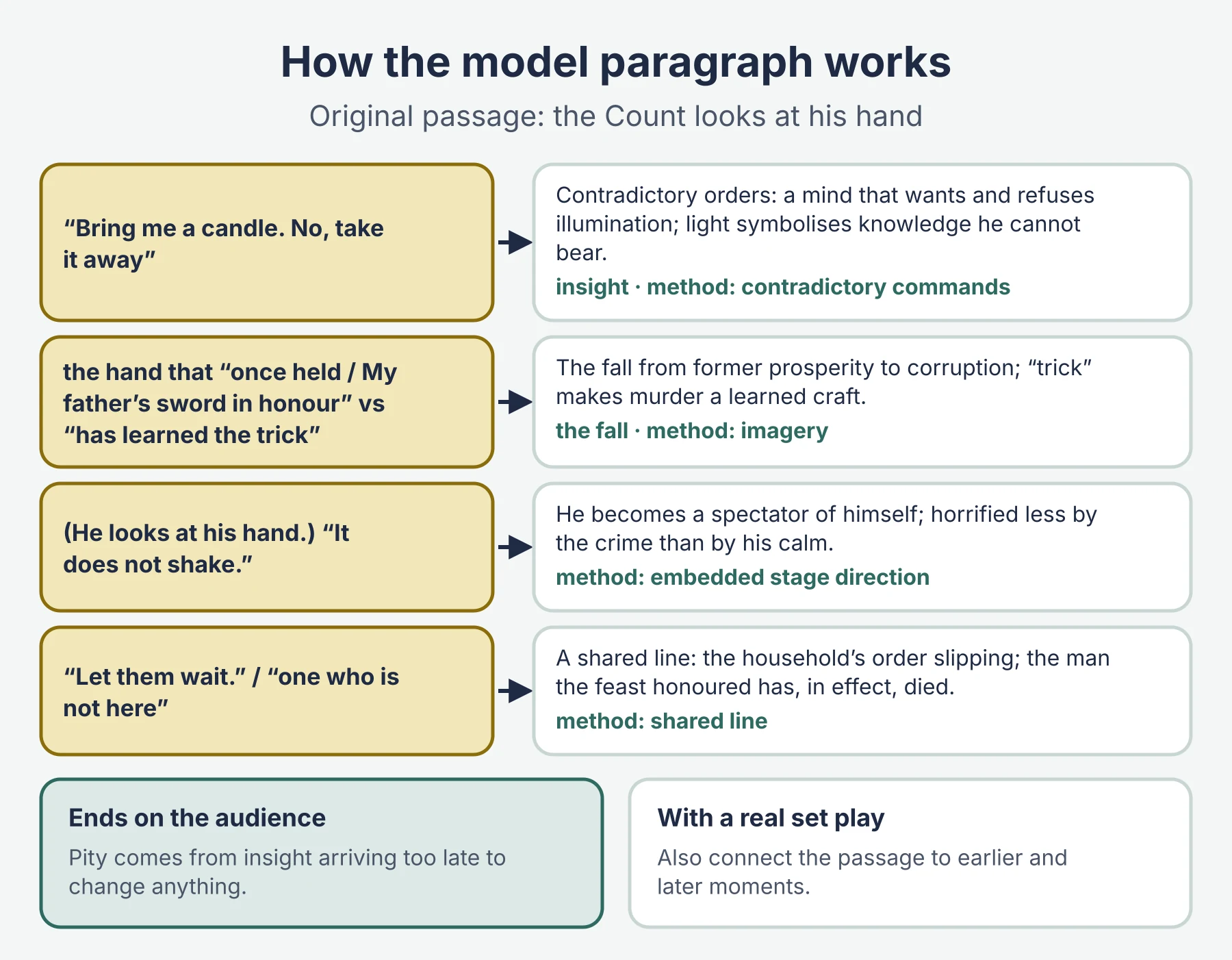
COUNT: Bring me a candle. No, take it away; I have seen enough by daylight. Was it I That signed the paper? This hand, that once held My father’s sword in honour at the gate, Has learned the trick of writing other men’s deaths. (He looks at his hand.) It does not shake. That frightens me the most. STEWARD: My lord, the guests are waiting. COUNT: Let them wait. The feast was laid for one who is not here.
Model paragraph:
The passage stages the moment of tragic insight as a failure of the Count’s own body to register guilt. The contradictory orders about the candle (“Bring me a candle. No, take it away”) show a mind that both wants and refuses illumination, so the light becomes a symbol of the knowledge he cannot bear. Marking the contrast between the hand that “once held / My father’s sword in honour” and the hand that “has learned the trick” of signing deaths, the dramatist traces the fall from the hero’s former prosperity to corruption; “trick” makes murder sound like a skill, a learned craft rather than a single error. The embedded stage direction, with the Count studying his own hand, makes the audience watch him become a spectator of himself, and his fear that it “does not shake” is the climax of the speech: he is horrified less by the crime than by his calm. When the Steward breaks in with the waiting guests, the shared line with the curt “Let them wait” shows the social order of the household already slipping out of his care, and the final line suggests that the man the feast honoured has, in effect, died. The audience’s pity comes from the insight arriving too late to change anything, which is why the moment works as tragedy rather than as remorse alone.
Notice what the paragraph does: it names two aspects (insight; the fall from prosperity), analyses method (contradictory commands, imagery, an embedded stage direction, a shared line), and ends on the audience’s response. With a real set play, the final step would also connect the passage to earlier and later moments of the play.
Choosing your memory bank by play
Because you cannot predict the passage, revise moments that link easily to any part of the play:
- Othello: the temptation in Act 3 Scene 3; Iago’s soliloquies; Othello’s final speech.
- King Lear: the love test and division of the kingdom; the storm; the reunion with Cordelia; the Gloucester sub-plot as a parallel fall.
- Hamlet: the Ghost’s commands; the soliloquies; the play-within-the-play; the graveyard.
- Doctor Faustus: the pact signed in blood; the Good and Evil Angels; the final soliloquy as the clock strikes.
- The Duchess of Malfi: the secret wooing of Antonio; Ferdinand’s and Bosola’s roles as opponents; the Duchess’s death in Act 4; Bosola’s change of heart.
For each moment, learn a handful of short quotations and one sentence on which aspect of tragedy it best shows.
Common mistakes
- Writing an essay on the whole play with the passage as decoration. The passage is the starting point; most of the answer should analyse it.
- Analysing only the passage. The opposite error: without links to the wider play you cannot show significance.
- Listing conventions. Saying “this is hamartia” earns little; arguing whether the flaw is the real cause of the fall earns a great deal.
- Ignoring the stage. Silence, entrances, props and who is watching are all dramatic method.
- Context as history lesson. Every contextual point should change the reading of a line.
Exam technique
The specification states that significance is frequently used in framing questions. It asks you to weigh how the passage is written, the contexts that apply, and the interpretations it allows. Questions typically ask you to explore, which means following an argument through the passage rather than surveying features. Unit 1 lasts 2 hours for two 25-mark answers, so about an hour each is proportionate; spend the first five to eight minutes annotating the passage and noting two links to the wider play.
More resources on this topic
- Unit 1 Section A revision notes
- Unit 1 Section A practice questions
- Unit 1 Section B study guide: later dramatic tragedies
Specification
OxfordAQA International AS and A-level English Literature (9675) specification PDF, Version 5.3, section 3.1 — oxfordaqa.com.
Related resources
-
Practice questions
OxfordAQA International A-Level English Literature (9675): Unit 1 Section A, Elizabethan and Jacobean Tragedy – Practice Questions
Thirteen original questions on the 9675 Unit 1 Section A passage task, using two invented Jacobean-style extracts, with point-by-point answers.
English Literature · OxfordAQA · AS Level
Try questions -
Revision notes
OxfordAQA International A-Level English Literature (9675): Unit 1 Section A, Elizabethan and Jacobean Tragedy – Revision Notes
Condensed notes for the OxfordAQA 9675 Unit 1 Section A passage question: the five plays, tragic aspects, dramatic terms, exam traps and a self-test.
English Literature · OxfordAQA · AS Level
Revise topic -
Study guides
OxfordAQA International A-Level English Literature (9675): Unit 1 Section B, Later Dramatic Tragedies
How to write the 9675 Unit 1 Section B essay on a later dramatic tragedy: the five plays, modern tragic ideas, an essay plan and a model paragraph.
English Literature · OxfordAQA · AS Level
Read guide
Get free revision emails (optional)
Occasional emails with practice questions, worked explanations and links to free resources for the qualification and subjects you choose. No spam, and you can unsubscribe from any email. The free tools on this site never need an email.