
Study Guides
OxfordAQA International A-Level English Literature (9675): Unit 1 Section B, Later Dramatic Tragedies
How to write the 9675 Unit 1 Section B essay on a later dramatic tragedy: the five plays, modern tragic ideas, an essay plan and a model paragraph.
- Subject
- English Literature
- Level
- AS LEVEL
- Topic
- Unit 1 – Aspects of Dramatic Tragedy
- Author
- Marlbridge Academic Team
- Updated
- Reviewed by
- Ammar Bilal (what this means)
Aligned to OxfordAQA A Level English Literature (9675), Version 5.3, for International AS exams from May/June 2018, A-level from May/June 2019. Official specification .
Syllabus page (what it covers and how it is assessed): OxfordAQA A Level English Literature.
Syllabus points this page covers
9675 (AS Level)
- Section B: Later dramatic tragedies
Found an error? Report a correction.
Need help with this topic? Request a free trial class for A Level English Literature (9675).
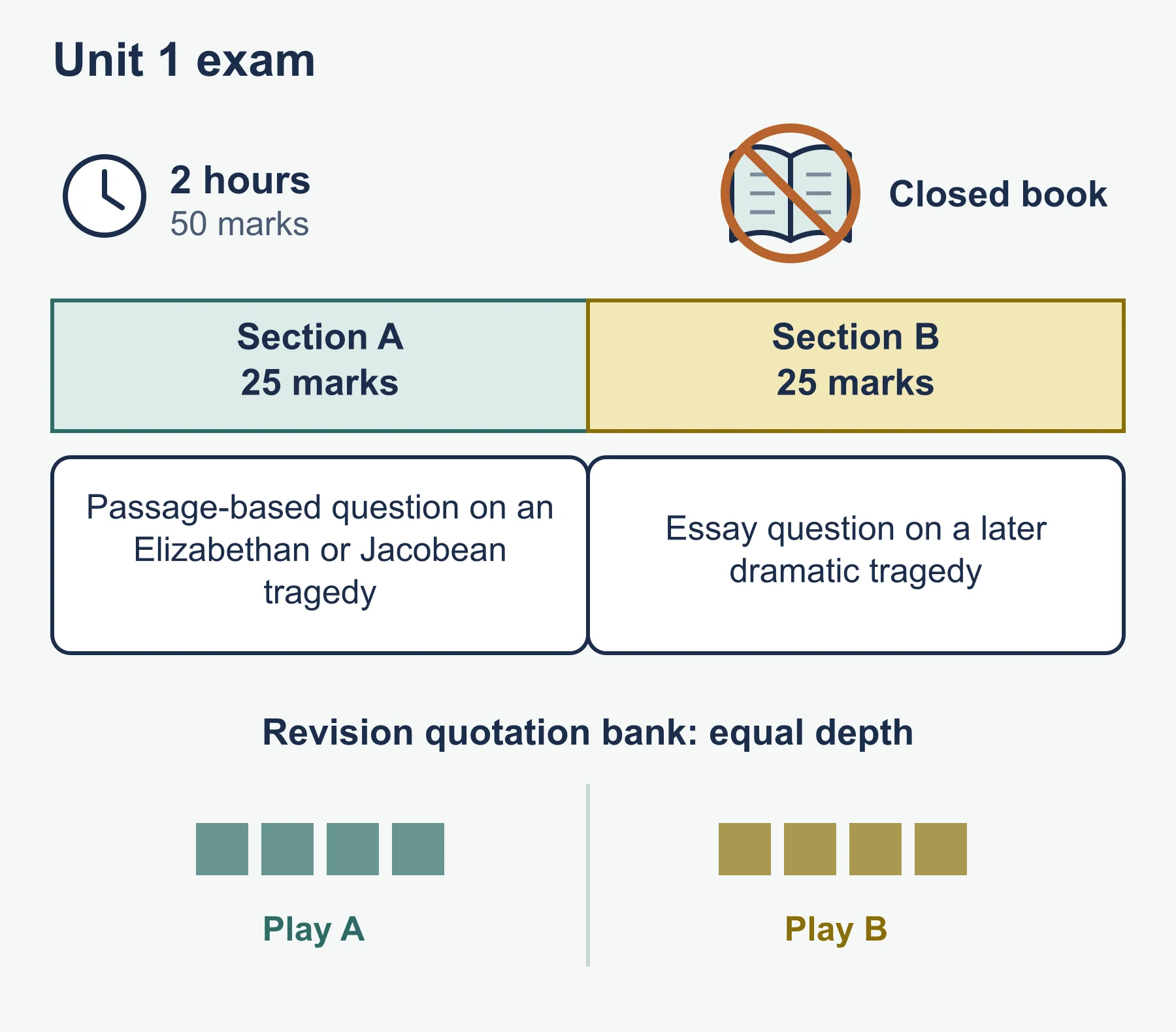
Section B of Unit 1 Aspects of Dramatic Tragedy in OxfordAQA International AS and A-level English Literature (9675) is an essay question, worth 25 marks, on one later dramatic tragedy. No passage is printed and the exam is closed book, so you build an argument about the whole play from memory. The Aspects of Dramatic Tragedy unit overview explains how the unit fits together; this guide concentrates on the Section B essay and on how modern playwrights reshape tragedy.
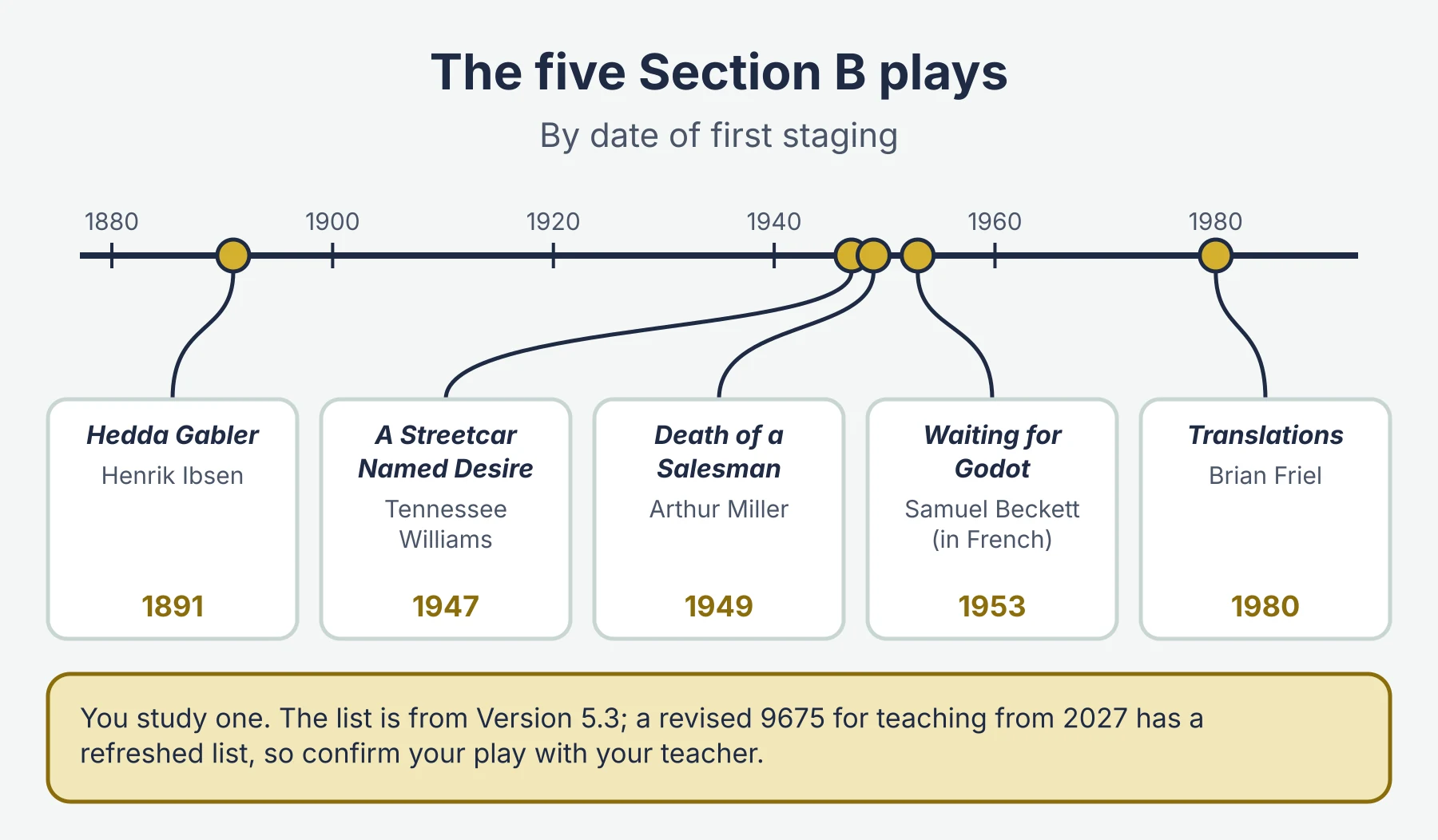
The five Section B plays
| Playwright | Play | First staged |
|---|---|---|
| Henrik Ibsen | Hedda Gabler | 1891 |
| Tennessee Williams | A Streetcar Named Desire | 1947 |
| Arthur Miller | Death of a Salesman | 1949 |
| Samuel Beckett | Waiting for Godot | 1953 (in French) |
| Brian Friel | Translations | 1980 |
You study one. The list is from Version 5.3; a revised 9675 for teaching from 2027 has a refreshed set-text list, so confirm your play with your teacher.
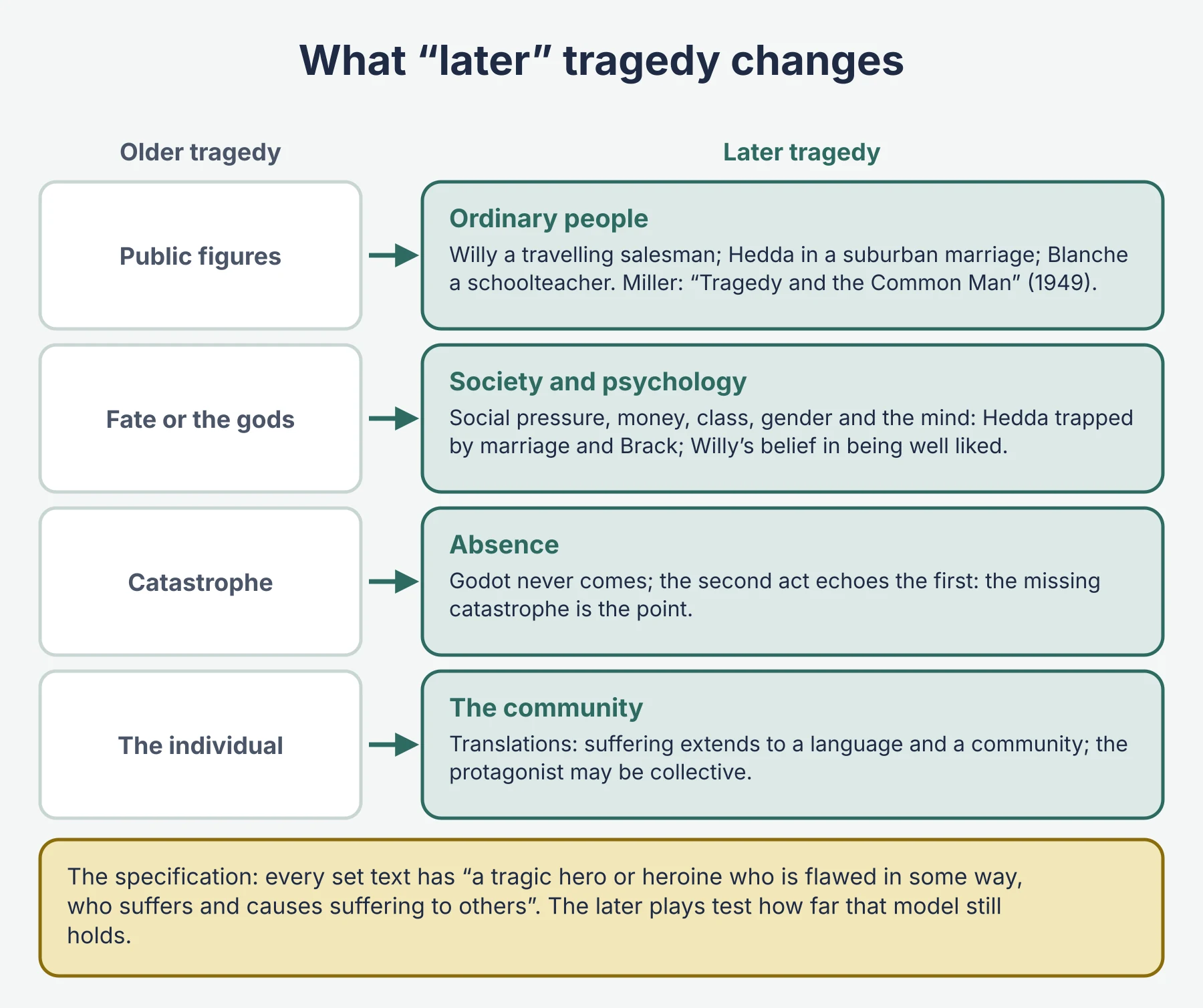
What “later” tragedy changes
The specification says every set text has “a tragic hero or heroine who is flawed in some way, who suffers and causes suffering to others”, but the later plays test how far that older model still holds. Four shifts are worth understanding.
From public to domestic. The specification contrasts tragedy “about public figures” with tragedy “about representations of ordinary people”. Willy Loman is a travelling salesman; Hedda is a general’s daughter trapped in a suburban marriage; Blanche is a schoolteacher who has lost the family estate. Miller defended this shift in his 1949 essay “Tragedy and the Common Man”, arguing that the common man is as apt a subject for tragedy as kings.
From fate to society and psychology. Where older tragedy can invoke fate or the gods, these plays locate inevitability in social pressure, money, class, gender and the mind. Hedda’s sense of being trapped by marriage and by Judge Brack, or Willy’s belief in success through being well liked, work as a modern equivalent of fate.
From catastrophe to absence. Waiting for Godot, which Beckett subtitled in English “a tragicomedy in two acts”, repeats rather than resolves: Godot never comes, and the second act echoes the first. The specification’s reminder that “the absence of an ‘aspect’ can be as significant as its presence” is essential here: the missing catastrophe and missing resolution are the point.
From individual to community. In Translations, set in 1833 in a Donegal hedge school as the British army maps and anglicises Irish place names, the suffering extends from individuals to a language and a community. You can argue that the tragic protagonist is collective.
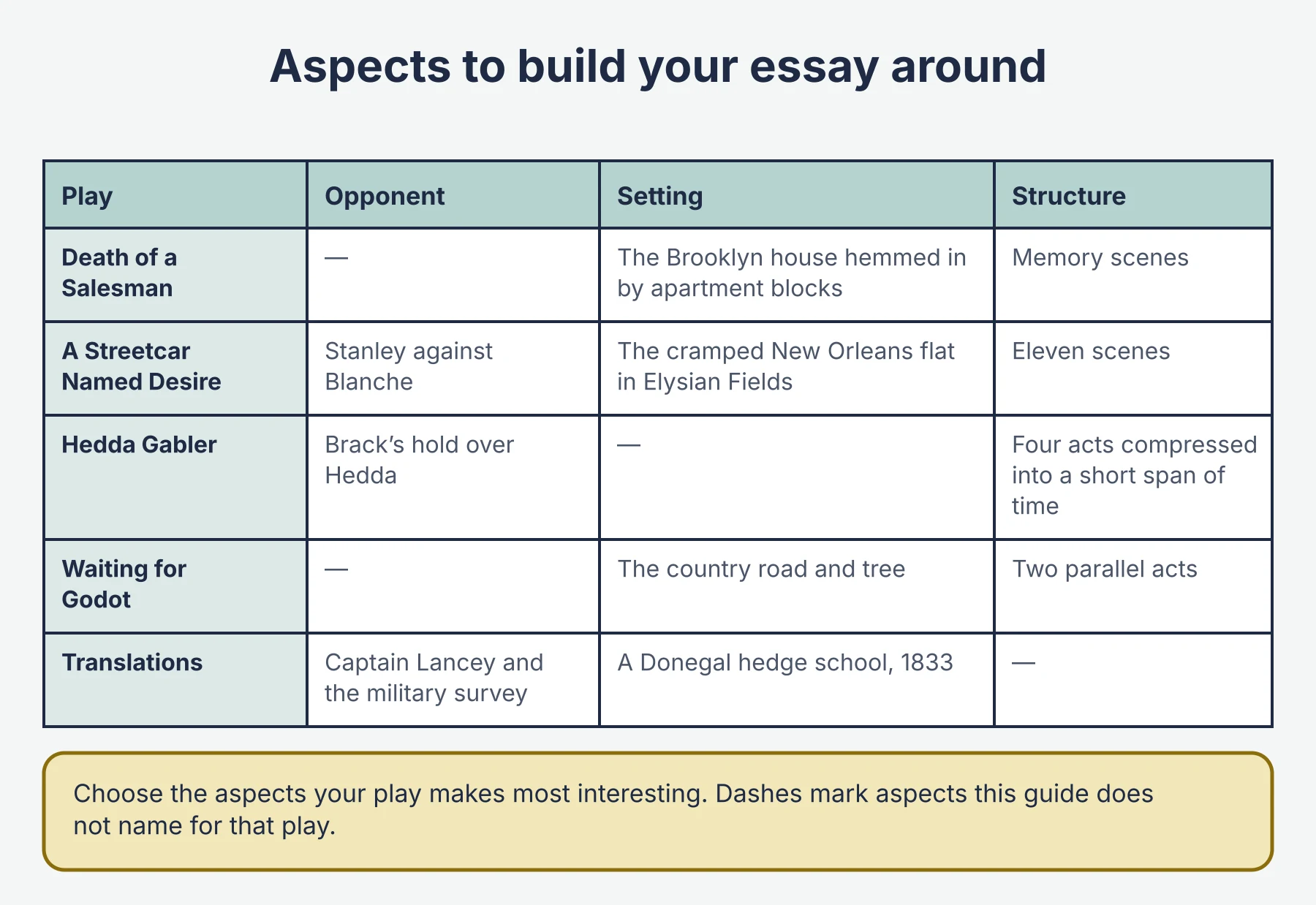
Aspects to build your essay around
Choose aspects from the specification’s list that your play makes most interesting:
- the journey towards death and whether the hero gains insight (Willy’s confusion to the end; Hedda’s final act of control);
- the opponent: Stanley against Blanche; Brack’s hold over Hedda; Captain Lancey and the military survey in Translations;
- settings, places and times: the Brooklyn house hemmed in by apartment blocks; the cramped New Orleans flat in Elysian Fields; the country road and tree in Godot;
- violence and revenge, including violence that happens offstage;
- structure: Miller’s memory scenes, Williams’s eleven scenes, Ibsen’s four acts compressed into a short span of time, Beckett’s two parallel acts;
- dramatic language: Blanche’s poetic evasions, the tangled idioms of the Lomans, the non-English speech of the Irish characters that the audience hears in English;
- the audience: pity, fear, and the “understanding of the human condition” the specification names.
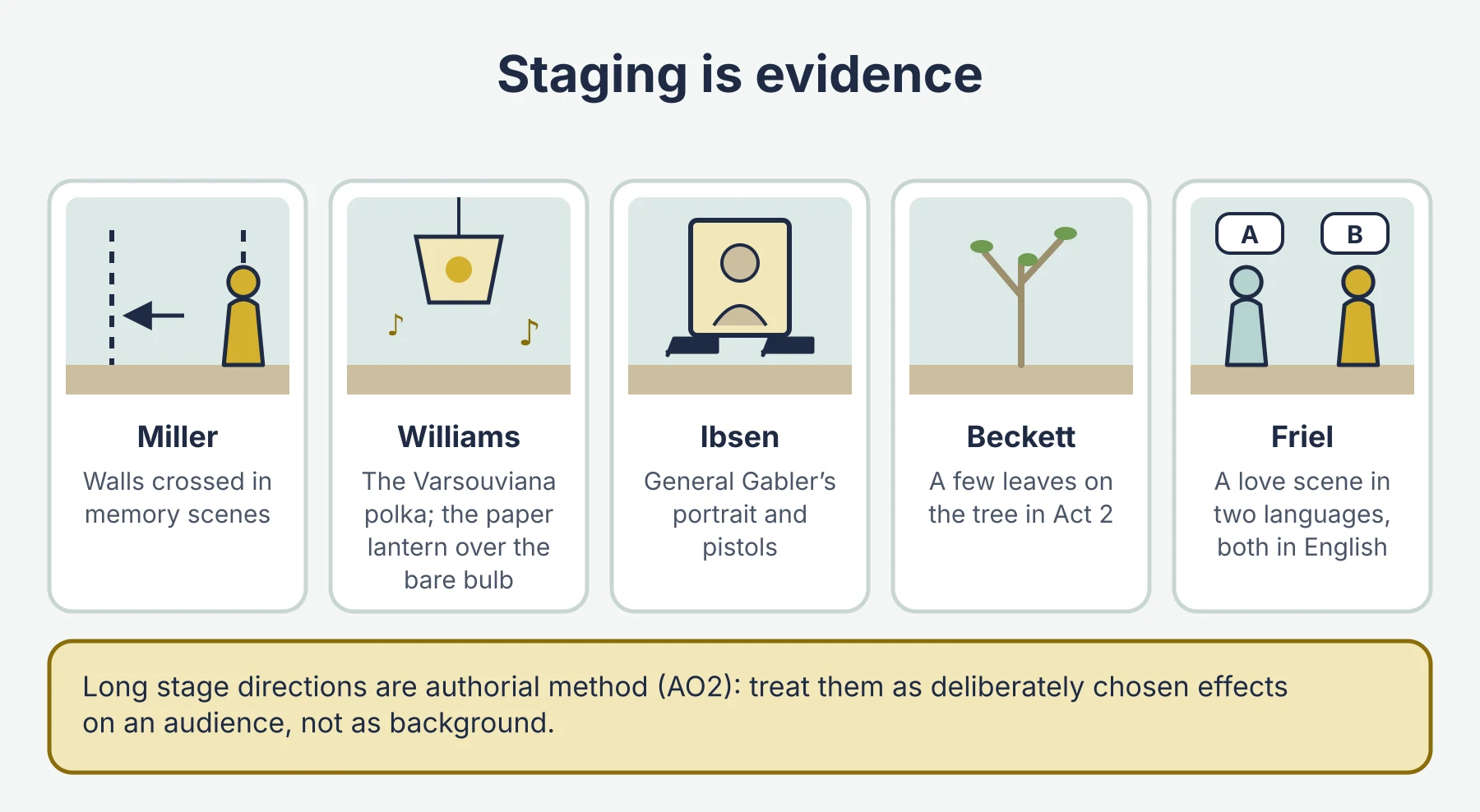
Staging is evidence
Later playwrights write long stage directions, and these count as authorial method (AO2). Miller asks for a house through which the walls are crossed in memory scenes; Williams uses the Varsouviana polka that Blanche hears and the paper lantern over the bare bulb; Ibsen places General Gabler’s portrait and pistols at the heart of the room; Beckett gives the tree a few leaves in the second act; Friel has two characters speaking different languages in a love scene, both performed in English. A strong essay treats these as deliberately chosen effects on an audience, not as background.
Planning a Section B essay
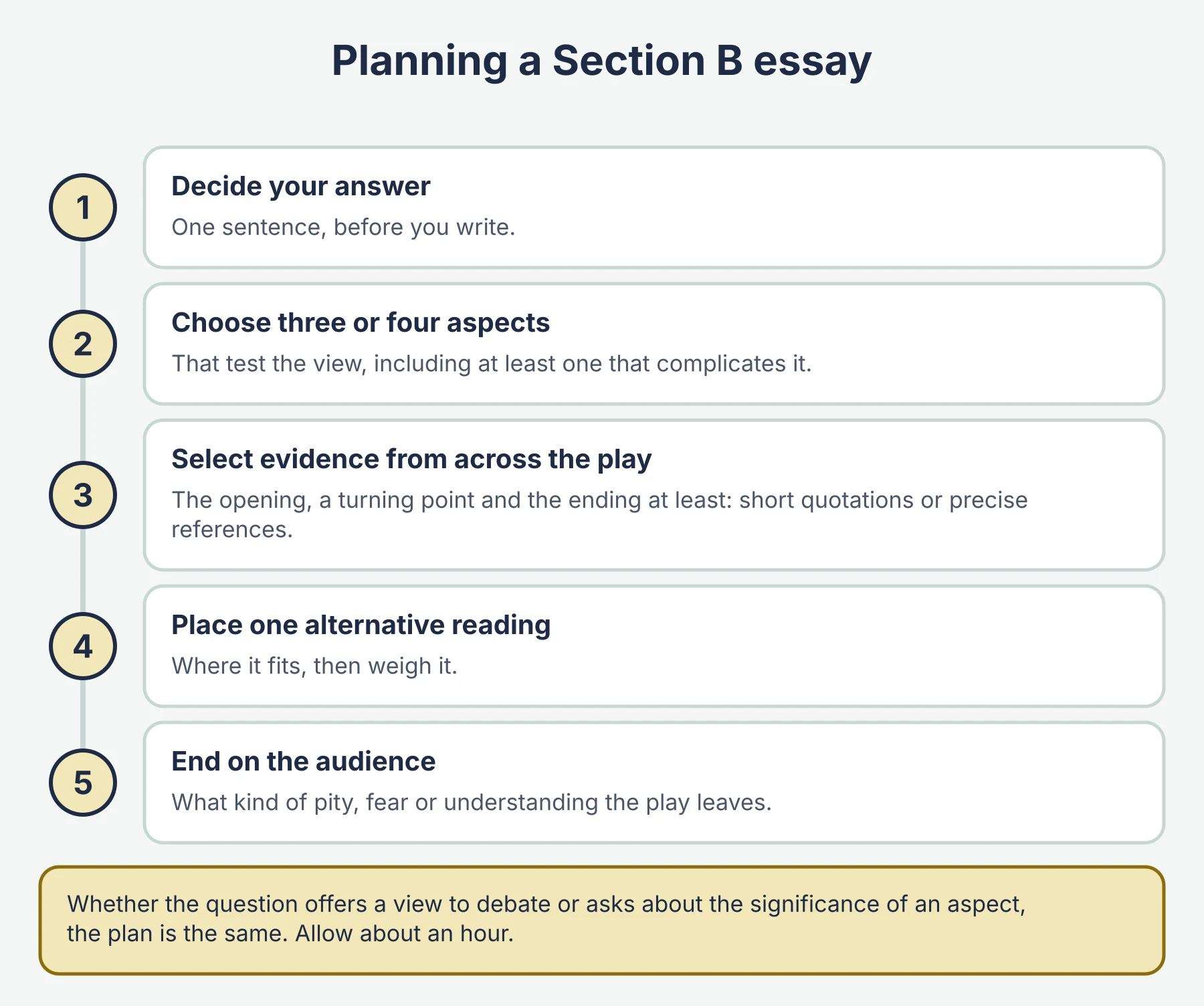
Questions on these plays often offer a view to debate or ask you to explore the significance of an aspect. Either way, the plan is the same.
- Decide your answer in one sentence before you write.
- Choose three or four aspects that test the view, including at least one that complicates it.
- Select evidence from across the play: the opening, a turning point and the ending at least, each with one or two short quotations or precise references.
- Place one alternative reading where it fits, then weigh it.
- End on the audience: what kind of pity, fear or understanding the play leaves.
Worked example
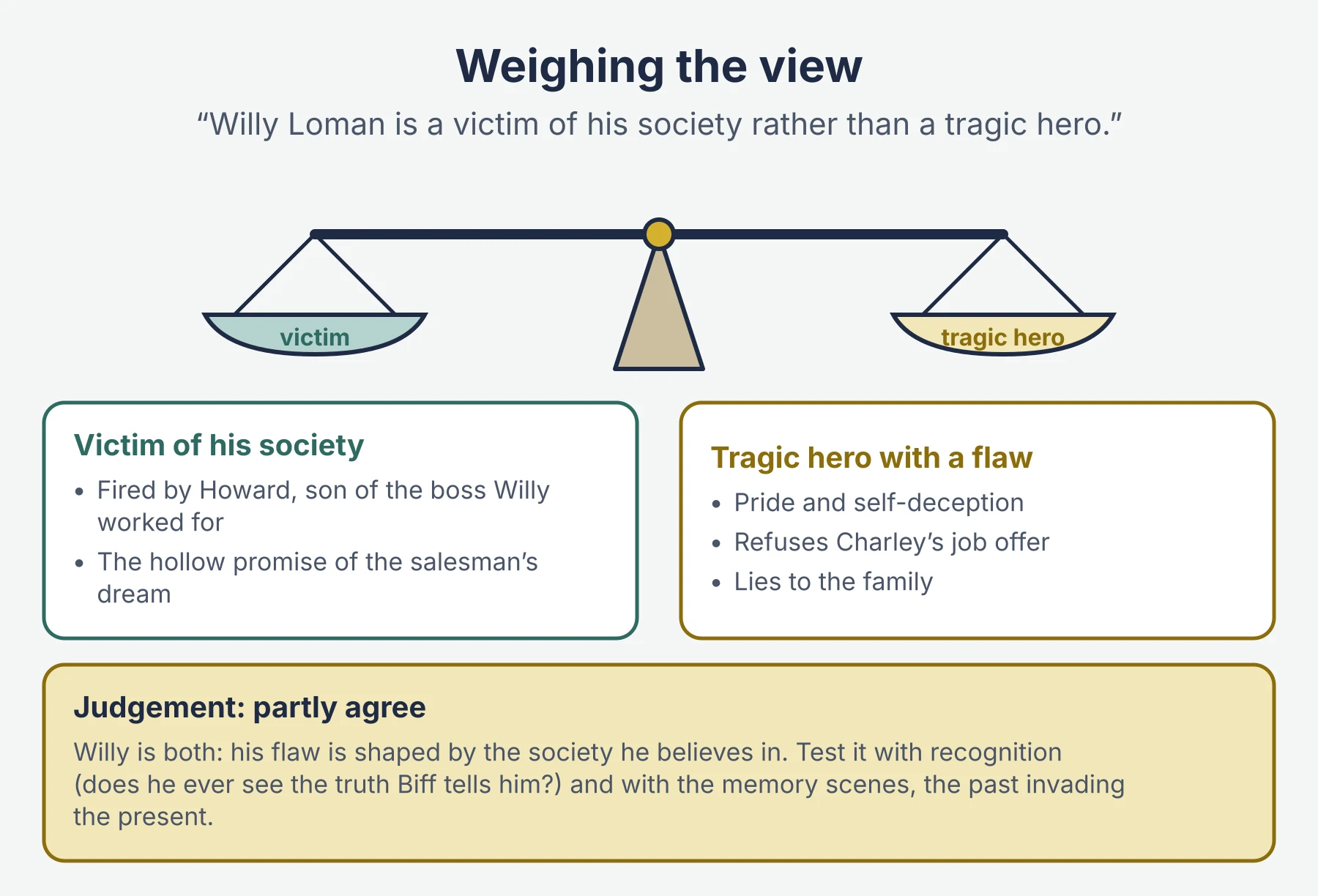
Question shape (original): “Willy Loman is a victim of his society rather than a tragic hero.” Discuss this view of Death of a Salesman.
Plan: Partly agree. (1) Society: the firing by Howard, the son of the boss Willy worked for; the hollow promise of the salesman’s dream. (2) Flaw: Willy’s own pride and self-deception, his refusal of Charley’s job offer, his lies to the family. (3) Recognition: whether Willy ever sees the truth that Biff tries to tell him. (4) Structure and staging: memory scenes showing the past invading the present. Judgement: Willy is both, and the play’s tragic force comes from the way his flaw is shaped by the society he believes in.
Model paragraph:
Miller makes it difficult to separate Willy’s flaw from the society that produced it. His pride is real: he refuses Charley’s offer of work even after being fired, because accepting would admit that being well liked has failed him, and this refusal is a choice, not an accident. Yet the values behind the refusal are not his own invention. The memory scenes, in which the walls of the house are crossed as if they did not exist, show the past breaking into the present at moments of humiliation, so the audience sees Willy’s mind returning compulsively to the moment when his belief in the dream seemed justified. When Linda insists that attention must finally be paid to such a person, she claims for an ordinary salesman the dignity older tragedy gave to kings, which is exactly the position Miller defended. The tragedy therefore lies less in a single error than in Willy’s loyalty to a false idea of success: he is a victim of his society, but one who keeps choosing that society’s terms, and the audience’s pity depends on watching him make the choice.
The paragraph argues, uses precise reference and close paraphrase, analyses staging as method, brings in context through Miller’s own view, and returns to the question’s terms.
Common mistakes
- Narrating the plot. The examiner knows the play; every paragraph needs an argument.
- Forcing the play into an old template. Arguing that Blanche “has hamartia” is weaker than asking how far a modern heroine’s suffering is caused by her own choices.
- Evidence from one act only. A whole-play essay needs the beginning, middle and end.
- Ignoring stage directions, which are among the strongest evidence of method in these plays.
- Treating context as background history. Use it to explain why a character’s choices are limited or why an audience responds as it does.
Exam technique
Command words such as discuss and explore both require argument across the play, with more than one view weighed. Allow about an hour, as Unit 1 lasts 2 hours for two 25-mark answers. If you answer Section A first, leave yourself the full hour for this essay rather than letting the passage answer overrun.
More resources on this topic
- Unit 1 Section B revision notes
- Unit 1 Section B practice questions
- Unit 1 Section A study guide: Elizabethan and Jacobean tragedy
Specification
OxfordAQA International AS and A-level English Literature (9675) specification PDF, Version 5.3, section 3.1 — oxfordaqa.com.
Related resources
-
Practice questions
OxfordAQA International A-Level English Literature (9675): Unit 1 Section B, Later Dramatic Tragedies – Practice Questions
Twelve original questions building the 9675 Unit 1 Section B essay on later tragedy: concepts, an invented scene and planning tasks, with answers.
English Literature · OxfordAQA · AS Level
Try questions -
Revision notes
OxfordAQA International A-Level English Literature (9675): Unit 1 Section B, Later Dramatic Tragedies – Revision Notes
Revision notes for the 9675 Unit 1 Section B essay: the five later tragedies, how modern drama reshapes tragic aspects, key terms, exam traps and a self-test.
English Literature · OxfordAQA · AS Level
Revise topic -
Study guides
OxfordAQA International A-Level English Literature (9675): Violence and Revenge in Later Dramatic Tragedies
How the five 9675 Section B plays use violence and revenge, often offstage or turned inward, and how to build an essay on this aspect of tragedy.
English Literature · OxfordAQA · AS Level
Read guide
Get free revision emails (optional)
Occasional emails with practice questions, worked explanations and links to free resources for the qualification and subjects you choose. No spam, and you can unsubscribe from any email. The free tools on this site never need an email.