
Revision Notes
OxfordAQA International A-Level English Literature (9675): Unit 1 Section B, Later Dramatic Tragedies – Revision Notes
Revision notes for the 9675 Unit 1 Section B essay: the five later tragedies, how modern drama reshapes tragic aspects, key terms, exam traps and a self-test.
- Subject
- English Literature
- Level
- AS LEVEL
- Topic
- Unit 1 – Aspects of Dramatic Tragedy
- Author
- Marlbridge Academic Team
- Updated
- Reviewed by
- Ammar Bilal (what this means)
Aligned to OxfordAQA A Level English Literature (9675), Version 5.3, for International AS exams from May/June 2018, A-level from May/June 2019. Official specification .
Syllabus page (what it covers and how it is assessed): OxfordAQA A Level English Literature.
Syllabus points this page covers
9675 (AS Level)
- Section B: Later dramatic tragedies
Found an error? Report a correction.
Need help with this topic? Request a free trial class for A Level English Literature (9675).
Quick recall for the Section B essay on a later dramatic tragedy. For the full explanation, an essay plan and a model paragraph, use the Unit 1 Section B study guide.
The essay in one box
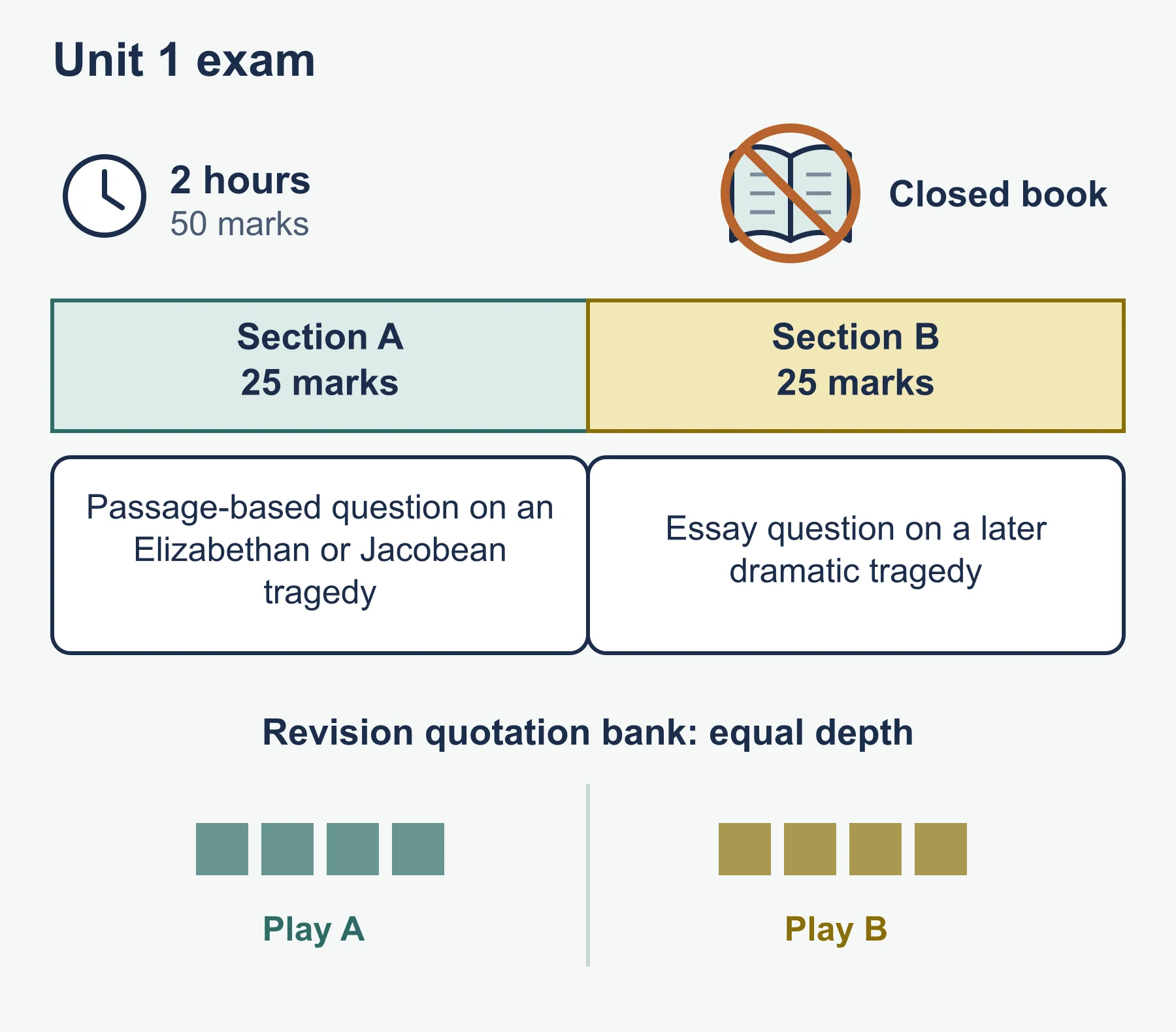
- One essay question on your later tragedy: 25 marks, half of Unit 1.
- No passage is printed, and the exam is closed book: evidence comes from memory.
- AO1 (genre, contexts, interpretations), AO2 (authorial methods) and AO3 (argued, accurate response) are weighted equally.
- About an hour in the 2-hour unit.
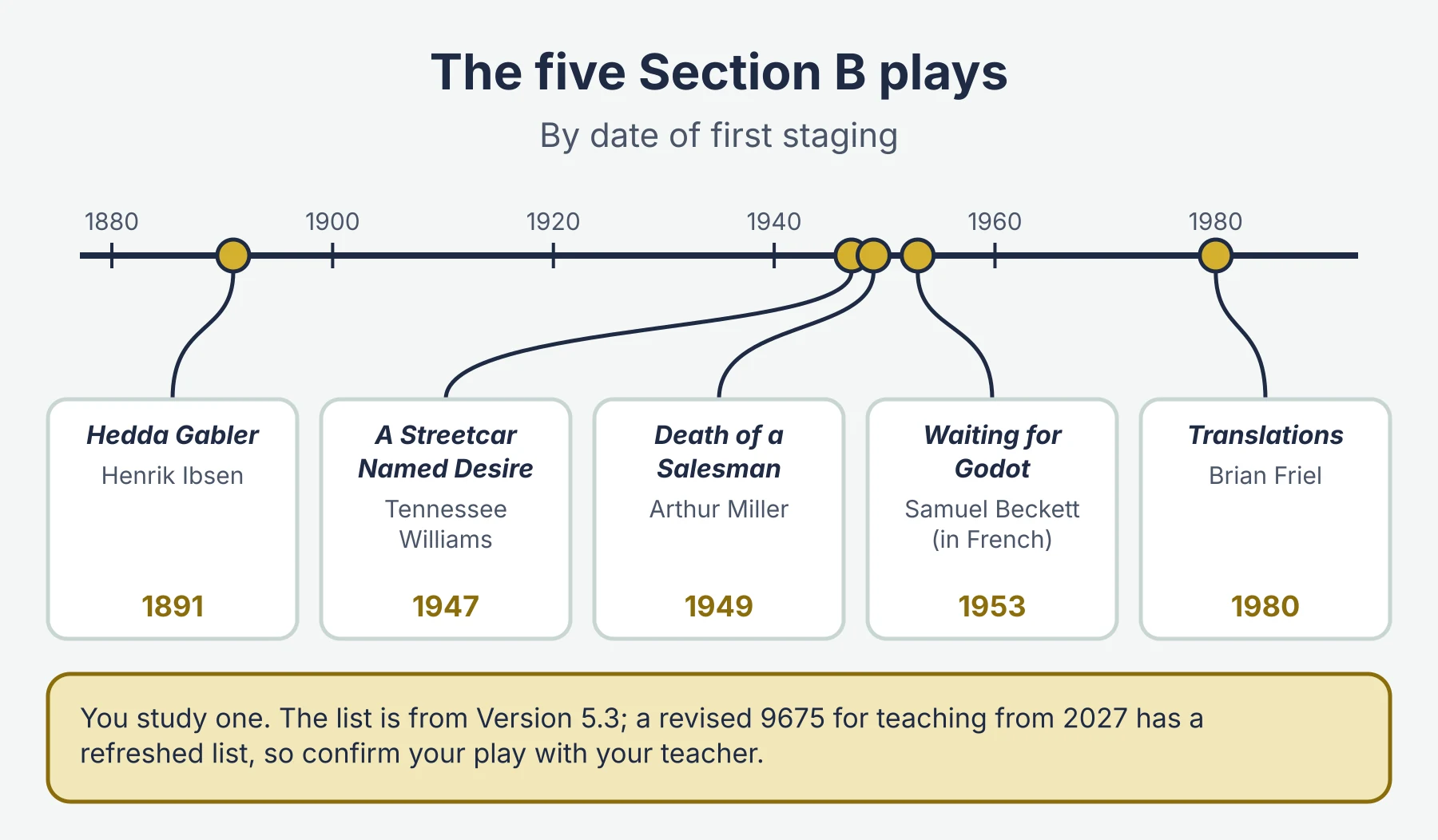
The five plays at a glance
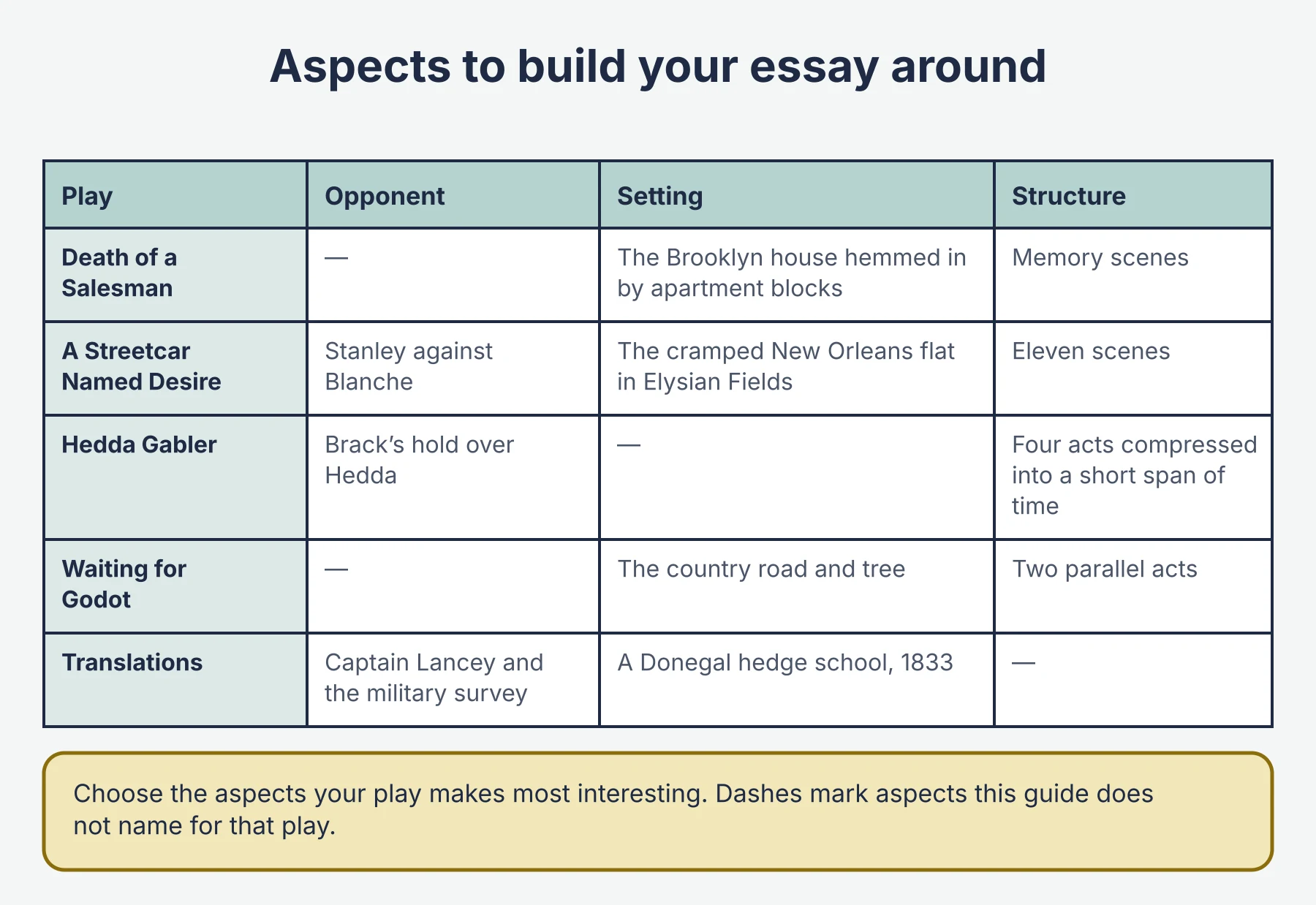
| Play | Tragic figure | Opponent or pressure | Distinctive method |
|---|---|---|---|
| Hedda Gabler (Ibsen) | Hedda | Judge Brack; marriage and respectability | Realist set, symbolic props (the pistols, the manuscript) |
| A Streetcar Named Desire (Williams) | Blanche DuBois | Stanley Kowalski | Eleven scenes; music, light and sound as psychology |
| Death of a Salesman (Miller) | Willy Loman | The dream of success; his own self-deception | Memory scenes within one set |
| Waiting for Godot (Beckett) | Vladimir and Estragon | Time, waiting, an absent Godot | Two parallel acts; repetition |
| Translations (Friel) | A community; also Hugh, Maire, Yolland | The 1833 Ordnance Survey and anglicisation | English on stage representing two languages |
Check your play against your centre’s specification version: a revised 9675 is published for teaching from 2027.
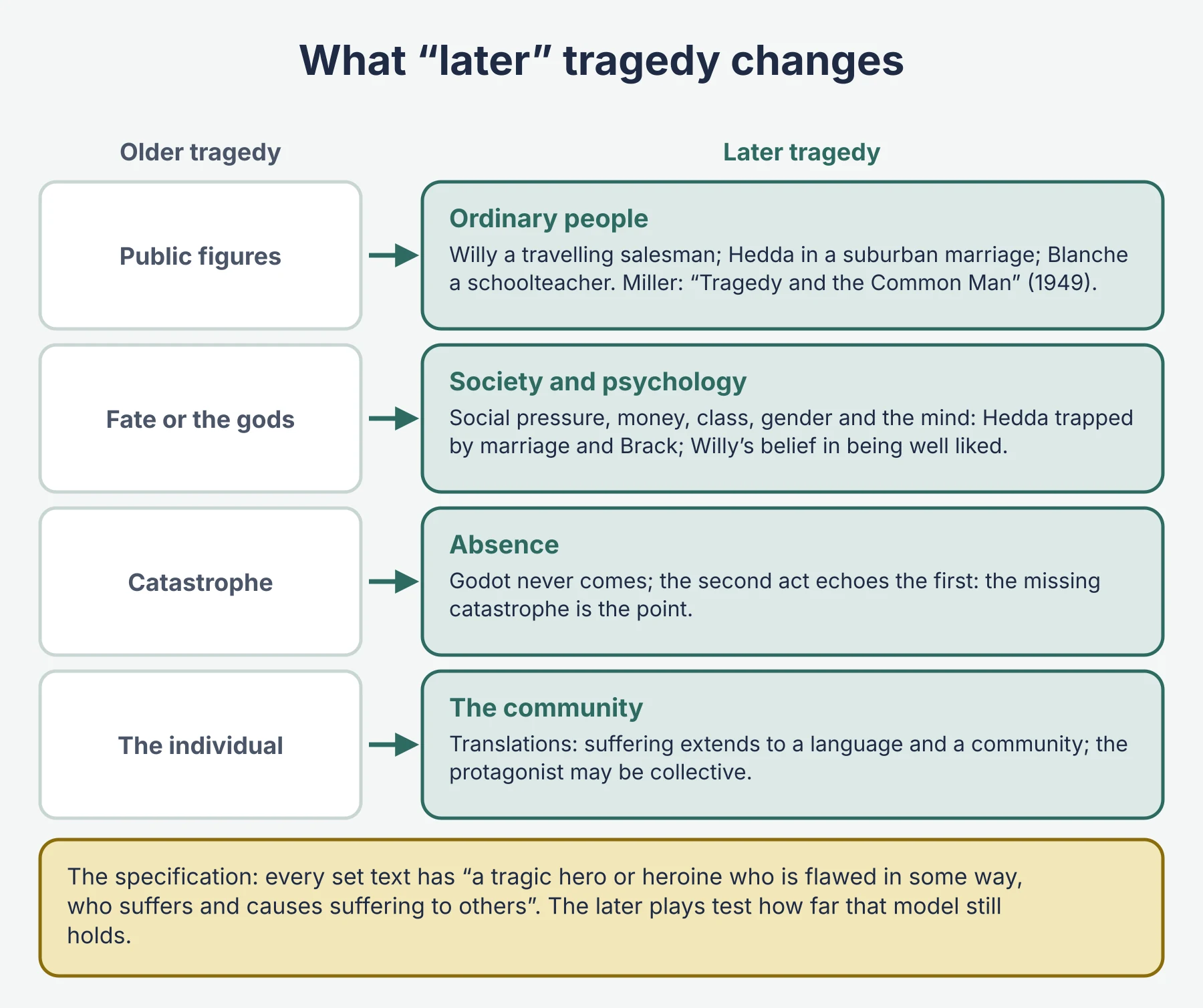
How later tragedy bends the old aspects
- Hero: ordinary people rather than kings. Miller’s 1949 essay “Tragedy and the Common Man” argues that ordinary people are fit subjects for tragedy.
- Fate: replaced or supplemented by society, money, class, gender, colonial power and psychology.
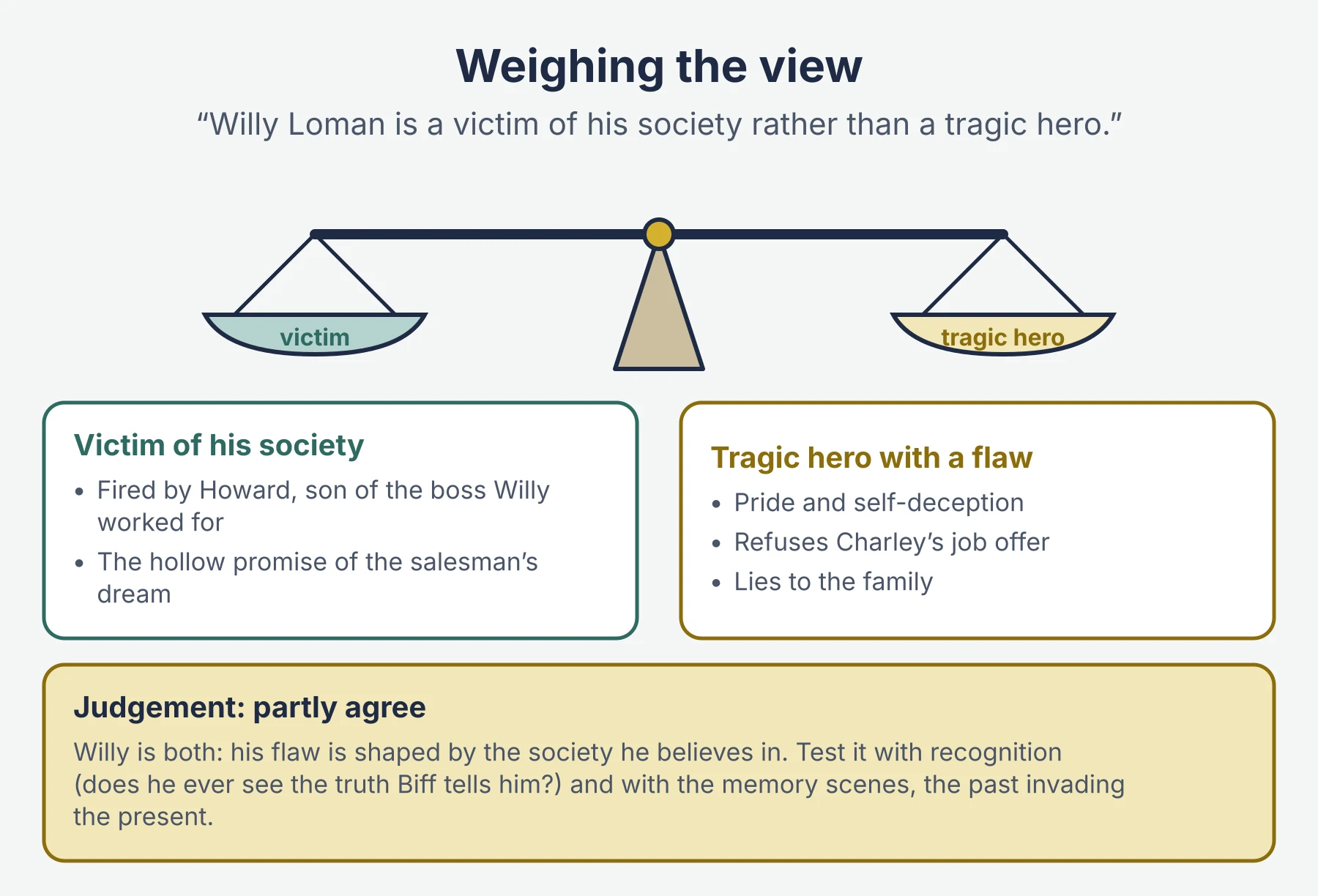
- Recognition: often partial, delayed or refused. Ask whether your protagonist ever sees the truth.
- Catastrophe: sometimes offstage (a shot heard from another room, a disappearance) or absent altogether, as in Godot.
- Order restored? Older tragedy often ends with a new ruler; later tragedy may leave the world unchanged, which is itself a statement.
- Absence: the specification notes the absence of an aspect can be as significant as its presence.
Key terms
| Term | Meaning | Most useful for |
|---|---|---|
| Domestic tragedy | Tragedy of private, family life | Miller, Ibsen, Williams |
| Realism | Stage world imitating everyday life closely | Hedda Gabler |
| Expressionism | Staging that shows inner experience | Willy’s memory scenes |
| Tragicomedy | Mixing tragic and comic | Godot, which Beckett subtitled “a tragicomedy in two acts” |
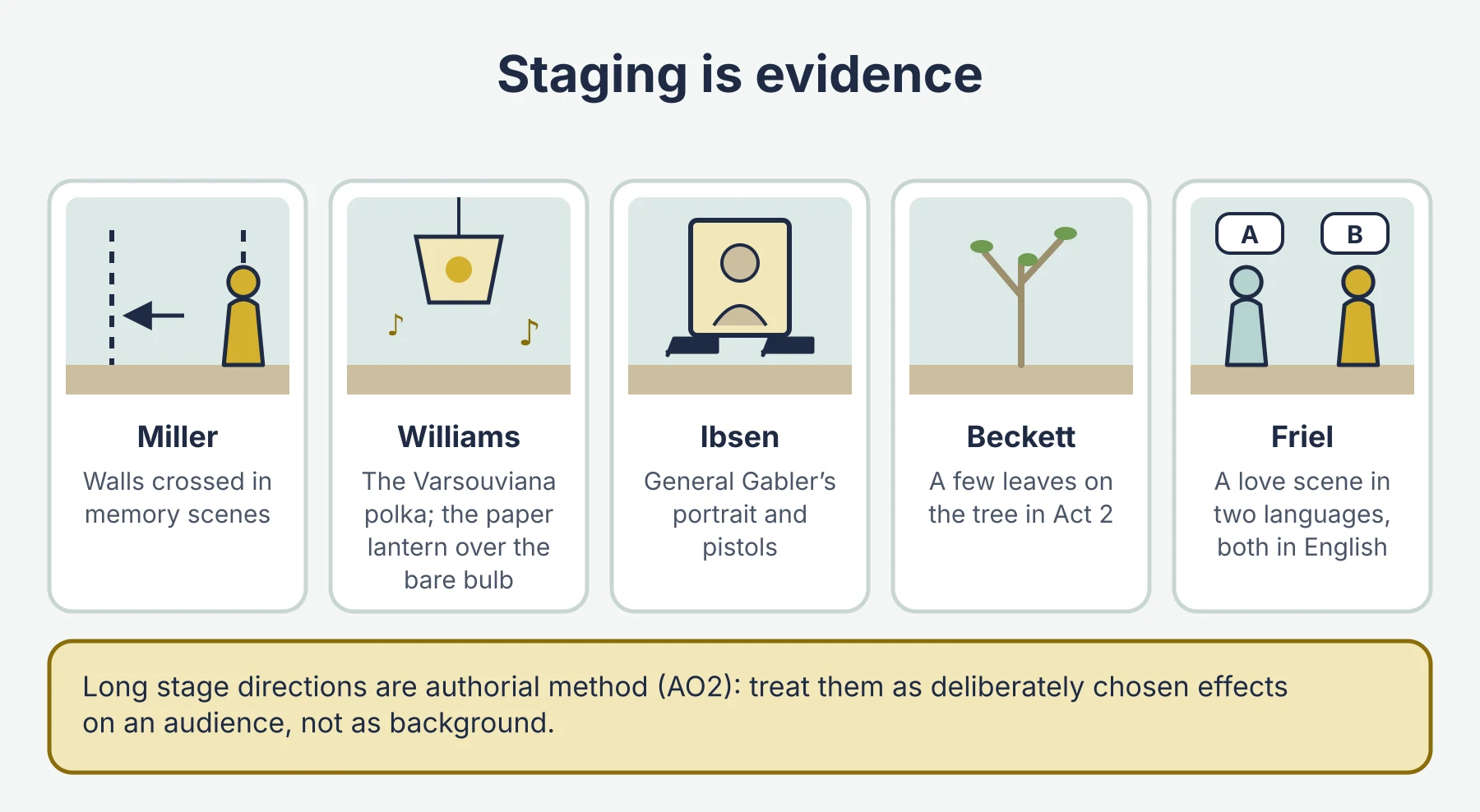
| Stage directions | The playwright’s written instructions | All five: treat as method |
| Motif | Recurring image, sound or object | The polka in Streetcar; the pistols in Hedda |
| Offstage action | Events heard or reported but not seen | Climaxes in Hedda and Translations |
| Circular structure | Ending that returns to the start | Godot |
| Collective protagonist | A group or community as the tragic subject | Translations |
| Dramatic irony | Audience knows more than characters | The Lomans’ lies; the Translations love scene, understood only by the audience |
Evidence to keep ready
For whichever play you study, keep short quotations or precise references for:
- the opening (how the tragic situation is set up);
- a turning point (the moment the fall becomes certain);
- the opponent’s strongest scene;
- a moment of insight or refused insight;
- the ending and the audience left behind.
Five moments, each tagged to two aspects, give enough flexibility for any question.
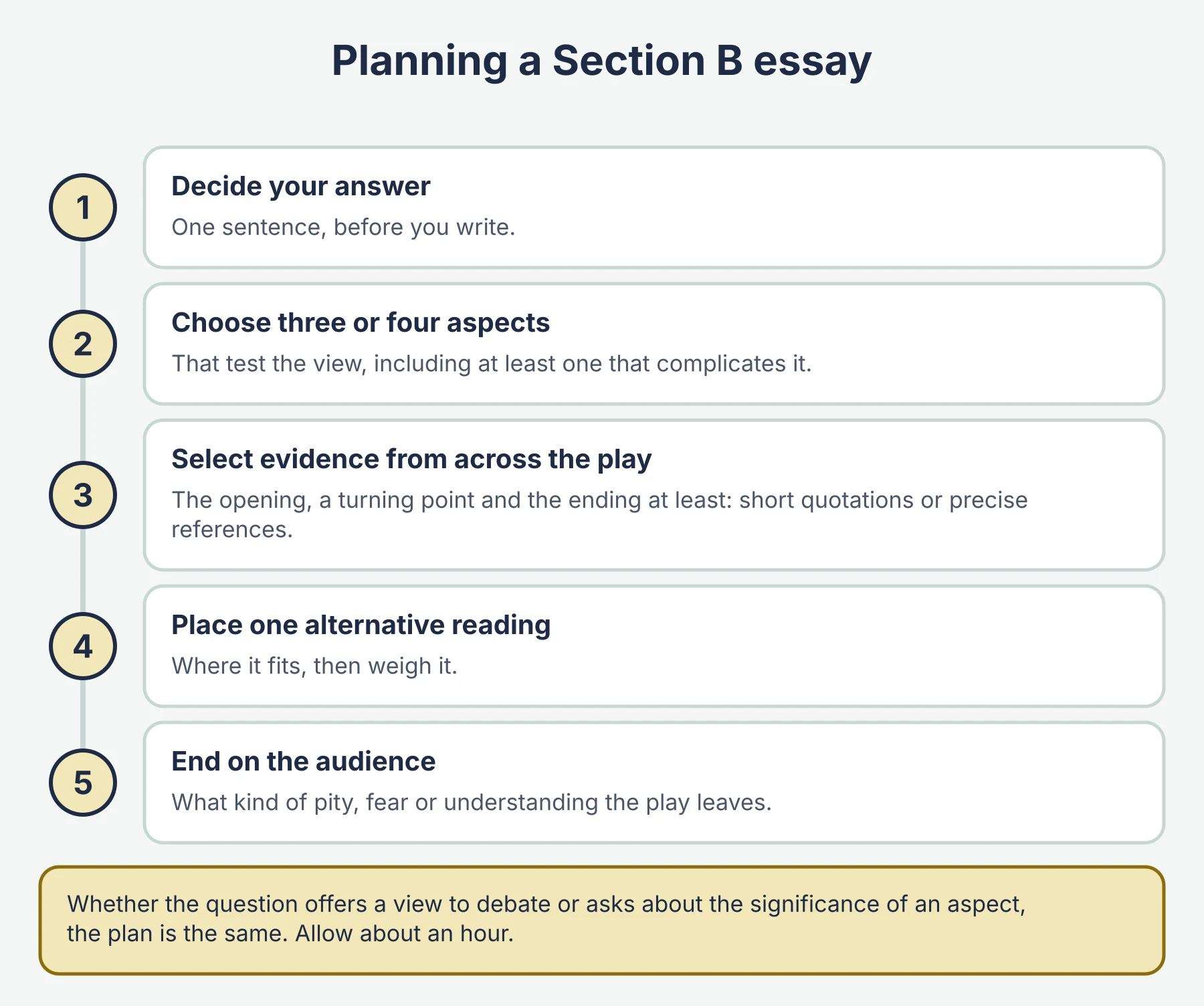
Essay shape
- One-sentence answer to the question.
- Three or four aspects, one complicating the view.
- Evidence from across the whole play.
- An alternative reading, weighed.
- A conclusion on the audience’s response.
Exam traps
- Plot summary in place of argument.
- Calling every flaw “hamartia” without testing whether the modern play works that way.
- Ignoring stage directions, music, lighting and props.
- Evidence from the first half of the play only.
- A conclusion that repeats the introduction instead of reaching a judgement.
- Misquoting: a precise paraphrase is better than a wrong quotation.
Self-test
- What is printed on the paper for Section B?
- In what year was Death of a Salesman first staged, and which essay did Miller publish that year?
- Name the opponent most often discussed in A Streetcar Named Desire.
- What subtitle did Beckett give the English Waiting for Godot?
- In what year, and where, is Translations set?
- Give two objects in Hedda Gabler that carry symbolic weight.
- How can the absence of an aspect be significant? Give an example from a later tragedy.
- What is a collective protagonist?
- Why do stage directions count as authorial method?
- Name the five moments these notes suggest revising for any play.
- Give two ways later tragedy replaces the role fate plays in older tragedy.
- What should a Section B conclusion do?
Answers
- Only the question: no passage is printed.
- 1949; “Tragedy and the Common Man”.
- Stanley Kowalski.
- “A tragicomedy in two acts”.
- 1833, in a hedge school in Donegal, Ireland.
- Any two: General Gabler’s pistols; Løvborg’s manuscript; the general’s portrait.
- A missing aspect breaks the audience’s expectation; for example, Godot never arrives, so the expected resolution or catastrophe is withheld and waiting itself becomes the suffering.
- A group or community, rather than one individual, treated as the subject of the tragedy.
- They are the playwright’s deliberate choices about what the audience sees and hears, so they shape meaning just as dialogue does.
- The opening, a turning point, the opponent’s strongest scene, a moment of insight or refused insight, and the ending.
- Any two: social expectations; money and class; gender roles; colonial power; psychology and memory.
- Reach a judgement on the question and say what the play leaves the audience understanding.
Try the Unit 1 Section B practice questions, then revise the passage skills in the Section A revision notes.
Related resources
-
Study guides
OxfordAQA International A-Level English Literature (9675): Violence and Revenge in Later Dramatic Tragedies
How the five 9675 Section B plays use violence and revenge, often offstage or turned inward, and how to build an essay on this aspect of tragedy.
English Literature · OxfordAQA · AS Level
Read guide -
Practice questions
OxfordAQA International A-Level English Literature (9675): Violence and Revenge in Later Dramatic Tragedies – Practice Questions
Twelve original questions on violence and revenge for the 9675 Section B essay, with an invented modern scene, essay plans and mark-scheme-style answers.
English Literature · OxfordAQA · AS Level
Try questions -
Revision notes
OxfordAQA International A-Level English Literature (9675): Violence and Revenge in Later Dramatic Tragedies – Revision Notes
Condensed notes on violence and revenge in the five 9675 Section B plays: forms of violence, offstage events, what replaces revenge, key terms and a self-test.
English Literature · OxfordAQA · AS Level
Revise topic
Get free revision emails (optional)
Occasional emails with practice questions, worked explanations and links to free resources for the qualification and subjects you choose. No spam, and you can unsubscribe from any email. The free tools on this site never need an email.