
Revision Notes
OxfordAQA International A-Level English Literature (9675): Unit 1 Section A, Elizabethan and Jacobean Tragedy – Revision Notes
Condensed notes for the OxfordAQA 9675 Unit 1 Section A passage question: the five plays, tragic aspects, dramatic terms, exam traps and a self-test.
- Subject
- English Literature
- Level
- AS LEVEL
- Topic
- Unit 1 – Aspects of Dramatic Tragedy
- Author
- Marlbridge Academic Team
- Updated
- Reviewed by
- Ammar Bilal (what this means)
Aligned to OxfordAQA A Level English Literature (9675), Version 5.3, for International AS exams from May/June 2018, A-level from May/June 2019. Official specification .
Syllabus page (what it covers and how it is assessed): OxfordAQA A Level English Literature.
Syllabus points this page covers
9675 (AS Level)
- Section A: Elizabethan and Jacobean tragedy
Found an error? Report a correction.
Need help with this topic? Request a free trial class for A Level English Literature (9675).
Condensed recall for the passage-based question on Elizabethan and Jacobean tragedy. For the full method and a worked model paragraph, use the Unit 1 Section A study guide.
The question in one box
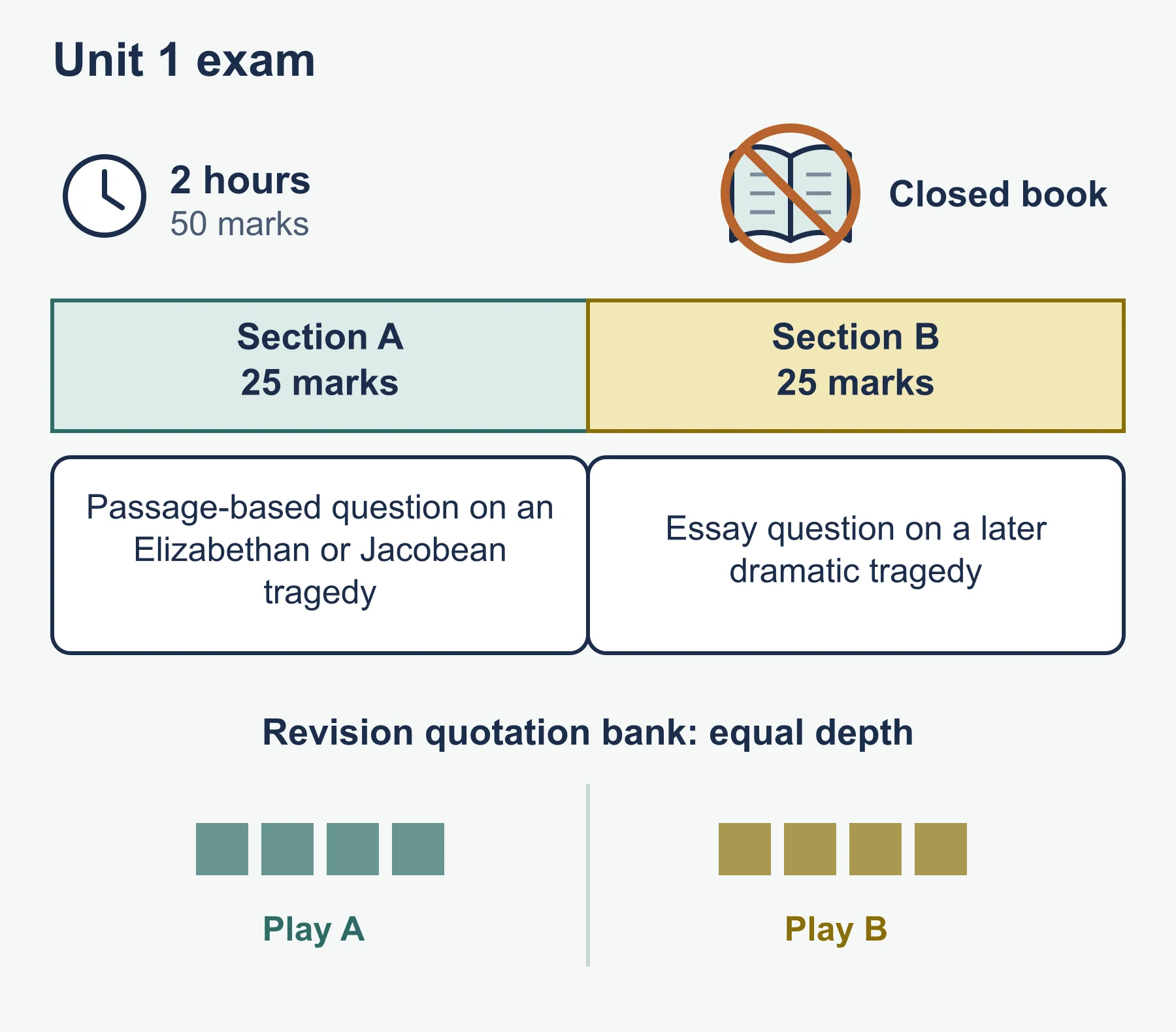
- One passage-based question on your chosen play: 25 marks, half of Unit 1.
- The passage is printed; the rest of the play comes from memory (closed book).
- AO1, AO2 and AO3 carry equal weight: contexts, genre and interpretations (AO1), authorial methods (AO2), and an argued response in accurate writing (AO3).
- Unit 1 is 2 hours for two answers, so allow about an hour for Section A.
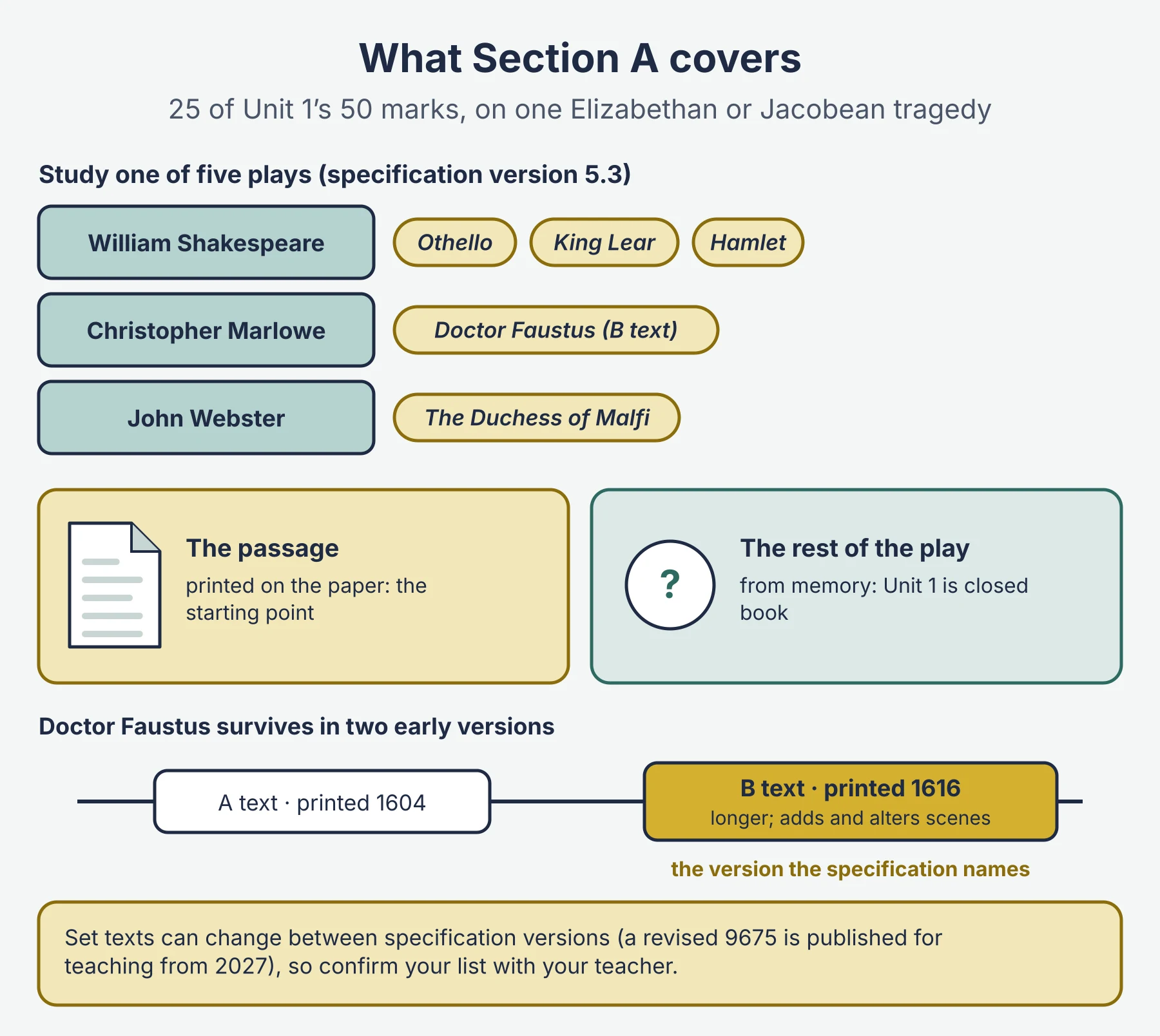
The five plays (Version 5.3)
| Play | Playwright | A tragic angle worth revising |
|---|---|---|
| Othello | Shakespeare | The villain’s contest of power; a hero misled by trust |
| King Lear | Shakespeare | Blindness and insight; the Gloucester sub-plot as parallel fall |
| Hamlet | Shakespeare | Delay and revenge; soliloquy as the mind under pressure |
| Doctor Faustus (B text) | Marlowe | A self-chosen damnation; morality-play structure |
| The Duchess of Malfi | Webster | A heroine destroyed by male control; a villain who repents |
Check your list with your teacher: a revised 9675 for teaching from 2027 has a refreshed set-text list.
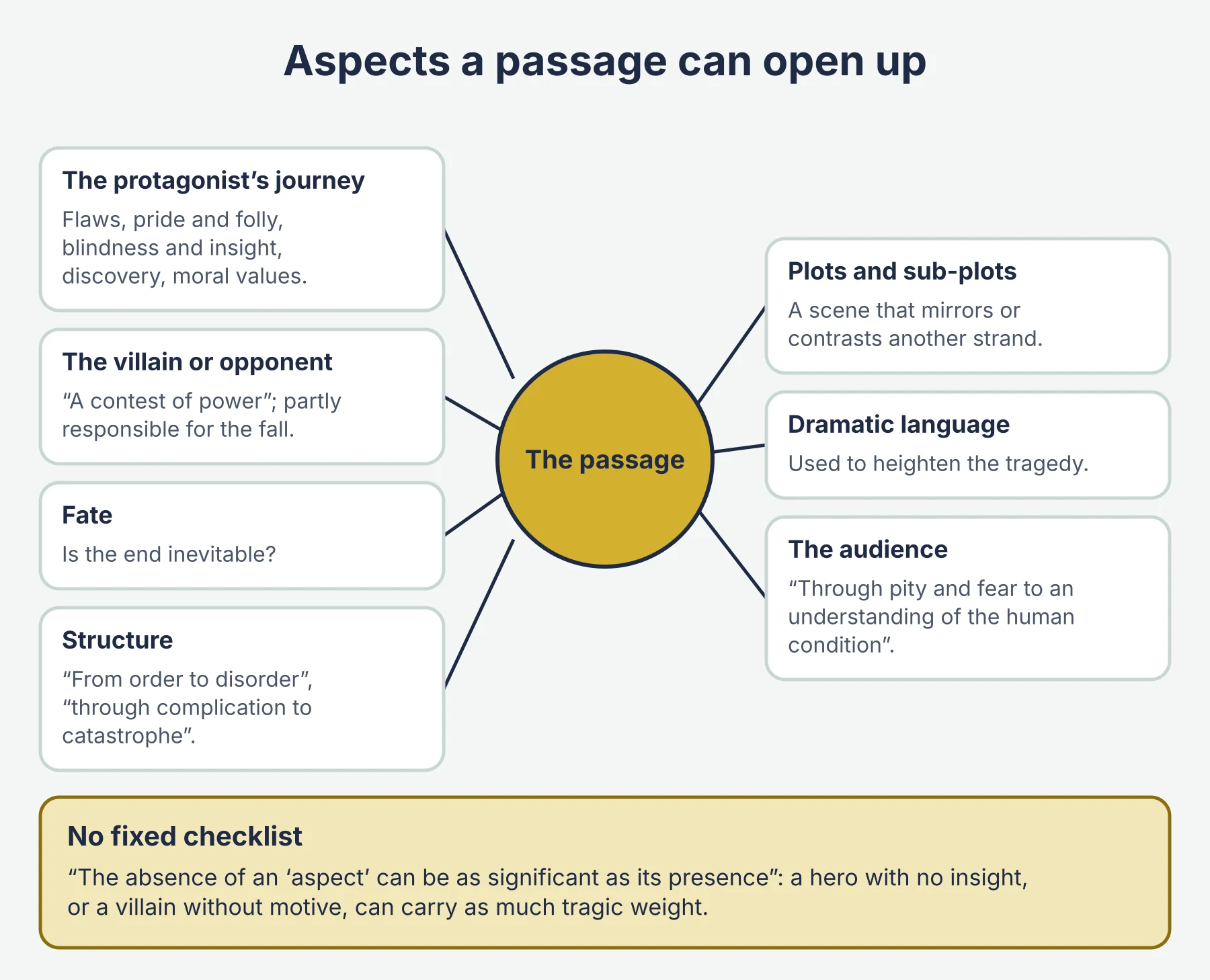
Aspects of tragedy a passage can show
The specification lists areas to explore rather than a closed list:
- type of tragedy: classical and public or domestic and ordinary;
- settings, both place and time;
- the hero’s journey towards death: flaws, pride, folly, blindness, insight, discovery, values;
- the villain or opponent and the contest of power;
- fate and inevitability;
- how the hero’s behaviour affects the world around them;
- violence and revenge;
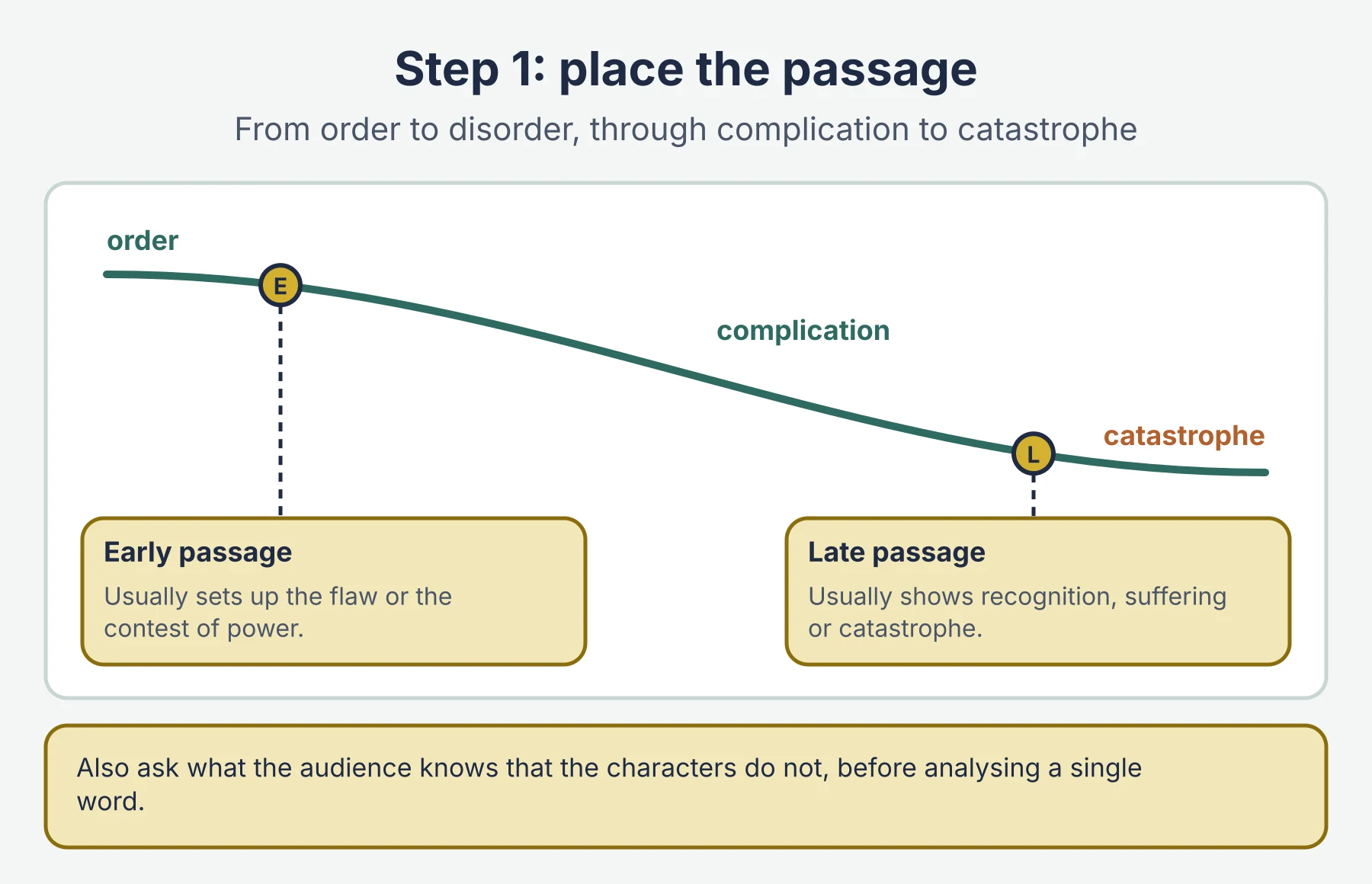
- structure: complication to catastrophe, order to disorder, prosperity to the tragic end;
- plots and sub-plots;
- dramatic language heightening the tragedy;
- the audience: pity, fear and understanding of the human condition.
Remember: the absence of an aspect can be as significant as its presence.
Key terms
| Term | Meaning | Use it to say |
|---|---|---|
| Blank verse | Unrhymed iambic pentameter | When a character’s control of verse holds or breaks |
| Prose | Unmetred speech | A drop in status, madness, intimacy or plotting |
| Shared line | One verse line split between speakers | Speed, tension, one character overriding another |
| Soliloquy | Speech alone on stage | Private thought; the audience as confidant |
| Aside | Brief remark others on stage do not hear | Dramatic irony and complicity |
| Embedded stage direction | Action implied in the dialogue | What the audience actually sees |
| Dramatic irony | Audience knows more than a character | Dread, pity and suspense |
| Anagnorisis | Recognition or discovery | The moment of insight, often too late |
| Peripeteia | Reversal of fortune | A turning point in the structure |
| Catharsis | Release of pity and fear | The audience’s response at the end |
| Machiavel | Scheming stage villain | Iago, Edmund and the Cardinal as types |
| Revenge tragedy | Genre of wrong, delay and bloody revenge | Hamlet, The Duchess of Malfi |
The Greek terms are useful shorthand; the specification itself describes these ideas in plain English, so either is acceptable when used accurately.
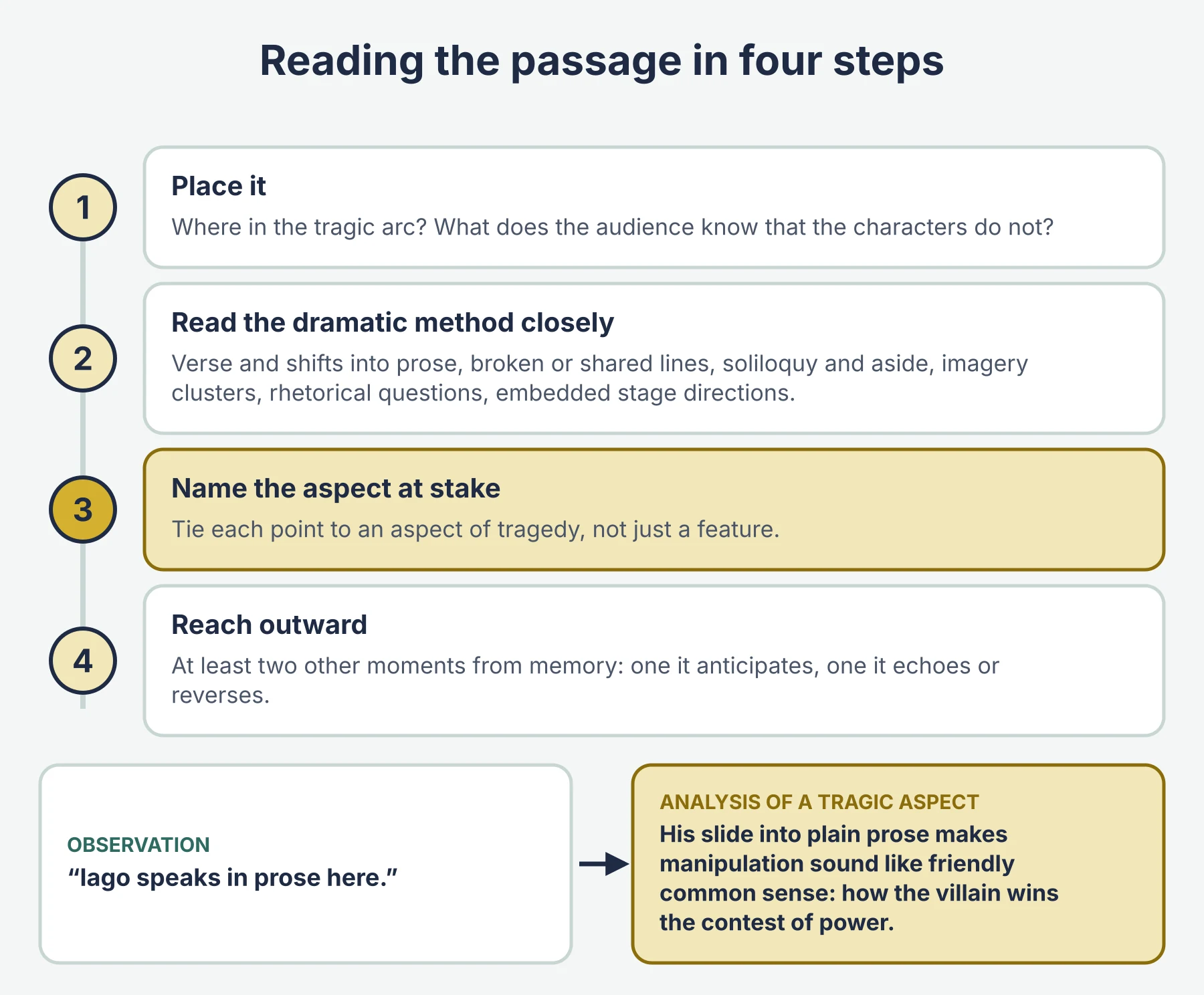
Method in four words: place, read, name, reach
- Place the passage in the arc and note the dramatic irony at that point.
- Read the method closely: verse, prose, imagery, rhetoric, stage directions.
- Name the tragic aspect each point illuminates.
- Reach out to two other moments from memory: one before, one after.
Context that earns its place
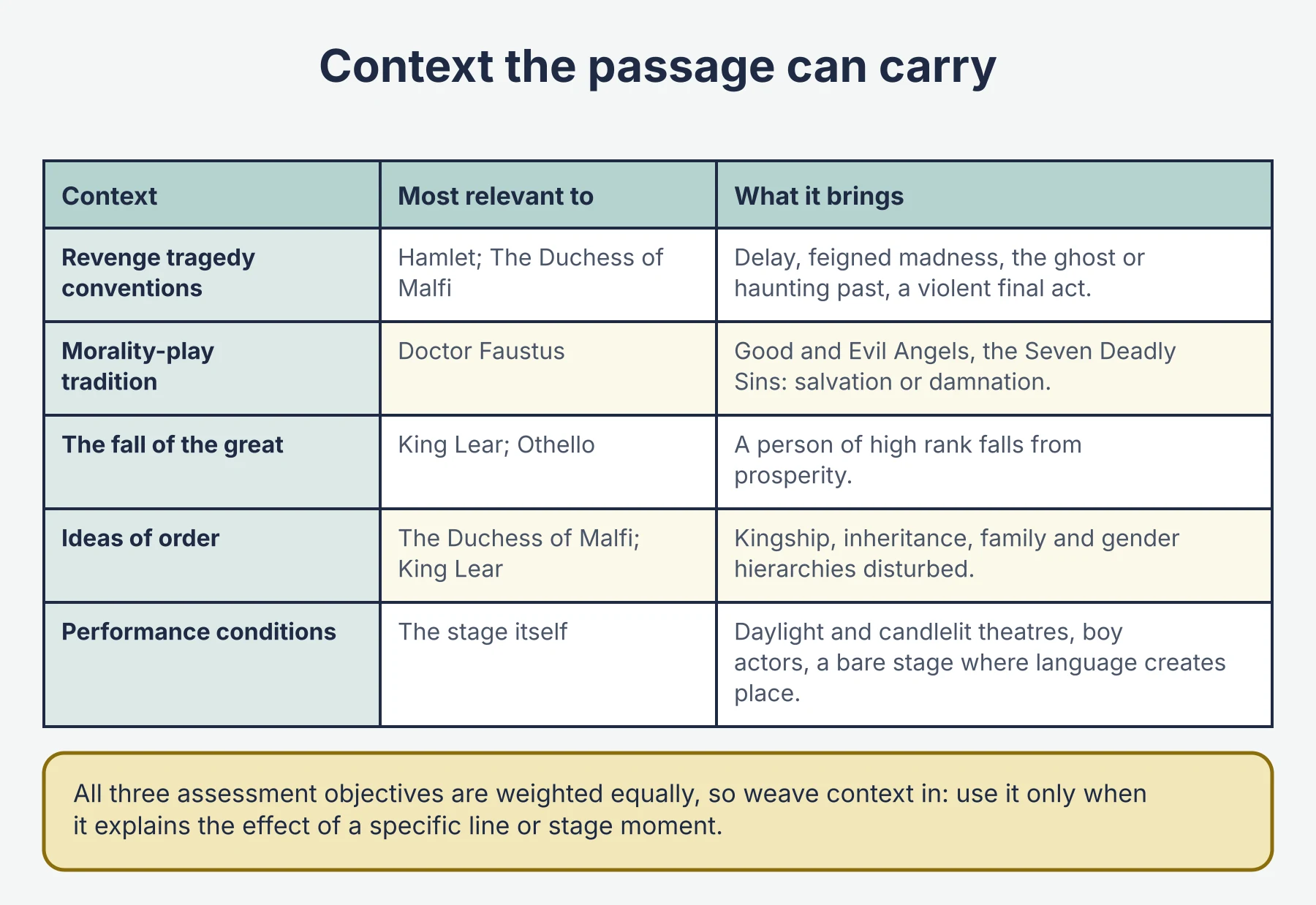
- Revenge tragedy: the ghost, delay, feigned madness, the violent final act.
- Morality tradition in Faustus: Good and Evil Angels; the Seven Deadly Sins.
- Order and hierarchy: kingship, inheritance, family and gender roles.
- Staging: a bare stage, boy actors in female roles, language creating night and storm.
Each contextual point should change how a specific line or moment reads.
Exam traps
- A general essay on the play with the passage barely used.
- Close analysis of the passage with no reference to the rest of the play.
- Naming a convention (“this is hamartia”) without arguing how the play uses it.
- Quoting from memory inaccurately: shorter, accurate quotations are safer than long, wrong ones.
- Forgetting the audience: a play is seen and heard, so write about staging and sound.
- Running out of time for Section B: Section A is half the unit, not more.
Self-test
- How many marks is Unit 1 Section A worth, and what is printed on the paper?
- Which three assessment objectives are tested, and how are they weighted?
- Which two early versions of Doctor Faustus exist, and which is set?
- What does the specification say about the absence of an aspect of tragedy?
- Give two features of a revenge tragedy.
- What is an embedded stage direction, and why does it matter for these plays?
- What can a shift from verse into prose suggest?
- Define anagnorisis.
- Name the four steps of the passage method in these notes.
- Which play’s sub-plot follows a parallel fall of a father deceived by a child?
- Why might a writer place a comic or low-status moment just before a catastrophe?
- Roughly how long should you spend on Section A?
Answers
- 25 marks, half of the 50-mark unit; a passage from the set play is printed.
- AO1 (genre, contexts, interpretations), AO2 (authorial methods), AO3 (argued response in accurate writing); all three are weighted equally.
- The A text (printed 1604) and the B text (printed 1616); the B text is set.
- That the absence of an aspect can be as significant as its presence.
- Any two: a wrong demanding revenge; delay; a ghost or haunting past; feigned or real madness; a violent final act.
- An action implied within the dialogue; early texts print few stage directions, so these lines are the best evidence of what the audience sees.
- Any one: a fall in status or control; madness; intimacy; plotting or deception.
- Recognition or discovery: the moment a character sees the truth, often too late.
- Place, read, name, reach.
- King Lear: Gloucester is deceived by Edmund about Edgar.
- Contrast heightens the shock and pity of the catastrophe, and can comment ironically on it.
- About an hour, since Unit 1 lasts 2 hours for two answers of equal value.
Test the method on the Unit 1 Section A practice questions, then compare the essay demands of the Section B revision notes.
Related resources
-
Study guides
OxfordAQA International A-Level English Literature (9675): Unit 1 Section B, Later Dramatic Tragedies
How to write the 9675 Unit 1 Section B essay on a later dramatic tragedy: the five plays, modern tragic ideas, an essay plan and a model paragraph.
English Literature · OxfordAQA · AS Level
Read guide -
Practice questions
OxfordAQA International A-Level English Literature (9675): Unit 1 Section B, Later Dramatic Tragedies – Practice Questions
Twelve original questions building the 9675 Unit 1 Section B essay on later tragedy: concepts, an invented scene and planning tasks, with answers.
English Literature · OxfordAQA · AS Level
Try questions -
Revision notes
OxfordAQA International A-Level English Literature (9675): Unit 1 Section B, Later Dramatic Tragedies – Revision Notes
Revision notes for the 9675 Unit 1 Section B essay: the five later tragedies, how modern drama reshapes tragic aspects, key terms, exam traps and a self-test.
English Literature · OxfordAQA · AS Level
Revise topic
Get free revision emails (optional)
Occasional emails with practice questions, worked explanations and links to free resources for the qualification and subjects you choose. No spam, and you can unsubscribe from any email. The free tools on this site never need an email.