
Study Guides
OxfordAQA International A-Level English Literature (9675): Unit 2 Section A, Prose and Place
How to write the 9675 Unit 2 Section A prose essay on place: the six novels, how narration builds place, open-book technique, a plan and a model paragraph.
- Subject
- English Literature
- Level
- AS LEVEL
- Topic
- Unit 2 – Place in Literary Texts
- Author
- Marlbridge Academic Team
- Updated
- Reviewed by
- Ammar Bilal (what this means)
Aligned to OxfordAQA A Level English Literature (9675), Version 5.3, for International AS exams from May/June 2018, A-level from May/June 2019. Official specification .
Syllabus page (what it covers and how it is assessed): OxfordAQA A Level English Literature.
Syllabus points this page covers
9675 (AS Level)
- Section A: Prose
Found an error? Report a correction.
Need help with this topic? Request a free trial class for A Level English Literature (9675).
Section A of Unit 2 Place in Literary Texts in OxfordAQA International AS and A-level English Literature (9675) is one essay question, worth 25 marks, on your prose set text. The unit is open book. The Place in Literary Texts unit overview sets out the whole unit and the specification’s list of “place” angles; this guide shows how those angles work in a novel, where place reaches the reader through a narrator.
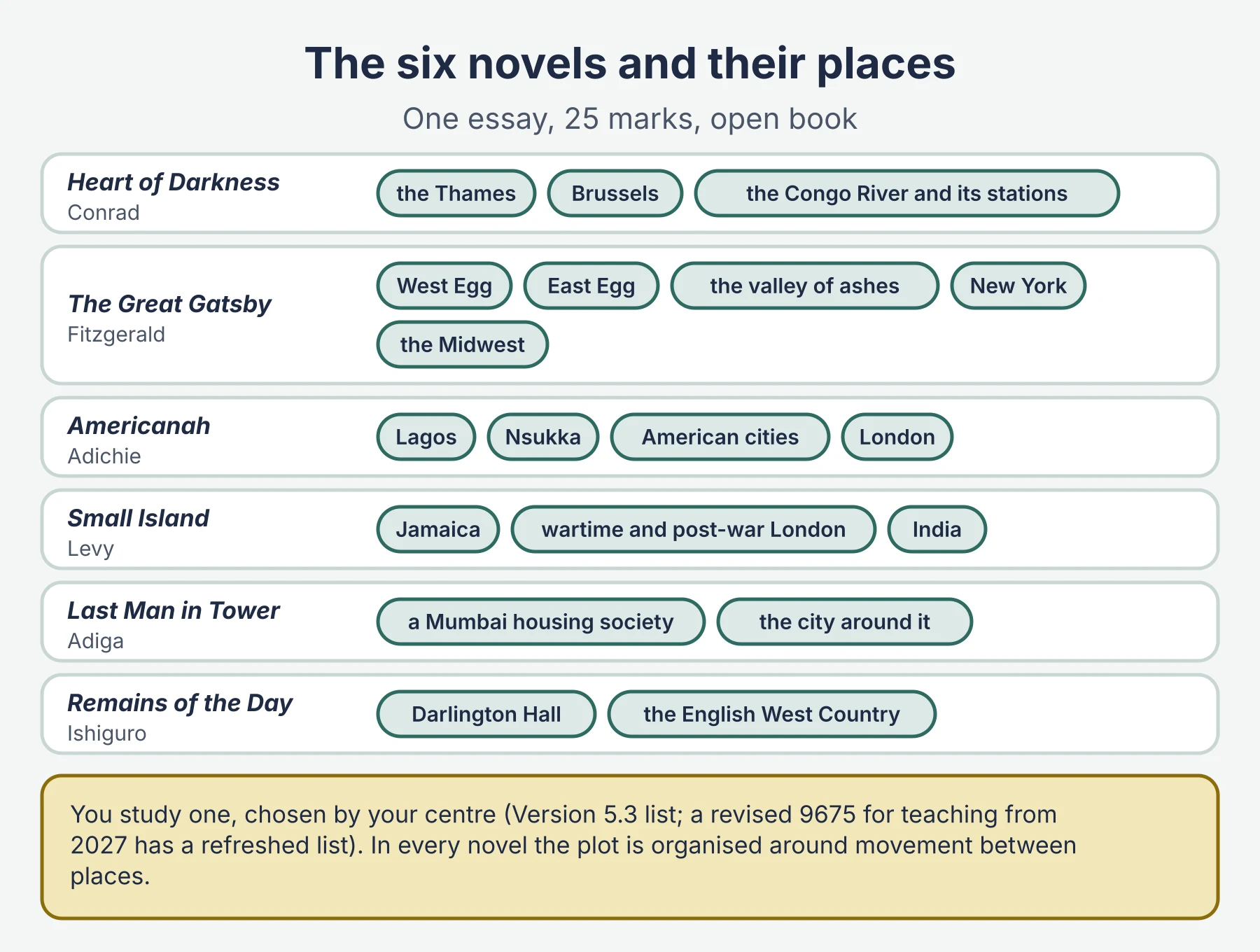
The six Section A novels
| Author | Novel | Places it moves between |
|---|---|---|
| Joseph Conrad | Heart of Darkness | The Thames, Brussels, the Congo River and its stations |
| F. Scott Fitzgerald | The Great Gatsby | West Egg, East Egg, the valley of ashes, New York, the Midwest |
| Chimamanda Ngozi Adichie | Americanah | Lagos, Nsukka, American cities, London |
| Andrea Levy | Small Island | Jamaica, wartime and post-war London, India |
| Aravind Adiga | Last Man in Tower | A Mumbai housing society and the city around it |
| Kazuo Ishiguro | Remains of the Day | Darlington Hall and the English West Country |
You study one, chosen by your centre. The list is from Version 5.3; a revised 9675 for teaching from 2027 has a refreshed set-text list.
What the specification means by place
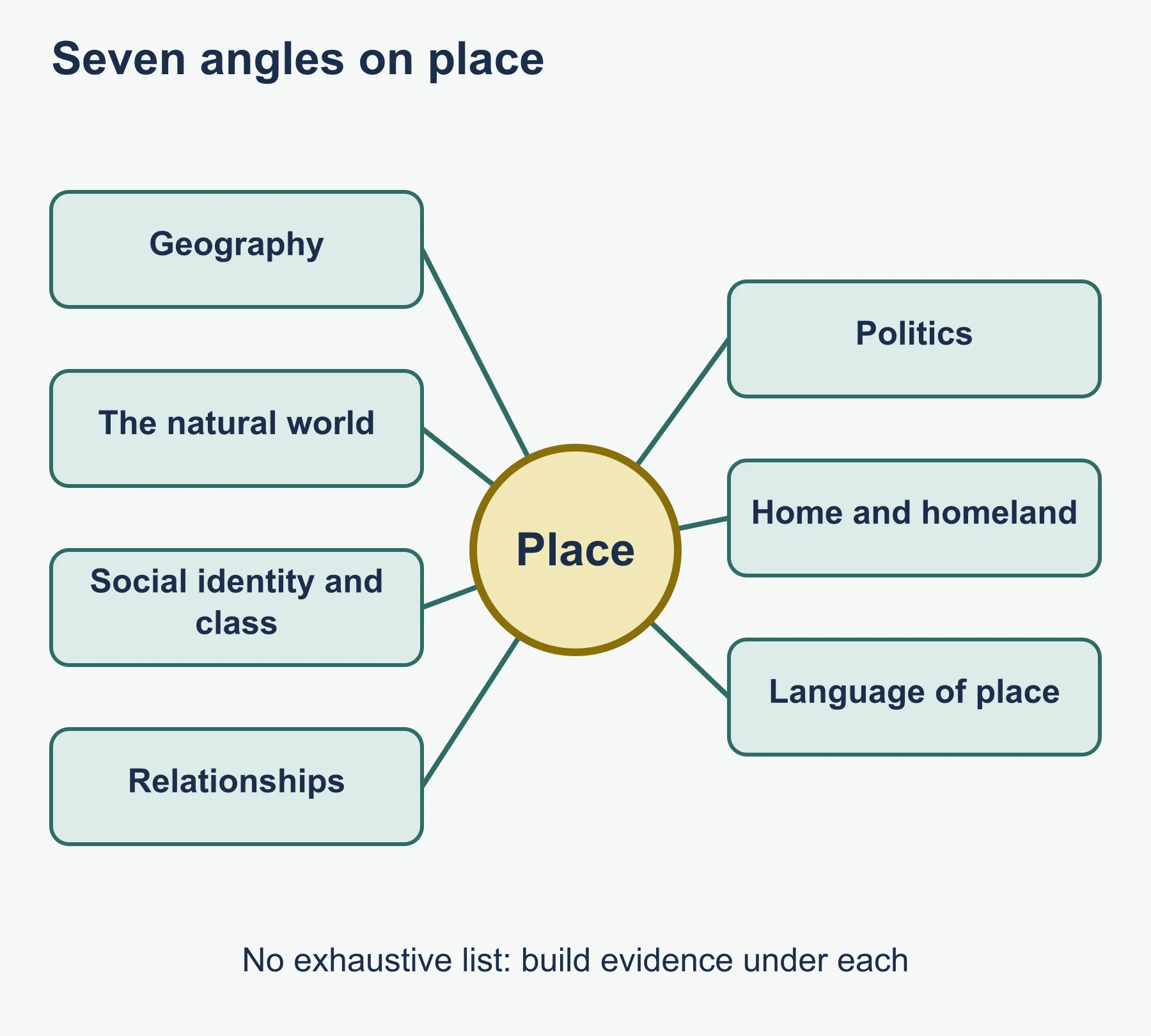
The specification links the texts “through the significance of place(s)” to their “stories; their narrative structures; their socio-cultural views of the world; their potential meanings”. Its list of ideas to explore includes geographical locations from houses to countries, the natural world and its “despoliation”, social identity and class, relationships, place as a political space, home and homeland, and “the language and representation of place”.
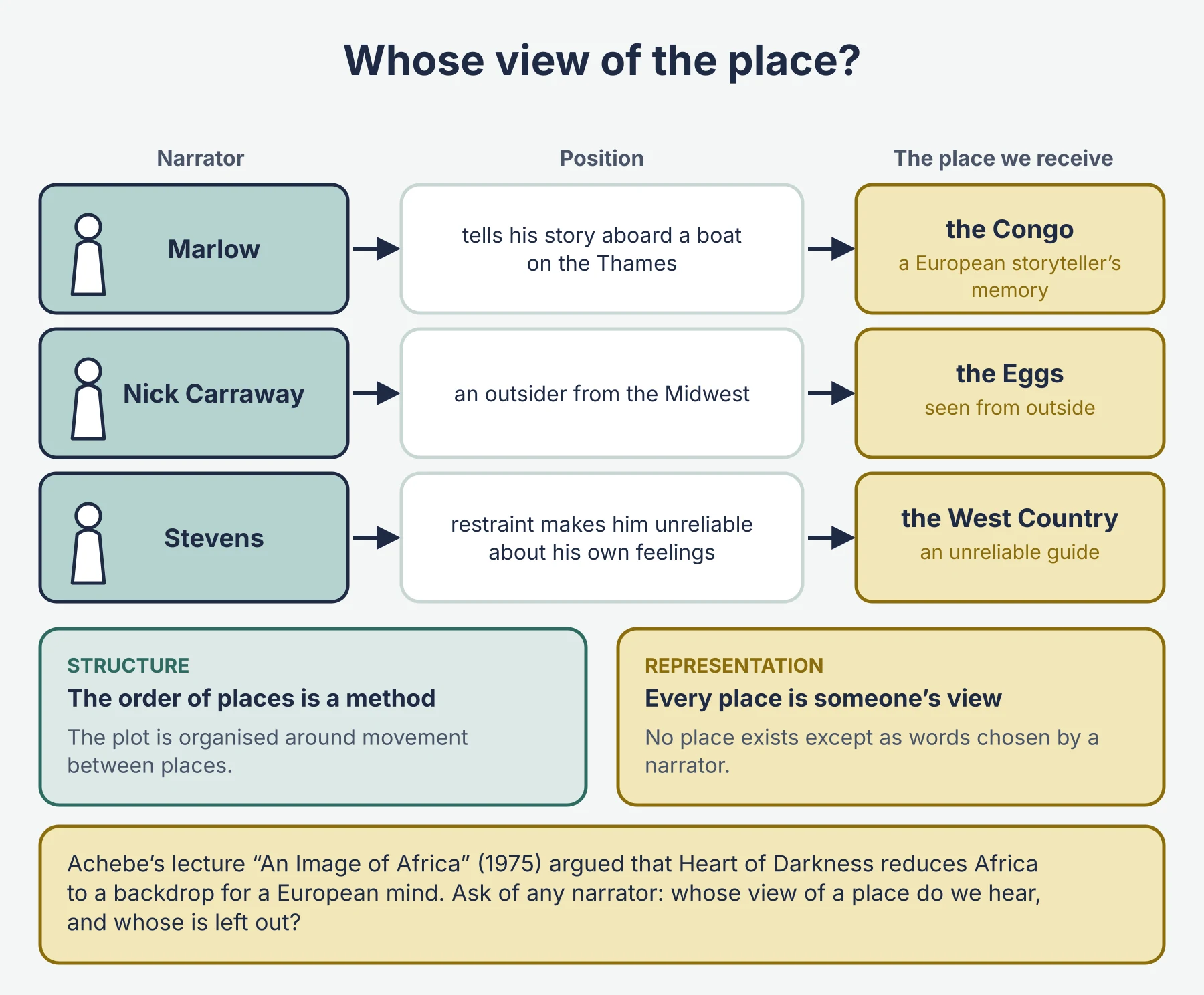
Two of those words matter most for a prose essay. Structure: in all six novels the plot is organised around movement between places, so the order in which places appear is a method. Representation: no place exists in a novel except as words chosen by a narrator, so every place is someone’s view of a place.
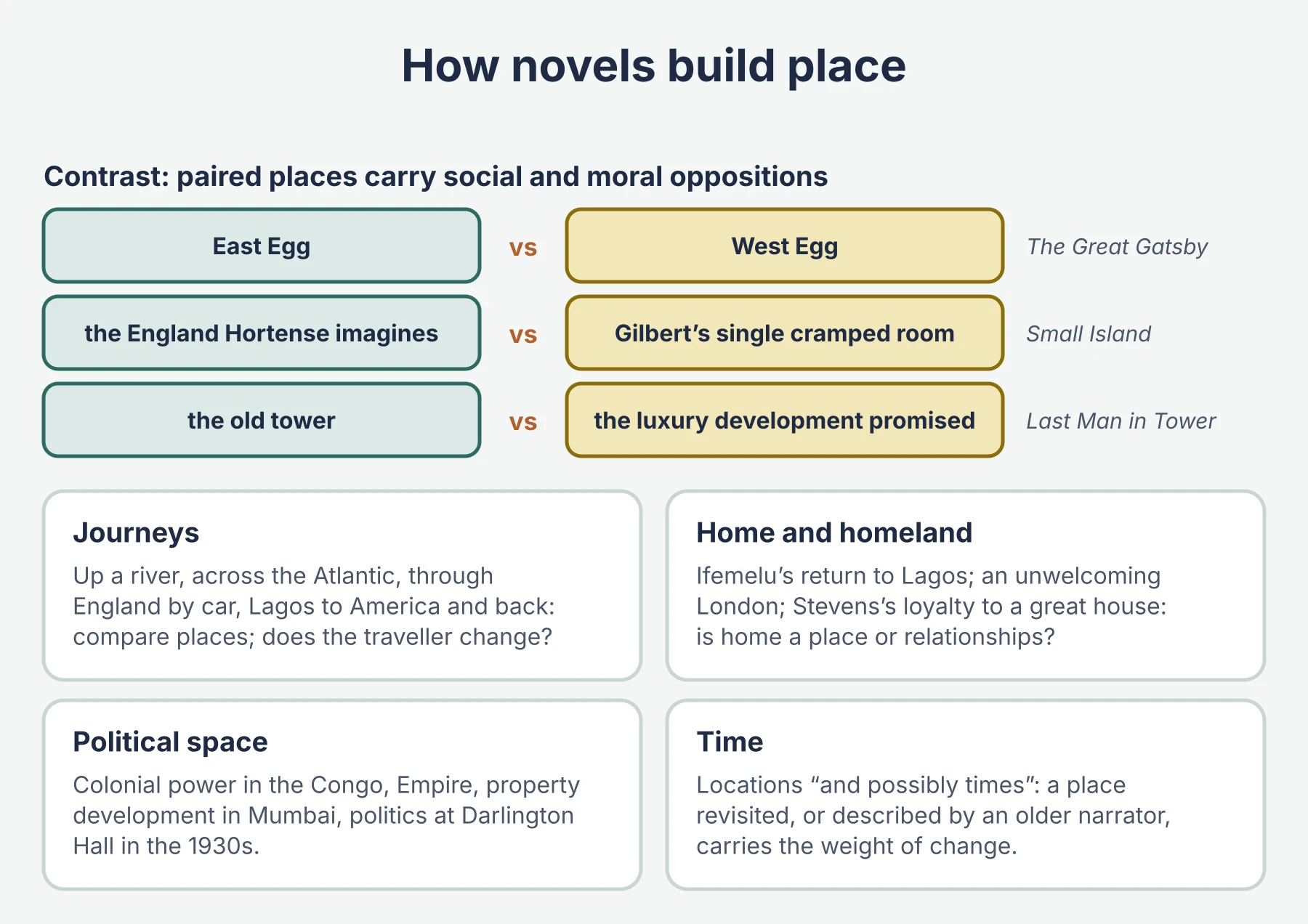
How novels build place
The narrator’s position. Ask who sees the place and what they cannot see. Marlow tells his story aboard a boat on the Thames, so the Congo is filtered through a European storyteller’s memory. Nick Carraway is an outsider from the Midwest describing the Eggs. Stevens’s trip through the West Country is narrated by a man whose restraint makes him an unreliable guide to his own feelings.
Journeys. Many of the novels are built on journeys: up a river, across the Atlantic, through England by car, from Lagos to America and back. A journey structure invites you to compare places and to ask whether the traveller changes.
Contrast. Paired places (East and West Egg; the England Hortense imagines and the single cramped room Gilbert rents in Small Island; the old tower and the luxury development promised in Last Man in Tower) carry social and moral oppositions.
Home and homeland. Several protagonists lose, leave or return home. Ifemelu’s return to Lagos, Hortense’s and Gilbert’s arrival in a London that does not welcome them, and Stevens’s loyalty to a great house all raise the question of whether home is a place or a set of relationships.
Place as political space. Colonial power in the Congo, the Empire in Small Island, property development in Mumbai, and the politics conducted at Darlington Hall in the 1930s all make places sites of power.
Time. The specification notes locations “and possibly times”. A place revisited after years, or described by an older narrator, carries the weight of change.
Open-book technique
Because you have the novel in the exam, you are expected to use precise, accurate textual detail. That is an advantage only if you can find material quickly. Before the exam:
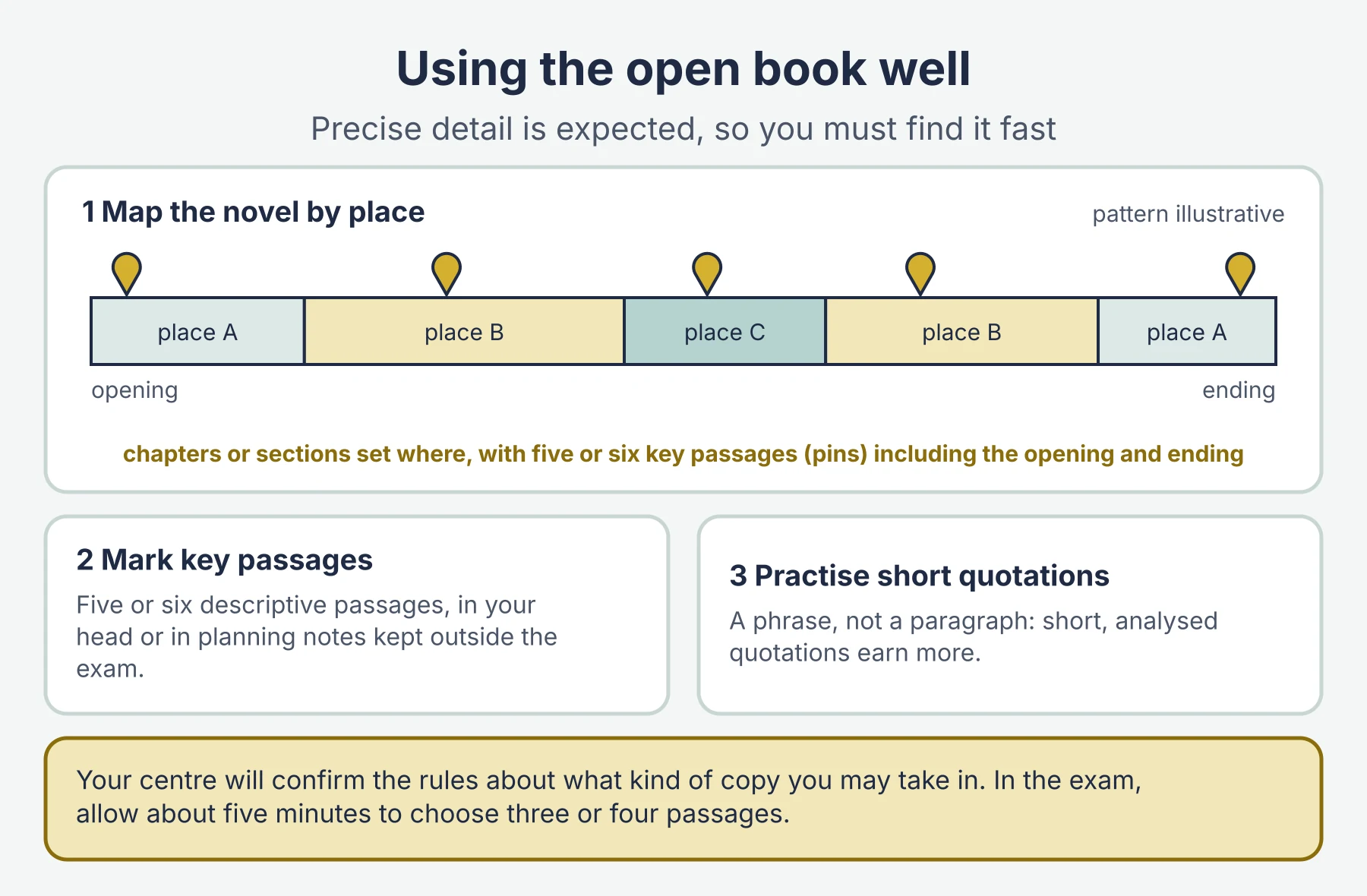
- map the novel by place: which chapters or sections are set where;
- mark, in your head or in planning notes kept outside the exam, five or six key descriptive passages, including the opening and ending;
- practise choosing short quotations (a phrase, not a paragraph).
Your centre will confirm the board’s rules about what kind of copy you may take in. Do not spend exam time copying long passages: short, analysed quotations earn more than extended ones.
Worked example
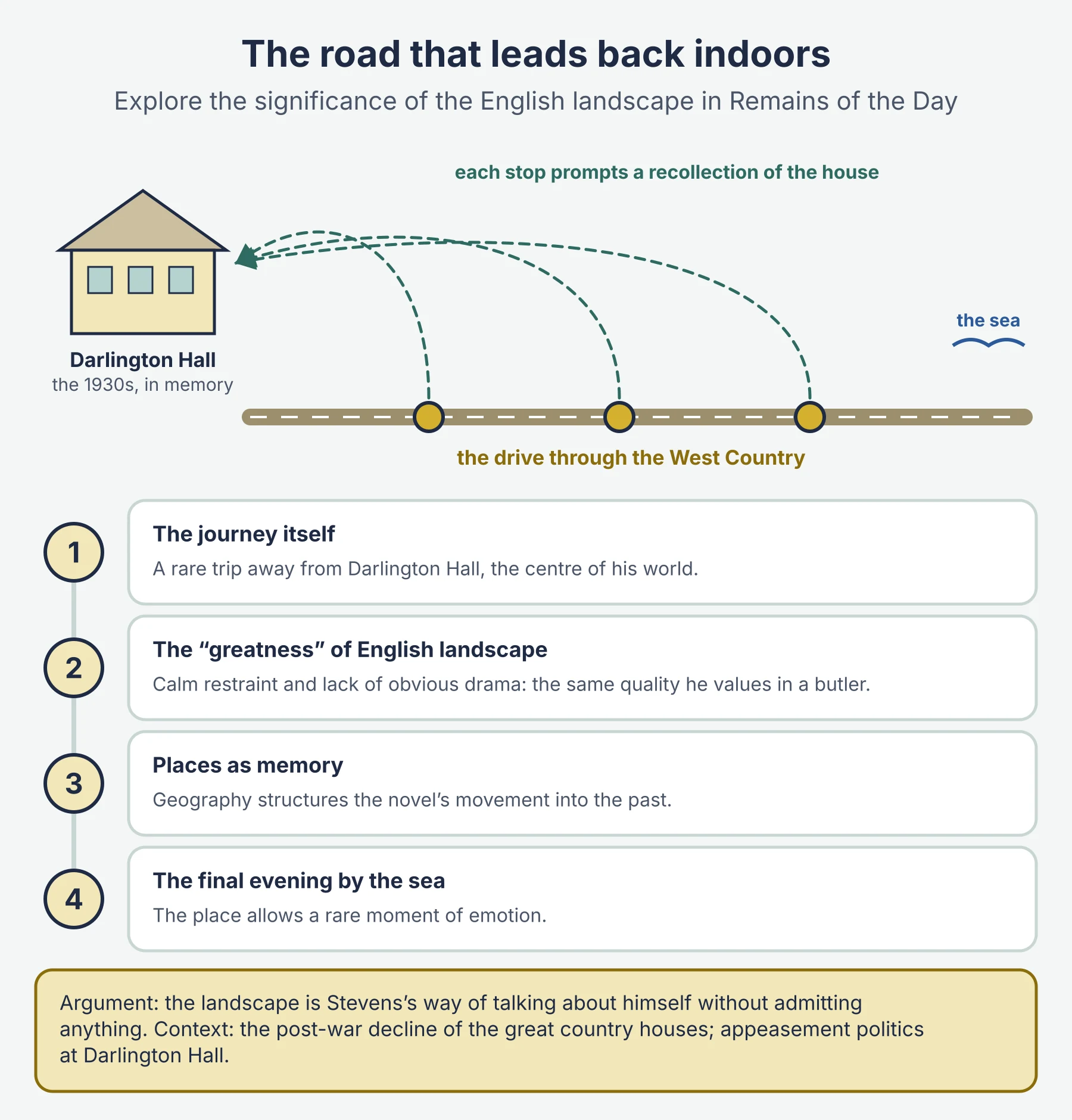
Question shape (original): Explore the significance of the English landscape in Remains of the Day.
Plan. Argument: the landscape is Stevens’s way of talking about himself without admitting anything. (1) The journey itself: a rare trip away from Darlington Hall, which has been the centre of his world. (2) His reflection on the “greatness” of English landscape, which he praises for its calm restraint and lack of obvious drama, the same quality he values in a butler. (3) Places as memory: each stop prompts a recollection of the house in the 1930s, so geography structures the novel’s movement into the past. (4) The final evening by the sea, where the place allows a rare moment of emotion. Context: the post-war decline of the great country houses and the appeasement politics conducted at Darlington Hall.
Model paragraph:
Stevens’s praise of the English landscape is a disguised self-portrait. When he argues that its greatness lies in a calm beauty that does not need to display itself, he uses almost exactly the terms he later applies to the dignity of a great butler, so the reader learns to hear a description of countryside as a defence of emotional restraint. Ishiguro makes the irony structural: the drive through the West Country repeatedly gives way to memories of Darlington Hall, as if Stevens cannot look at an open landscape without returning to the house that enclosed his life. The open road should promise freedom, but the narrative keeps pulling him back indoors into the 1930s, where the reader glimpses what his restraint cost him, both with Miss Kenton and in his loyal service to an employer whose politics he never questioned. Place therefore works as the novel’s main method of evasion: the more Stevens describes the land, the more clearly the reader sees what he will not say.
The paragraph uses a precise paraphrase where a long quotation would waste time, analyses structure as well as description, links place to identity and class, and builds an interpretation of the narrator.
Interpretations worth knowing
Critical views can sharpen an argument about place, as long as you test them. Chinua Achebe’s lecture “An Image of Africa” (delivered 1975) argued that Heart of Darkness reduces Africa to a backdrop for a European mind, which raises the question of whose place the Congo is in the novel. Similar questions can be asked of any narrator: whose view of a place does the novel let us hear, and whose does it leave out?
Common mistakes
- Treating place as scenery rather than as a source of meaning about class, power or identity.
- Describing locations without analysing the language that represents them.
- Forgetting the narrator: a place in a first-person novel is always someone’s perception.
- Ignoring structure: the order and contrast of places is evidence.
- Over-quoting in an open-book exam at the expense of analysis.
Exam technique
Questions may ask you to explore the significance of a place or an aspect of place, or to discuss a view. “Significance”, the specification explains, means weighing how the text is written, the contexts that apply and the meanings it allows. Unit 2 lasts 2 hours for two 25-mark essays, so allow about an hour, including five minutes to choose your three or four passages.
More resources on this topic
- Unit 2 Section A revision notes
- Unit 2 Section A practice questions
- Unit 2 Section B study guide: poetry and place
Specification
OxfordAQA International AS and A-level English Literature (9675) specification PDF, Version 5.3, section 3.2 — oxfordaqa.com.
Related resources
-
Practice questions
OxfordAQA International A-Level English Literature (9675): Unit 2 Section A, Prose and Place – Practice Questions
Twelve original questions for the 9675 Unit 2 Section A prose essay on place, with an invented homecoming passage, planning tasks and point-by-point answers.
English Literature · OxfordAQA · AS Level
Try questions -
Revision notes
OxfordAQA International A-Level English Literature (9675): Unit 2 Section A, Prose and Place – Revision Notes
Recall notes for the 9675 Unit 2 Section A prose essay: six novels and their places, narrative methods, key terms, open-book traps and a self-test.
English Literature · OxfordAQA · AS Level
Revise topic -
Study guides
OxfordAQA International A-Level English Literature (9675): Unit 2 Section B, Poetry and Place
How to write the 9675 Unit 2 Section B poetry essay on place: the Wordsworth, Frost, Hardy and Heaney selections, poetic methods, a plan and a model reading.
English Literature · OxfordAQA · AS Level
Read guide
Get free revision emails (optional)
Occasional emails with practice questions, worked explanations and links to free resources for the qualification and subjects you choose. No spam, and you can unsubscribe from any email. The free tools on this site never need an email.