
Study Guides
OxfordAQA International A-Level English Literature (9675): Unit 2 Section B, Poetry and Place
How to write the 9675 Unit 2 Section B poetry essay on place: the Wordsworth, Frost, Hardy and Heaney selections, poetic methods, a plan and a model reading.
- Subject
- English Literature
- Level
- AS LEVEL
- Topic
- Unit 2 – Place in Literary Texts
- Author
- Marlbridge Academic Team
- Updated
- Reviewed by
- Ammar Bilal (what this means)
Aligned to OxfordAQA A Level English Literature (9675), Version 5.3, for International AS exams from May/June 2018, A-level from May/June 2019. Official specification .
Syllabus page (what it covers and how it is assessed): OxfordAQA A Level English Literature.
Syllabus points this page covers
9675 (AS Level)
- Section B: Poetry
Found an error? Report a correction.
Need help with this topic? Request a free trial class for A Level English Literature (9675).
Section B of Unit 2 Place in Literary Texts in OxfordAQA International AS and A-level English Literature (9675) is one essay question, worth 25 marks, on your poetry set text: a selection of poems by one poet. The exam is open book. The Place in Literary Texts unit overview introduces the unit; this guide is about how poems create place and how to write about a selection rather than a single poem.
The four selections
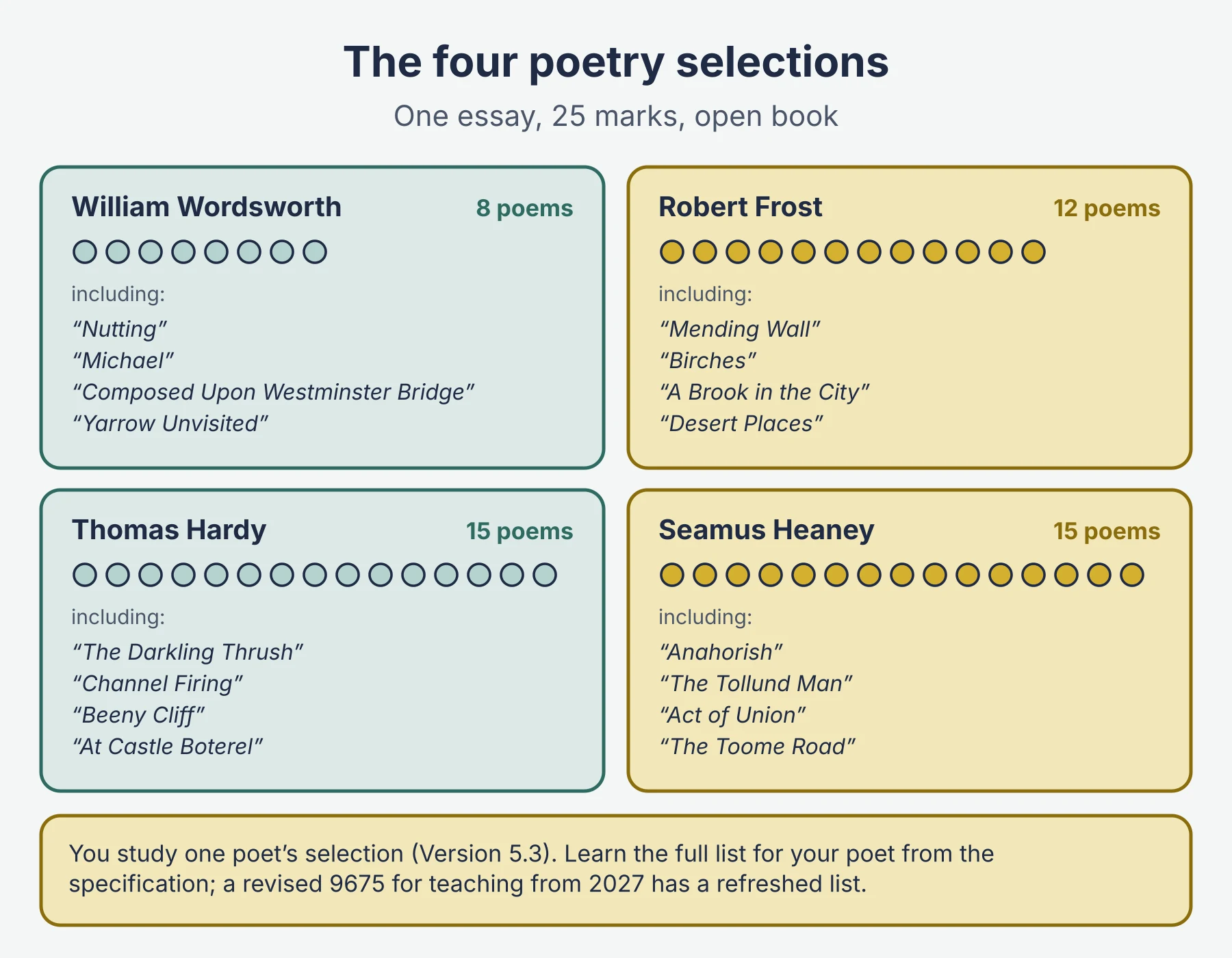
Version 5.3 lists four poets, each with a named selection:
- William Wordsworth (8 poems): including “Lines composed a few miles above Tintern Abbey”, “Nutting”, “Michael”, “Composed Upon Westminster Bridge”, “Yarrow Unvisited” and the stanzas on Peele Castle.
- Robert Frost (12 poems): including “Mending Wall”, “After Apple-Picking”, “The Wood-Pile”, “Birches”, “‘Out, Out –’”, “Stopping by Woods on a Snowy Evening”, “A Brook in the City” and “Desert Places”.
- Thomas Hardy (15 poems): including “Neutral Tones”, “The Darkling Thrush”, “Channel Firing”, “The Convergence of the Twain”, “The Going”, “After a Journey”, “Beeny Cliff”, “At Castle Boterel”, “Places” and “The Oxen”.
- Seamus Heaney (15 poems): including “Mid-Term Break”, “Personal Helicon”, “Requiem for the Croppies”, “Bogland”, “Anahorish”, “The Tollund Man”, “North”, “Punishment”, “Act of Union” and “The Toome Road”.
Learn the full list for your poet from the specification; set texts can change between versions, and a revised 9675 for teaching from 2027 has a refreshed list.
How poems make place
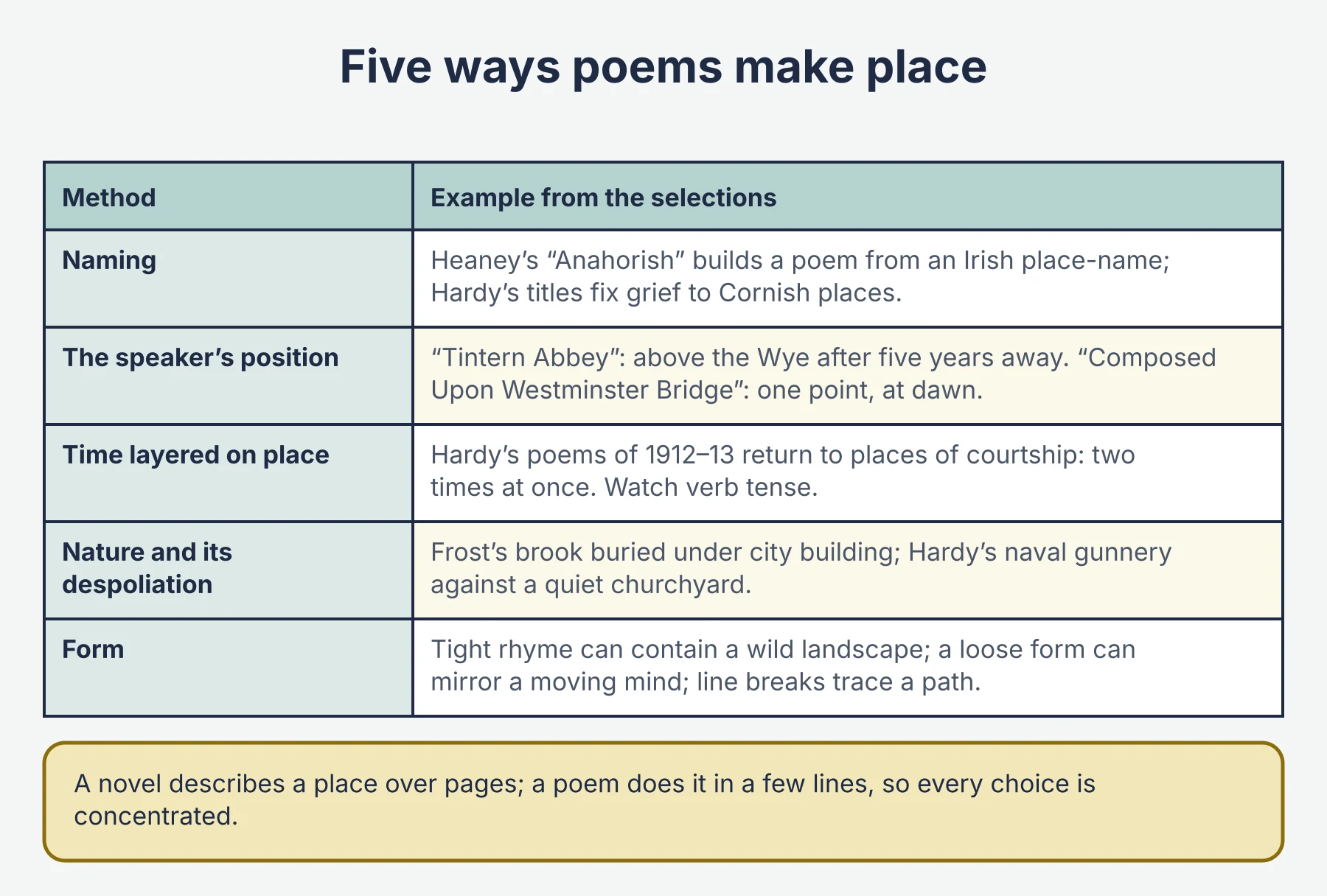
A novel can describe a place over pages; a poem does it in a few lines, so every choice is concentrated. Five methods do most of the work.
Naming. Place-names anchor a poem in a real location and can carry history. Heaney’s “Anahorish” builds a whole poem from an Irish place-name, so the sound of the word becomes a way of claiming a landscape and a language. Hardy’s titles (“Beeny Cliff”, “At Castle Boterel”) fix grief to particular Cornish places.
The speaker’s position. Where does the speaker stand, and when? Wordsworth’s speaker in “Tintern Abbey” stands above the Wye after five years away, so the place is seen through memory; “Composed Upon Westminster Bridge” fixes the speaker at one point, at dawn, looking at a city made still.
Time layered on place. Hardy’s poems of 1912-13, written after the death of his first wife, Emma, return to the places where they courted, so the landscape holds two times at once. A strong essay notices verb tense and shifts between past and present.
Nature and its despoliation. The specification lists the natural world, “its beauty and possibly its despoliation”. Frost’s “A Brook in the City” imagines a brook buried under city building; Hardy’s “Channel Firing” sets naval gunnery against a quiet churchyard.
Form. Sonnets, blank verse, ballad-like quatrains and free verse each shape how a place is experienced. A tightly rhymed form can contain a wild landscape; a loose form can mirror a mind moving through it. Line breaks and enjambment can trace a path or a view.
Place as more than landscape
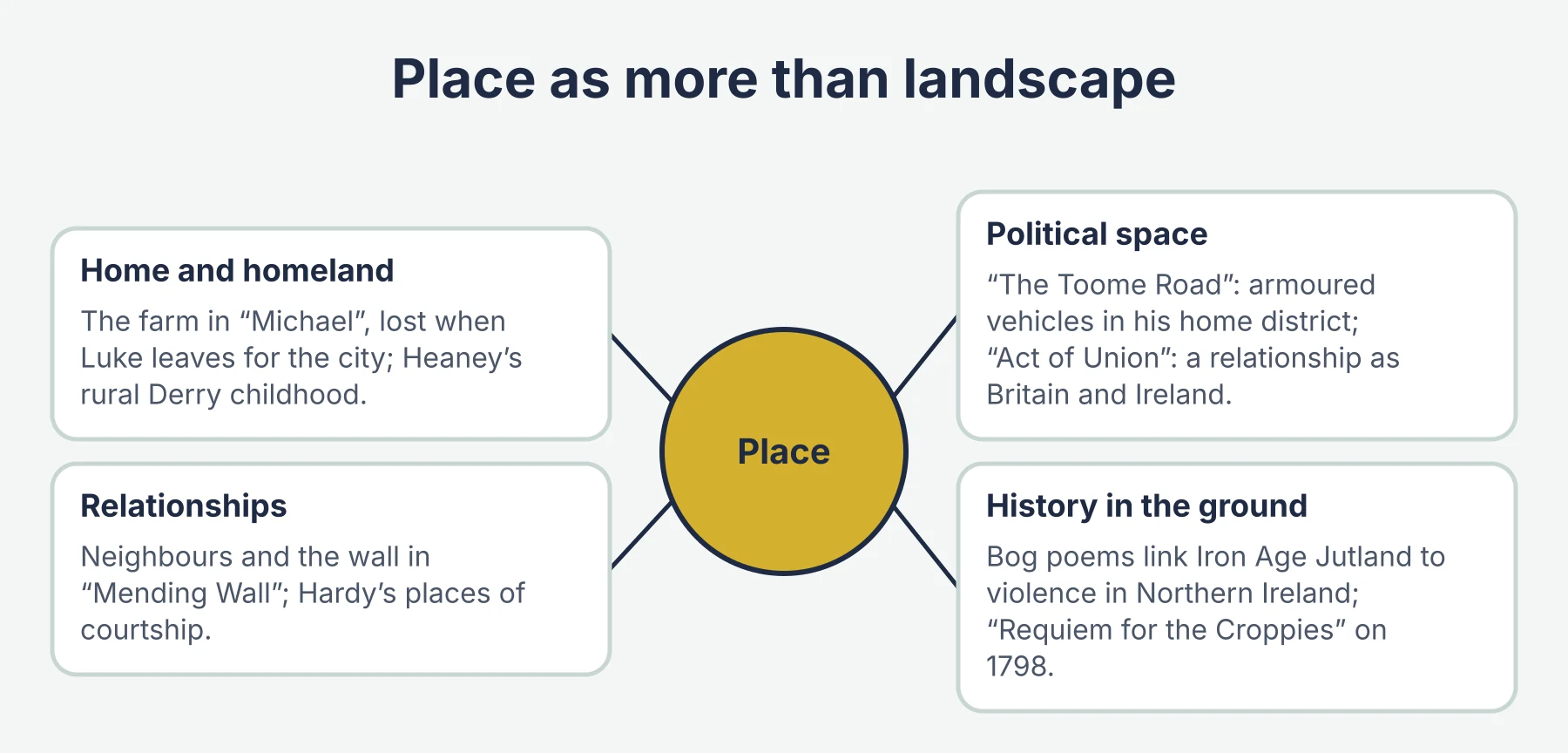
The specification’s angles show that place in poetry is often social and political:
- Home and homeland: the farm in “Michael” and what is lost when Luke leaves for the city; Heaney’s rural Derry childhood.
- Place as political space: Heaney’s “The Toome Road”, where armoured vehicles pass through his home district, and “Act of Union”, which uses a relationship as an image of Britain and Ireland.
- Relationships: the neighbours and the wall in “Mending Wall”; Hardy’s places of courtship.
- History in the ground: Heaney’s bog poems, in which preserved bodies link Iron Age Jutland to violence in Northern Ireland; “Requiem for the Croppies”, on the 1798 rebellion.
Writing about a selection
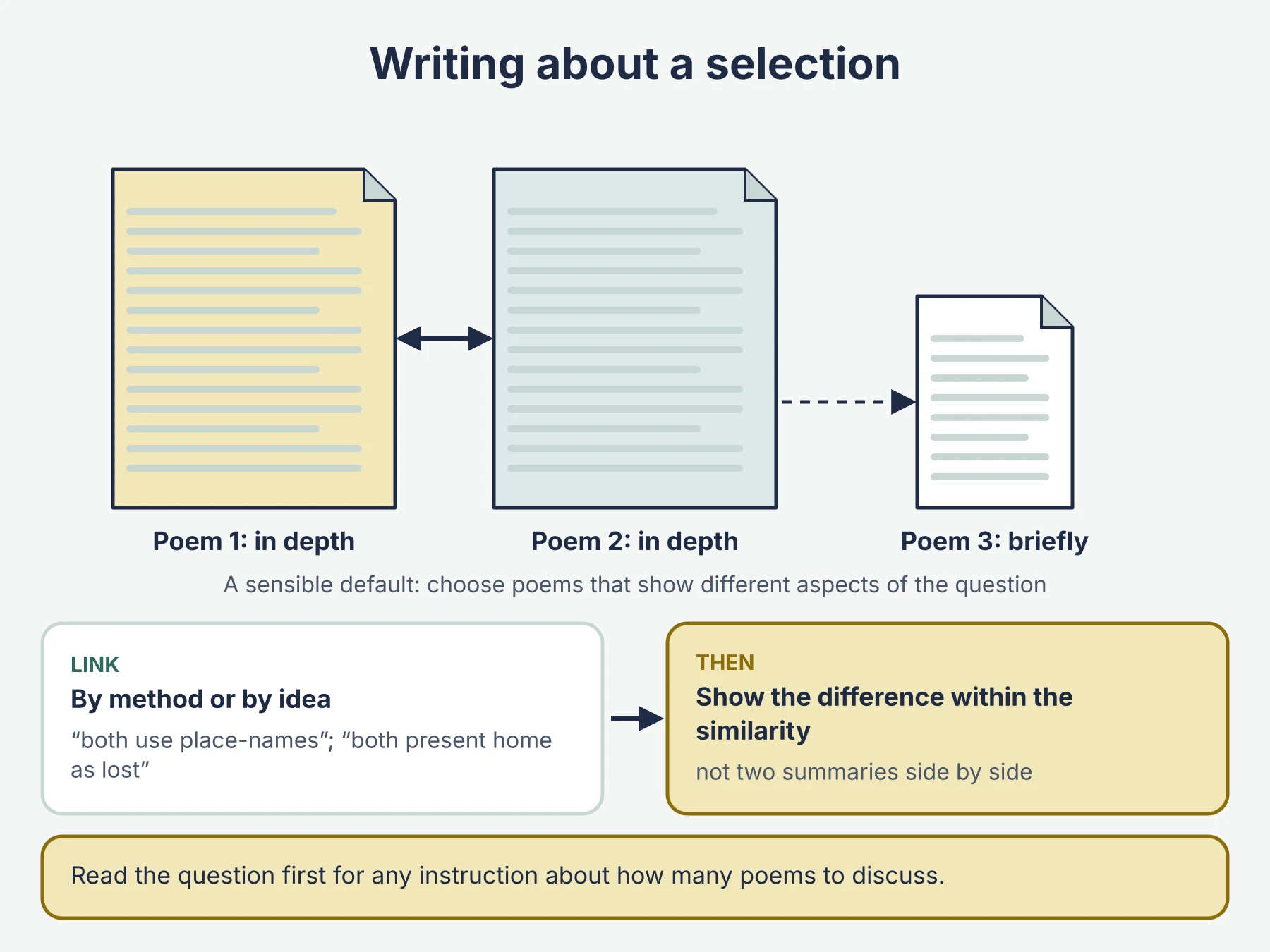
Because you have studied a body of poems, the strongest essays usually range across more than one. Read the question carefully for any instruction about how many poems to discuss. A sensible default is to analyse two poems in depth and refer more briefly to a third, choosing poems that show different aspects of the question rather than repeating one point.
Make your comparisons purposeful: link poems by method (both use place-names) or by idea (both present home as lost), then show the difference within the similarity.
Worked example on an original poem
The poem below is original, written for this guide. It is not from any set selection.
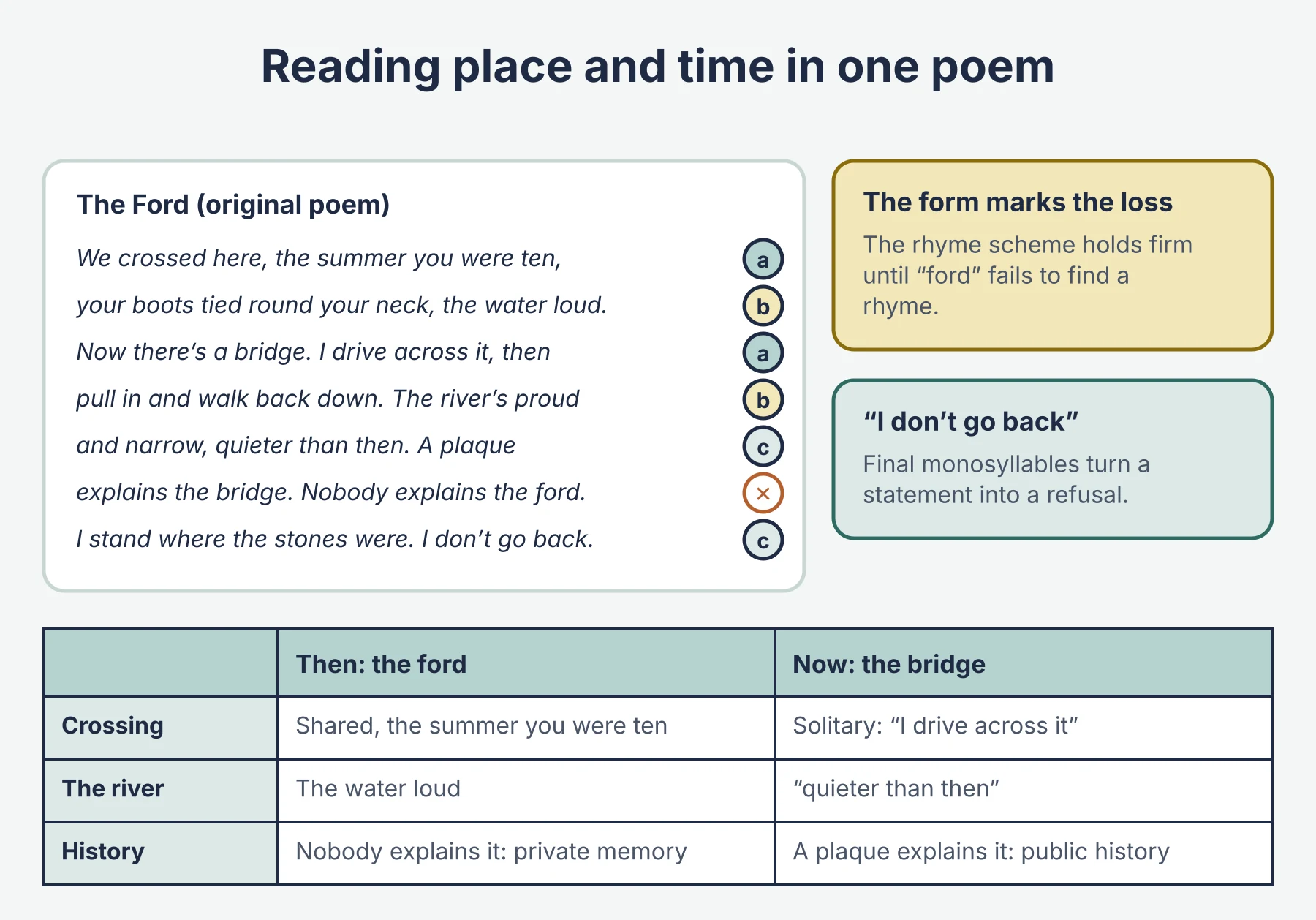
The Ford
We crossed here, the summer you were ten, your boots tied round your neck, the water loud. Now there’s a bridge. I drive across it, then pull in and walk back down. The river’s proud and narrow, quieter than then. A plaque explains the bridge. Nobody explains the ford. I stand where the stones were. I don’t go back.
Model reading: The poem sets two crossings of one river against each other: the shared, noisy ford of childhood and the solitary drive across a bridge. Place carries time, since the river is “quieter than then” and the speaker must “walk back down” from the new road to reach the old one. The rhyme scheme holds firm until the end, where “ford” fails to find a rhyme, so the form itself marks the gap left by what has gone. The contrast between the official “plaque” and the unexplained ford sets public history against private memory: the place has been rewritten, and only the speaker can read the older version. The final monosyllables, “I don’t go back”, turn a literal statement into a refusal: the past remains in the place but cannot be re-entered.
Use the same moves on your poet: position and time, method and form, and what the place finally means.
A plan using a set selection
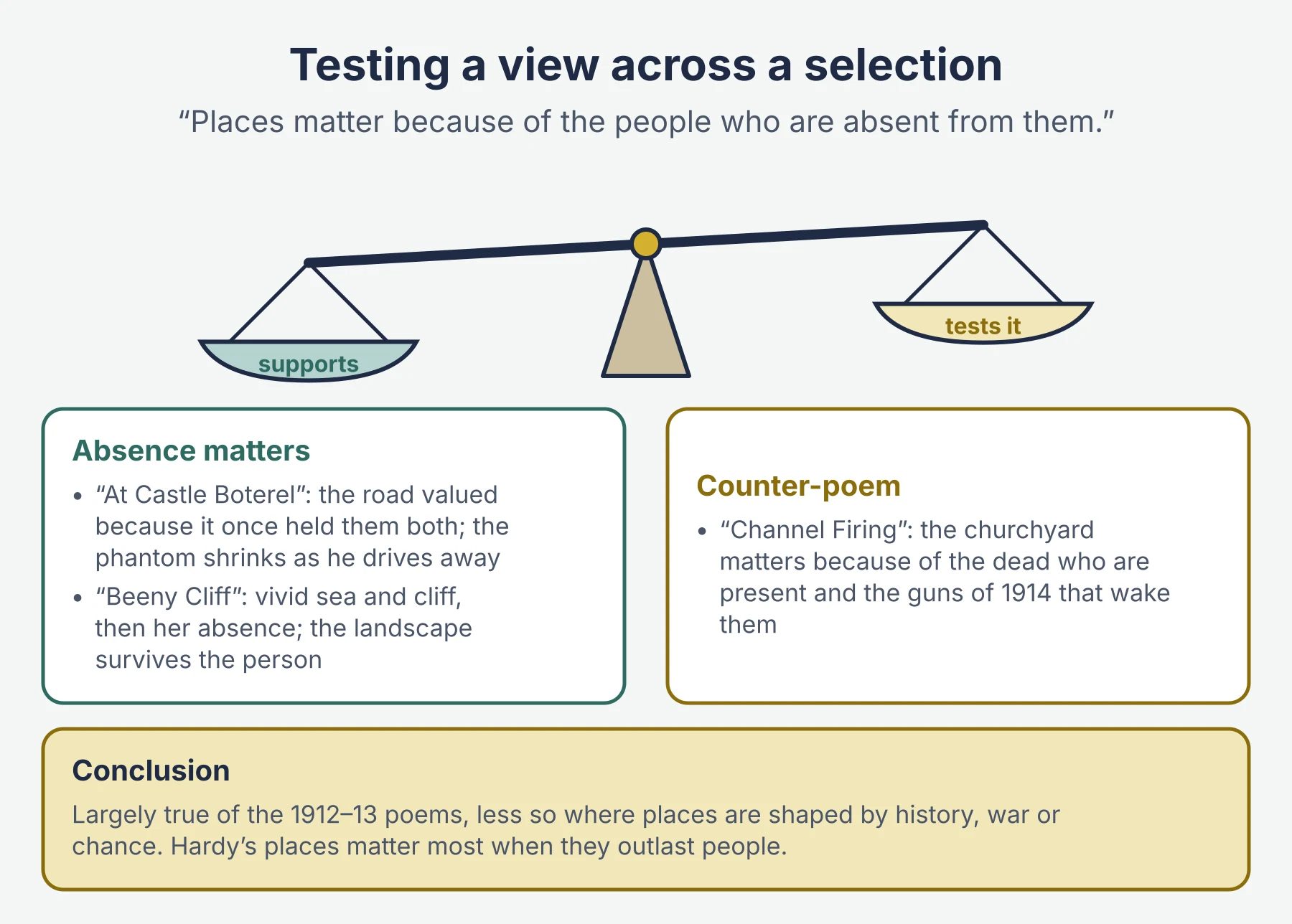
Question shape (original): “In the poems, places matter because of the people who are absent from them.” Explore this view of Hardy’s poems.
- Argument: largely true of the poems of 1912-13, less true where Hardy’s places are shaped by history, war or chance.
- Poem 1, “At Castle Boterel”: the speaker revisits a Cornish road where he and Emma once walked; the landscape is valued because it once held them both, and the closing stanzas see the phantom figure shrinking as he drives away. Method: past and present tense held together; the enduring rocks set against fleeting human time.
- Poem 2, “Beeny Cliff”: the sea and cliff are vividly present, yet the final stanza turns to her absence; the landscape survives the person.
- Counter-poem, “Channel Firing”: here the place, a churchyard by the sea, matters because of the dead who are present and the guns of 1914 that wake them; absence is not the point.
- Context: Emma’s death in 1912 and Hardy’s journey back to Cornwall; the approaching war in “Channel Firing”.
- Conclusion: Hardy’s places matter most when they outlast people, whether the absent beloved or the dead in the ground.
The plan names poems precisely, gives each a distinct role, and includes a poem that tests the view.
Common mistakes
- One poem only when the selection invites range.
- Paraphrase in place of analysis of language, sound and form.
- Background biography with no link to the words of the poem.
- Place as scenery: missing the political, social and personal meanings.
- Comparison as a list: two poem summaries placed side by side.
Exam technique
As with Section A, questions may ask you to explore the significance of an aspect of place or to discuss a view. Allow about an hour. Use the open book to select short, exact quotations; do not copy whole stanzas.
More resources on this topic
- Unit 2 Section B revision notes
- Unit 2 Section B practice questions
- Unit 2 Section A study guide: prose and place
Specification
OxfordAQA International AS and A-level English Literature (9675) specification PDF, Version 5.3, section 3.2 — oxfordaqa.com.
Related resources
-
Practice questions
OxfordAQA International A-Level English Literature (9675): Unit 2 Section B, Poetry and Place – Practice Questions
Twelve original questions for the 9675 Unit 2 Section B poetry essay on place, with an invented poem and planning tasks, answered point by point.
English Literature · OxfordAQA · AS Level
Try questions -
Revision notes
OxfordAQA International A-Level English Literature (9675): Unit 2 Section B, Poetry and Place – Revision Notes
Recall notes for the 9675 Unit 2 Section B poetry essay: the four poets, how poems build place, poetic terms, exam traps and a self-test.
English Literature · OxfordAQA · AS Level
Revise topic -
Study guides
OxfordAQA A-Level English Literature: Place in Literary Texts (9675)
Unit 2 Place in Literary Texts of OxfordAQA International AS English Literature 9675: one prose and one poetry text studied through the idea of place.
English Literature · OxfordAQA · AS Level
Read guide
Get free revision emails (optional)
Occasional emails with practice questions, worked explanations and links to free resources for the qualification and subjects you choose. No spam, and you can unsubscribe from any email. The free tools on this site never need an email.