
Revision Notes
OxfordAQA International A-Level English Literature (9675): Unit 2 Section B, Poetry and Place – Revision Notes
Recall notes for the 9675 Unit 2 Section B poetry essay: the four poets, how poems build place, poetic terms, exam traps and a self-test.
- Subject
- English Literature
- Level
- AS LEVEL
- Topic
- Unit 2 – Place in Literary Texts
- Author
- Marlbridge Academic Team
- Updated
- Reviewed by
- Ammar Bilal (what this means)
Aligned to OxfordAQA A Level English Literature (9675), Version 5.3, for International AS exams from May/June 2018, A-level from May/June 2019. Official specification .
Syllabus page (what it covers and how it is assessed): OxfordAQA A Level English Literature.
Syllabus points this page covers
9675 (AS Level)
- Section B: Poetry
Found an error? Report a correction.
Need help with this topic? Request a free trial class for A Level English Literature (9675).
Condensed notes for the poetry essay on place. For the full method and a model reading, use the Unit 2 Section B study guide.
The essay in one box
- One essay on your poet’s selection: 25 marks, half of Unit 2.
- Open book; AO1, AO2 and AO3 weighted equally.
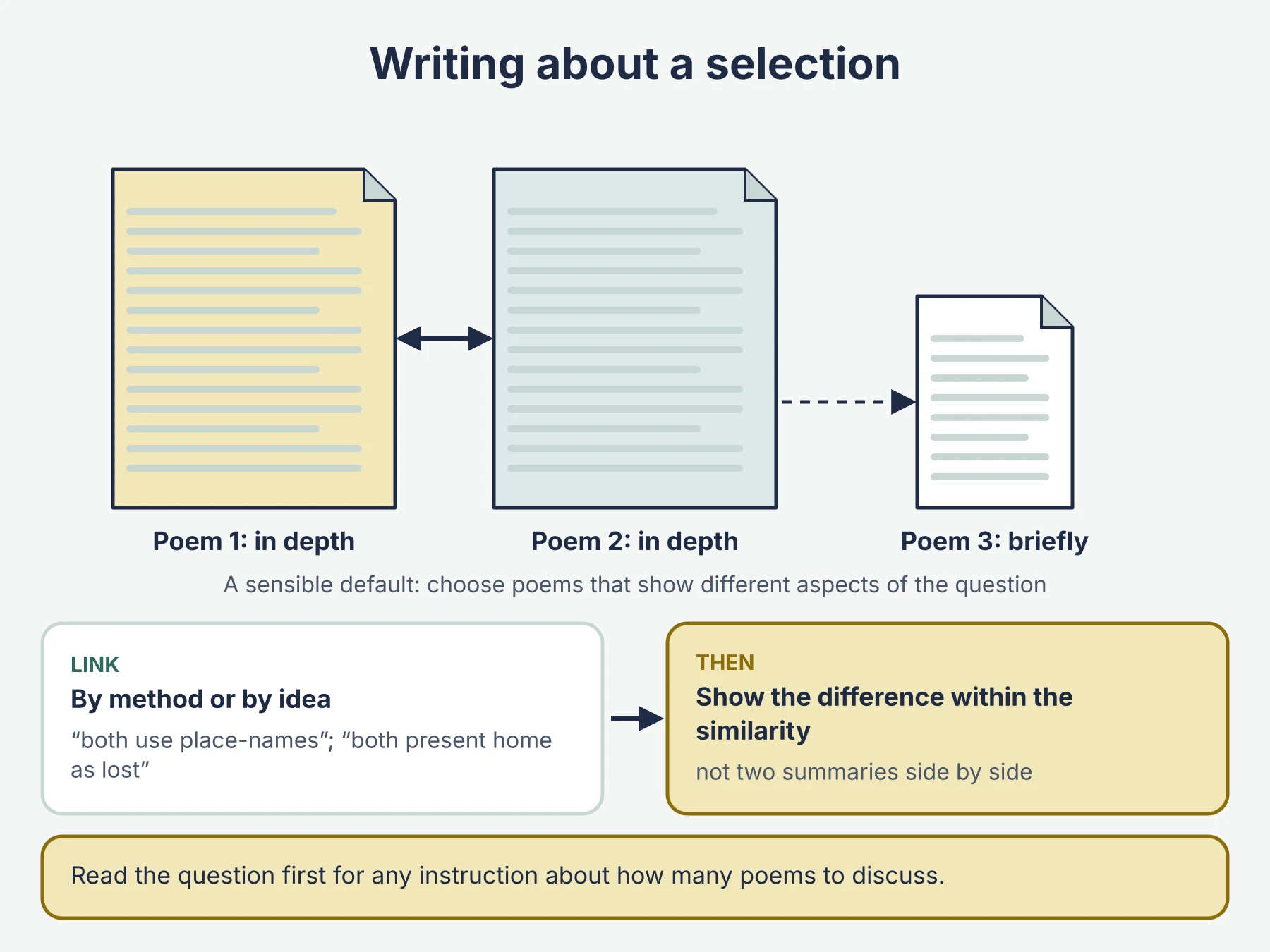
- About an hour. Usually two poems in depth plus brief range, unless the question says otherwise.
Four poets and their places
| Poet | Typical places | Recurring concerns |
|---|---|---|
| Wordsworth | The Wye valley; the Lake District; London from a bridge; Scottish rivers | Nature, memory, the growth of the mind, rural life and loss |
| Frost | New England farms, woods, walls and snowfields | Boundaries, work, isolation, choice, nature’s indifference |
| Hardy | Dorset and Cornwall; churchyards; the open sea | Memory, grief, time, chance, the modern world’s arrival |
| Heaney | Rural County Derry; Irish bogs; Jutland | Childhood, language, history in the land, political violence |
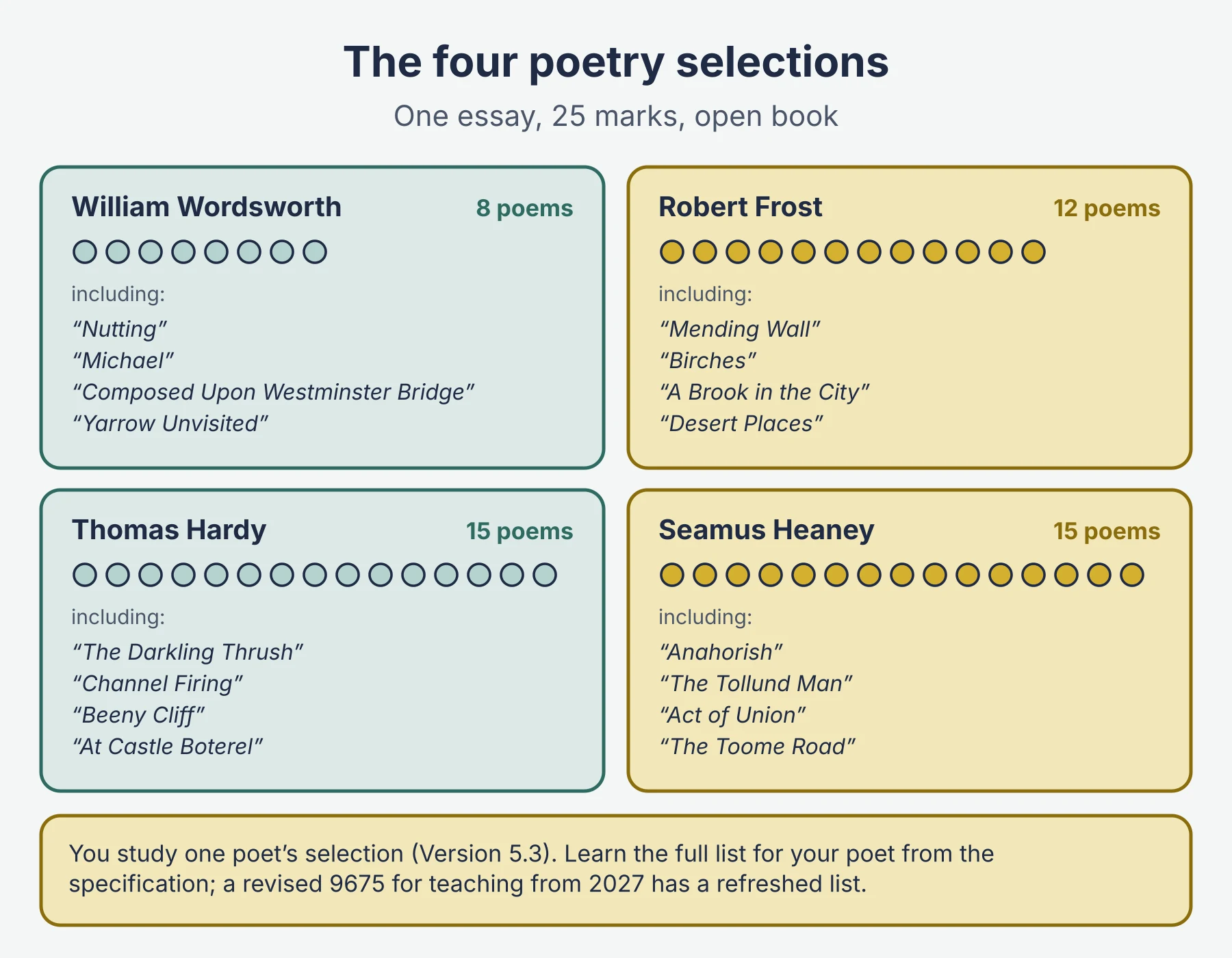
The selections are 8 poems (Wordsworth), 12 (Frost), 15 (Hardy) and 15 (Heaney) in Version 5.3. Check your list: a revised 9675 for teaching from 2027 has a refreshed set-text list.
Poems to pair by idea
- Return and memory: “Tintern Abbey”; Hardy’s “After a Journey” and “At Castle Boterel”.
- Boundaries: “Mending Wall”; Heaney’s “Act of Union”.
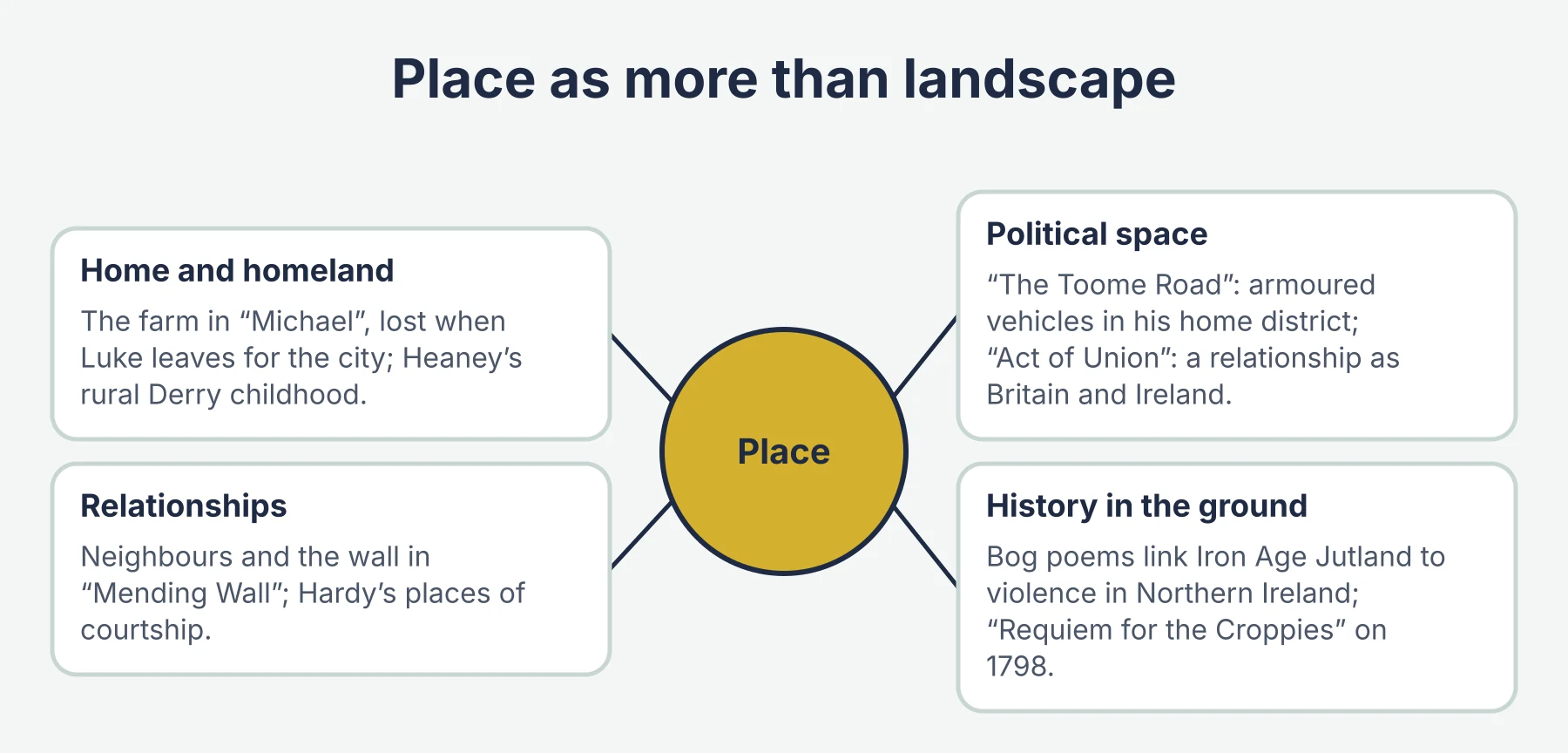
- Home lost or threatened: “Michael”; “Mid-Term Break”; “The Toome Road”.
- Nature damaged or indifferent: “A Brook in the City”; “Desert Places”; “Channel Firing”; “Nutting”.
- History in the land: “Requiem for the Croppies”; “Bogland”; “The Tollund Man”.
- City and stillness: “Composed Upon Westminster Bridge”.
Choose poems that differ within a shared idea, so comparison produces an argument.
How poems build place
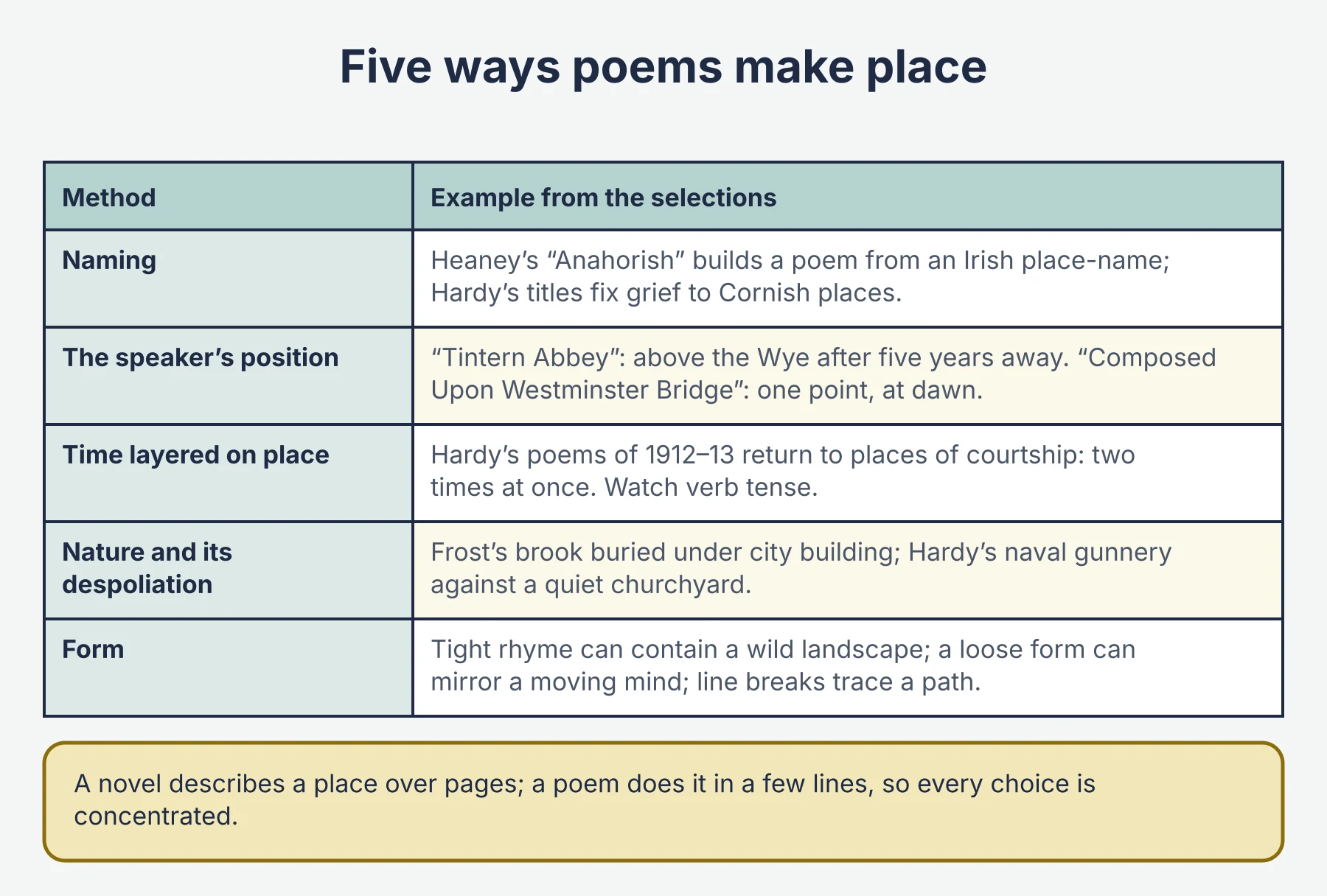
- Naming: place-names carry history and sound (“Anahorish”, “Beeny Cliff”).
- Speaker’s position: where and when the speaker stands.
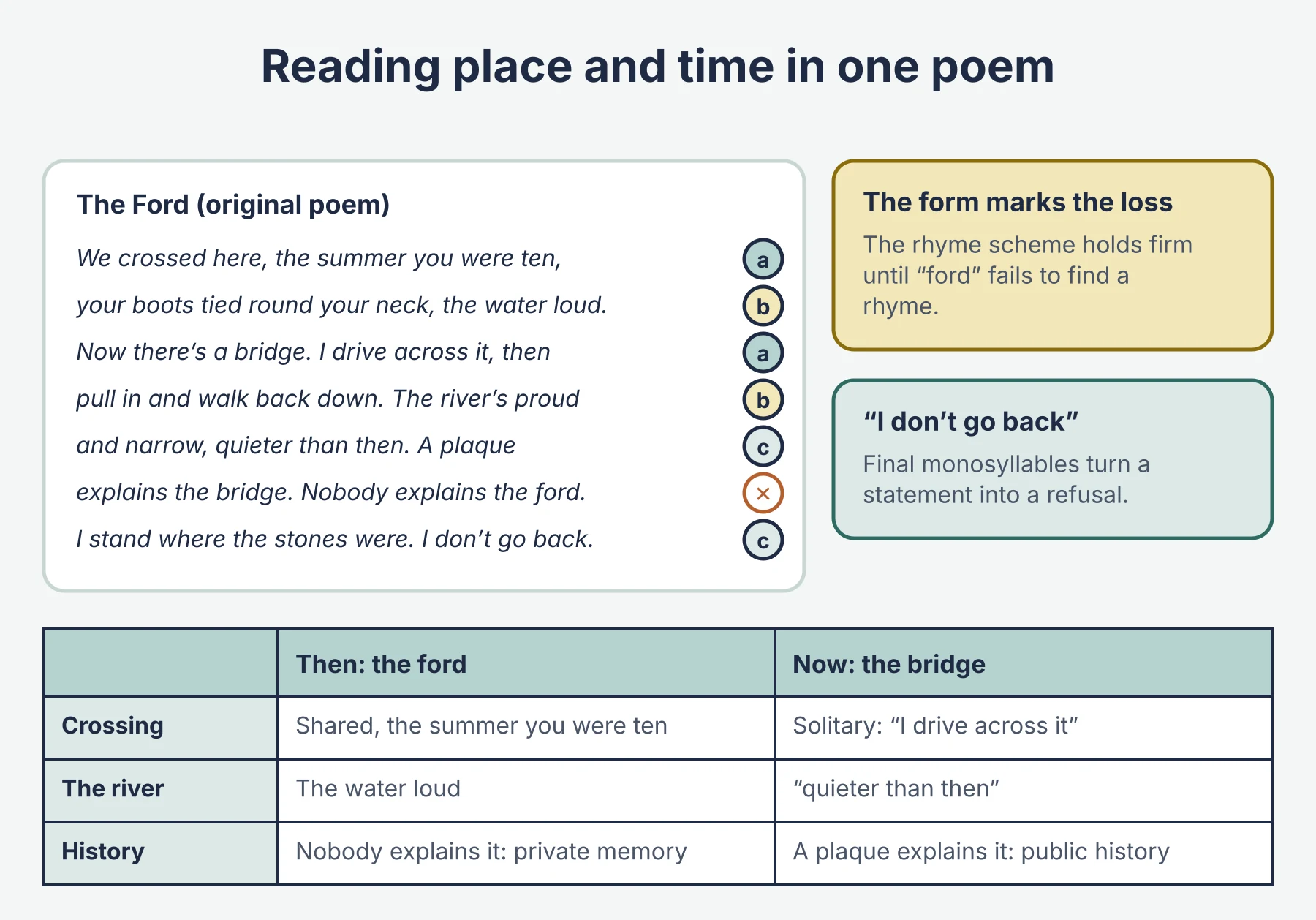
- Time layered on place: past and present tenses side by side.
- Sensory detail: sound, light and texture compressing a whole landscape.
- Form and structure: sonnet, blank verse, quatrains, free verse; line breaks tracing movement.
- Imagery and symbol: a wall, a tree, a bog, a ship.
- Voice and dialect: local words that root the poem in a community.
Key terms
| Term | Meaning |
|---|---|
| Pastoral | Poetry idealising rural life |
| Topographical poem | A poem about a specific place or view |
| Blank verse | Unrhymed iambic pentameter (“Tintern Abbey”, “Mending Wall”) |
| Sonnet | Fourteen-line poem with a turn (“Westminster Bridge”) |
| Enjambment | A sentence running over a line break |
| Caesura | A pause within a line |
| Elegy | A poem of mourning (Hardy’s poems of 1912-13) |
| Dinnseanchas | Irish tradition of place-name lore, often linked to Heaney’s place-name poems |
| Persona | The voice or speaker of a poem |
| Volta | The turn in a poem’s argument |
Context in one line each
- Wordsworth: Romantic belief in nature’s power to shape the mind; the Lyrical Ballads era.
- Frost: New England rural life; plain speech in strict forms.
- Hardy: grief after Emma Hardy’s death in 1912; distrust of progress; the Titanic (1912) in “The Convergence of the Twain”.
- Heaney: rural Catholic childhood in Northern Ireland; the Troubles; P. V. Glob’s book on the preserved bodies of Iron Age Denmark behind the bog poems.
Essay shape
- One-sentence answer to the question.
- Two poems in depth, chosen because they differ within a shared idea.
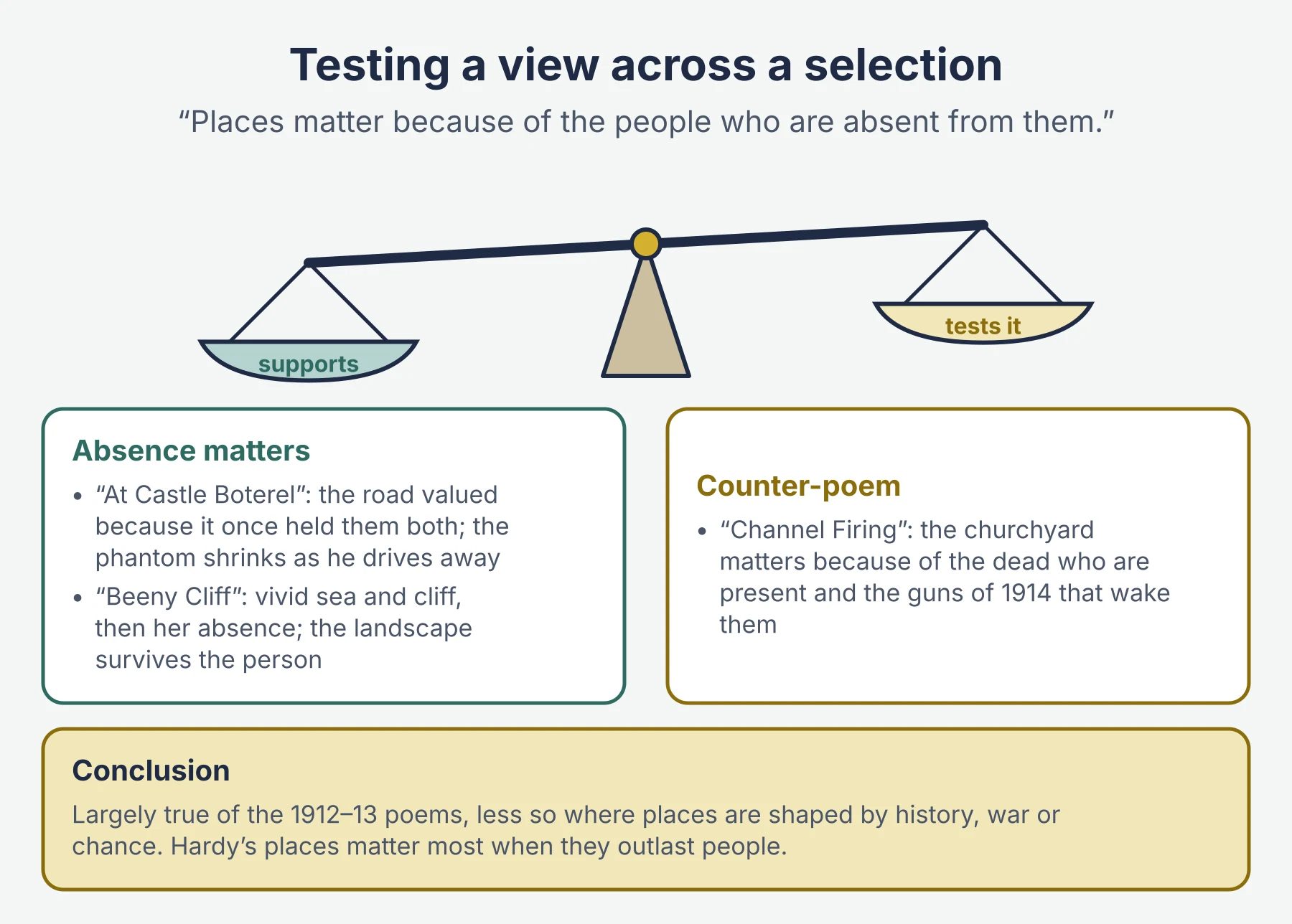
- Brief reference to a third poem that tests or extends the argument.
- Methods analysed in each: naming, position, time, form, imagery.
- Context only where it explains the words; a conclusion that weighs the view.
Exam traps
- Writing on one poem when the question and selection invite range.
- Paraphrasing what the poem says instead of analysing how it says it.
- Biography with no link to the words.
- Ignoring form and sound.
- Comparison as two separate summaries.
- Copying whole stanzas from the open book.
Self-test
- How many marks is Unit 2 Section B worth?
- Which Wordsworth poem is a sonnet about a city at dawn?
- In which poem by Frost do two neighbours repair a boundary each spring?
- Which life event lies behind Hardy’s poems of 1912-13?
- Which Heaney poem builds itself around an Irish place-name?
- Name two of Heaney’s bog poems in the selection.
- What is a topographical poem?
- What does layering time on place mean? Give an example.
- Give two ways form can contribute to a poem’s sense of place.
- Which Hardy poem concerns the Titanic?
- Name one Section B poem that presents place as political space, and explain why.
- What is the usual default for how many poems to discuss?
Answers
- 25 marks, half of the 50-mark unit.
- “Composed Upon Westminster Bridge”.
- “Mending Wall”.
- The death of his first wife, Emma, in 1912.
- “Anahorish”.
- Any two: “Bogland”; “The Tollund Man”; “Bog Queen”; “The Grauballe Man”; “Punishment”.
- A poem about a specific place or view.
- A poem presents a place as it is now and as it was, so the landscape holds memory; for example, Wordsworth revisiting the Wye after five years, or Hardy returning to the Cornish places of his courtship.
- Any two: line breaks and enjambment tracing movement or a view; rhyme and metre containing or resisting a landscape; stanza shape reflecting a structure such as a wall or a path; a volta marking a shift in how the place is seen.
- “The Convergence of the Twain”.
- For example, “The Toome Road”: armoured vehicles moving through Heaney’s home ground make the landscape a site of military power and local resistance.
- Two poems in depth with brief reference to a third, unless the question gives an instruction.
Practise with the Unit 2 Section B practice questions, and revisit the prose methods in the Unit 2 Section A revision notes.
Related resources
-
Study guides
OxfordAQA A-Level English Literature: Place in Literary Texts (9675)
Unit 2 Place in Literary Texts of OxfordAQA International AS English Literature 9675: one prose and one poetry text studied through the idea of place.
English Literature · OxfordAQA · AS Level
Read guide -
Practice questions
Place in Literary Texts (9675): Practice Questions
Original exam-style practice questions with full worked answers on Unit 2 of OxfordAQA International AS & A-Level English Literature (9675).
English Literature · OxfordAQA · AS Level
Try questions -
Revision notes
Place in Literary Texts (9675): Revision Notes
Condensed notes on Unit 2 Place in Literary Texts of OxfordAQA 9675: the prose and poetry sections, the specification's angles on place, and exam technique.
English Literature · OxfordAQA · AS Level
Revise topic
Get free revision emails (optional)
Occasional emails with practice questions, worked explanations and links to free resources for the qualification and subjects you choose. No spam, and you can unsubscribe from any email. The free tools on this site never need an email.