
Revision Notes
OxfordAQA International A-Level English Literature (9675): Unit 2 Section A, Prose and Place – Revision Notes
Recall notes for the 9675 Unit 2 Section A prose essay: six novels and their places, narrative methods, key terms, open-book traps and a self-test.
- Subject
- English Literature
- Level
- AS LEVEL
- Topic
- Unit 2 – Place in Literary Texts
- Author
- Marlbridge Academic Team
- Updated
- Reviewed by
- Ammar Bilal (what this means)
Aligned to OxfordAQA A Level English Literature (9675), Version 5.3, for International AS exams from May/June 2018, A-level from May/June 2019. Official specification .
Syllabus page (what it covers and how it is assessed): OxfordAQA A Level English Literature.
Syllabus points this page covers
9675 (AS Level)
- Section A: Prose
Found an error? Report a correction.
Need help with this topic? Request a free trial class for A Level English Literature (9675).
Condensed notes for the prose essay on place. For the full method, a plan and a model paragraph, use the Unit 2 Section A study guide.
The essay in one box
- One essay on your prose set text: 25 marks, half of Unit 2.
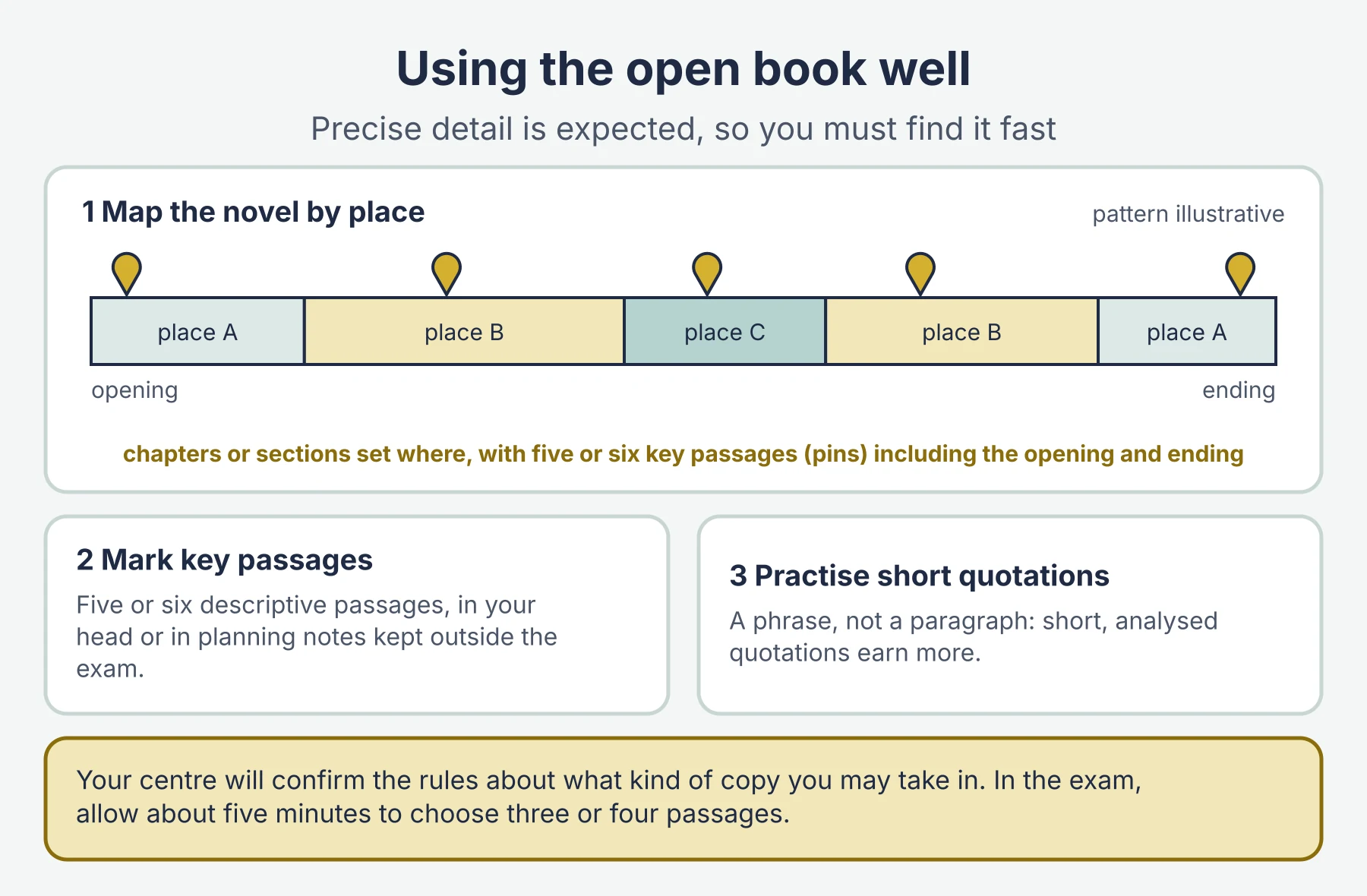
- Open book: precise, accurate detail is expected.
- AO1, AO2 and AO3 are weighted equally.
- Allow about an hour of the 2-hour unit.
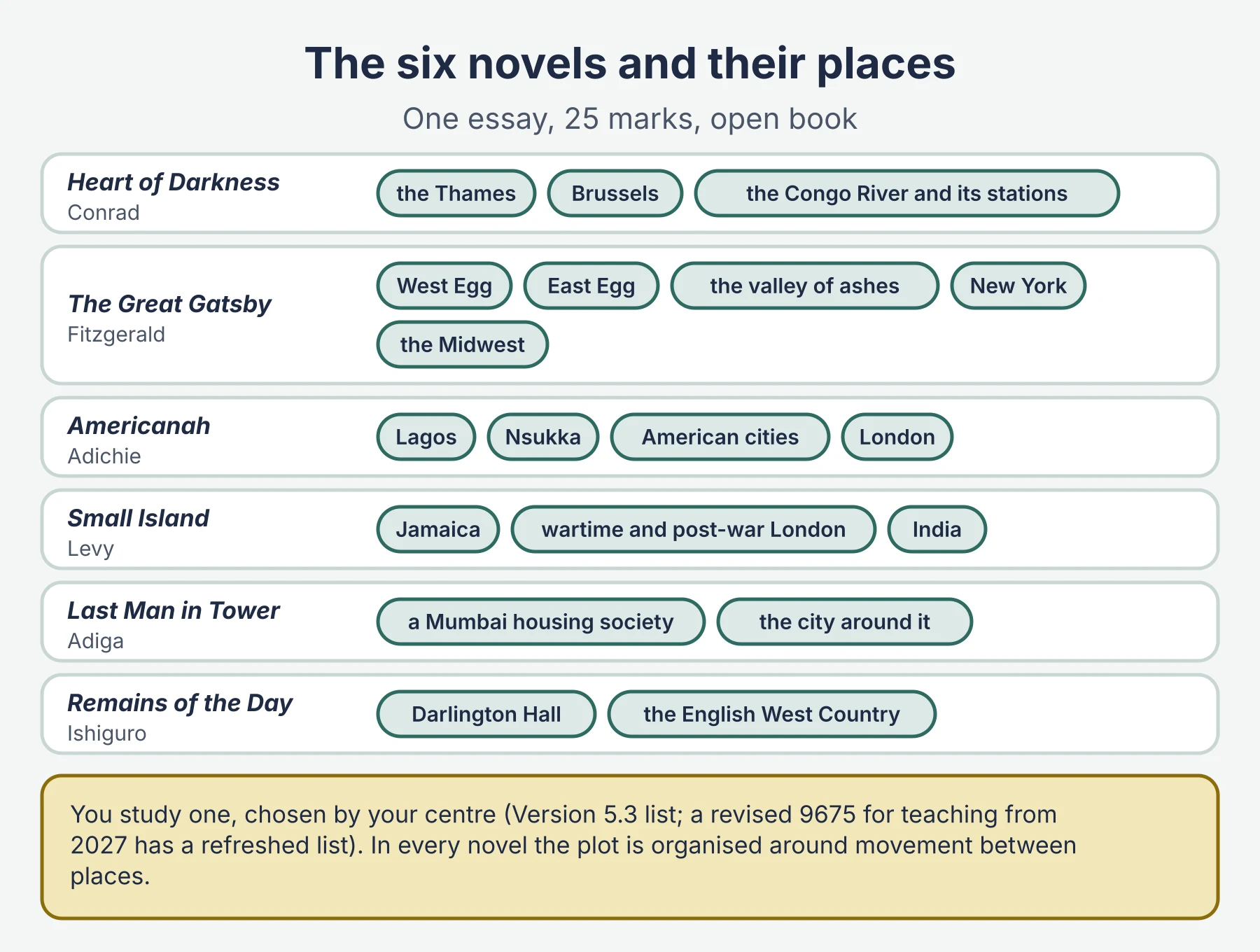
Six novels, their places and a key question
| Novel | Main places | A question about place |
|---|---|---|
| Heart of Darkness (Conrad) | Thames; Brussels; the Congo stations | Whose view of the Congo does Marlow’s narration give us? |
| The Great Gatsby (Fitzgerald) | West Egg; East Egg; valley of ashes; New York; the Midwest | How does geography map class and aspiration? |
| Americanah (Adichie) | Lagos; Nsukka; American cities; London | Is home a country, a person or a way of speaking? |
| Small Island (Levy) | Jamaica; London; India | How does the “mother country” receive those who arrive from the Empire? |
| Last Man in Tower (Adiga) | A Mumbai housing society; the changing city | Who has the right to a place when money wants it? |
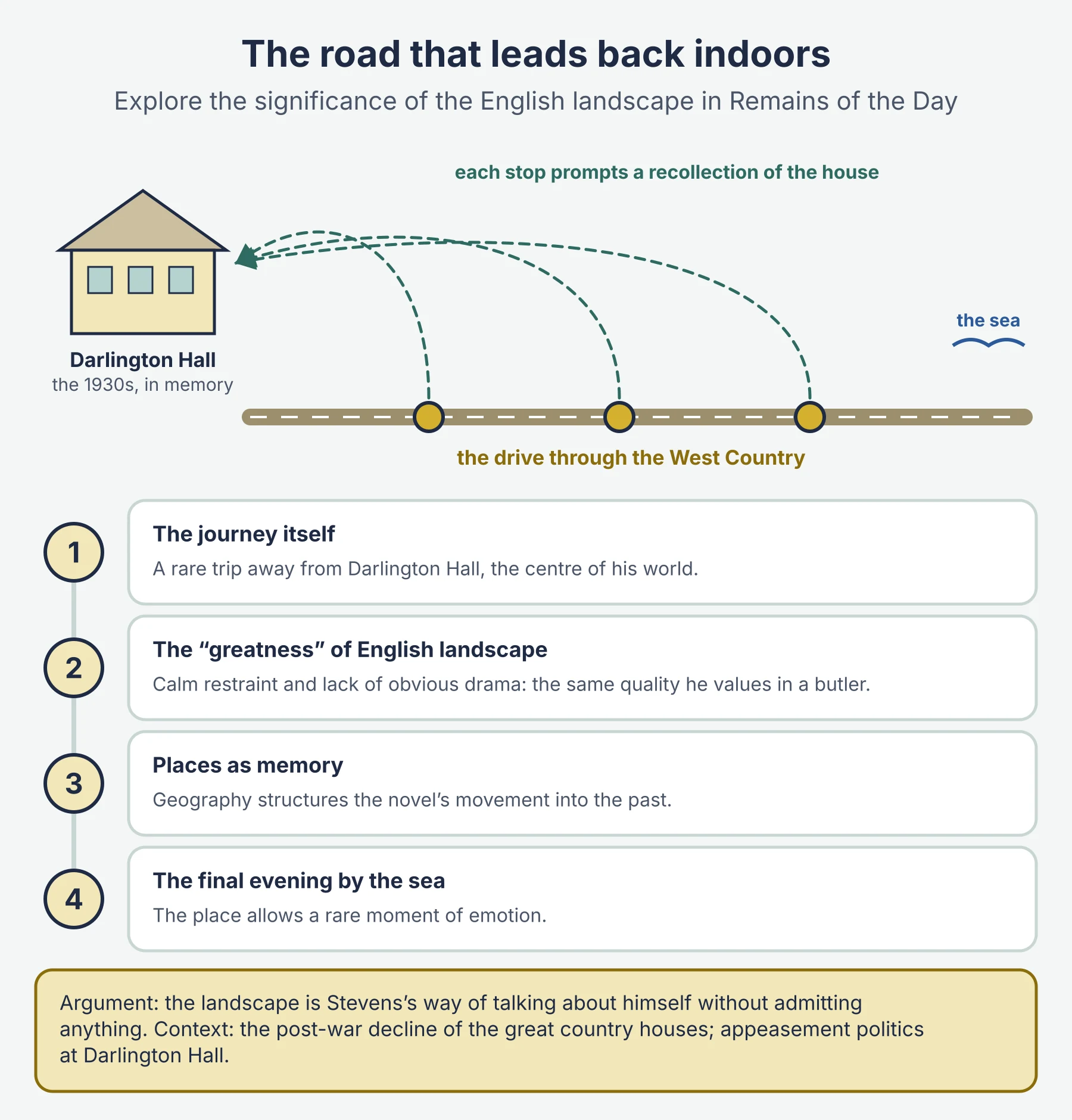
| Remains of the Day (Ishiguro) | Darlington Hall; the West Country | How does landscape speak for a man who will not speak for himself? |
Check your text with your teacher: a revised 9675 for teaching from 2027 has a refreshed list.
The specification’s place angles
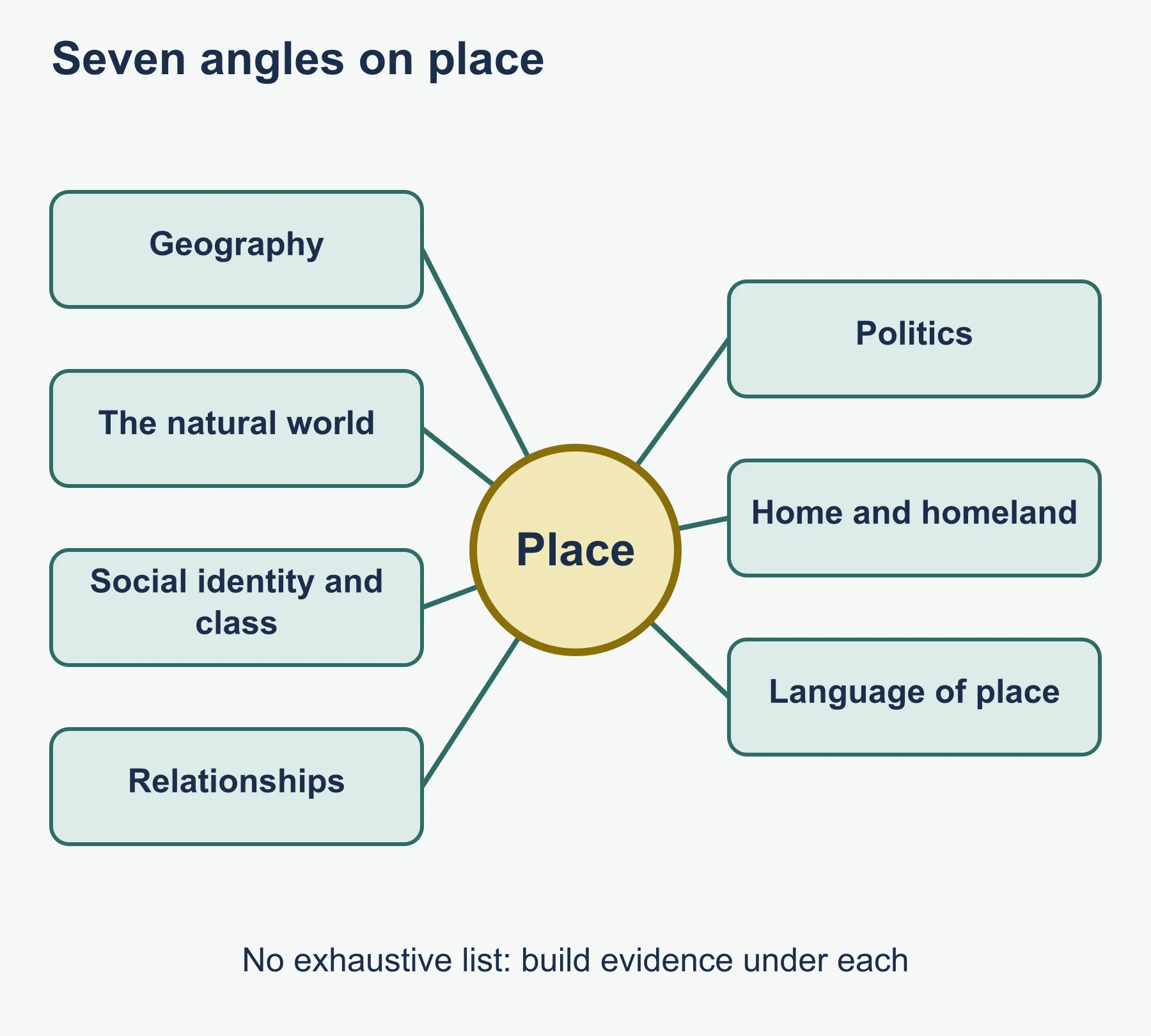
Geographical locations (houses to countries) · where and when stories take place · the natural world, its beauty and “despoliation” · social identity and how people are placed in society · social class · relationships · place as political space · home and homeland · the language and representation of place.
There is no exhaustive list: choose the angles that make your novel most interesting.
Methods that build place in prose
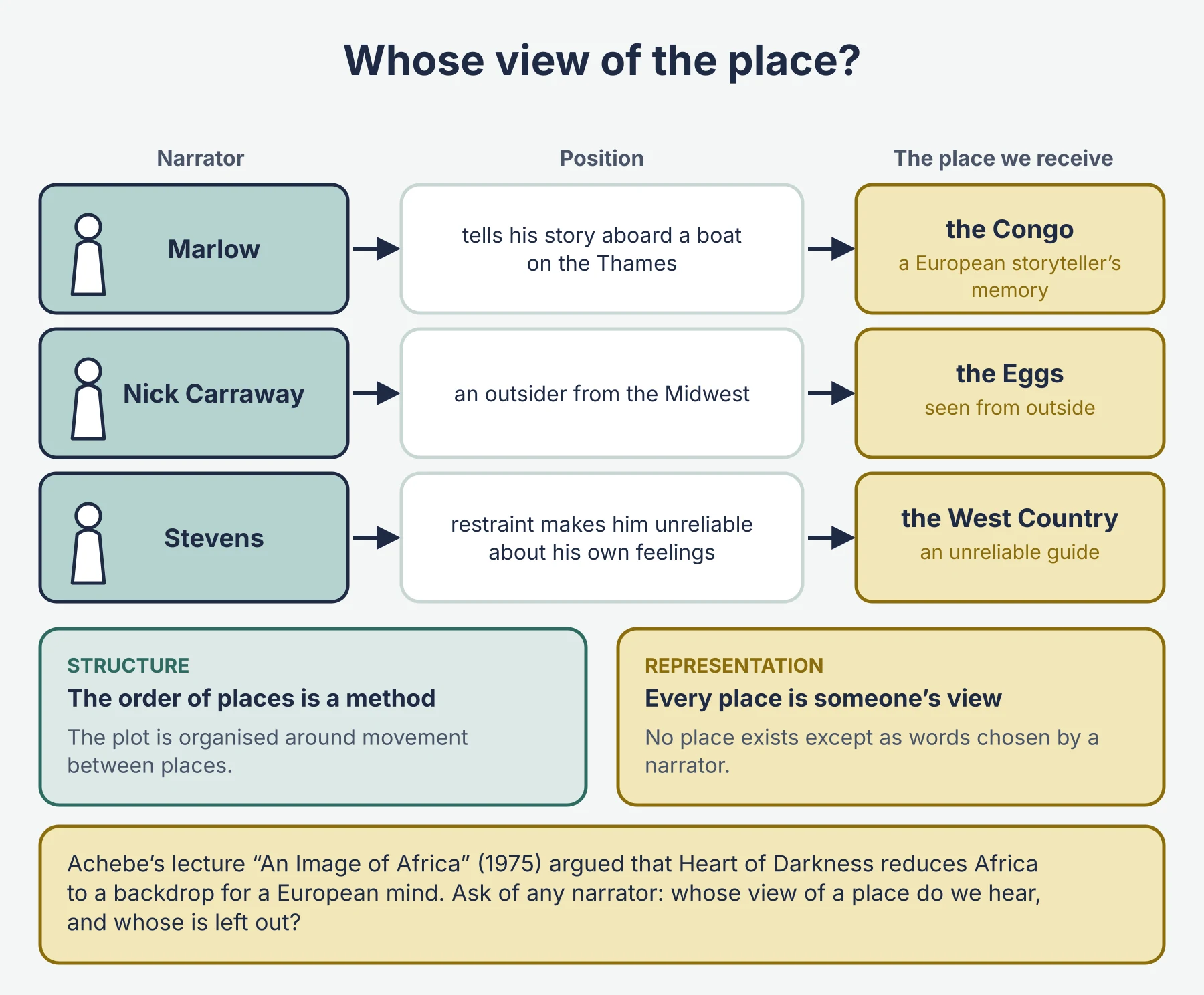
- Narrative viewpoint: first-person, frame or multiple narrators decide what a place looks like.
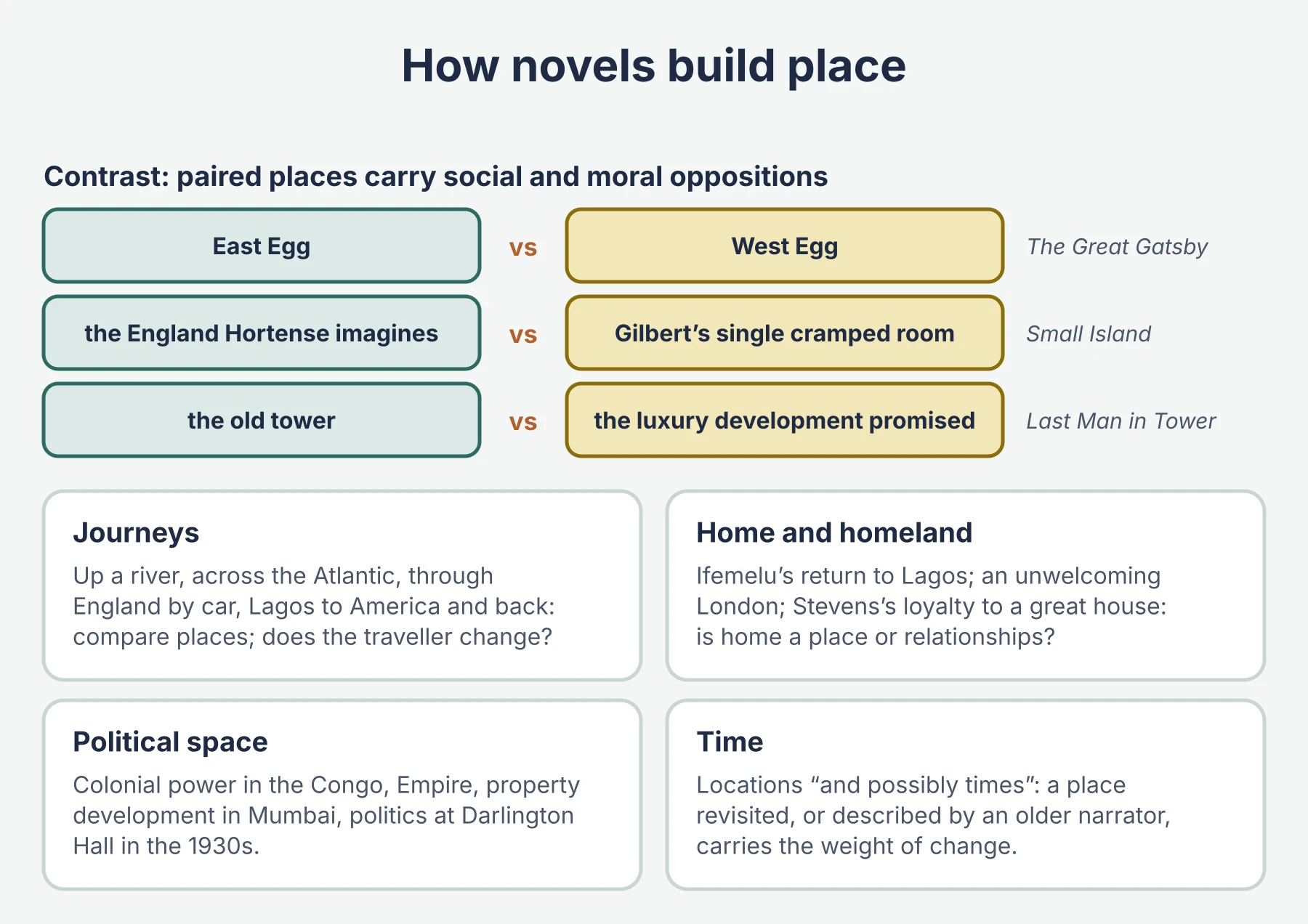
- Journey structure: movement between places organises the plot.
- Contrast: paired places carry opposing values.
- Symbolic setting: a place or object stands for an idea (a light, a river, a tower).
- Time and memory: places revisited or remembered carry change.
- Lexis of place: names, dialect, foreign words and registers that make a place sound particular.
- Pathetic fallacy and atmosphere: weather and light reflecting mood.
Key terms
| Term | Meaning |
|---|---|
| Setting | Where and when the narrative takes place |
| Frame narrative | A story told within another story (Marlow on the Thames) |
| Unreliable narrator | A narrator whose account the reader has reason to doubt |
| Multiple narration | Several narrators giving different views of the same places |
| Diaspora | Communities living away from an ancestral homeland |
| Liminal space | A threshold or in-between place, such as a ship or a border |
| Postcolonial reading | Interpretation focused on empire, colonised places and voices |
| Pathetic fallacy | Nature reflecting human feeling |
| Symbolic geography | Places arranged to carry moral or social meaning |
| Dislocation | A sense of being out of place, culturally or physically |
Planning in five lines
- One-sentence answer about the significance of place in the question.
- Three or four passages from different parts of the novel.
- For each, the method that creates place and the meaning it carries.
- One context and one alternative interpretation, used where they explain a passage.
- A conclusion on what place finally means in the novel.
Context worth linking to place
- Empire and its aftermath: the Congo Free State; Caribbean migration to Britain after 1948.
- Class and wealth in 1920s America.
- Migration and race in twenty-first-century America and Britain.
- Property and change in modern Mumbai.
- The decline of English country houses after the Second World War, and 1930s appeasement.
Exam traps
- Place treated as background scenery.
- Long quotations copied without analysis: open book rewards precision, not quantity.
- No attention to the narrator’s limited or biased view.
- One part of the novel only: use the opening, the middle and the end.
- Ignoring the question’s specific angle (for example, “home” or “class”) in favour of a general answer on place.
- Annotating the copy you take into the exam: follow the board’s open-book rules as your centre explains them.
Self-test
- Is Unit 2 open or closed book?
- The specification says place is significant to the texts’ stories. Name the three other things it says place is significant to.
- Which novel uses a frame narrative on the Thames?
- Which two “Eggs” does Fitzgerald contrast?
- In which city is Last Man in Tower set?
- Who narrates Remains of the Day, and why does his narration matter for place?
- Give two places in Americanah.
- What is a liminal space? Give an example from a Section A novel.
- Name three of the specification’s place angles beyond physical geography.
- What is the danger of long quotations in an open-book exam?
- Who delivered the lecture “An Image of Africa”, and what did it argue?
- Why is a journey structure useful to an essay on place?
Answers
- Open book.
- Their narrative structures, their socio-cultural views of the world, and their potential meanings.
- Heart of Darkness.
- West Egg and East Egg.
- Mumbai.
- Stevens, the butler; his restraint and unreliability mean landscapes often express what he will not admit.
- Any two: Lagos; Nsukka; American cities such as Philadelphia or Princeton; London.
- A threshold or in-between place; for example, the river in Heart of Darkness or a ship carrying migrants to Britain in Small Island.
- Any three: social identity; social class; relationships; political space; home and homeland; the natural world; the language of place.
- They use time without adding analysis; short, precise quotations analysed closely earn more.
- Chinua Achebe (1975); that Heart of Darkness reduces Africa to a backdrop for a European mind.
- It lets you compare places and show whether the traveller changes, linking place to character and structure.
Practise with the Unit 2 Section A practice questions, then compare how poems build place in the Unit 2 Section B revision notes.
Related resources
-
Study guides
OxfordAQA International A-Level English Literature (9675): Unit 2 Section B, Poetry and Place
How to write the 9675 Unit 2 Section B poetry essay on place: the Wordsworth, Frost, Hardy and Heaney selections, poetic methods, a plan and a model reading.
English Literature · OxfordAQA · AS Level
Read guide -
Practice questions
OxfordAQA International A-Level English Literature (9675): Unit 2 Section B, Poetry and Place – Practice Questions
Twelve original questions for the 9675 Unit 2 Section B poetry essay on place, with an invented poem and planning tasks, answered point by point.
English Literature · OxfordAQA · AS Level
Try questions -
Revision notes
OxfordAQA International A-Level English Literature (9675): Unit 2 Section B, Poetry and Place – Revision Notes
Recall notes for the 9675 Unit 2 Section B poetry essay: the four poets, how poems build place, poetic terms, exam traps and a self-test.
English Literature · OxfordAQA · AS Level
Revise topic
Get free revision emails (optional)
Occasional emails with practice questions, worked explanations and links to free resources for the qualification and subjects you choose. No spam, and you can unsubscribe from any email. The free tools on this site never need an email.