
Revision Notes
OxfordAQA International A-level Sociology (9690): Artificial intelligence and cyborgs – Revision Notes
Revision notes for OxfordAQA 9690 section 3.2.3.5: how AI types differ, algorithmic bias cases, AI and work, hidden labour, human-machine merging and robots.
- Subject
- Sociology
- Level
- A LEVEL
- Topic
- Unit 5 – People and Technology
- Author
- Marlbridge Academic Team
- Updated
- Reviewed by
- Naqiya Yousaf (what this means)
Aligned to OxfordAQA A Level Sociology (9690), Version 1.1. Official specification .
Syllabus page (what it covers and how it is assessed): OxfordAQA A Level Sociology.
Syllabus points this page covers
9690 (A Level)
- 3.2.3.5 Artificial intelligence and cyborgs
Found an error? Report a correction.
Need help with this topic? Request a free trial class for A Level Sociology (9690).
These notes condense content point 3.2.3.5 Artificial intelligence and cyborgs of OxfordAQA International A-level Sociology (9690), Version 1.1, assessed in the Unit 5 People and technology exam. Full explanations are in the AI and cyborgs study guide; the rest of the unit is in the People and technology revision notes.
What the specification lists
- Differences between types of AI.
- Algorithms: issues of power and inequality.
- The extent to which people and organisations are using AI and effects of this.
- Emerging technologies that merge the human and machine/technology.
- Robots and cyborgs.
Core recall
Types of AI
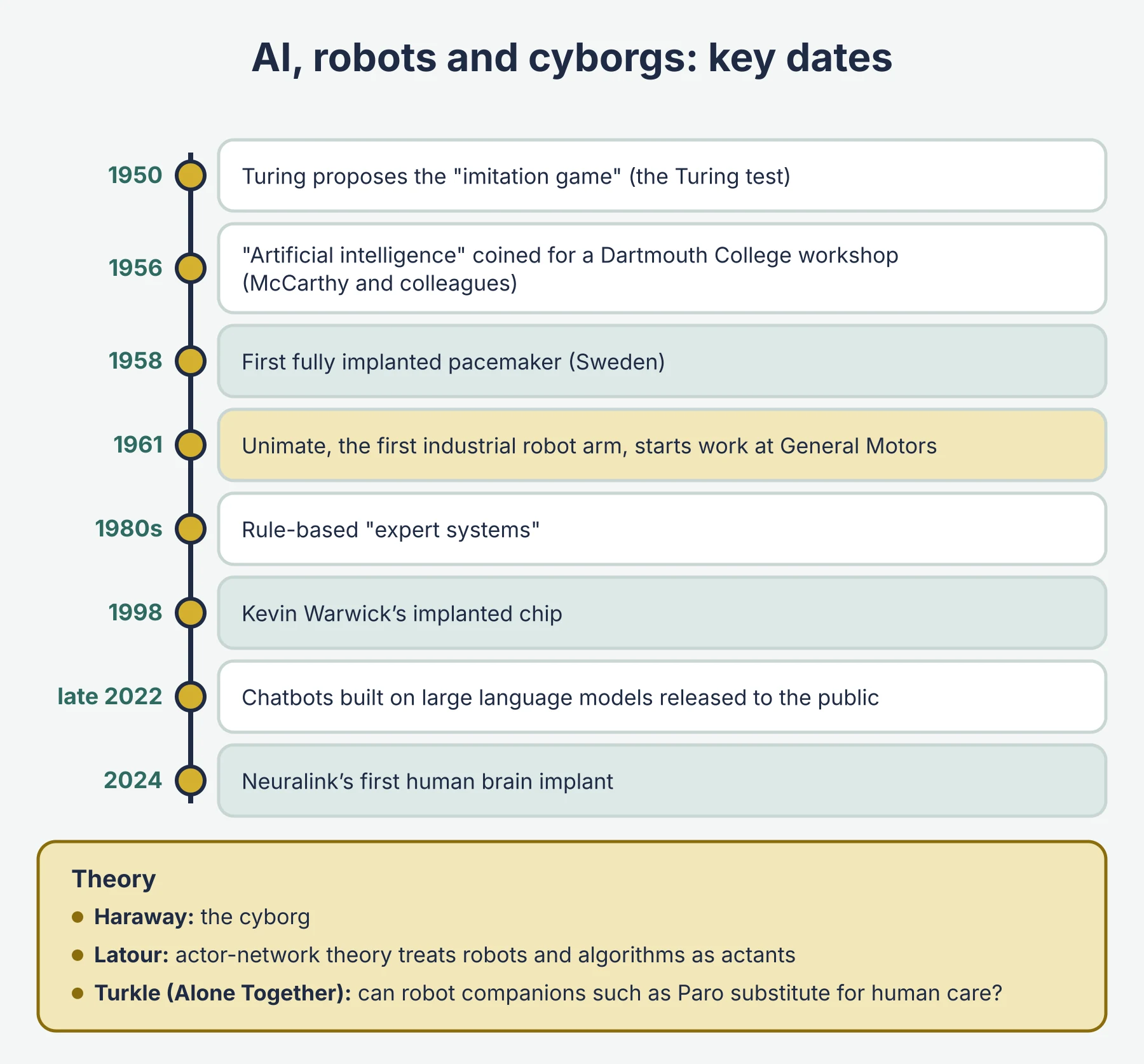
- Turing (1950): the imitation game (Turing test).
- “Artificial intelligence” coined for the Dartmouth workshop (1956), McCarthy and colleagues.
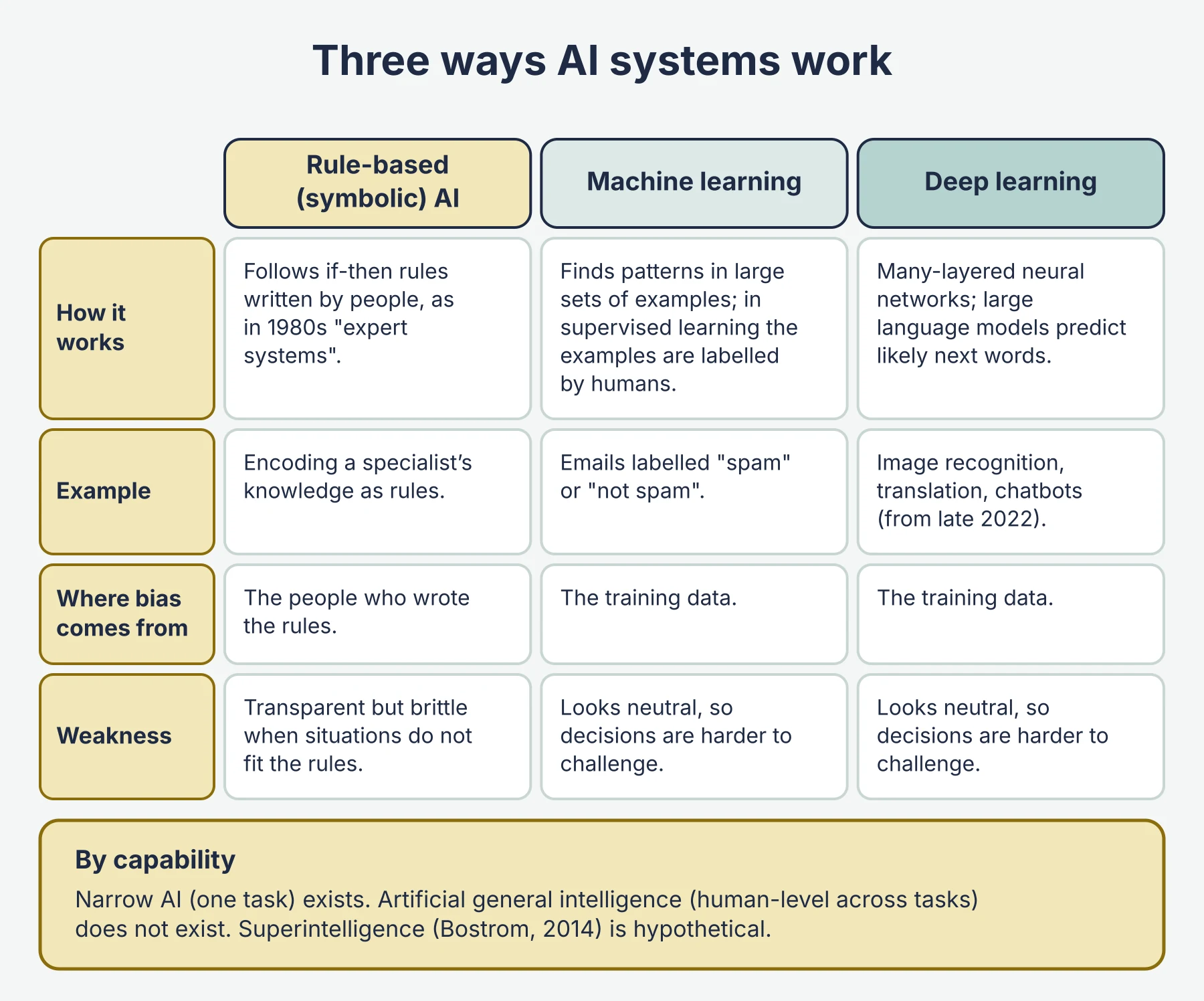
- Rule-based (symbolic): human-written if-then rules, as in 1980s expert systems; transparent but brittle.
- Machine learning: finds patterns in examples; supervised learning uses human-labelled data.
- Deep learning: many-layered neural networks; large language models predict likely next words; public chatbots from late 2022.
- By capability: narrow AI; artificial general intelligence (does not exist); superintelligence (hypothetical, Bostrom, 2014).
- By output: generative versus predictive.
- Rule-based systems carry rule-writers’ biases; learning systems carry training-data biases.
Algorithms, power and inequality
- Buolamwini and Gebru (2018): facial analysis errors highest for darker-skinned women.
- Noble (2018): search results reproduce stereotypes. O’Neil (2016) and Eubanks (2018): automated decisions hit poorer people.
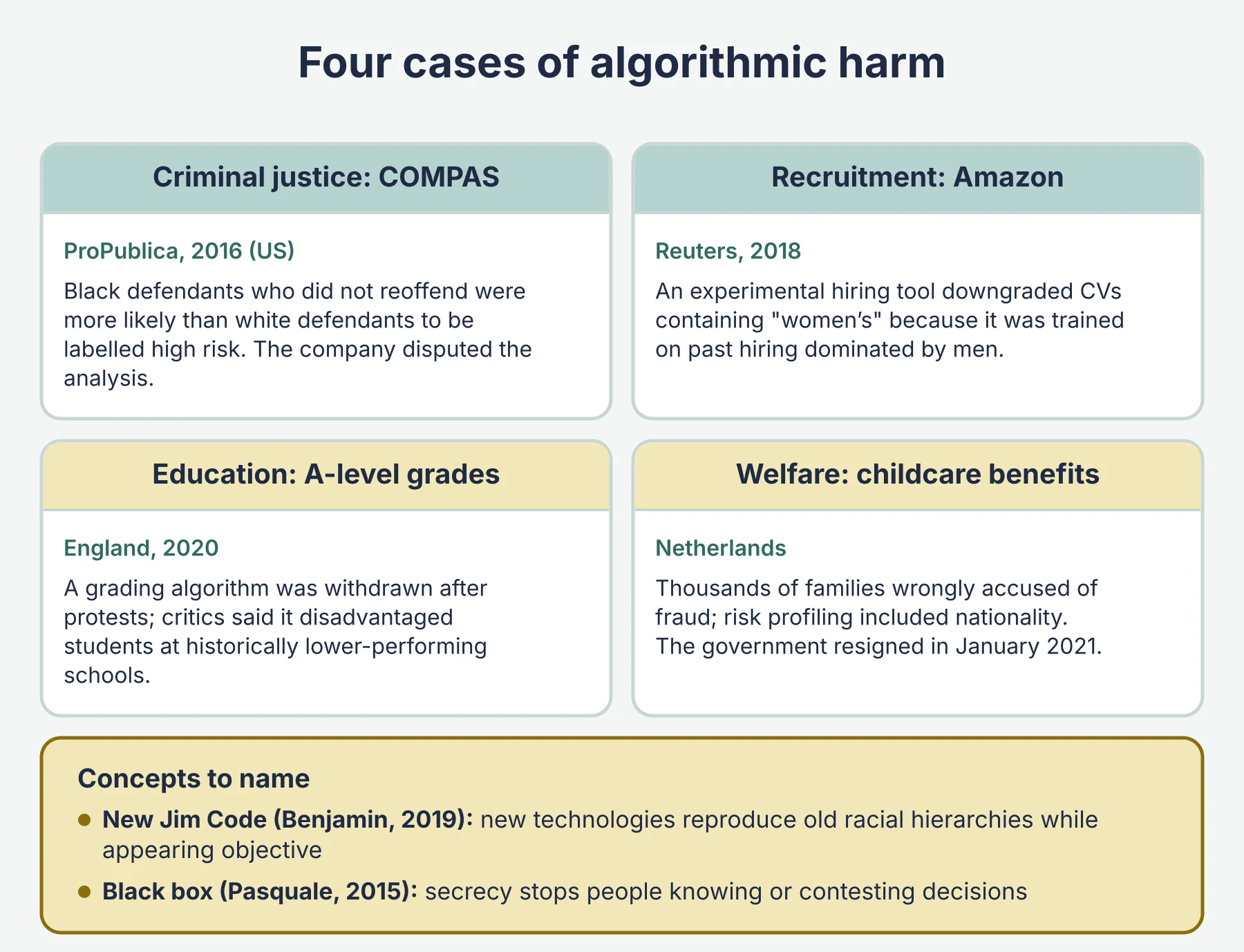
- COMPAS (ProPublica, 2016): Black defendants who did not reoffend more often labelled high risk; analysis disputed by the company.
- Amazon hiring tool (reported 2018): downgraded CVs containing “women’s”; abandoned.
- England’s 2020 A-level grading algorithm: withdrawn after protests.
- Netherlands childcare benefits scandal: wrongful fraud accusations; government resigned January 2021.
- Benjamin (2019): the New Jim Code. Pasquale (2015): the black box society. Feedback loops in predictive policing.
- For algorithms: can be audited; humans are biased too. Against: scale, opacity, appearance of objectivity.
Extent and effects
- Uses: search, translation, recommendations, fraud detection, medical imaging, customer service, policing, education; uneven by country, sector, group.
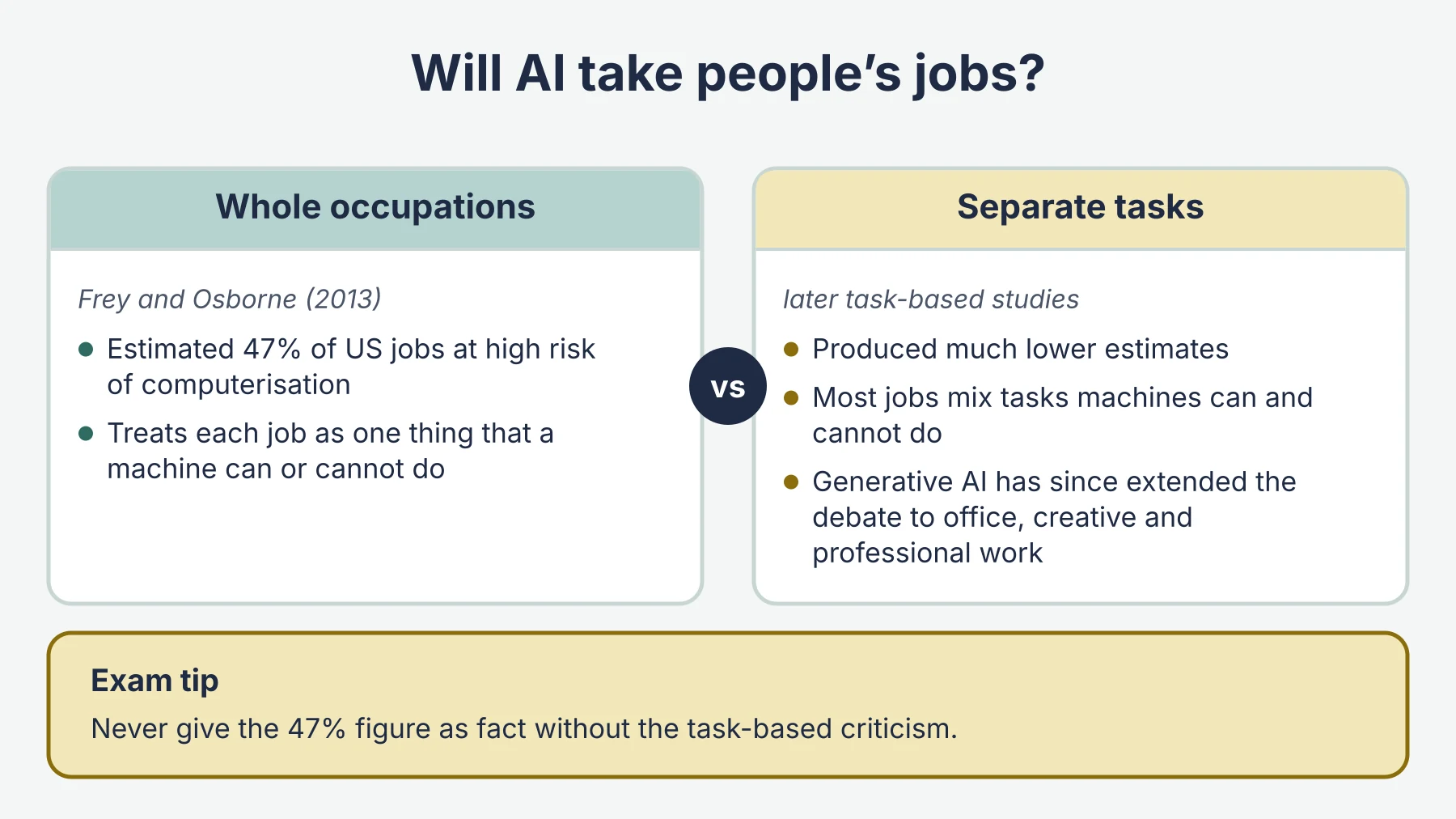
- Frey and Osborne (2013): 47% of US jobs at high risk; task-based studies give much lower estimates.
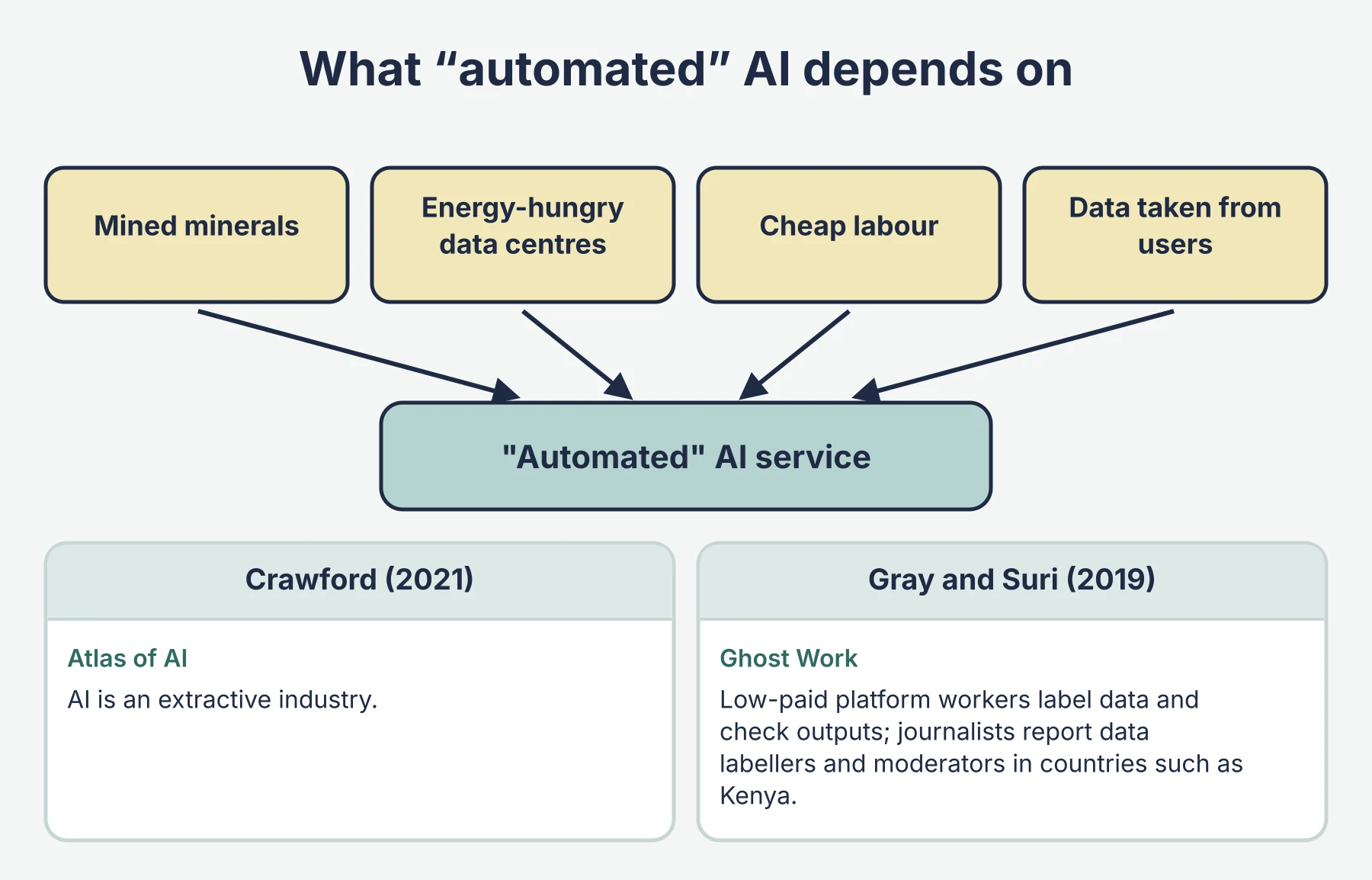
- Gray and Suri (2019): ghost work by low-paid data labellers; reports of moderators in Kenya.
- Crawford (2021): AI as an extractive industry of minerals, energy, labour and data.
- Benefits: diagnosis, translation, accessibility. Readings: Marxist (profit, control) versus optimistic (productivity, access).
Human and machine
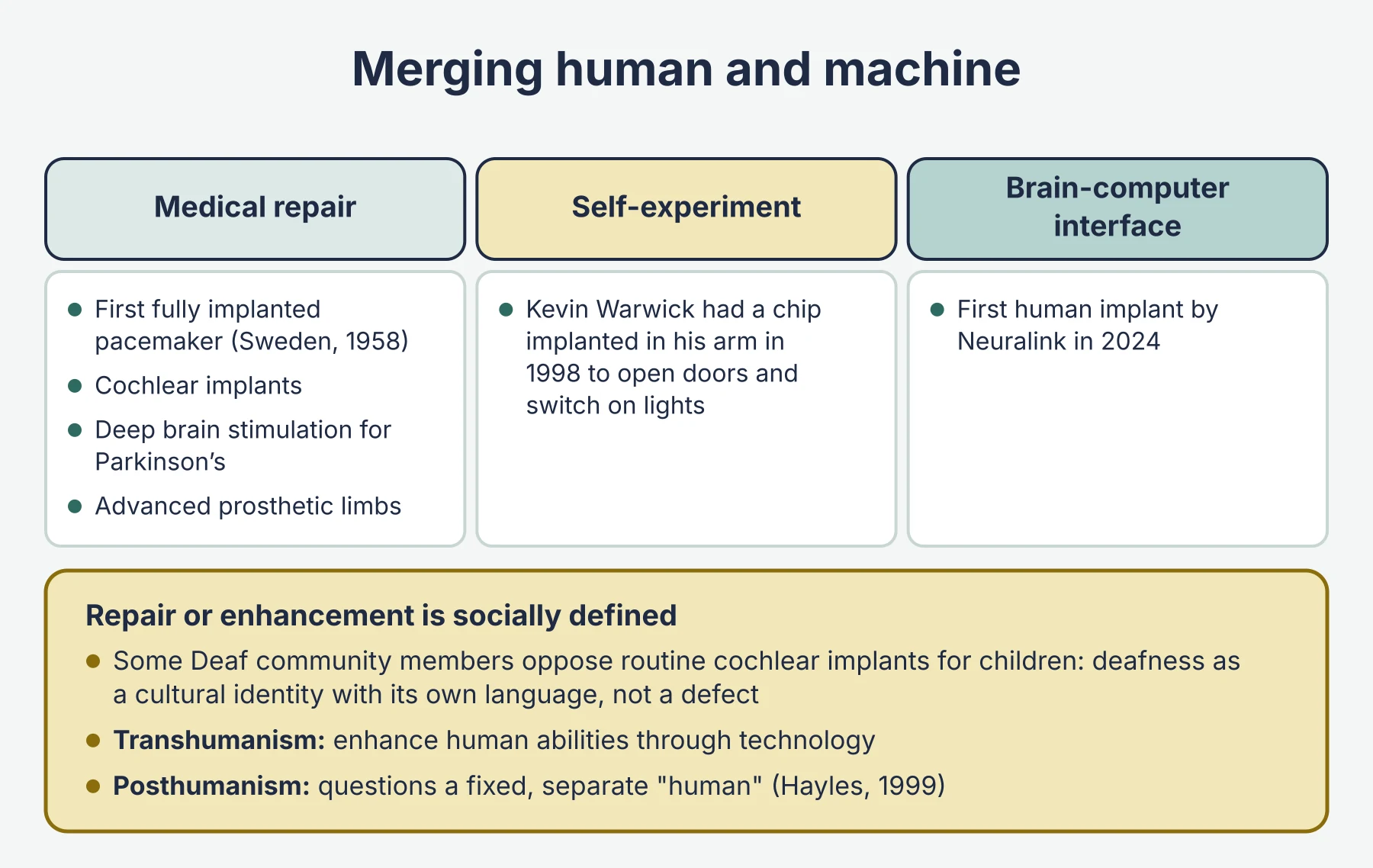
- First fully implanted pacemaker (Sweden, 1958); cochlear implants; deep brain stimulation; prosthetics; brain-computer interfaces (first Neuralink human implant, 2024).
- Kevin Warwick: implanted chip (1998).
- Deaf community objections to routine cochlear implants: deafness as culture, not defect.
- Transhumanism (enhancement) versus posthumanism (questioning a fixed human). Hayles (1999), How We Became Posthuman.
Robots and cyborgs
- Čapek’s R.U.R. (1920): “robot”. Clynes and Kline (1960): “cyborg”.
- Unimate, first industrial robot arm, at General Motors (1961).
- Care robots such as Paro the robotic seal; Turkle questions robotic companionship.
- Armed drones; UN debates on autonomous weapons.
- Haraway’s cyborg; Latour’s actants.
Key terms
| Term | Definition |
|---|---|
| Turing test | Test of whether a machine’s responses can be told apart from a human’s |
| Rule-based AI | AI following rules written by humans |
| Machine learning | AI that learns patterns from data |
| Supervised learning | Training on examples labelled by humans |
| Deep learning | Machine learning using many-layered neural networks |
| Large language model | AI trained on vast text to predict likely next words |
| Training data | Examples used to build a machine-learning system |
| Algorithmic bias | Systematic unfair outcomes produced by an algorithm |
| Black box | Decision system whose workings are hidden from those affected |
| Feedback loop | Outputs that generate data which confirm the original prediction |
| Ghost work | Hidden human labour behind automated services |
| Cyborg | Organism combining biological and machine parts |
| Transhumanism | Movement to enhance humans through technology |
| Posthumanism | Questioning of a fixed, separate human identity |
Exam traps
- Say which type of AI you mean; “AI” alone is too vague.
- AGI and superintelligence are hypothetical.
- The 47% figure needs the task-based criticism.
- Algorithmic bias comes from data, design and deployment; name the mechanism.
- Cyborgs are not only fiction: use medical implants.
- “Repair” and “enhancement” are socially defined, as the cochlear implant debate shows.
Self-test
- What is the Turing test?
- When and where was the term “artificial intelligence” coined?
- How does rule-based AI differ from machine learning?
- What is supervised learning?
- What did ProPublica report about COMPAS?
- Why did Amazon’s hiring tool downgrade some CVs?
- What did Benjamin mean by the New Jim Code?
- What is a feedback loop in predictive policing?
- What criticism has been made of Frey and Osborne’s 47% estimate?
- What is ghost work?
- Why have some Deaf people opposed routine cochlear implants?
- What is the difference between transhumanism and posthumanism?
Answers
- A test of whether a human questioner can reliably tell a machine’s answers from a person’s.
- In 1956, for a workshop at Dartmouth College organised by John McCarthy and colleagues.
- Rule-based AI follows rules written by humans; machine learning finds patterns in data.
- Training a system on examples that humans have labelled.
- Black defendants who did not reoffend were more likely than white defendants to have been labelled high risk.
- It was trained on past hiring dominated by men, so it learned to penalise CVs mentioning “women’s”.
- New technologies can reproduce racial hierarchies while appearing objective.
- More police in a predicted area record more crime there, which seems to confirm the prediction.
- Looking at tasks within jobs rather than whole occupations gives much lower estimates.
- Low-paid human work, such as labelling data, hidden behind services presented as automated.
- They see deafness as a cultural identity with its own language, not a defect to fix.
- Transhumanism seeks to enhance humans through technology; posthumanism questions the idea of a fixed, separate human.
Apply these with the AI and cyborgs practice questions.
Related resources
-
Study guides
OxfordAQA International A-level Sociology (9690): Digital technologies
Guide to OxfordAQA 9690 section 3.2.3.4: online games, media adapting to digital, self-tracking and gamification, surveillance, cybercrime and digital divides.
Sociology · OxfordAQA · A Level
Read guide -
Practice questions
OxfordAQA International A-level Sociology (9690): Digital technologies – Practice Questions
Original OxfordAQA 9690 practice questions on online games, on-demand media, self-tracking, surveillance, cybercrime and digital divides, with full answers.
Sociology · OxfordAQA · A Level
Try questions -
Revision notes
OxfordAQA International A-level Sociology (9690): Digital technologies – Revision Notes
Revision notes for OxfordAQA 9690 section 3.2.3.4: games, media adapting, self-tracking, social sorting, the surveillant assemblage, cybercrime and divides.
Sociology · OxfordAQA · A Level
Revise topic
Related articles
Get free revision emails (optional)
Occasional emails with practice questions, worked explanations and links to free resources for the qualification and subjects you choose. No spam, and you can unsubscribe from any email. The free tools on this site never need an email.