
Revision Notes
OxfordAQA International A-level Sociology (9690): Digital technologies – Revision Notes
Revision notes for OxfordAQA 9690 section 3.2.3.4: games, media adapting, self-tracking, social sorting, the surveillant assemblage, cybercrime and divides.
- Subject
- Sociology
- Level
- A LEVEL
- Topic
- Unit 5 – People and Technology
- Author
- Marlbridge Academic Team
- Updated
- Reviewed by
- Naqiya Yousaf (what this means)
Aligned to OxfordAQA A Level Sociology (9690), Version 1.1. Official specification .
Syllabus page (what it covers and how it is assessed): OxfordAQA A Level Sociology.
Syllabus points this page covers
9690 (A Level)
- 3.2.3.4 Digital technologies
Found an error? Report a correction.
Need help with this topic? Request a free trial class for A Level Sociology (9690).
These notes condense content point 3.2.3.4 Digital technologies of OxfordAQA International A-level Sociology (9690), Version 1.1, assessed in the Unit 5 People and technology exam. Full explanations are in the digital technologies study guide; the rest of the unit is in the People and technology revision notes.
What the specification lists
- Digital/online games.
- Ways “traditional” media are adapting to the digital age.
- Technologies for health and fitness, including quantification and gamification of social life.
- Technologies for surveillance.
- Illegal and anti-social uses: cybercrimes and cyber security; hacking.
- Inequalities in access to digital technologies; digital divides.
Core recall
Games
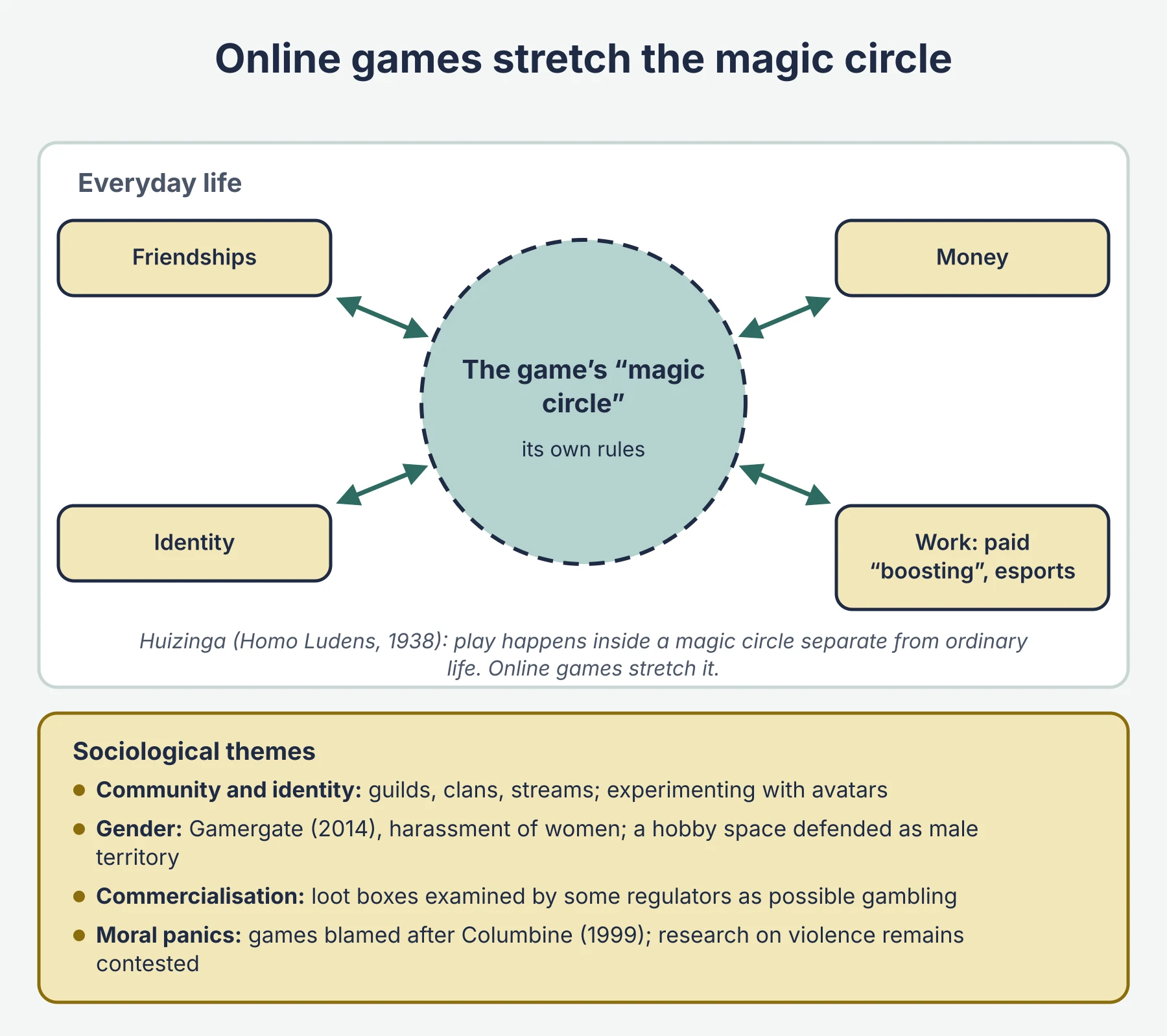
- Huizinga (1938): play as a basis of culture, inside a “magic circle”; online games blur it.
- Community and identity: guilds, clans, streams, avatars.
- Gamergate (2014): harassment of women in gaming.
- Loot boxes: regulators ask whether they resemble gambling.
- Moral panics after school shootings such as Columbine (1999); evidence of links to serious violence contested.
Traditional media adapting
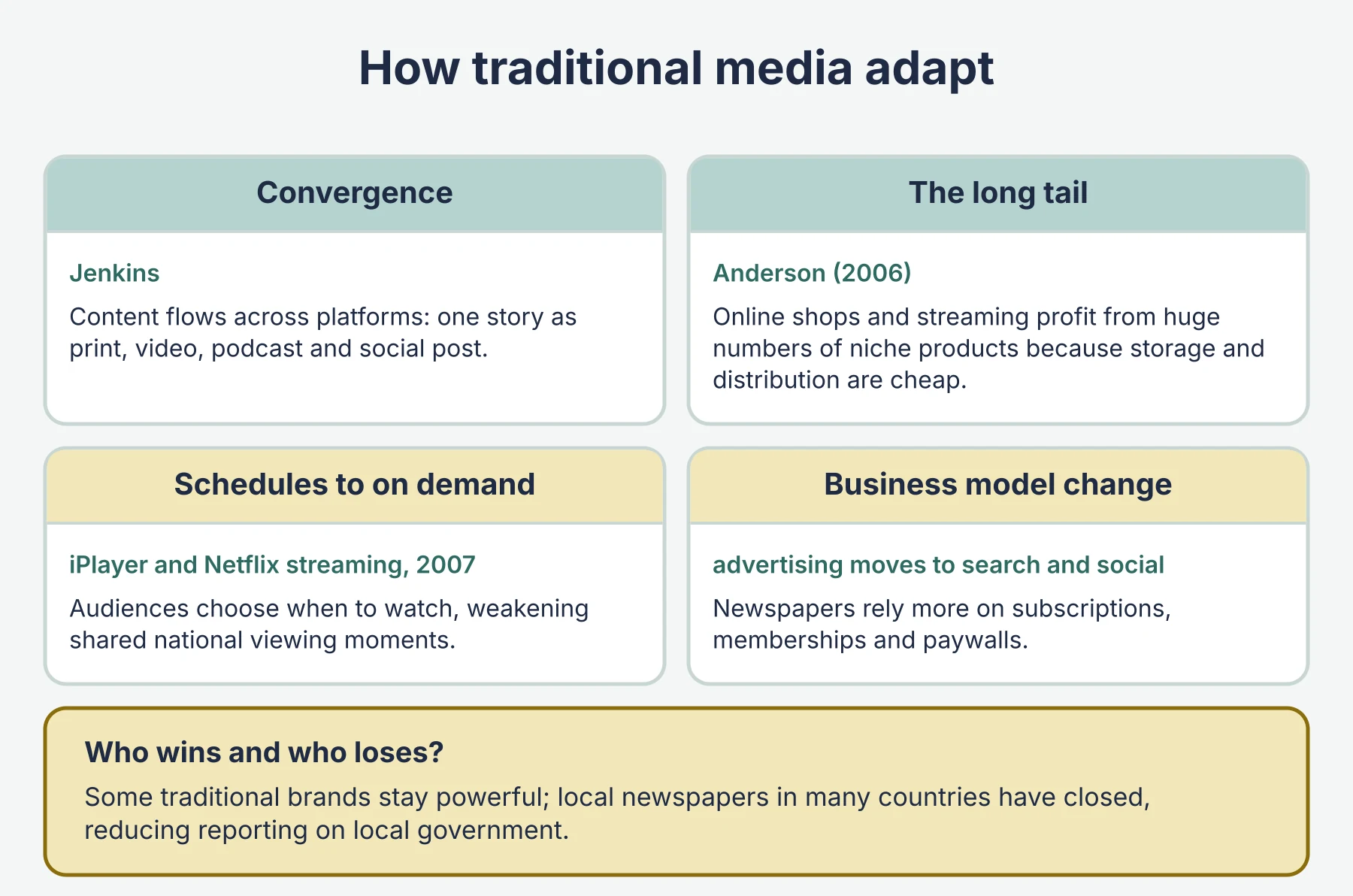
- Convergence (Jenkins): one story across many platforms.
- Anderson (2006): the long tail of niche products.
- On demand: BBC iPlayer and Netflix streaming both from 2007; weaker shared viewing.
- Advertising has moved to platforms; newspapers turn to subscriptions and paywalls; local papers close.
Health and fitness
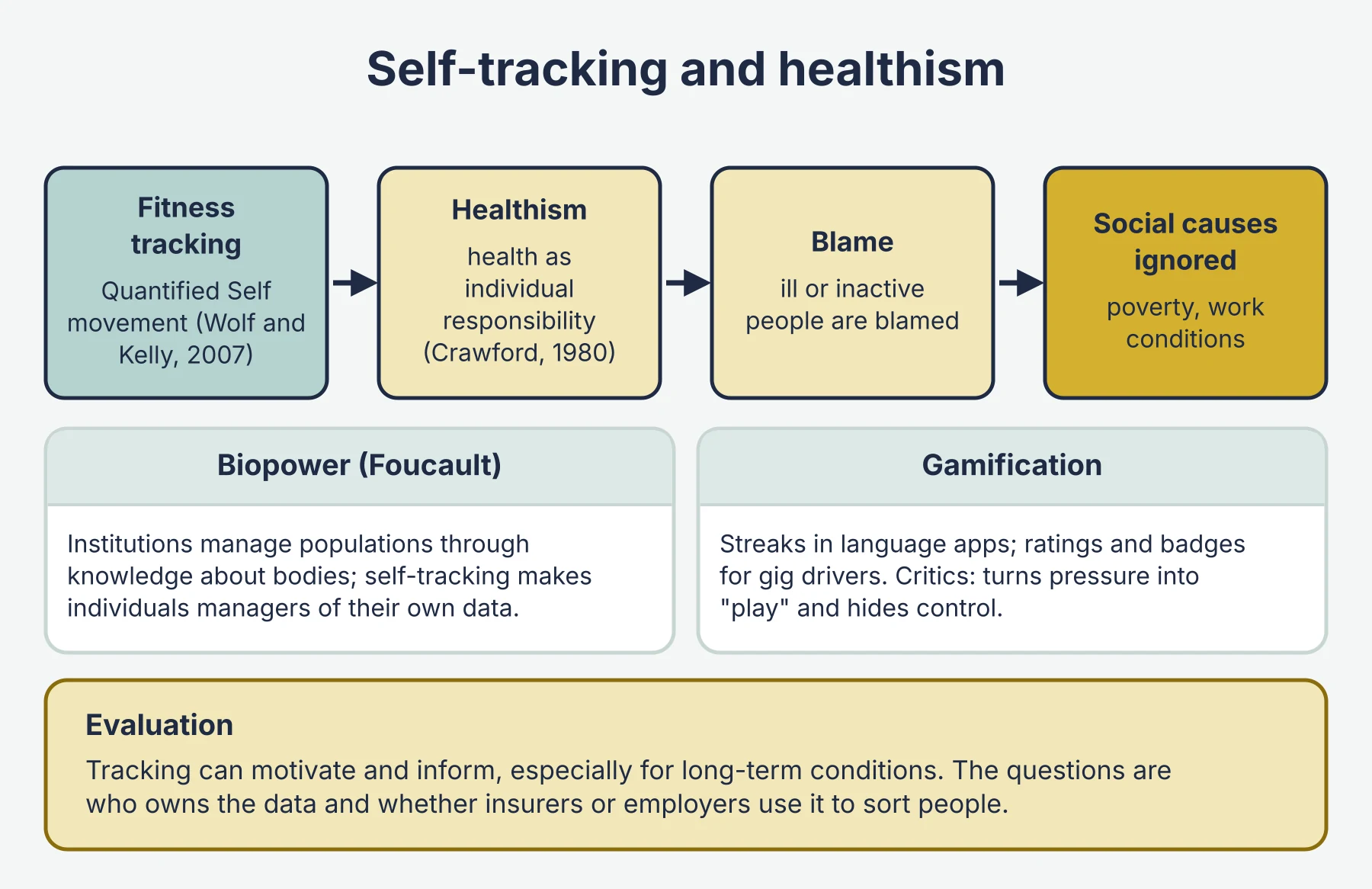
- Quantified Self movement (Wolf and Kelly, 2007); Lupton on self-tracking.
- Crawford (1980): healthism, health as individual responsibility.
- Foucault: biopower; self-tracking makes individuals managers of their own data.
- Gamification: streaks, badges, ratings for gig workers; critics say it disguises control.
- Questions: who owns the data; do insurers and employers use it to sort people?
Surveillance
- Panopticon (Foucault) and synopticon (Mathiesen).
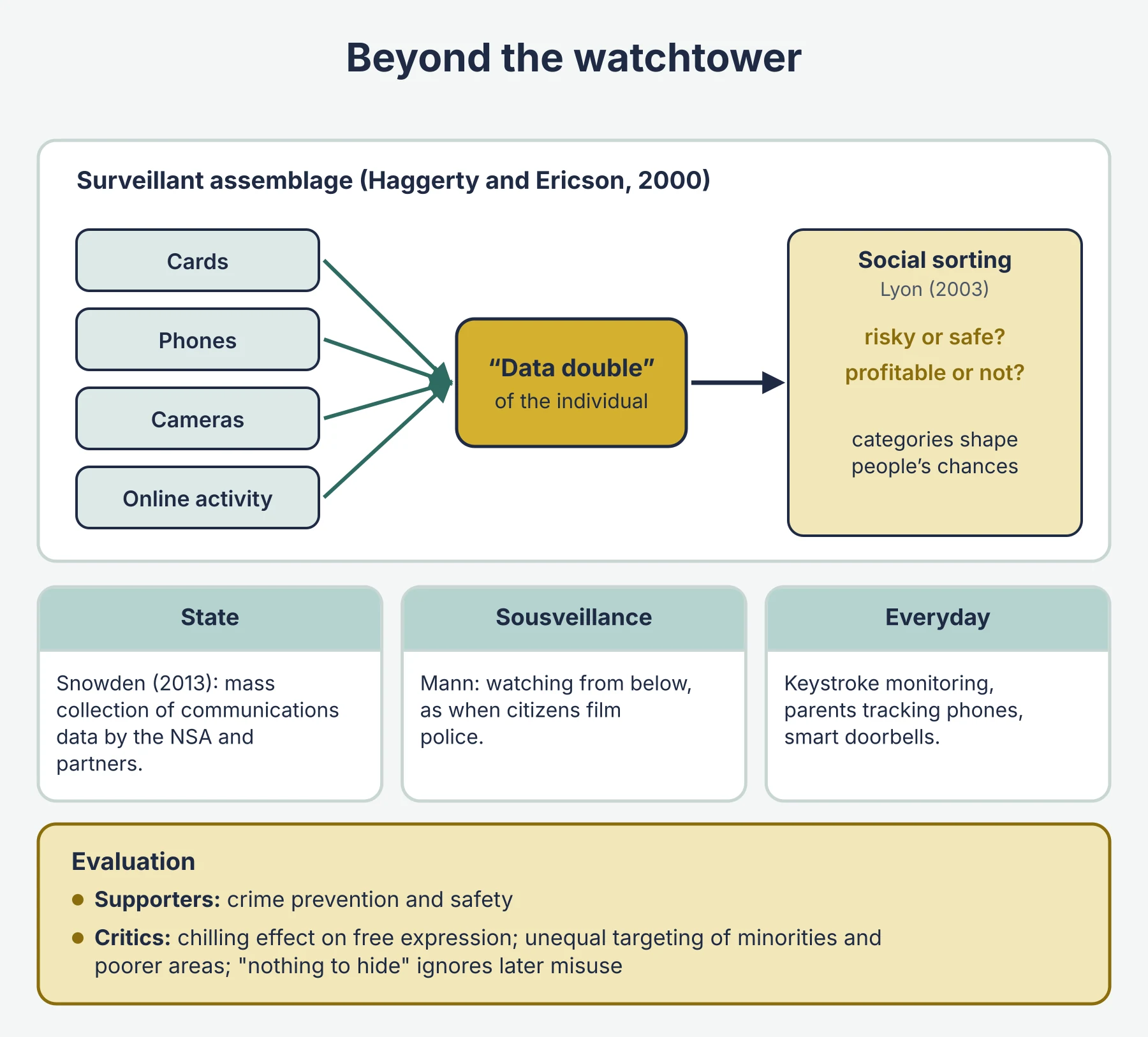
- Lyon (2003): social sorting into categories that shape life chances.
- Haggerty and Ericson (2000): surveillant assemblage combining data into “data doubles”.
- Snowden (2013): mass collection of communications data by the US National Security Agency.
- Mann: sousveillance, watching from below.
- Everyday: workplace monitoring, parental tracking, smart doorbells.
- For: crime prevention, safety. Against: chilling effect, unequal targeting, later misuse of data.
Cybercrime and security
- Wall: crimes against, using and in the content of computers.
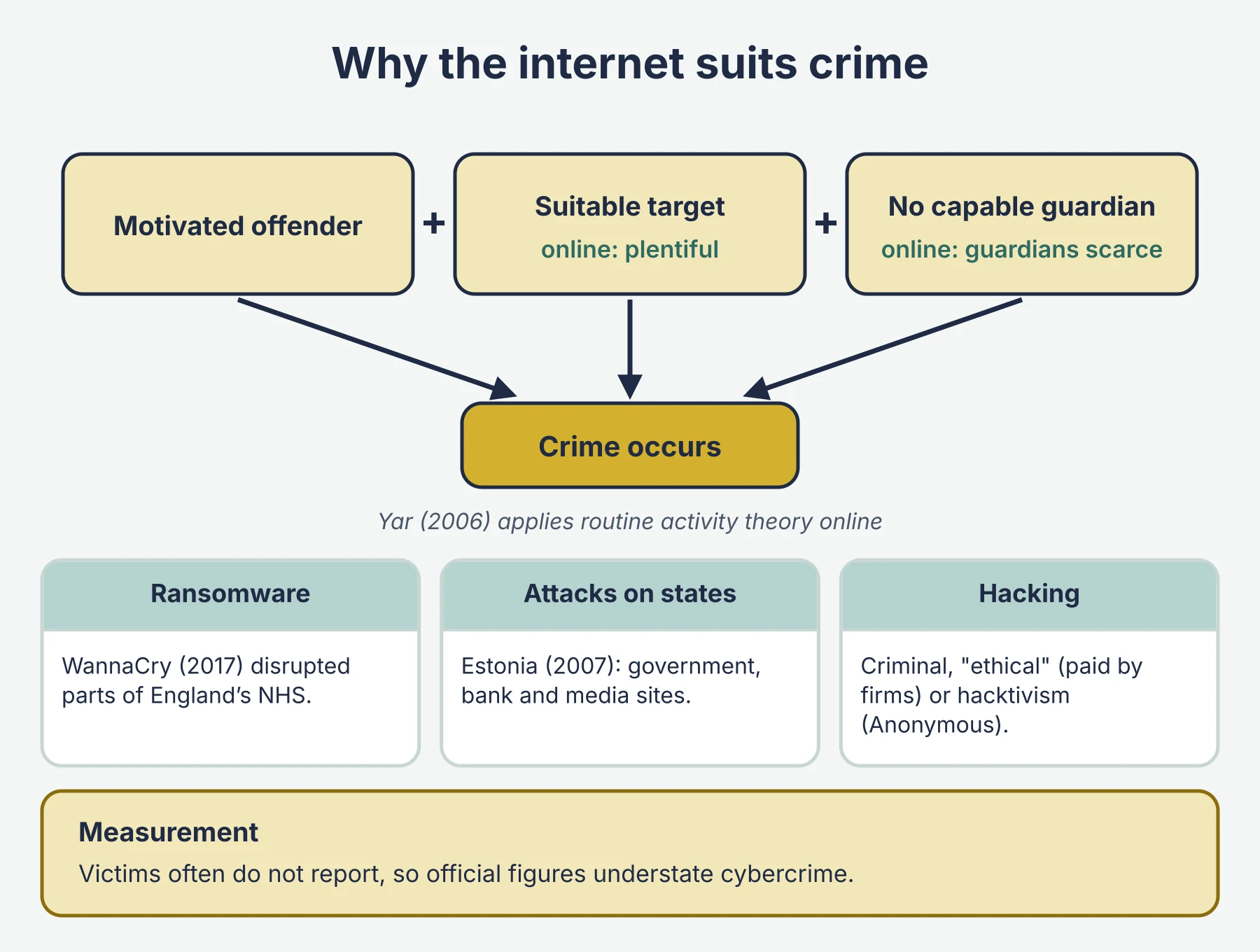
- Yar (2006): routine activity theory online, many targets, few guardians.
- WannaCry ransomware (2017) disrupted parts of England’s NHS.
- Estonia (2007): attacks on state, bank and media websites.
- Hacking: criminal, ethical, hacktivism (Anonymous).
- Security: passwords, encryption, two-factor authentication, laws, cooperation. Under-reporting distorts figures.
Digital divides
- Norris (2001): global, social and democratic divides.
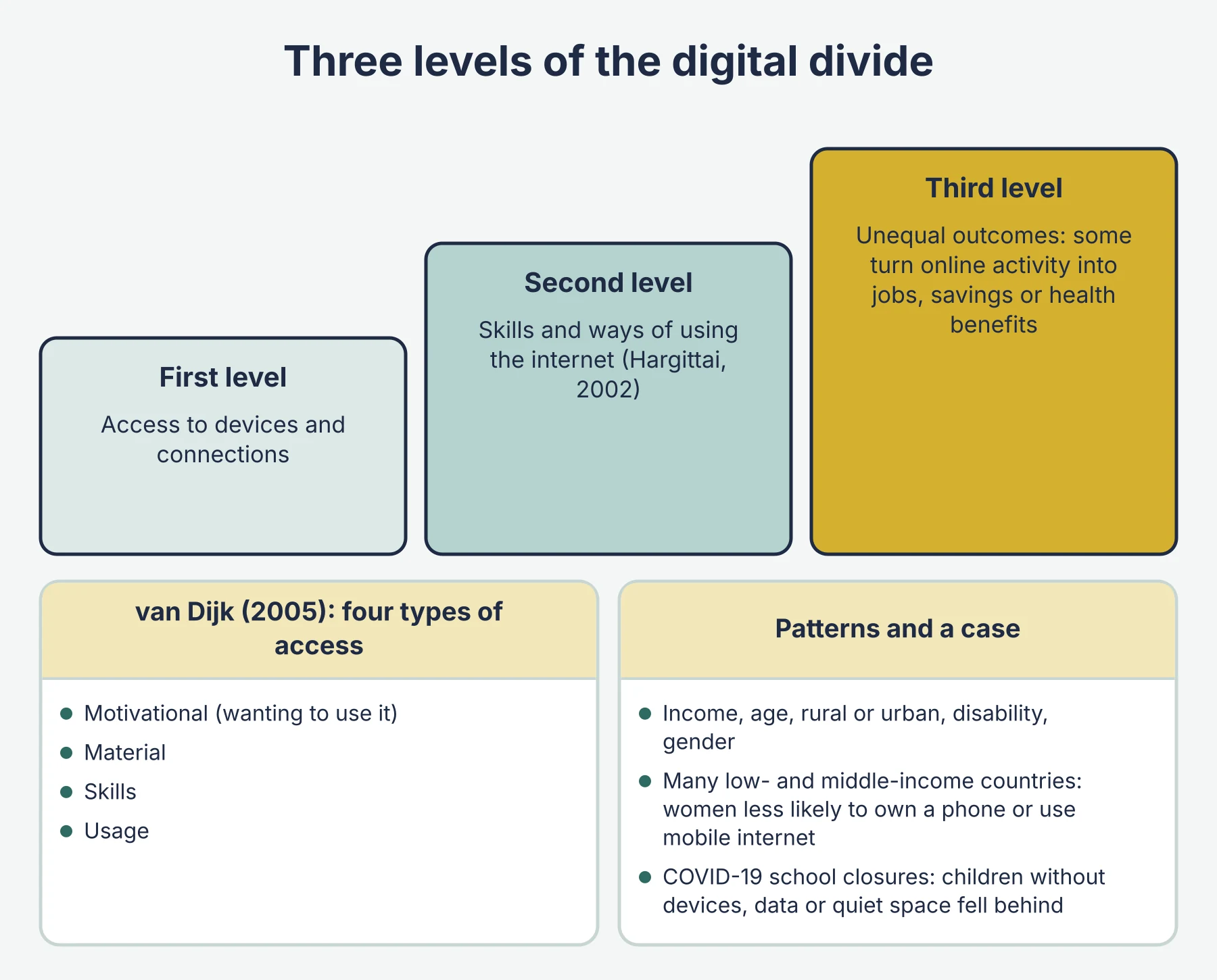
- First level (access), second level (skills and use; Hargittai, 2002), third level (outcomes).
- Van Dijk (2005): motivational, material, skills and usage access.
- Patterns: income, age, rural/urban, disability, gender (women less likely to own mobiles in many low- and middle-income countries).
- COVID-19 school closures exposed the divide.
Key terms
| Term | Definition |
|---|---|
| Magic circle | Separate space of play with its own rules (Huizinga) |
| Loot box | Paid random reward in a game |
| Convergence | Flow of content across multiple media platforms |
| Long tail | Profit from many niche products rather than a few hits |
| Quantified self | Tracking personal data about the body and behaviour |
| Healthism | Treating health as mainly individual responsibility |
| Gamification | Adding game features such as points and badges to non-game activities |
| Social sorting | Using surveillance data to classify people (Lyon) |
| Surveillant assemblage | Combining scattered data flows into profiles (Haggerty and Ericson) |
| Data double | The profile of a person built from their data |
| Sousveillance | Watching the powerful from below |
| Ransomware | Malware that locks data until payment is made |
| Hacktivism | Hacking for political causes |
| Second-level divide | Inequality in skills and ways of using the internet |
Linking points
- To social control: the panopticon, social sorting and the surveillant assemblage extend AS-level work on formal and informal social control.
- To crime: cybercrime and its under-reporting connect to AS-level problems of measuring crime with official statistics.
- To development: global digital divides are one of the persistent inequalities discussed under obstacles to progress in Unit 3.
Exam traps
- Games and moral panics: present fears as contested, not proven.
- Digital divides are about skills and outcomes as well as access.
- Hacking is one form of cybercrime; not all hacking is criminal.
- The panopticon is not the only model; social sorting and assemblage often fit digital data better.
- Healthism links tracking to blame; include social causes of ill health.
- Adaptation produces winners and losers; say who.
Self-test
- What did Huizinga mean by the magic circle?
- Why have loot boxes attracted regulators’ attention?
- What is the long tail?
- Give two ways traditional media have adapted to the digital age.
- What is healthism?
- What is social sorting?
- What is a data double?
- What is sousveillance?
- How does routine activity theory explain cybercrime?
- What happened in the WannaCry attack?
- What is the second-level digital divide?
- Name van Dijk’s four types of access.
Answers
- Play takes place in a separate space with its own rules, apart from ordinary life.
- They are paid random rewards that may resemble gambling.
- Online businesses can profit from huge numbers of niche products, not only hits.
- Any two: streaming and on-demand services; paywalls and subscriptions; podcasts; social media accounts; live blogs.
- Treating health as mainly an individual responsibility achieved through lifestyle.
- Using surveillance to classify people into categories that shape their chances.
- A profile of a person assembled from their scattered data.
- Watching from below, such as citizens filming police.
- Crime occurs when a motivated offender meets a suitable target without capable guardianship; online, targets are many and guardians few.
- Ransomware encrypted computers worldwide in 2017, disrupting parts of England’s NHS.
- Inequality in skills and ways of using the internet among people who have access.
- Motivational, material, skills and usage access.
Apply these in the digital technologies practice questions.
Related resources
-
Study guides
OxfordAQA International A-level Sociology (9690): The internet and social and new media
Guide to OxfordAQA 9690 section 3.2.3.3: the internet, changing communication, mental health, platform ownership, misinformation, creators and influencers.
Sociology · OxfordAQA · A Level
Read guide -
Practice questions
OxfordAQA International A-level Sociology (9690): The internet and social and new media – Practice Questions
Original OxfordAQA 9690 practice questions on online communication, mental health, platform ownership, misinformation and citizen journalism, with answers.
Sociology · OxfordAQA · A Level
Try questions -
Revision notes
OxfordAQA International A-level Sociology (9690): The internet and social and new media – Revision Notes
Revision notes for OxfordAQA 9690 section 3.2.3.3: network society, networked publics, mental health, platform power, filter bubbles and online audiences.
Sociology · OxfordAQA · A Level
Revise topic
Related articles
Get free revision emails (optional)
Occasional emails with practice questions, worked explanations and links to free resources for the qualification and subjects you choose. No spam, and you can unsubscribe from any email. The free tools on this site never need an email.