
Study Guides
OxfordAQA International A-level Sociology (9690): The internet and social and new media
Guide to OxfordAQA 9690 section 3.2.3.3: the internet, changing communication, mental health, platform ownership, misinformation, creators and influencers.
- Subject
- Sociology
- Level
- A LEVEL
- Topic
- Unit 5 – People and Technology
- Author
- Marlbridge Academic Team
- Updated
- Reviewed by
- Naqiya Yousaf (what this means)
Aligned to OxfordAQA A Level Sociology (9690), Version 1.1. Official specification .
Syllabus page (what it covers and how it is assessed): OxfordAQA A Level Sociology.
Syllabus points this page covers
9690 (A Level)
- 3.2.3.3 The internet and social and new media
Found an error? Report a correction.
Need help with this topic? Request a free trial class for A Level Sociology (9690).
This guide covers content point 3.2.3.3 The internet and social and new media of the OxfordAQA International A-level Sociology (9690) specification, Version 1.1, assessed in the Unit 5 People and technology exam. The specification lists: “The internet: fast global access to information”; “Social and new media: changes in communication; social media and mental health”; “Ownership and control of new and social media”; “Social media and misinformation and disinformation; conspiracy theories”; and “Relationships between social media and audiences: greater audience involvement including as content creators and citizen journalists; social media influencers”.
The People and technology study guide introduces Jenkins, Haidt, Orben and Przybylski, Uscinski and Parent, and defines creators, citizen journalists and influencers. This page adds the theories and research that let you analyse and evaluate each content point. Use it with the internet and social media revision notes and the internet and social media practice questions.
The internet: fast global access to information
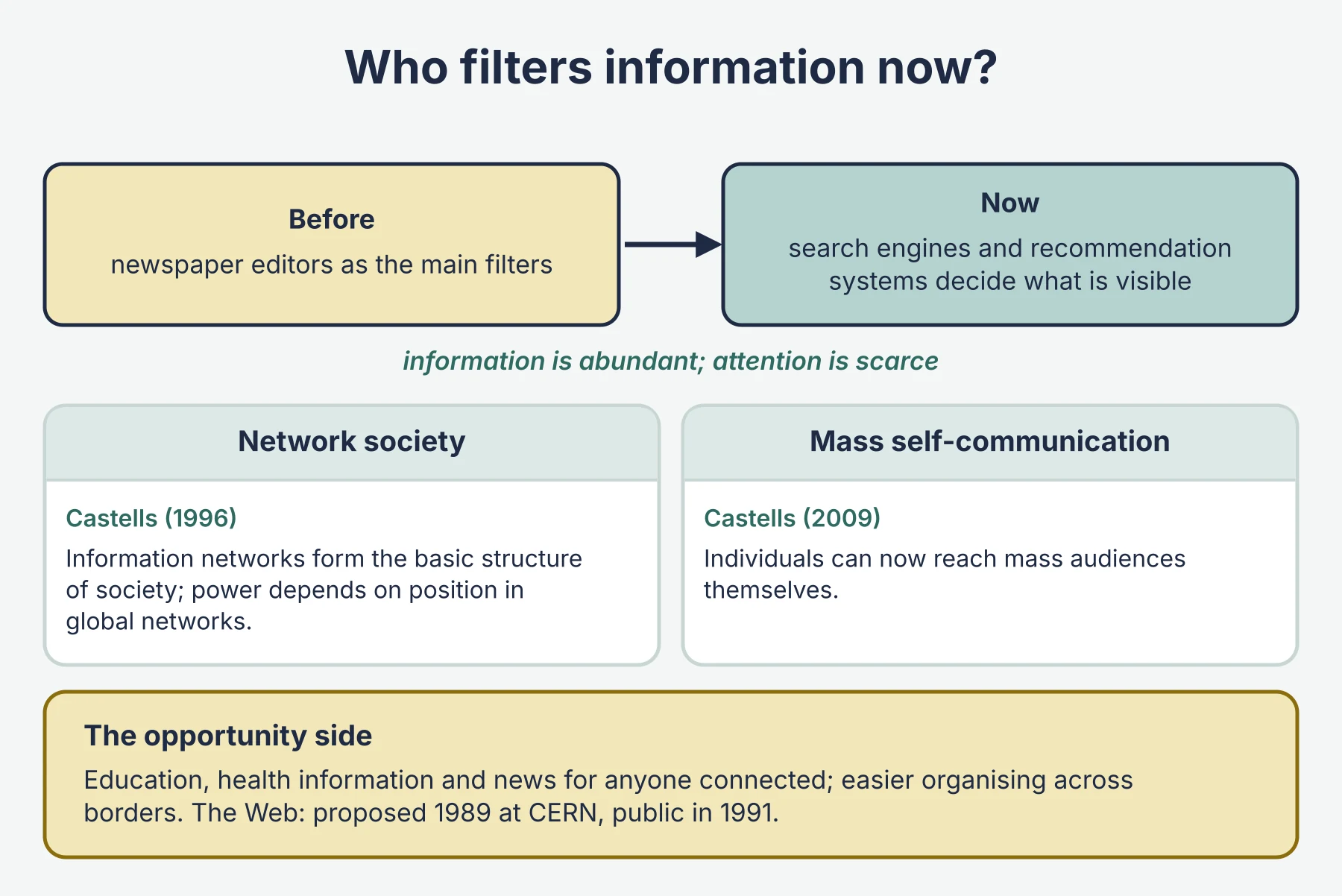
Tim Berners-Lee proposed the World Wide Web in 1989 while working at CERN, and it opened to the public in 1991. Manuel Castells (The Rise of the Network Society, 1996) argued that information networks now form the basic structure of society: economic, political and cultural power depends on position in global networks. In Communication Power (2009) he added mass self-communication: individuals can now reach mass audiences themselves.
Fast access has two sides:
- Opportunity: education, health information and news available to anyone connected; easier organising across borders.
- New gatekeepers: search engines and recommendation systems now decide what is visible, replacing newspaper editors as the main filters for many people. Information abundance also means attention, not information, is scarce.
Changes in communication
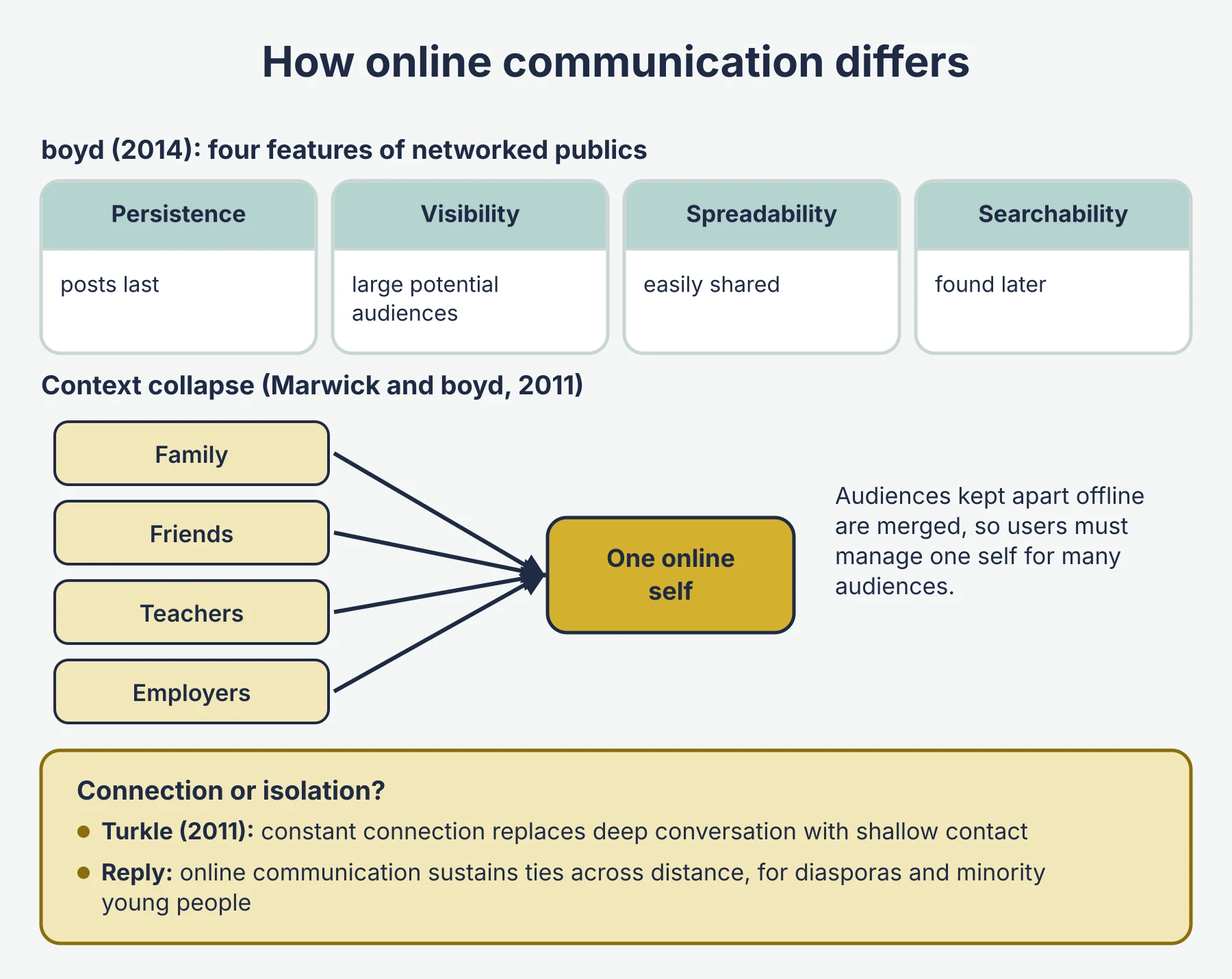
- Networked publics: danah boyd (It’s Complicated, 2014), studying American teenagers, identified four features of online communication: persistence (posts last), visibility (large potential audiences), spreadability (content is easily shared) and searchability (content can be found later).
- Context collapse: Alice Marwick and danah boyd (2011) described how social media merge audiences (family, friends, teachers, employers) who would be separated offline, so users must manage one self for many audiences.
- Connection or isolation? Sherry Turkle (Alone Together, 2011) argued that constant connection can replace deep conversation with shallow contact. Others reply that online communication sustains relationships across distance, especially for diasporas and for young people from minority groups who find support online.
Social media and mental health: evaluating the evidence
The unit guide contrasts Haidt with Orben and Przybylski. Add:
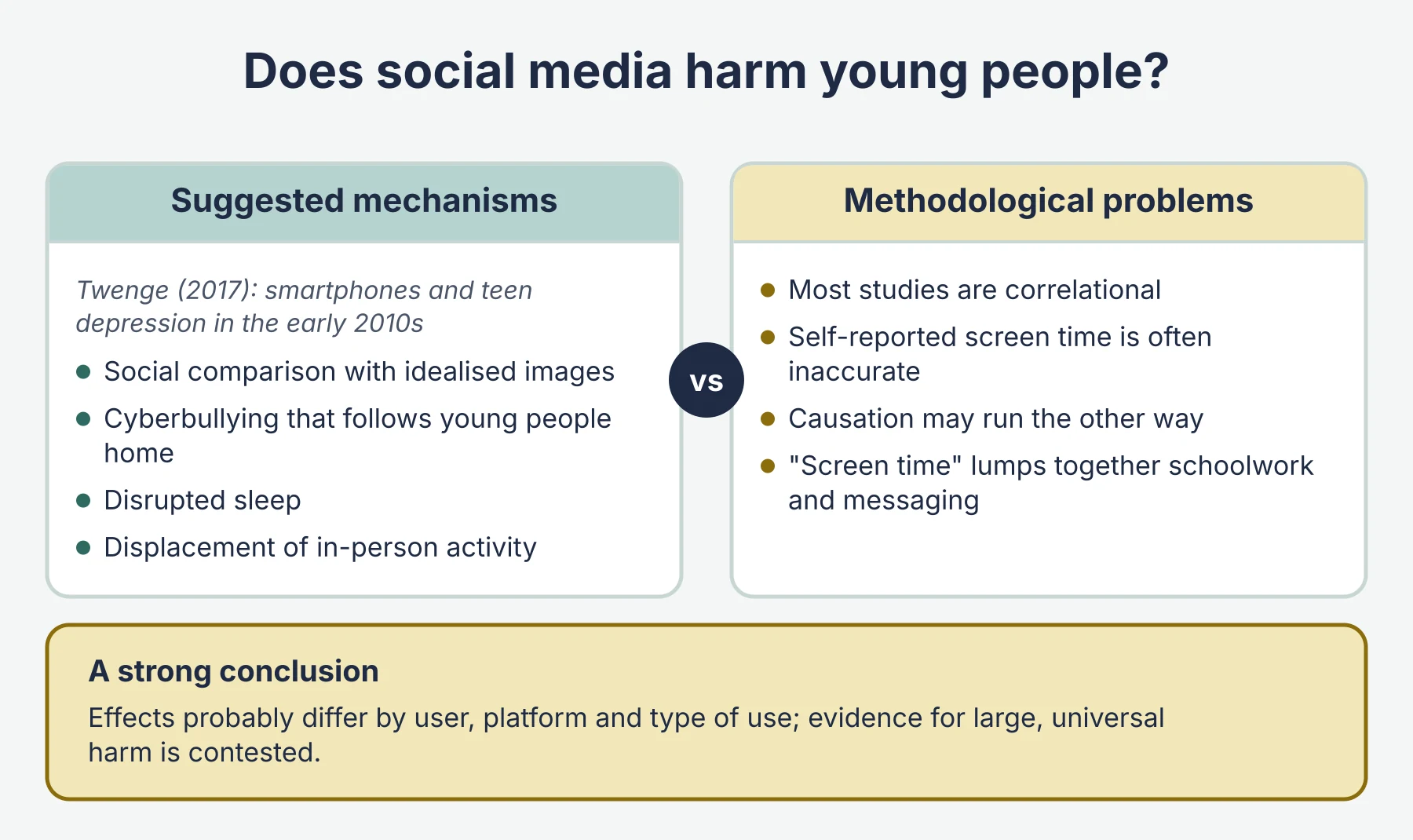
- Jean Twenge (iGen, 2017) linked rises in reported depression and loneliness among US teenagers in the early 2010s to the spread of smartphones.
- Mechanisms suggested: social comparison with idealised images; cyberbullying that follows young people home; disrupted sleep; displacement of in-person activity.
- Methodological issues: most studies are correlational; many rely on self-reported screen time, which is often inaccurate; causation may run the other way (unhappy young people may use social media more); “screen time” lumps together very different activities, from schoolwork to messaging friends.
A strong answer concludes that effects probably differ by user, platform and type of use, and that the evidence for large, universal harm is contested.
Ownership and control of new and social media
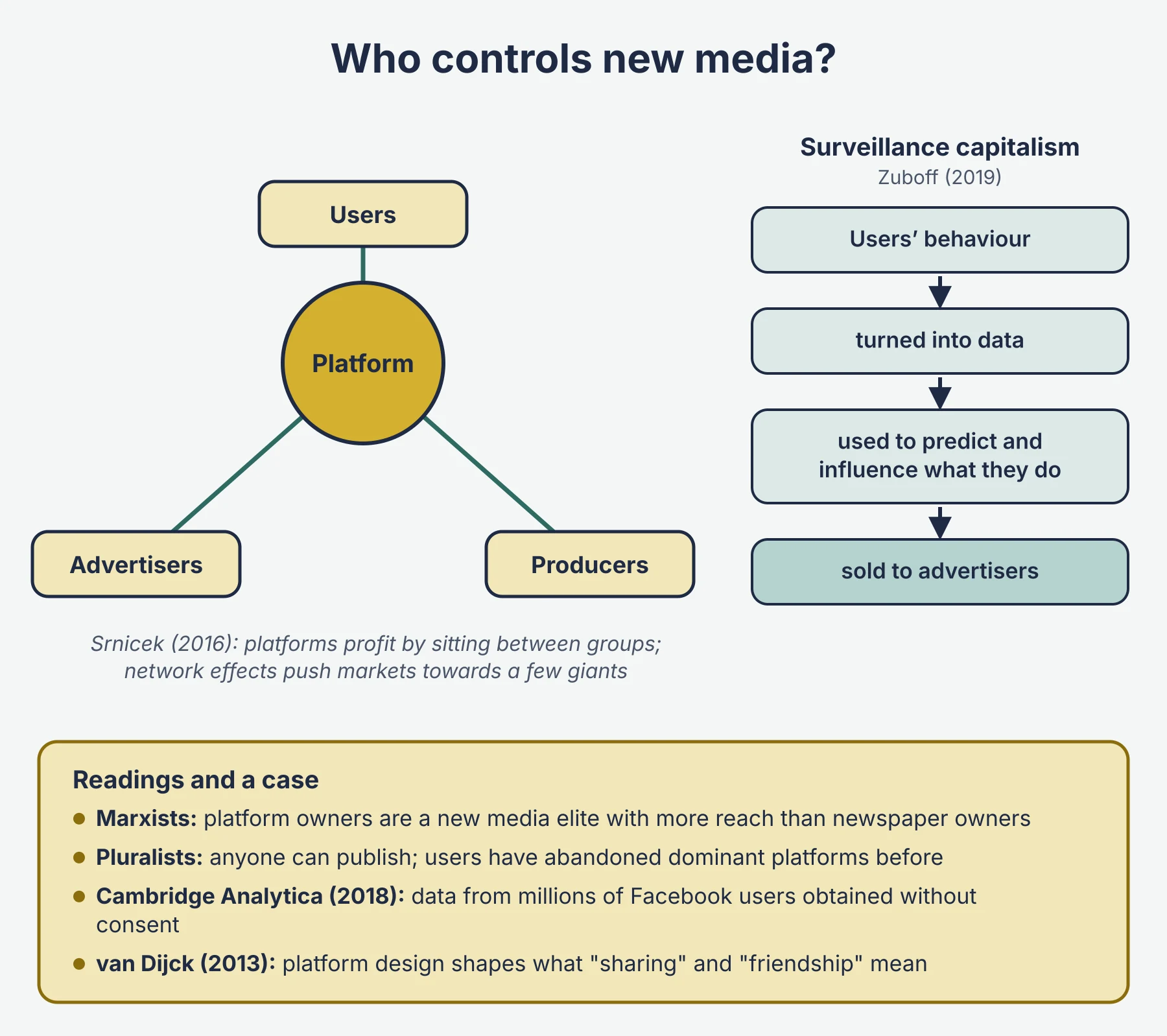
- Platform capitalism: Nick Srnicek (Platform Capitalism, 2016) argued that platforms profit by positioning themselves between users, advertisers and producers, and that network effects (a platform becomes more valuable as more people use it) push markets towards a few giants.
- Surveillance capitalism: Shoshana Zuboff (The Age of Surveillance Capitalism, 2019) argued that platforms turn users’ behaviour into data used to predict and influence what they will do, which is sold to advertisers.
- The culture of connectivity: José van Dijck (2013) showed how platforms’ technical design and business models shape what “sharing” and “friendship” mean online.
- A case: in 2018 it emerged that the political consultancy Cambridge Analytica had obtained personal data from millions of Facebook users without their consent, raising questions about who controls user data.
Marxist and pluralist readings. Marxists see platform owners as a new media elite with greater reach than newspaper owners. Pluralists point out that anyone can publish, and that users have abandoned once-dominant platforms before.
Misinformation, disinformation and conspiracy theories
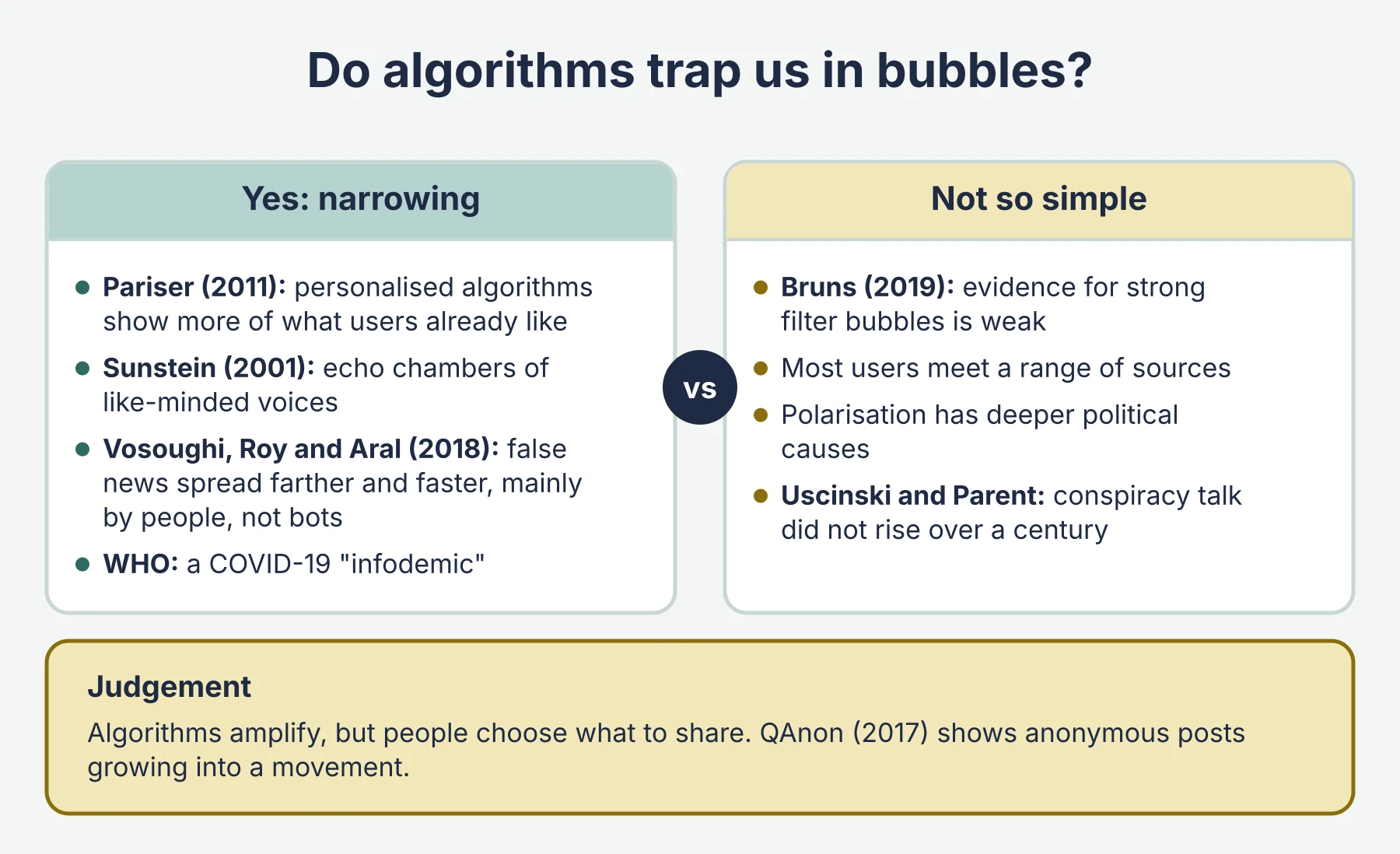
- Filter bubbles: Eli Pariser (The Filter Bubble, 2011) argued that personalised algorithms show users more of what they already like, narrowing their view. Echo chambers (Cass Sunstein, Republic.com, 2001) describe groups that only hear like-minded voices.
- Speed of falsehood: a large study by Soroush Vosoughi, Deb Roy and Sinan Aral (2018) of stories shared on Twitter found that false news spread farther and faster than true news, and that people, not automated bots, were mainly responsible.
- Infodemic: the World Health Organization used this term during the COVID-19 pandemic for an overabundance of information, including false information, that makes it hard to find reliable guidance.
- Conspiracy theories: QAnon, which emerged online in 2017, shows how anonymous posts can grow into a movement. Uscinski and Parent’s finding that conspiracy talk did not rise over a century cautions against assuming the internet created conspiracism.
Evaluation. Axel Bruns (Are Filter Bubbles Real?, 2019) argued that evidence for strong filter bubbles is weak: most users encounter a range of sources, and polarisation has deeper political causes. Algorithms amplify, but people choose what to share.
Audience involvement: creators, citizen journalists, influencers
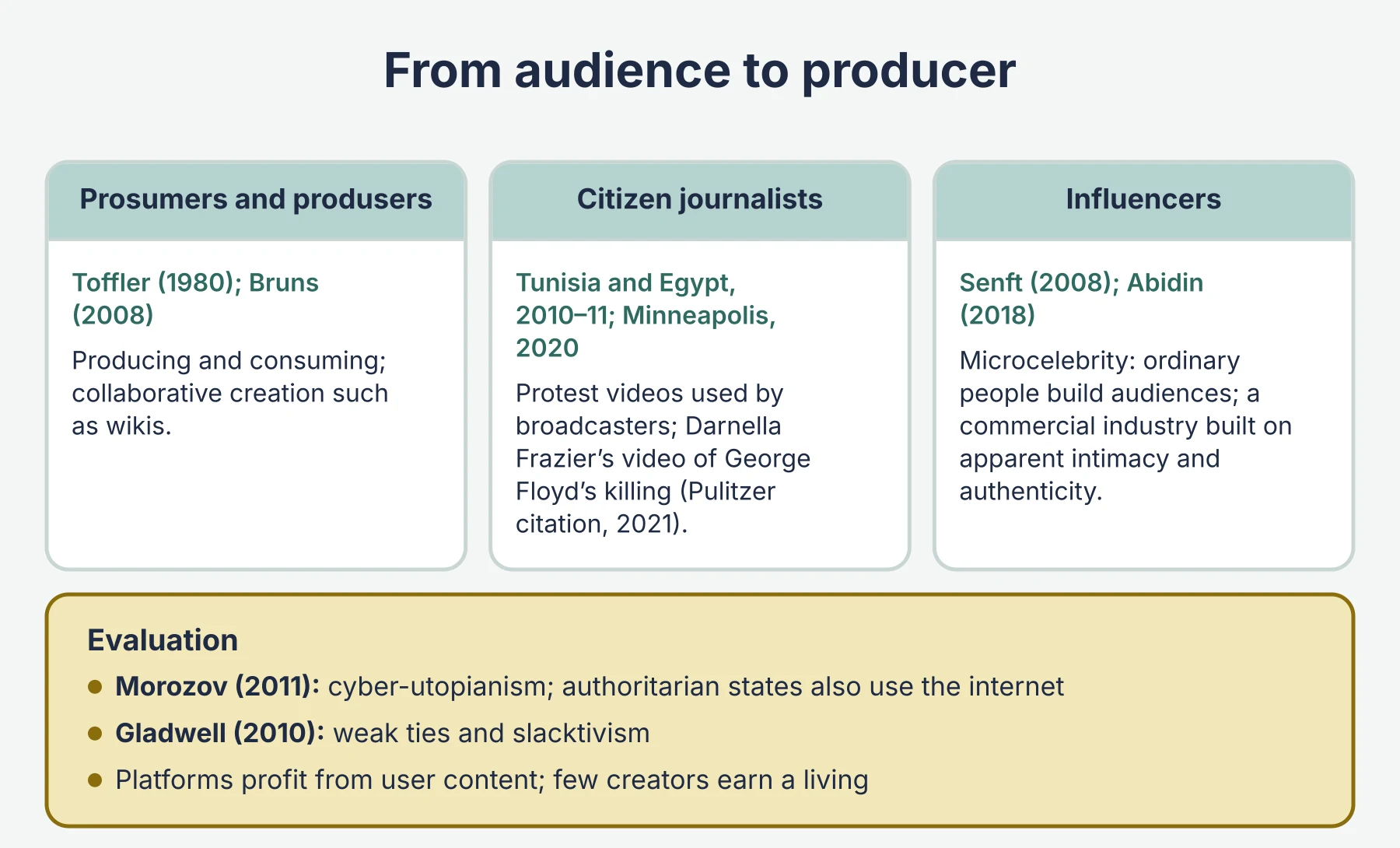
- Prosumers and produsers: Alvin Toffler (The Third Wave, 1980) predicted the “prosumer”, who both produces and consumes. Axel Bruns (2008) used produsage for collaborative creation such as wikis.
- Citizen journalism: during the uprisings in Tunisia and Egypt in 2010 and 2011, protesters shared videos and updates that international broadcasters then used. In 2020 a teenager’s phone video of the killing of George Floyd in Minneapolis was central to public awareness; Darnella Frazier received a special Pulitzer citation in 2021.
- Influencers and microcelebrity: Theresa Senft (Camgirls, 2008) coined microcelebrity for ordinary people building audiences online. Crystal Abidin (Internet Celebrity, 2018) analysed influencers as a commercial industry built on the appearance of intimacy and authenticity.
Evaluation.
- Evgeny Morozov (The Net Delusion, 2011) criticised cyber-utopianism, the belief that the internet naturally empowers citizens; authoritarian states also use it for surveillance and propaganda.
- Malcolm Gladwell (“Small Change”, 2010) argued that online activism relies on weak ties and often amounts to slacktivism: low-cost support, such as liking a post, that brings little change.
- Platforms profit from user content, and only a small share of creators earn a living, so “audience power” is unevenly spread.
Annotated model answer
Extract from a 12-mark answer: Evaluate the view that social media spread misinformation more than ‘traditional’ media.
Vosoughi, Roy and Aral found that false news spread farther and faster than true news on Twitter [knowledge]. During the pandemic, false health claims circulated widely on messaging apps in my society [application]. Algorithms reward engagement, and Pariser argues personalisation narrows what users see [analysis]. However, Bruns finds filter bubbles weaker than claimed, and traditional media have spread propaganda too, so the difference is speed and scale rather than a new problem [evaluation and judgement].
Common mistakes
- Stating that social media cause mental illness as fact.
- Treating filter bubbles as proven.
- Calling every creator an influencer or citizen journalist.
- Forgetting that platforms profit from user-generated content.
- Writing about “the internet” as one thing; distinguish platforms, uses and users.
Exam technique
For explain questions, give a feature of social media and its consequence (spreadability means false stories travel before corrections). For evaluate answers, contrast optimistic (participatory culture, citizen journalism) and critical (platform capitalism, Morozov) views, and use own-society examples of platforms, campaigns or influencers where asked.
Where next
Surveillance, games and digital divides are covered in digital technologies; algorithms in artificial intelligence and cyborgs.
Related resources
-
Practice questions
OxfordAQA International A-level Sociology (9690): The internet and social and new media – Practice Questions
Original OxfordAQA 9690 practice questions on online communication, mental health, platform ownership, misinformation and citizen journalism, with answers.
Sociology · OxfordAQA · A Level
Try questions -
Revision notes
OxfordAQA International A-level Sociology (9690): The internet and social and new media – Revision Notes
Revision notes for OxfordAQA 9690 section 3.2.3.3: network society, networked publics, mental health, platform power, filter bubbles and online audiences.
Sociology · OxfordAQA · A Level
Revise topic -
Study guides
OxfordAQA International A-level Sociology (9690): Pre-and non-digital technologies
Guide to OxfordAQA 9690 section 3.2.3.1: machines and work, mobilities and mass transport, consumerism, and technological determinism versus constructionism.
Sociology · OxfordAQA · A Level
Read guide
Related articles
Get free revision emails (optional)
Occasional emails with practice questions, worked explanations and links to free resources for the qualification and subjects you choose. No spam, and you can unsubscribe from any email. The free tools on this site never need an email.