
Study Guides
OxfordAQA International A-level Sociology (9690): Pre-and non-digital technologies
Guide to OxfordAQA 9690 section 3.2.3.1: machines and work, mobilities and mass transport, consumerism, and technological determinism versus constructionism.
- Subject
- Sociology
- Level
- A LEVEL
- Topic
- Unit 5 – People and Technology
- Author
- Marlbridge Academic Team
- Updated
- Reviewed by
- Naqiya Yousaf (what this means)
Aligned to OxfordAQA A Level Sociology (9690), Version 1.1. Official specification .
Syllabus page (what it covers and how it is assessed): OxfordAQA A Level Sociology.
Syllabus points this page covers
9690 (A Level)
- 3.2.3.1 Pre-and non-digital technologies
Found an error? Report a correction.
Need help with this topic? Request a free trial class for A Level Sociology (9690).
This guide covers content point 3.2.3.1 Pre-and non-digital technologies of the OxfordAQA International A-level Sociology (9690) specification, Version 1.1, assessed in the Unit 5 People and technology exam. The specification lists: “Machines: industrialisation and the changing nature of work, including extraction, manufacturing, and service industries”; “Mobilities and mass transport: cars and roads; railways; air travel; effects on people and on the environment”; “Consumerism and conspicuous consumption of material goods”; and “Technological determinism; social constructionist views of technology”.
The People and technology study guide introduces Bell, Braverman, Blauner, Urry’s automobility, Veblen, Marx’s hand-mill, Pinch and Bijker’s bicycle and Latour. This page adds the history of work organisation, more on mobility and consumption, and further cases for the determinism debate. Use it with the pre- and non-digital technologies revision notes and the pre- and non-digital technologies practice questions.
Machines and the changing nature of work
From craft to factory
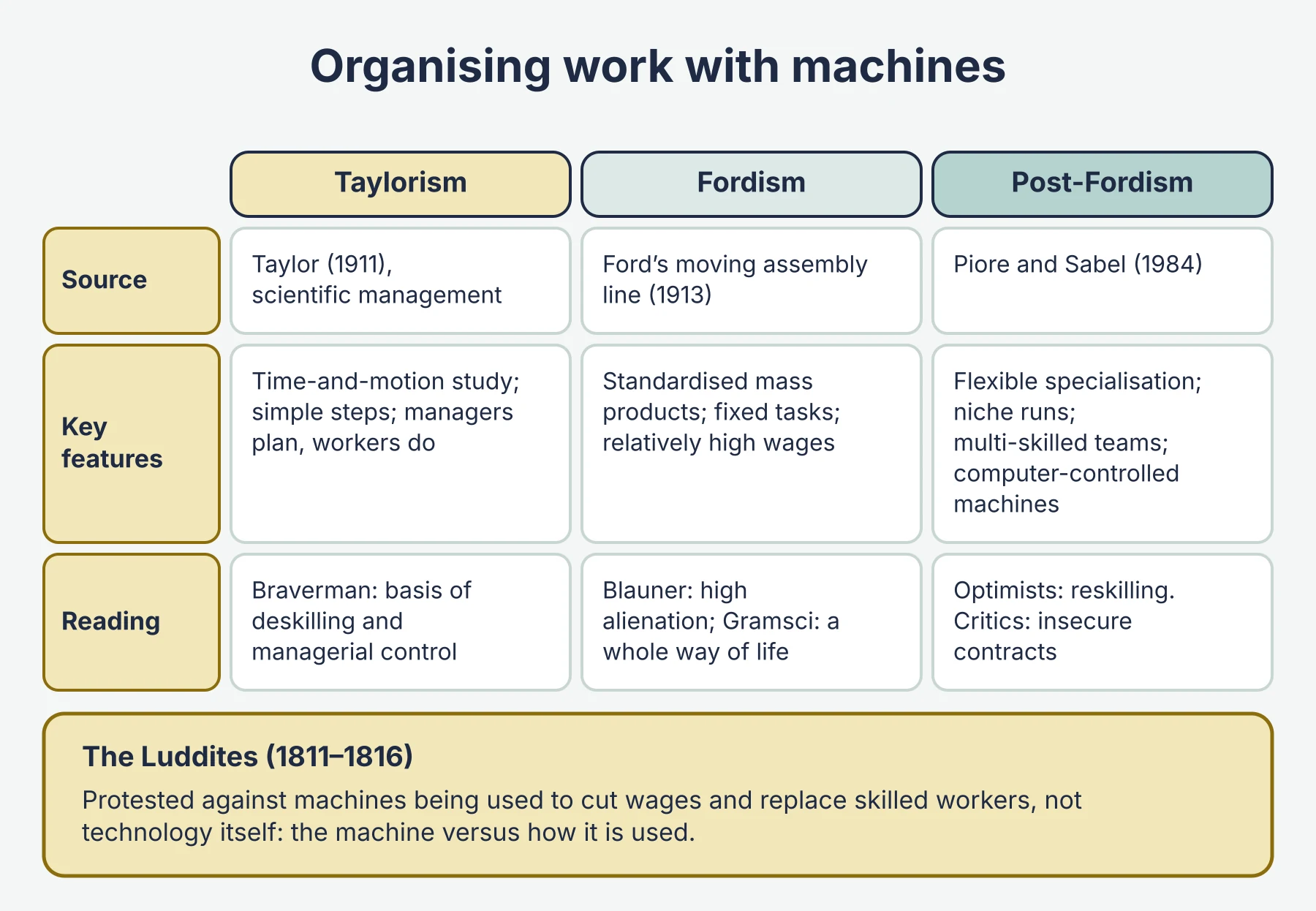
Before industrialisation, much production was done by skilled craft workers who controlled the pace and method of their work. Machines changed that control. The Luddites (1811 to 1816), textile workers in northern England who broke machines, are often remembered as opposing technology itself; historians stress they were protesting against the use of machines to cut wages and replace skilled workers. That distinction, between a machine and how it is used, runs through the whole topic.
Taylorism, Fordism and after
| System | Key features | Sociological reading |
|---|---|---|
| Taylorism (F. W. Taylor, The Principles of Scientific Management, 1911) | Time-and-motion study; break tasks into simple steps; separate planning (managers) from doing (workers) | Braverman: the basis of deskilling and managerial control |
| Fordism (Henry Ford’s moving assembly line, 1913) | Standardised products made in huge numbers; fixed tasks; relatively high wages so workers could buy the goods | Blauner: high alienation on the line; Gramsci later used “Fordism” for a whole way of life |
| Post-Fordism (Michael Piore and Charles Sabel, The Second Industrial Divide, 1984) | Flexible specialisation; smaller runs for niche markets; multi-skilled teams; computer-controlled machines | Optimists: reskilling and autonomy. Critics: flexibility often means insecure contracts |
Extraction, manufacturing and services
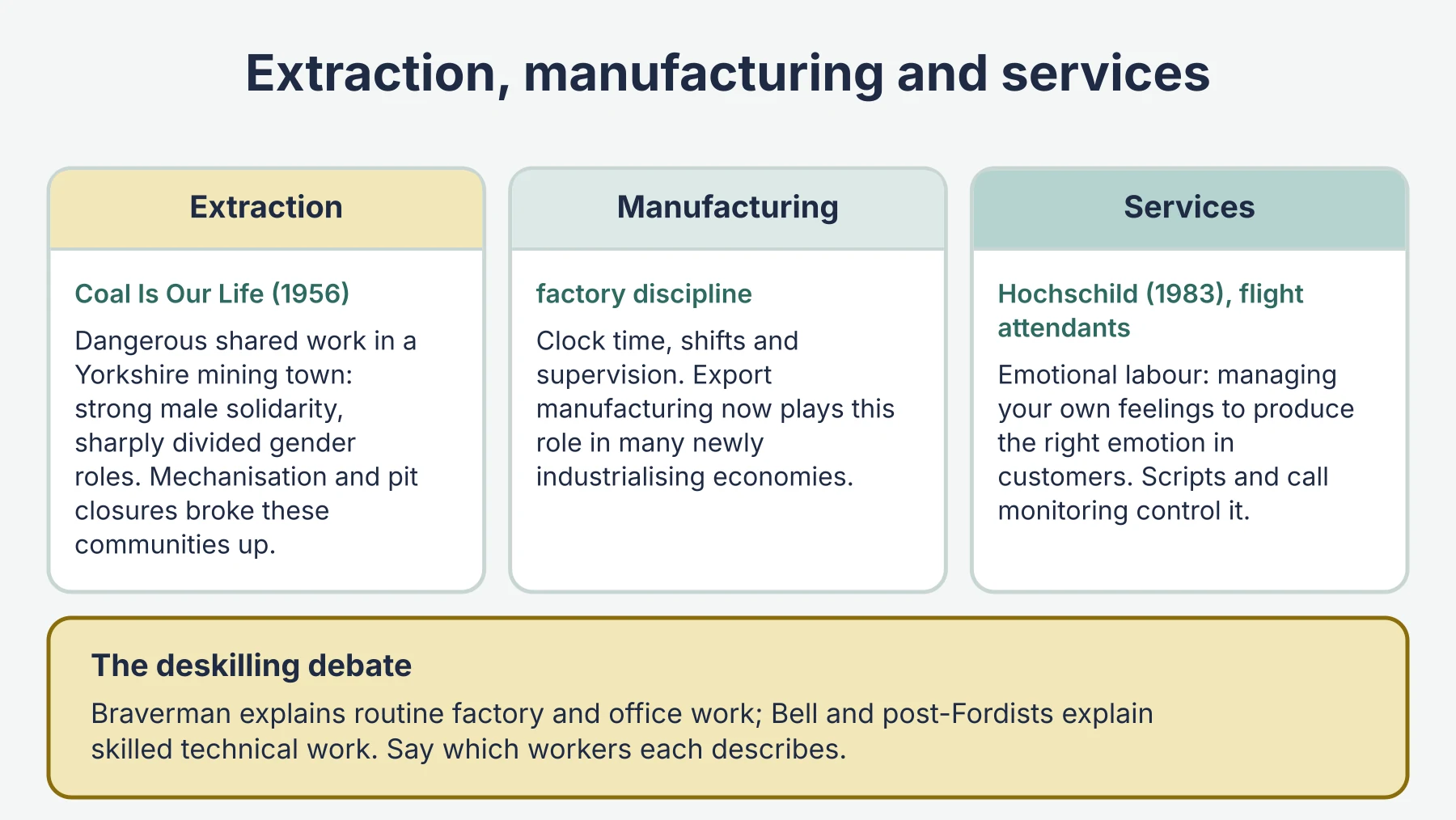
- Extraction (mining, oil, quarrying) created tightly knit occupational communities. Norman Dennis, Fernando Henriques and Clifford Slaughter’s Coal Is Our Life (1956) described a Yorkshire mining town where dangerous shared work produced strong male solidarity and sharply divided gender roles. Mechanisation and pit closures later broke up such communities.
- Manufacturing brought factory discipline: clock time, shifts and supervision. In many newly industrialising economies, manufacturing for export now plays the role it once played in Europe.
- Service industries now employ most workers in richer economies. Arlie Hochschild (The Managed Heart, 1983), studying flight attendants, showed that service work demands emotional labour: managing one’s own feelings to produce the right emotion in customers. Technology in services (scripts, call monitoring, checkouts) can control emotional as well as physical work.
Evaluation. The deskilling debate is not settled. Braverman explains routine factory and office work well; Bell and post-Fordist writers explain the growth of skilled technical work. A strong answer says which kinds of workers each describes.
Mobilities and mass transport
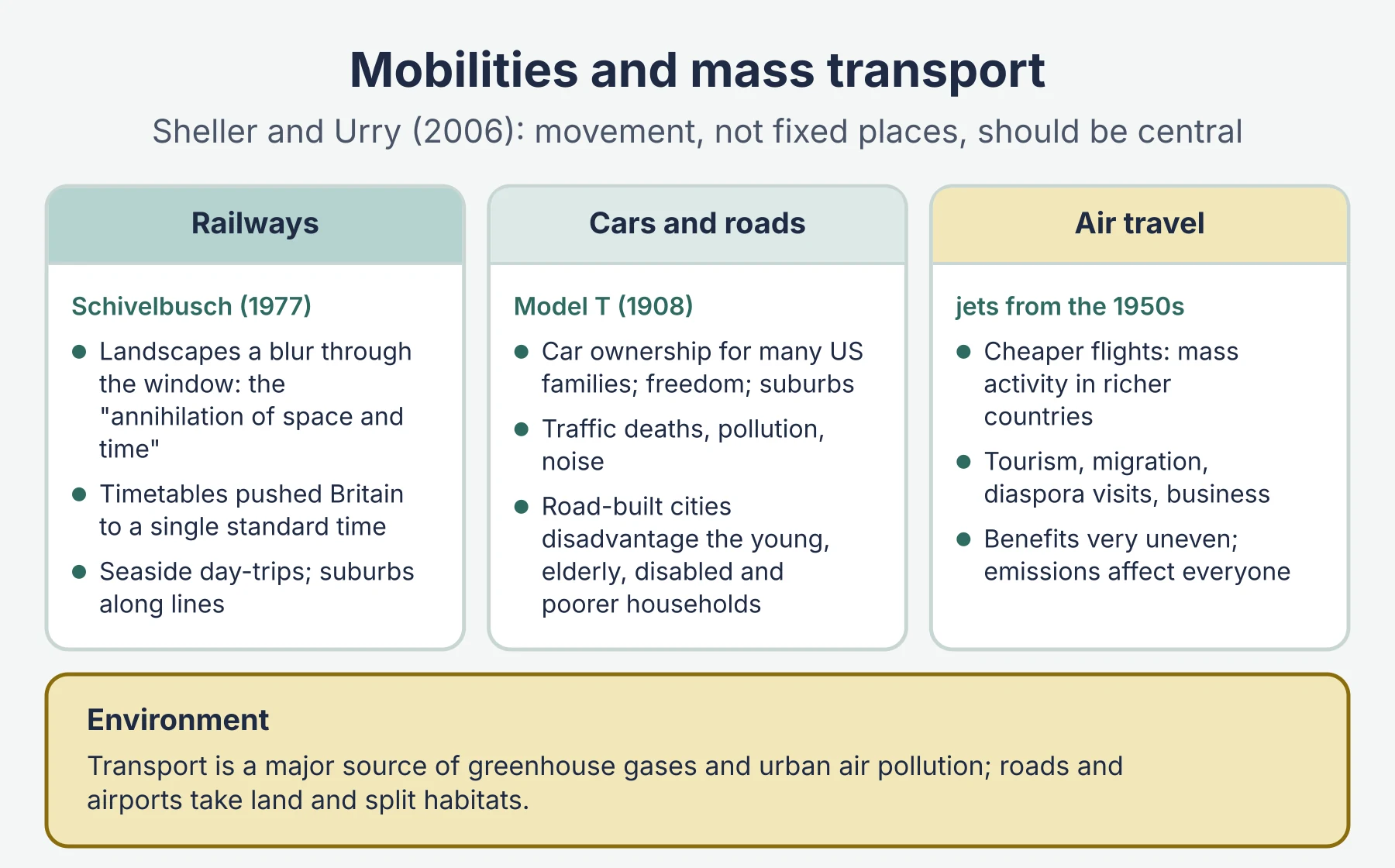
Mimi Sheller and John Urry (“The New Mobilities Paradigm”, 2006) argued that movement, not fixed places, should be central to sociology, because social life depends on the movement of people, objects and information.
Railways. Wolfgang Schivelbusch (The Railway Journey, 1977) argued that rail travel changed perception: passengers experienced landscapes as a blur seen through a window, and contemporaries spoke of the “annihilation of space and time”. Railways also required timetables, which pushed Britain towards a single standard time. Railways opened seaside holidays to working-class day-trippers and allowed suburbs to grow along lines.
Cars and roads. Ford’s Model T (1908) made car ownership possible for many families in the United States. Cars brought personal freedom and new suburbs, but also traffic deaths, air pollution, noise, and cities designed around roads, which disadvantage people without cars: often the young, the elderly, the disabled and poorer households.
Air travel. Jet airliners from the 1950s made long-distance travel faster; cheaper flights later turned air travel into a mass activity in richer countries. Its benefits (tourism, migration, family visits across diasporas, business) are spread very unevenly, while its emissions affect everyone.
Effects on the environment. Transport is a major source of greenhouse gases and urban air pollution, and roads and airports take land and split habitats. This links to Unit 4’s content on mass transport and commuting.
Consumerism and conspicuous consumption
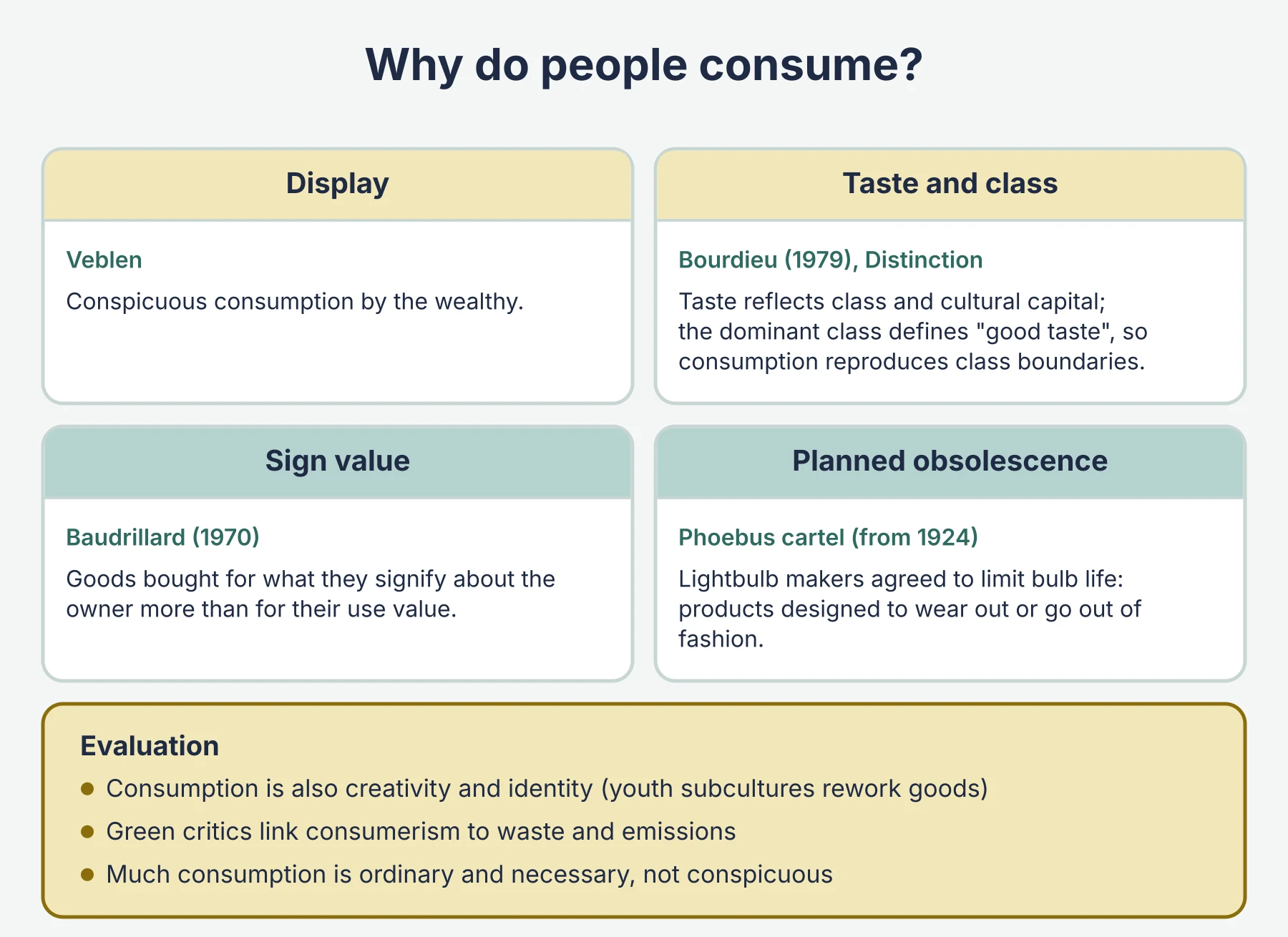
- Veblen (in the unit guide) explains display by the wealthy.
- Pierre Bourdieu (Distinction, 1979) argued that taste in food, music, furniture and clothing reflects class position and cultural capital: the dominant class defines “good taste”, so consumption reproduces class boundaries even when goods are affordable to many.
- Jean Baudrillard (The Consumer Society, 1970) argued that people buy goods for their sign value, what they signify about the owner, more than for their use value.
- Planned obsolescence: products designed to wear out or go out of fashion. The Phoebus cartel of lightbulb manufacturers (from 1924) agreed to limit bulb life, a well-documented early case.
Evaluation. Consumption is also a source of creativity and identity, for example in youth subcultures that rework mass-produced goods. Green critics link consumerism to waste and emissions; others note that much consumption is ordinary and necessary rather than conspicuous.
Technological determinism versus social construction: further cases
Determinist cases.
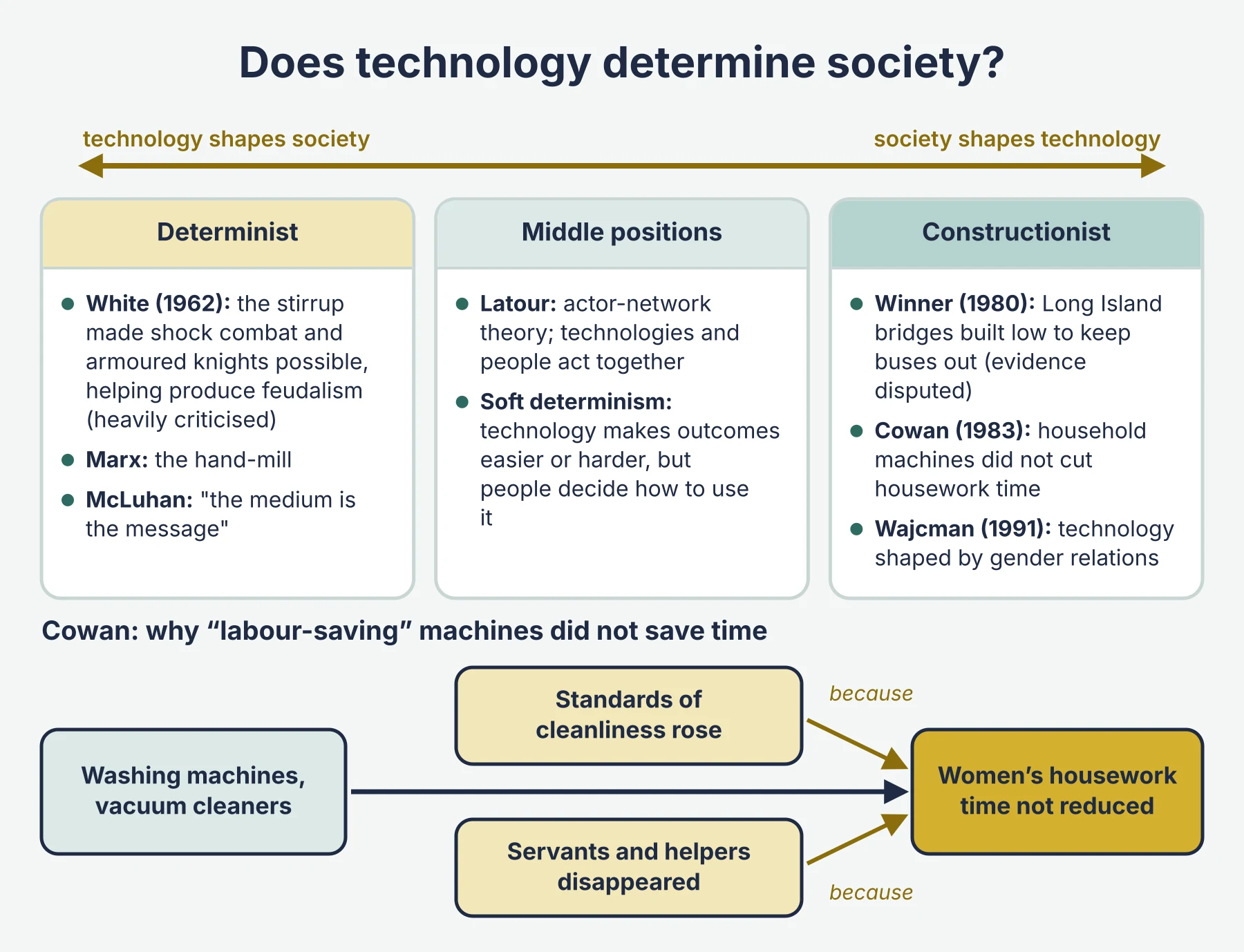
- Lynn White Jr (Medieval Technology and Social Change, 1962) argued that the stirrup made mounted shock combat possible, which required expensive armoured knights and so helped produce feudalism. Historians have heavily criticised the argument, but it is a classic example of determinist reasoning.
- Marx’s hand-mill quotation and McLuhan’s “the medium is the message” are in the unit guide.
Constructionist and critical cases.
- Langdon Winner (“Do Artifacts Have Politics?”, 1980) claimed that low bridges over parkways on Long Island, New York, were built so that buses, used mainly by poorer and Black residents, could not reach the beaches. Later researchers disputed the evidence, but Winner’s wider point stands: designs can build social choices into objects.
- Ruth Schwartz Cowan (More Work for Mother, 1983) showed that household technologies such as washing machines and vacuum cleaners did not reduce the time women spent on housework, because standards of cleanliness rose and servants and other helpers disappeared from many homes.
- Judy Wajcman (Feminism Confronts Technology, 1991) argued that technology is shaped by gender relations: men have dominated design and engineering, so technologies often reflect men’s interests.
A middle position. Latour’s actor-network theory (in the unit guide) treats technologies and people as acting together. Another middle route is soft determinism: technologies make some outcomes easier and others harder, but people decide how to use them.
Annotated model answer
Extract from a 12-mark answer: Evaluate the view that technology determines the nature of work.
Braverman argued that machines and scientific management deskill workers and give managers control [knowledge]. Assembly-line work in garment factories in my society, where each worker sews the same seam all day, supports this [application]. But Blauner found alienation varied with the type of technology, and Hochschild shows service work is controlled through emotional rules, not machines [analysis]. So the same technology can be used to deskill or reskill depending on management choices and workers’ bargaining power, which supports a constructionist rather than determinist view [evaluation and judgement].
Common mistakes
- Treating the Luddites as simply anti-technology.
- Using “Fordism” as a synonym for “factory work”; it is a specific system of mass production and mass consumption.
- Discussing mobilities only as travel; include effects on people and environment.
- Confusing Veblen’s conspicuous consumption with Baudrillard’s sign value; Veblen stresses display of wealth, Baudrillard stresses meaning.
- Presenting White or Winner without noting the criticisms of their evidence.
Exam technique
For explain questions on work, give the technology, the change in work and the consequence for workers. For evaluate questions on determinism, use at least one determinist and one constructionist case, then judge. Bring in own-society examples of transport, factories, malls or brands where the question asks for them.
Where next
Communication technologies before the internet are covered in ‘traditional’ media. Environmental effects of transport are developed in human impacts on environment.
Related resources
-
Practice questions
OxfordAQA International A-level Sociology (9690): Pre-and non-digital technologies – Practice Questions
Original OxfordAQA 9690 practice questions on machines and work, Fordism, emotional labour, mobilities, consumption and theories of technology, with answers.
Sociology · OxfordAQA · A Level
Try questions -
Revision notes
OxfordAQA International A-level Sociology (9690): Pre-and non-digital technologies – Revision Notes
Revision notes for OxfordAQA 9690 section 3.2.3.1: Taylorism, Fordism, emotional labour, railways and cars, consumerism, and determinism versus construction.
Sociology · OxfordAQA · A Level
Revise topic -
Study guides
OxfordAQA International A-level Sociology (9690): 'Traditional' media
Guide to OxfordAQA 9690 section 3.2.3.2: post, telegraph and broadcasting, mass culture, ownership, propaganda, representations and media-audience models.
Sociology · OxfordAQA · A Level
Read guide
Related articles
Get free revision emails (optional)
Occasional emails with practice questions, worked explanations and links to free resources for the qualification and subjects you choose. No spam, and you can unsubscribe from any email. The free tools on this site never need an email.