
Study Guides
OxfordAQA International A-level Sociology (9690): Human impacts on environment
Guide to OxfordAQA 9690 section 3.2.2.2: views of nature, consumption, pollution, the climate crisis as a social problem, responses, theories and justice.
- Subject
- Sociology
- Level
- A LEVEL
- Topic
- Unit 4 – People and the Environment
- Author
- Marlbridge Academic Team
- Updated
- Reviewed by
- Naqiya Yousaf (what this means)
Aligned to OxfordAQA A Level Sociology (9690), Version 1.1. Official specification .
Syllabus page (what it covers and how it is assessed): OxfordAQA A Level Sociology.
Syllabus points this page covers
9690 (A Level)
- 3.2.2.2 Human impacts on environment
Found an error? Report a correction.
Need help with this topic? Request a free trial class for A Level Sociology (9690).
This guide covers content point 3.2.2.2 Human impacts on environment of the OxfordAQA International A-level Sociology (9690) specification, Version 1.1, assessed in the Unit 4 People and the environment exam. It is the longest content point in the unit. The specification lists views of the relationship between people and the natural world; future generations and “the long now”; consumption, sustainability and energy; agriculture and food; mass transport, commuting, tourism and over-tourism; pollution, plastics and e-waste; changing landscapes and oceans; global heating and wildfires; the “social construction of the environment and climate crises as social problems”; responses including scepticism and denialism, governments and the IPCC, and environmental movements; ecological modernisation theory and green Marxism; inequalities “in the effects of environmental and climate changes and in access to acting sustainably”; and environmental and climate justice.
The People and the environment study guide already explains Hannigan, Bullard, the two theories and the main examples. This page adds the concepts that turn description into analysis: paradigms, paradoxes, risk and justice. Use it with the human impacts revision notes and the human impacts practice questions.
Views of people and the natural world: deeper ideas
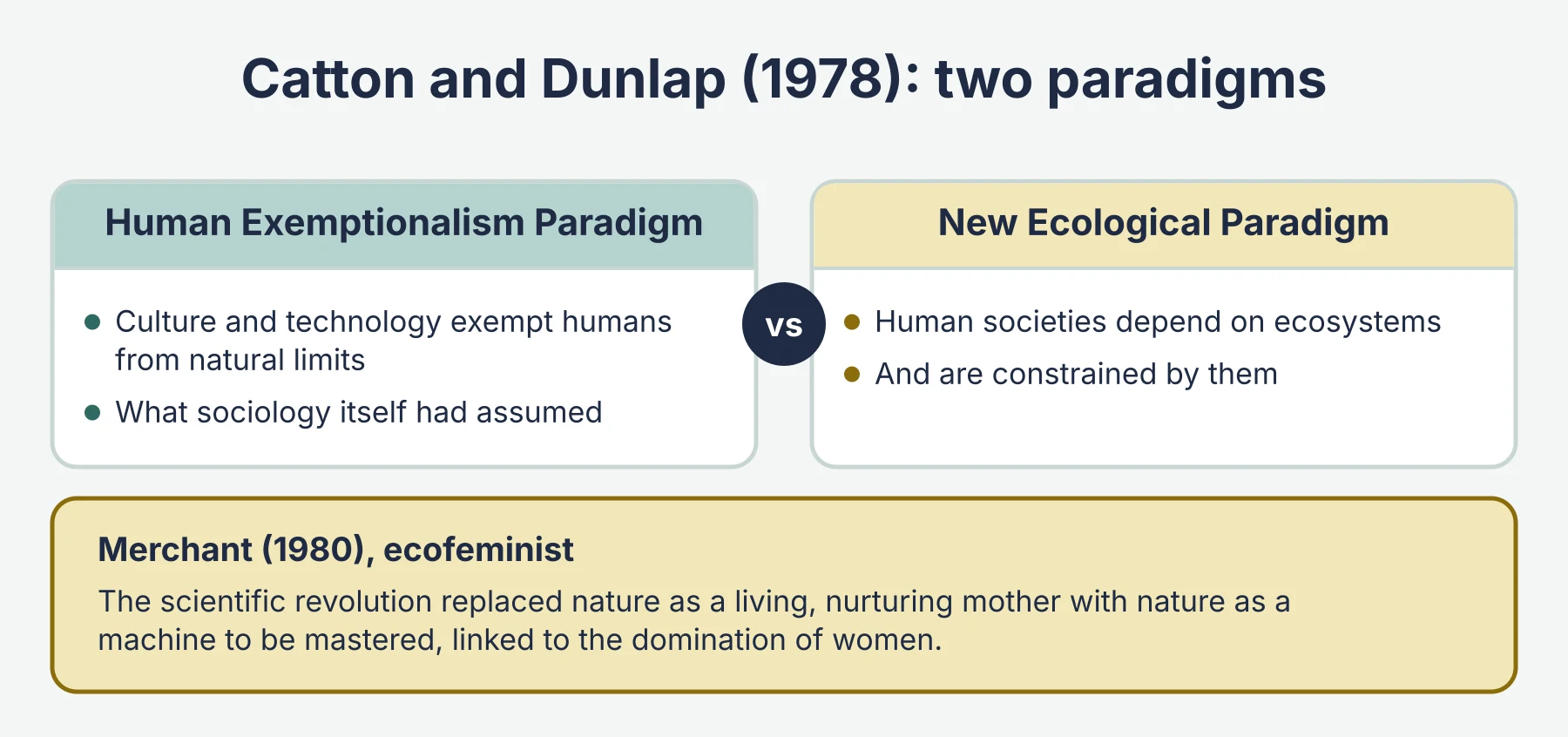
Exploitation for human use. William Catton and Riley Dunlap (1978) argued that sociology itself had assumed a Human Exemptionalism Paradigm: the belief that culture and technology exempt humans from natural limits. They proposed a New Ecological Paradigm in which human societies depend on, and are constrained by, ecosystems. Carolyn Merchant (The Death of Nature, 1980), an ecofeminist historian, argued that the scientific revolution replaced an image of nature as a living, nurturing mother with an image of nature as a machine to be mastered, and linked this to the domination of women.
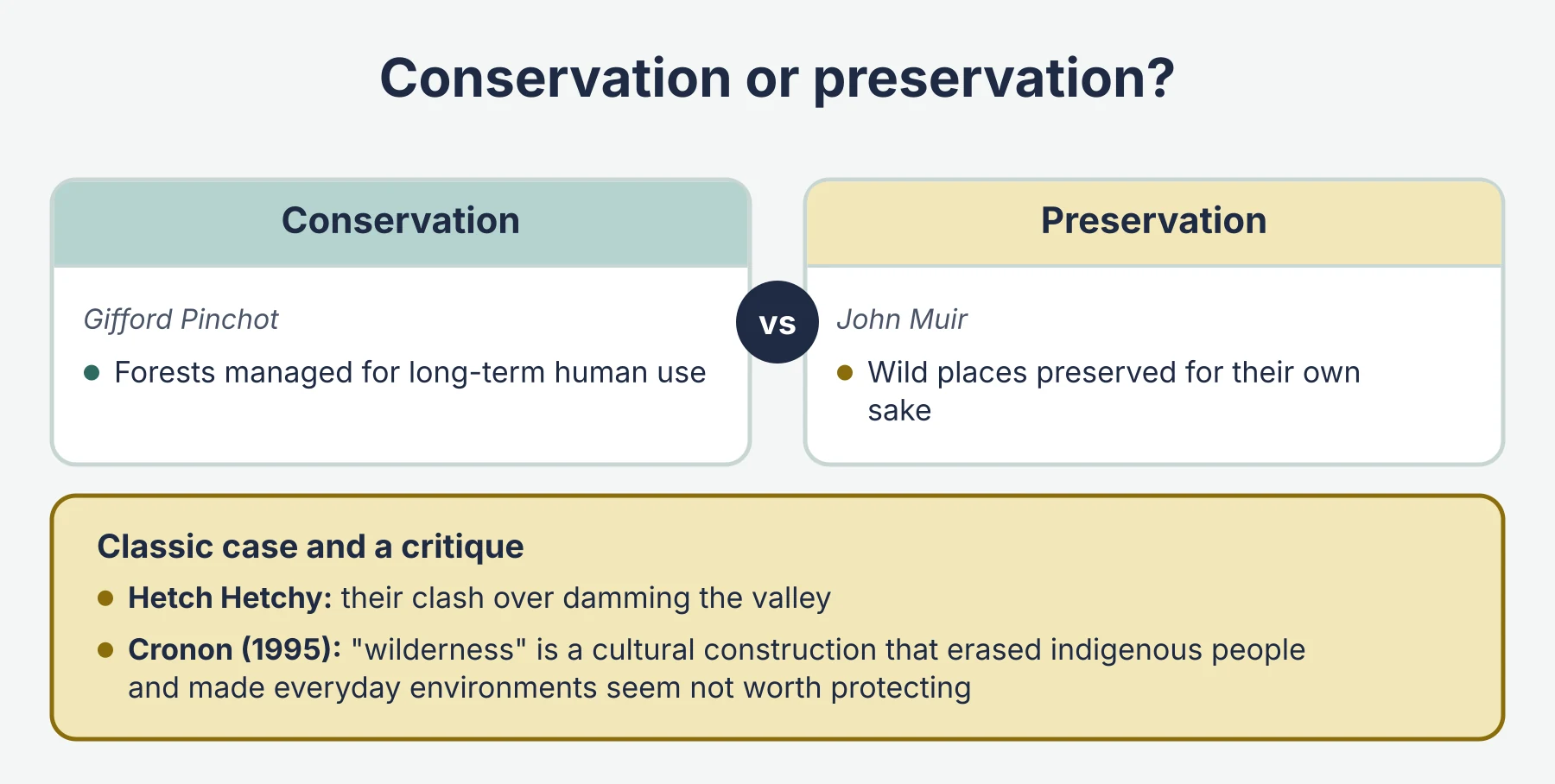
Romanticism and its critics. Romantic ideas helped create the modern idea of “wilderness”. The historian William Cronon (“The Trouble with Wilderness”, 1995) argued that wilderness is a cultural construction: treating some landscapes as untouched erased the indigenous people who had lived in and shaped them, and could make everyday environments seem not worth protecting.
Conservation versus preservation. Early twentieth-century US debates set Gifford Pinchot, who wanted forests managed for long-term human use, against John Muir, who wanted wild places preserved for their own sake. Their clash over damming the Hetch Hetchy valley is a classic case of two views of nature.
Media representations. Rachel Carson’s Silent Spring (1962), on the effects of pesticides, shows how one book can turn a scientific issue into a public one. Nature documentaries that showed plastic harming marine life, such as Blue Planet II (2017), were widely credited with raising public concern about plastics. Media coverage tends to favour dramatic events (fires, floods) over slow processes (soil loss), which links to Hannigan’s argument about claims-making.
The long now and future generations
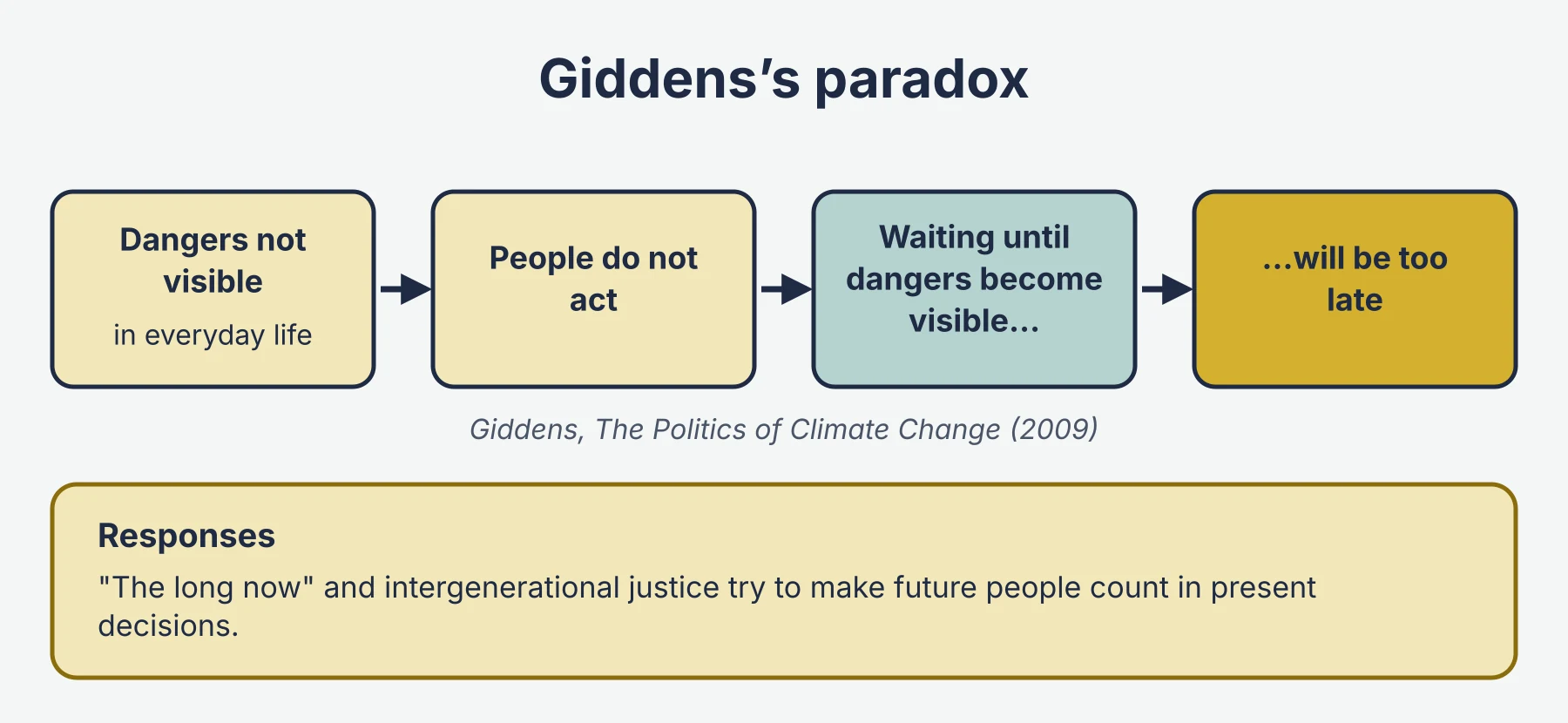
Thinking across generations is hard. Anthony Giddens (The Politics of Climate Change, 2009) described Giddens’s paradox: because the dangers of climate change are not visible in everyday life, people do not act, yet waiting until they become visible will be too late. Ideas such as “the long now” and intergenerational justice try to make future people count in present decisions.
Consumption, sustainability and energy
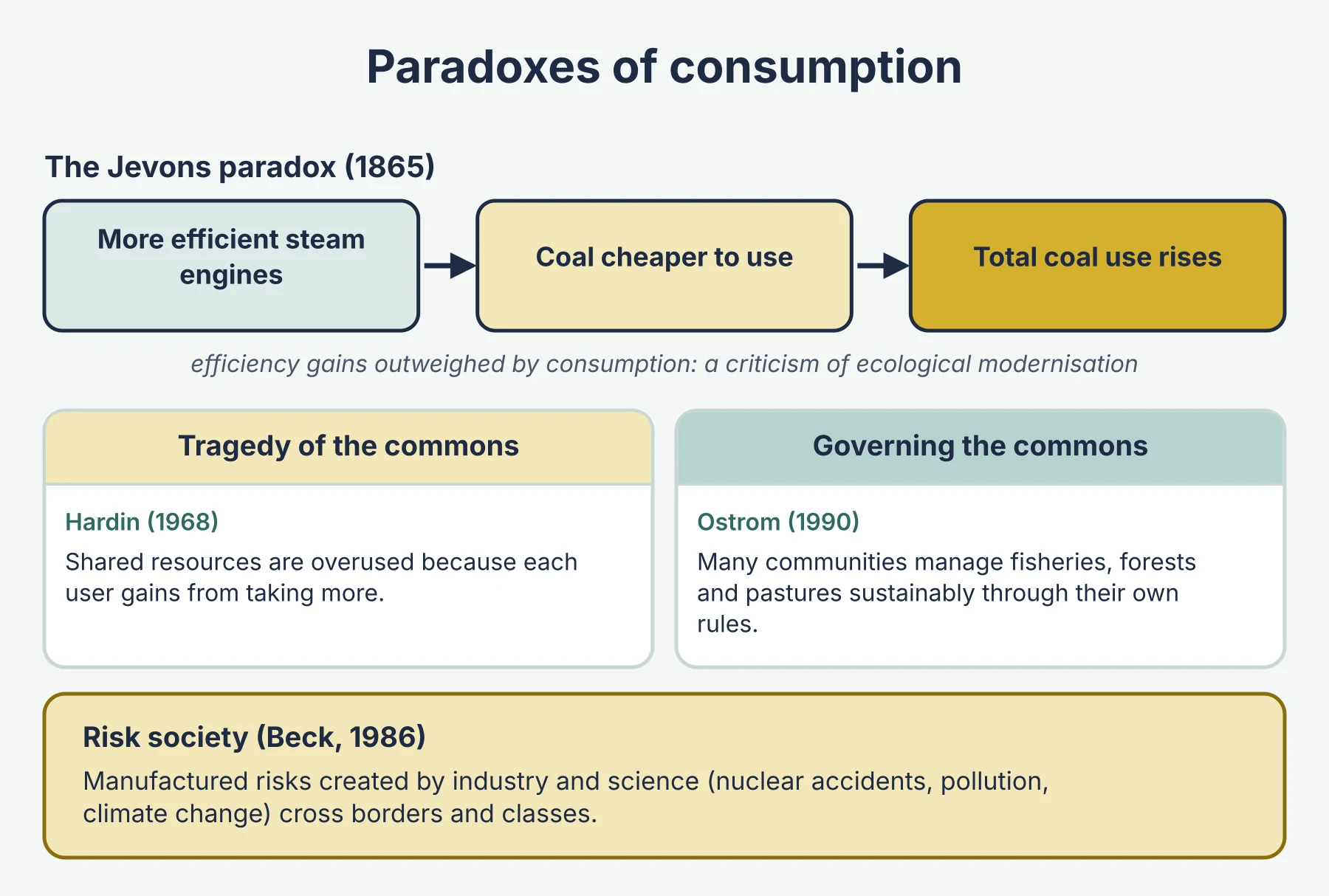
- The Jevons paradox: William Stanley Jevons (1865) observed that more efficient steam engines increased total coal use, because efficiency made coal cheaper to use. Efficiency gains can therefore be outweighed by rising consumption, a key criticism of ecological modernisation.
- The commons: Garrett Hardin’s “The Tragedy of the Commons” (1968) argued that shared resources will be overused because each user gains from taking more. Elinor Ostrom (Governing the Commons, 1990) showed that many communities manage common fisheries, forests and pastures sustainably through their own rules.
- Risk society: Ulrich Beck (Risk Society, 1986) argued that modern societies increasingly face manufactured risks, created by industry and science themselves (nuclear accidents, pollution, climate change), which cross borders and classes.
Food, movement and pollution: cases to use
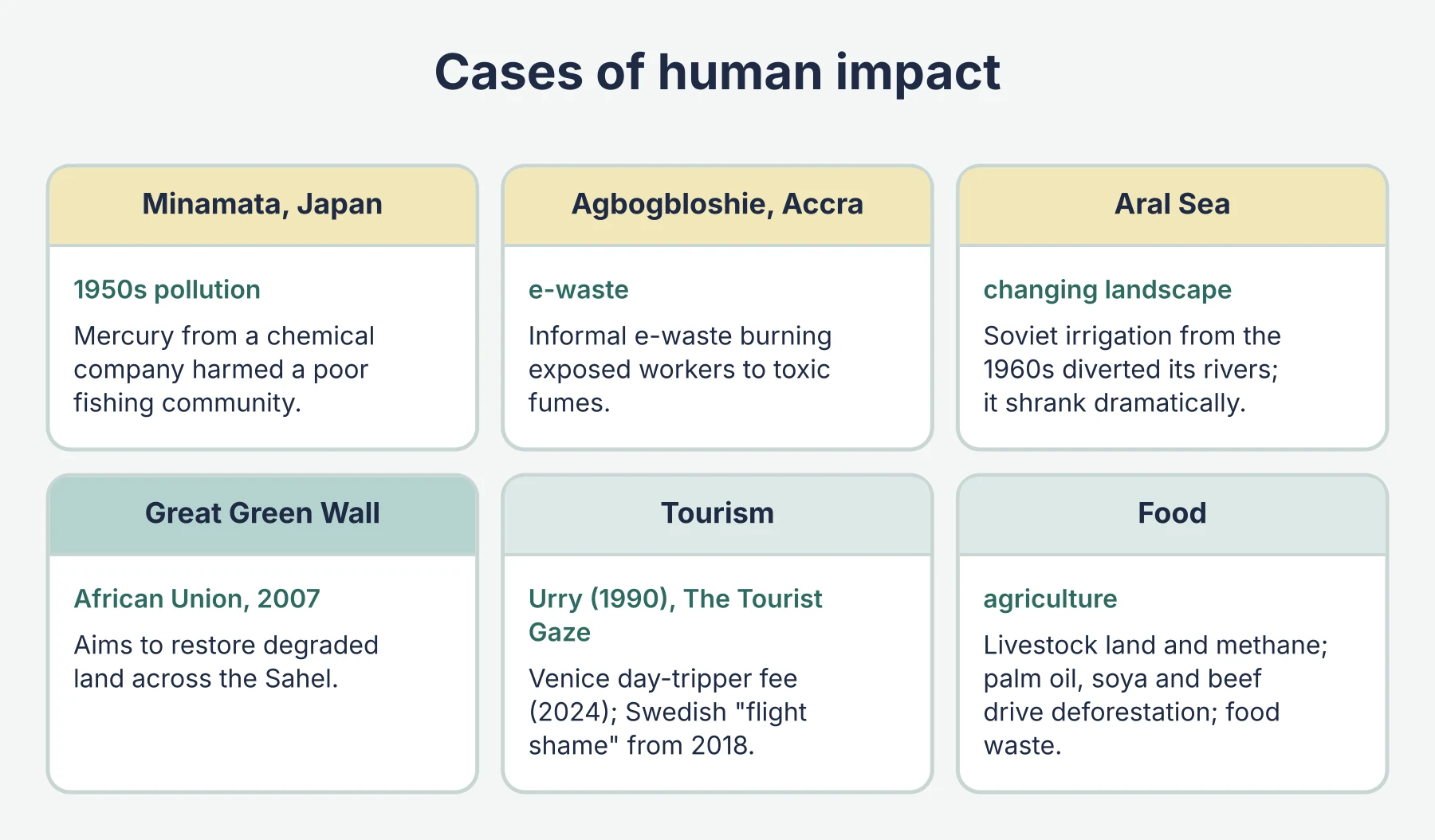
- Agriculture and food: livestock farming uses large areas of land and releases methane; demand for palm oil, soya and beef drives tropical deforestation; food waste wastes the land, water and energy used to grow it.
- Mass transport and tourism: John Urry (The Tourist Gaze, 1990) argued that tourism is organised around socially structured ways of looking at places, which shapes which landscapes are developed. Venice introduced an entry fee for day-trippers in 2024 to manage visitor numbers. The Swedish idea of “flight shame” (flygskam), popular from 2018, shows a cultural response to aviation emissions.
- Pollution: mercury released by a chemical company caused Minamata disease in Japan in the 1950s, a landmark case of industrial pollution harming a poor fishing community. Agbogbloshie in Accra, Ghana, became known as a site of informal e-waste burning that exposed workers to toxic fumes.
- Changing landscapes: Soviet irrigation schemes from the 1960s diverted rivers feeding the Aral Sea, which shrank dramatically. The African Union’s Great Green Wall initiative (launched 2007) aims to restore degraded land across the Sahel.
The climate crisis and social construction
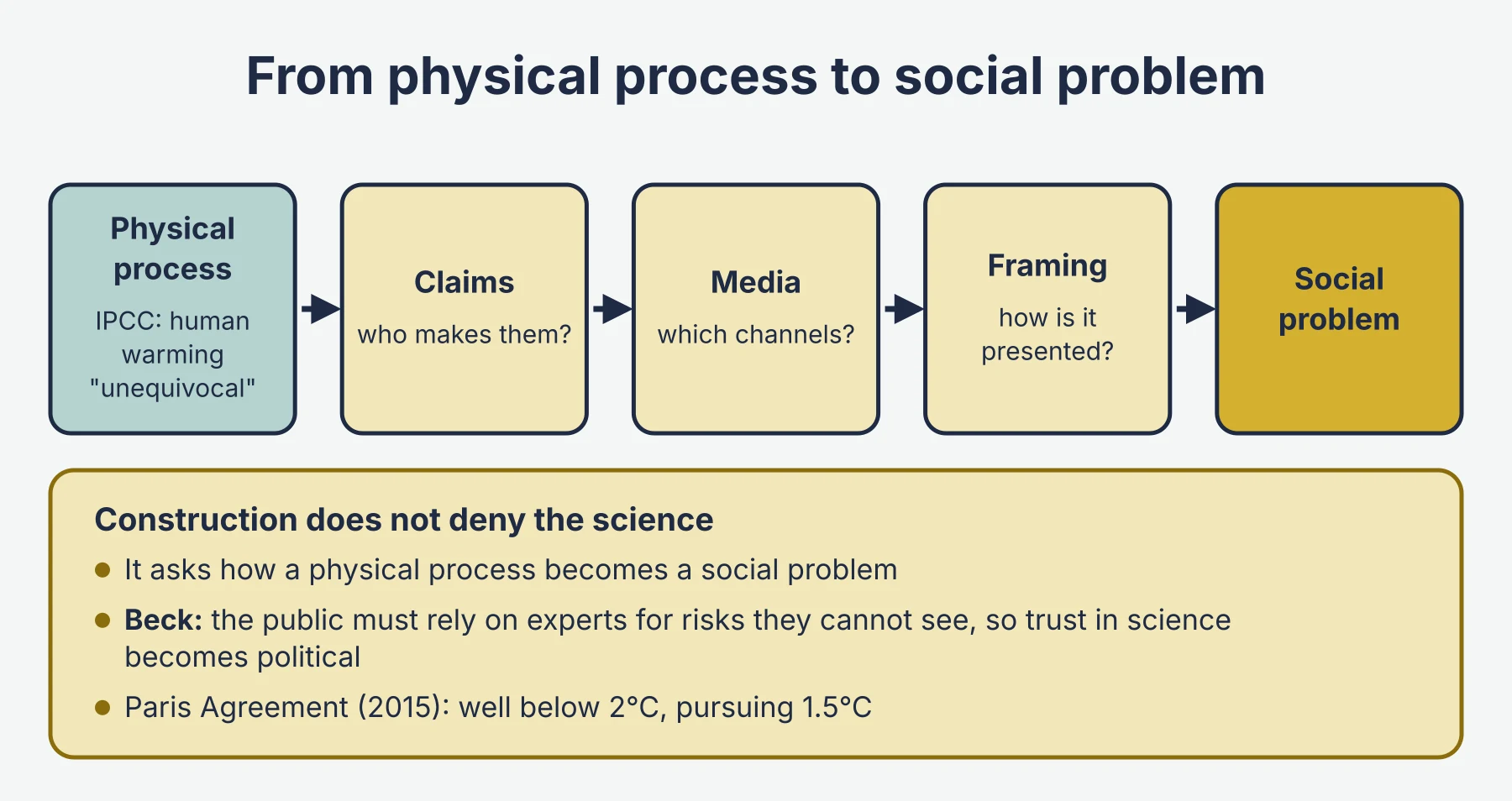
The IPCC’s Sixth Assessment Report (2021 to 2023) stated that it is “unequivocal” that human influence has warmed the atmosphere, ocean and land. The Paris Agreement (2015) set the goal of holding warming well below 2°C and pursuing efforts to limit it to 1.5°C.
Social construction does not deny this. It asks how a physical process becomes a social problem: who makes claims, through which media, with what framing. Beck’s risk society adds that the public must rely on experts for risks they cannot see, which makes trust in science a central political question.
Responses: why denial persists
- Organised doubt: Oreskes and Conway (in the unit guide).
- Identity: Aaron McCright and Riley Dunlap (2011) found that conservative white men in the United States were especially likely to deny climate change, linking denial to the defence of a social and economic order.
- Socially organised denial: Norgaard (in the unit guide).
- Governments and the IPCC: the IPCC assesses evidence but does not set policy; governments negotiate targets, and national interests (fossil-fuel exports, development needs) shape what they agree.
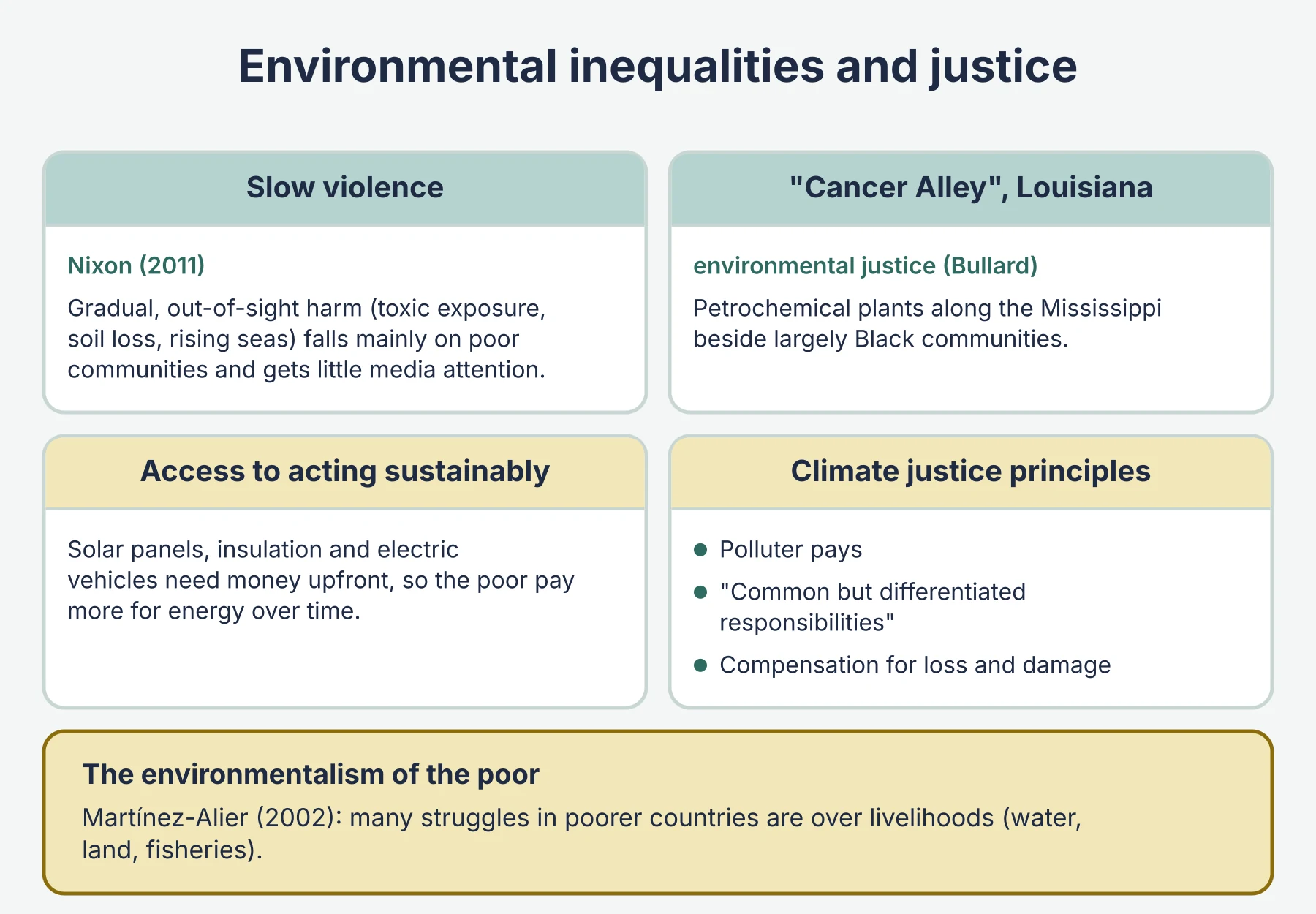
- Movements: Joan Martínez-Alier (The Environmentalism of the Poor, 2002) argued that many environmental struggles in poorer countries are conflicts over livelihoods (water, land, fisheries) rather than the middle-class concern for nature often associated with Western movements.
Ecological modernisation and green Marxism: sharpening the evaluation
| Test | Ecological modernisation | Green Marxism |
|---|---|---|
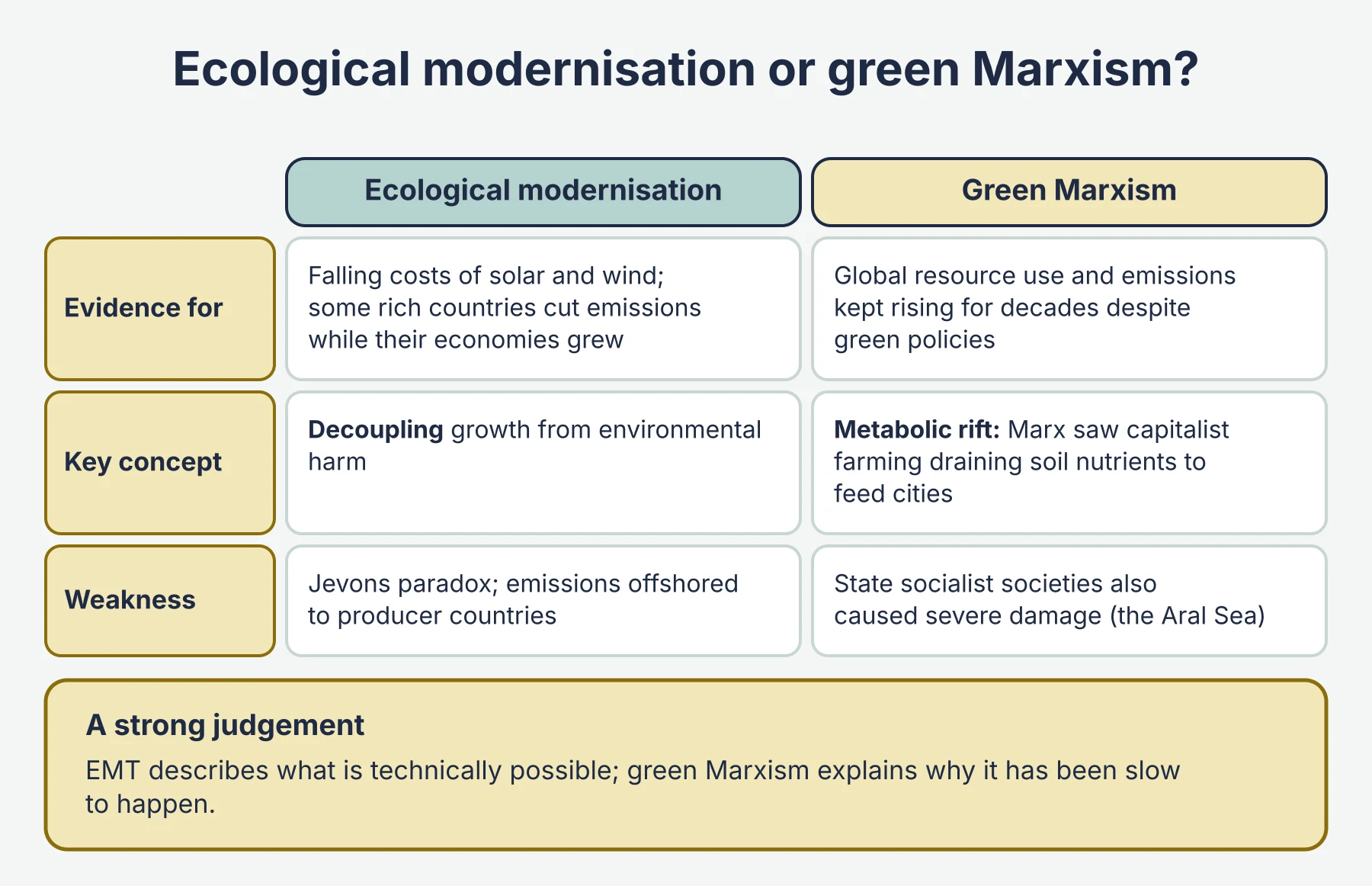
| Evidence for | Falling costs of solar and wind power; some rich countries cut emissions while their economies grew | Global resource use and emissions kept rising for decades despite green policies |
| Key concept | Decoupling growth from environmental harm | Metabolic rift: Marx, drawing on soil science, saw capitalist farming draining soil nutrients to feed cities |
| Weakness | Jevons paradox; emissions offshored to producer countries | State socialist societies also caused severe damage (the Aral Sea) |
A strong judgement often concludes that EMT describes what is technically possible, while green Marxism explains why it has been slow to happen.
Inequalities and justice
- Slow violence: Rob Nixon (Slow Violence and the Environmentalism of the Poor, 2011) described harm that is gradual and out of sight (toxic exposure, soil loss, rising seas), which falls mainly on poor communities and attracts little media attention.
- Cases within countries: the stretch of the Mississippi river in Louisiana nicknamed “Cancer Alley”, lined with petrochemical plants beside largely Black communities, is a widely studied example in the environmental justice tradition Bullard founded.
- Access to acting sustainably: cheaper sustainable choices often require money upfront (solar panels, insulation, electric vehicles), so the poor pay more for energy over time and are blamed less fairly for emissions.
- Climate justice principles: polluter pays; “common but differentiated responsibilities”; compensation for loss and damage.
Annotated model answer
Extract from a 12-mark answer: Assess the view that environmental problems are socially constructed.
Hannigan argues that environmental problems must be claimed by scientists, popularisers and the media to become public issues [knowledge]. Plastic pollution in oceans rose up the agenda after documentaries showed its effects on marine life [application]. This explains why some harms gain attention while others, such as Nixon’s “slow violence”, stay hidden [analysis]. However, realists stress that warming is “unequivocal” according to the IPCC whether or not it is claimed, so construction explains which problems are noticed, not whether they exist [evaluation and judgement].
Common mistakes
- Treating social construction as denial of the problem.
- Using EMT and green Marxism without the Jevons paradox or offshoring as evidence.
- Listing environmental problems without linking them to consumption, power or inequality.
- Discussing inequality only between countries; the specification also asks about within.
- Calling the IPCC a government; it assesses evidence for governments.
Exam technique
For outline and explain questions, pair each problem with a cause and a social group affected. For assess and evaluate, set constructionist against realist, or EMT against green Marxism, and use own-society examples such as local air pollution, floods or tourism.
Where next
Cities and climate risk are developed in the built human environment. Biodiversity and animals follow in people and animals.
Related resources
-
Practice questions
OxfordAQA International A-level Sociology (9690): Human impacts on environment – Practice Questions
Original OxfordAQA 9690 practice questions on views of nature, consumption, the commons, risk, climate responses, green Marxism and inequality, with answers.
Sociology · OxfordAQA · A Level
Try questions -
Revision notes
OxfordAQA International A-level Sociology (9690): Human impacts on environment – Revision Notes
Revision notes for OxfordAQA 9690 section 3.2.2.2: views of nature, consumption, pollution, climate as a social problem, denial, EMT, green Marxism and justice.
Sociology · OxfordAQA · A Level
Revise topic -
Study guides
OxfordAQA International A-level Sociology (9690): People and animals
Guide to OxfordAQA 9690 section 3.2.2.3: Bryant, welfare and rights, domestication, pets, zoonoses, the Columbian Exchange, biodiversity and biotechnology.
Sociology · OxfordAQA · A Level
Read guide
Related articles
Get free revision emails (optional)
Occasional emails with practice questions, worked explanations and links to free resources for the qualification and subjects you choose. No spam, and you can unsubscribe from any email. The free tools on this site never need an email.