
Study Guides
OxfordAQA International A-level Sociology (9690): The built human environment
Guide to OxfordAQA 9690 section 3.2.2.1: nomads, rural life, urbanisation, slums, suburbs, segregation, megacities, non-places and demographic transition.
- Subject
- Sociology
- Level
- A LEVEL
- Topic
- Unit 4 – People and the Environment
- Author
- Marlbridge Academic Team
- Updated
- Reviewed by
- Naqiya Yousaf (what this means)
Aligned to OxfordAQA A Level Sociology (9690), Version 1.1. Official specification .
Syllabus page (what it covers and how it is assessed): OxfordAQA A Level Sociology.
Syllabus points this page covers
9690 (A Level)
- 3.2.2.1 The built human environment
Found an error? Report a correction.
Need help with this topic? Request a free trial class for A Level Sociology (9690).
This guide covers content point 3.2.2.1 The built human environment of the OxfordAQA International A-level Sociology (9690) specification, Version 1.1, assessed in the Unit 4 People and the environment exam. The specification lists: “Nomadic lifestyles”; “Rural areas: peasants and landless labourers, rural depopulation”; “Urbanisation; social life in cities: ‘slums’ and informal housing; suburbia; segregation; gated communities; megacities; non-places”; “Power and inequalities in rural and urban areas”; “Cities and changing environment and climate”; and “Demographic transition theory”.
The People and the environment study guide gives the basic definitions and introduces Mike Davis and Marc Augé. This page adds the classic theories of urban life and the debates that let you evaluate them. Condense it with the built environment revision notes and practise with the built environment practice questions.
Nomadic lifestyles
Nomadism takes several forms: pastoral nomads move with herds; hunter-gatherers move with seasonal food sources; and commercial or service nomads, such as many Roma and Irish Traveller communities historically, moved to trade and offer services.
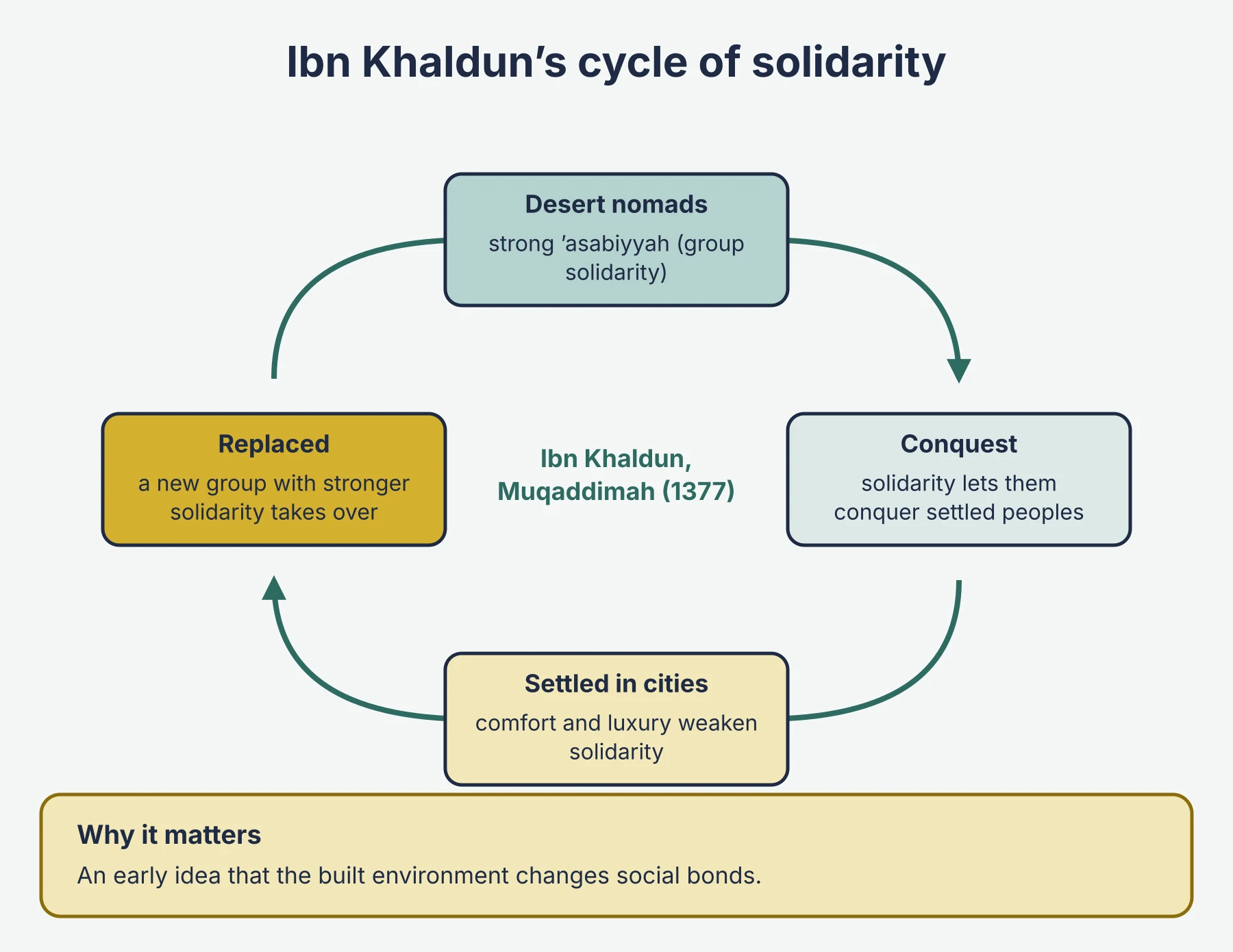
The fourteenth-century scholar Ibn Khaldun (Muqaddimah, 1377) offered one of the earliest sociological accounts. He argued that desert nomads had strong ’asabiyyah (group solidarity), which allowed them to conquer settled peoples; once settled in cities, their solidarity weakened through comfort and luxury, until a new group replaced them. The cycle shows an early idea that the built environment changes social bonds.
States have long pressed nomads to settle. Under Soviet collectivisation in the early 1930s, forced settlement of Kazakh herders and the seizure of their livestock contributed to a devastating famine. Today, pressures come from national borders that cut across grazing routes, privatisation of rangeland, conservation areas and drought. Nomads are often seen by states as hard to tax, school and count, which helps explain this pressure.
Rural areas: peasants and landless labourers
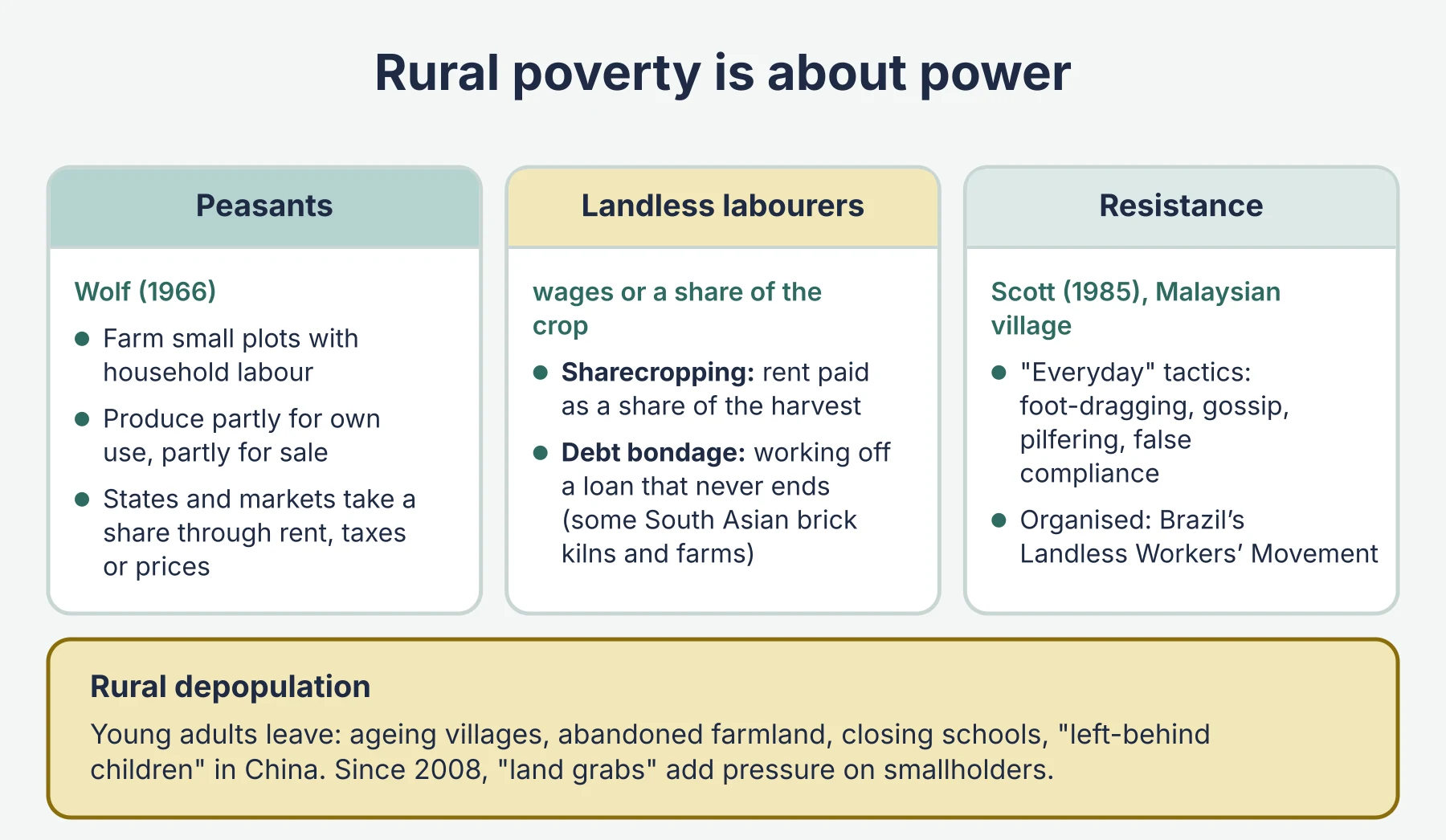
Peasants farm small plots mainly with household labour, producing partly for their own use and partly for sale. Eric Wolf (Peasants, 1966) stressed that peasants are always tied to wider states and markets that take a share of their output through rent, taxes or prices.
Landless labourers sell their labour for wages or a share of the crop. Arrangements such as sharecropping (paying rent as a share of the harvest) and debt bondage (working to repay a loan that never ends, still found in some brick kilns and farms in South Asia) show that rural poverty is about power over land and credit, not only low productivity.
Resistance. James C. Scott (Weapons of the Weak, 1985), studying a Malaysian village, showed that poor farmers resist through “everyday” tactics such as foot-dragging, gossip, pilfering and false compliance, rather than open revolt. Organised resistance includes Brazil’s Landless Workers’ Movement (covered in the unit guide).
Rural depopulation removes young adults, leaving ageing villages, abandoned farmland and closing schools. In China, internal migration has left many “left-behind children” living with grandparents. Remittances may sustain households, but the community loses labour and leadership. Since the 2008 food price spike, large-scale purchases or leases of farmland by investors and foreign states (“land grabs”) have added pressure on smallholders in parts of Africa, Asia and Latin America.
Urbanisation and social life in cities
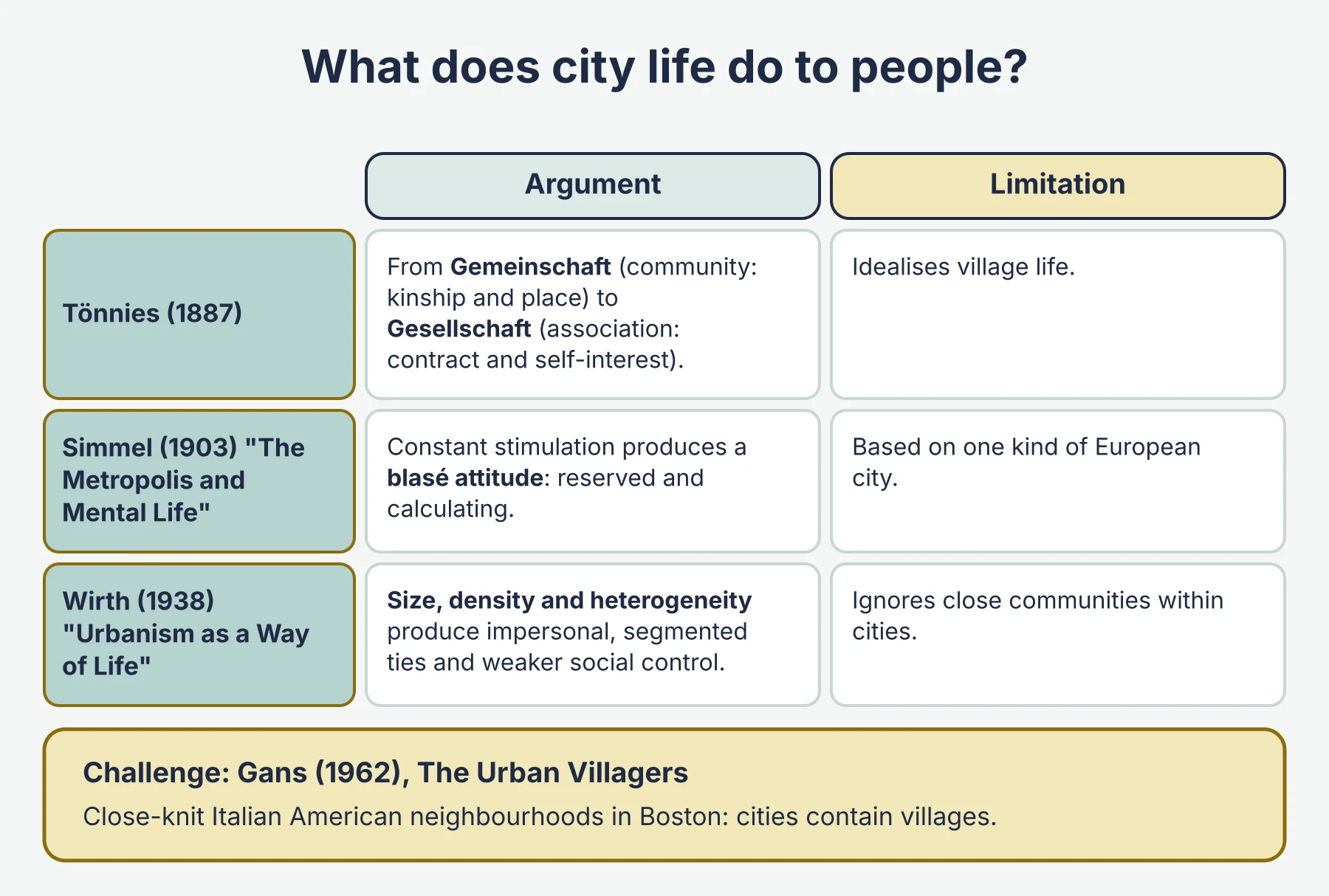
The United Nations estimates that the world’s urban population passed its rural population around 2007. Three classic theories of what city life does to people are still useful.
| Thinker | Argument | Limitation |
|---|---|---|
| Ferdinand Tönnies (1887) | Shift from Gemeinschaft (community based on kinship and place) to Gesellschaft (association based on contract and self-interest) | Idealises village life |
| Georg Simmel, “The Metropolis and Mental Life” (1903) | Constant stimulation produces a blasé attitude: city dwellers become reserved and calculating to protect themselves | Based on one kind of European city |
| Louis Wirth, “Urbanism as a Way of Life” (1938) | Size, density and heterogeneity produce impersonal, segmented relationships and weaker social control | Ignores close communities within cities |
Herbert Gans (The Urban Villagers, 1962) challenged Wirth by showing close-knit Italian American neighbourhoods in Boston: cities contain villages. The Chicago School’s concentric zone model (Ernest Burgess, 1925) described rings of land use around a central business district, with the poorest in the “zone of transition”.
Slums and informal housing
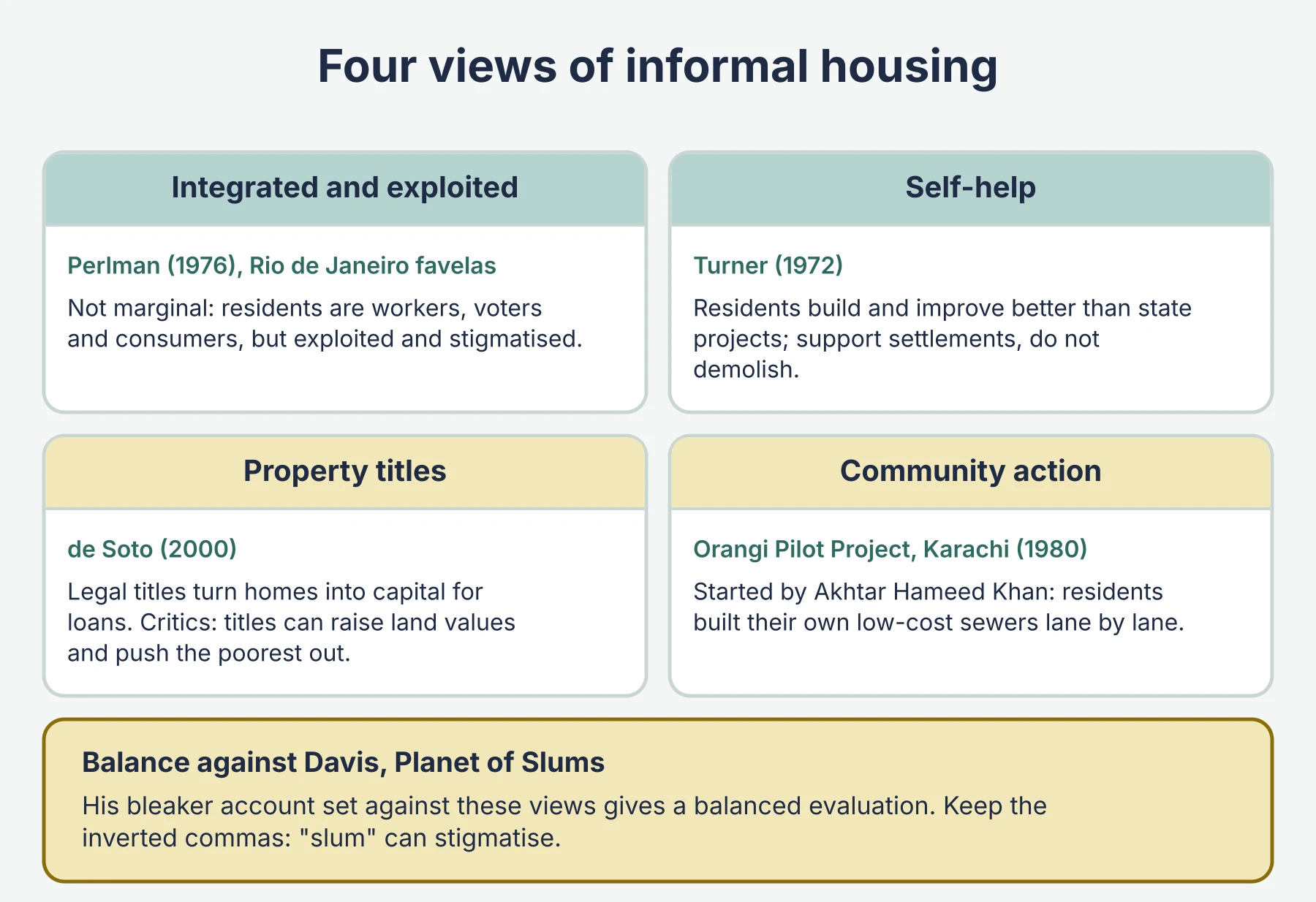
The specification puts ‘slums’ in inverted commas because the word can stigmatise. Debates to know:
- Marginality or exploitation? Janice Perlman (The Myth of Marginality, 1976) found that residents of Rio de Janeiro’s favelas were not cut off from society but integrated into it as workers, voters and consumers, and exploited and stigmatised by it.
- Self-help: John F. C. Turner (Freedom to Build, 1972) argued that residents build and improve housing better than state projects, so governments should support rather than demolish informal settlements.
- Property titles: Hernando de Soto (The Mystery of Capital, 2000) argued that giving legal titles would turn informal homes into capital that could secure loans. Critics reply that titles can raise land values and push the poorest out.
- Community action: the Orangi Pilot Project in Karachi, started by Akhtar Hameed Khan in 1980, helped residents build their own low-cost sewers lane by lane.
These views set against Davis’s bleaker Planet of Slums give a balanced evaluation.
Suburbia, segregation and gated communities
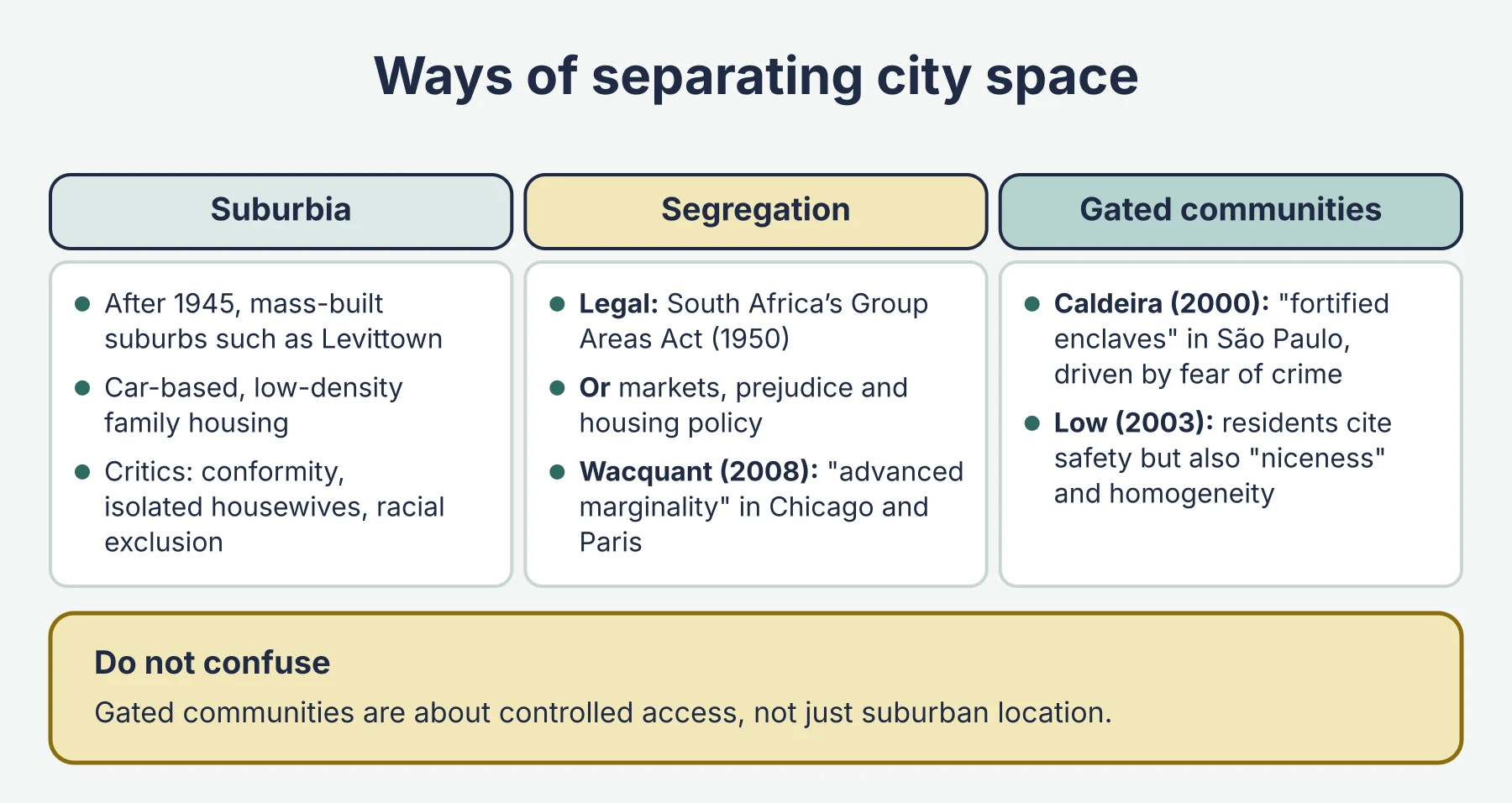
- Suburbia: after 1945, mass-built suburbs such as Levittown in the United States spread car-based, low-density family housing. Critics linked them to conformity, isolation of housewives and racial exclusion.
- Segregation: separation can be legal, as under South Africa’s Group Areas Act (1950), which assigned residential areas by race, or the result of markets, prejudice and housing policy. Loïc Wacquant (Urban Outcasts, 2008) described “advanced marginality” in stigmatised neighbourhoods of Chicago and Paris.
- Gated communities: Teresa Caldeira (City of Walls, 2000) showed that fear of crime in São Paulo produced “fortified enclaves” that separate the rich from public space. Setha Low (Behind the Gates, 2003) found that residents of US gated communities cited safety but also wanted “niceness” and social homogeneity.
Megacities and non-places
Megacities concentrate opportunity and risk. They draw investment and migrants, but stretch water, transport and housing, and their informal settlements are often in floodplains or on hillsides.
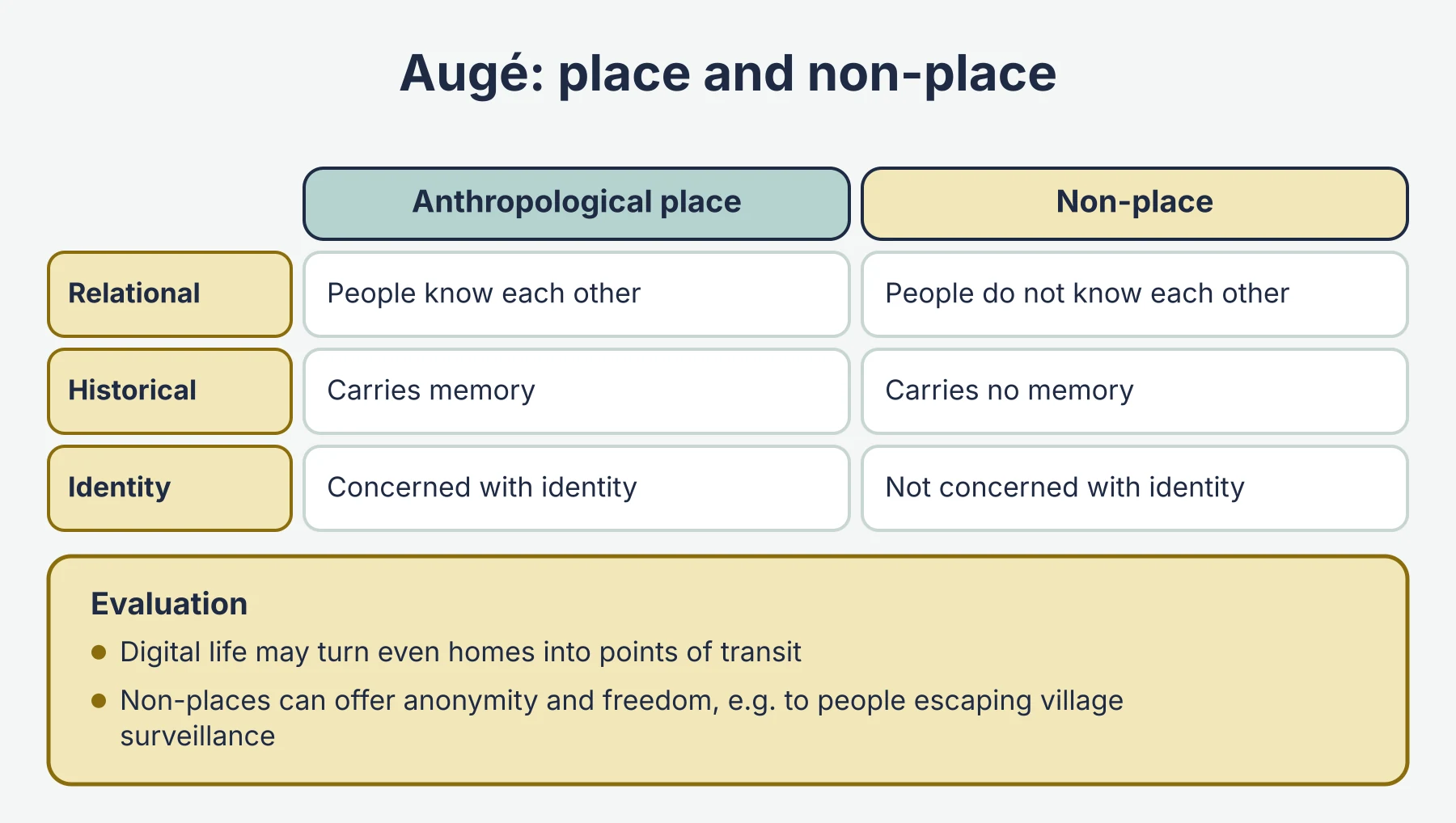
For non-places, deepen the overview with Augé’s contrast: an anthropological place is relational (people know each other), historical (it carries memory) and concerned with identity; a non-place is none of these. Evaluation: digital life may turn even homes into points of transit, but non-places can also offer anonymity and freedom, for example to people escaping village surveillance.
Power and inequalities in rural and urban areas
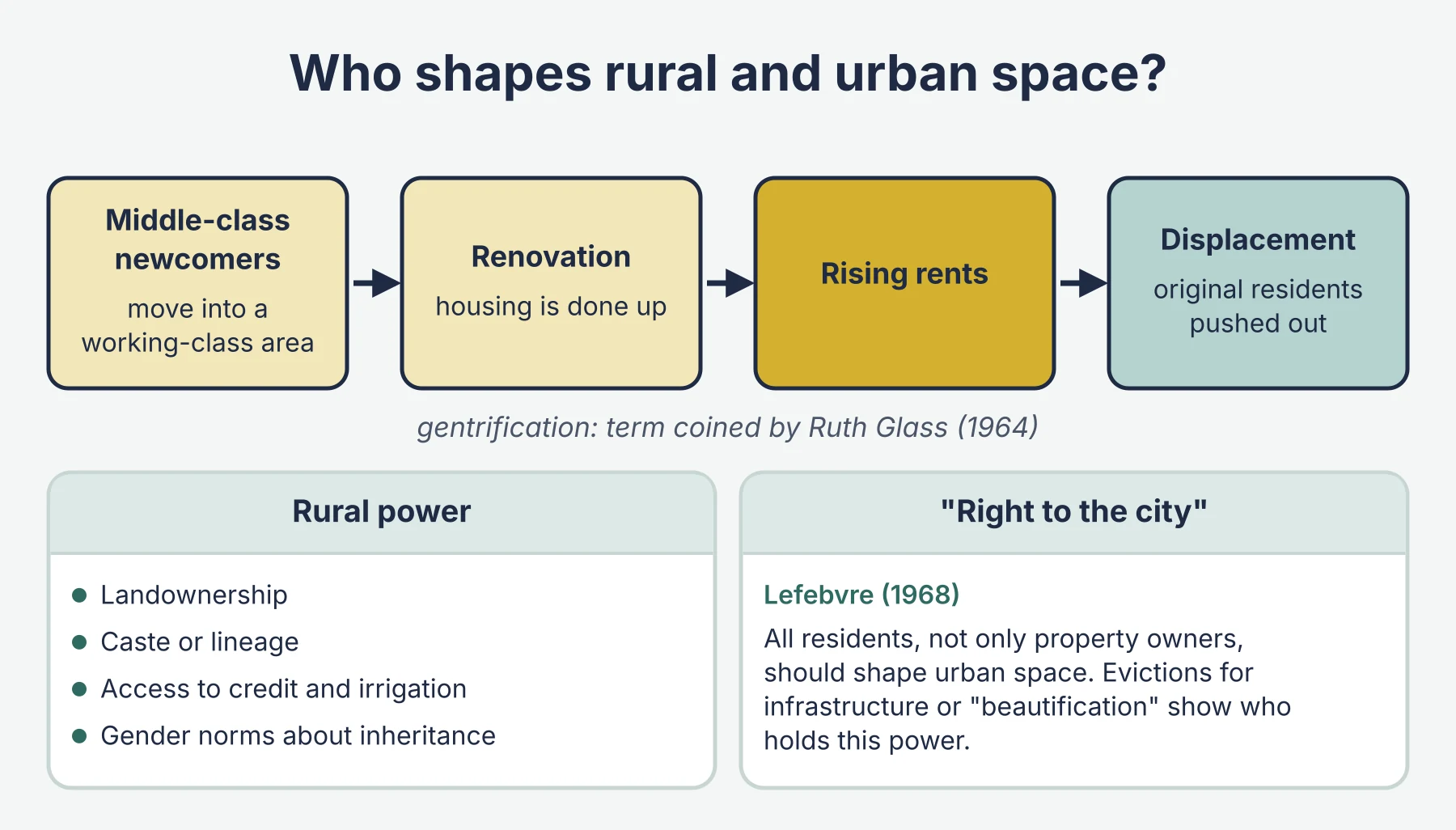
- Rural: landownership, caste or lineage, access to credit and irrigation, and gender norms about inheritance shape who gains from farming.
- Urban: gentrification, a term coined by Ruth Glass (1964), describes middle-class newcomers renovating working-class areas and displacing original residents through rising rents. Henri Lefebvre’s “right to the city” (1968) argued that all residents, not only property owners, should shape urban space. Evictions for infrastructure or “beautification” projects show who holds this power.
Cities and changing environment and climate
Cities are both causes and victims. They concentrate emissions from transport, buildings and industry, but dense, public-transport cities can use less energy per person than sprawling suburbs. Coastal megacities face sea-level rise and subsidence; Indonesia announced in 2019 that it would move its capital from Jakarta to a new city, Nusantara, partly because of these risks. City networks such as C40 (founded 2005) let mayors cooperate on climate action across borders.
Demographic transition theory in depth
The overview gives the four stages. To evaluate fully:
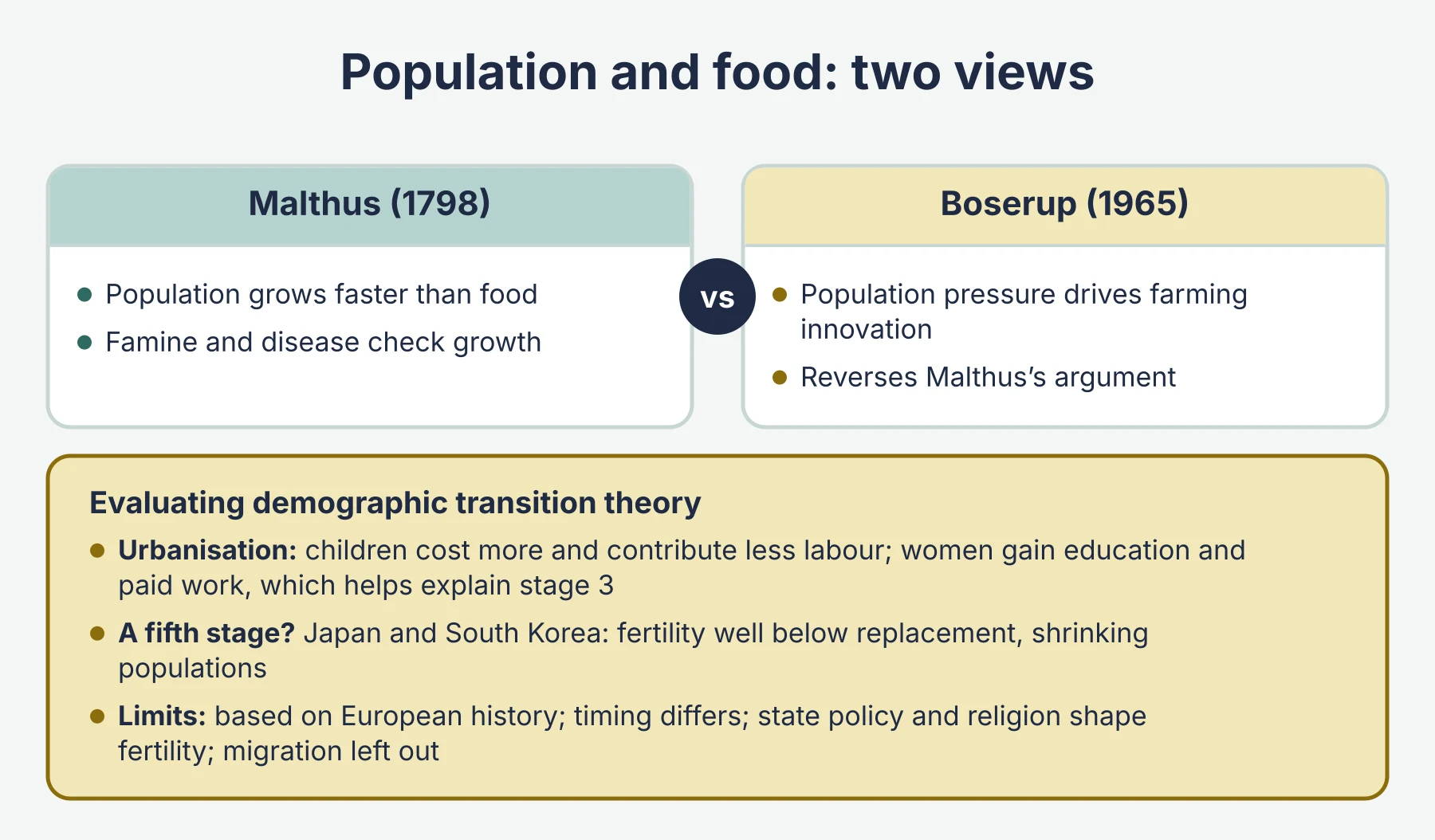
- Malthus (An Essay on the Principle of Population, 1798) argued that population grows faster than food, so famine and disease check growth. Ester Boserup (The Conditions of Agricultural Growth, 1965) reversed this: population pressure drives farming innovation.
- Urbanisation and fertility: in cities, children cost more (housing, schooling) and contribute less labour, and women have more access to education and paid work, so urbanisation helps explain stage 3.
- A fifth stage? Some countries, such as Japan and South Korea, now have fertility well below replacement level and shrinking populations, which the original model did not predict.
- Limits: based on European history; timing differs widely; state policy and religion shape fertility; migration is left out.
Annotated model answer
Extract from a 12-mark answer: Evaluate the view that city life weakens community.
Wirth argued that size, density and heterogeneity make urban relationships impersonal [knowledge]. In my city, apartment neighbours often do not know each other’s names [application]. Yet Gans found “urban villagers” in Boston, and informal settlements often have strong mutual aid, as the Orangi Pilot Project shows [analysis, counter-evidence]. Community may change form rather than disappear: it becomes based on networks, religion or work rather than street, so Wirth overstates the loss [evaluation and judgement].
Common mistakes
- Using “slum” without acknowledging the debate the inverted commas signal.
- Treating rural areas as unchanging; the specification stresses depopulation and power.
- Describing DTT without evaluation.
- Confusing suburbia with gated communities; gates are about controlled access.
- Writing about cities and climate with no example.
Exam technique
Outline a feature of city life with an example; explain its consequence; in evaluate answers, set a classic theorist (Tönnies, Simmel, Wirth) against contemporary evidence (Gans, Perlman, Caldeira) and use your own society where asked.
Where next
How cities and consumption affect nature is covered in human impacts on environment. Rural-urban migration links to migration and diasporas.
Related resources
-
Practice questions
OxfordAQA International A-level Sociology (9690): The built human environment – Practice Questions
Original OxfordAQA 9690 practice questions on nomads, rural power, urban life, informal housing, segregation and demographic transition, with full answers.
Sociology · OxfordAQA · A Level
Try questions -
Revision notes
OxfordAQA International A-level Sociology (9690): The built human environment – Revision Notes
Revision notes for OxfordAQA 9690 section 3.2.2.1: nomadism, rural power and depopulation, urban theory, slums, segregation, gated communities and DTT.
Sociology · OxfordAQA · A Level
Revise topic -
Study guides
OxfordAQA International A-level Sociology (9690): Human impacts on environment
Guide to OxfordAQA 9690 section 3.2.2.2: views of nature, consumption, pollution, the climate crisis as a social problem, responses, theories and justice.
Sociology · OxfordAQA · A Level
Read guide
Related articles
Get free revision emails (optional)
Occasional emails with practice questions, worked explanations and links to free resources for the qualification and subjects you choose. No spam, and you can unsubscribe from any email. The free tools on this site never need an email.