
Revision Notes
OxfordAQA International A-level Sociology (9690): The built human environment – Revision Notes
Revision notes for OxfordAQA 9690 section 3.2.2.1: nomadism, rural power and depopulation, urban theory, slums, segregation, gated communities and DTT.
- Subject
- Sociology
- Level
- A LEVEL
- Topic
- Unit 4 – People and the Environment
- Author
- Marlbridge Academic Team
- Updated
- Reviewed by
- Naqiya Yousaf (what this means)
Aligned to OxfordAQA A Level Sociology (9690), Version 1.1. Official specification .
Syllabus page (what it covers and how it is assessed): OxfordAQA A Level Sociology.
Syllabus points this page covers
9690 (A Level)
- 3.2.2.1 The built human environment
Found an error? Report a correction.
Need help with this topic? Request a free trial class for A Level Sociology (9690).
These notes condense content point 3.2.2.1 The built human environment of OxfordAQA International A-level Sociology (9690), Version 1.1, assessed in the Unit 4 People and the environment exam. Full explanations are in the built human environment study guide; the rest of the unit is in the People and the environment revision notes.
What the specification lists
- Nomadic lifestyles.
- Rural areas: peasants and landless labourers, rural depopulation.
- Urbanisation; social life in cities: ‘slums’ and informal housing; suburbia; segregation; gated communities; megacities; non-places.
- Power and inequalities in rural and urban areas.
- Cities and changing environment and climate.
- Demographic transition theory.
Core recall
Nomadic lifestyles
- Types: pastoral (herds), hunter-gatherer (seasonal food), commercial or service (trade and services, as many Roma and Traveller groups historically).
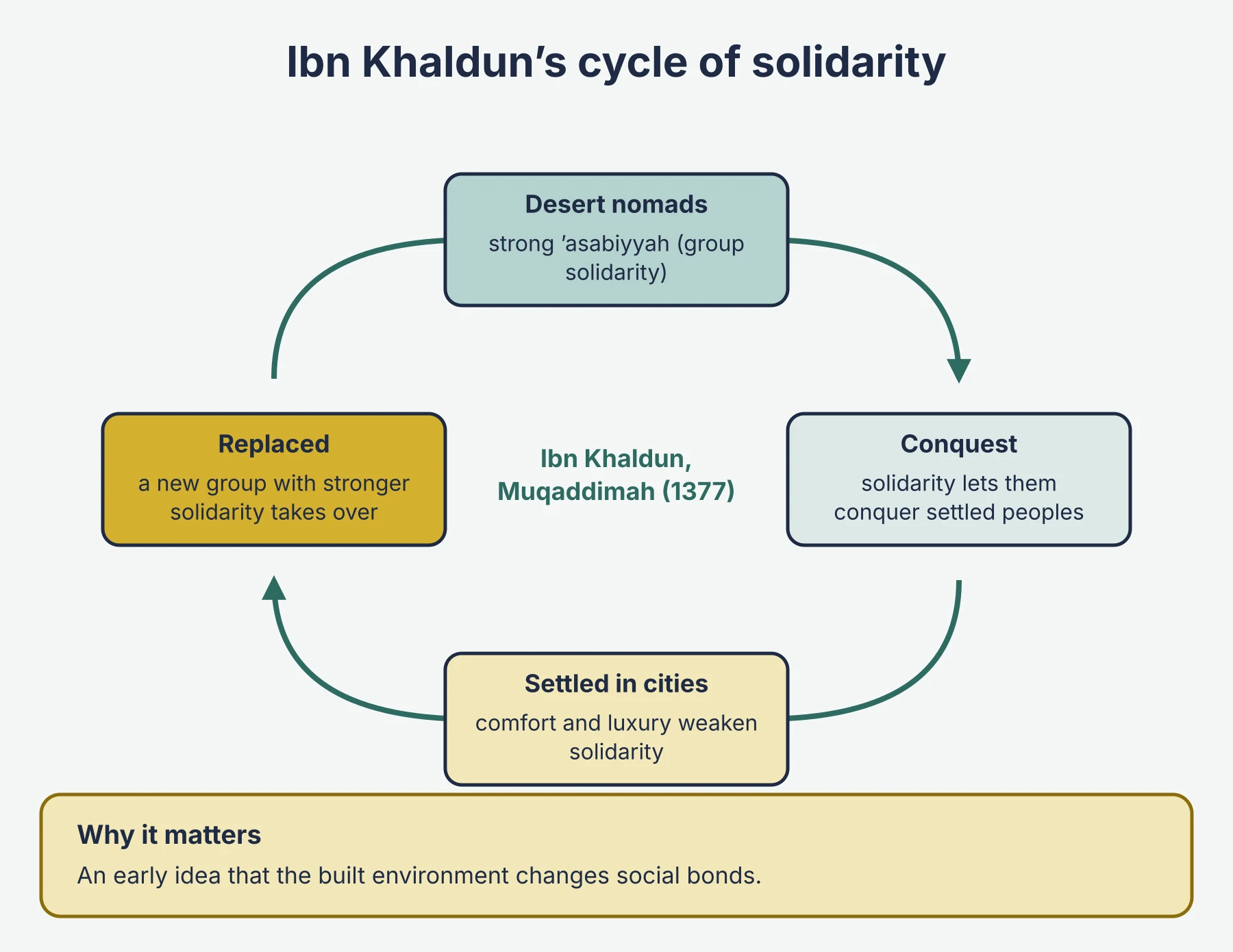
- Ibn Khaldun (1377): nomads’ strong ’asabiyyah (group solidarity) lets them conquer; settled city life weakens it.
- Forced settlement: Soviet collectivisation of Kazakh herders (early 1930s) contributed to famine.
- Modern pressures: borders across grazing routes, privatised rangeland, conservation areas, drought; states find nomads hard to tax, school and count.
Rural areas
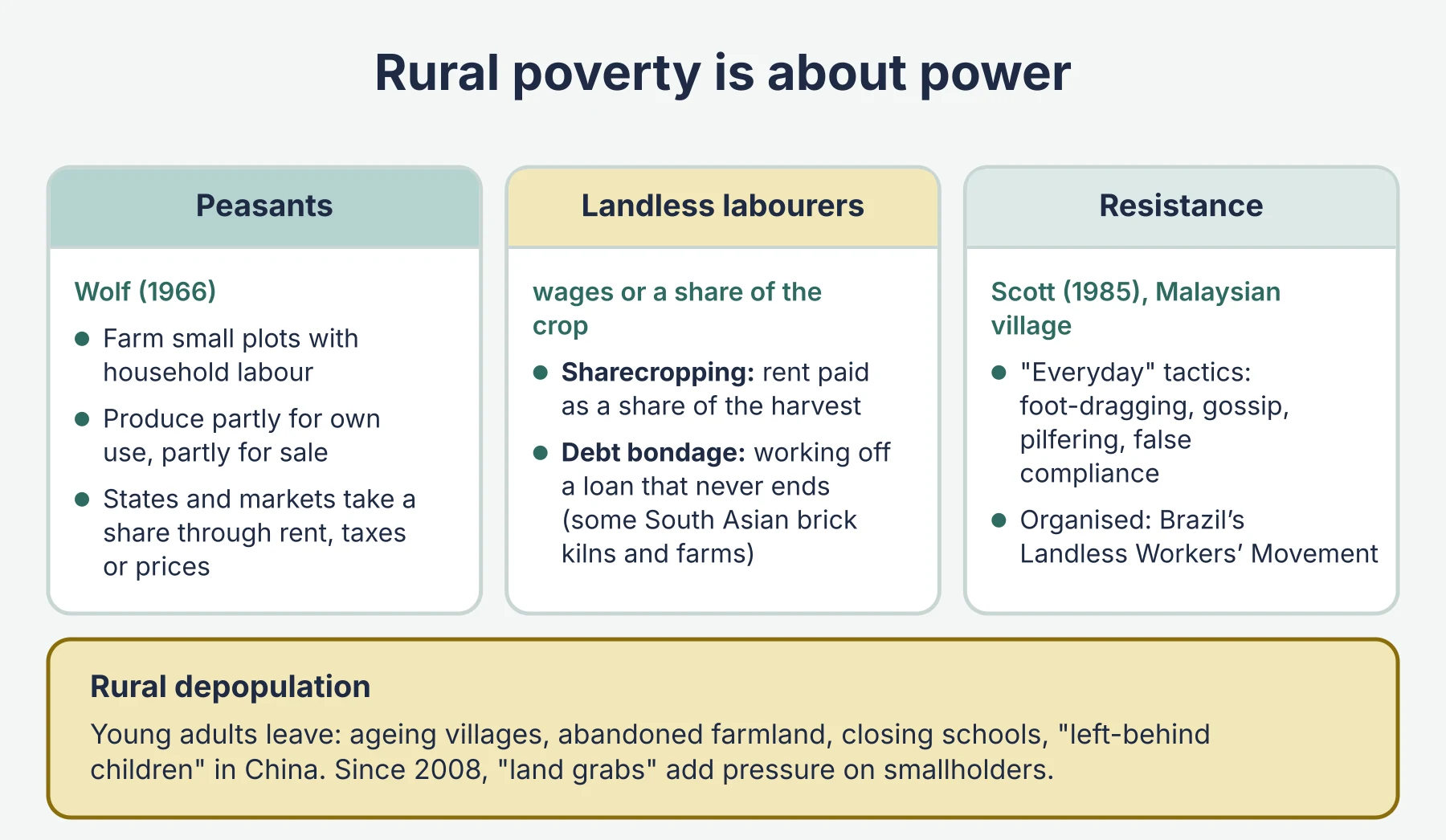
- Peasants: small plots, household labour, partly for own use. Wolf (1966): always tied to states and markets that take a share.
- Landless labourers: wages or crop share; sharecropping; debt bondage (brick kilns and farms in parts of South Asia).
- Scott (1985): “weapons of the weak”, everyday resistance such as foot-dragging and gossip.
- Rural depopulation: ageing villages, closing schools, abandoned land; China’s “left-behind children”.
- Land grabs: investor and foreign-state purchases of farmland, especially after the 2008 food price spike.
Urban theory
- Urban population passed rural around 2007 (UN estimate).
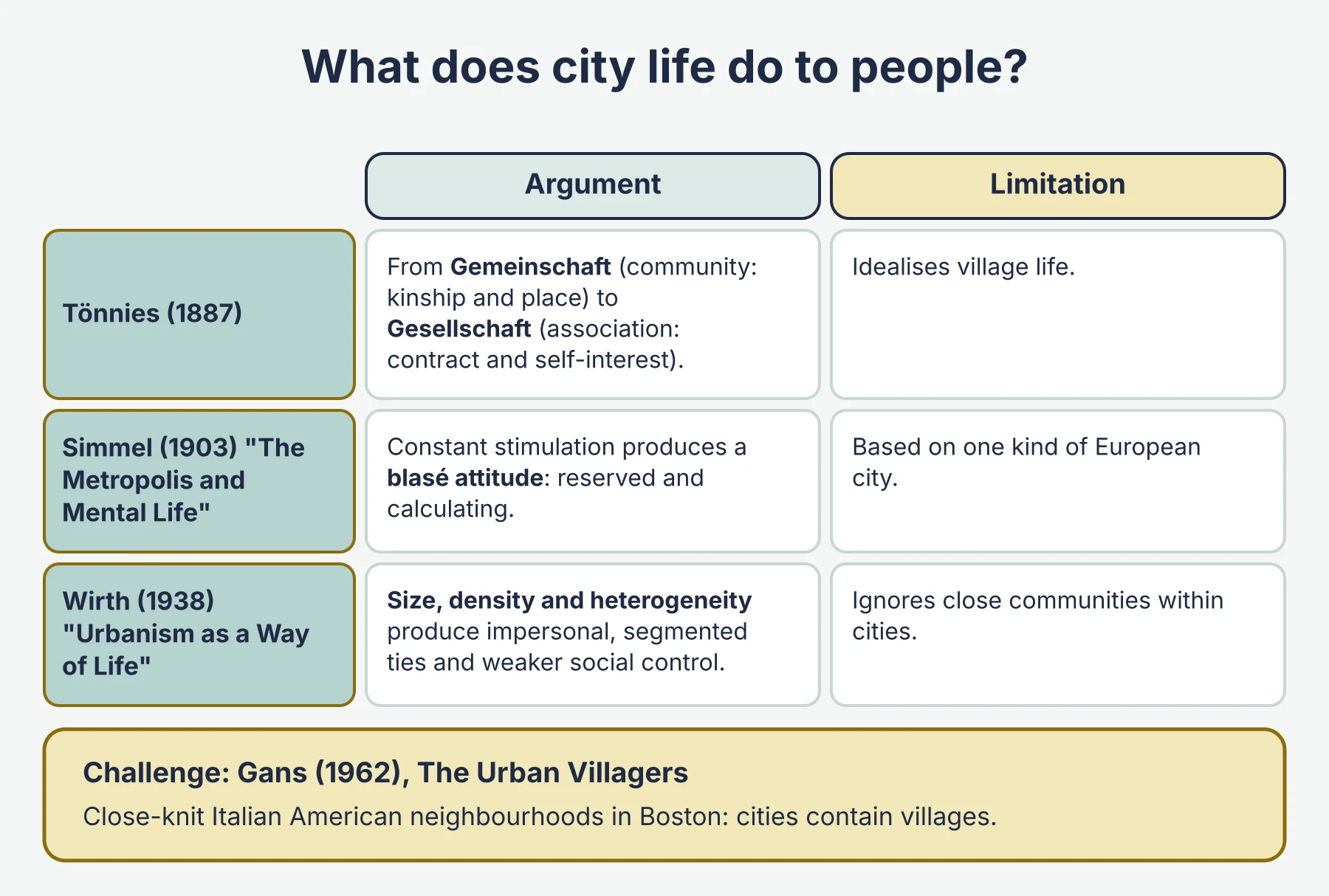
- Tönnies (1887): Gemeinschaft to Gesellschaft.
- Simmel (1903): the blasé attitude.
- Wirth (1938): size, density, heterogeneity produce impersonal relationships.
- Gans (1962): “urban villagers”, close communities in cities.
- Burgess (1925): concentric zones; the poorest in the zone of transition.
‘Slums’ and informal housing
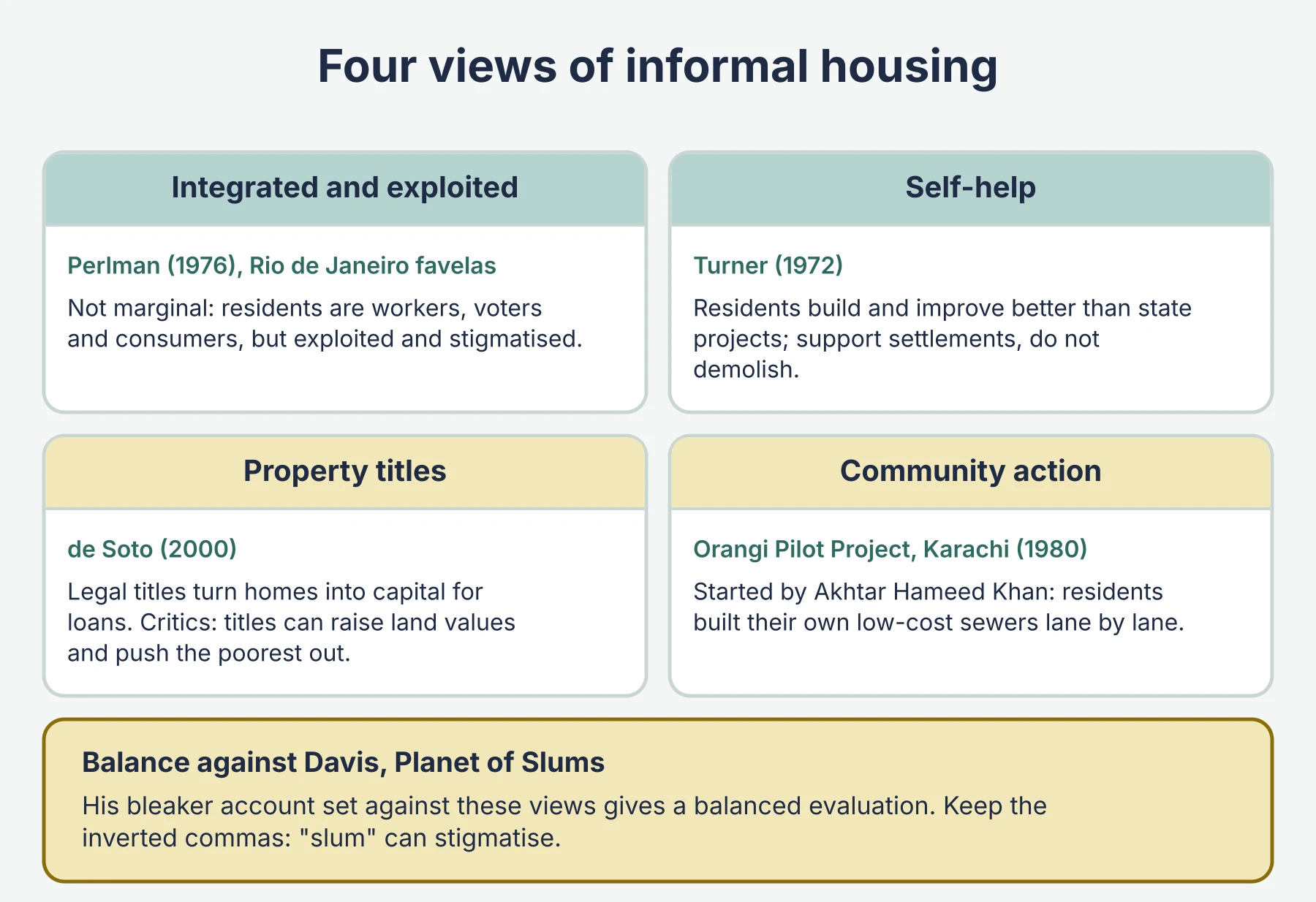
- Perlman (1976): favela residents integrated but exploited, not marginal.
- Turner (1972): support self-help building rather than demolition.
- de Soto (2000): legal titles turn homes into capital. Criticism: titles can raise land values and displace the poorest.
- Orangi Pilot Project, Karachi (from 1980, Akhtar Hameed Khan): residents built low-cost sewers.
- Contrast with Davis’s Planet of Slums.
Suburbia, segregation, gated communities
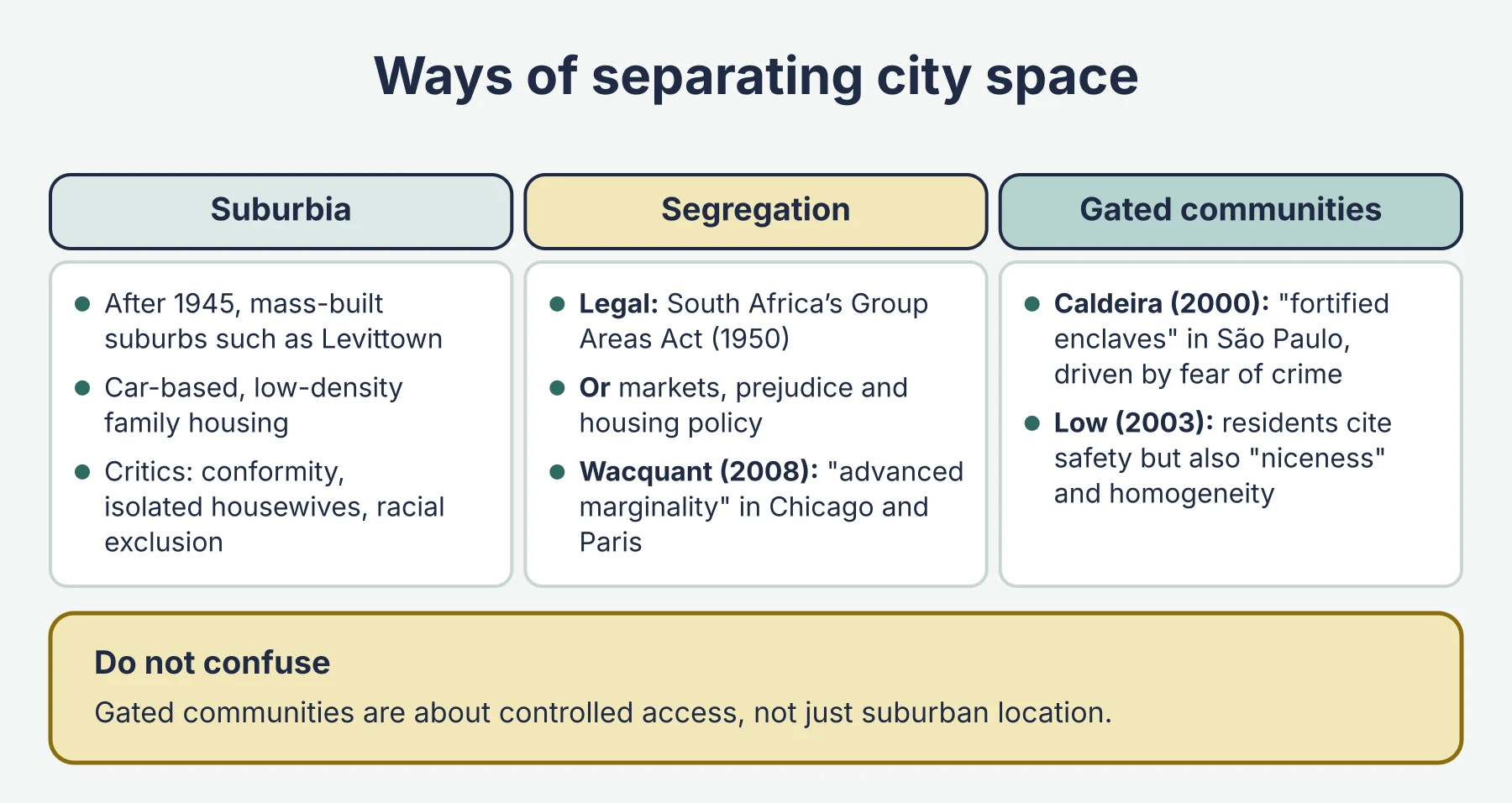
- Post-1945 mass suburbs (Levittown): car-based, linked to conformity, isolation and racial exclusion.
- Legal segregation: South Africa’s Group Areas Act (1950). Market segregation: prices, prejudice, policy.
- Wacquant (2008): advanced marginality in stigmatised neighbourhoods.
- Caldeira (2000): “fortified enclaves” in São Paulo.
- Low (2003): gated residents seek safety, “niceness” and homogeneity.
Megacities and non-places
- Megacities: 10 million plus; concentrate opportunity and risk.
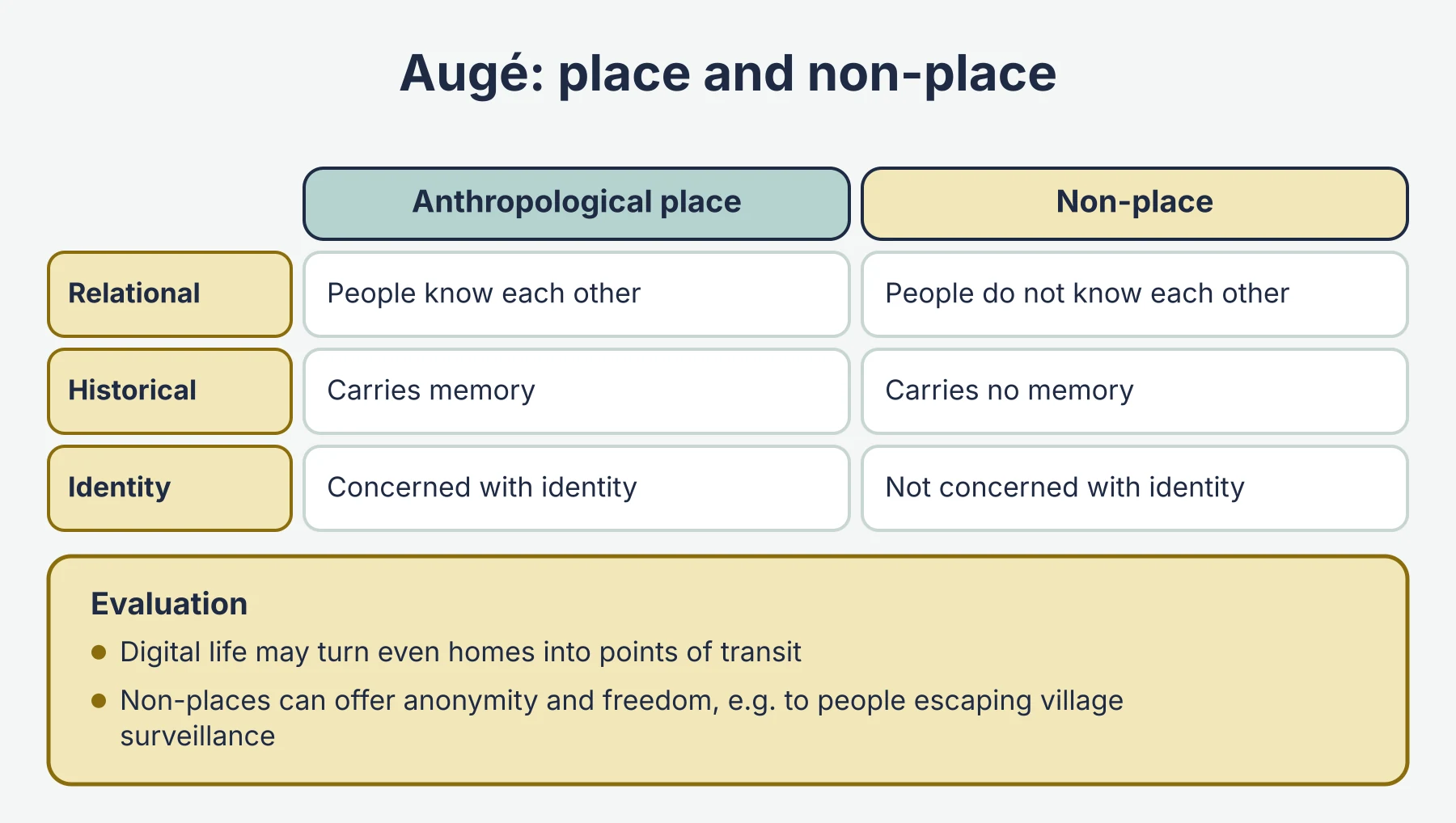
- Augé: anthropological place is relational, historical, about identity; non-places are none of these. Counter: anonymity can be freeing.
Power and inequalities
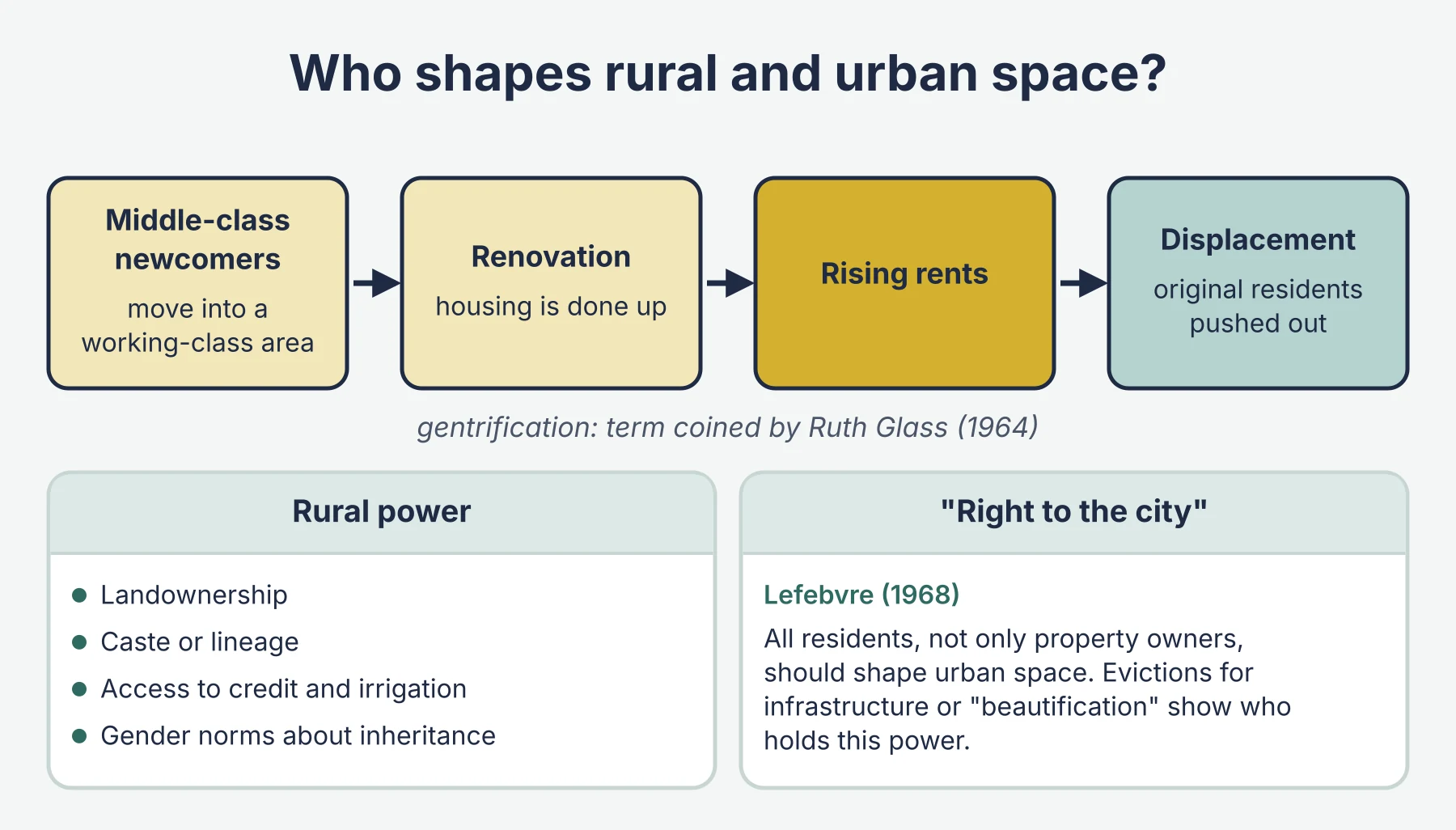
- Rural: land, caste or lineage, credit, irrigation, inheritance norms.
- Urban: gentrification (Glass, 1964); right to the city (Lefebvre, 1968); evictions for infrastructure.
Cities and climate
- Cities concentrate emissions but dense cities can use less energy per person.
- Jakarta: subsidence and flooding; new capital Nusantara announced in 2019.
- C40 city network (2005).
Demographic transition theory
- Four stages (high-high; falling death rate; falling birth rate; low-low).
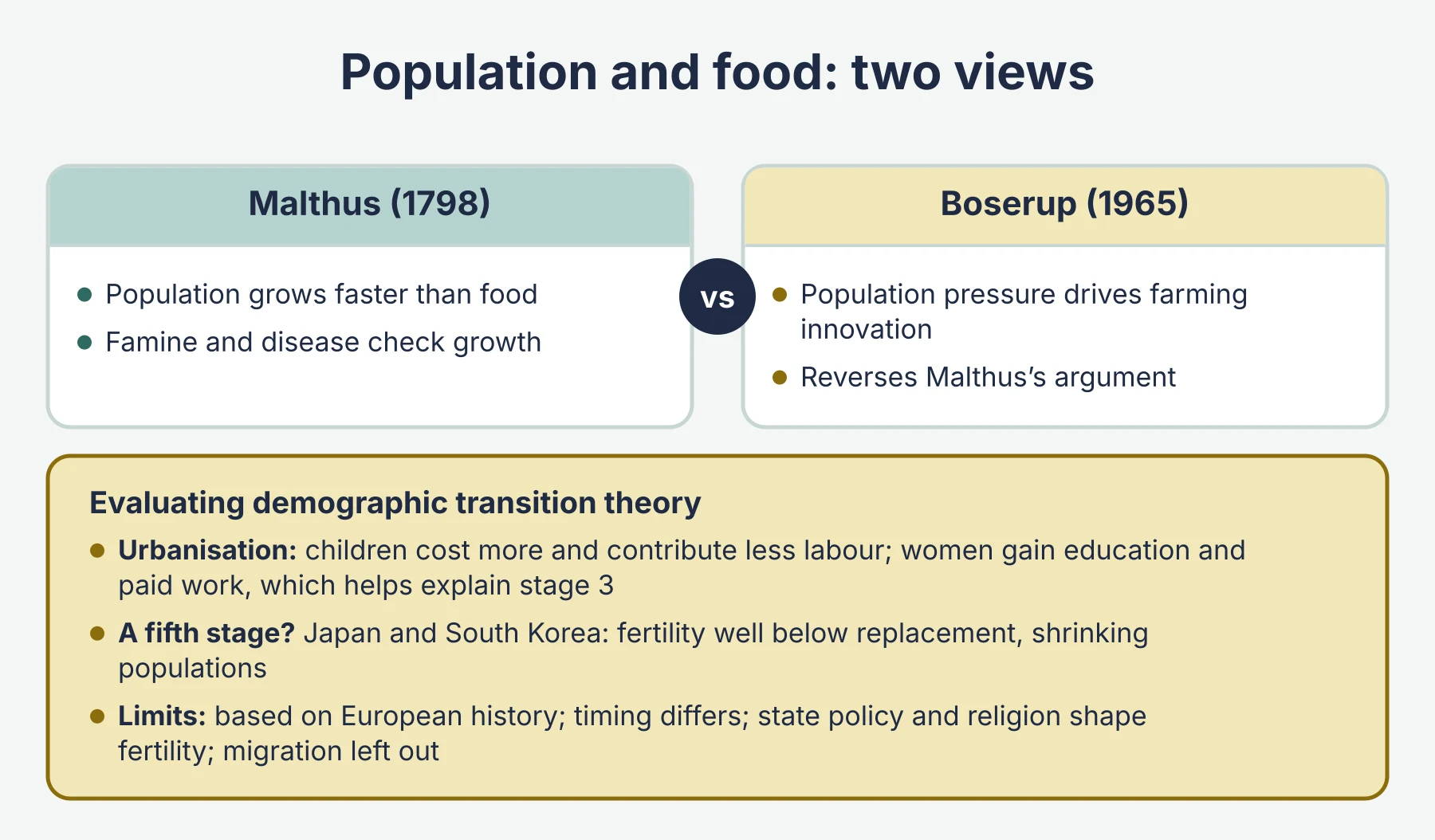
- Malthus (1798): population outruns food. Boserup (1965): population pressure drives innovation.
- Urbanisation lowers fertility: children cost more, women gain education and work.
- Possible fifth stage: below-replacement fertility in Japan and South Korea.
- Limits: European basis; timing varies; state and religion matter; ignores migration.
Key terms
| Term | Definition |
|---|---|
| Sedentarisation | Settlement of formerly nomadic people |
| ’Asabiyyah | Group solidarity (Ibn Khaldun) |
| Peasant | Small farmer using household labour, tied to wider markets and states |
| Debt bondage | Working to repay a loan that is never cleared |
| Rural depopulation | Decline of rural population as young adults leave |
| Gemeinschaft | Community based on kinship and place |
| Gesellschaft | Association based on contract and self-interest |
| Blasé attitude | Reserved, calculating outlook produced by urban overstimulation (Simmel) |
| Informal settlement | Housing built without legal title or planning permission |
| Gated community | Residential area with walls and controlled entry |
| Gentrification | Middle-class renovation of working-class areas, displacing residents |
| Right to the city | Claim that all residents should shape urban space (Lefebvre) |
| Megacity | Urban area of over 10 million people |
| Non-place | Space of transit or consumption without relationships, history or identity (Augé) |
Exam traps
- “Slum” is in inverted commas in the specification: show awareness that the label is contested.
- Wirth is not the last word; always counter with Gans or community evidence from informal settlements.
- Do not treat peasants and landless labourers as the same group; the difference is ownership or control of land.
- DTT questions need evaluation: European basis, state policy, a possible fifth stage.
- A gated community is not just a suburb; the defining feature is controlled access.
- Name a real city when discussing climate risk.
Self-test
- Name three forms of nomadism.
- What did Ibn Khaldun argue about nomads and cities?
- What is debt bondage?
- What did Scott mean by “weapons of the weak”?
- What three features of cities did Wirth identify?
- How did Gans challenge Wirth?
- What did Perlman find about favela residents?
- Give one argument for and one against de Soto’s property titles.
- What did Caldeira call the walled estates of São Paulo?
- Who coined “gentrification” and what does it mean?
- How does urbanisation help explain falling birth rates?
- Give two criticisms of demographic transition theory.
Answers
- Pastoral, hunter-gatherer, and commercial or service nomadism.
- Nomads’ strong group solidarity lets them conquer settled peoples, but city comfort weakens it until another group replaces them.
- Working to repay a loan that is never cleared, so the worker is tied to the lender.
- Everyday resistance by poor farmers, such as foot-dragging, gossip and false compliance, instead of open revolt.
- Size, density and heterogeneity.
- He found close-knit “urban villagers” in Boston, showing community survives in cities.
- They were integrated into society as workers, voters and consumers, but exploited and stigmatised.
- For: titles turn homes into capital for loans. Against: titles can raise land values and push the poorest out.
- “Fortified enclaves”.
- Ruth Glass (1964); middle-class newcomers renovating working-class areas and displacing original residents.
- Children cost more and contribute less labour in cities, and women gain education and paid work.
- Any two: based on European history; timing varies; ignores state policy and religion; ignores migration; did not predict below-replacement fertility.
Test yourself with the built human environment practice questions.
Related resources
-
Study guides
OxfordAQA International A-level Sociology (9690): Human impacts on environment
Guide to OxfordAQA 9690 section 3.2.2.2: views of nature, consumption, pollution, the climate crisis as a social problem, responses, theories and justice.
Sociology · OxfordAQA · A Level
Read guide -
Practice questions
OxfordAQA International A-level Sociology (9690): Human impacts on environment – Practice Questions
Original OxfordAQA 9690 practice questions on views of nature, consumption, the commons, risk, climate responses, green Marxism and inequality, with answers.
Sociology · OxfordAQA · A Level
Try questions -
Revision notes
OxfordAQA International A-level Sociology (9690): Human impacts on environment – Revision Notes
Revision notes for OxfordAQA 9690 section 3.2.2.2: views of nature, consumption, pollution, climate as a social problem, denial, EMT, green Marxism and justice.
Sociology · OxfordAQA · A Level
Revise topic
Related articles
Get free revision emails (optional)
Occasional emails with practice questions, worked explanations and links to free resources for the qualification and subjects you choose. No spam, and you can unsubscribe from any email. The free tools on this site never need an email.