
Revision Notes
OxfordAQA International A-level Sociology (9690): Human impacts on environment – Revision Notes
Revision notes for OxfordAQA 9690 section 3.2.2.2: views of nature, consumption, pollution, climate as a social problem, denial, EMT, green Marxism and justice.
- Subject
- Sociology
- Level
- A LEVEL
- Topic
- Unit 4 – People and the Environment
- Author
- Marlbridge Academic Team
- Updated
- Reviewed by
- Naqiya Yousaf (what this means)
Aligned to OxfordAQA A Level Sociology (9690), Version 1.1. Official specification .
Syllabus page (what it covers and how it is assessed): OxfordAQA A Level Sociology.
Syllabus points this page covers
9690 (A Level)
- 3.2.2.2 Human impacts on environment
Found an error? Report a correction.
Need help with this topic? Request a free trial class for A Level Sociology (9690).
These notes condense content point 3.2.2.2 Human impacts on environment of OxfordAQA International A-level Sociology (9690), Version 1.1, assessed in the Unit 4 People and the environment exam. Full explanations are in the human impacts on environment study guide; the rest of the unit is in the People and the environment revision notes.
What the specification lists
- Views of people and the natural world: exploitation; romanticism; conservation; media representations.
- Future generations and “the long now”.
- Consumption; sustainability; energy sources; agriculture and food.
- Mass transport and commuting; tourism and over-tourism.
- Air, land and water pollution; plastics; e-waste.
- Desertification; deforestation; extraction and mining; national parks and protected areas; oceans.
- Global heating; wildfires.
- Social construction of environmental and climate crises as social problems.
- Responses: scepticism and denialism; governments and the IPCC; environmental movements.
- Ecological modernisation theory; green Marxism.
- Inequalities between and within countries; environmental and climate justice.
Core recall
Views of nature
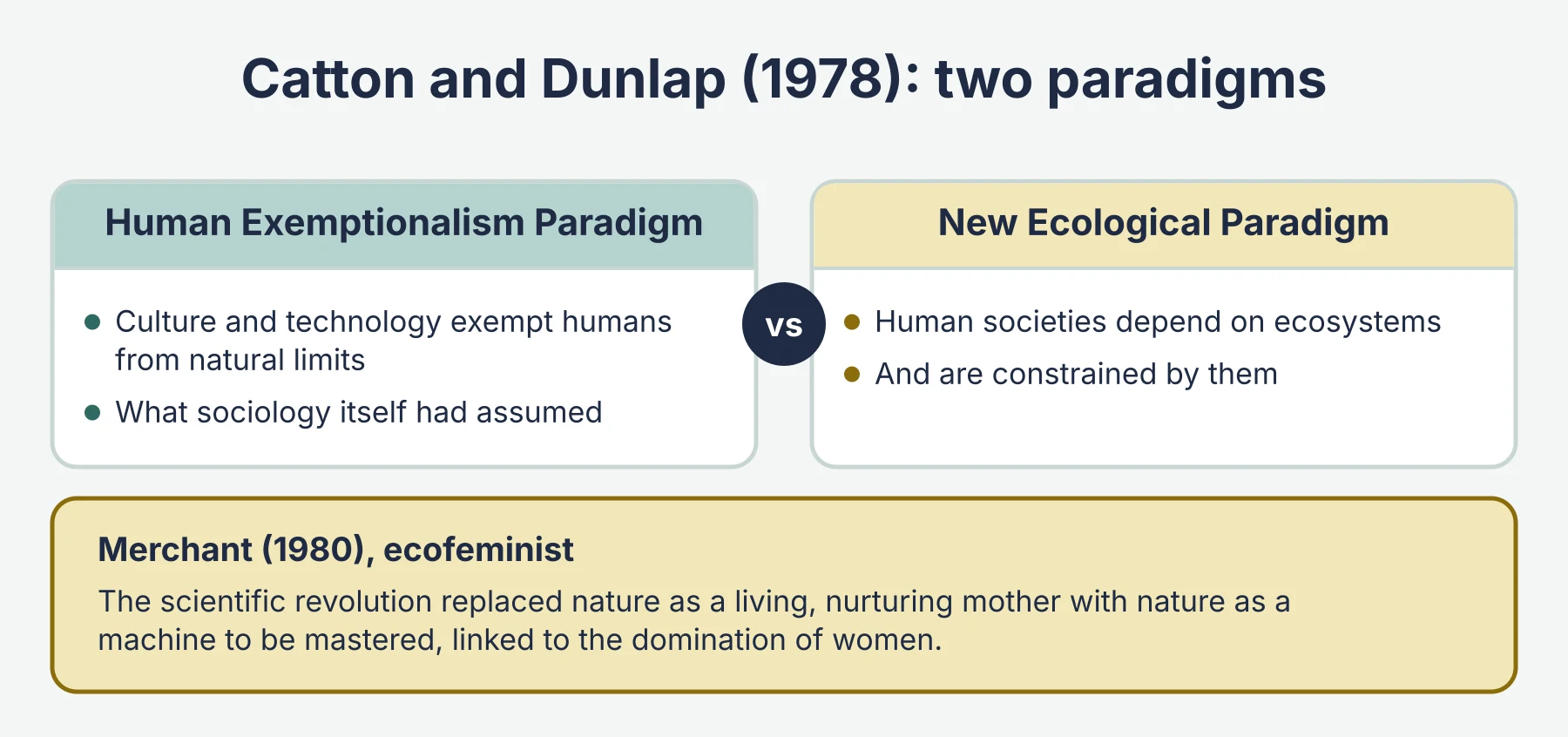
- Catton and Dunlap (1978): Human Exemptionalism Paradigm versus New Ecological Paradigm.
- Merchant (1980): scientific revolution turned nature from nurturing mother to machine; ecofeminist link to domination of women.
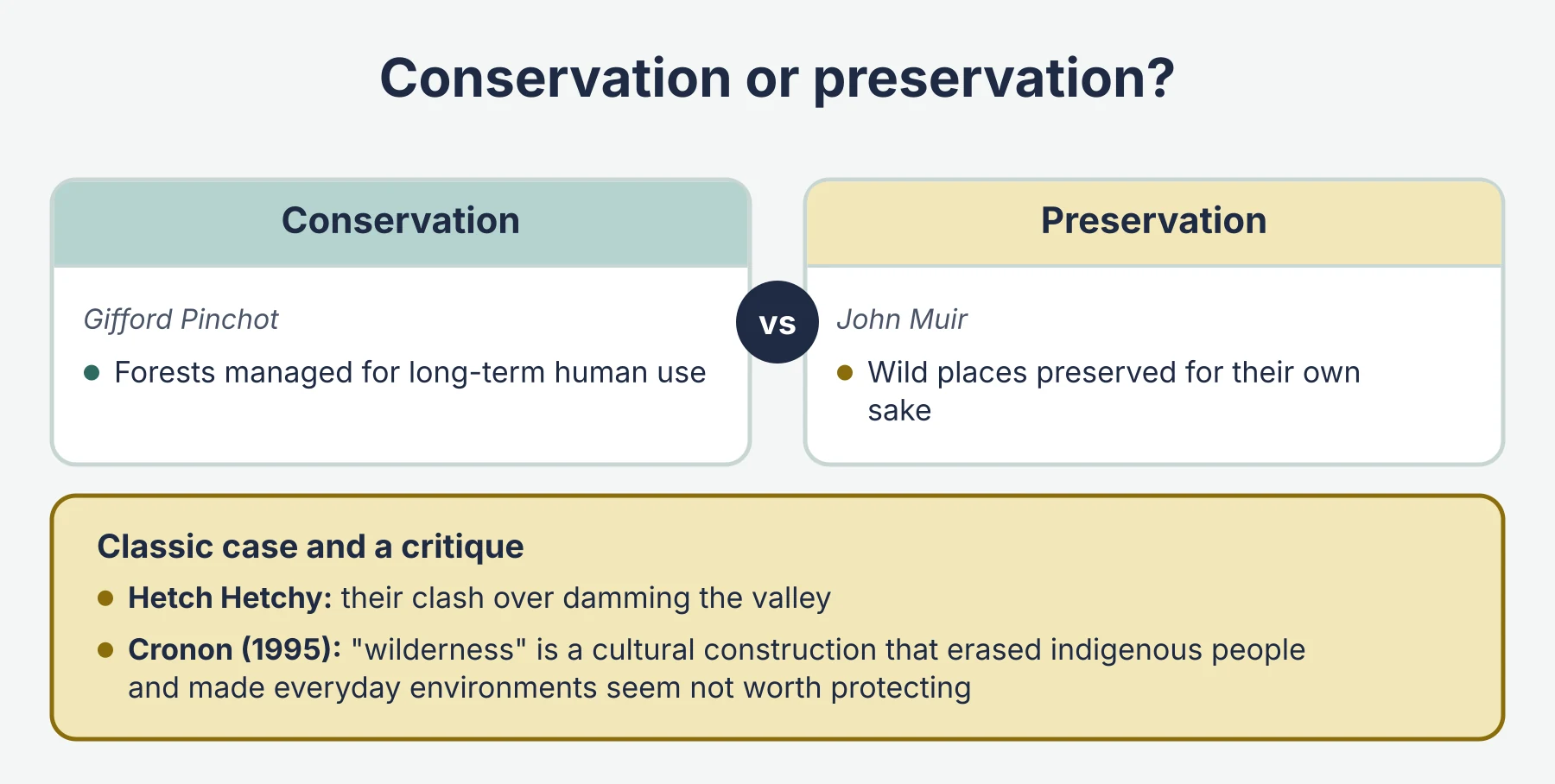
- Cronon (1995): “wilderness” is a cultural construction that erased indigenous people.
- Pinchot (managed use) versus Muir (preservation): the Hetch Hetchy dispute.
- Carson (1962), Silent Spring: a book that made pesticides a public issue.
- Documentaries such as Blue Planet II (2017) credited with raising concern about plastics.
- Media favour dramatic events over slow processes.
Time and consumption
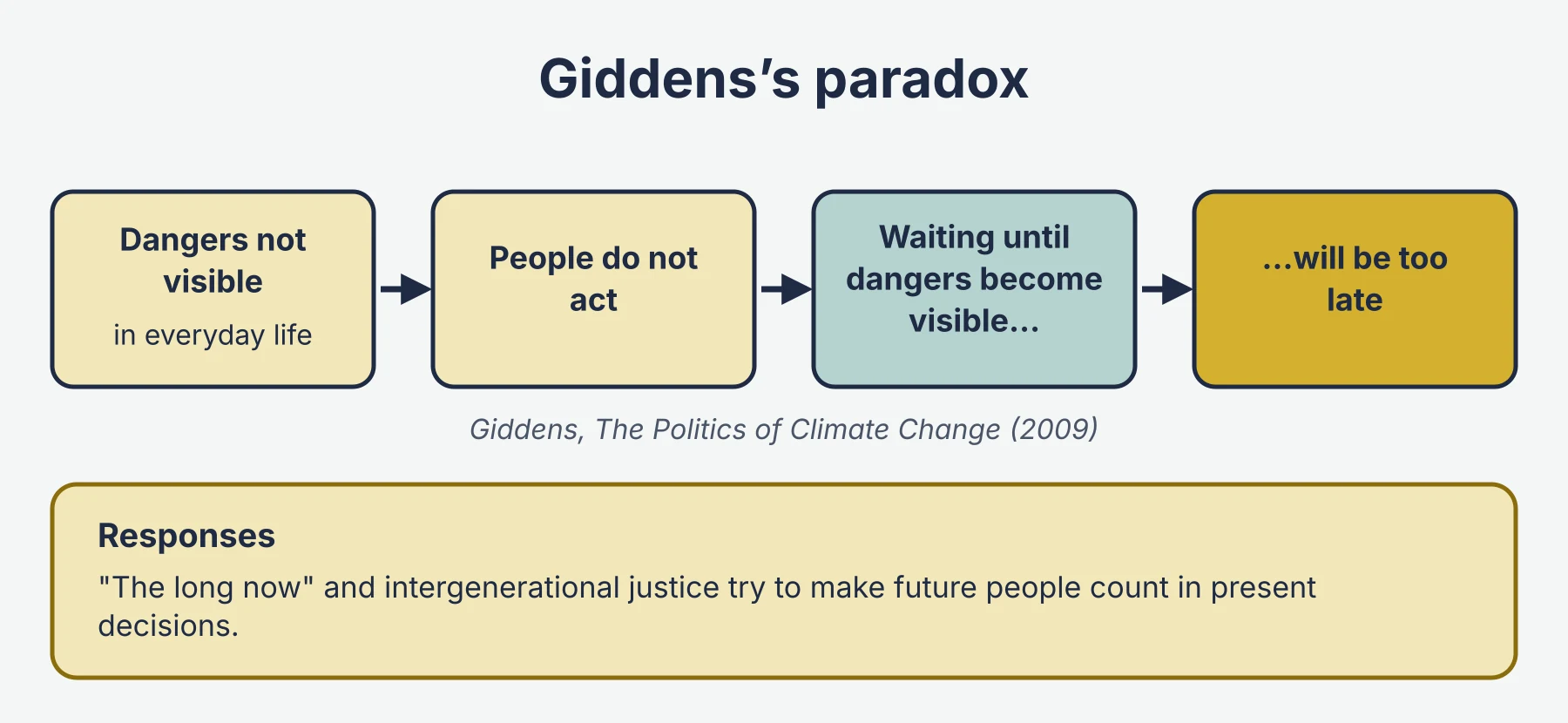
- Giddens’s paradox (2009): invisible dangers mean no action until too late.
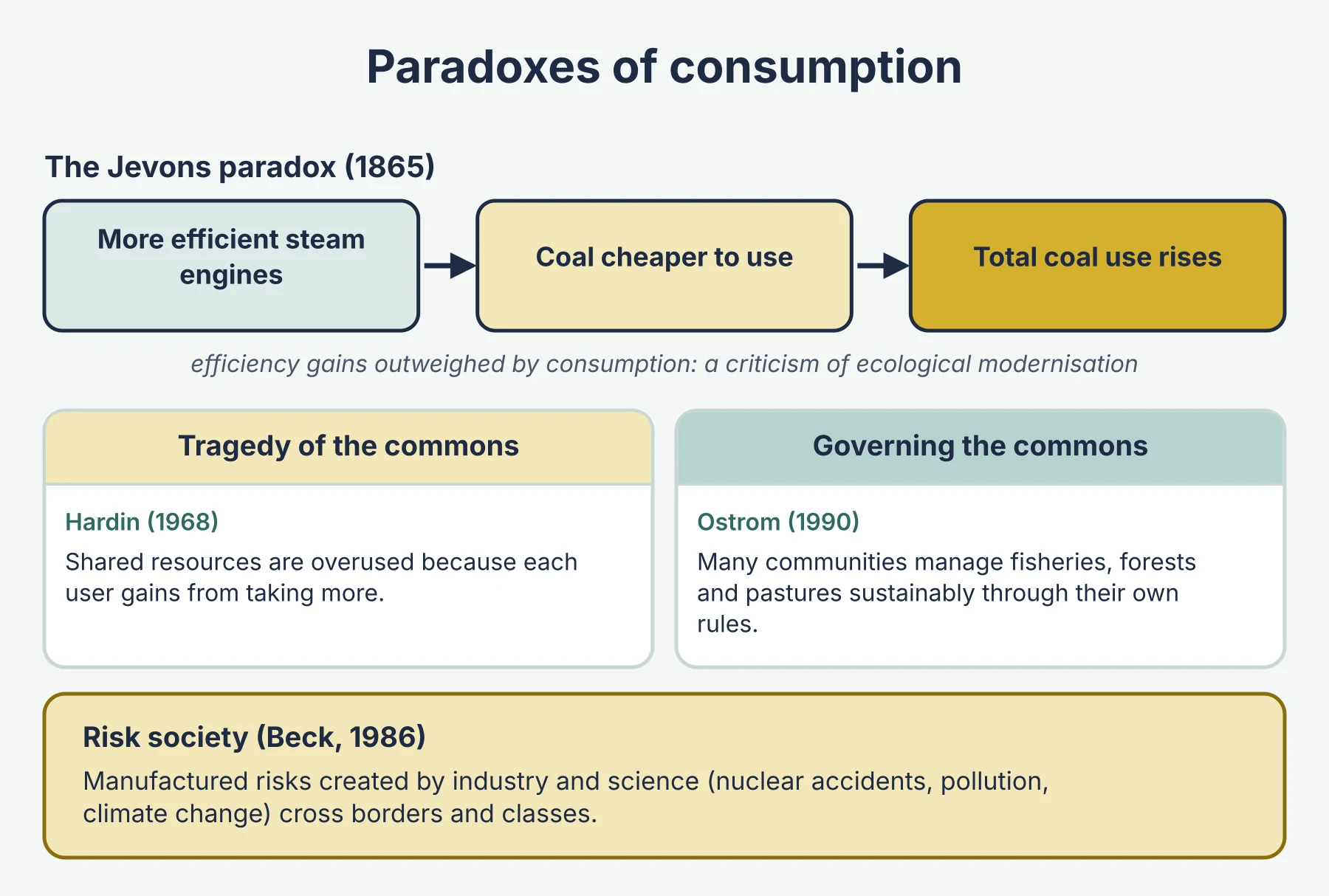
- Jevons paradox (1865): efficiency can raise total use.
- Hardin (1968): tragedy of the commons. Ostrom (1990): communities can manage commons sustainably.
- Beck (1986): risk society and manufactured risks that cross borders and classes.
Cases
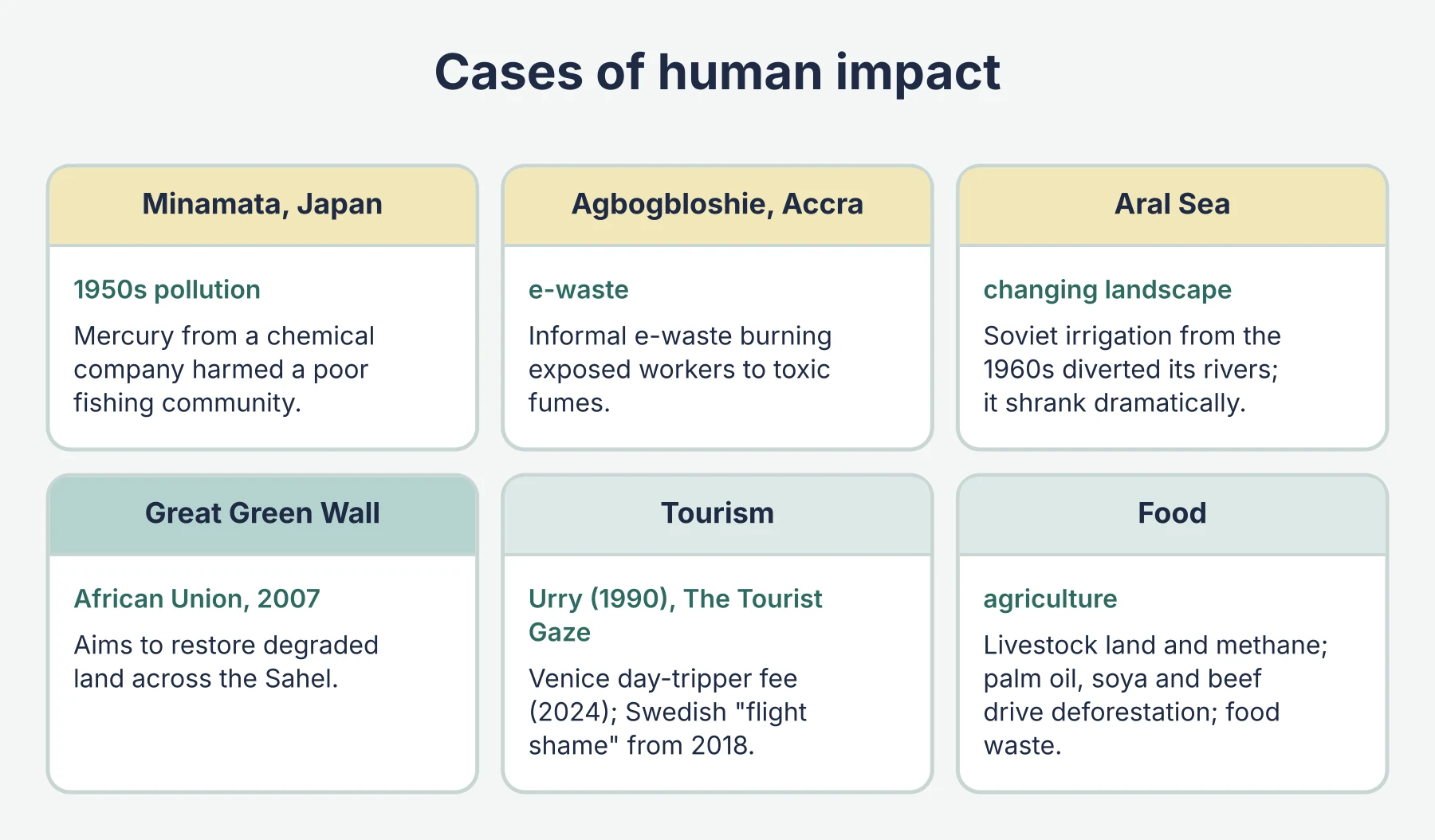
- Food: livestock land use and methane; palm oil, soya and beef drive deforestation; food waste.
- Tourism: Urry’s tourist gaze (1990); Venice day-tripper fee (2024); “flight shame” (2018).
- Pollution: Minamata mercury poisoning, Japan (1950s); e-waste burning at Agbogbloshie, Accra.
- Landscapes: Aral Sea shrinkage after Soviet irrigation; Great Green Wall initiative in the Sahel (2007).
Climate crisis
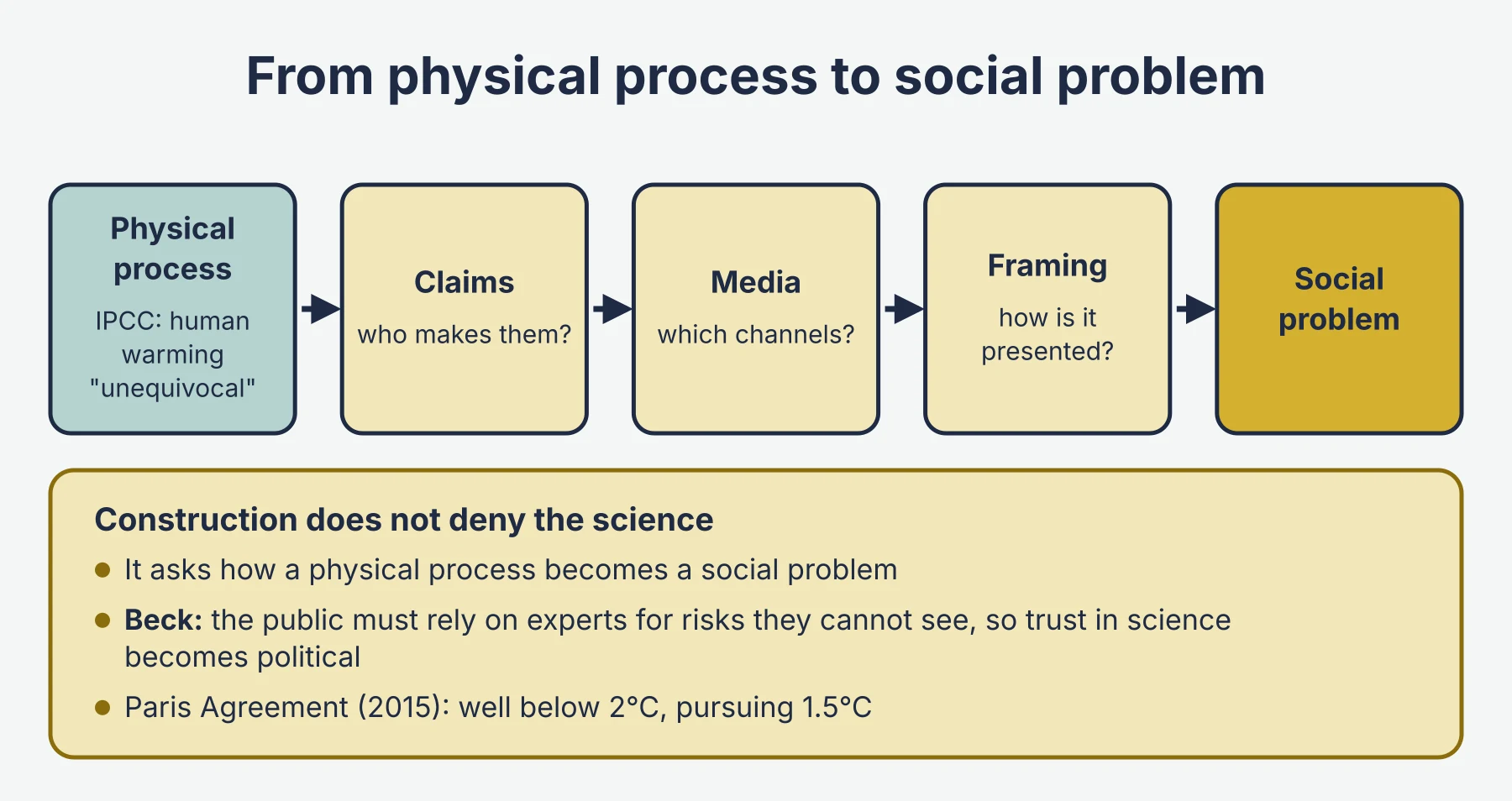
- IPCC Sixth Assessment Report (2021 to 2023): human influence on warming is “unequivocal”.
- Paris Agreement (2015): well below 2°C, pursuing 1.5°C.
- Construction asks how a real process becomes a social problem; Beck adds dependence on experts.
Responses
- Organised doubt (Oreskes and Conway); socially organised denial (Norgaard).
- McCright and Dunlap (2011): denial concentrated among conservative white men in the US.
- IPCC assesses evidence; governments negotiate and are shaped by national interests.
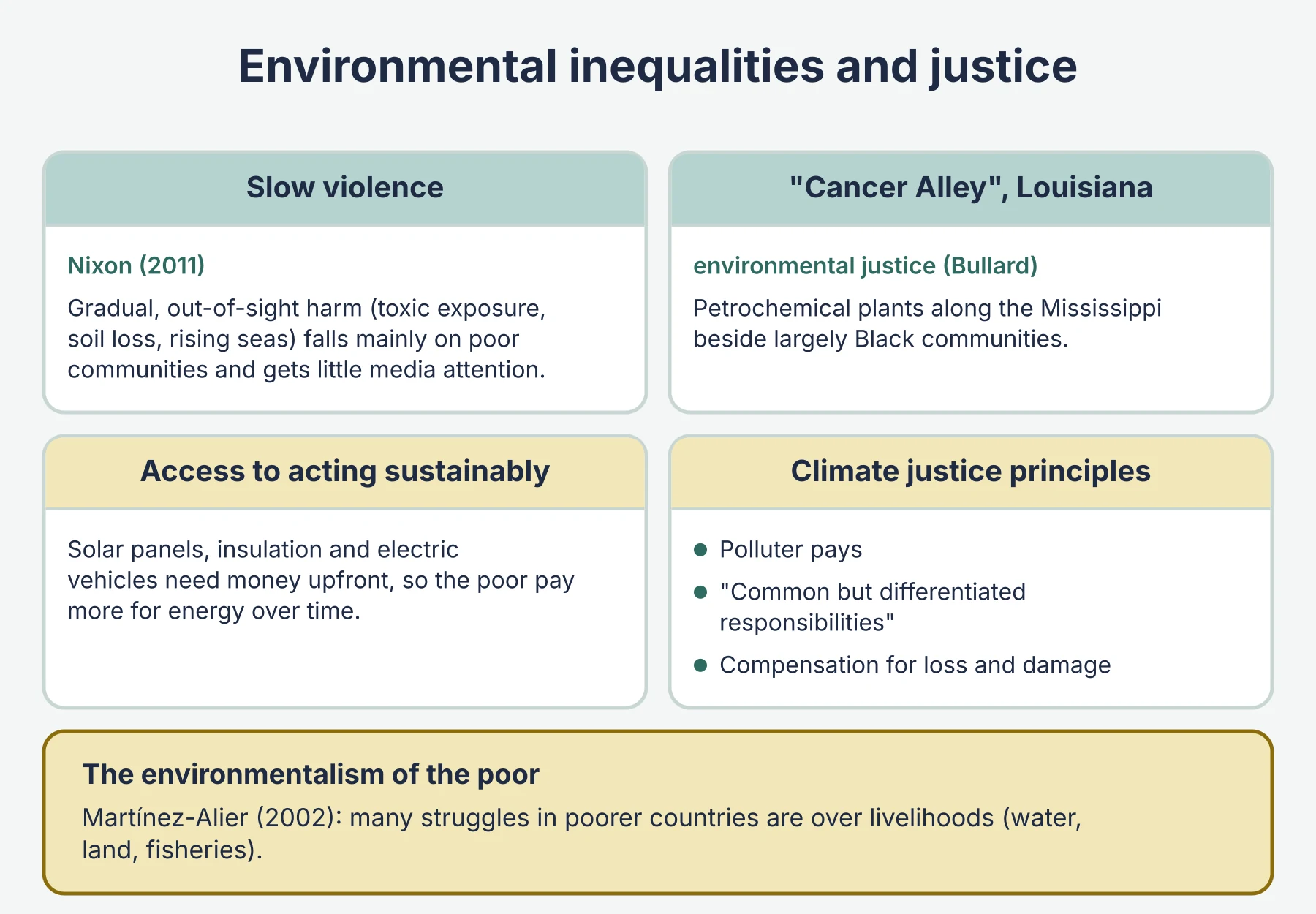
- Martínez-Alier (2002): “environmentalism of the poor”, struggles over livelihoods.
Theories
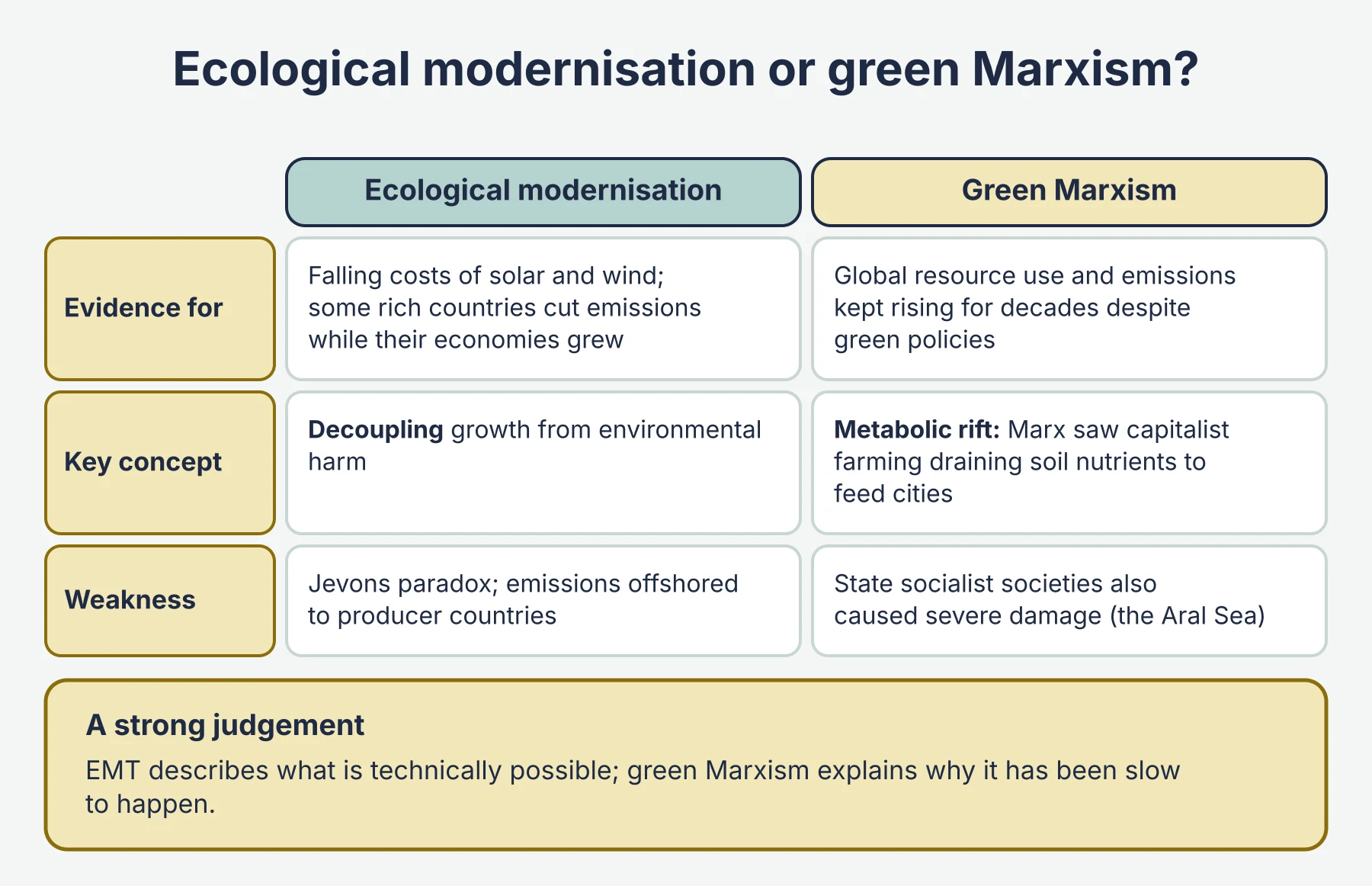
- EMT: decoupling; renewables cheaper; some rich economies grew while cutting emissions. Weaknesses: Jevons paradox, offshoring.
- Green Marxism: metabolic rift (Marx on soil depletion); treadmill of production. Weakness: state socialist damage such as the Aral Sea.
- Judgement line: EMT shows what is technically possible; green Marxism explains why it is slow.
Inequalities and justice
- Nixon (2011): slow violence against poor communities, little media attention.
- “Cancer Alley”, Louisiana: petrochemical plants beside largely Black communities.
- Sustainable choices often need money upfront, so the poor pay more over time.
- Principles: polluter pays; common but differentiated responsibilities; loss and damage.
Key terms
| Term | Definition |
|---|---|
| Human Exemptionalism Paradigm | Assumption that culture and technology free humans from natural limits |
| New Ecological Paradigm | View that societies depend on and are limited by ecosystems |
| Wilderness | Idea of untouched nature, criticised as a cultural construction |
| Giddens’s paradox | Invisible climate dangers lead to inaction until it is too late |
| Jevons paradox | Efficiency gains increase total resource use |
| Tragedy of the commons | Overuse of shared resources by self-interested users (Hardin) |
| Manufactured risk | Risk created by modern science and industry (Beck) |
| Tourist gaze | Socially structured way tourists look at places (Urry) |
| Decoupling | Economic growth without matching growth in environmental harm |
| Metabolic rift | Break between society and natural cycles under capitalism |
| Slow violence | Gradual, hidden environmental harm (Nixon) |
| Environmentalism of the poor | Environmental struggles over livelihoods in poorer communities |
| Polluter pays | Principle that those causing harm should bear its costs |
Exam traps
- Social construction is not denial: say that problems are real but must be claimed.
- “Sustainability” needs a definition and a test, such as decoupling.
- Ostrom answers Hardin: do not cite the tragedy of the commons as fact.
- The IPCC is not a government and does not make law.
- Name the inequality: between countries, within countries, or in access to acting sustainably.
- Pair every case with a concept; a list of disasters earns little.
Self-test
- What did Catton and Dunlap mean by the Human Exemptionalism Paradigm?
- What did Merchant argue about the scientific revolution?
- Why did Cronon call wilderness a cultural construction?
- Explain Giddens’s paradox.
- What is the Jevons paradox and which theory does it challenge?
- How did Ostrom challenge Hardin?
- What is a manufactured risk?
- Give one example of industrial pollution harming a poor community.
- What did McCright and Dunlap find about climate denial?
- What did Martínez-Alier mean by the environmentalism of the poor?
- What is slow violence?
- Give one strength and one weakness of ecological modernisation theory.
Answers
- The assumption, common in sociology, that culture and technology exempt humans from natural limits.
- It replaced an image of nature as a living mother with nature as a machine to master, linked to the domination of women.
- Treating landscapes as untouched ignored the indigenous people who lived in and shaped them.
- Climate dangers are not visible in daily life, so people do not act, but waiting until they are visible will be too late.
- Greater efficiency can increase total resource use; it challenges ecological modernisation theory.
- She showed that many communities manage shared resources sustainably through their own rules.
- A risk created by modern science and industry, such as nuclear accidents or climate change.
- Minamata mercury poisoning in Japan, or e-waste burning at Agbogbloshie.
- Conservative white men in the US were especially likely to deny climate change.
- Environmental struggles in poorer countries are often conflicts over livelihoods such as land, water and fisheries.
- Gradual, hidden environmental harm that falls mainly on poor communities and gets little attention.
- Strength: renewable costs have fallen and some economies grew while cutting emissions. Weakness: the Jevons paradox or offshoring of emissions.
Apply these in the human impacts on environment practice questions.
Related resources
-
Study guides
OxfordAQA International A-level Sociology (9690): People and animals
Guide to OxfordAQA 9690 section 3.2.2.3: Bryant, welfare and rights, domestication, pets, zoonoses, the Columbian Exchange, biodiversity and biotechnology.
Sociology · OxfordAQA · A Level
Read guide -
Practice questions
OxfordAQA International A-level Sociology (9690): People and animals – Practice Questions
Original OxfordAQA 9690 practice questions on human-animal relations, welfare and rights, slaughter, zoonoses, conservation and experiments, with answers.
Sociology · OxfordAQA · A Level
Try questions -
Revision notes
OxfordAQA International A-level Sociology (9690): People and animals – Revision Notes
Revision notes for OxfordAQA 9690 section 3.2.2.3: Bryant, the sociozoologic scale, welfare and rights, slaughter, pets, zoonoses, biodiversity and the 3Rs.
Sociology · OxfordAQA · A Level
Revise topic
Related articles
Get free revision emails (optional)
Occasional emails with practice questions, worked explanations and links to free resources for the qualification and subjects you choose. No spam, and you can unsubscribe from any email. The free tools on this site never need an email.