
Study Guides
OxfordAQA International A-level Sociology (9690): People and animals
Guide to OxfordAQA 9690 section 3.2.2.3: Bryant, welfare and rights, domestication, pets, zoonoses, the Columbian Exchange, biodiversity and biotechnology.
- Subject
- Sociology
- Level
- A LEVEL
- Topic
- Unit 4 – People and the Environment
- Author
- Marlbridge Academic Team
- Updated
- Reviewed by
- Naqiya Yousaf (what this means)
Aligned to OxfordAQA A Level Sociology (9690), Version 1.1. Official specification .
Syllabus page (what it covers and how it is assessed): OxfordAQA A Level Sociology.
Syllabus points this page covers
9690 (A Level)
- 3.2.2.3 People and animals
Found an error? Report a correction.
Need help with this topic? Request a free trial class for A Level Sociology (9690).
This guide covers content point 3.2.2.3 People and animals of the OxfordAQA International A-level Sociology (9690) specification, Version 1.1, assessed in the Unit 4 People and the environment exam. The specification lists: “The zoological connection (Bryant); views of the relationship between humans and animals”; “Animal welfare; animal cruelty and animal rights”; “Domestication: working animals; livestock: production and slaughter of animals for food”; “Pets: companion animal-human relationships and the therapeutic use of animals”; “Health: relationships between animals and diseases affecting people including zoonotic diseases”; “The Columbian Exchange”; “Biodiversity: extinctions; reduction in numbers including megafauna; hunting and fishing; invasive species”; “Attempts to counter biodiversity loss, including conservation, zoos, rewilding, reintroduction of species and de-extinction”; and “Biotechnology and genomics; animal experimentation”.
The People and the environment study guide defines these terms and introduces Bryant, Singer, Regan, Crosby and the Yellowstone wolves. This page adds the sociological frameworks and further cases you need to analyse them. Pair it with the people and animals revision notes and the people and animals practice questions.
Why animals are a sociological topic
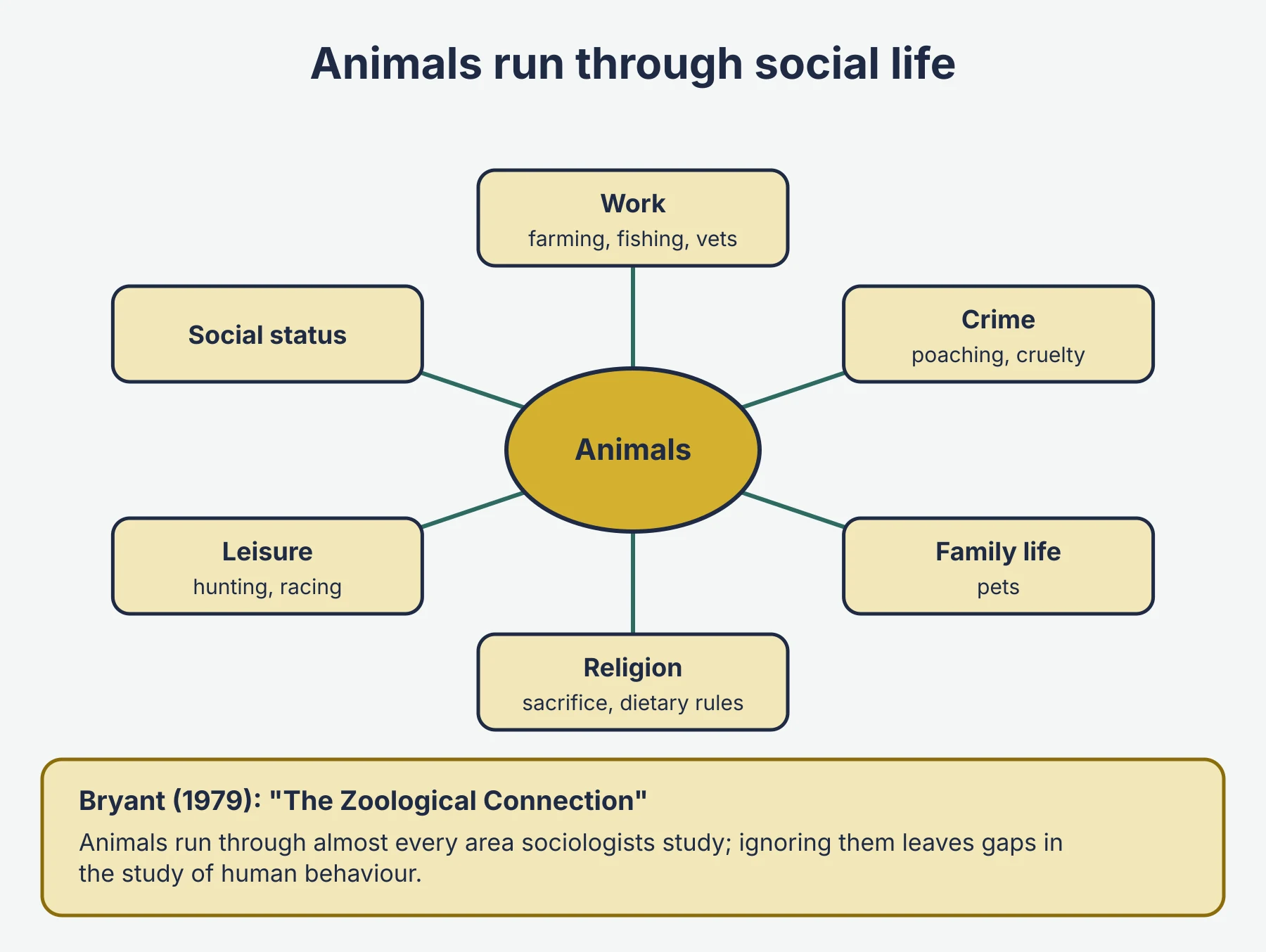
Clifton Bryant’s article “The Zoological Connection: Animal-Related Human Behavior” (Social Forces, 1979) argued that animals run through almost every area sociologists study: work (farming, fishing, veterinary care), crime (poaching, cruelty), family life (pets), religion (sacrifice, dietary rules), leisure (hunting, racing) and social status. His point was that ignoring animals leaves gaps in the study of human behaviour.
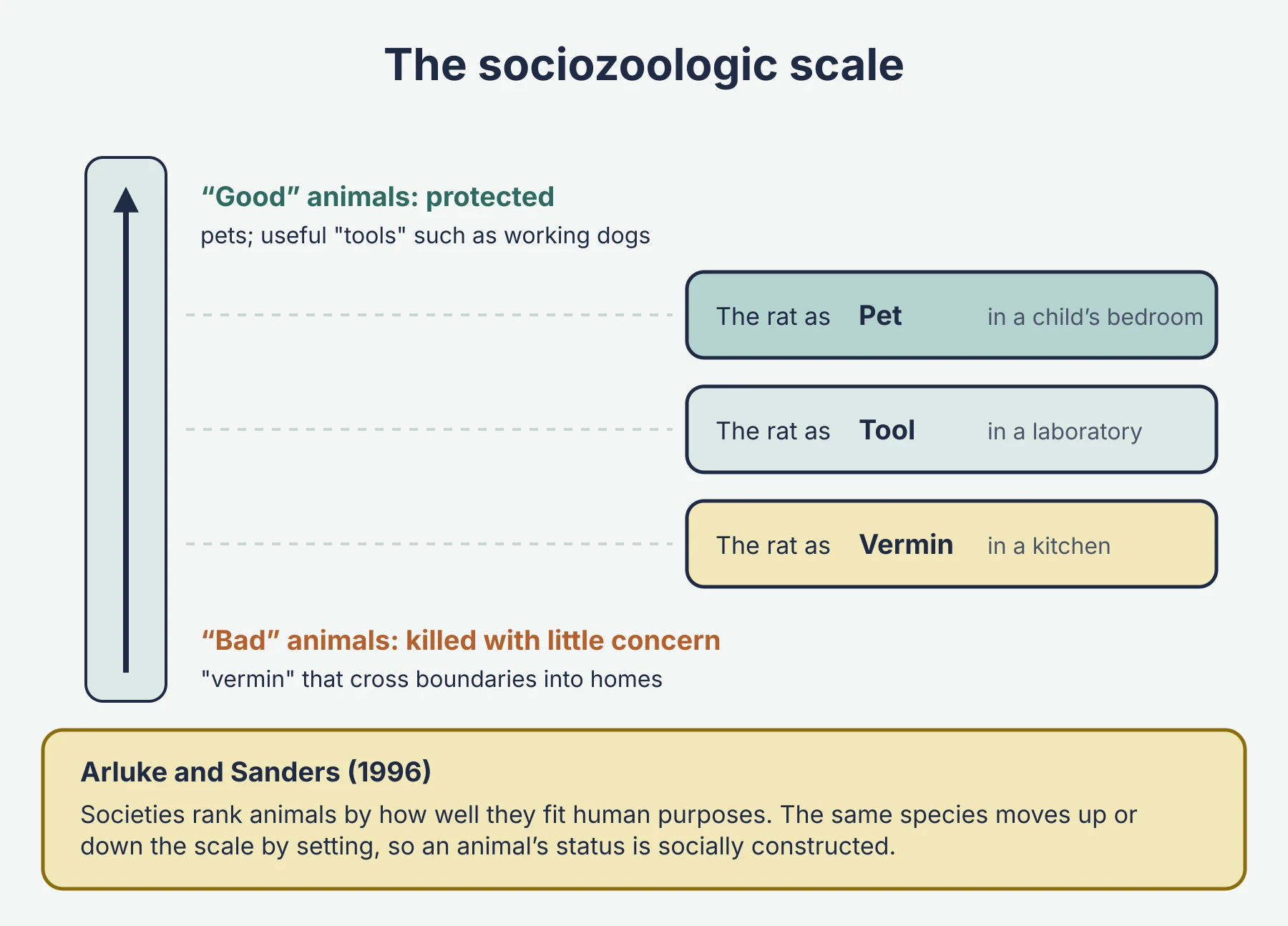
Arnold Arluke and Clinton Sanders (Regarding Animals, 1996) developed this with the sociozoologic scale: societies rank animals by how well they fit human purposes. “Good” animals, such as pets and useful “tools” like working dogs, are protected; “bad” animals, such as “vermin” that cross boundaries into homes, can be killed with little concern. The same species can move up or down the scale in different settings: a rat is vermin in a kitchen, a tool in a laboratory and a pet in a child’s bedroom. This shows that the status of animals is socially constructed.
Views of humans and animals
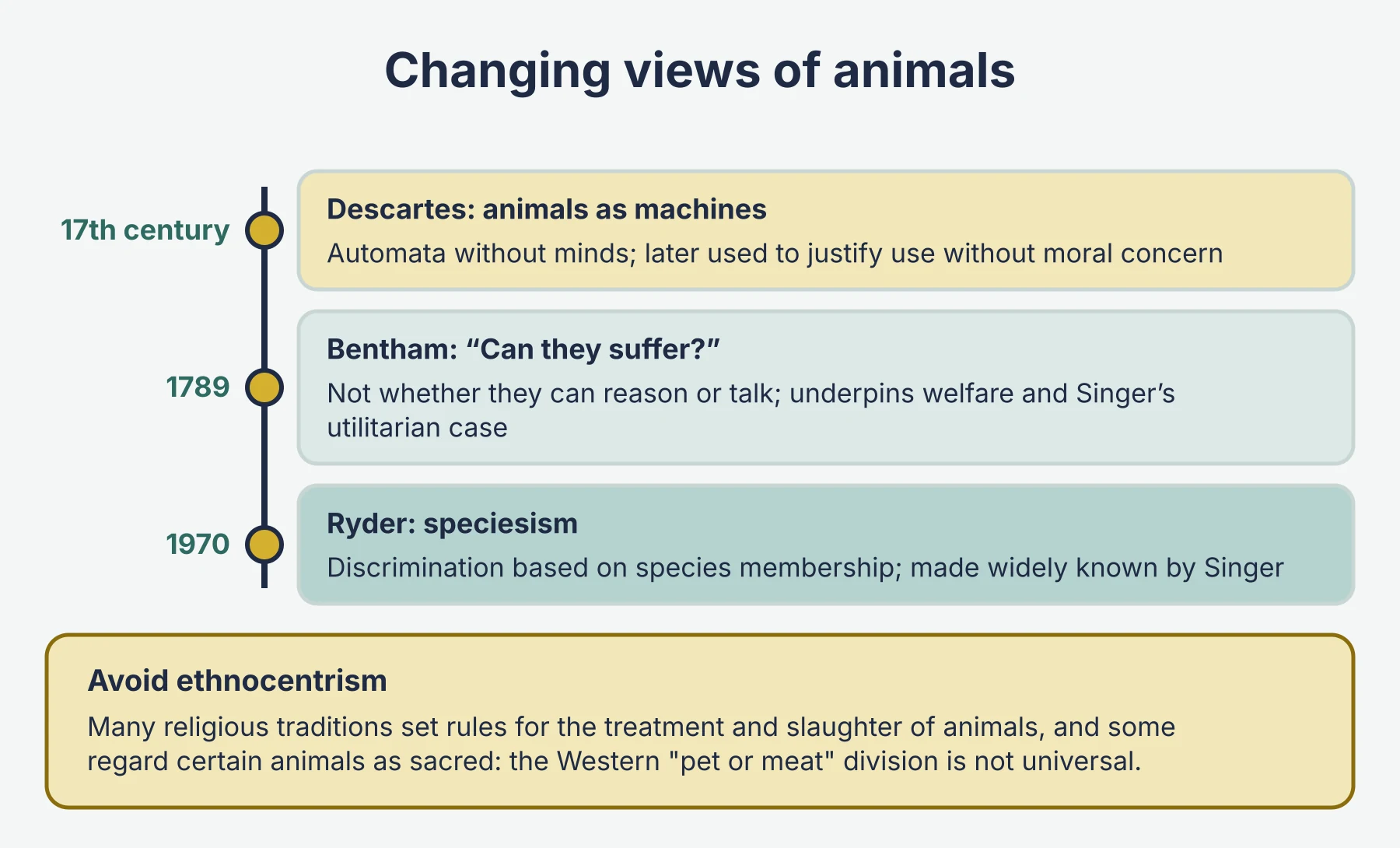
- Animals as machines: the philosopher René Descartes (seventeenth century) argued that animals were automata without minds, which was later used to justify their use without moral concern.
- Suffering matters: Jeremy Bentham (1789) wrote that the question is not whether animals can reason or talk, but “Can they suffer?”. This underpins welfare and Singer’s utilitarian case.
- Speciesism: Richard Ryder coined the term in 1970 for discrimination based on species membership; Singer made it widely known.
- Cultural and religious diversity: many religious traditions set rules for the treatment and slaughter of animals, and some regard certain animals as sacred. Answers should avoid presenting the Western “pet or meat” division as universal.
Welfare, cruelty and rights
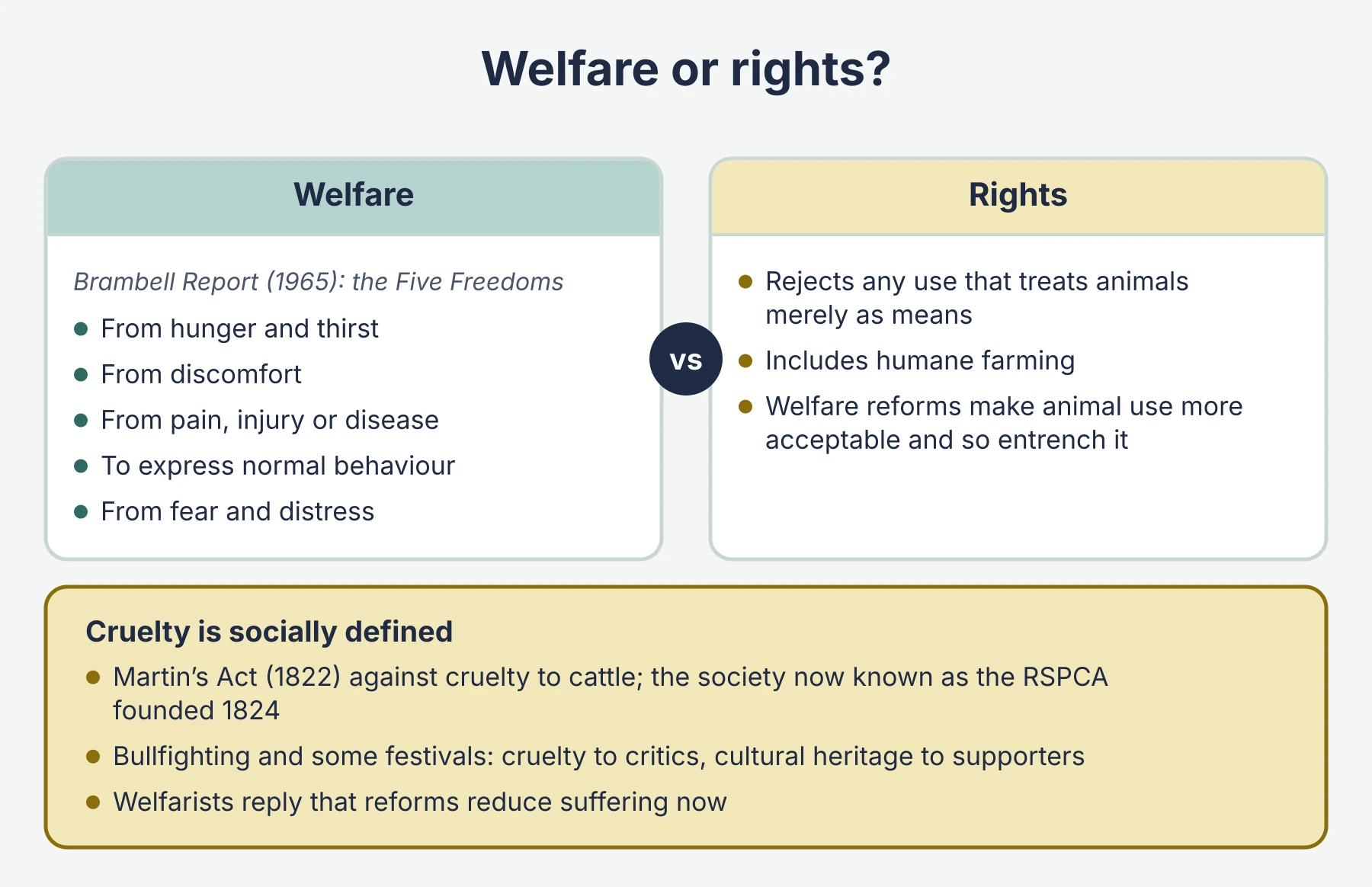
- Welfare: the UK Brambell Report (1965) led to the Five Freedoms for farmed animals: freedom from hunger and thirst; from discomfort; from pain, injury or disease; to express normal behaviour; and from fear and distress.
- Cruelty: Britain’s 1822 law against cruelty to cattle (Martin’s Act) was among the first, and the society now known as the RSPCA was founded in 1824. Cruelty is socially defined: practices such as bullfighting or some traditional festivals are cruel to critics and cultural heritage to supporters.
- Rights: the rights view rejects any use that treats animals merely as means, including humane farming.
Evaluation: welfare reforms can make the use of animals more acceptable and so entrench it, which is why rights theorists criticise them; welfarists reply that reforms reduce suffering now.
Domestication, livestock and slaughter
Domestication turned some wild species into working animals and food over thousands of years, beginning with dogs. Today, the scale of industrial livestock production is the central sociological issue.
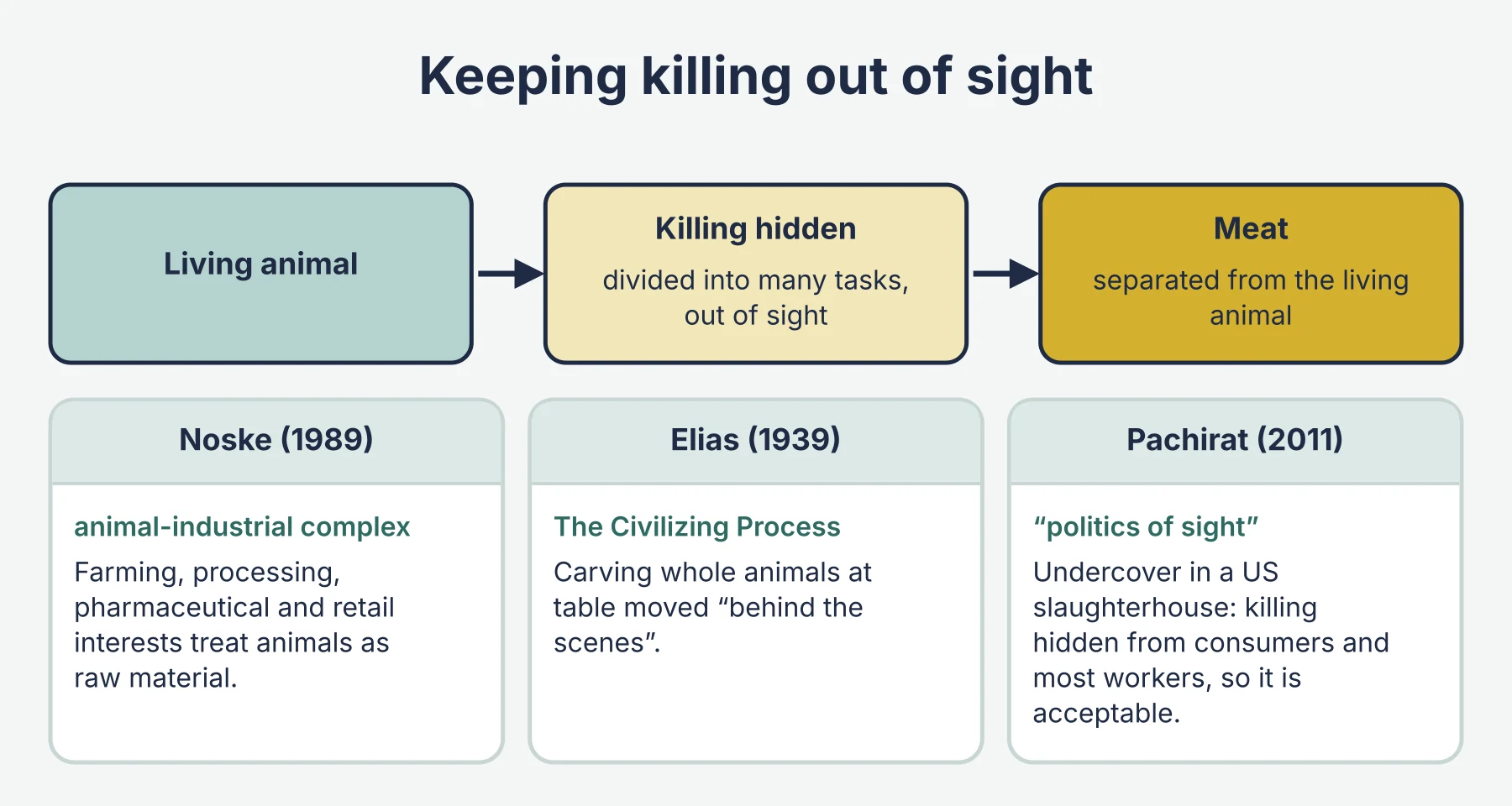
- Barbara Noske (Humans and Other Animals, 1989) used the term animal-industrial complex for the network of farming, processing, pharmaceutical and retail interests that treats animals as raw material.
- Norbert Elias (The Civilizing Process, 1939) noted that carving whole animals at the table moved “behind the scenes” as European manners changed, so meat was separated from the living animal.
- Timothy Pachirat (Every Twelve Seconds, 2011), who worked undercover in a US slaughterhouse, described a “politics of sight”: killing is divided into many tasks and hidden from consumers and even most workers, which makes it socially acceptable.
Pets and therapeutic use
James Serpell (In the Company of Animals, 1986) examined why people keep companion animals at great cost, arguing that the benefit is social and emotional companionship. Pets are increasingly treated as family members, with names, birthdays and medical care. Therapeutic uses include guide and assistance dogs, therapy animals in hospitals, care homes and schools, and equine-assisted therapy. Research findings on health benefits are mixed, and the welfare of working therapy animals is itself a concern.
Animals and human health
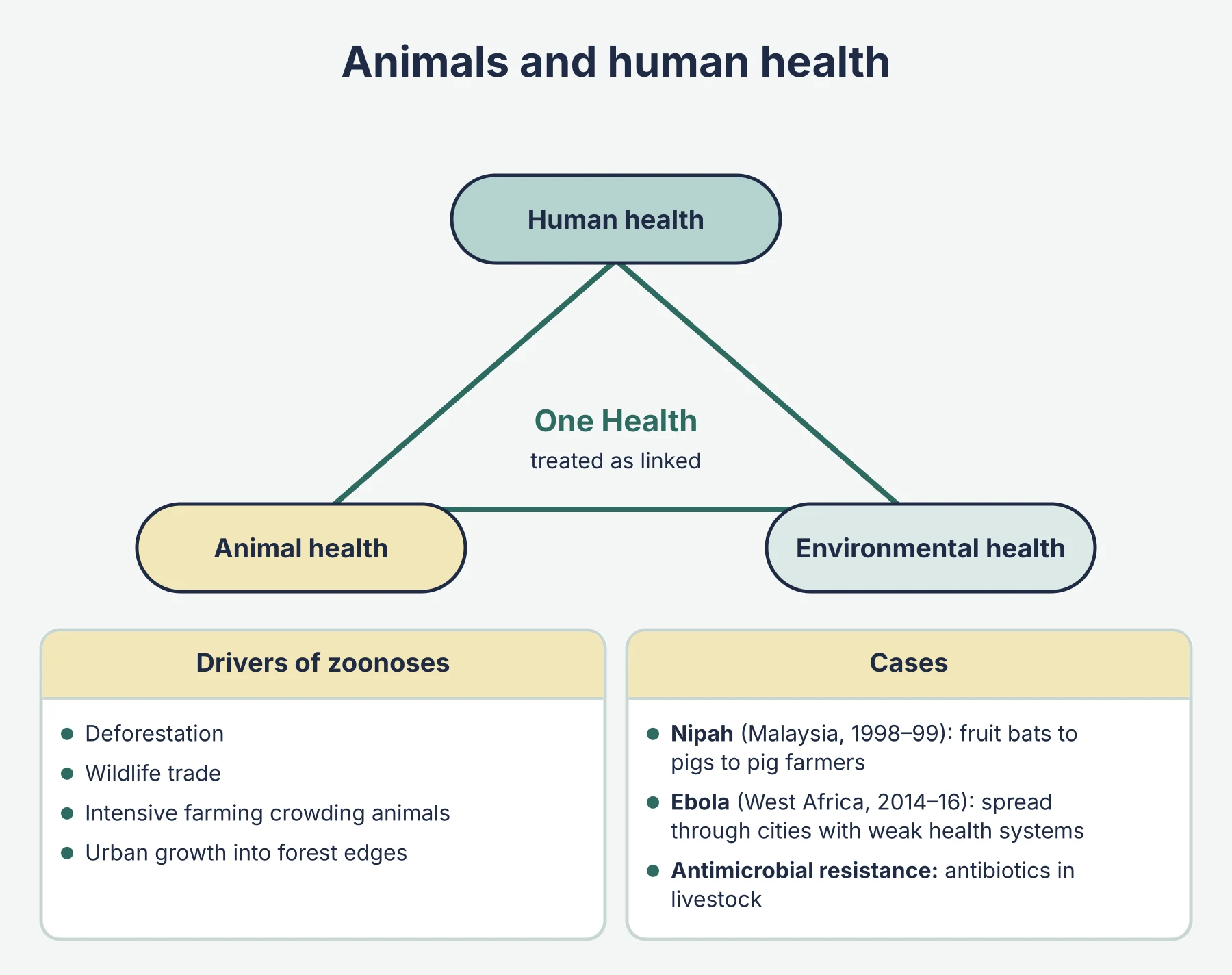
- Zoonoses arise where people, livestock and wildlife meet. Nipah virus emerged in Malaysia in 1998 to 1999 among pig farmers, carried from fruit bats via pigs. The West African Ebola epidemic of 2014 to 2016 spread rapidly through cities with weak health systems.
- Drivers: deforestation, wildlife trade, intensive farming that crowds animals together, and urban growth into forest edges.
- Antimicrobial resistance: heavy use of antibiotics in livestock contributes to resistant bacteria that threaten human medicine.
- One Health: an approach used by international health bodies that treats human, animal and environmental health as linked.
The Columbian Exchange in depth
Crosby later developed his argument in Ecological Imperialism (1986): European colonists succeeded in temperate regions partly because their “portmanteau biota” (crops, livestock, weeds, pests and diseases) spread with them. The horse transformed the lives of Plains peoples in North America, who built new hunting and mobile societies around it. Diseases such as smallpox devastated indigenous populations. Potatoes and maize helped support population growth in Europe, Africa and Asia. This shows animals and other species as active agents in history, an idea close to Latour’s actor-network theory.
Biodiversity loss
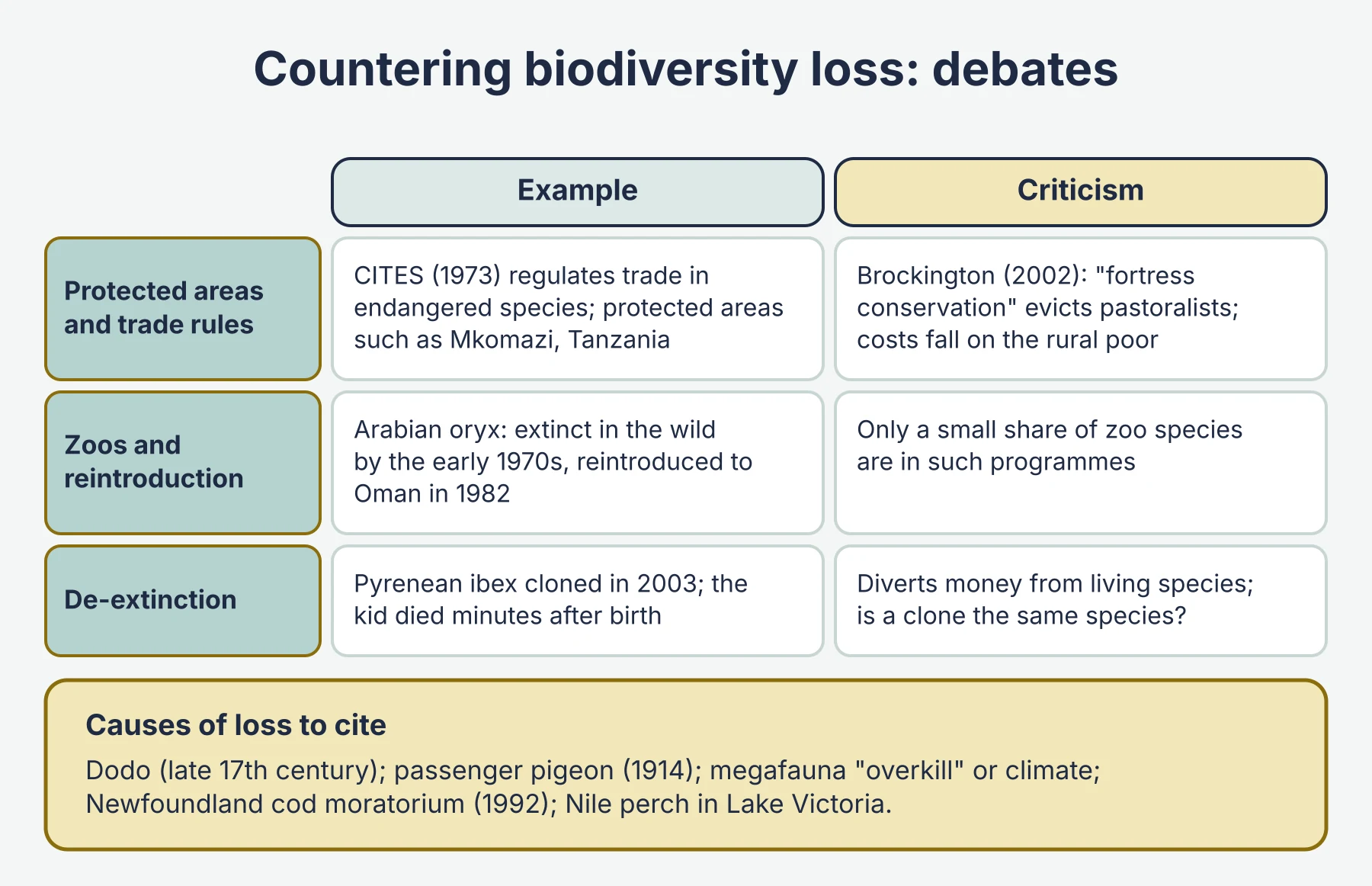
- Extinctions: the dodo of Mauritius was extinct by the late seventeenth century; the last passenger pigeon, Martha, died at Cincinnati Zoo in 1914, after a species once counted in billions was hunted out.
- Megafauna: many large mammals disappeared at the end of the last ice age; Paul Martin’s “overkill” hypothesis blamed human hunters, while others stress climate change.
- Fishing: the collapse of Atlantic cod off Newfoundland led Canada to declare a fishing moratorium in 1992, ending work for thousands of people.
- Invasive species: Nile perch introduced to Lake Victoria contributed to the loss of many native cichlid fish species.
Countering biodiversity loss: debates
- Conservation and protected areas: CITES (1973) regulates international trade in endangered species. Dan Brockington (Fortress Conservation, 2002), studying Mkomazi in Tanzania, criticised conservation that evicts local pastoralists, so the costs of protecting wildlife fall on the rural poor.
- Zoos and reintroduction: the Arabian oryx, extinct in the wild by the early 1970s, was bred in captivity and reintroduced to Oman in 1982. Zoos present this as proof they are “arks”; critics argue that only a small share of zoo species are in such programmes.
- De-extinction: in 2003 scientists cloned the Pyrenean ibex (bucardo), extinct since 2000; the kid died minutes after birth. Critics argue de-extinction diverts money from protecting living species and raises the question of whether a cloned or gene-edited animal is the same species.
Biotechnology, genomics and experimentation
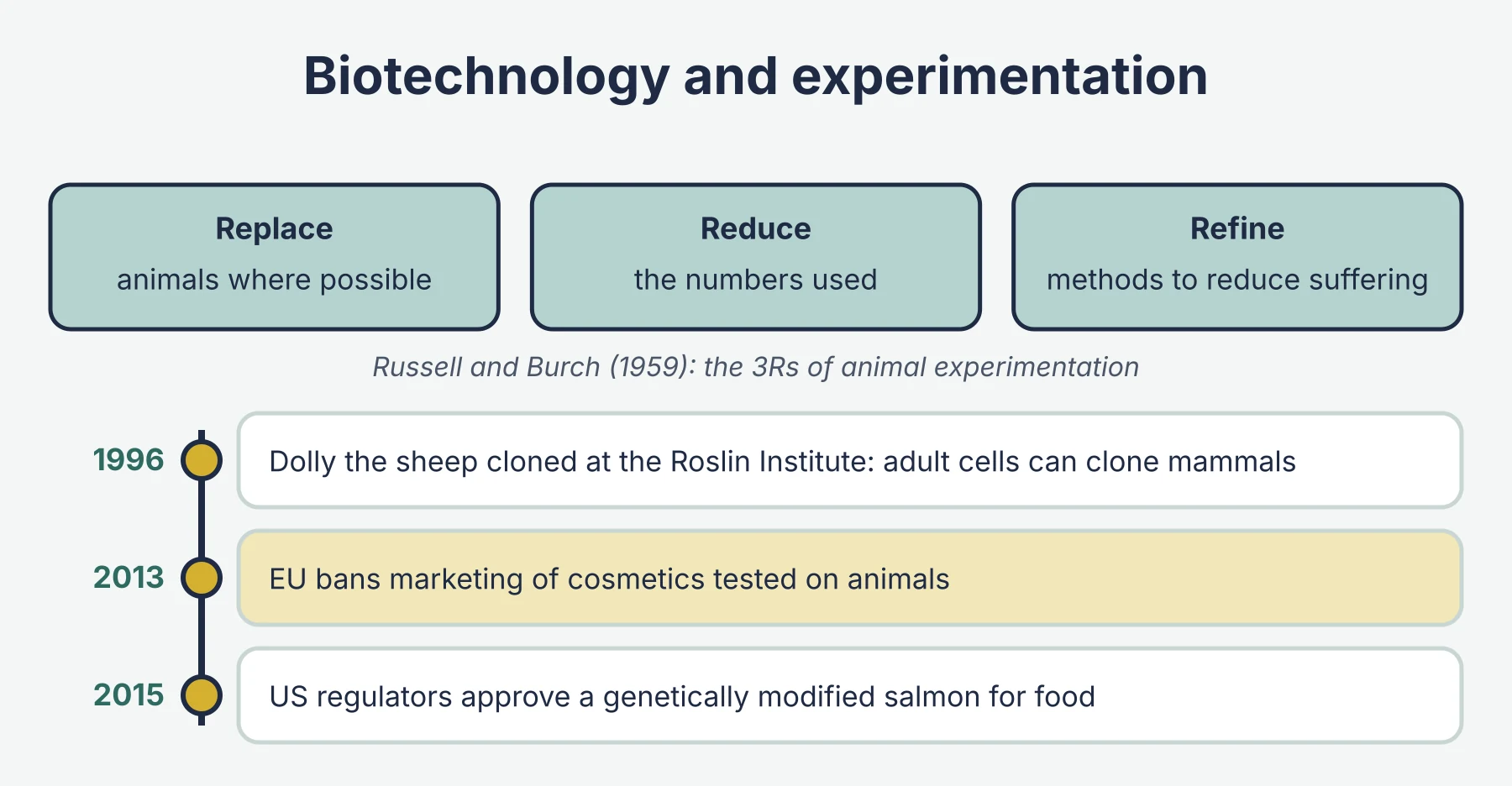
Dolly the sheep, cloned in 1996 at the Roslin Institute in Scotland, showed that adult cells could be used to clone mammals. In 2015 US regulators approved a genetically modified salmon for food. Gene-editing tools now allow precise changes to animal genomes. For experimentation, William Russell and Rex Burch (1959) set out the 3Rs: replace animals where possible, reduce numbers, refine methods to reduce suffering. The European Union banned the marketing of cosmetics tested on animals from 2013.
Annotated model answer
Extract from an 8-mark answer: Analyse how the status of animals is socially constructed.
Arluke and Sanders’s sociozoologic scale shows that societies rank animals by how they fit human purposes [knowledge]. In my society, dogs are pets in some homes and treated as unclean or as guards in others [application]. The same species, such as the rat, can be vermin, a laboratory tool or a pet depending on setting [analysis]. So an animal’s treatment depends on the meaning given to it, not its biology, although rights theorists argue capacity to suffer should count whatever the label [evaluation].
Common mistakes
- Treating welfare and rights as the same.
- Writing about zoonoses without explaining the social drivers.
- Describing the Columbian Exchange as one-way.
- Presenting zoos and de-extinction without criticism.
- Forgetting cultural and religious variation in views of animals.
Exam technique
Outline questions want a term plus an example. Explain questions want a cause and consequence, for example “deforestation brings people into contact with bats, so new viruses can spill over”. Evaluate answers should weigh human interests against animal welfare or rights and include own-society examples, such as working animals, festivals or local conservation.
Where next
Wider environmental change is in human impacts on environment. Biotechnology links to artificial intelligence and cyborgs.
Related resources
-
Practice questions
OxfordAQA International A-level Sociology (9690): People and animals – Practice Questions
Original OxfordAQA 9690 practice questions on human-animal relations, welfare and rights, slaughter, zoonoses, conservation and experiments, with answers.
Sociology · OxfordAQA · A Level
Try questions -
Revision notes
OxfordAQA International A-level Sociology (9690): People and animals – Revision Notes
Revision notes for OxfordAQA 9690 section 3.2.2.3: Bryant, the sociozoologic scale, welfare and rights, slaughter, pets, zoonoses, biodiversity and the 3Rs.
Sociology · OxfordAQA · A Level
Revise topic -
Study guides
OxfordAQA International A-level Sociology (9690): The built human environment
Guide to OxfordAQA 9690 section 3.2.2.1: nomads, rural life, urbanisation, slums, suburbs, segregation, megacities, non-places and demographic transition.
Sociology · OxfordAQA · A Level
Read guide
Related articles
Get free revision emails (optional)
Occasional emails with practice questions, worked explanations and links to free resources for the qualification and subjects you choose. No spam, and you can unsubscribe from any email. The free tools on this site never need an email.